Review
. 2016 Mar;36(3):539-54.
doi: 10.1177/0271678X15616978. Epub 2015 Nov 17.

Drugs of abuse and blood-brain barrier endothelial dysfunction: A focus on the role of oxidative stress

Affiliations
Review

Drugs of abuse and blood-brain barrier endothelial dysfunction: A focus on the role of oxidative stress

Ravi K Sajja et al. J Cereb Blood Flow Metab. 2016 Mar.

Abstract

Psychostimulants and nicotine are the most widely abused drugs with a detrimental impact on public health globally. While the long-term neurobehavioral deficits and synaptic perturbations are well documented with chronic use of methamphetamine, cocaine, and nicotine, emerging human and experimental studies also suggest an increasing incidence of neurovascular complications associated with drug abuse. Short- or long-term administration of psychostimulants or nicotine is known to disrupt blood-brain barrier (BBB) integrity/function, thus leading to an increased risk of brain edema and neuroinflammation. Various pathophysiological mechanisms have been proposed to underlie drug abuse-induced BBB dysfunction suggesting a central and unifying role for oxidative stress in BBB endothelium and perivascular cells. This review discusses drug-specific effects of methamphetamine, cocaine, and tobacco smoking on brain microvascular crisis and provides critical assessment of oxidative stress-dependent molecular pathways focal to the global compromise of BBB. Additionally, given the increased risk of human immunodeficiency virus (HIV) encephalitis in drug abusers, we have summarized the synergistic pathological impact of psychostimulants and HIV infection on BBB integrity with an emphasis on unifying role of endothelial oxidative stress. This mechanistic framework would guide further investigations on specific molecular pathways to accelerate therapeutic approaches for the prevention of neurovascular deficits by drugs of abuse.

Keywords: Drug abuse; alternative; blood-brain barrier; cocaine; methamphetamine; nicotine; oxidative stress; tight junctions.


Figures

Figure 1.
Figure 1.
Structural and functional aspects of the BBB constituted by brain microvascular endothelial cells surrounded by pericytes and astroglial end feet processes. As shown in the figure, BBB permeability to paracellular markers is strictly limited due to the expression of interendothelial TJ complexes. Also, BBB endothelium is equipped with a number of nutrient and efflux transporter systems that tightly regulate the transmembrane passage of endogenous and xenobiotic substrates including nutrients. TJ: tight junctional; BBB: blood-brain barrier; ZO-1: zonula occludentes-1; JAM: junctional adhesion molecule; VE: vascular endothelial.
Figure 2.
Figure 2.
Methamphetamine interaction with the BBB. METH directly affect the endothelial physiology by eliciting a significant inflammatory and oxidative stress response through release of pro-inflammatory cytokines, MMPs, and increased nuclear translocation of NF-κB. A subsequent activation of MLCK/Rho-A leads to down-regulation of TJ proteins such as ZO-1, claudin-5, and occludin. Also, METH deregulates glucose transport and cellular metabolism by abrogation of GLUT-1. Increased expression of inflammatory cell adhesion molecules at the BBB endothelium (ICAM, VCAM) facilitates endothelial-leukocytes interaction and WBC transmigration across the BBB. BBB: blood-brain barrier; METH: methamphetamine; MMPs: matrix metalloproteinases; NF-κB: nuclear factor kappa-light-chain-enhancer of activated B cells; TJ: tight junctional; ZO-1: zonula occludentes-1; GLUT-1: glucose transporter-1; TNFα: tumor necrosis factor-alpha; AP-1: activator protein 1; Nrf2: nuclear factor E2-related factor-2; MMPs: matrix metalloproteinases; WBC: white blood cell; EC: endothelial cell; CAMs: Cell adhesion molecules; NOX: NADPH oxidase; ICAM: intercellular adhesion molecule; VCAM: vascular cell adhesion molecule.
Figure 3.
Figure 3.
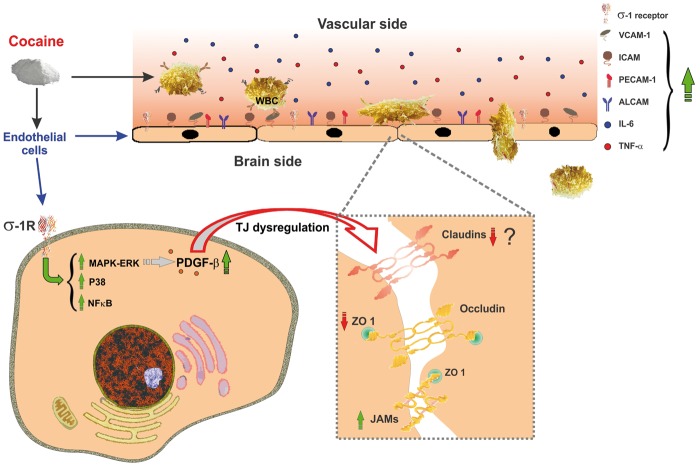
Cocaine induces BBB dysfunction. Cocaine interacts with σ1 receptors on the BBB endothelium and elicits activation of p38 MAPK signaling pathways and NF-κB nuclear translocation. Downstream to the activation of p38 MAPK, cocaine up-regulates the expression of PDGF-β. This leads to compromised TJ integrity through down-regulation of ZO-1 and claudin-5. Additionally, cocaine promotes the release of pro-inflammatory cytokines (e.g. IL-6, TNF-α) from circulating WBCs and expression of BBB endothelial adhesion molecules that facilitate endothelial-leukocyte interaction and infiltration into the brain parenchyma. BBB: blood-brain barrier; MAPK: mitogen-activated protein kinase; NF-κB: nuclear factor kappa-light-chain-enhancer of activated B cells; PDGF-β: platelet-derived growth factor-beta; TJ: tight junctional; ZO-1: zonula occludentes-1; IL: interleukin; TNFα: tumor necrosis factor-alpha; WBC: white blood cell.
Figure 4.
Figure 4.
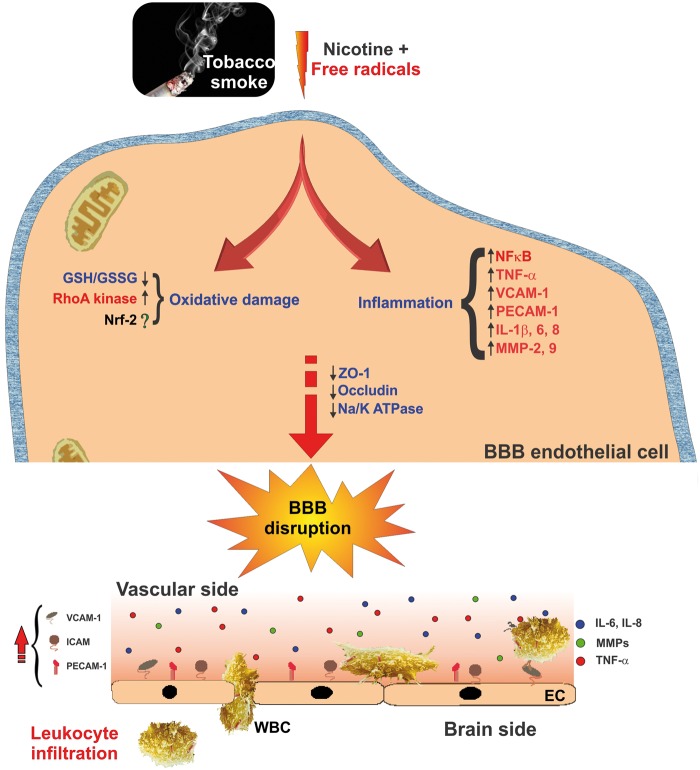
Effect of TS exposure and nicotine on BBB endothelial physiology and function. Schematic illustration describing oxidative stress and inflammatory pathways involved in TS-derived nicotine and free radicals-induced BBB endothelial dysfunction. Up-regulation of pro-inflammatory cytokines and MMPs including endothelial cell adhesion molecules triggers BBB endothelial activation resulting in loss of BBB integrity and facilitate leukocytes infiltration. BBB: blood-brain barrier; TS: tobacco smoke; MMPs: matrix metalloproteinases; Nrf2: nuclear factor E2-related factor-2; TNFα: tumor necrosis factor-alpha; IL: interleukin; ZO-1: zonula occludentes-1; WBC: white blood cell; EC: endothelial cell.

References

    1. Herbeck DM, Brecht ML, Lovinger K. Mortality, causes of death, and health status among methamphetamine users. J Addict Dis 2015; 34: 88–100. - PMC - PubMed
    1. Yamamoto BK, Raudensky J. The role of oxidative stress, metabolic compromise, and inflammation in neuronal injury produced by amphetamine-related drugs of abuse. J Neuroimmune Pharmacol 2008; 3: 203–217. - PMC - PubMed
    1. Curtin K, et al. Methamphetamine/amphetamine abuse and risk of Parkinson's disease in Utah: a population-based assessment. Drug Alcohol Depend 2015; 146: 30–38. - PMC - PubMed
    1. Clark KH, Wiley CA, Bradberry CW. Psychostimulant abuse and neuroinflammation: emerging evidence of their interconnection. Neurotox Res 2013; 23: 174–188. - PubMed
    1. Peraile I, et al. Dopamine transporter down-regulation following repeated cocaine: implications for 3,4-methylenedioxymethamphetamine-induced acute effects and long-term neurotoxicity in mice. Br J Pharmacol 2010; 159: 201–211. - PMC - PubMed

Publication types

MeSH terms