


Physical activity as a treatment of non-alcoholic fatty liver disease: A systematic review
- PMID: 26261693
- PMCID: PMC4528277
- DOI: 10.4254/wjh.v7.i16.2041
Physical activity as a treatment of non-alcoholic fatty liver disease: A systematic review
Abstract
Aim: To review the effectiveness of exercise as a therapy for nonalcoholic fatty liver disease (NAFLD) and potential benefits in treating insulin resistance and atherosclerosis.
Methods: Medline (EBSCOhost) and PubMed were searched for English-language randomized controlled trials and prospective cohort studies in human adults aged ≥ 18 which investigated the various effects of exercise alone, a combination of exercise and diet, or exercise and diet coupled with behavioral modification on NAFLD from 2010 to Feburary 2015.
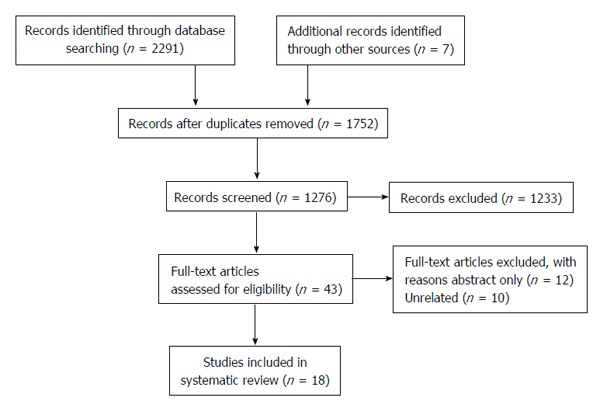
Results: Eighteen of 2298 available studies were chosen for critical review, which included 6925 patients. Nine (50%) studies were randomized controlled trials. Five (27.8%) studies utilized biopsy to examine the effects of physical activity on hepatic histology. The most commonly employed imaging modality to determine change in hepatic steatosis was hydrogen-magnetic resonance spectroscopy. Only two studies examined the effects of low impact physical activity for patients with significant mobility limitations and one compared the efficacy of aerobic and resistance exercise. No studies examined the exact duration of exercise required for hepatic and metabolic improvement in NAFLD.
Conclusion: While exercise improved hepatic steatosis and underlying metabolic abnormalities in NAFLD, more studies are needed to define the most beneficial form and duration of exercise treatment.
Keywords: Exercise; Fatty liver; Non-alcoholic steatohepatitis; Nonalcoholic fatty liver disease; Obesity.
Figures
References
-
- Nobili V, Alkhouri N, Alisi A, Della Corte C, Fitzpatrick E, Raponi M, Dhawan A. Nonalcoholic fatty liver disease: a challenge for pediatricians. JAMA Pediatr. 2015;169:170–176. - PubMed
-
- Williams CD, Stengel J, Asike MI, Torres DM, Shaw J, Contreras M, Landt CL, Harrison SA. Prevalence of nonalcoholic fatty liver disease and nonalcoholic steatohepatitis among a largely middle-aged population utilizing ultrasound and liver biopsy: a prospective study. Gastroenterology. 2011;140:124–131. - PubMed
-
- Anstee QM, Targher G, Day CP. Progression of NAFLD to diabetes mellitus, cardiovascular disease or cirrhosis. Nat Rev Gastroenterol Hepatol. 2013;10:330–344. - PubMed
-
- Vernon G, Baranova A, Younossi ZM. Systematic review: the epidemiology and natural history of non-alcoholic fatty liver disease and non-alcoholic steatohepatitis in adults. Aliment Pharmacol Ther. 2011;34:274–285. - PubMed
-
- Machado M, Marques-Vidal P, Cortez-Pinto H. Hepatic histology in obese patients undergoing bariatric surgery. J Hepatol. 2006;45:600–606. - PubMed
LinkOut - more resources
Full Text Sources
Other Literature Sources
