


MIND diet slows cognitive decline with aging
- PMID: 26086182
- PMCID: PMC4581900
- DOI: 10.1016/j.jalz.2015.04.011
MIND diet slows cognitive decline with aging
Abstract
Introduction: The Mediterranean and dash diets have been shown to slow cognitive decline; however, neither diet is specific to the nutrition literature on dementia prevention.
Methods: We devised the Mediterranean-Dietary Approach to Systolic Hypertension (DASH) diet intervention for neurodegenerative delay (MIND) diet score that specifically captures dietary components shown to be neuroprotective and related it to change in cognition over an average 4.7 years among 960 participants of the Memory and Aging Project.
Results: In adjusted mixed models, the MIND score was positively associated with slower decline in global cognitive score (β = 0.0092; P < .0001) and with each of five cognitive domains. The difference in decline rates for being in the top tertile of MIND diet scores versus the lowest was equivalent to being 7.5 years younger in age.
Discussion: The study findings suggest that the MIND diet substantially slows cognitive decline with age. Replication of these findings in a dietary intervention trial would be required to verify its relevance to brain health.
Keywords: Aging; Cognition; Cognitive decline; Diet; Epidemiologic study; Nutrition.
Copyright © 2015 The Alzheimer's Association. Published by Elsevier Inc. All rights reserved.
Conflict of interest statement
The authors have no relevant disclosures of potential conflicts of interest.
Figures
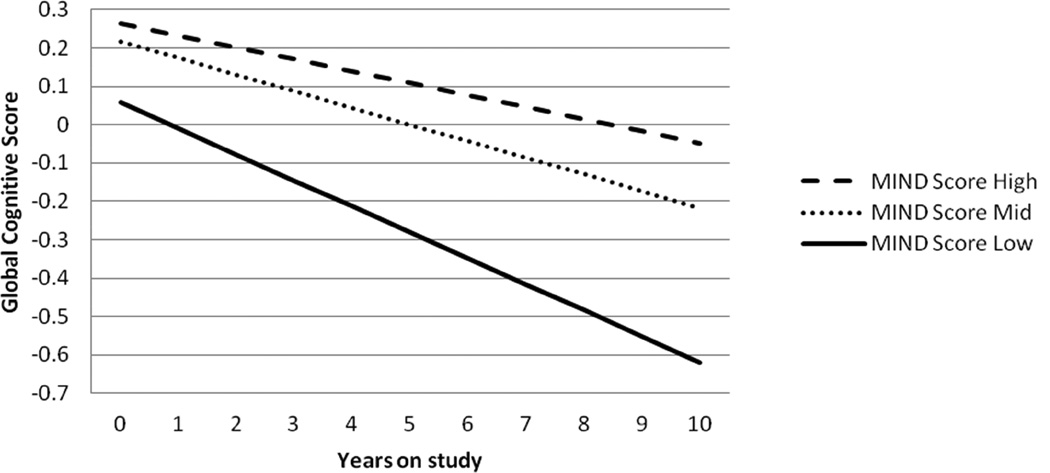
 ; median 6, range 2.5–6.5). The rates of change were based on the mixed model with MIND diet score modeled as two indicator variables for tertile 2 and tertile 3 (tertile 1, the referent) and adjusted for age, sex, education, smoking, physical activity, participation in cognitively stimulating activities, and total energy intake. For tertile 3: β=0.0366, standard error=0.0101, p=0.003 and for tertile 2: β=0.0243, standard error=0.0099, p=0.01.
References
-
- 2013 Alzheimer’s Disease Facts and Figures. 2. Vol. 9. Alzheimer’s Association; 2013. - PubMed
-
- Changing the Trajectory of Alzheimer’s Disease: How a Treatment by 2025 Saves Lives and Dollars. Alzheimer’s Association; 2015.
-
- Panagiotakos DB, Pitsavos C, Arvaniti F, Stefanadis C. Adherence to the Mediterranean food pattern predicts the prevalence of hypertension, hypercholesterolemia, diabetes and obesity, among healthy adults; the accuracy of the MedDietScore. Prev Med. 2007;44:335–340. - PubMed
-
- Sacks FM, Appel LJ, Moore TJ, et al. A dietary approach to prevent hypertension: a review of the Dietary Approaches to Stop Hypertension (DASH) Study. Clin Cardiol. 1999;22:III6–III10. - PubMed
Publication types
MeSH terms
Grants and funding
LinkOut - more resources
Full Text Sources
Other Literature Sources
Medical
