


Global risk factor rankings: the importance of age-based health loss inequities caused by alcohol and other risk factors
- PMID: 26054859
- PMCID: PMC4467665
- DOI: 10.1186/s13104-015-1207-8
Global risk factor rankings: the importance of age-based health loss inequities caused by alcohol and other risk factors
Abstract
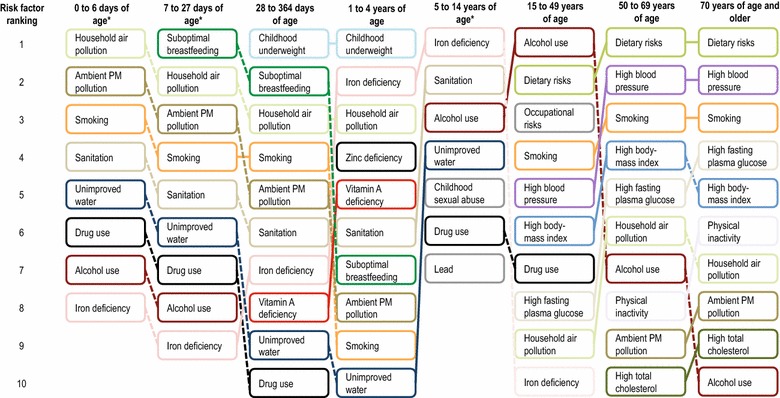
Background: Achieving health equity is a priority of the World Health Organization; however, there is a scant amount of literature on this topic. As the underlying influences that determine health loss caused by risk factors are age-dependent, the aim of this paper is to examine how the risk factor rankings for health loss differ by age.
Methods: Rankings were based on data obtained from the 2010 Global Burden of Disease study. Health loss (as measured by Disability Adjusted Life Years lost) by risk factor was estimated using Population-Attributable Fractions, years of life lost due to premature mortality, and years lived with disability, which were calculated for 187 countries, 20 age groups and both sexes. Uncertainties of the risk factor rankings were estimated using 1,000 simulations taken from posterior distributions
Results: The top risk factors by age were: household air pollution for neonates 0-6 days of age [95% uncertainty interval (UI): 1 to 1]; suboptimal breast feeding for children 7-27 days of age (95% UI: 1-1); childhood underweight for children 28 days to less than 1 year of age and 1-4 years of age (95% UI: 1-2 and 1-1, respectively); iron deficiency for children and youth 5-14 years of age (95% UI: 1-1); alcohol use for people 15-49 years of age (95% UI: 1-2); and dietary risks for people 50 years of age and older (95% UI: 1-1). Rankings of risk factors varied by sex among the older age groups. Alcohol and smoking were the most important risk factors among men 15 years of age and older, and high body mass and intimate partner violence were some of the most important risk factors among women 15 years of age and older.
Conclusions: Our analyses confirm that the relative importance of risk factors is age-dependent. Therefore, preventing harms caused by various modifiable risk factors using interventions that target people of different ages should be a priority, especially since easily implemented and cost-effective public health interventions exist.
Figures
References
-
- World Health Organization . Equity, social determinants and public health programmes. Geneva: World Health Organization; 2010.
-
- World health Organization . Closing the gap in a generation: health equity through action on the social determinants of health. Commission on Social Determinants of Health Final Report. Geneva: World Health Organization; 2008.
MeSH terms
Substances
LinkOut - more resources
Full Text Sources
Other Literature Sources
Medical
Research Materials
