. 2014 Dec 5;2(1):50.
doi: 10.1186/s40168-014-0050-9. eCollection 2014.

Microbial shifts in the aging mouse gut

Affiliations

Microbial shifts in the aging mouse gut

Morgan Gi Langille et al. Microbiome. .

Abstract

Background: The changes that occur in the microbiome of aging individuals are unclear, especially in light of the imperfect correlation of frailty with age. Studies in older human subjects have reported subtle effects, but these results may be confounded by other variables that often change with age such as diet and place of residence. To test these associations in a more controlled model system, we examined the relationship between age, frailty, and the gut microbiome of female C57BL/6 J mice.

Results: The frailty index, which is based on the evaluation of 31 clinical signs of deterioration in mice, showed a near-perfect correlation with age. We observed a statistically significant relationship between age and the taxonomic composition of the corresponding microbiome. Consistent with previous human studies, the Rikenellaceae family, which includes the Alistipes genus, was the most significantly overrepresented taxon within middle-aged and older mice. The functional profile of the mouse gut microbiome also varied with host age and frailty. Bacterial-encoded functions that were underrepresented in older mice included cobalamin (B12) and biotin (B7) biosynthesis, and bacterial SOS genes associated with DNA repair. Conversely, creatine degradation, associated with muscle wasting, was overrepresented within the gut microbiomes of the older mice, as were bacterial-encoded β-glucuronidases, which can influence drug-induced epithelial cell toxicity. Older mice also showed an overabundance of monosaccharide utilization genes relative to di-, oligo-, and polysaccharide utilization genes, which may have a substantial impact on gut homeostasis.

Conclusion: We have identified taxonomic and functional patterns that correlate with age and frailty in the mouse microbiome. Differences in functions related to host nutrition and drug pharmacology vary in an age-dependent manner, suggesting that the availability and timing of essential functions may differ significantly with age and frailty. Future work with larger cohorts of mice will aim to separate the effects of age and frailty, and other factors.

Keywords: Aging; Alistipes; B12; Frailty index; Mice; Microbiome.


Figures

Figure 1
Figure 1
Age (x-axis) and frailty index (y-axis) for the mice used in this study. Age correlated significantly with frailty index (Spearman correlation = 0.86, p = 1.064 × 10−5) and samples were derived from three age groupings: young (red), middle (blue), and old (green). Note that corresponding frailty scores were not performed for 4 of the 21 stool samples, so only 17 points are shown in the plot.
Figure 2
Figure 2
Principal coordinate analysis of 16S sequences from 21 samples using unweighted (A) and weighted (B) UniFrac shows distinct separation of samples based on their age and frailty into groups of young (red), middle (blue), and old (green).
Figure 3
Figure 3
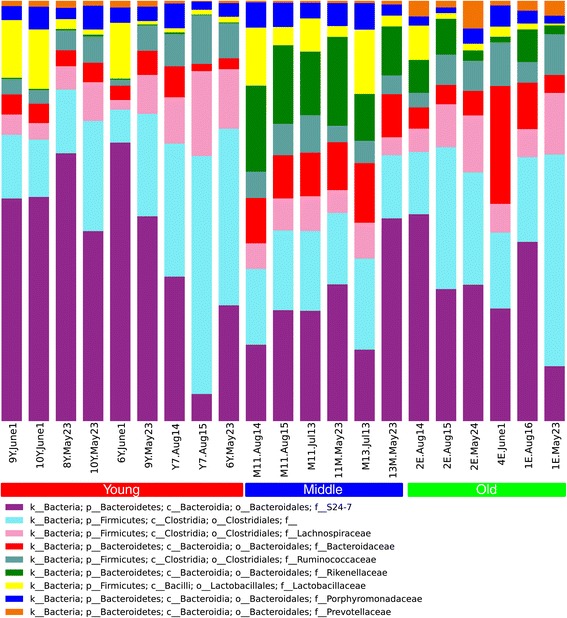
Taxonomic composition for the nine most abundant families determined using identified 16S sequences, across all 21 samples ordered by increasing age; increasing frailty in each group is ordered from left to right. For visual clarity, only the nine most abundant families are shown in the plot. Taxonomic ranks are indicated as follows: ‘k’, kingdom (or domain); ‘p’, phylum; ‘c’, class; ‘o’, order; ‘f’, family. The unspecified ‘f__’ represents those OTUs that do not have a specific family name but are known to be within the order Clostridiales.
Figure 4
Figure 4
Taxonomic differences between sample types as predicted by PhyloSift. Lineages that are overrepresented in the old and middle groups are shown in orange, while those more prevalent in the young group are shown in green. Branches which have no difference in abundance between groups were pruned from the tree. Taxon branches are collapsed to family level where the significant overrepresentation is not to a specific species. Numbers within brackets are the count of taxa within that family.
Figure 5
Figure 5
Notable functional categories with significant differences in abundance across the young, middle, and old mice. (A) Functions related to carbohydrate and lactate metabolism. (B) Other functions including vitamin biosynthesis and DNA repair.

References

    1. Cho I, Blaser MJ. The human microbiome: at the interface of health and disease. Nat Rev Genet. 2012;13:260–270. - PMC - PubMed
    1. Marchesi JR, Dutilh BE, Hall N, Peters WHM, Roelofs R, Boleij A, Tjalsma H. Towards the human colorectal cancer microbiome. PLoS One. 2011;6:e20447. doi: 10.1371/journal.pone.0020447. - DOI - PMC - PubMed
    1. Fahlén A, Engstrand L, Baker BS, Powles A, Fry L. Comparison of bacterial microbiota in skin biopsies from normal and psoriatic skin. Arch Dermatol Res. 2012;304:15–22. doi: 10.1007/s00403-011-1189-x. - DOI - PubMed
    1. Giongo A, Gano KA, Crabb DB, Mukherjee N, Novelo LL, Casella G, Drew JC, Ilonen J, Knip M, Hyöty H, Veijola R, Simell T, Simell O, Neu J, Wasserfall CH, Schatz D, Atkinson MA, Triplett EW. Toward defining the autoimmune microbiome for type 1 diabetes. ISME J. 2011;5:82–91. doi: 10.1038/ismej.2010.92. - DOI - PMC - PubMed
    1. Major G, Spiller R. Irritable bowel syndrome, inflammatory bowel disease and the microbiome. Curr Opin Endocrinol Diabetes Obes. 2014;21:15–21. doi: 10.1097/MED.0000000000000032. - DOI - PMC - PubMed