


Body mass index and risk of breast cancer: a nonlinear dose-response meta-analysis of prospective studies
- PMID: 25504309
- PMCID: PMC4265780
- DOI: 10.1038/srep07480
Body mass index and risk of breast cancer: a nonlinear dose-response meta-analysis of prospective studies
Abstract
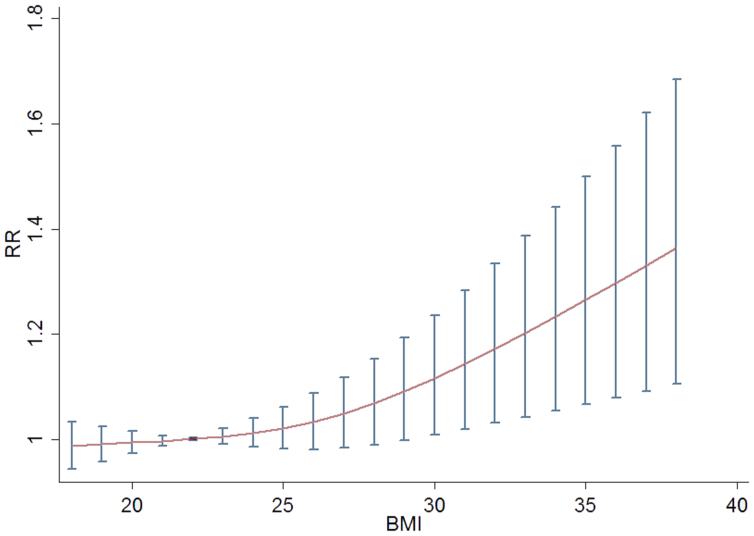
The role of Body Mass Index (BMI) for Breast Cancer (BC) remains to be great interest for a long time. However, the precise effect of nonlinear dose-response for BMI and BC risk is still unclear. We conducted a dose-response meta-analysis to quantitatively assess the effect of BMI on BC risk. Twelve prospective studies with 4,699 cases identified among 426,199 participants and 25 studies of 22,809 cases identified among 1,155,110 participants in premenopausal and postmenopausal groups, respectively, were included in this meta-analysis. Significant non-linear dose-response (P < 0.001) association was identified between BMI and BC risk in postmenopausal women. Individuals with BMI of 25, 30, and 35 kg/m(2) yielded relative risks (RRs) of 1.02 [95% confidence interval (CI): 0.98-1.06], 1.12 (95% CI: 1.01-1.24), and 1.26 (95% CI: 1.07-1.50), respectively, when compared to the mean level of the normal BMI range. However, inverse result though not significant was observed in premenopausal women. In conclusion, the results of this meta-analysis highlighted that obesity contributed to increased BC risk in a nonlinear dose-response manner in postmenopausal women, and it is important to realize that body weight control may be a crucial process to reduce BC susceptibility.
Figures
References
-
- Carmichael A. R. & Bates T. Obesity and breast cancer: a review of the literature. Breast 13, 85–92 (2004). - PubMed
-
- Flegal K. M., Carroll M. D., Ogden C. L. & Curtin L. R. Prevalence and trends in obesity among US adults, 1999–2008. JAMA 303, 235–241 (2010). - PubMed
-
- Wu Y. F. et al. The current prevalence status of body overweight and obesity in China: data from the China National Nutrition and Health Survey. Zhonghua Yu Fang Yi Xue Za Zhi 39, 316–320 (2005). - PubMed
-
- Renehan A. G., Tyson M., Egger M., Heller R. F. & Zwahlen M. Body-mass index and incidence of cancer: a systematic review and meta-analysis of prospective observational studies. Lancet 371, 569–578 (2008). - PubMed
-
- Jemal A. et al. Global cancer statistics. CA Cancer J Clin 61, 69–90 (2011). - PubMed
Publication types
MeSH terms
LinkOut - more resources
Full Text Sources
Other Literature Sources
Medical
