


How do systematic reviews incorporate risk of bias assessments into the synthesis of evidence? A methodological study
- PMID: 25481532
- PMCID: PMC4316857
- DOI: 10.1136/jech-2014-204711
How do systematic reviews incorporate risk of bias assessments into the synthesis of evidence? A methodological study
Abstract
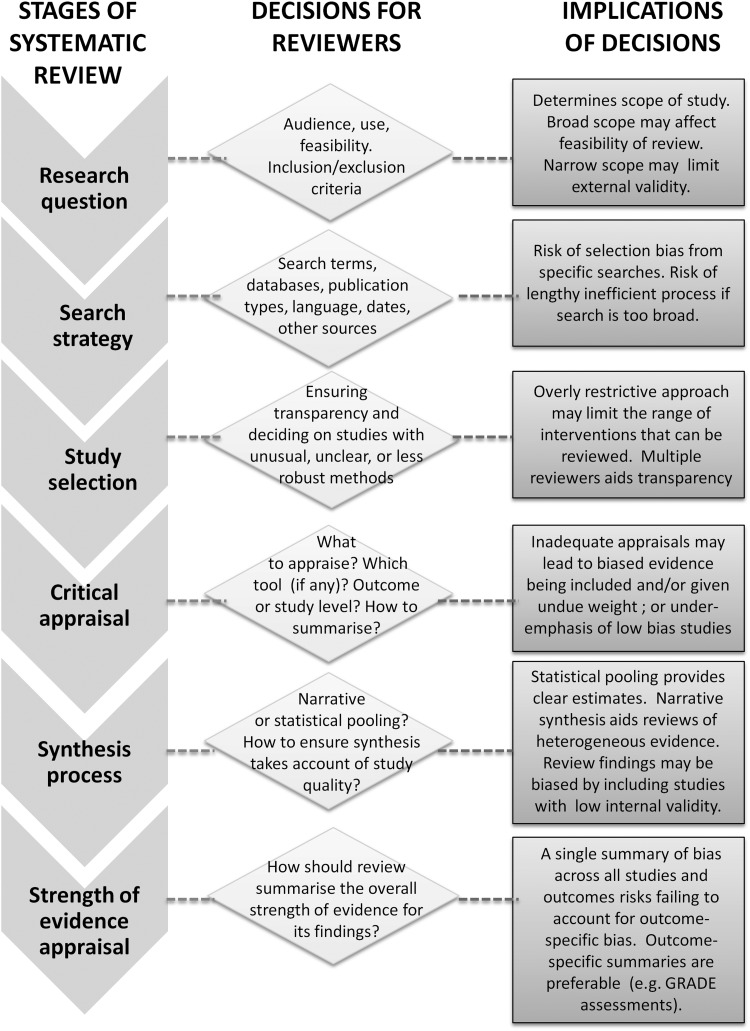
Background: Systematic reviews (SRs) are expected to critically appraise included studies and privilege those at lowest risk of bias (RoB) in the synthesis. This study examines if and how critical appraisals inform the synthesis and interpretation of evidence in SRs.
Methods: All SRs published in March-May 2012 in 14 high-ranked medical journals and a sample from the Cochrane library were systematically assessed by two reviewers to determine if and how: critical appraisal was conducted; RoB was summarised at study, domain and review levels; and RoB appraisals informed the synthesis process.
Results: Of the 59 SRs studied, all except six (90%) conducted a critical appraisal of the included studies, with most using or adapting existing tools. Almost half of the SRs reported critical appraisal in a manner that did not allow readers to determine which studies included in a review were most robust. RoB assessments were not incorporated into synthesis in one-third (20) of the SRs, with their consideration more likely when reviews focused on randomised controlled trials. Common methods for incorporating critical appraisals into the synthesis process were sensitivity analysis, narrative discussion and exclusion of studies at high RoB. Nearly half of the reviews which investigated multiple outcomes and carried out study-level RoB summaries did not consider the potential for RoB to vary across outcomes.
Conclusions: The conclusions of the SRs, published in major journals, are frequently uninformed by the critical appraisal process, even when conducted. This may be particularly problematic for SRs of public health topics that often draw on diverse study designs.
Keywords: EPIDEMIOLOGY; Epidemiological methods; PUBLIC HEALTH; SYSTEMATIC REVIEWS.
Published by the BMJ Publishing Group Limited. For permission to use (where not already granted under a licence) please go to http://group.bmj.com/group/rights-licensing/permissions.
Figures
References
-
- Evidence-Based Medicine Working Group. Evidence-based medicine: a new approach to teaching the practice of medicine. JAMA 1992;268:2420–5. - PubMed
-
- Petticrew M, Roberts H. Systematic reviews in the social sciences: a practical guide. Oxford: Blackwell Publishing, 2009.
-
- Helfand M, Balshem H. AHRQ series paper 2: principles for developing guidance: AHRQ and the Effective Health-Care Program. J Clin Epidemiol 2010;63: 484–90. - PubMed
-
- Higgins JPT, Green S, eds. Cochrane handbook for systematic reviews of interventions version 5.1.0. The Cochrane Collaboration, 2011.
-
- Schulz KF, Chalmers I, Hayes RJ. ,et al. Empirical evidence of bias: dimensions of methodological quality associated with estimates of treatment effects in controlled trials. JAMA 1995;273:408–12. - PubMed
Publication types
MeSH terms
Grants and funding
LinkOut - more resources
Full Text Sources
Other Literature Sources
