


Public acceptability of population-level interventions to reduce alcohol consumption: a discrete choice experiment
- PMID: 24858928
- PMCID: PMC4065329
- DOI: 10.1016/j.socscimed.2014.05.010
Public acceptability of population-level interventions to reduce alcohol consumption: a discrete choice experiment
Abstract
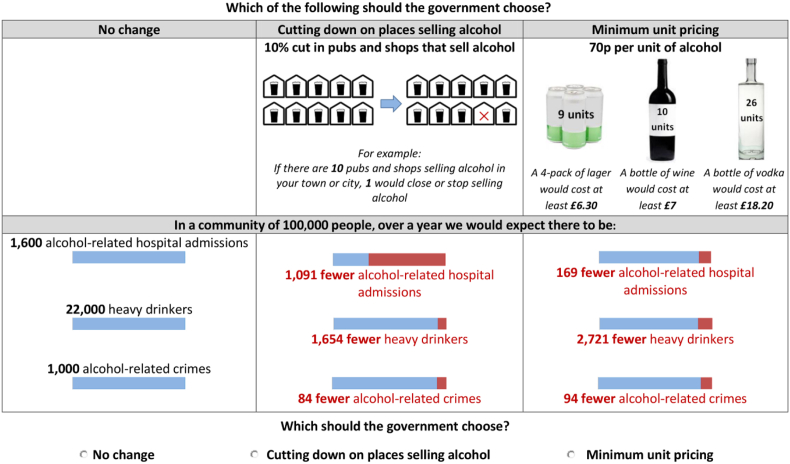
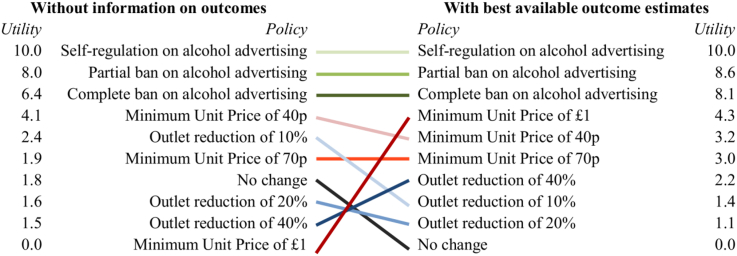
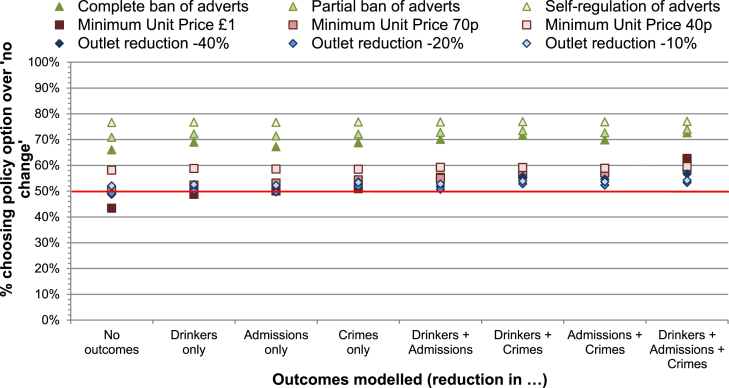
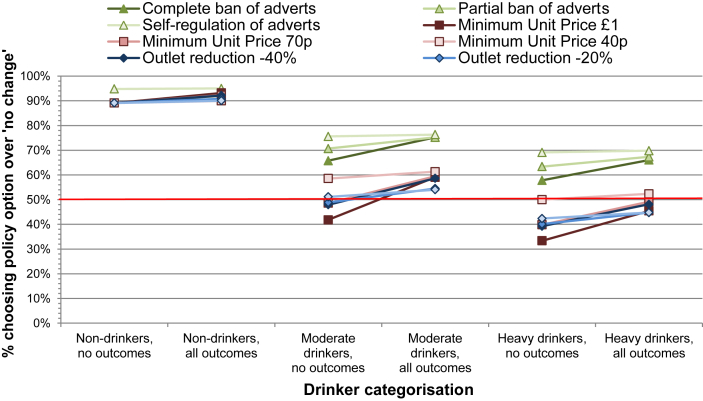
Public acceptability influences policy action, but the most acceptable policies are not always the most effective. This discrete choice experiment provides a novel investigation of the acceptability of different interventions to reduce alcohol consumption and the effect of information on expected effectiveness, using a UK general population sample of 1202 adults. Policy options included high, medium and low intensity versions of: Minimum Unit Pricing (MUP) for alcohol; reducing numbers of alcohol retail outlets; and regulating alcohol advertising. Outcomes of interventions were predicted for: alcohol-related crimes; alcohol-related hospital admissions; and heavy drinkers. First, the models obtained were used to predict preferences if expected outcomes of interventions were not taken into account. In such models around half of participants or more were predicted to prefer the status quo over implementing outlet reductions or higher intensity MUP. Second, preferences were predicted when information on expected outcomes was considered, with most participants now choosing any given intervention over the status quo. Acceptability of MUP interventions increased by the greatest extent: from 43% to 63% preferring MUP of £1 to the status quo. Respondents' own drinking behaviour also influenced preferences, with around 90% of non-drinkers being predicted to choose all interventions over the status quo, and with more moderate than heavy drinkers favouring a given policy over the status quo. Importantly, the study findings suggest public acceptability of alcohol interventions is dependent on both the nature of the policy and its expected effectiveness. Policy-makers struggling to mobilise support for hitherto unpopular but promising policies should consider giving greater prominence to their expected outcomes.
Keywords: Alcohol; Health policy; Public acceptability; UK.
Copyright © 2014 The Authors. Published by Elsevier Ltd.. All rights reserved.
Figures
References
-
- Bloomfield K., Grittner U., Kramer S., Gmel G. Social inequalities in alcohol consumption and alcohol-related problems in the study countries of the EU concerted action 'gender, culture and alcohol problems: a multinational study'. Alcohol Alcohol. 2006;41:i26–i36. - PubMed
-
- Bongers I.M.B., Van de Goor I.A.M., Garretsen H.F.L. Social climate on alcohol in Rotterdam, the Netherlands: public opinion on drinking behaviour and alcohol control measures. Alcohol Alcohol. 1998;33:141–150. - PubMed
-
- Giesbrecht N., Ialomiteanu A., Anglin L., Adlaf E. Alcohol marketing and retailing: public opinion and recent policy developments in Canada. J. Subst. Use. 2007;12:389–404.
Publication types
MeSH terms
Grants and funding
LinkOut - more resources
Full Text Sources
Other Literature Sources
Medical
Molecular Biology Databases
