


Childhood bullying involvement predicts low-grade systemic inflammation into adulthood
- PMID: 24821813
- PMCID: PMC4040559
- DOI: 10.1073/pnas.1323641111
Childhood bullying involvement predicts low-grade systemic inflammation into adulthood
Abstract
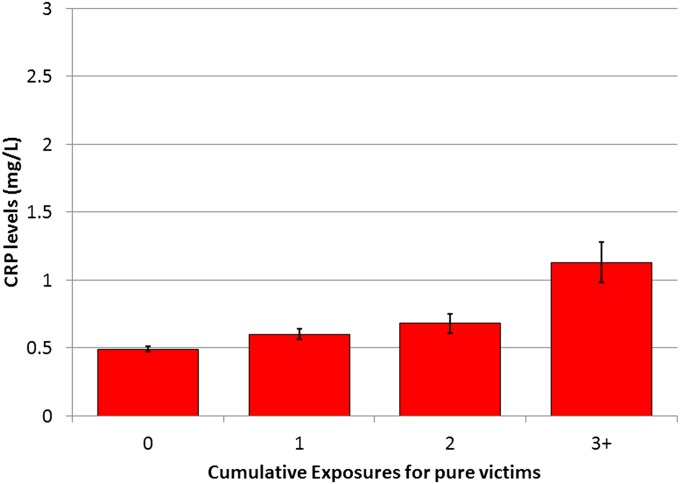
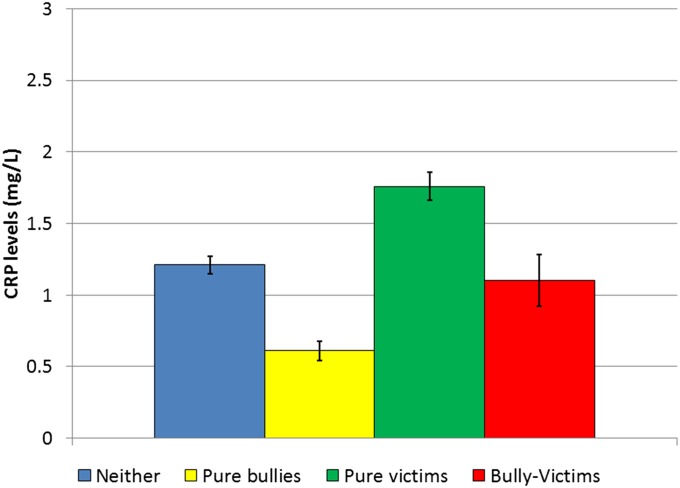
Bullying is a common childhood experience that involves repeated mistreatment to improve or maintain one's status. Victims display long-term social, psychological, and health consequences, whereas bullies display minimal ill effects. The aim of this study is to test how this adverse social experience is biologically embedded to affect short- or long-term levels of C-reactive protein (CRP), a marker of low-grade systemic inflammation. The prospective population-based Great Smoky Mountains Study (n = 1,420), with up to nine waves of data per subject, was used, covering childhood/adolescence (ages 9-16) and young adulthood (ages 19 and 21). Structured interviews were used to assess bullying involvement and relevant covariates at all childhood/adolescent observations. Blood spots were collected at each observation and assayed for CRP levels. During childhood and adolescence, the number of waves at which the child was bullied predicted increasing levels of CRP. Although CRP levels rose for all participants from childhood into adulthood, being bullied predicted greater increases in CRP levels, whereas bullying others predicted lower increases in CRP compared with those uninvolved in bullying. This pattern was robust, controlling for body mass index, substance use, physical and mental health status, and exposures to other childhood psychosocial adversities. A child's role in bullying may serve as either a risk or a protective factor for adult low-grade inflammation, independent of other factors. Inflammation is a physiological response that mediates the effects of both social adversity and dominance on decreases in health.
Keywords: epidemiology; longitudinal; risk factor; social functioning; stress.
Conflict of interest statement
The authors declare no conflict of interest.
Figures
References
-
- Sourander AMD, et al. Childhood predictors of psychiatric disorders among boys: A prospective community-based follow-up study from age 8 years to early adulthood. J Am Acad Child Adolesc Psychiatry. 2005;44(8):756–767. - PubMed
-
- Winsper C, Lereya T, Zanarini M, Wolke D. Involvement in bullying and suicide-related behavior at 11 years: A prospective birth cohort study. J Am Acad Child Adolesc Psychiatry. 2012;51(3):271. e3. - PubMed
-
- Gini G, Pozzoli T. Association between bullying and psychosomatic problems: A meta-analysis. Pediatrics. 2009;123(3):1059–1065. - PubMed
Publication types
MeSH terms
Substances
Grants and funding
LinkOut - more resources
Full Text Sources
Other Literature Sources
Medical
Molecular Biology Databases
Research Materials
Miscellaneous
