Nine scoring models for short-term mortality in alcoholic hepatitis: cross-validation in a biopsy-proven cohort
- PMID: 24612165
- PMCID: PMC4015369
- DOI: 10.1111/apt.12654
Nine scoring models for short-term mortality in alcoholic hepatitis: cross-validation in a biopsy-proven cohort
Abstract
Background: Several prognostic models have emerged in alcoholic hepatitis (AH), but lack of external validation precludes their universal use.
Aim: To validate the Maddrey Discriminant Function (DF); Glasgow Alcoholic Hepatitis Score (GAHS); Mayo End-stage Liver Disease (MELD); Age, Bilirubin, INR, Creatinine (ABIC); MELD-Na, UK End-stage Liver Disease (UKELD), and three scores of corticosteroid response at 1 week: an Early Change in Bilirubin Levels (ECBL), a 25% fall in bilirubin, and the Lille score.
Methods: Seventy-one consecutive patients with biopsy-proven AH, admitted between November 2007-September 2011, were evaluated. The clinical and biochemical parameters were analysed to assess prognostic models with respect to 30- and 90-day mortality.
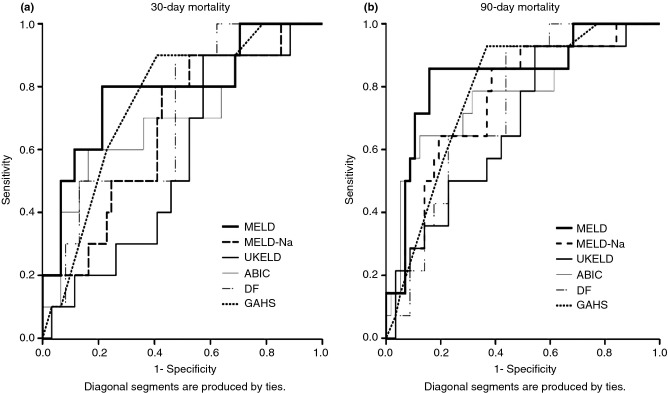
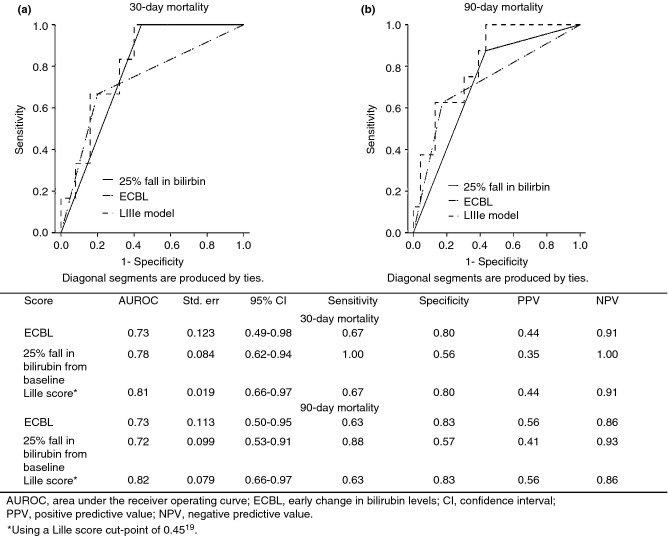
Results: There were no significant differences in the areas under the receiver operating characteristics curve (AUROCs) relative to 30-day/90-day mortality: MELD 0.79/0.84, DF 0.71/0.74, GAHS 0.75/0.78, ABIC 0.71/0.78, MELD-Na 0.68/0.76, UKELD 0.56/0.68. One-week rescoring yielded a trend towards improved predictive accuracies (30-day/90-day AUROCs: 0.69–0.84/0.77–0.86). In patients with admission DF ≥ 32 (n = 31), response to corticosteroids according to ECBL, 25% fall in bilirubin and the Lille model yielded AUROCs of 0.73/0.73, 0.78/0.72 and 0.81/0.82 for a 30-day/90-day outcome respectively. All models showed excellent negative predictive values (NPVs; range: 86–100%), while the positive ones were low (range: 17–50%).
Conclusions: MELD, DF, GAHS, ABIC and scores of corticosteroid response proved to be valid in an independent cohort of biopsy-proven alcoholic hepatitis. MELD modifications incorporating sodium did not confer any prognostic advantage over classical MELD. Based on excellent NPVs, the models are best to identify patients at low risk of death.
Figures
Comment in
-
Commentary: scoring models for short-term mortality in alcoholic hepatitis.Aliment Pharmacol Ther. 2014 May;39(10):1235. doi: 10.1111/apt.12710. Aliment Pharmacol Ther. 2014. PMID: 24735136 No abstract available.
-
Letter: Prognostic scores in alcoholic hepatitis.Aliment Pharmacol Ther. 2014 Jun;39(11):1340-1. doi: 10.1111/apt.12734. Aliment Pharmacol Ther. 2014. PMID: 24803255 No abstract available.
-
Letter: Prognostic scores in alcoholic hepatitis--authors' reply.Aliment Pharmacol Ther. 2014 Jun;39(11):1341. doi: 10.1111/apt.12757. Aliment Pharmacol Ther. 2014. PMID: 24803256 No abstract available.
-
Letter: scoring models in alcoholic hepatitis.Aliment Pharmacol Ther. 2015 Jul;42(1):126. doi: 10.1111/apt.13224. Aliment Pharmacol Ther. 2015. PMID: 26040528 No abstract available.
-
Letter: scoring models in alcoholic hepatitis - authors' reply.Aliment Pharmacol Ther. 2015 Jul;42(1):127. doi: 10.1111/apt.13246. Aliment Pharmacol Ther. 2015. PMID: 26040529 No abstract available.
References
-
- Menon KV, Gores GJ, Shah VH. Pathogenesis, diagnosis, and treatment of alcoholic liver disease. Mayo Clin Proc. 2001;76:1021–9. - PubMed
-
- Morgan TR. Treatment of alcoholic hepatitis. Semin Liver Dis. 1993;13:384–94. - PubMed
-
- Cohen SM, Ahn J. Review article: the diagnosis and management of alcoholic hepatitis. Aliment Pharmacol Ther. 2009;30:3–13. - PubMed
-
- European Association for the Study of the Liver. EASL Clinical Practical Guidelines: management of Alcoholic Liver Disease. J Hepatol. 2012;57:399–420. - PubMed
-
- Nguyen-Khac E, Thevenot T, Piquet MA, et al. Glucocorticoids plus N-acetylcysteine in severe alcoholic hepatitis. N Engl J Med. 2011;365:1781–9. - PubMed
Publication types
MeSH terms
LinkOut - more resources
Full Text Sources
Other Literature Sources
Miscellaneous