


Age, period, and cohort effects in heavy episodic drinking in the US from 1985 to 2009
- PMID: 23433898
- PMCID: PMC4827021
- DOI: 10.1016/j.drugalcdep.2013.01.019
Age, period, and cohort effects in heavy episodic drinking in the US from 1985 to 2009
Abstract
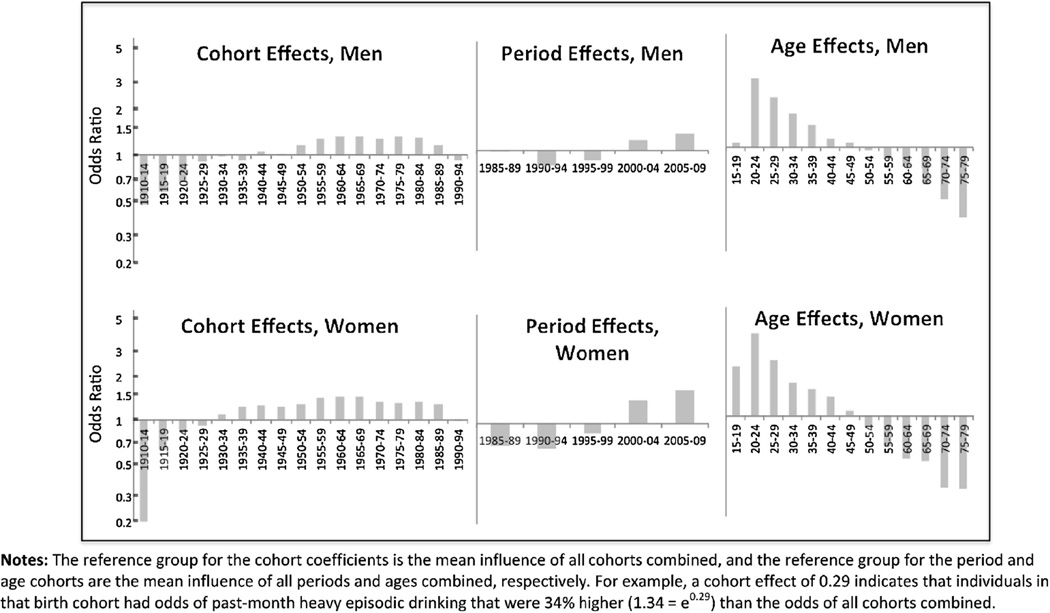
Background: Evaluating population-level patterns of heavy episodic drinking by age, period, and cohort is critical to understanding population-level influences on rates over time and to forecasting future trends for public health planning efforts. The present study examined trends in heavy episodic drinking in the US from 1985 through 2009 in a nationally representative sample that included adolescents and adults.
Methods: Data are drawn from repeated cross-sectional surveys of US households as part of the National Household Survey on Drug Use and Health conducted in 1985, 1988, and annually from 1990 though 2009, inclusive (N=809,281). Heavy episodic drinking was defined as any instance of consuming five or more drinks in one sitting in the past month. Age-period-cohort models were identified using the Intrinsic Estimator algorithm.
Results: Heavy episodic drinking is decreasing in the US among adolescents and young adults, with the most recently born cohorts (born in the 1990s) at lower odds of heavy episodic drinking compared with cohorts born in the 1960s, 1970s, and 1980s. Results were consistent across sex and race/ethnicity, with the exception that the decrease is not apparent among Hispanics.
Conclusions: These data are promising in that young cohorts appear to be reducing heavy episodic drinking, however the lack of decrease among Hispanics suggests targeted intervention and prevention as well as increased surveillance are necessary.
Keywords: Age–period–cohort effects; Binge drinking; Heavy episodic drinking; Intrinsic Estimator; NHSDUH; National Household Survey on Drug Use and Health; United States.
Copyright © 2013 Elsevier Ireland Ltd. All rights reserved.
Conflict of interest statement
The authors report no conflicts of interest.
Figures


References
-
- Barker P, Gfroerer J, Caspar R, Lessler J. Proceedings of the 1998 Joint Statistical Meetings, American Statistical Association, Survey Research Methods Section, Dallas, TX. Alexandria, VA: American Statistical Association; 1998. Major Design Changes in the National Household Survey on Drug Abuse; pp. 732–737.
-
- Bjork C, Thygesen LC, Vinther-Larsen M, Gronbaek MN. Time trends in heavy drinking among middle-aged and older adults in Denmark. Alcohol. Clin. Exp. Res. 2008;32:120–127. - PubMed
-
- Caetano R. Ethnicity and drinking in northern California: a comparison among whites, blacks and Hispanics. Alcohol Alcohol. 1984a;19:31–44. - PubMed
-
- Caetano R. Self-reported intoxication among Hispanics in northern California. J. Stud. Alcohol. 1984b;45:349–354. - PubMed
Publication types
MeSH terms
Grants and funding
LinkOut - more resources
Full Text Sources
Other Literature Sources
Miscellaneous
