


Neighborhood disadvantage, high alcohol content beverage consumption, drinking norms, and drinking consequences: a mediation analysis
- PMID: 23423945
- PMCID: PMC3732692
- DOI: 10.1007/s11524-013-9786-y
Neighborhood disadvantage, high alcohol content beverage consumption, drinking norms, and drinking consequences: a mediation analysis
Abstract
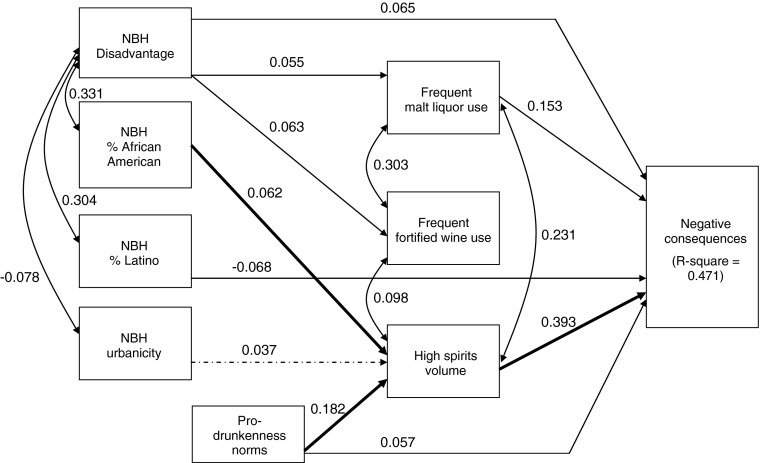
Alcohol use can cause significant harm. We examined the relationships between neighborhood disadvantage, consumption of high-alcohol-content beverages (HACB), drinking norms, and self-reported drinking consequences using data from the 2000 and 2005 National Alcohol Surveys (N = 9,971 current drinkers) and the 2000 Decennial Census. We hypothesized that (1) individuals living in disadvantaged neighborhoods would report more negative drinking consequences than individuals living in more affluent neighborhoods, and (2) this relationship would be mediated by HACB consumption and pro-drunkenness drinking norms. Neighborhood disadvantage was based on a composite measure of socioeconomic indicators from the 2000 Decennial Census (five-item composite, alpha = 0.89). We measured high alcohol content beverage consumption in terms of whether respondents engaged in frequent or heavy consumption of malt liquor, fortified wine, or distilled spirits/liquor. The outcome was a dichotomous indicator of two or more of 15 past-year social, legal, work, and health consequences. Simultaneous, multivariate path modeling tested direct and indirect effects of neighborhood disadvantage, HACB consumption, and pro-drunkenness norms on consequences. Individuals living in disadvantaged neighborhoods reported significantly more negative drinking consequences than individuals living in more affluent neighborhoods. Consumption of high-alcohol-content beverages and pro-drunkenness norms did not mediate this relationship. However, heavy distilled spirits/liquor use was a significant mediator of other neighborhood characteristics (i.e., percent African American). Living in an African American neighborhood was related to increased spirits/liquor consumption and, in turn, reporting more negative drinking consequences. Greater scrutiny of advertising and tax policies related to distilled spirits/liquor is needed to prevent future drinking problems, especially in minority neighborhoods.
Figures
References
-
- Scribner R, Cohen D, Kaplan S, Allen SH. Alcohol availability and homicide in New Orleans: conceptual considerations for small area analysis of the effect of alcohol outlet density. J Stud Alcohol. 1999;60(3):310–316. - PubMed
Publication types
MeSH terms
Grants and funding
LinkOut - more resources
Full Text Sources
Other Literature Sources
Medical
Miscellaneous
