


Automated primary care screening in pediatric waiting rooms
- PMID: 22508925
- PMCID: PMC3340595
- DOI: 10.1542/peds.2011-2875
Automated primary care screening in pediatric waiting rooms
Abstract
Background and objective: Implementing US Preventive Services Task Force and American Academy of Pediatrics preventive service guidelines within the short duration of a visit is difficult because identifying which of a large number of guidelines apply to a particular patient is impractical. Clinical decision support system integrated with electronic medical records offer a good strategy for implementing screening in waiting rooms. Our objective was to determine rates of positive risk screens during typical well-care visits among children and adolescents in a primary care setting.
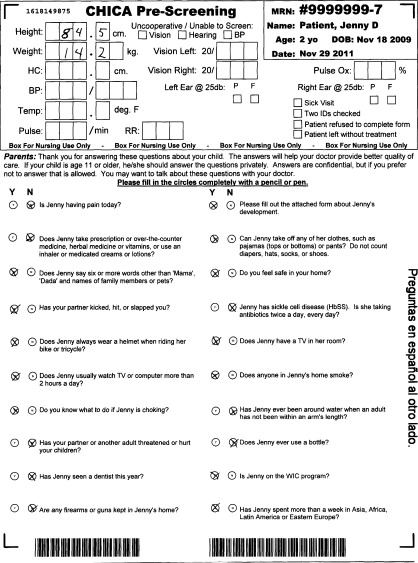
Methods: Child Health Improvement through Computer Automation (CHICA) is a pediatric clinical decision support system developed by our research group. CHICA encodes clinical guidelines as medical logic modules to generate scanable paper forms: the patient screening form to collect structured data from patient families in the waiting room and the physician worksheet to provide physician assessments at each visit. By using visit as a unit of analysis from CHICA's database, we have determined positive risk screen rates in our population.
Results: From a cohort of 16 963 patients, 408 601 questions were asked in 31 843 visits. Of the questions asked, 362 363 (89%) had a response. Of those, 39 176 (11%) identified positive risk screens in both the younger children and the adolescent age groups.
Conclusions: By automating the process of screening and alerting the physician to those who screened positive, we have significantly decreased the burden of identifying relevant guidelines and screening of patient families in our clinics.
References
-
- USPSTF Agency for Healthcare Research and Quality, 4th ed. United States Preventive Services Task Force. Guide to Clinical Preventive Services; 2008:2009–2010. Available at: www.ahrq.gov/clinic/uspstfix.htm. Accessed March 5, 2012
-
- Kottke TE, Brekke ML, Solberg LI. Making “time” for preventive services. Mayo Clin Proc. 1993;68(8):785–791 - PubMed
-
- Belamarich PF, Gandica R, Stein RE, Racine AD. Drowning in a sea of advice: pediatricians and American Academy of Pediatrics policy statements. Pediatrics. 2006;118(4). Available at: www.pediatrics.org/cgi/content/full/118/4/e964 - PubMed
-
- Mangione-Smith R, DeCristofaro AH, Setodji CM, et al. The quality of ambulatory care delivered to children in the United States. N Engl J Med. 2007;357(15):1515–1523 - PubMed
Publication types
MeSH terms
Grants and funding
LinkOut - more resources
Full Text Sources
Medical
