


Mechanisms of alcohol-mediated hepatotoxicity in human-immunodeficiency-virus-infected patients
- PMID: 21633654
- PMCID: PMC3103807
- DOI: 10.3748/wjg.v17.i20.2500
Mechanisms of alcohol-mediated hepatotoxicity in human-immunodeficiency-virus-infected patients
Abstract
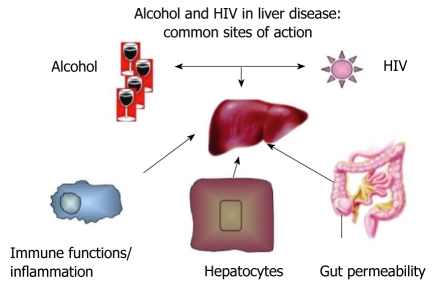
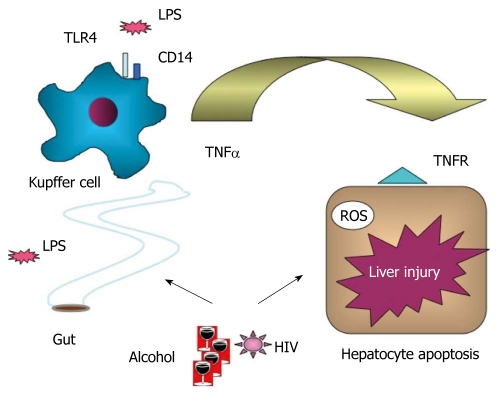
Clinical observations have demonstrated that excessive chronic alcohol use negatively affects human immunodeficiency virus (HIV) infection and contributes to the liver manifestations of the disease, even in HIV mono-infection. HIV/hepatitis C virus (HCV) co-infection is associated with increased progression of HVC liver disease compared to HCV infection alone, and both of these are negatively affected by alcohol use. Recent data suggest that alcohol use and HIV infection have common targets that contribute to progression of liver disease. Both HIV infection and chronic alcohol use are associated with increased gut permeability and elevated plasma levels of lipopolysaccharide; a central activator of inflammatory responses. Both alcoholic liver disease and HIV infection result in non-specific activation of innate immunity, proinflammatory cytokine cascade upregulation, as well as impaired antigen presenting cell and dendritic cell functions. Finally, alcohol, HIV and antiretroviral therapy affect hepatocyte functions, which contributes to liver damage. The common targets of alcohol and HIV infection in liver disease are discussed in this mini-review.
Keywords: Hepatitis B virus; Hepatitis C virus; Inflammation; Intestine; Liver.
Figures
References
-
- Schneider MF, Gange SJ, Williams CM, Anastos K, Greenblatt RM, Kingsley L, Detels R, Mu ñoz A. Patterns of the hazard of death after AIDS through the evolution of antiretroviral therapy: 1984-2004. AIDS. 2005;19:2009–2018. - PubMed
-
- Palella FJ, Delaney KM, Moorman AC, Loveless MO, Fuhrer J, Satten GA, Aschman DJ, Holmberg SD. Declining morbidity and mortality among patients with advanced human immunodeficiency virus infection. HIV Outpatient Study Investigators. N Engl J Med. 1998;338:853–860. - PubMed
-
- Palella FJ, Baker RK, Moorman AC, Chmiel JS, Wood KC, Brooks JT, Holmberg SD. Mortality in the highly active antiretroviral therapy era: changing causes of death and disease in the HIV outpatient study. J Acquir Immune Defic Syndr. 2006;43:27–34. - PubMed
Publication types
MeSH terms
Grants and funding
LinkOut - more resources
Full Text Sources
Medical
