The effect of an early education program on adult health: the Carolina Abecedarian Project randomized controlled trial
- PMID: 21233425
- PMCID: PMC3036683
- DOI: 10.2105/AJPH.2010.200063
The effect of an early education program on adult health: the Carolina Abecedarian Project randomized controlled trial
Abstract
Objectives: We explored whether a successful randomized controlled trial of early education, the Carolina Abecedarian Project (ABC), which enrolled infants from 1972 to 1977 at the Frank Porter Graham Child Development Institute in Chapel Hill, North Carolina, improved health outcomes and behaviors by 21 years of age.
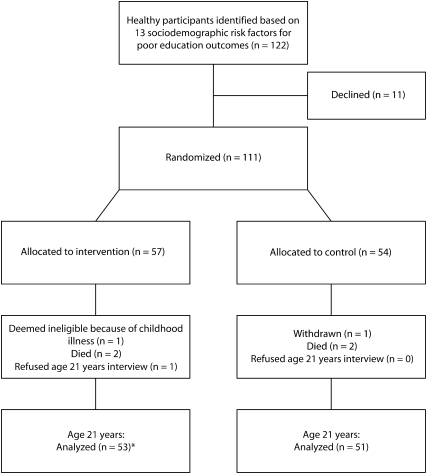
Methods: ABC randomized 111 infants to receive an intensive early education program or nutritional supplements and parental counseling alone; participants have been followed to the present day. We examined the effect of ABC on health outcomes and behavioral risk factors when participants were aged 21 years, and then explored the mediators of this relationship.
Results: Relative to the control group, the ABC treatment group was previously found to have improved cognition and educational attainment. We found that the intervention also improved heath (P = .05) and health behaviors (P = .03) when participants were aged 21 years. These improvements in behaviors were not mediated by IQ, math and reading scores at 15 years of age, educational attainment, or health insurance.
Conclusions: Effective early education programs may improve health and reduce risky health behaviors in adulthood.
Figures
References
-
- Grossman M. Education and nonmarket outcomes. : Hanushek E, Welch F, Handbook of the Economics of Education. Amsterdam, Netherlands: Elsevier; 2006
-
- Belfield CR, Nores M, Barnett S, Schweinhart L. The High/Scope Perry Preschool Program: cost-benefit analysis using data from the age-40 follow-up. J Hum Resour. 2006;41(1):162–190
-
- Lleras-Muney A. The relationship between education and adult mortality in the United States. Rev Econ Stud. 2005;72(1):189–221
-
- Carneiro P, Heckman JJ. Human capital policy. : Heckman J, Krueger A, Inequality in America: What Role for Human Capital Policies? Cambridge, MA: MIT Press; 2003
-
- Levin H, Belfield C. The Price We Pay: Economic and Social Consequences of Inadequate Education. Washington, DC: Brookings Institution Press; 2007
Publication types
MeSH terms
LinkOut - more resources
Full Text Sources