


Adolescents' expectancies for smoking to regulate affect predict smoking behavior and nicotine dependence over time
- PMID: 20547013
- PMCID: PMC2930050
- DOI: 10.1016/j.drugalcdep.2010.04.001
Adolescents' expectancies for smoking to regulate affect predict smoking behavior and nicotine dependence over time
Abstract
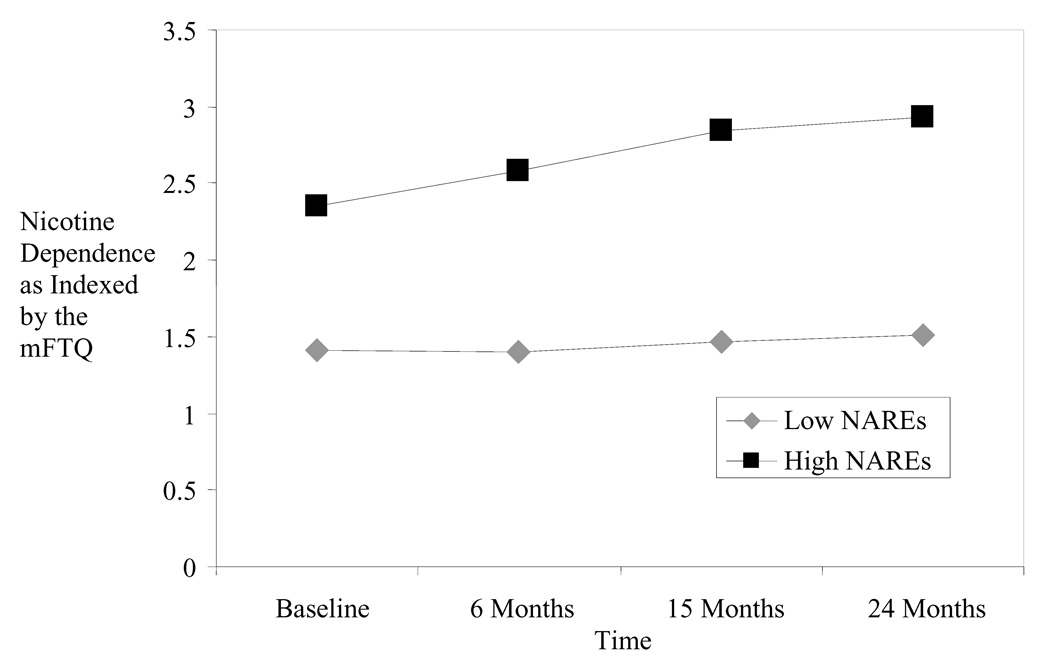
Aims: Mounting evidence suggests that individuals smoke, in part, to regulate affective experience (e.g., tension reduction, mood enhancement). Implicit in such motives is the expectancy or belief that smoking will decrease negative affect and increase positive affect. The contribution of cognitively-driven expectancies to the initiation and continuation of smoking during adolescence remains largely uninvestigated. The current study examined the influence of negative affect relief expectancies (NAREs) for smoking on smoking behavior and nicotine dependence using longitudinal data from a study on the emotional and social contexts of youth smoking.
Methods: Participants were 568 adolescents with smoking experience (mean age 15.67, 56.7% female). Three separate mixed regression models were estimated to determine the relative contribution of NAREs to smoking behavior and nicotine dependence measured at 4 time points over 2 years.
Results: NAREs for smoking influenced all smoking outcomes at baseline and predicted increases in smoking behavior and nicotine dependence over time, even after controlling for anxious and depressive symptoms and baseline nicotine dependence.
Conclusions: Outcome expectancies for affect management emerged as an important risk factor for smoking escalation and the development of nicotine dependence during adolescence. The present findings highlight the potential importance of cognitively-driven expectancies as a risk factor for smoking escalation during this critical developmental period.
Copyright 2010 Elsevier Ireland Ltd. All rights reserved.
Figures
References
-
- Akaike H. Likelihood of a model and information criteria. Journal of Econometrics. 1981;16:3–14.
-
- Baker TB, Brandon TH, Chassin L. Motivational influences on cigarette smoking. Annual Review Of Psychology. 2004a;55:463–491. - PubMed
-
- Baker TB, Piper ME, McCarthy DE, Majeskie MR, Fiore MC. Addiction motivation reformulated: An affective processing model of negative reinforcement. Psychol Rev. 2004b;111:33–51. - PubMed
-
- Bock RD. Multivariate statistical methods in behavioural research. New York: McGraw Hill; 1975.
Publication types
MeSH terms
Grants and funding
LinkOut - more resources
Full Text Sources
Medical
