Long-term follow-up in cancer prevention trials (It ain't over 'til it's over)
- PMID: 20522799
- PMCID: PMC2883740
- DOI: 10.1158/1940-6207.CAPR-10-0096
Long-term follow-up in cancer prevention trials (It ain't over 'til it's over)
Abstract
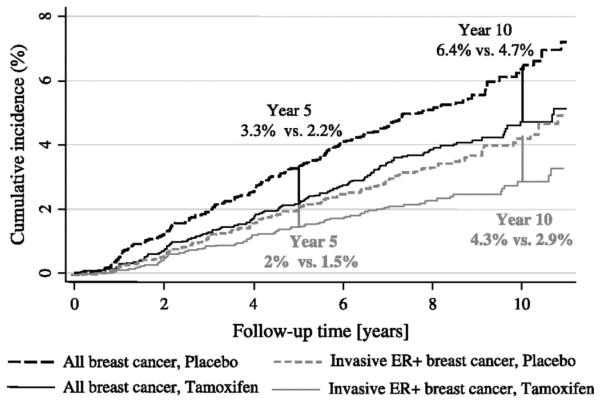
The update of the Study of Tamoxifen and Raloxifene by Vogel et al. (beginning on p. 696 in this issue of the journal) highlights the overall importance of long-term follow-up of cancer prevention trials, which need long follow-up to fully determine agent risks and benefits. Biomarkers (e.g., reduced cervical intraepithelial neoplasia 3 after human papillomavirus vaccination) can provide an early indication of efficacy but almost never replace the cancer end point in determining the ultimate utility of an agent. Long follow-up is also important to fully determine preventive benefit, as illustrated by the tamoxifen trials, where only 60% as many treated women were needed to prevent one cancer at 10 years as at approximately 5 years, the time of the early reports.
2010 AACR.
Figures
Comment on
-
Update of the National Surgical Adjuvant Breast and Bowel Project Study of Tamoxifen and Raloxifene (STAR) P-2 Trial: Preventing breast cancer.Cancer Prev Res (Phila). 2010 Jun;3(6):696-706. doi: 10.1158/1940-6207.CAPR-10-0076. Epub 2010 Apr 19. Cancer Prev Res (Phila). 2010. PMID: 20404000 Free PMC article. Clinical Trial.
References
-
- Rowhani-Rahbar A, Mao C, Alvarez FB, et al. Long-term efficacy of a prophylactic human papillomavirus type 16 vaccine. Presented at the 25th International Papillomavirus Conference: Clinical & Educational Workshop; Malmö, Sweden. 2009 May 8–14; Abstract O-01.03.
-
- Paavonen J, Naud P, Salmerón J, et al. Efficacy of human papillomavirus (HPV)-16/18 AS04-adjuvanted vaccine against cervical infection and precancer caused by oncogenic HPV types (PATRICIA): final analysis of a double-blind, randomised study in young women. Lancet. 2009;374:301–14. - PubMed
-
- Brown DR, Kjaer SK, Sigurdsson K, et al. The impact of quadrivalent human papillomavirus (HPV; types 6, 11, 16, and 18) L1 virus-like particle vaccine on infection and disease due to oncogenic nonvaccine HPV types in generally HPV-naive women aged 16-26 years. J Infect Dis. 2009;199:926–35. - PubMed
Publication types
MeSH terms
Substances
Grants and funding
LinkOut - more resources
Full Text Sources
Medical