


Intestinal dysbiosis and reduced immunoglobulin-coated bacteria associated with coeliac disease in children
- PMID: 20181275
- PMCID: PMC2843610
- DOI: 10.1186/1471-2180-10-63
Intestinal dysbiosis and reduced immunoglobulin-coated bacteria associated with coeliac disease in children
Abstract
Background: Coeliac disease is a chronic intestinal inflammatory disorder due to an aberrant immune response to dietary gluten proteins in genetically predisposed individuals. Mucosal immune response through IgA secretion constitutes a first line of defence responsible for neutralizing noxious antigens and pathogens. The aim of this study was the characterization of the relationships between immunoglobulin-coated bacteria and bacterial composition of faeces of coeliac disease (CD) patients, untreated and treated with a gluten-free diet (GFD) and healthy controls.
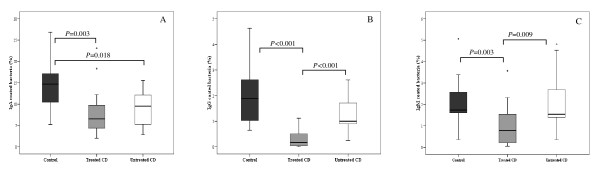
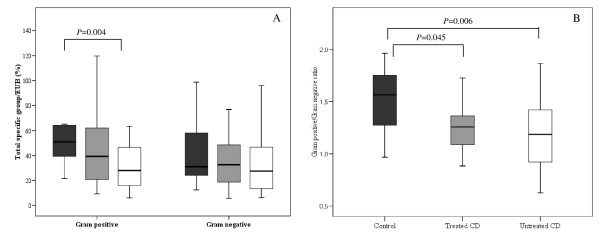
Results: IgA-coated faecal bacterial levels were significantly lower in both untreated and treated CD patients than in healthy controls. IgG and IgM-coated bacterial levels were also significantly lower in treated CD patients than in untreated CD patients and controls. Gram-positive to Gram-negative bacteria ratio was significantly reduced in both CD patients compared to controls. Bifidobacterium, Clostridium histolyticum, C. lituseburense and Faecalibacterium prausnitzii group proportions were less abundant (P < 0.050) in untreated CD patients than in healthy controls. Bacteroides-Prevotella group proportions were more abundant (P < 0.050) in untreated CD patients than in controls. Levels of IgA coating the Bacteroides-Prevotella group were significantly reduced (P < 0.050) in both CD patients in comparison with healthy controls.
Conclusions: In CD patients, reduced IgA-coated bacteria is associated with intestinal dysbiosis, which altogether provide new insights into the possible relationships between the gut microbiota and the host defences in this disorder.
Figures
References
-
- Drago S, El Asmar R, Di Pierro M, Grazia Clemente M, Tripathi A, Sapone A, Thakar M, Iacono G, Carroccio A, D'Agate C, Not T, Zampini L, Catassi C, Fasano A. Gliadin, zonulin and gut permeability: Effects on celiac and non-celiac intestinal mucosa and intestinal cell lines. Scand J Gastroenterol. 2006;41:408–419. doi: 10.1080/00365520500235334. - DOI - PubMed
Publication types
MeSH terms
Substances
LinkOut - more resources
Full Text Sources
Other Literature Sources
Medical
Miscellaneous
