Low to moderate alcohol intake is not associated with increased mortality after breast cancer
- PMID: 20160253
- PMCID: PMC2836421
- DOI: 10.1158/1055-9965.EPI-09-0927
Low to moderate alcohol intake is not associated with increased mortality after breast cancer
Abstract
Background: Both alcohol consumption and obesity have been linked with breast cancer morbidity and mortality. An inverse association between alcohol intake and obesity suggests possible confounding between these variables (and perhaps other factors) with breast cancer outcomes.
Methods: Alcohol intake (beer, wine, spirits, and total) was examined in 3,088 women previously diagnosed and treated for breast cancer within an intervention trial that targeted vegetables, fiber, and fat but not alcohol or weight loss. Factors associated with baseline alcohol intake were included in Cox proportional hazards models for recurrence and mortality.
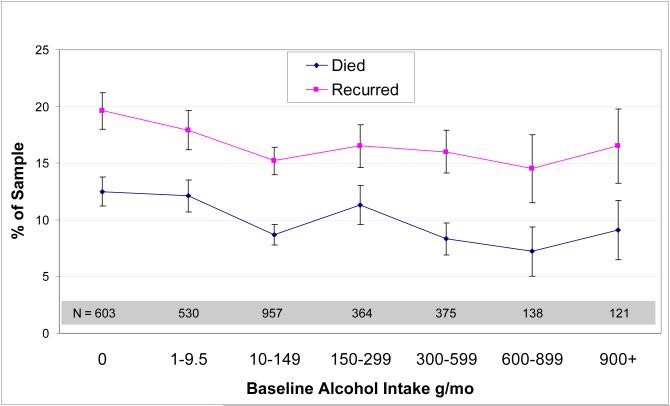
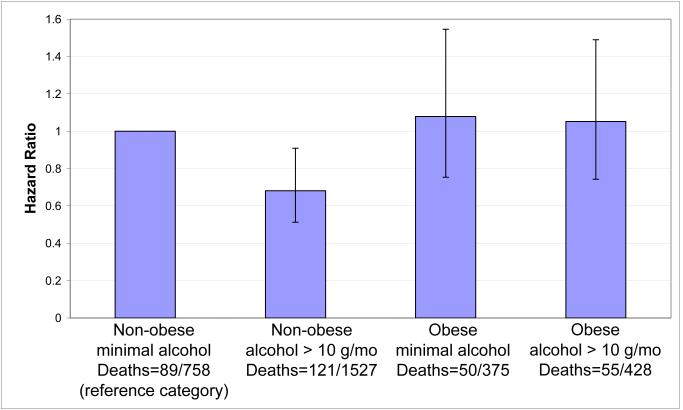
Results: Alcohol intake was significantly associated with higher education and physical activity levels. Neither light alcohol intake nor obesity was significantly associated with breast cancer recurrence, but moderate alcohol intake >300 g/mo was protective against all-cause mortality (hazard ratio, 0.69; 95% confidence intervals, 0.49-0.97) in a proportional hazards model adjusted for obesity. Obese women were 61% more likely to be nondrinkers than drinkers, and 76% more likely to be light drinkers than moderate/heavy drinkers. In nonobese women, alcohol intake >10 g/mo was associated with lower risk of all-cause mortality (hazard ratio, 0.68; 95% confidence intervals, 0.51-0.91).
Conclusion: Light alcohol intake, regardless of body weight, did not increase the risk of breast cancer recurrence or all-cause mortality in this cohort of middle-aged women previously diagnosed with breast cancer. Alcohol intake was associated with other favorable prognostic indicators, which may explain its apparent protective effect in nonobese women.
Figures
References
-
- Allen NE, Beral V, Casabonne D, et al. Moderate alcohol intake and cancer incidence in women. J Natl Cancer Inst. 2009;101:296–305. - PubMed
-
- Mahoney MC, Bevers T, Linos E, Willett WC. Opportunities and strategies for breast cancer prevention through risk reduction. CA Cancer J Clin. 2008;58:347–71. - PubMed
-
- Tjonneland A, Christensen J, Olsen A, et al. Alcohol intake and breast cancer risk: the European Prospective Investigation into Cancer and Nutrition (EPIC) Cancer Causes Control. 2007;18:361–73. - PubMed
-
- Ewertz M, Gillanders S, Meyer L, Zedeler K. Survival of breast cancer patients in relation to factors which affect the risk of developing breast cancer. Int J Cancer. 1991;49:526–30. - PubMed
Publication types
MeSH terms
Grants and funding
LinkOut - more resources
Full Text Sources
Medical