


Underlying causes of the black-white racial disparity in breast cancer mortality: a population-based analysis
- PMID: 19584327
- PMCID: PMC2710374
- DOI: 10.1093/jnci/djp176
Underlying causes of the black-white racial disparity in breast cancer mortality: a population-based analysis
Abstract
Background: In the United States, a black-to-white disparity in age-standardized breast cancer mortality rates emerged in the 1980s and has widened since then.
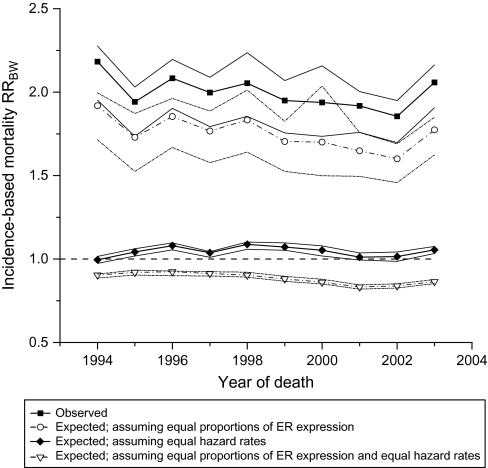
Methods: To further explore this racial disparity, black-to-white rate ratios (RRs(BW)) for mortality, incidence, hazard of breast cancer death, and incidence-based mortality (IBM) were investigated using data from the National Cancer Institute's Surveillance, Epidemiology, and End Results program on 244 786 women who were diagnosed with breast cancer from January 1990 through December 2003 and followed through December 2004. A counterfactual approach was used to examine the expected IBM RRs(BW), assuming equal distributions for estrogen receptor (ER) expression, and/or equal hazard rates of breast cancer death, among black and white women.
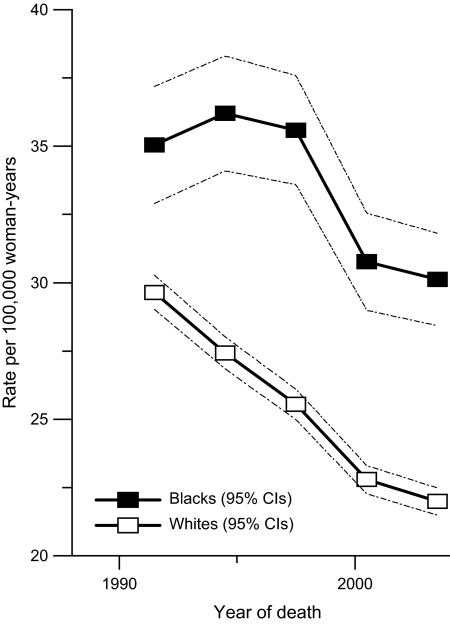
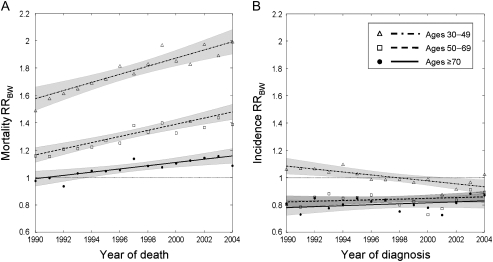
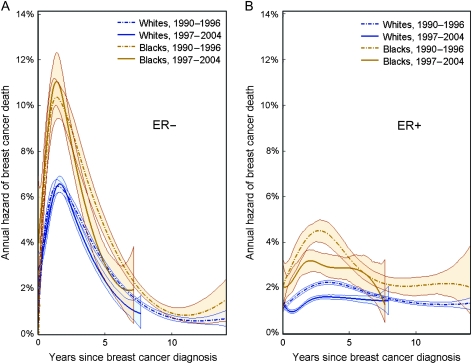
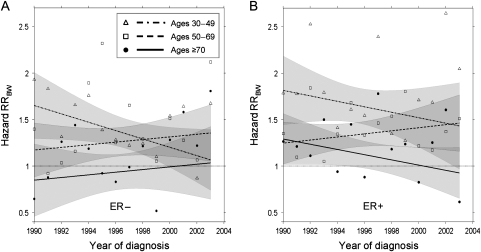
Results: From 1990 through 2004, mortality RR(BW) was greater than 1.0 and widened over time (age-standardized breast cancer mortality rates fell from 36 to 29 per 100 000 for blacks and from 30 to 22 per 100 000 for whites). In contrast, incidence RR(BW) was generally less than 1.0. Absolute hazard rates of breast cancer death declined substantially for ER-positive tumors and modestly for ER-negative tumors but were persistently higher for blacks than whites. Equalizing the distributions of ER expression in blacks and whites decreased the IBM RR(BW) slightly. Interestingly, the black-to-white disparity in IBM RR(BW) was essentially eliminated when hazard rates of breast cancer death were matched within each ER category.
Conclusions: The black-to-white disparity in age-standardized breast cancer mortality was largely driven by the higher hazard rates of breast cancer death among black women, diagnosed with the disease, irrespective of ER expression, and especially in the first few years following diagnosis. Greater emphasis should be placed on identifying the etiology of these excess hazards and developing therapeutic strategies to address them.
Figures
Comment in
-
Is race really a negative prognostic factor for cancer?J Natl Cancer Inst. 2009 Jul 15;101(14):970-1. doi: 10.1093/jnci/djp185. Epub 2009 Jun 30. J Natl Cancer Inst. 2009. PMID: 19567421 No abstract available.
References
-
- Jatoi I, Chen BE, Anderson WF, Rosenberg PS. Breast cancer mortality trends in the United States according to estrogen receptor status and age at diagnosis. J Clin Oncol. 2007;25(13):1683–1690. - PubMed
-
- Jatoi I, Miller AB. Why is breast-cancer mortality declining? Lancet Oncol. 2003;4(4):251–254. - PubMed
-
- Blackman DJ, Masi CM. Racial and ethnic disparities in breast cancer mortality: are we doing enough to address the root causes? J Clin Oncol. 2006;24(14):2170–2178. - PubMed
-
- Jatoi I, Anderson WF, Rao SR, Devesa SS. Breast cancer trends among black and white women in the United States. J Clin Oncol. 2005;23(31):7836–7841. - PubMed
Publication types
MeSH terms
Substances
Grants and funding
LinkOut - more resources
Full Text Sources
Medical
