


Brief screens for detecting alcohol use disorder among 18-20 year old young adults in emergency departments: Comparing AUDIT-C, CRAFFT, RAPS4-QF, FAST, RUFT-Cut, and DSM-IV 2-Item Scale
- PMID: 19398161
- PMCID: PMC3217267
- DOI: 10.1016/j.addbeh.2009.03.038
Brief screens for detecting alcohol use disorder among 18-20 year old young adults in emergency departments: Comparing AUDIT-C, CRAFFT, RAPS4-QF, FAST, RUFT-Cut, and DSM-IV 2-Item Scale
Abstract
Background: This study compared six of the briefest screening instruments for detecting DSM-IV-defined Alcohol Use Disorder (AUD) among older adolescents treated in Emergency Departments (ED).
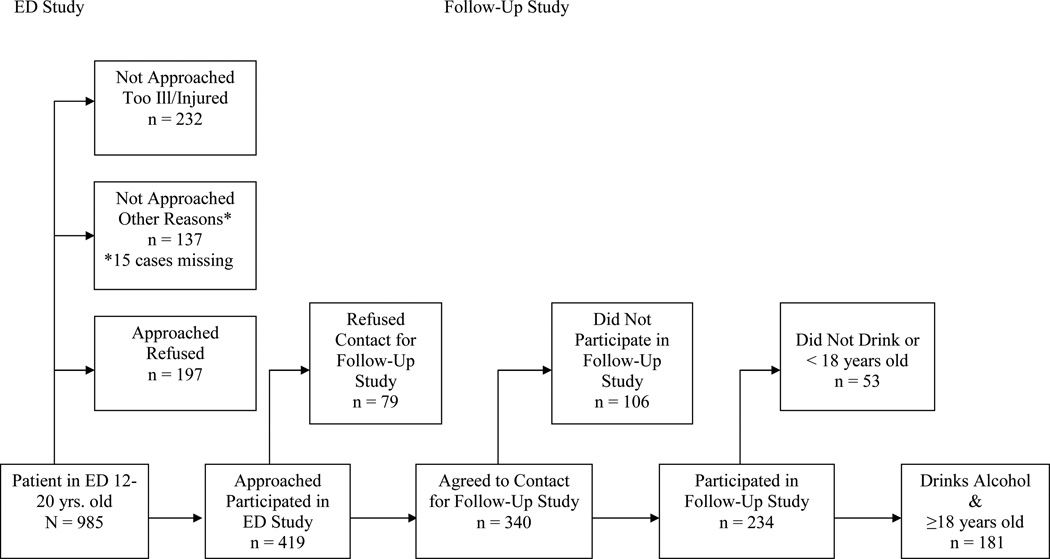
Methods: The AUDIT-C, the RAPS4-QF, the FAST, the CRAFFT, the RUFT-Cut, and 2-Items from the Diagnostic and Statistical Manual IV of the American Psychiatric Association [American Psychiatric Association (1994). Diagnostic and Statistical Manual of Psychiatric Disorders, (1994) (DSM-IV). 4th ed. Washington D.C.: American Psychiatric Association] criteria for AUD (heretofore referred to as the DSM-IV 2-Item Scale) were evaluated against the criterion of a current DSM-IV diagnosis of either alcohol abuse or dependence. The instruments were administered to 181 alcohol-using older adolescents (57% males; age range 18-20 years) in an ED and compared using Receiver Operator Characteristic (ROC) analyses against the criterion of a current DSM-IV diagnosis of alcohol abuse or dependence.
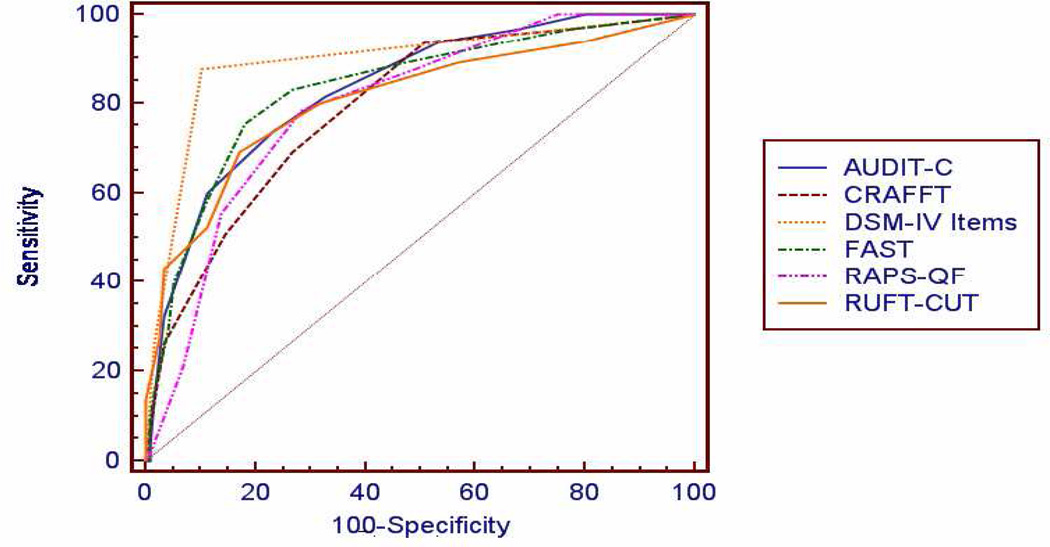
Results: Of these instruments, the DSM-IV 2-Item Scale performed best for identifying AUD (88% sensitivity and 90% specificity), followed by the FAST and the AUDIT-C.
Conclusions: Two items from the DSM-IV criteria for AUD performed best for identifying ED-treated older adolescents with alcohol use disorders. The FAST and AUDIT-C performed well, but are longer and more difficult to score in the hectic environment of the Emergency Department.
Figures
References
-
- Allen JP, Litten RZ, Fertig JB, Babor T. A review of research on the Alcohol Use Disorders Identification Test (AUDIT) Alcoholism: Clinical & Experimental Research. 1997;21:613–619. - PubMed
-
- American Psychiatric Association. Diagnostic and Statistical Manual of Psychiatric Disorders, (1994) (DSM-IV) 4th ed. Washington D.C.: American Psychiatric Association; 1994.
-
- Canagasaby A, Vinson DC. Screening for hazardous or harmful drinking using one or two quantity-frequency questions. Alcohol & Alcoholism. 2007;40:208–213. - PubMed
-
- Cherpitel CJ. Screening for alcohol problems in the emergency room: A rapid alcohol problems screen. Drug and Alcohol Dependence. 1995;40:133–137. - PubMed
-
- Cherpitel CJ. Performance of screening instruments for identifying alcohol dependence in the general population, compared with clinical populations. Alcoholism: Clinical & Experimental Research. 1998;22:1399–1404. - PubMed
Publication types
MeSH terms
Grants and funding
LinkOut - more resources
Full Text Sources
