


Evaluation of an overdose prevention and response training programme for injection drug users in the Skid Row area of Los Angeles, CA
- PMID: 19268564
- PMCID: PMC4291458
- DOI: 10.1016/j.drugpo.2009.01.003
Evaluation of an overdose prevention and response training programme for injection drug users in the Skid Row area of Los Angeles, CA
Abstract
Background: Fatal opioid overdose is a significant cause of mortality among injection drug users (IDUs).
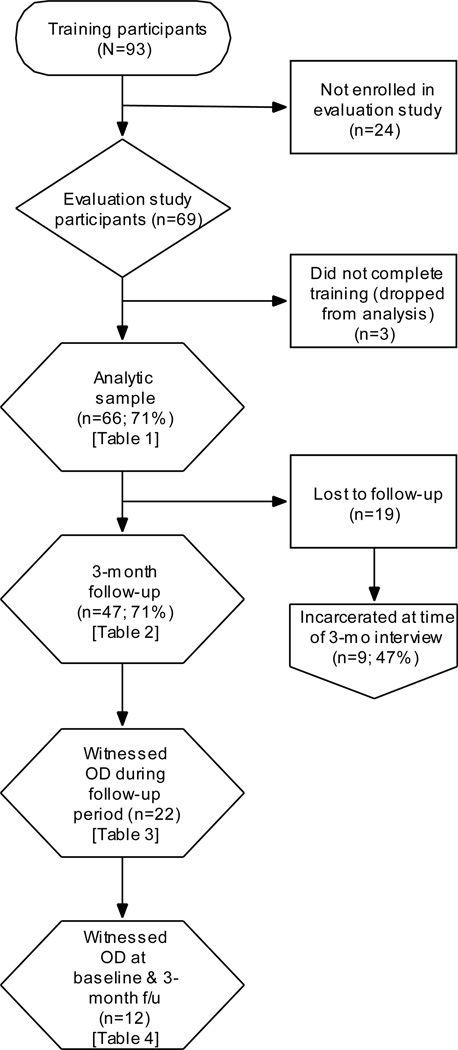
Methods: We evaluated an overdose prevention and response training programme for IDUs run by a community-based organisation in Los Angeles, CA. During a 1-h training session participants learned skills to prevent, recognise, and respond to opioid overdoses, including: calling for emergency services, performing rescue breathing, and administering an intramuscular injection of naloxone (an opioid antagonist). Between September 2006 and January 2008, 93 IDUs were trained. Of those, 66 (71%) enrolled in the evaluation study and 47 participants (71%) completed an interview at baseline and 3-month follow-up.
Results: Twenty-one percent of participants were female, 42% were white, 29% African American, and 18% Latino. Most were homeless or lived in temporary accommodation (73%). We found significant increases in knowledge about overdose, in particular about the use of naloxone. Twenty-two participants responded to 35 overdoses during the follow-up period. Twenty-six overdose victims recovered, four died, and the outcome of five cases was unknown. Response techniques included: staying with the victim (85%), administering naloxone (80%), providing rescue breathing (66%), and calling emergency services (60%). The average number of appropriate response techniques used by participants increased significantly from baseline to follow-up (p<0.05). Half (53%) of programme participants reported decreased drug use at follow-up.
Conclusion: Overdose prevention and response training programmes may be associated with improved overdose response behaviour, with few adverse consequences and some unforeseen benefits, such as reductions in personal drug use.
Copyright 2009 Elsevier B.V. All rights reserved.
Figures
References
-
- Baca CT, Grant KJ. Take-home naloxone to reduce heroin death. Addiction. 2005;100(12):1823–1831. - PubMed
-
- Blasi G, et al. Policing our way out of homelessness? The first year of the safer cities initiative on Skid Row. Los Angeles, CA: UCLA School of Law; 2007.
-
- Bourdieu P. The forms of capital. In: Richardson J, editor. Handbook of theory and research for the sociology of education. New York: Greenwood Press; 1986.
-
- Burris S, Norland J, Edlin BR. Legal aspects of providing naloxone to heroin users in the United States. International Journal of Drug Policy. 2001;12(3):237–248.
-
- Davidson PJ, Ochoa KC, Hahn JA, Evans JL, Moss AR. Witnessing heroin-related overdoses: The experiences of young injectors in San Francisco. Addiction. 2002;97(12):1511–1516. - PubMed
Publication types
MeSH terms
Substances
Grants and funding
LinkOut - more resources
Full Text Sources
Medical
