Modeling cognitive influences on drinking and alcohol problems
- PMID: 19118395
- PMCID: PMC2629621
- DOI: 10.15288/jsad.2009.70.78
Modeling cognitive influences on drinking and alcohol problems
Abstract
Objective: We explored the relationships between two domains of alcohol-related cognitions (expectations and reasons for drinking) and their associations with alcohol consumption and alcohol dependence. It is hypothesized that alcohol-related cognitions will relate directly to drinking behaviors and indirectly to alcohol dependence.
Method: Data came from the 1995 National Alcohol Survey, which included black and Hispanic oversamples. The analysis was restricted to 2,817 respondents who reported alcohol consumption at least once in the past year. Path analysis, including key demographic factors, modeled the associations between expectations, reasons for drinking, frequency of heavy drinking, and alcohol dependence.
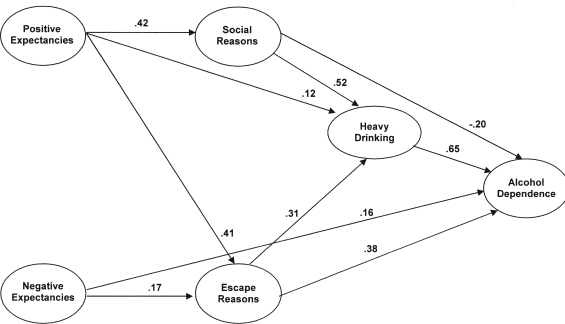
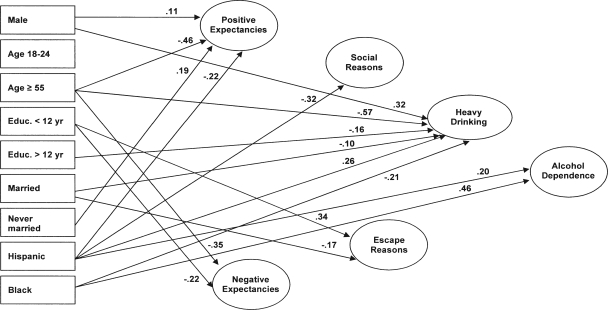
Results: Exploratory and confirmatory factor analyses yielded separate latent variables for expectations (positive and negative), reasons for drinking (social and escape), frequency of heavy alcohol use, and alcohol-dependence symptoms. Associations between positive expectations and frequency of heavy drinking were partially mediated by social and escape reasons for drinking. Associations between negative expectancies and alcohol dependence were partially mediated by escape reasons for drinking. Associations between reasons for drinking and alcohol dependence were partially mediated by the frequency of heavy drinking. Associations between demographic variables and alcohol dependence were mediated by the frequency of heavy drinking; black race and Hispanic ethnicity also showed additional direct effects on dependence.
Conclusions: Alcohol-related cognitions exhibit complex associations with drinking behaviors and alcohol dependence. Implications for research on ethnic minority health disparities and public policy are discussed.
Figures
References
-
- American Psychiatric Association. Diagnostic and Statistical Manual of Mental Disorders (DSM-IV) Washington, DC: 1994.
-
- Brown SA, Creamer VA, Stetson BA. Adolescent alcohol expectancies in relation to personal and parental drinking patterns. J. Abnorm. Psychol. 1987;96:117–121. - PubMed
-
- Brown SA, Goldman MS, Inn A, Anderson LR. Expectations of reinforcement from alcohol: Their domain and relation to drinking patterns. J. Cons. Clin. Psychol. 1980;48:419–426. - PubMed
-
- Caetano R. Ethnicity drinking in Northern California: A comparison among whites, blacks and Hispanics. Alcohol Alcsm. 1984;19:31–44. - PubMed
Publication types
MeSH terms
Grants and funding
LinkOut - more resources
Full Text Sources
Medical
Miscellaneous