


doi: 10.3201/eid1408.080059.
Cutaneous infrared thermometry for detecting febrile patients
Affiliations
- PMID: 18680649
- PMCID: PMC2600390
- DOI: 10.3201/eid1408.080059
Item in Clipboard
Cutaneous infrared thermometry for detecting febrile patients
Emerg Infect Dis.
2008 Aug.
Abstract
We assessed the accuracy of cutaneous infrared thermometry, which measures temperature on the forehead, for detecting patients with fever in patients admitted to an emergency department. Although negative predictive value was excellent (0.99), positive predictive value was low (0.10). Therefore, we question mass detection of febrile patients by using this method.
Figures
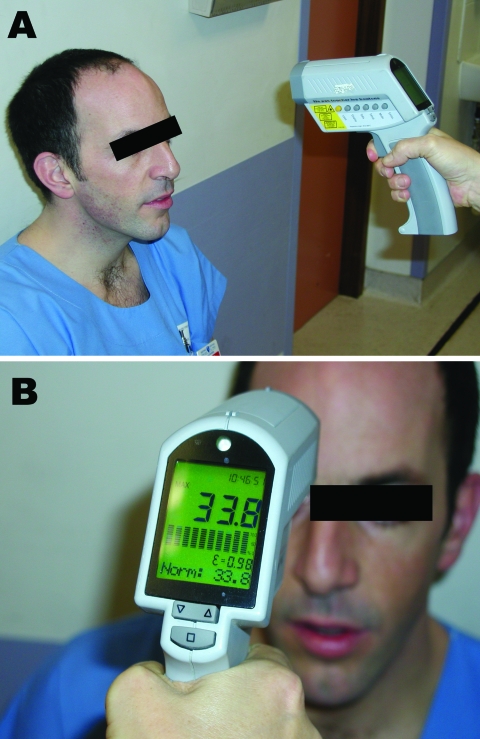
Measurement of cutaneous temperature with an infrared thermometer. A) The device is placed 20 cm from the forehead. B) As soon as the examiner pulls the trigger, the temperature measured is shown on the display. Used with permission.
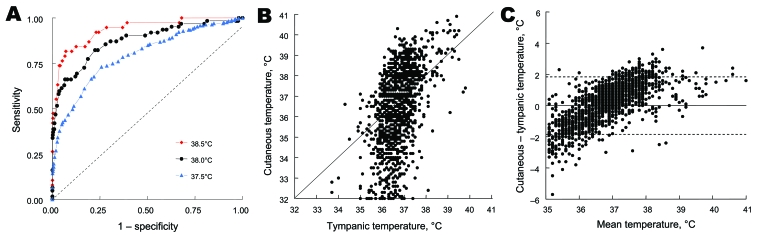
A) Comparison of receiver operating characteristic (ROC) curves showing relationship between sensitivity (true positive) and 1 – specificity (true negative) in determining value of cutaneous temperature for predicting various thresholds of hyperthermia definitions (37.5°C, 38.0°C, and 38.5°C) of tympanic temperature. Areas under ROC curves (95% confidence interval) were 0.935 (0.876–0.966), 0.873 (0.807–0.917), and 0.792 (0.749–0.829), respectively, and all were significantly (p<0.001) different from the identity line (dashed diagonal line). B) Correlation and C) Bland and Altman diagrams comparing cutaneous and tympanic temperature measurements (n = 2,026 patients). Values on the y-axis in panel C represent differences between cutaneous and tympanic temperatures. The solid horizontal line in panel C represents the null difference between cutaneous and tympanic temperatures, and the 2 dashed horizontal lines represent ± 2 standard deviations.
References
-
- Hughes WT, Patterson GG, Thronton D, Williams BJ, Lott L, Dodge R. Detection of fever with infrared thermometry: a feasibility study. J Infect Dis. 1985;152:301–6. - PubMed
Publication types
MeSH terms
LinkOut - more resources
Full Text Sources
Other Literature Sources
Medical