


Indirect effects of acute alcohol intoxication on sexual risk-taking: The roles of subjective and physiological sexual arousal
- PMID: 18431618
- PMCID: PMC3571090
- DOI: 10.1007/s10508-008-9346-9
Indirect effects of acute alcohol intoxication on sexual risk-taking: The roles of subjective and physiological sexual arousal
Abstract
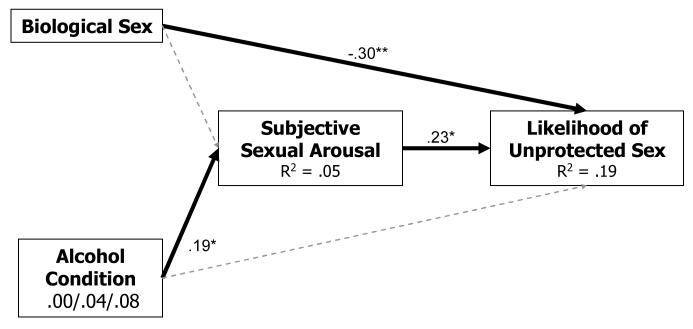
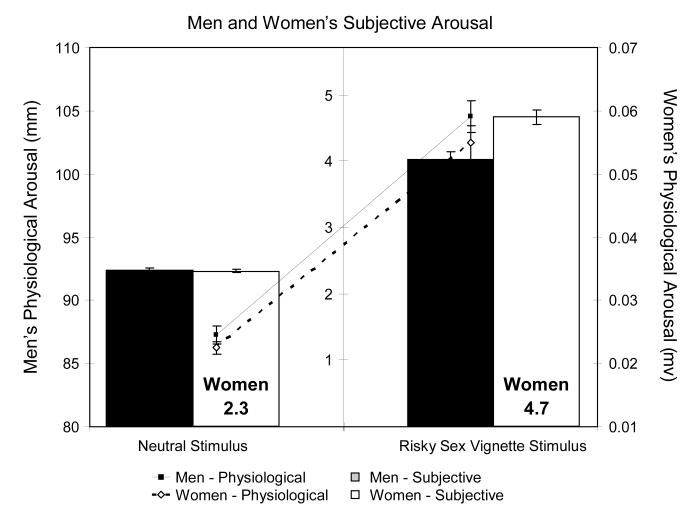
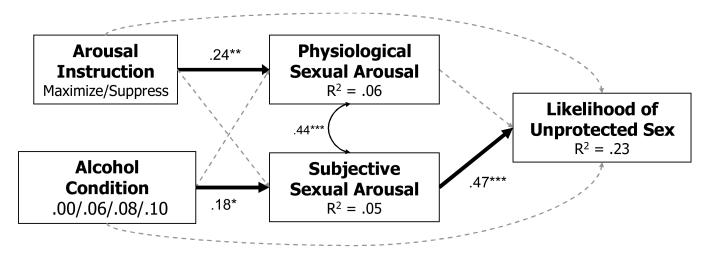
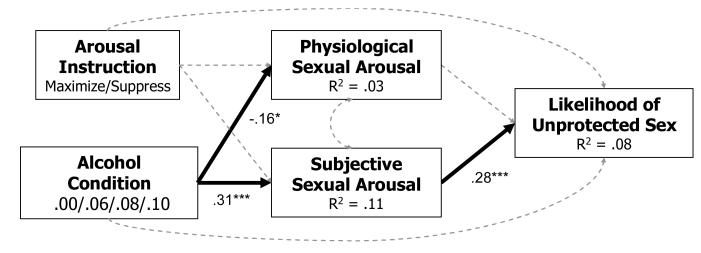
Three experiments supported the idea that alcohol fosters sexual risk-taking in men and women, in part, through its effects on sexual arousal. In Experiment 1, increasing alcohol dosage (target blood alcohol levels of .00, .04, .08%) heightened men's and women's risk-taking intentions. Alcohol's effect was indirect via increased subjective sexual arousal; also, men exhibited greater risk-taking than women. In Experiment 2, an extended dosage range (target blood alcohol levels of .00, .06, .08, .10%) heightened men's risk-taking intentions. Alcohol's effect again was indirect via subjective arousal. Physiological sexual arousal, which was unaffected by alcohol, increased risk-taking via increased subjective arousal. In Experiment 3, alcohol increased women's risk-taking indirectly via subjective arousal, but alcohol-attenuated physiological arousal had no effect on risk-taking. Implications for alcohol myopia theory and prevention interventions are discussed.
Figures
References
-
- Amaro H. Love, sex, and power: Considering women’s realities in HIV prevention. American Psychologist. 1995;50:437–447. - PubMed
-
- Ariely D, Loewenstein G. The heat of the moment: The effect of sexual arousal on sexual decision making. Journal of Behavioral Decision Making. 2006;19:87–98.
-
- Bancroft J, Janssen E, Carnes L, Goodrich D, Strong D, Long JS. Sexual activity and risk taking in young heterosexual men: The relevance of sexual arousability, mood, and sensation seeking. Journal of Sex Research. 2004;41:181–192. - PubMed
Publication types
MeSH terms
Substances
Grants and funding
LinkOut - more resources
Full Text Sources
