


Smoking-cessation media campaigns and their effectiveness among socioeconomically advantaged and disadvantaged populations
- PMID: 18381998
- PMCID: PMC2374829
- DOI: 10.2105/AJPH.2007.117499
Smoking-cessation media campaigns and their effectiveness among socioeconomically advantaged and disadvantaged populations
Abstract
Objectives: We examined whether the impact of televised smoking cessation ads differed by a population's education and income.
Methods: We used longitudinal data from the Wisconsin Behavioral Health Survey, a statewide sample of 452 adult smokers who were interviewed in 2003 to 2004 and followed up 1 year later. Logistic regression was used to assess whether baseline recall of secondhand smoke ads and "keep trying to quit" ads was associated with quit attempts and smoking abstinence at 1 year. Interaction terms were used to assess whether these associations differed by the smokers' education and income levels.
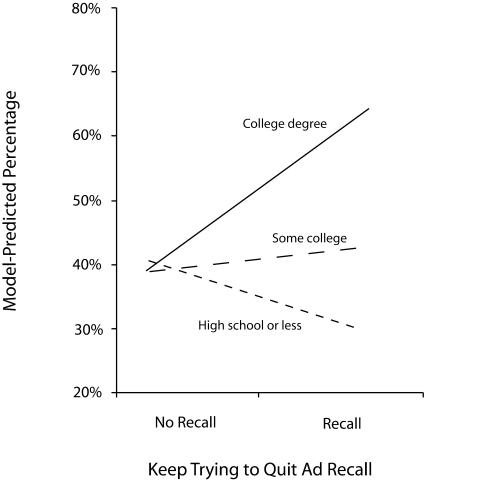
Results: Overall, neither keep-trying-to-quit nor secondhand smoke ad recall was associated with quit attempts or smoking abstinence. Keep-trying-to-quit ads were significantly more effective in promoting quit attempts among higher-versus lower-educated populations. No differences were observed for secondhand smoke ads by the smokers' education or income levels.
Conclusions: Some media campaign messages appear less effective in promoting quit attempts among less-educated populations compared with those who have more education. There is a need to develop media campaigns that are more effective with less-educated smokers.
Figures
References
-
- Hopkins DP, Briss PA, Ricard CJ, et al. for the Task Force on Community Preventive Services. Reviews of evidence regarding interventions to reduce tobacco use and exposure to environmental tobacco smoke. Am J Prev Med. 2001;20(suppl 2):16–66. - PubMed
-
- Friend K, Levy DT. Reductions in smoking prevalence and cigarette consumption associated with mass-media campaigns. Health Educ Res. 2002;17:85–98. - PubMed
-
- Tichenor PJ, Donohue GA, Olien CN. Mass media flow and differential growth in knowledge. Public Opin Q. 1970;34:159–170.
-
- Ceci SJ, Papierno PB. The rhetoric and reality of gap closing: when the “have-nots” gain but the “haves” gain even more. Am Psychol. 2005;60:149–160. - PubMed
-
- Viswanath K, Emmons KM. Message effects and social determinants of health: its application to cancer disparities. J Commun. 2006;56(suppl 1):S238–S264.
Publication types
MeSH terms
Grants and funding
LinkOut - more resources
Full Text Sources
Medical
