Prediagnostic use of hormone therapy and mortality after breast cancer
- PMID: 18381475
- PMCID: PMC2780320
- DOI: 10.1158/1055-9965.EPI-07-0610
Prediagnostic use of hormone therapy and mortality after breast cancer
Erratum in
- Cancer Epidemiol Biomarkers Prev. 2009 Jun;18(6):1943
Abstract
Background: A few studies have observed reduced breast cancer mortality in women who used hormone therapy before diagnosis. Due to the high prevalence of past and current hormone use, it is important to investigate whether these preparations are related to breast cancer mortality.
Methods: To evaluate the influence of prediagnostic use of hormone therapy on breast cancer mortality, a prospective cohort of 12,269 women ages 50 years or more diagnosed with incident invasive breast cancer and residents of Wisconsin, Massachusetts, or New Hampshire were enrolled in three phases beginning in 1988. They were followed for death until December 31, 2005, using the National Death Index. Cumulative mortality and multivariable adjusted hazard rate ratios for breast cancer and other mortality causes were calculated for women according to any hormone therapy use, and for exclusive use of estrogen or estrogen-progestin (EP).
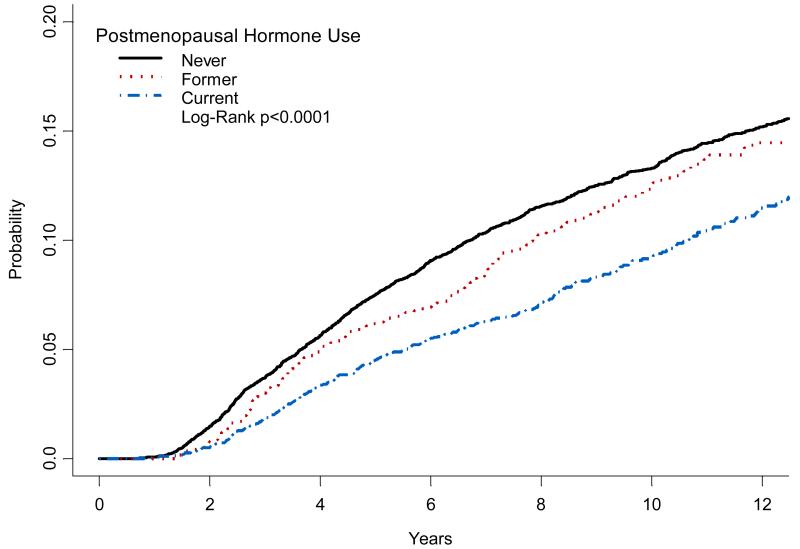
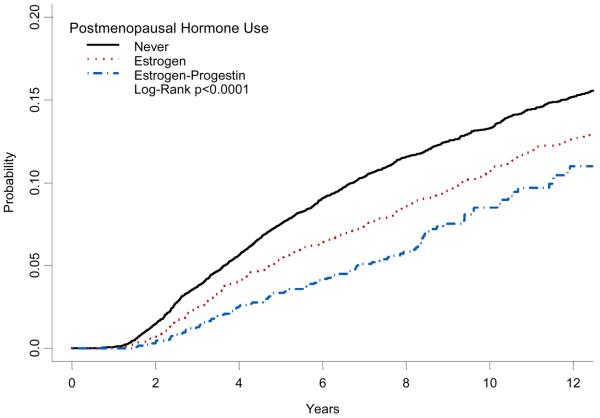
Results: During an average 10.3 years of follow-up, 1,690 deaths from breast cancer were documented. Cumulative mortality from breast cancer was lower among hormone therapy users, specifically current users at the time of diagnosis, and EP users, compared with nonusers. Adjusted survival varied by type and duration of hormone therapy before diagnosis. A reduced risk of death from breast cancer was associated with EP preparations (hazard rate ratio, 0.73; 0.59-0.91) and with > or =5 years of EP use (0.60; 0.43-0.84). No association was observed for women who were former or current users of E-alone preparations.
Conclusions: Although use of combined EP preparations increases breast cancer risk, in this study, use of these hormones before diagnosis was associated with reduced risk of death after a breast cancer diagnosis. The better survival among users, particularly of EP, persisted after adjustment of screening, stage, and measured confounders.
Figures
References
-
- Collaborative Group on Hormonal Factors in Breast Cancer Breast cancer and hormone replacement therapy: collaborative reanalysis of data from 51 epidemiological studies of 52,705 women with breast cancer and 108,411 women without breast cancer. Lancet. 1997;350(9084):1047–59. - PubMed
-
- Rossouw JE, Anderson GL, Prentice RL, LaCroix AZ, Kooperberg C, Stefanick ML, et al. Risks and benefits of estrogen plus progestin in healthy postmenopausal women: principal results From the Women's Health Initiative randomized controlled trial. JAMA. 2002;288(3):321–33. - PubMed
-
- Bergkvist L, Adami HO, Persson I, Bergstrom R, Krusemo UB. Prognosis after breast cancer diagnosis in women exposed to estrogen and estrogen-progestogen replacement therapy. Am J Epidemiol. 1989;130(2):221–8. - PubMed
-
- Ewertz M, Gillanders S, Meyer L, Zedeler K. Survival of breast cancer patients in relation to factors which affect the risk of developing breast cancer. Int J Cancer. 1991;49(4):526–30. - PubMed
-
- Schairer C, Gail M, Byrne C, Rosenberg PS, Sturgeon SR, Brinton LA, et al. Estrogen replacement therapy and breast cancer survival in a large screening study. J Natl Cancer Inst. 1999;91(3):264–70. - PubMed
Publication types
MeSH terms
Grants and funding
LinkOut - more resources
Full Text Sources
Medical
Miscellaneous