


Leptin regulates striatal regions and human eating behavior
- PMID: 17690262
- PMCID: PMC3838941
- DOI: 10.1126/science.1144599
Leptin regulates striatal regions and human eating behavior
Abstract
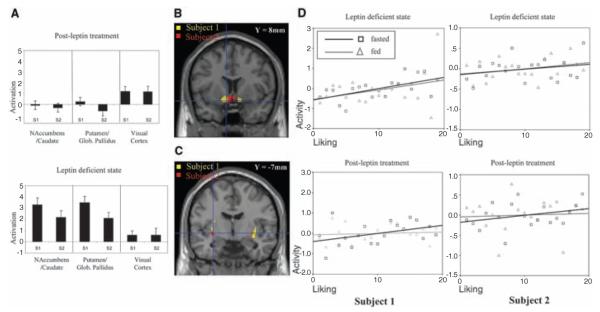
Studies of the fat-derived hormone leptin have provided key insights into the molecular and neural components of feeding behavior and body weight regulation. An important challenge lies in understanding how the rewarding properties of food interact with, and can override, physiological satiety signals and promote overeating. We used functional magnetic resonance imaging to measure brain responses in two human patients with congenital leptin deficiency who were shown images of food before and after 7 days of leptin replacement therapy. Leptin was found to modulate neural activation in key striatal regions, suggesting that the hormone acts on neural circuits governing food intake to diminish the perception of food reward while enhancing the response to satiety signals generated during food consumption.
Figures
Comment in
-
Imaging obesity: fMRI, food reward, and feeding.Cell Metab. 2007 Dec;6(6):423-5. doi: 10.1016/j.cmet.2007.11.007. Cell Metab. 2007. PMID: 18054310
References
Publication types
MeSH terms
Substances
Grants and funding
LinkOut - more resources
Full Text Sources
Other Literature Sources
