Comparative analysis of alcohol control policies in 30 countries
- PMID: 17455992
- PMCID: PMC1876414
- DOI: 10.1371/journal.pmed.0040151
Comparative analysis of alcohol control policies in 30 countries
Abstract
Background: Alcohol consumption causes an estimated 4% of the global disease burden, prompting governments to impose regulations to mitigate the adverse effects of alcohol. To assist public health leaders and policymakers, the authors developed a composite indicator-the Alcohol Policy Index-to gauge the strength of a country's alcohol control policies.
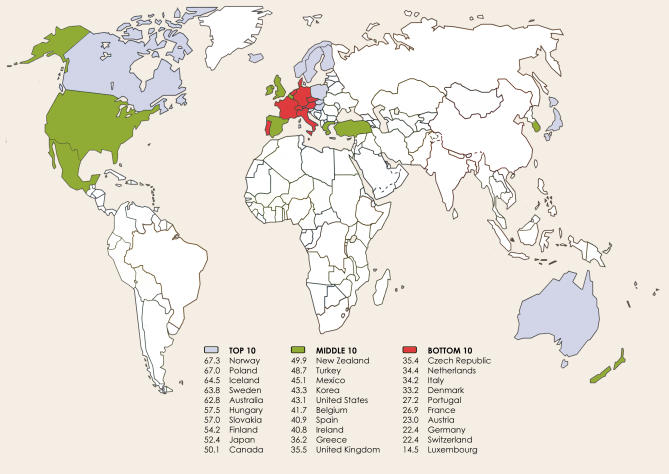
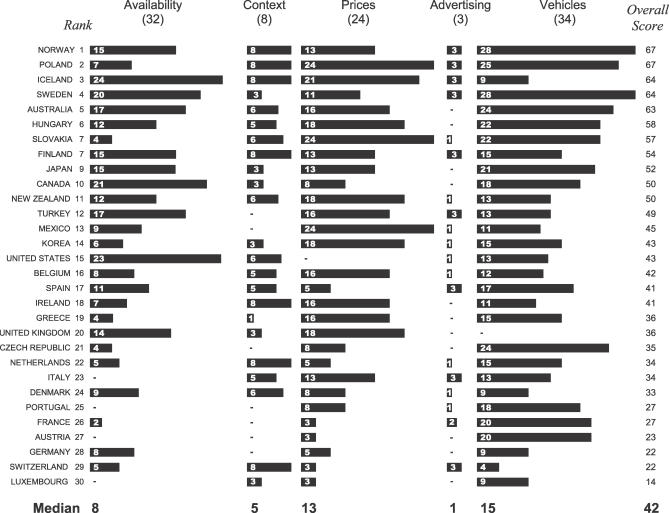
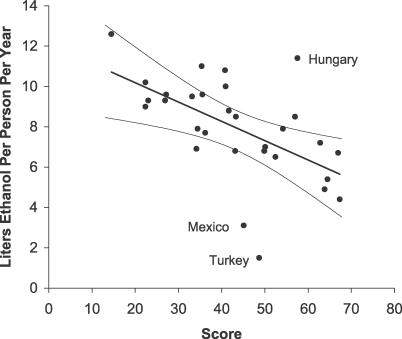
Methods and findings: The Index generates a score based on policies from five regulatory domains-physical availability of alcohol, drinking context, alcohol prices, alcohol advertising, and operation of motor vehicles. The Index was applied to the 30 countries that compose the Organization for Economic Cooperation and Development and regression analysis was used to examine the relationship between policy score and per capita alcohol consumption. Countries attained a median score of 42.4 of a possible 100 points, ranging from 14.5 (Luxembourg) to 67.3 (Norway). The analysis revealed a strong negative correlation between score and consumption (r = -0.57; p = 0.001): a 10-point increase in the score was associated with a one-liter decrease in absolute alcohol consumption per person per year (95% confidence interval, 0.4-1.5 l). A sensitivity analysis demonstrated the robustness of the Index by showing that countries' scores and ranks remained relatively stable in response to variations in methodological assumptions.
Conclusions: The strength of alcohol control policies, as estimated by the Alcohol Policy Index, varied widely among 30 countries located in Europe, Asia, North America, and Australia. The study revealed a clear inverse relationship between policy strength and alcohol consumption. The Index provides a straightforward tool for facilitating international comparisons. In addition, it can help policymakers review and strengthen existing regulations aimed at minimizing alcohol-related harm and estimate the likely impact of policy changes.
Conflict of interest statement
Figures
References
-
- Room R, Babor T, Rehm J. Alcohol and public health. Lancet. 2005;365:519–30. - PubMed
-
- Babor T, Caetano R, Casswell S, Edwards G, Giesbrecht N, et al. Alcohol: No ordinary commodity: Research and public policy. New York: Oxford University Press; 2003. 290
-
- Bruun K, Edwards G, Lumio M, et al. Alcohol control policies in public health perspective. Helsinki: The Finnish Foundation for Alcohol Studies; 1975. 106
-
- World Health Organization. Alcohol consumption and alcohol-related problems: Development of national policies and programmes; The Thirty-sixth World Health Assembly, Twelfth plenary meeting,; 1983 13 May.; 1983. Committee A, first report. Available: http://www.who.int/substance_abuse/en/WHA36.12.pdf. Accessed 16 June 2005.
Publication types
MeSH terms
Grants and funding
LinkOut - more resources
Full Text Sources
Medical