. 2006 Jun;39(2):105-10.
doi: 10.1016/j.alcohol.2006.08.003. Epub 2006 Oct 2.

An explanation for the paradoxical induction and suppression of an acute phase response by ethanol

Affiliations

An explanation for the paradoxical induction and suppression of an acute phase response by ethanol

Brandon S Pruett et al. Alcohol. 2006 Jun.

Abstract

Binge ethanol (EtOH) consumption suppresses inflammatory responses and resistance to infection, but paradoxically it is associated with increased levels of acute phase proteins (which are indicators of inflammation) and an increased risk of inflammation-mediated pathologies such as cardiovascular disease and cirrhosis of the liver. The latter effect may be mediated by increased translocation of bacteria leading to activation of toll-like receptor 4 (TLR4). In this study, the dose-response and time course of the effects of EtOH alone or EtOH in conjunction with a TLR4 agonist (lipopolysaccharide [LPS]) were evaluated in mice. EtOH alone at a dosage of 6 g/kg induced an acute phase response (as indicated by enzyme-linked immunosorbent assay for serum amyloid A and serum amyloid P) that was maximal 24 h after dosing. Lower dosages of EtOH did not have this effect but did suppress the acute phase response to LPS and the production of interleukin-6 up to 3 h after dosing. EtOH at 6 g/kg did not induce an acute phase response in C3H/HeJ (TLR4 mutant) mice, indicating that this response is mediated through TLR4. These results provide a resolution for the apparently paradoxical pro- and anti-inflammatory actions of EtOH with regard to acute phase responses.


Figures
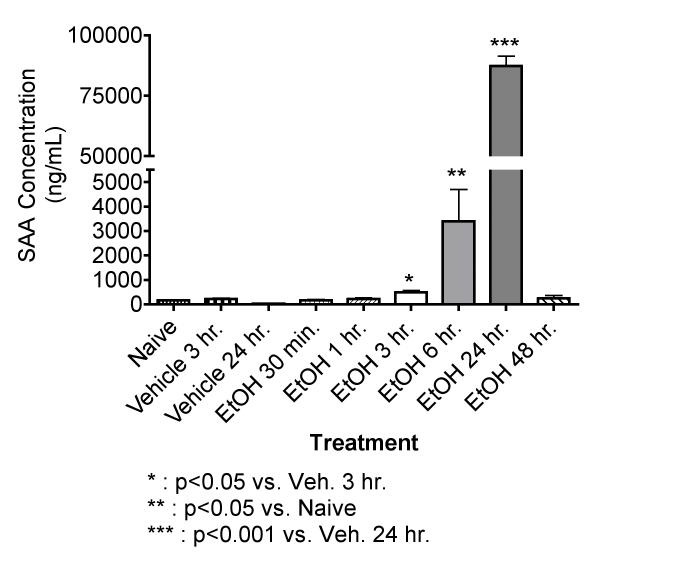
Figure 1
Figure 1
Effects of EtOH at 6 g/kg on the Acute Phase Protein SAA in mice. EtOH treated mice were given 32 % EtOH solution by oral gavage at 6 g/kg. Vehicle treated mice received a volume of water by oral gavage corresponding to a 6 g/kg dose of 32 % EtOH solution. The naive group received no treatment. At the time points indicated, the mice were bled, and the SAA concentrations were determined by ELISA. The results shown are means ± SEM for groups of 5 mice each. These results were obtained in two separate experiments (30 min, 1 hr and 2 hr; 6 hr, 24 hr, and 48 hr).
Figure 2
Figure 2
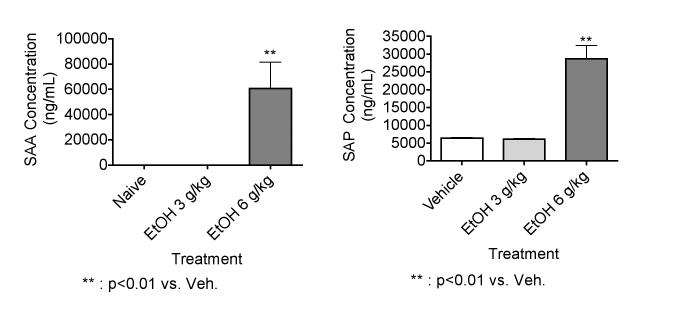
Effects of EtOH at 3 g/kg and 6 g/kg on SAA and SAP. EtOH treated mice were given 32 % EtOH solution by oral gavage at 3 or 6 g/kg. Vehicle treated mice received a volume of water by oral gavage corresponding to a 6 g/kg dose of 32 % EtOH solution. The naive group received no treatment. Mice were bled 24 hr after EtOH administration, and SAA and SAP concentrations were determined by ELISA. The results shown are means ± SEM for groups of 5 mice each.
Figure 3
Figure 3
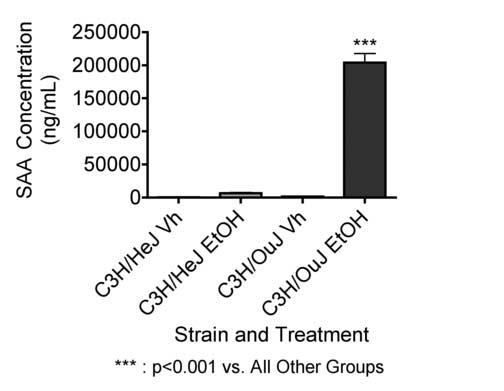
Role of TLR4 in the acute phase response to EtOH. EtOH treated mice were given 32 % EtOH solution by oral gavage at 5 g/kg. Vehicle treated mice received a volume of water by oral gavage corresponding to a 5 g/kg dose of 32 % EtOH solution. At 24 hr, the mice were bled, and the SAA concentrations were determined by ELISA. The results shown are means ± SEM and the group size for the vehicle groups was 3 and the group size for the EtOH groups was 7.
Figure 4
Figure 4
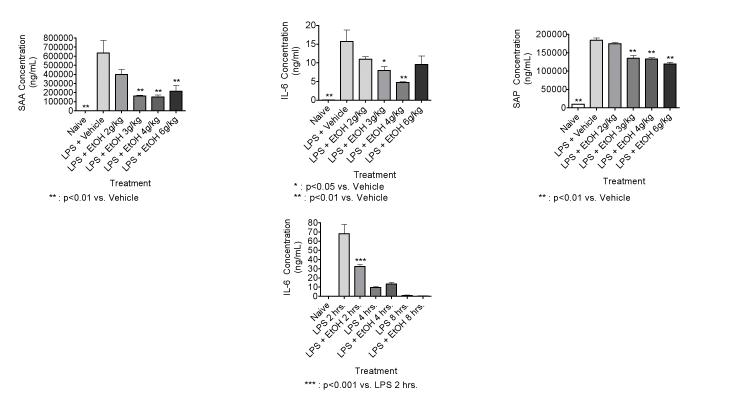
EtOH dose-responsively inhibits SAA production in response to LPS (25 μg/mouse, iv) at 3 hr (in the upper panels), and the duration of the suppression of IL-6 is relatively brief (lower panel). Mice were treated with EtOH (using a 32 % EtOH solution by oral gavage) to achieve the indicated dosages. Vehicle treated mice received a volume of water by oral gavage corresponding to a 6 g/kg dose of 32 % EtOH solution. The naive group received no treatment. The mice were bled, and the SAA and IL-6 concentrations were determined by ELISA. The results shown are means ± SEM for groups of 5 mice each.

References

    1. Arroyo-Espliguero R, Avanzas P, Jeffery S, Kaski JC. CD14 and toll-like receptor 4: a link between infection and acute coronary events? Heart. 2004;90(9):983–8. - PMC - PubMed
    1. Bode C, Bode JC. Activation of the innate immune system and alcoholic liver disease: effects of ethanol per se or enhanced intestinal translocation of bacterial toxins induced by ethanol? Alcohol Clin Exp Res. 2005;29(11 Suppl):166S–71S. - PubMed
    1. Bottazzi B, Garlanda C, Salvatori G, Jeannin P, Manfredi A, Mantovani A. Pentraxins as a key component of innate immunity. Curr. Opin. Immunol. 2006;18:10–15. - PubMed
    1. Britton A, McKee M. The relation between alcohol and cardiovascular disease in Eastern Europe: explaining the paradox. J Epidemiol Community Health. 2000;54(5):328–32. - PMC - PubMed
    1. Carson EJ, Pruett SB. Development and characterization of a binge drinking model in mice for evaluation of the immunological effects of ethanol. Alcoholism: Clin. Exp. Res. 1996;20:132–138. - PubMed

Publication types

MeSH terms

LinkOut - more resources