


The neurocognitive bases of human multimodal food perception: consciousness
- PMID: 17027988
- PMCID: PMC3373180
- DOI: 10.1016/j.brainresrev.2006.09.002
The neurocognitive bases of human multimodal food perception: consciousness
Abstract
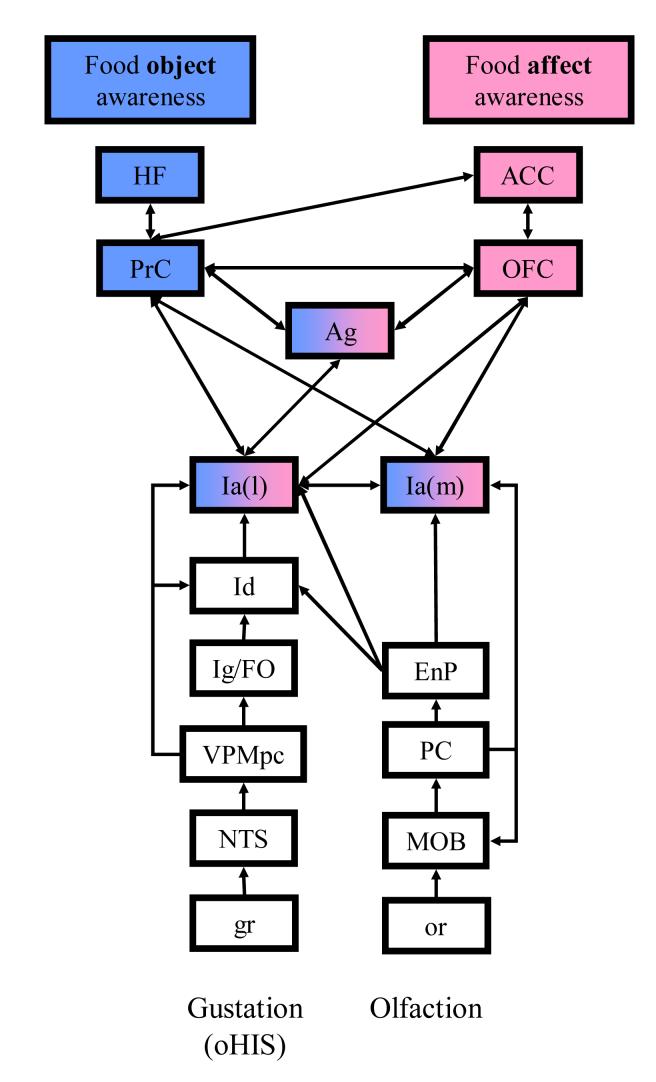
This review explores how we become aware of the (integrated) flavor of food. In recent years, progress has been made understanding the neural correlates of consciousness. Experimental and computational data have been largely based on the visual system. Contemporary neurobiological frameworks of consciousness are reviewed, concluding that neural reverberation among forward- and back-projecting neural ensembles across brain areas is a common theme. In an attempt to extrapolate these concepts to the oral-sensory and olfactory systems involved with multimodal flavor perception, the integration of the sensory information of which into a flavor gestalt has been reviewed elsewhere (Verhagen, J.V., Engelen, L., 2006. The neurocognitive bases of human multimodal food perception: Sensory integration. Neurosci. Biobehav. Rev. 30(5): 613_650), I reconceptualize the flavor-sensory system by integrating it into a larger neural system termed the Homeostatic Interoceptive System (HIS). This system consists of an oral (taste, oral touch, etc.) and non-oral part (non oral-thermosensation, pain, etc.) which are anatomically and functionally highly similar. Consistent with this new concept and with a large volume of experimental data, I propose that awareness of intraoral food is related to the concomitant reverberant self-sustained activation of a coalition of neuronal subsets in agranular insula and orbitofrontal cortex (affect, hedonics) and agranular insula and perirhinal cortex (food identity), as well as the amygdala (affect and identity) in humans. I further discuss the functional anatomy in relation essential nodes. These formulations are by necessity to some extent speculative.
Figures
References
-
- Anderson AK, Christoff K, et al. Dissociated neural representations of intensity and valence in human olfaction. Nature Neuroscience. 2003;6:196–202. - PubMed
-
- Anderson AK, Phelps EA. Lesions of the human amygdala impair enhanced perception of emotionally salient events. Nature. 2001;411:305–309. - PubMed
-
- Ashkenazi A, Marks LE. Effect of endogenous attention on detection of weak gustatory and olfactory flavors. Percept & Psychophys. 2004;66(4):596–608. - PubMed
-
- Barbas H. Organization of cortical afferent input to orbitofrontal areas in the rhesus monkey. Neuroscience. 1993;56(4):841–64. - PubMed
Publication types
MeSH terms
Grants and funding
LinkOut - more resources
Full Text Sources
