


Genetic and environmental influences on stages of alcohol use across adolescence and into young adulthood
- PMID: 16586152
- PMCID: PMC1521926
- DOI: 10.1007/s10519-006-9062-y
Genetic and environmental influences on stages of alcohol use across adolescence and into young adulthood
Abstract
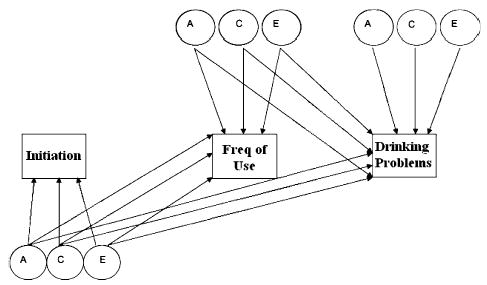
The progression to alcohol dependence unfolds across multiple stages, including the decision to initiate use, the development of regular patterns of use, and (for some individuals) the subsequent development of problems associated with alcohol use. Using data from two population-based, longitudinal twin studies, FinnTwin16 (FT16) and FinnTwin12 (FT12), we applied multiple stage genetic models (Heath et al., Twin Res. 5 (2002) 113) to better understand the extent to which genetic and environmental influences impact the initiation of alcohol use, frequency of use in adolescence and young adulthood, and alcohol problems in young adulthood. Shared environmental factors played a large role in initiation, and a more moderate role on frequency of use, and it was largely the same influences acting across these stages of use. However, there was no significant evidence of shared environmental influences on alcohol problems in early adulthood. Problems were largely influenced by genetic factors that overlapped with genetic influences on frequency of use. Unique environmental factors were largely specific to each stage, with some overlap between alcohol problems and frequency of use at age 25.
Figures

References
-
- Carmelli D, Heath AC, Robinette D. Genetic analysis of drinking behavior in World War II veteran twins. Genetic Epidemiol. 1993;10:201–213. - PubMed
-
- Carmelli D, Swan GE, Robinette D, Fabsitz R. Heritability of substance use in the NAS-NRC Twin Registry. Acta Genetica Medica Gemellol. 1990;39:91–98. - PubMed
-
- Chou SP, Pickering RP. Early onset of drinking as a risk factor for lifetime alcohol-related problems. Brit J Addict. 1992;87:1199–1204. - PubMed
-
- Clapper RL, Buka SL, Goldfield EC, Lipsitt LL, Tsuang MT. Adolescent problem behaviors as predictors of adult alcohol diagnoses. Intl J Addict. 1995;30:507–523. - PubMed
-
- Cloninger CR, Bohman M, Sigvardsson S. Inheritance of alcohol abuse: Cross-fostering analysis of adopted men. Arch Gen Psych. 1981;38:861–867. - PubMed
Publication types
MeSH terms
Grants and funding
LinkOut - more resources
Full Text Sources
Medical
