


The anxious amygdala: CREB signaling and predisposition to anxiety and alcoholism
- PMID: 16200206
- PMCID: PMC1236699
- DOI: 10.1172/JCI26436
The anxious amygdala: CREB signaling and predisposition to anxiety and alcoholism
Abstract
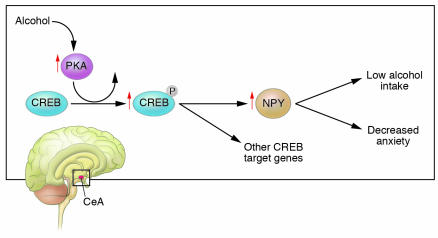
The amygdala is believed to play a key role in assigning emotional significance to specific sensory input, and conditions such as anxiety, autism, stress, and phobias are thought to be linked to its abnormal function. Growing evidence has also implicated the amygdala in mediation of the stress-dampening properties of alcohol. In this issue of the JCI, Pandey and colleagues identify a central amygdaloid signaling pathway involved in anxiety-like and alcohol-drinking behaviors in rats. They report that decreased phosphorylation of cAMP responsive element-binding protein (CREB) resulted in decreased neuropeptide Y (NPY) expression in the central amygdala of alcohol-preferring rats, causing high anxiety-like behavior. Alcohol intake by these animals was shown to increase PKA-dependent CREB phosphorylation and thereby NPY expression, subsequently ameliorating anxiety-like behavior. These provocative data suggest that a CREB-dependent neuromechanism underlies high anxiety-like and excessive alcohol-drinking behavior.
Figures
Comment on
-
Deficits in amygdaloid cAMP-responsive element-binding protein signaling play a role in genetic predisposition to anxiety and alcoholism.J Clin Invest. 2005 Oct;115(10):2762-73. doi: 10.1172/JCI24381. J Clin Invest. 2005. PMID: 16200210 Free PMC article.
References
-
- Saitz R. Clinical practice. Unhealthy alcohol use. N. Engl. J. Med. 2005;352:596–607. - PubMed
-
- Grant BF. Alcohol consumption, alcohol abuse and alcohol dependence. The United States as an example. Addiction. 1994;89:1357–1365. - PubMed
-
- Harwood HJ, Fountain D, Livermore G. Economic costs of alcohol abuse and alcoholism. Recent Dev. Alcohol. 1998;14:307–330. - PubMed
-
- Tupala E, Tiihonen J. Dopamine and alcoholism: neurobiological basis of ethanol abuse [review] Prog. Neuropsychopharmacol. Biol. Psychiatry. 2004;28:1221–1247. - PubMed
