Nature: "Sidewinder" tech a leap forward in DNA synthesis

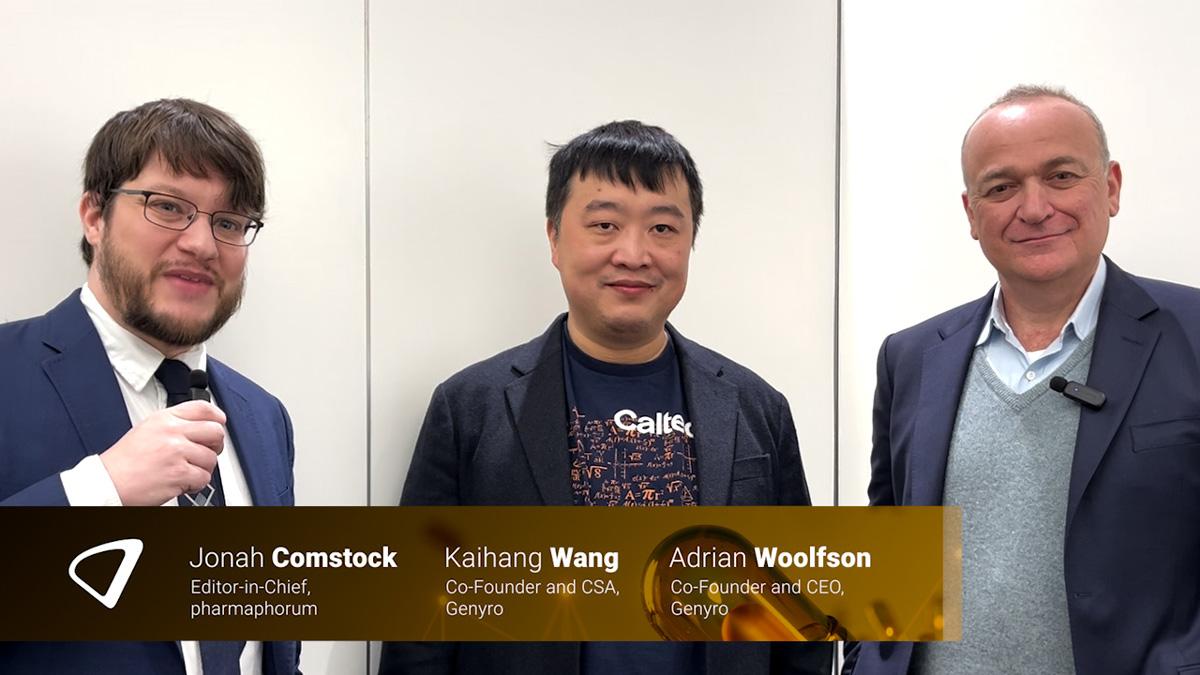
Adrian Woolfson and Kaihang Wang at the Informa Biotech Showcase.
Updated January 26th with technology licensing information.
A new technology elucidated yesterday in the journal Nature has the potential to be a leap forward in DNA synthesis, allowing the writing of DNA sequences essentially from scratch, rather than having to reach new sequences only by modifying existing DNA.
The new technology, called Sidewinder, introduces a three-way DNA junction, whereas historically only two-way junctions have been employed. This enables the third junction, Sidewinder, to store much more complex construction information as it doesn’t need to be part of the final sequence.
“Fundamentally this enables you to turn DNA into a programmable material and into a predictive engineering material,” said Adrian Woolfson, a molecular biologist, tech entrepreneur, and CEO of Genyro, a new biotech which announced Monday it had exclusively licensed the technology from the California Institute of Technology where it was developed.
In the Nature paper, researchers detailed how they used the technology to assemble the native coding sequence of apolipoprotein E (APOE), a complex protein responsible for regulating cholesterol transport.
Kaihang Wang, an inventor of the technology, assistant professor at Caltech, and chief scientific advisor at Genyro, compares it to page numbers in a book.
“In order to have a book, not only do we need to have the printed each individual page, you also need to arrange them into the correct order to form the book, right?” he told pharmaphorum. “And before us, DNA construction was kind of like in the era of you have the printing press, but you don't have the other thing called a page number to actually align and assemble the books in the right order.”
Woolfson predicts this technology will allow for a huge leap forward in genetic engineering, especially when combined with the iterative nature of generative AI.
“Essentially, we're democratising the process of DNA assembly, or construction if you prefer to call it construction. And this really frees up scientists and the biopharmaceutical industry to build anything that they like. Until now, there's been a big disconnect between the ability to design DNA using AI and the ability to construct it. And this technology really kind of bridges that gap and enables [a] feedback cycle between design, construct, [and] test.”
For the pharma industry, it could open the door for all kinds of organisms that are currently possible to build in a computer, but not in a lab.
“What we're able to do now with this new technology is reimagine genomes from first principles,” Woolfson said. “So we go beyond the tree of life and enter the forest of possible life. And within the forest of possible life lie all kinds of incredible therapeutics, which would never have been realisable without a technology that can write them de novo.”
Of course the possibilities also extend in a dangerous direction, Woolfson acknowledged.
“With tremendous power comes tremendous responsibility,” he said, “which is why we're considerably invested in ensuring that that this technology is used safely and that we're able to screen sequences to ensure that there are no biohazard issues associated with them.”
Check out our video interview with Woolfson and Wang from San Francisco this month.