2026 Perodua Traz SUV - from RM76k


Latest Carro Malaysia Cars For Sale

Search oto.my Car Classifieds

Latest Stories

  • JPJ Selangor officers have started wearing bodycams

    JPJ Selangor officers have started wearing bodycams

    JPJ enforcement officers in Selangor are now wearing body-worn cameras (bodycams) to enhance transparency, accountability and integrity during enforcement operations. It started last Monday, according to the state’s JPJ director Azrin Borhan.

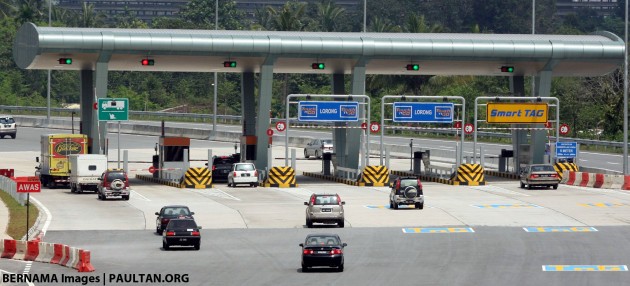
    The visual and audio recordings captured by the bodycams serve as valid supporting evidence, Azrin said. “The use of bodycams is also intended to protect enforcement officers from misunderstandings, unfounded accusations or harassment while carrying out their duties,” he told reporters at the Sungai Ramal toll plaza last night, reported by Bernama.

    Earlier this year, transport minister Anthony Loke said wearing bodycams would improve JPJ officers’ effectiveness in the field, particularly in enforcement for heavy vehicles. It was specifically requested by JPJ director-general Datuk Aedy Fadly Ramli to ensure the highest standards of image, safety and integrity for officers on duty.

    “The use of body cameras not only protects the image and integrity of JPJ but also safeguards the officers themselves. As I have mentioned before, sometimes our officers face criticism, humiliation and various accusations. With the body camera, JPJ officers are protected, as any evidence during their enforcement actions can be captured,” Loke said then.

    PDRM officers would have already started wearing bodycams when on duty, if the timeline given by Bukit Aman crime prevention and community safety department director Datuk Wan Hassan Wan Ahmad in February was adhered to. Have you noticed the devices? Good move?

     
  • 2026 Hyundai Staria facelift launched in Korea – redesigned interior, 1.6 turbo hybrid, no more diesel

    2026 Hyundai Staria facelift launched in Korea – redesigned interior, 1.6 turbo hybrid, no more diesel

    Hyundai Staria Lounge facelift

    Over four years old it may be, but the Hyundai Staria still looks like something from another galaxy. Time is still time, though, and the Korean carmaker has seen fit to give the MPV/van a facelift in time for 2026. There are Cargo (two-, three- or five-seat commercial van), Tourer (nine- or 11-seat MPV) and Lounge (seven- or nine-seat MPV) versions – we Malaysians are obviously more familiar with the latter two configurations.

    The Tourer is priced from 35.02-39.99 million won (RM97k-110k), including a 36.59 million won (RM101k) 11-seat 1.6 Turbo Hybrid variant, while the Lounge goes for 44.99-50.21 million won (RM124k-139k), including a 47.05 million won (RM130k) seven-seat 1.6 Turbo Hybrid variant. Meanwhile, the Cargo is priced from 32.59-38.2 million won (RM90k-105k), and even this utilitarian fellow has a 34.9 million won (RM96k) five-seat 1.6 Turbo Hybrid variant.

    Let’s start with the looks. The slim front DRL strip used to be in three pieces (in Malaysia, all three pieces light up on the seven-seater for an unbroken line; on the 10-seater the middle piece is blank) but now it’s one continuous line regardless. Also, Hyundai says ‘STARIA’ is engraved on the DRL’s sides, which we can’t really see from these photos.

    New (top row) and old interiors; premium (left) and regular variants

    That new grille with lots of dashes reminds us of the much-smaller Stargazer. The Lounge gets a chromed, more rectangular grille while the others get a slightly rounder, unchromed one. The grille-integrated headlamps appear to be unchanged – located within rectangular surrounds on the Lounge and rounder pods on the Tourer and Cargo. Hyundai hasn’t provided a rear shot yet, so it’s anyone’s guess if there are changes to the back.

    But never mind, step inside to a totally redesigned interior! More horizontal dashboard, more rectangular screens (now 12.3 inches compared to 10.25 before), new infotainment system, more physical buttons as opposed to touch buttons, new steering wheel with Ioniq-style four dots, redesigned centre stack. Previously the centre air vents were awkwardly placed on either side of the centre screen (and not in line); now they’re united under the centre screen.

    As before, there are two different gear selection methods. The regular Staria continues to use a conventional gear lever but the Lounge (analogous to our seven-seater) has changed from push-button gear selection to a more intuitive Ioniq-style column twist gear selector. There’s now a ‘boarding assist’ steering wheel – this should mean a wheel that retreats into the dashboard to ease driver entry and exit.

    2026 Hyundai Staria facelift launched in Korea – redesigned interior, 1.6 turbo hybrid, no more diesel

    Hyundai Staria Tourer facelift

    In Korea, the Staria facelift will have 1.6 turbo hybrid petrol and 3.5 litre LPG powertrains (bye bye long-serving 2.2 litre turbodiesel). Since the chances of us getting the LPG are practically zero, let’s look at the hybrid – 180 hp and 265 Nm of torque sounds just like the engine used by the Tucson and Santa Fe hybrids, so we can safely assume a 65 PS/264 Nm electric motor, a six-speed auto and a 235 PS/367 Nm total system output. A maximum fuel efficiency of 13.1 km/l is touted.

    Ride and NVH should be better, too – Hyundai says the front suspension now has a more rigid connection between the body and the sub-frame, and the latter’s bushings “enhance the response to road shocks, which allows for more stable control of body movement in high-speed and straight-line driving situations.”

    2026 Hyundai Staria facelift launched in Korea – redesigned interior, 1.6 turbo hybrid, no more diesel

    Hyundai Staria Cargo facelift

    The Cargo model has an improved rear damper valve with an increased degree of freedom of damping force, while the range-topping Lounge’s rear suspension features hydro bushings to improve shock absorption and reduce vibration. There’s thicker sound insulation material in the bulkhead, and more sound-absorbing materials have been added to the vehicle’s rear and lower sections.

    Available tech includes walk-away lock, digital key, built-in front and rear dashcams, multi-zone voice recognition and standard ADAS functions such as forward collision avoidance assist (intersection oncoming car/frontal oncoming car) and rear side collision avoidance assist (forward exit). ACC and lane keep assist are of course available on higher models. Our pre-facelift Staria recently got CKD’d – explore here.

     
  • E-hailing drivers must clock over 2,000 km monthly to qualify for higher Budi95 petrol quota – Amir Hamzah

    E-hailing drivers must clock over 2,000 km monthly to qualify for higher Budi95 petrol quota – Amir Hamzah

    E-hailing drivers who drive less than 2,000 km in a month will not be eligible for the additional allocation of subsidised RON 95 petrol under the Budi Madani RON 95 (Budi95) scheme for Malaysian citizens with driving licences, New Straits Times has reported.

    The eligibility ceiling is determined by the distance recorded in e-hailing operators’ systems for the previous month, said second finance minister Datuk Seri Amir Hamzah Azizan.

    Those who travel less than 2,000 km a month would be eligible for the basic 300 litre quota, while those who log between 2,000 km and 5,000 km of monthly mileage owuld be eligible for an additional 300 litres, for a total quota of 600 litres. Those who log more than 5,000 km a month will be eligible for an additional 500 litres above the 300 litre basic quota, bringing their total eligibility to 800 litres.

    At present, eligible users get a quota of 300 litres a month, which the finance ministry has deemed to be sufficient for 99% of users of privately owned vehicles.

    E-hailing drivers must clock over 2,000 km monthly to qualify for higher Budi95 petrol quota – Amir Hamzah

    “This real-data approach prevents leakage to inactive drivers, part-time drivers, or misused accounts, ensuring subsidies reach drivers who genuinely rely on e-hailing as their main source of income. The government will continue monitoring usage patterns and make improvements as needed to ensure the BUDI95 mechanism remains effective, targeted, and sustainable,” Amir Hamzah said.

    According to the report, more than 106,000 e-hailing drivers, or 65%, out of a total of 164,000 registered e-hailing drivers qualified for the higher Budi95 quota ceiling of between 600 litres and 800 litres. Monthly mileage is determined by combining travel data from all e-hailing operators, verified by the Land Public Transport Agency (APAD) and the Commercial Vehicle Licensing Board in Sabah and Sarawak.

    Only Malaysian drivers with valid passenger service vehicle (PSV) licences and e-hailing permits are considered, and e-hailing operators must report accurate monthly mileage to APAD and LPKP at the start of each month to prevent subsidy leakage.

    Meanwhile, the Malaysian government currently has no plans to replace Budi95 petrol subsidies with EV cash rebates, said the second finance minister.

    “Doing so would change Budi 95’s original purpose and could reduce its effectiveness in targeting drivers who still rely on combustion-engine vehicles. Budi 95 is not intended to encourage EV adoption; that is handled separately through initiatives such as charging infrastructure development and national automotive industry policies,” he said.

     
  • Cable theft caused Prasarana RM20.6m losses, affects Rapid KL train services for millions in Klang Valley

    Cable theft caused Prasarana RM20.6m losses, affects Rapid KL train services for millions in Klang Valley

    Cable theft is disrupting Rapid KL rail operations, directly affecting millions of commuters in the Klang Valley. This is in addition to losses of RM20.6 million in the past three years, Prasarana says. Delays aside, there’s also the safety risk issue.

    In a statement issued yesterday, the public transport operator said that cases of cable theft are increasing. In 2024, 41 cases of cable theft were recorded, but there have been 69 cases this year, which is a 68% increase. This trend is spurred by demand and the market price of the cables, specifically the copper inside, which makes it lucrative to syndicates.

    Prasarana group chief health, safety, security, environment and sustainable development officer Idzqandar Abu Bakar said that cable theft doesn’t just impact the company’s balance sheet, but it involves operational safety and affects millions of commuters who rely on rail services daily.

    Cable theft caused Prasarana RM20.6m losses, affects Rapid KL train services for millions in Klang Valley

    “Every theft incident causes disruption to train operations. Repair and replacement of cables must be carried out immediately to restore critical systems, and in this situation, passengers are the most affected,” he said, adding that every incident also impacts other rail operators and telecommunications companies. It’s also affecting the the East Coast Rail Link’s completion timeline.

    Idzqandar said that this is a repetitive and organised crime that brings widespread implications to critical national infrastructure. On its part, Prasarana has deployed security personnel, joint patrols with the PDRM, installed CCTVs and even tested the use of sniffer dogs on the two MRT lines.

    “Prasarana is also working with MRT Corp to strengthen physical security at certain locations. However, with a rail line spanning over 200 km, this effort is difficult to implement alone without the support of a more comprehensive enforcement and regulatory ecosystem,” Idzqandar said, urging all stakeholders including enforcement agencies, lawmakers, industry players and the public to collectively address the issue.

    Cable theft caused Prasarana RM20.6m losses, affects Rapid KL train services for millions in Klang Valley

    The statement said that despite all the measures taken, theft is still happening and there are even repeated cases involving the same individual. The company says that as long as the crime syndicates can sell on the cables openly and lucratively, this scourge will continue. It is urging tighter enforcement on the chain of cable sales and heavier punishment for repeat offenders.

    What can the public do to help? Immediately report any suspicious activities around the rail lines to the police. Here’s hoping that the cops can take down not just the thieves, but the buyers of their loot – cut off the root cause to solve the problem.

     
  • Toyota to start selling US-produced Camry sedan, Highlander SUV, Tundra pick-up in Japan from 2026

    Toyota to start selling US-produced Camry sedan, Highlander SUV, Tundra pick-up in Japan from 2026

    Toyota aims to introduce three US-produced models to the Japanese market from 2026, and these will be the Camry, Highlander and Tundra, the Japanese brand has announced.

    In addition to meeting the needs of Japanese customers, the move to sell the three models in Japan is also aimed at helping to improve Japan-US trade relations, the manufacturer stated. For right-hand-drive markets, the Tundra went on sale in Australia from November 2024.

    For the United States, the Camry is produced at the Toyota Motor Manufacturing Kentucky (TMMK), while the Highlander emerges from Toyota Motor Manufacturing Indiana (TMMI). Its right-hand-drive equivalent, the Kluger was sold in Japan, as well as in Australia.

    The US-market Tundra is made at Toyota Motor Manufacturing Texas (TMMTX); for right-hand-drive Australia, the Walkinshaw Automotive Group has been tasked with the re-engineering work for the right-hand-drive conversion of units built in the US as left-hand-drive.

    The current XV80-generation Camry which Malaysia gets in 2.5 litre hybrid and 2.5 litre petrol guises are both made in Thailand, and both versions were launched in Malaysia towards the end of 2024.

    The Kluger, which is the right-hand-drive relation to the Highlander, gets a 2.4 litre turbocharged four-cylinder petrol engine from the Lexus NX, and this replaced the 3.5 litre naturally aspirated petrol V6 engine which powered the Kluger’s Australian-market predecessor.

    The current, third-generation Tundra emerged in September 2021, entering the US full-sized pick-up truck market with the V35A-FTS 3.5 litre twin-turbo V6 engine that outputs 389 hp and 649 Nm. This powers the model built on a high-strength boxed, steel-ladder frame, aluminium-reinforced composite bed, featuring multi-link rear suspension with coil springs, bringing a maximum payload of 880 kg.

     
  • Gov’t says no increase in toll rate for 10 highways in 2026 – MEX, DUKE, SKVE, LPT2, LATAR, Grand Saga

    Gov’t says no increase in toll rate for 10 highways in 2026 – MEX, DUKE, SKVE, LPT2, LATAR, Grand Saga

    The government says that the toll rate will not be increased for 10 major highways in 2026. This was announced by works minister Datuk Seri Alexander Nanta Linggi, who said the decision was made following a cabinet meeting on Wednesday.

    In a Facebook post, he said that while the government will have to bear the huge financial implications of the move, with compensation to highway concessionaires amounting to RM591.56 million for 2026, it had chosen to do so in order to prioritise the interests of the people.

    He added that the decision is in line with the announcement made by prime minister Datuk Seri Anwar Ibrahim in July that the government would absorb over RM500 million to prevent toll hikes on 10 major highways.

    The 10 routes are:

    • Kuala Lumpur–Putrajaya Expressway (MEX)
    • Duta–Ulu Kelang Expressway (DUKE)
    • South Klang Valley Expressway (SKVE)
    • East Coast Expressway Phase 2 (LPT2)
    • KL–Kuala Selangor Expressway (LATAR)
    • Cheras–Kajang Expressway (Grand Saga)
    • Senai–Desaru Expressway (SDE)
    • Butterworth Outer Ring Expressway (LLB)
    • New North Klang Strait Bypass (SEPADU)
    • Sultan Abdul Halim Mu’adzam Shah bridge

    The government previously managed to stave off a toll rate hike back in 2022, when it took over the Gamuda group’s four highways to save RM4.3 billion in subsidies and prevent an increase; it later locked in the current toll rates of those highways for the next ten years.

     
  • Omoda C9 Matte Black Limited Edition in Malaysia

    Omoda C9 Matte Black Limited Edition in Malaysia

    Go to Omoda | Jaecoo Malaysia‘s social media pages and you’ll see this – the Omoda C9 Matte Black Limited Edition. The caption says it’ll be “exceptionally rare” and calls on customers to “book a test drive today and secure your chance to experience this limited edition”, but offers little more in the way of details, including how many (or how few) units there’ll be, plus the all-important price.

    The model name is quite self-explanatory, really. It can’t be based on the PHEV as that hasn’t been launched yet. So it’s got to be the ICE model, although we can’t categorically tell from this one shot whether it’s the 2WD (silver callipers) or AWD (red callipers).

    Launched in December 2024, the Shah Alam-assembled D-segment SUV has a 261 PS/400 Nm 2.0 litre turbo four-cylinder engine and an eight-speed auto, plus front-MacPherson strut and rear-multi link suspension (with Continuous Damping Control adaptive suspension on the AWD).

    Retail prices for the regular car are RM168,800 for the 2WD and RM188,800 for the AWD, although Omoda | Jaecoo Malaysia is offering some year-end deals at the moment. As for this limited edition, let’s wait and see how much this is going to cost, or if you’d much rather wrap your C9 yourself.

     
  • Christmas 2025 – 50% toll discount from Dec 23-24

    Christmas 2025 – 50% toll discount from Dec 23-24

    The works ministry (KKR) has announced a 50% toll discount from December 23-24, for Christmas. The toll-free period for Class 1 private vehicles, or Class 2 at the Penang Bridge.

    Toll-free travel will be applicable to all highways except for toll plazas at our country’s southern border, namely the toll plazas at Bangunan Sultan Iskandar and Tanjung Kupang (Second Link) in Johor. The government is compensating highway concessionaires RM20.65 million for this gesture.

    KKR said that the dates were chosen as part of a holiday period traffic dispersal initiative, which will also optimise the operations of the R&Rs of the highways – to avoid overcrowding, basically.

    For those who are celebrating Christmas or enjoying the year-end holiday season by travelling back to the hometown, take a break if you’re nodding off. Ensure that your Touch n Go card has sufficient credit so as to not hold up traffic. KKR advises the use of the TuJu Highway Navigation App LLM and PLUS’ MyPLUS-TTA.

     
  • 2026 C28 Nissan Serena facelift debuts – 2.0L petrol, 1.4L e-Power hybrid powertrains, from RM73k in Japan

    2026 C28 Nissan Serena facelift debuts – 2.0L petrol, 1.4L e-Power hybrid powertrains, from RM73k in Japan

    The Nissan Serena facelift has made its debut for its native Japanese market, four years since the C28-generation people-mover emerged. In Malaysia, the pre-facelift C28 was previewed earlier this month, ahead of its Malaysian-market launch scheduled for the first quarter of next year.

    The revised MPV is distinguished from the outgoing iteration by its front fascia that now wear V-shaped patterns instead of the pre-facelift’s horizontal lines, with a corresponding re-orientation of the LED daytime running lights. Elsewhere, a new alloy wheel design features on the facelifted model.

    Two powertrain variants are offered in Japan, consisting of the MR20DD 2.0 litre naturally aspirated petrol engine, similar to the 150 PS/200 Nm in the pre-facelift, and the HR14DDe e-Power 1.4 litre naturally-aspirated inline-three petrol engine that functions as a generator for its 163 PS/315 Nm drive motor (with a second motor on the rear axle for AWD variants).

    C28 Nissan Serena facelift, Autech Sports Spec

    In response to owner feedback, the C28 Serena facelift now gets a memory function for its e-Pedal (one-pedal driving) mode selection, which lets drivers keep their preferred e-Pedal operation mode for the next time the vehicle is started.

    The C28 Serena facelift will be sold in Japan in X, Highway Star V and Luxion trim variants, the latter reserved for e-Power variants. The Highway Star V and Luxion variants get a new exterior look, the latter also gaining new interior upholstery exclusive to the variant.

    In Japan, the facelifted model may also be specified with the Autech Line package which brings a diffrent 16-inch alloy wheel design, dark chrome front grille trim, exterior door mirrors in a metallic finish, a new “tailor fit” seat material, and an Autech Line emblem.

    Inside, the C28 Serena facelift continues to offer seven- and eight-seater cabin layouts depending on variant, and these are now joined by the four- or five-seater Multi Box variant that replaces third-row seating with a “large-capacity storage box” that can also serve as a bench or a table.

    The Multi Box is so named for the added compartments’ ability to be accessed from the top and sides, while an internal divider yields layout options. When the second row of seats are folded down, the load space can double as a bed, with a mat made of water-resistant Cordura.

    For infotainment, the C28 Serena facelift brings the NissanConnect system with support for Google Maps, Google Assistant and Google Play, and includes a alert function that notifies the driver via smartphone in case they have forgotten to lock the vehicle, close the windows or if the hazard lights have been left on.

    For added safety, the C28 Serena facelift also adds a rear seat occupant reminder, to remind the driver to check the cabin for passengers or luggage.

    The C28-generation Nissan Serena facelift is set to go on sale in Japan in February, starting at 2,785,200 yen (RM72,990). In Malaysia, the C28 Serena was shown earlier this month in its pre-facelift guise, which is set for market introduction in the first quarter of next year.

     
  • Perodua expects 44-46% market share in 2025 – could national makes top 67% record? It depends on Proton

    Perodua expects 44-46% market share in 2025 – could national makes top 67% record? It depends on Proton

    Click to enlarge

    With two more weeks to go before 2025 ends, Perodua is on course for another record year of sales. The perennial market leader’s current high of 358,102 units was set last year, an 8.4% increase over 2023’s 330,325 units, which was the previous record. The highest before that? 2022, of course.

    At last weekend’s media preview session for the just-launched Traz SUV, Perodua president and CEO Datuk Seri Zainal Abidin Ahmad reiterated that the company is on track to breach the 359,000 units sales mark. which would be a new sales record. With another bumper year, Perodua is also expected to maintain its ASEAN No.2 spot. Yes, for those who are not aware, P2 is P2 in ASEAN by sales behind Toyota, having overtaken Honda in 2024.

    Last year, Perodua’s market share was 43.8% of a total industry volume (TIV) of 817k units, a new record for Malaysia. This year, the Rawang carmaker estimates that its slice of the pie will be from 44% to 46% of a TIV of between 780k to 805k units. P2’s market share has been hovering above 40% for some time now, but is the needle now inching towards half?

    Perodua expects 44-46% market share in 2025 – could national makes top 67% record? It depends on Proton

    2023-2024 Malaysia auto sales – click to enlarge

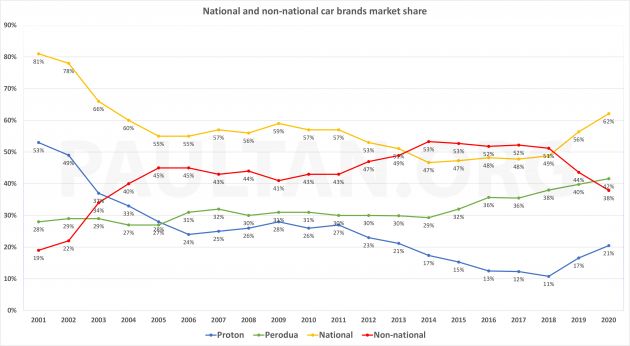
    Zooming out for a broader view, the highest market share for national makes since the early 2000s is 66.9%, achieved in 2023. It was the highest level for Proton-Perodua since 2003, when the duo commanded 66% of sales.

    The strong showing by the national brands is a continuation of their rise after dropping to below 50% market share from 2014 to 2018. That slump was due to Proton’s low contribution, but with Geely now at the wheel, the tide has definitely turned.

    As for the market leader, they’re already at full throttle with year after year of record sales. As it is, four out of every 10 new cars sold in Malaysia are Peroduas, and sales is only limited by production capacity, not demand, as some models have waiting lists of a couple of months. P2 has been doing the heavy lifting for some time now, benefitting the local automotive ecosystem.

    Could the national market share top 67% in 2025? Again, it all depends on Proton. P1’s market share has been hovering near 20% of late (18.9% in 2023 and 18.1% in 2024), and should Tanjong Malim breach that level and Perodua hit its upper estimate, we could see a new high point.
    Perodua expects 44-46% market share in 2025 – could national makes top 67% record? It depends on Proton

    National vs non-national brands market share, 2001-2020

    How was the market like the last time national makes were so dominant? Some might be too young to remember, but 2003 was a time when Proton led Perodua 37% versus 29%. However, this was the tail end of Proton’s dominance, as it was already on a steep decline – just one year ago in 2002, it was P1 49% and P2 22%, with a combined national market share of 78%.

    The inevitable happened when Perodua overtook Proton to lead the market for the first time in 2005, thanks to the overwhelming success of the original Myvi.

    Every time Proton launches a model, the company’s marketing department, the event’s MC and the media (including this writer, who grew up in the OG Saga) will feel nostalgic reminiscing about the good old days with past Protons, but do you realise that generations of Malaysians do not share this nostalgia? That’s because their first car was most likely a Perodua hatchback, many of them Myvis. I bet you never saw this example of a generation gap – bro, we are old!

    After it wrested P1 from P1, Perodua never looked back. The Myvi went on to become ‘king’ and wave after wave of successful models followed to widen the gap, which maxed out in 2018 at 38% versus just 11% for Proton. The 2014-2018 period also saw non-national makes overtake P1-P2 for the first time ever, led by a Honda revving in its VTEC zone.

    Click to enlarge

    This period of N-N dominance did not last very long. In 2017, China’s Geely stepped in to breathe life into a Proton that was in critical condition, providing new models that would boost the company’s sales and help it enter higher segments. Proton’s recovery was not at the expense of Perodua though, but the non-national players. Look at all the X70s and X50s on the road today – all those sales would’ve otherwise gone to Honda, Toyota and Mazda.

    Proton has since reclaimed its No.2 spot and market share has gone from an all-time low of 11% in 2018 to the almost 20% of today. With wind in their respective sails and no imminent threat from the foreign brands, Proton (new Saga is out; volume seller is first of a range of AMA models) and Perodua (laughed at by online trolls, loved by real buyers; always has another gear to widen the gap when needed) are well-positioned to push the national makes market share to levels last seen two decades ago. If not this year, the next, if not…

    We’ve dived deep into this national vs non-national trend before, tracking the ups and downs of Perodua/Proton and Toyota/Honda over the years – click on the links to read more if you’re into stats and trends. We’ll revisit this next year when the official 2025 numbers are out, and also check out the ‘China effect’ on our auto market.

     
  • Honda Malaysia’s 25th anniversary campaign Nov winners take home Civic 1.5L RS and CR-V e:HEV RS

    Honda Malaysia’s 25th anniversary campaign Nov winners take home Civic 1.5L RS and CR-V e:HEV RS

    Honda Malaysia (HMSB) has announced the next two lucky draw winners of its 25th Anniversary “Because of You” campaign, with the prizes, consisting of a Civic 1.5L RS and CR-V 2.0L e:HEV RS, handed over to the winners.

    The winner of the Civic 1.5L RS was Zulkeffli Abdul Rahman from Negeri Sembilan, who purchased an HR-V 1.5T V as a second car for his family. He was unable to attend the presentation ceremony and as such, his daughters, Nuramirah Zulkeffli and Nuratikah Zulkeffli, accepted the prize on his behalf.

    “Honda really rewards their customers. As an existing Honda owner,. I have always trusted the brand, so it was an automatic first choice for me when I was looking for a second family car. Now, I not only have a brand-new SUV, but also a newly-won Civic RS in my driveway alongside my City. My family is thrilled, and we can’t wait for our next family road trip,” he said.

    Honda Malaysia’s 25th anniversary campaign Nov winners take home Civic 1.5L RS and CR-V e:HEV RS

    Meanwhile, Mohamad Farees Rahim Ab Kadir from Johor was completely taken by surprise when he found out he had won the CR-V e:HEV RS. His entry for the lucky draw contest came from his purchase of a City Hatchback RS.

    “Winning the CR-V e:HEV RS is truly beyond my expectations. I had it in mind that I might upgrade to an SUV one day. Now, I have the option of driving around in a sporty hot hatch or enjoying a more premium SUV drive with my family,” he said.

    The two vehicles are among the six grand prizes being offered by the company as part of its anniversary celebrations. Earlier this month, the first two winners received their prizes, and with the announcement of the November winners, two grand prizes remain to be unveiled.

     
  • BYD Atto 2 for Europe – larger 64.8 kWh battery, more power, 430 km WLTP, faster charging up to 155 kW DC

    BYD Atto 2 for Europe – larger 64.8 kWh battery, more power, 430 km WLTP, faster charging up to 155 kW DC

    Amidst the recent reveal of the 1,020-km BYD Atto 2 DM-i PHEV for Europe, one little but important detail seemed to fall by the wayside – the fully-electric (EV) version has gained a bigger 64.8 kWh battery choice there (making possible a 430 km WLTP range) and a more powerful 203 PS/310 Nm motor.

    This new variant is called the Comfort and it’s the new range-topping Atto 2 (PHEV aside). It’s priced in the UK at £34,950 (RM191k) as opposed to the £30,850 (RM169k) Boost, which is analogous to our RM100k (before early-bird rewards) Malaysian-market car. To jog your memory, our sole Atto 2 variant has 177 PS, 290 Nm of torque, a 51.1 kWh battery and a 350 km WLTP range.

    Malaysian-market BYD Atto 2: 177 PS/290 Nm, 51.1 kWh, 350 km WLTP

    In spite of the 26 PS and 20 Nm gain, acceleration (0-100 km/h in 7.9 seconds) and top speed (160 km/h) are unchanged – then again, the bigger battery has made the car about 130 kg heavier. Charging speeds are also up – the Comfort can swallow 11 kW AC (0-100% in seven hours 12 minutes) and 155 kW DC (10-80% in 25 minutes, 30-80% in 19 minutes). Compare this with our 51.1 kWh car, which can stomach just 7 kW AC and 82 kW DC, the latter enabling 30-80% in 28 minutes.

    Curiously, despite its bigger battery, the Comfort has slightly more boot space (450 versus 400 litres), and with the back seats folded it becomes 1,370 versus 1,340 litres. Apart from all the differences mentioned above, Boost and Comfort are quite equally equipped. What do you think? Want this in Malaysia? Of course you do. But you may have to wait until the second half of 2026 at the very least, for that’s when BYD expects to begin Tanjong Malim CKD operations (remember, no more tax-free CBU EVs).

    BYD Atto 2 in Malaysia

     
  • Beat the effects of heat with Solar Gard tint this festive season, with up to 30% off on all tint and PPF products

    Beat the effects of heat with Solar Gard tint this festive season, with up to 30% off on all tint and PPF products

    With Christmas and New Year around the corner, this likely means more outstation drives with the family and spending longer periods in the car. With the sun beating down relentlessly on the vehicle, it’s paramount to ensure that you and your occupants are protected from the heat.

    That’s where window tint films comes in. If you don’t have it on your car, getting this small year-end upgrade will provide you with a high level of protection from the effects of heat and skin damage brought about by infrared and ultraviolet (UV) rays. Of course, not all window films are the same, so it’s important to choose one that provides not just quality, but value.

    Solar Gard has a wide range of film solutions, all offering quality that is proven. Utilising spectrally selective technology that offers outstanding heat reduction, optical clarity and colour stability, Solar Gard’s products are backed by years of Saint-Gobain experience and excellence, ensuring that any product you pick from the range will always deliver.

    If you’re looking for a premium, clean look, with strong UV protection and heat rejection, the LX Series is the one to go for. Engineered with advanced Multi Layer Sputtered Metalised Technology from the US, the LX70 film offers exceptional heat rejection and consistent performance, while allowing 70% natural light into the cabin.

    Beat the effects of heat with Solar Gard tint this festive season, with up to 30% off on all tint and PPF products

    If you fancy something darker, there’s the Black Phantom Series. Built with advanced Nano Ceramic Technology, the window film delivers powerful heat absorption while offering unmatched privacy and protection across the entire range. Other options include the Ultra Performance Series, Sterling Series, Silver Series, Stainless Steel Series, Titanium Series and Quantum Series.

    Backed by up to seven years manufacturer warranty, Solar Gard films will continue to perform, with a time-tested, high-temperature adhesive system ensuring that the films will not bubble or peel off from the glass.

    Your ride is equally important, so no better way than to start the new year protecting what you drive than with Clearshield Pro, a paint protection film (PPF) that provides a tough, clear barrier that acts like body armor for your paint, protecting it against chips, scratches and stains caused by road debris, insects and more.

    With up to 30% off on all Solar Gard automotive window films and PPF products, there’s no better time to protect you, your family and your car from the sun than now. Visit any Solar Gard outlet nationwide or check out Solar Gard’s website, Facebook page or Instagram account for more information.

     
  • Hidden door handles – China launches public consultation on mechanical release draft standards

    Hidden door handles – China launches public consultation on mechanical release draft standards

    China’s ministry of industry and information technology (MIIT) has launched a public consultation on draft national standards which require car doors to remain mechanically operable after collisions or EV fires. CarNewsChina reports, citing Y-Auto, that the proposals are open for comment from December 17-23.

    Released on September 24, the draft requires, among others, that each door, excluding tailgates, be able to be mechanically opened by occupants or rescuers without tools in emergencies, even if they’re locked.

    Outside door handles must be able to take at least 500 Newtons of force without breaking or detaching, be situated within defined accessible areas on the door or adjacent door frame, and must have enough hand clearance so the door can be opened mechanically even in the event of power loss or system failure.

    Hidden door handles – China launches public consultation on mechanical release draft standards

    As for the inside door handles, each door must have at least one mechanically-operating handle and any of the handles must be independently able to open the door. At least one handle must be clearly visible to occupants, positioned within specified distances from the door edge and relative to the seat reference point.

    Also, the inside door handles must have permanent identification markings, including standardised symbols with a minimum size, high contrast and low-light legibility. Each handle must be able to take at least 200 Newtons of force, with lower thresholds specified for electronic button-type handles.

    The draft also defines criteria for determining whether vehicles share the same handle type configuration and outlines phased implementation timelines. For newly type-approved models, specific spatial requirements will apply 13 months after the regulation takes effect, while all other requirements apply immediately. Vehicles already type-approved must comply 25 months after the regulation comes into force.

    Hidden door handles – China launches public consultation on mechanical release draft standards

    It was previously reported that research on this topic has been conducted since 2024, involving over 100 industry experts from China and abroad, the examination of over 230 models, and the static and dynamic validation of over 20 models, the latter based on road accident data.

    Side impact crash tests reportedly showed a 67% post-collision operability rate, compared to 98% for conventional mechanical handles. There was also a 47% increase in the number of door handle-related accidents (87% were apparently caused by pop-out handles), as well as a 132% increase in the number of finger-pinching incidents – including those that fractured children’s fingers.

    So there you go – whether you call them hidden, pop-out, flush, aerodynamic or retractable door handles, they won’t be banned, but they’ll need to be designed and engineered much more stringently moving forward. Share your thoughts with us in the comments.

     
  • JPJ denies alleged release of EE registration plate series, police report lodged for further investigation

    JPJ denies alleged release of EE registration plate series, police report lodged for further investigation

    File image; JPJ director-general Datuk Aedy Fadly Ramli

    The road transport department (JPJ) has denied issuing ‘EE’ series number plates, as alleged on social media. “The approval letter circulating on social media is fake and constitutes a form of fraud that has the potential to confuse and deceive the public,” JPJ director-general Datuk Aedy Fadly Ramli said in a statement.

    Preliminary investigations have found that the format and identity of official JPJ correspondence was used unlawfully, which included the use of letterheads, writing style and layout which were designed to resemble official JPJ documents, which cause confusion among the public and have affected the department’s credibility, the JPJ director-general said.

    The department has lodged a police report for further investigation, and reminds the public to be vigilant and not be deceived by any dubious offers relating to vehicle registration plates, and to always verify information through official JPJ channels to avoid becoming victims of fraud.


Latest Fuel Prices

PETROL
BUDI 95 RM1.99
RON 95 RM2.62 (-0.02)
RON 97 RM3.24 (-0.03)
RON 100 RM5.25
VPR RM6.36
DIESEL
EURO 5 B10 RM3.02 (-0.04)
EURO 5 B7 RM3.22 (-0.04)
Last Updated Dec 18, 2025

Latest Videos


Tools