US20140360413A1 - Active workstation apparatus and method - Google Patents
Active workstation apparatus and method Download PDFInfo
- Publication number
- US20140360413A1 US20140360413A1 US14/263,646 US201414263646A US2014360413A1 US 20140360413 A1 US20140360413 A1 US 20140360413A1 US 201414263646 A US201414263646 A US 201414263646A US 2014360413 A1 US2014360413 A1 US 2014360413A1
- Authority
- US
- United States
- Prior art keywords
- desktop
- desktops
- user
- desk
- standing
- Prior art date
- Legal status (The legal status is an assumption and is not a legal conclusion. Google has not performed a legal analysis and makes no representation as to the accuracy of the status listed.)
- Abandoned
Links
- 238000000034 method Methods 0.000 title claims abstract description 28
- 239000000463 material Substances 0.000 abstract description 11
- 230000000276 sedentary effect Effects 0.000 abstract description 2
- 238000009432 framing Methods 0.000 description 8
- 230000008901 benefit Effects 0.000 description 5
- 230000000694 effects Effects 0.000 description 4
- 230000008520 organization Effects 0.000 description 4
- 238000013459 approach Methods 0.000 description 2
- 239000006260 foam Substances 0.000 description 2
- 210000004247 hand Anatomy 0.000 description 2
- 238000010438 heat treatment Methods 0.000 description 2
- 230000037081 physical activity Effects 0.000 description 2
- 239000012925 reference material Substances 0.000 description 2
- 230000004044 response Effects 0.000 description 2
- 230000000284 resting effect Effects 0.000 description 2
- 239000003381 stabilizer Substances 0.000 description 2
- 230000000007 visual effect Effects 0.000 description 2
- 210000000707 wrist Anatomy 0.000 description 2
- JOYRKODLDBILNP-UHFFFAOYSA-N Ethyl urethane Chemical compound CCOC(N)=O JOYRKODLDBILNP-UHFFFAOYSA-N 0.000 description 1
- 206010017577 Gait disturbance Diseases 0.000 description 1
- 239000004698 Polyethylene Substances 0.000 description 1
- 208000027418 Wounds and injury Diseases 0.000 description 1
- 230000006978 adaptation Effects 0.000 description 1
- 235000013361 beverage Nutrition 0.000 description 1
- 210000000038 chest Anatomy 0.000 description 1
- 230000006378 damage Effects 0.000 description 1
- 238000011161 development Methods 0.000 description 1
- 238000005516 engineering process Methods 0.000 description 1
- 230000004438 eyesight Effects 0.000 description 1
- 238000009408 flooring Methods 0.000 description 1
- 210000000245 forearm Anatomy 0.000 description 1
- 230000006870 function Effects 0.000 description 1
- 208000014674 injury Diseases 0.000 description 1
- 230000003993 interaction Effects 0.000 description 1
- 238000005259 measurement Methods 0.000 description 1
- 230000003340 mental effect Effects 0.000 description 1
- NJPPVKZQTLUDBO-UHFFFAOYSA-N novaluron Chemical compound C1=C(Cl)C(OC(F)(F)C(OC(F)(F)F)F)=CC=C1NC(=O)NC(=O)C1=C(F)C=CC=C1F NJPPVKZQTLUDBO-UHFFFAOYSA-N 0.000 description 1
- 238000005192 partition Methods 0.000 description 1
- 230000002093 peripheral effect Effects 0.000 description 1
- 230000005043 peripheral vision Effects 0.000 description 1
- -1 polyethylene Polymers 0.000 description 1
- 229920000573 polyethylene Polymers 0.000 description 1
- 229920000642 polymer Polymers 0.000 description 1
- 238000009877 rendering Methods 0.000 description 1
- 230000000630 rising effect Effects 0.000 description 1
- 230000035807 sensation Effects 0.000 description 1
- 238000004513 sizing Methods 0.000 description 1
- 230000007704 transition Effects 0.000 description 1
Images




Classifications
-
- A—HUMAN NECESSITIES
- A47—FURNITURE; DOMESTIC ARTICLES OR APPLIANCES; COFFEE MILLS; SPICE MILLS; SUCTION CLEANERS IN GENERAL
- A47B—TABLES; DESKS; OFFICE FURNITURE; CABINETS; DRAWERS; GENERAL DETAILS OF FURNITURE
- A47B87/00—Sectional furniture, i.e. combinations of complete furniture units, e.g. assemblies of furniture units of the same kind such as linkable cabinets, tables, racks or shelf units
- A47B87/002—Combination of tables; Linking or assembling means therefor
-
- A—HUMAN NECESSITIES
- A47—FURNITURE; DOMESTIC ARTICLES OR APPLIANCES; COFFEE MILLS; SPICE MILLS; SUCTION CLEANERS IN GENERAL
- A47B—TABLES; DESKS; OFFICE FURNITURE; CABINETS; DRAWERS; GENERAL DETAILS OF FURNITURE
- A47B21/00—Tables or desks for office equipment, e.g. typewriters, keyboards
- A47B21/02—Tables or desks for office equipment, e.g. typewriters, keyboards with vertical adjustable parts
-
- A—HUMAN NECESSITIES
- A47—FURNITURE; DOMESTIC ARTICLES OR APPLIANCES; COFFEE MILLS; SPICE MILLS; SUCTION CLEANERS IN GENERAL
- A47B—TABLES; DESKS; OFFICE FURNITURE; CABINETS; DRAWERS; GENERAL DETAILS OF FURNITURE
- A47B21/00—Tables or desks for office equipment, e.g. typewriters, keyboards
-
- A—HUMAN NECESSITIES
- A47—FURNITURE; DOMESTIC ARTICLES OR APPLIANCES; COFFEE MILLS; SPICE MILLS; SUCTION CLEANERS IN GENERAL
- A47B—TABLES; DESKS; OFFICE FURNITURE; CABINETS; DRAWERS; GENERAL DETAILS OF FURNITURE
- A47B2220/00—General furniture construction, e.g. fittings
- A47B2220/06—Treadmill combined with furniture
Definitions
- This invention relates to exercise apparatus and, more particularly, to novel systems and methods for combining a desk-type work space with exercise apparatus and methods.
- What is needed is a system and method for providing ready access to work space that is fixed, semi permanently, in order to be immediately accessible, while providing ability for physical activity.
- a workstation having multiple desk surfaces, such as a main desk accessible in a seated position from a chair, and a standing desk accessible by standing upright.
- One of these may be arranged over a unit of exercise equipment, such as an exercise bicycle, treadmill, or the like.
- a system and method in accordance with the invention may provide an apparatus having various stations sized to receive a user at that station. Accordingly, each station may have associated therewith at least one deck or desk. Each desk will typically have an upper and lower surface, the upper surface being accessible for working. The upper surface will typically be substantially planar.
- the upper surface will typically be flat throughout, but may have interruptions in that uniform planar expanse for tools, equipment, accessories, holders, wells, and so forth.
- pencil holders, computer monitors, anchor points, supports, edges, consoles, control boxes, and so forth may be implemented on or adjacent to a top surface, thus providing localized areas that will not necessarily be exactly planar.
- a planar surface will typically be level, horizontal in two dimensions. It may be tilted for visibility, easier access for drawing, or the like.
- a double duty desk may provide for multiple desks for one individual, multiple desks for multiple persons, or the like.
- a standing-height desk (standing desk) may be adjustable, but need not be quickly adjustable.
- a desk may simply use set screws to fix a telescoping leg at a particular height, thus adjusting a height for a desktop of a standing desk.
- An exercise device such as a treadmill, exercise bike, or the like may be placed in close proximity to the standing desk in order for a user to occupy the exercise device while working at the desk.
- a standing desk may have an adjacent sitting desk.
- a user may step away from an exercise device and the associated work surface of a standing desk in order to sit down at a sitting desk where a computer, other papers, or other activities may be waiting.
- a user from the standing position, the seated position, or both may be able to view the standing desk, the sitting desk, a return, or any combination or subcombination thereof.
- a sitting-height desk will typically be fixed, dedicated, not shared, and need not be readily adjustable. Notwithstanding adjustability may be a desirable parameter, such adjustability need not be frequent, nor even convenient. For example, many commercial desks are prefabricated at a standard height. Such standard heights are highly functional.
- a standing desk will typically be set at a height suitable for a user or a group of users.
- a standing desk may be set at a particular height. That height may be permanently fixed, may be adjustable with some inconvenience, or may be readily adjustable and conveniently so.
- height adjustments may be driven by cranks, rack-and-pinion drives, equilibrated (spring or counter-weight driven) supports, or the like. Nevertheless, such complexities need not be requirements in a system, inasmuch as a working height of any working surface is coincident with about the lower extent of the rib cage of a user. Whether sitting or standing, such a height is about at the same distance from a user's shoulder as is that same user's elbow. Thus, elbows can be rested on a desktop or withdrawn therefrom. Hands can easily access papers, books, keyboards, controls, and the like on the desktop.
- the standing desktop may be comparatively easier to adjust.
- the sitting-height desk will seldom need any adjustment. Initially, depending on the height of a user and convenience or preference, the sitting-height desk portion may be adjustable. Nevertheless, once adjusted, any dedicated desk need not be readjusted, inasmuch as it will not typically have a different user.
- returns or wing desks may be attached laterally beside the station where a user would typically sit. This permits a “wrap around” approach to flat working surfaces in order to support accessories, tools, papers, computers, monitors, personal effects, and so forth.
- multiple workstations may be interconnected to be occupied simultaneous by a plurality of users. Simultaneously, workstations may be occupied by individuals who work closely, work in a team, or are in the same organization. Most users may not desire, or may not need, to spend more than a small (less than half) fraction of a work day on an exercise machine at a standing workstation.
- Multiple sitting workstations or sitting-height desks may be provided with shared structural supports. Those shared structural supports may be shared with the standing desk therebetween. Thus, one or more users may use a standing desk, and two or more users may share a standing desk.
- stability may be improved by providing rigidized, stabilized, braced structures extending horizontally and vertically and interconnected between the various work spaces.
- a larger bearing area, more bearing surface area, intermediate bracing, longer baseline or bearing length (horizontal extent between supports), and the like provide greater leverage and greater support. This provides better stability and stiffness to the structures underlying the various desk surfaces.
- Gussets, angled braces, cross-members, underlying framing or frames, and so forth may be used.
- vertical supports or legs may span vertical expanses between the floor or other supporting surface and a desktop. These vertical supports or legs may be telescoping to extend an extension portion from a base portion in order to adjust height.
- a foot or feet may extend horizontally at a lower end of any leg in order to provide a longer bearing length, and thus more stability, less rocking, less susceptibility to tipping over, and generally greater stability for the vertical supports or legs.
- workstations may be ganged together with multiple work spaces with adjacent desks, alternating in a suitable fashion. For example, alternating with sitting-height desks may be standing-height desks.
- a standing-height desk may straddle an exercise device, such as a treadmill or exercise bicycle.
- the desk may have its own free-standing support, independent from the exercise device.
- a user may actually park a particular exercise device in the work space that will access a standing desk. Meanwhile, a user may swap out that exercise device, replacing it with a separate exercise device, and park various devices at various other workstations, or elsewhere.
- a user has the option of standing at a standing desk, with no exercise equipment present, standing on a treadmill at a stationary, standing while walking on a treadmill, sitting or standing upright on a device, or sitting in some other position on an exercise bicycle, or the like.
- a user has a great range of motion, and many options by having free standing desks that may be used independently from any specific exercise device, while being usable with several different exercise device types.
- an exercise system or a system of workstations that accommodates exercise equipment may actually face other devices (head-to-head, back to back, or in another arrangement such as at right angles) however desired.
- a workstation may be set facing, with its most forward edge against, or in close proximity to, a wall.
- an exercise system may be set laterally against a wall located on one side, the other, or both.
- an apparatus and system in accordance with the invention may be implemented in a standard industrial cubicle of any suitable size or arrangement, with multiple walls nearby. Those walls may be sized and spaced to hold standardized cabinets, cubbies (open-faced cabinets), closed-door cabinets, racks, shelves, or the like.
- those extended spaces outside the envelope of the standing decks and exercise machine may be arranged for convenient working by a user. Such arrangements may be selected by a user. Typical examples may be a set up that is effectively a private office. Another might be a shared office. Another situation may be a conference room or other meeting room.
- a user may read, browse online, attend webinars, edit, monitor, handwrite, type, lecture, listen, answer phones, make calls, develop software, or the like from a standing desk, sitting desk, or combination thereof.
- one may do all the foregoing tasks and many others while operating an exercise device at a standing desk, seated at a sitting desk, or a combination thereof, at will.
- FIG. 1 is a perspective view of one embodiment of a workstation in accordance with the invention.
- FIG. 2 is a perspective view of an alternative embodiment of a workstation, this having only a single sitting desk in combination with a standing desk and exercise equipment;
- FIG. 3 is a perspective view of a combined, shared workstation arrangement having a single standing desk and two sitting desks flanking it;
- FIG. 4 is a perspective view of an alternative embodiment having two standing desks over exercise equipment, with an intervening return therebetween;
- FIG. 5 is a perspective view of one embodiment illustrating three standing desks with intervening return desks as the sitting-height desk, and illustrating an alternative exercise machine;
- FIG. 6 is a perspective view of one embodiment of a system in accordance with the invention set up in the space of an office cubicle;
- FIG. 7 is a right side perspective view of an alternative embodiment, corresponding to the system of FIG. 6 ;
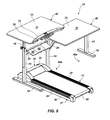
- FIG. 8 is a left side perspective view thereof
- FIG. 9 is a perspective view of an alternative embodiment thereof, including a return portion as a continuous part of the sitting desk thereof;
- FIG. 10 is a perspective view of an alternative embodiment thereof, in which the return forms the entire sitting desk portion extending axially parallel to the exercise equipment;
- FIG. 11 is a perspective view of one alternative embodiment having two sitting desks flanking a standing desk over an exercise machine
- FIG. 12 is a perspective view thereof, absent the flanking, sitting desks;
- FIG. 13 illustrates an alternative arrangement having three standing desks over exercise machines, with intermediate, short returns at sitting height between the standing desks;
- FIG. 14 is a perspective view of two banks of exercise machines of FIG. 13 , these arranged head-to-head;
- FIG. 15 is a top plan view thereof.
- FIG. 16 is a perspective view of an alternative embodiment, wherein two standing desks are arranged in opposite-facing, parallel directions.
- a system 10 in accordance with the invention may be configured as an apparatus 10 operating as workstations for one or more users.
- an exercise machine 12 may be selected from any suitable exercise equipment 12 .
- a treadmill 12 or other type of exercise device 12 may be suitable.
- supports 14 or legs 14 may have extensions 16 rendering the supports 14 telescopic or extendable in their vertical length.
- a support 14 may be provided with feet 18 or a foot. This may provide a longer bearing length or bearing distance in order to stabilize the support 14 against tipping or falling over.
- a desk 20 or workstation 20 may be supported at the top end (proximate end) of a support 14 . Meanwhile, a foot 18 may be secured at the distal end of the same support 14 .
- the extent of the desk 20 may be selected or calculated to be less than the maximum extent toward a user that the foot 18 extends. In this way, it is not possible to apply weight to the proximate edge of the desk 20 in a manner that would create a moment (as that term is used in engineering as a force at a distant) that would be outboard or beyond an end of the foot 18 .
- the desk 20 will be fundamentally stable against tipping over in response to weight applied at any location by a user.
- Each desk 20 may be formed to be flat, and thereby have a surface 21 or working surface 21 on the top face thereof. This surface 21 may be treated with a particular material, such as a laminate, a polymeric material, or other suitable material for a task to be accomplished by a user working at the desk 20 .
- Each desk 20 may be configured or selected to be either a standing desk 22 or a sitting desk 23 .
- a standing desk 22 may be set at a fixed height. Nevertheless, the actual height that the telescoping extension 16 extends from the base portion of the member 14 may be selected by a user and fixed for that user for all time.
- adjustability, even motorized, cranked, or otherwise rapid response of adjustability by the extension 16 within the member 14 may be engineered into the system 10 .
- a simple lifting by a user of the desk 20 may result in extending by the extension 16 in order to lengthen the member 14 for suitable use.
- the sitting desk 23 may be dedicated to a particular user.
- the standing desk 22 may be configured to be used in a standing position, and more readily adjustable for shared use. It is a benefit specific to a system 10 in accordance with the invention that multiple persons may use adjacent work spaces 40 or stations 40 simultaneously.
- a team work area may be populated by a group of from two to half a dozen workers who are in close proximity. They may have some relationship by organization, task, or the like.
- several systems 10 may be installed to provide individual workstations 40 a , 40 c at sitting desks 23 a , 23 c with an intermediate, shared, standing desk 22 .
- a system 10 in accordance with the invention may include multiple sitting desks 23 mechanically secured by their structural framing, such as the supports 14 , extensions 16 , feet 18 , and the like.
- it may be important to include a stabilizer 25 between adjacent and corresponding, supports 14 under a desk 20 .
- the stabilizer 25 connecting the supports 14 under the standing desk 22 may provide rigidization, dimensional stability, stiffness, and so forth.
- Braces 27 such as diagonal braces 27 illustrated or gussets 27 as illustrated in various configurations in the illustrated embodiments, may rigidize by the principal of triangulation of distances, any vertical members 14 against horizontal members 25 . Meanwhile, other framing 26 or frames 26 may extend below various surfaces, such as the desks 20 , or a return 24 (wing desk 24 ) or wing table 24 .
- an office desk may have a wing extension that pulls out much as a drawer, just above a set of drawers in the pedestal of such a desk. This provides an increase in work surface, and the ability to place items, papers, accessories, tools, or the like close at hand.
- a wing table 24 or a return 24 may extend along the work space 40 b of a standing user relying on the standing desk 22 .
- the positioning of the sitting desk 23 and the standing desk 22 may be very important.
- the positioning of the return 24 or wing desk 24 may also be important.
- the user in a seated position will find that the top surface 21 a of the sitting desk 23 a is at about the same height as an elbow. Thus, it is accessible from a seated position, to hands, eyes (for viewing papers and other equipment's on the working surface 21 a ), and so forth.
- the wing desk 24 or return 24 is also available, at the same height as illustrated.
- the top surface 21 b While, while a user is at the standing desk 22 , the top surface 21 b is at about elbow height, or waist height, thus making objects on the top working surface 21 b of the standing desk 22 available for viewing, touching, reaching by hand, and so forth. Meanwhile, the top surface 21 b is also available for resting the elbows, forearms, or the like thereon.
- top surfaces 21 a , 21 c , 21 d , 21 e are all available to a user standing at the standing desk 22 , in the work space 40 c .
- the actual usable work space in which a user may place objects, store objects, spread out papers and documents, arrange a computer monitor or keyboard, or other accessories, and the like are all available, accessible, and most can be reached.
- the height of the work surfaces 21 a , 21 c , 21 d , 21 e may be set to be accessible for viewing, reaching, or the like. Not only is this somewhat so when a user is in a seated position thereat (at a workstation location 40 a , 40 c ), but also is more effective when a user is standing, such as walking or exercising in the work space 40 b at the standing desk 22 ).
- a console 28 may be electrically connected to the exercise device 12 . Convenience in working, without interruption, is a substantial benefit in a system 10 in accordance with the invention. Accordingly, the console 28 is preferably designed and shaped to not interfere with reach, vision, activity, or the like for a user working at the standing desk 22 . Thus, the console 28 may be embedded in the standing desk 22 , placed slightly beneath it near the proximal edge closest to a user, or the like.
- relief 30 may be provided in the standing desk 22 in order to provide more ready access to items, without interference by the central portion of the standing desk 22 with a user.
- the standing desk 22 may “wrap around” a user in order to maintain a certain radial distance more-or-less constant between a user, and the closest edge of the standing desk 22 .
- a bumper 31 may be configured as a pad 31 , a wrist support 31 , a combination 31 thereof, or the like.
- the bumper 31 may be formed of a foamed, elastomeric polymer, such as a urethane foam, a polyethylene foam, or other expanded polymeric material.
- a wrist rest 31 as well as a protection 31 against an edge of the standing desk 22 may be provided.
- the exercise machine 12 may be selected from a variety of devices. For example, a treadmill 12 , an exercise bike 12 , a recumbent exerciser, a stepper, an elliptical walker, or the like may be involved. However, in selecting an exercise device 12 , it may best serve the needs of a worker to provide a minimum of distraction, and thus a minimum level of attention required by the exercise device 12 .
- the exercise device 12 may be swapped in and out of the work space 40 b and connected to the console 28 in a convenient place and manner.
- the exercise device 12 may be a particular type and may remain unchanged. Nevertheless, the exercise device 12 in the illustrated embodiment is completely disconnected mechanically from any support, and most registration or alignment requirements with the structure of the desks 20 .
- the cowling 32 over the motor 34 of the treadmill 12 illustrated does not interfere with the walking of a user on the treadmill 12 . It need not impinge on any aspect of accessing the standing desk 22 , the sitting desks 23 a , 23 c , nor the wing desks 24 or returns 24 .
- a trailing letter used herein in combination with a reference numeral represents a specific instance of the item identified by the reference numeral.
- the reference numeral may be used to refer any or all of the items corresponding to that reference numeral. Thus, it is not necessary to use or describe every lettered item, nor is it inconsistent to refer to an item identified by a reference numeral and trailing letter simply by the reference numeral.
- the reference numeral may refer to all of the instances, and may be thought of as the general reference for the general item type. Nevertheless, in distinguishing positions, specific items, and their relationships, it is sometimes convenient and more clear to a reader if the trailing letters are used to identify a specific instance discussed.
- the structure of the exercise 12 such as the treadmill 12 here, will typically involve guards 35 isolating certain equipment from a user. This increases safety, and relieves the user of having to pay particular undue attention to certain aspects of the structure.
- a frame 36 may be protected by guards 35 thereabove.
- feet 37 may space or adjust the frame 36 with respect to a supporting surface, such as a floor.
- a continuous belt 38 or endless belt 38 operates as the treadmill track 38 or belt 38 on which a user walks.
- the belt 38 advances, thus causing a user to be required to advance along the belt 38 , in order to stay stationary with respect to the desks 20 .
- a user may occupy any of the individual workstations 40 or positions 40 .
- desks 20 may still be delivered to individual users.
- a user will spend less than a full day walking on the treadmill 12 .
- much of the day may be spent at a sitting desk 23 .
- an individual user may share time with another user, inasmuch as each has a dedicated sitting desk 23 .
- the time available for accessing the standing desk 22 may be subdivided among multiple users.
- a “power user” may be able to operate at a desk 22 (standing desk 22 ) all day long, while standing, walking, jogging, running, or a combination thereof on the treadmill 12 .
- most users will spend only two hours or less per day actually exercising at a modest walking rate on the exercise device 12 .
- the available time may typically be subdivided or “multiplexed” appropriately as agreed between users.
- FIG. 1 includes two separate sitting desks 23 a , 23 c and an intermediate, shared, standing desk 22 .
- a single standing desk 22 is associated with a single sitting desk 23 .
- the latter embodiment is serviceable, even though the standing desk 22 is not shared.
- the standing desk 22 may be mechanically secured to a structure, such as the various supports 14 or legs 14 , interconnected by framing 26 supporting the desks 22 , 23 , 24 and also securing them to the supports 14 of the system 10 .
- framing 26 or frames 26 By means of the framing 26 or frames 26 , additional stiffness (e.g. section modulus) without additional thickness of the desktop material may be imparted to any desk 20 , whether the standing desk 22 , the sitting desk 23 , or a wing desk 24 .
- such frames 26 may also secure the supports 14 , and be stabilized by braces 27 or gussets 27 that triangulate distances to add substantial stability. Likewise, this minimizes the space, weight, expense, and interference associated with the supports 14 and other frames 26 .
- a user may move freely within the work space 40 a , 40 b , or 40 c , without interference from unused desks 22 , 23 , 24 or desk portion 22 , 23 , 24 , nor intermediate structures.
- the lateral clearance (from side to side) is likewise suitable for either standing, sitting, or a combination, as desired.
- a user may select a chair 50 of arbitrary, desirable configuration. For example, some workers prefer an arm chair. Others do not. Thus, different types of chairs 50 may be selected according to user preference.
- the specific height at which an individual sitting desk 23 is set may be unique, and selected for an individual. That individual, having a dedicated sitting desk 23 , may then set up the height 19 (e.g. 19 a , 19 b ) of that desk 23 according to user preference.
- a user may set the wing desk 24 at the same height 19 a as the sitting desk 23 .
- the wing desk 24 may be at yet another height 19 .
- the wing desk 24 , the sitting desk 23 , and any materials thereon may be visible, and may be manually accessible by reaching, for a user standing at the standing desk 22 .
- certain objects, monitors, and the like that may be set on the standing desk 22 may be visible or reachable from the seated position at a sitting desk 23 .
- a user operating at a standing desk 22 it is most important or at least comparatively more important, that a user operating at a standing desk 22 be able to see materials, papers, documents, accessories, computers, screens, and the like resting on a sitting desk 23 .
- a user at a standing desk 22 may still want access to materials at the dedicated sitting desk 23 . It is unlikely or less likely that a seated user operating at a sitting desk 23 will need access to materials on top of the standing desk 22 .
- the operational concept is somewhat contrary to dedicated use of the standing desk 22 . Nevertheless, in the embodiment of FIG. 2 , the standing desk 22 is associated with a single sitting desk 23 .
- a user may position a system 10 on a floor 51 , in order to support a system 10 of desks 20 .
- a user may then configure personal space on a dedicated sitting desk 23 with personally dedicated equipment.
- a computer 52 , a monitor 54 , a keyboard 56 , a mouse 57 , and the like may typically be associated with a single user.
- a monitor 54 may be set on the standing desk 22 . Such a monitor 54 may be available to multiple users by reconnection or switching a connection. On the other hand, a monitor 54 may be set on a sitting desk 23 when appropriate, and on the standing desk 22 for reference. Nevertheless, in the illustrated embodiments, a user may see quite clearly a monitor 54 sitting on a sitting desk 23 even when a user is standing and operating at a standing desk 22 .
- phones 58 , papers 59 , and the like may be moved about by a user.
- a user may place a phone 58 at any location being used as part of a work space 40 .
- a phone 58 may be moved to the standing desk 22 , and removed back to a sitting desk 23 at will.
- papers 59 may be placed on any desk 20 , and may be moved from a sitting desk 23 to a standing desk 22 at different times.
- the system 10 in accordance with the invention may provide user selection arbitrarily and user configuration arbitrarily in order to optimize personal preferences for workstation efficiency, access, organization, and so forth.
- an office will have walls 60 , 61 .
- a user at a sitting desk 23 may face a wall 60 , such as a forward wall 60 .
- a lateral wall 61 may be nearby or distant.
- a lateral wall 61 is adjacent a sitting desk 23 a , and may support shelves, cabinets, accessories, and the like.
- a frontal wall 60 or front wall 60 may be faced by a user. It 60 may also be engaged to support shelves, brackets, accessories, storage, cubbies (cubby-hole-type, open shelving) or the like.
- cabinets, files, other organization units or the like may also be secured to a wall 60 , 61 as desirable.
- a user may distribute accessories in a manner most conducive to the task at hand.
- a user will have the liberty to arrange the personal work space in accordance with personal desires.
- the shared work space such as that associated with the standing desk 22 may be set as agreed upon in order to be shared.
- it may be readily adjustable to be manipulated by each user timely and comparatively quickly when in use by that particular user.
- a laptop 62 may be used remotely or may be docked or otherwise used at a desk 20 .
- a user may have a phone 64 , a smartphone 64 , a personal digital assistant 64 , or the like.
- Other accessories 66 may be placed on the desk 20 , attached to a wall 60 , 61 , or the like.
- a safety tether 68 associated with an exercise machine 12 may be connected to the system 10 .
- a user moving away from the standing desk 22 may automatically pull on a safety tether 68 , thus causing immediate stoppage of all automatic or motorized mechanical activity of the exercise machine 12 .
- a system 10 in accordance with the invention need not dispense with the safety equipment available with exercise machines 12 in general.
- the desks 20 replace to a large extent, and may replace totally, the handles, bars, boundaries, and other registration devices suitable for gripping by a user in order to provide stability, gaging of distance, setting of pace on a treadmill 12 , and so forth.
- a user has the visual registration ability due to the positioning and non-moving nature of each of the desks 20 .
- Peripheral vision gives a sense and sensation of surrounding objects, their distance, and whether they are moving in relationship to a user.
- the desks 20 provide visual registration by a user even when viewed only in peripheral sight.
- the safety tether 68 may protect against the inability of a user to reach the console 28 , and shut off the exercise device 12 .
- the continued use of handles need not be undertaken as the desks, with their supports 14 and framing 26 , provide suitable structure, strength, support, access, size, and gripping ability for a user.
- the walls 60 , 61 , laptop 62 , phone 64 or PDA 64 , other accessories 66 , and safety tether 68 are included. Meanwhile, a phone 58 of conventional type also sits along with other accessories, such as beverage containers, and the like.
- an adjuster 70 may be configured as a crank 70 , a set screw 70 , or the like. Accordingly, by suitable sizing and weighting of the standing desk 22 , a user may readily lift the desk 22 by extending the extensions 16 from the supports 14 or the base portions of the supports 14 in order to adjust the height of the standing desk 22 .
- adjustments may be provided in order to tilt the standing desk 22 .
- adjusters 70 may be included at the attachment location between the extension 16 and the desktop of the standing desk 22 in order to tilt the standing desk 22 .
- the most basic adjustment is the adjustment of height, such as by a set screw 70 that will secure the base of the support 14 and the extension 16 against relative movement thereof.
- the adjustment 70 may be a set screw 70 that includes a knob easily turned to apply a force binding the extension 16 in place. In this way, adjustment is readily available, but not automatic, powered, or the like.
- a standing desk 22 may best be set at a particular height. Personal preference may be particularly sensitive to a matter of a height difference.
- sitting desks 23 are typically set at a fixed height 19 of from about twenty eight to about thirty two inches. Typically, a thirty inch desk height 19 is quite common.
- the supports 14 under the sitting desks 23 may not even have any adjustability. They may simply be fixed at a standard desk height 19 . Nevertheless, in certain embodiments, the supports 14 may be adjustable under the sitting desks 23 in order to be tailored in their configuration to the exact preferences of an individual user.
- the return 24 may be incorporated even in the absence of a sitting desk 23 . It has been found that users will frequently need or desire a place to set necessary-but-not-currently-used items. Drinks, reference materials, objects, telephones, and the like may be set on a return 24 that is shared between multiple standing desks 22 , even in the absence of dedicated sitting desks 23 .
- a pair of standing desks 22 is arranged with a shared return 24 therebetween.
- Each standing desk 22 has its own exercise device 12 .
- a user or a pair of users may have at hand and readily available, any item desired to be set on the return 24 , not necessary at hand on the standing desk 22 .
- a user may move papers from the standing desk 22 to the return 24 for storage or for safekeeping momentarily while other documents are placed in use on the working surface 21 of the standing desk 22 .
- the system 10 of FIG. 4 may be configured with additional sitting desks 23 outboard of the standing desks 22 .
- a user may have multiple returns 24 .
- a particular embodiment of a system 10 in accordance with the invention is set up in a room having walls 60 , 61 defining several work spaces 40 .
- the standing desks 22 are set up similarly to those of FIG. 4 with a return 24 between each adjacent set of standing desks 22 .
- a single exercise machine is associated with one location 40 .
- the other workstation locations 40 may also have exercise machines 12 installed thereat, but need not. Thus, one may work from a standing position, with or without additional motion imposed by or supported by an exercise machine 12 .
- each of the standing desks 22 faces a wall 60 .
- a single workstation 40 or standing desk 22 is flanked also by the lateral wall 61 .
- the returns 24 are not considered sitting desks 23 .
- the spacing is inadequate to support seating.
- the length or extent of each of the returns 24 is substantial, even more so than illustrated in FIG. 4 .
- each standing desk 22 appears to be dedicated, while the returns 24 are shared.
- a series of cubicles 86 will typically be arranged in “high-density” office space.
- An individual cubicle 86 or work area 86 may be furnished for one individual, multiple individuals, a group, a team, or the like. Accordingly, the specific dimensions of the cubicle 86 may be configured in accordance with the number of persons being served by that work space 86 .
- cubicles 86 may have walls 60 of various heights. In some working environments, walls 60 may traverse the entire distance from floor to ceiling of the enclosing room. In other embodiments, the height of the walls 60 or the partitions 60 around a cubicle 86 may extend about six feet overhead for most people. In other embodiments, the height is lower in order than individuals may converse with one another. Thus, the appropriateness of the work involved, the need for visibility, the need for oral communications or privacy, and the like may factor into the selection of the size or wall height for a cubicle 86 .
- the system 10 may be set up with a standing desk 22 adjacent a sitting desk 23 .
- an exercise device 12 in this instance, a treadmill 12
- a panel 80 provides additional positions for certain information, such as may be displayed on a monitor 82 or a screen 82 .
- the console 28 controlling the exercise device 12 may still be mounted near an edge of the standing desk 22 .
- a monitor 82 may be mounted above the working surface 21 of the standing desk 22 or may be positioned therebelow. In the illustrated embodiment, the monitor 82 may be visible to a user just as may the standing desk 22 . Thus, inasmuch as the space near the desk 22 and distant from the exercise device 12 will not interfere with walking movements, the panel 80 may be positioned to be visibly accessible to a user standing (e.g. exercising) at the standing desk 22 .
- Accessories 84 may include, for example, a shelf 84 or rack 84 mounted to a desk 22 , 23 , a support 14 , or the like.
- racks 84 , shelves 84 , and the like may also be secured to the walls 60 of the cubicle 86 .
- a lateral wall 61 b opposite a lateral wall 61 a may flank the system 10 .
- These walls 61 a , 61 b may provide additional space for holding brackets, shelves, cabinets, and the like.
- the desks 22 , 23 may be positioned very close to or touching the forward wall 60 .
- the system 10 may be spaced away from the wall 60 in order to provide space for projecting accessories such as shelving, cabinets, and so forth that will be available to a user, above one or more of the desks 22 , 23 .
- shelves, cabinets, or the like may be secured to the front wall 60 , the lateral walls 61 a , 61 b , or both, yet spaced sufficiently from any desk 22 , 23 so as not to interfere.
- the sitting desk 23 may be positioned immediately adjacent the front wall 60 . It may have a cabinet anchored to the top edge or near the top edge of the front wall 60 in such a way as not to interfere. A user may still have lighting, access, visibility, and the like while working at the sitting desk 23 .
- lighting may be provided under such a cabinet in order to illuminate the top surface 21 of the sitting desk 23 .
- shelving, cabinets, and the like may also be configured to maximize user visibility of a desk 20 , 22 , 23 from a position while using the standing desk 22 , sitting desk 23 , or both.
- FIGS. 7 through 12 While continuing to refer generally to FIGS. 1 through 15 , various configurations of a system 10 may optimize working space according to the desires of a particular user.
- the sitting desk 23 of FIG. 7 is comparatively as long or as wide, from a user perspective, as the standing desk 22 .
- the sitting work space 40 a is more spacious than the standing work space 40 b .
- a shelf 84 is provided, which will preclude a user sitting close to the distal or far end of the sitting desk 23 .
- relief may be provided in the sitting desk 23 in order to provide more firm and close attachment of framing 26 , associated with the sitting desk 23 , with the support 14 under the standing desk 22 .
- the return portion 24 of FIG. 9 may replace, or augment the presence of a separate return 24 , generally.
- the sitting desk 23 actually includes a return portion 24 all as part of the uninterrupted (continuous) working surface 21 thereof.
- the sitting desk 23 may actually be positioned as a return 24 . That is, the user standing in a work space 40 b at the standing desk 22 may have access to the entire length of the work surface 21 associated with the sitting desk 23 .
- the sitting desk 23 may be approached from a side opposite the exercise device 12 (e.g. treadmill 12 ) from the standing desk 22 .
- the entire length of the sitting desk 23 is still available for viewing of objects, papers, accessories, screens, computers, and the like. It is reachable by hand to retrieve any object placed thereon.
- the system 10 more thoroughly wraps around a standing user.
- a sitting desk 23 may reflect the aspect ratio (ratio of two dimensions, in this case length to width) of each of the sitting desks 23 .
- Each is the same as that of the sitting desk 23 of FIG. 10 .
- the sitting desks 23 extend a greater distance away from the exercise device 12 as embodied in the treadmill 12 .
- the work spaces 40 a , 40 c of FIG. 11 are considerably wider, from a seated user's point of view, along a frontal wall 60 .
- the overall footprint of the system 10 of FIG. 10 is comparatively narrower, measured crossways of (e.g. orthogonally, at right angles to) the moving direction of the treadmill 12 .
- a standing desk 22 may be used standing alone over an exercise device 12 , if desired.
- a system 10 may include a non-mechanically-connected treadmill 12 or other exercise device 12 positioned within the supports 14 . It may be literally completely unconnected except by the supporting floor surface.
- registration fittings, anchors, fasteners, registration stations, connectors, adapters, and the like may fix a treadmill 12 or other exercise device 12 with respect to the supports 14 or the exercise standing desk 22 .
- they ay be completely unnecessary. This provides for more ready access, simpler set up, and adjustment of the relative position of the exercise 12 by an individual user.
- by eschewing the forced registration of fixing the exercise device 12 in a bracket or cradle integral to the supports 14 of the standing desk 22 one may provide additional adjustability, arbitrary positioning, and so forth for user convenience, comfort, and personal preference.
- a system 10 may include a group or bank of standing desks 22 in comparatively close quarters.
- a return 24 that does not extend backward along the extent of the treadmills 12 and away from the standing desks 22 may replace any sitting desk 23 .
- such a configuration limits the usefulness of such a bank of standing desks 22 as far as personal, seated use. That is, in the embodiment of FIG. 13 , seated use is basically not available. Space is not available.
- FIGS. 14 and 15 certain spaces may be configured as illustrated in FIGS. 14 and 15 .
- banks are arranged in ranks, columns, or rows.
- two rows (banks 90 ) of standing tables 22 are arranged head-to-head. Accordingly, such a work space is comparatively less useful, maybe even approximating useless, for seated work.
- a general office space may provide individual desks for users, and make the standing desks 22 only available by moving to a different space where such standing desks 22 are ganged, or grouped.
- This may be a suitable arrangement for situations where the heat generated by perspiration of users, and the operation of motors 34 within the cowling 32 of the treadmills 12 may be carried away. This may occur by maintaining a lower room temperature, such as about 60 to about 65 degrees, rather than the more common 68 to about 72 degrees at which comfort heating is provided.
- a centralized room containing banks 90 of standing desks 22 may be maintained at a suitable temperature different from that of comfort heating in a general common, sedentary, work space.
- the system is modular in that individual systems 10 may be expanded by the addition of a number of sitting desks 23 , various combinations of standing desks 22 , arrangements, orientations, attachments, angular intersections of the central axis of such devices 20 , and so forth.
- the standing desk 22 and sitting desk 23 may be secured together to minimize the amount of hardware required while still obtaining the maximum bearing length (the distance between adjacent or distant supports for an object).
- a support 14 under a sitting desk 23 tends to support and stabilize the connecting support 14 of a standing desk 22 positioned adjacent thereto. Numerous embodiments showing this principal are included in the FIGS. 1 through 15 .
- fewer legs 14 or supports 14 are required, thus providing more open spaces, and clear space for positioning chairs 50 , feet and legs of a user, and so forth.
- a system 10 provides for multiple heights 19 of desks 20 .
- a sitting desk 23 may have a height 19 a selected by a user for seated work.
- a standing desk 22 may have a height 19 b suitable for standing.
- returns 24 may have different heights 19 , or the same height as either a sitting desk 23 , standing desk 22 , or the like.
- a shared standing desk 22 allows for a shared exercise device 12 in the work space 40 associated with different workstation system 10 available to users.
- the wing tables 24 or returns 24 may actually be replaced by sitting desks 23 oriented perpendicularly to the orientation to the standing desks 22 .
- footprint may be modularized, and may be highly adjustable between a more rectangular total footprint of a system 10 versus a more spread out footprint of the system 10 .
- the feet 18 associated with supports 14 below desks 20 may typically be secured such that at least one thereof extends outward farther than the edge of the corresponding desk 20 . In this way, support against tipping over is available to a user. Meanwhile, this permits much more flexibility in selecting and positioning an exercise device 12 under a standing desk 22 . It also provides safety, an effective railing or handle, and so forth.
- the system 10 may define forward and rearward directions with respect to a user on the exercise machine 12 while working at a standing desk 22 (e.g., standing desktop 22 ).
- a lateral direction is horizontally to the right or left, with respect to a user.
- a transverse direction may be either of the forward or rearward directions.
- An axial direction may be along any axis, such as a centerline of an object or person.
- Vertical is upward or downward with respect to a user and any supporting surface such as a floor.
Landscapes
- Combinations Of Kitchen Furniture (AREA)
- Rehabilitation Tools (AREA)
Abstract
An apparatus and method provide various desk structures as workstations to receive a user, standing or sitting, walking or stationary, exercising or sedentary. A double duty desk system may include multiple, dedicated “sitting desks” at seated height and fixed to a shared “standing desk,” the height of whose desktop stands accessible to a user exercising on an exercise bike, treadmill, stepper, or the like. A user in an exercise (e.g., standing) position may view materials set on the standing desk and on the attached sitting desks and returns. Heights of desks may be permanently fixed, adjustable, powered, mechanized, manual, or a combination. A user may selectively exercise or sit, in order to read, browse online, attend webinars, edit, monitor, handwrite, type, lecture, listen, answer phones, make calls, develop software, or the like from a standing or sitting position, at will.
Description
- This application claims the benefit of U.S. Provisional patent application Ser. No. 61/832,115, filed Jun. 6, 2013, entitled ACTIVE WORKSTATION APPARATUS AND METHOD, and claims the benefit of U.S. Provisional patent application Ser. No. 61/832,475, filed Jun. 7, 2013, entitled ACTIVE WORKSTATION APPARATUS AND METHOD, both of which are hereby incorporated by reference in its entirety.
- 1. Field of the Invention
- This invention relates to exercise apparatus and, more particularly, to novel systems and methods for combining a desk-type work space with exercise apparatus and methods.
- 2. Background Art
- For decades, work space, particularly desks constructed as work space or workstations for individuals, have continued a development approach that minimizes motion. Particularly, one objective appears to be the minimizing of any need of a worker to rise out of a desk chair to reach for anything in the work space. Thus, shelving, desktop (work surface), drawers, shelves, racks, and so forth are placed within arm's reach.
- Chair designs and flooring now accommodate chairs having casters that permit a chair to easily roll on a comparatively harder pad, even on carpeted area, by which a worker may move between areas of a desk or work space without rising from the seat. This is probably excellent engineering for efficiency, minimal energy, maintaining focus, and otherwise maintaining a center of work on the user.
- Nevertheless, technology workers, business people, secretaries, transcriptionists, engineers, designers, programmers, customer service representatives, sales persons, and so forth now spend numerous hours seated at a desk. Moreover, long hours, urgent deadlines, demanding projects and customers, long commutes, and other factors combine to consume free time, or that portion of a day that may have been free time in previous generations.
- What is needed is a system and method for providing ready access to work space that is fixed, semi permanently, in order to be immediately accessible, while providing ability for physical activity. For example, it would be an advance in the art to provide a workstation having multiple desk surfaces, such as a main desk accessible in a seated position from a chair, and a standing desk accessible by standing upright. One of these may be arranged over a unit of exercise equipment, such as an exercise bicycle, treadmill, or the like.
- It would be a further advance in the art to provide different areas of a workstation having different desk heights, all stabilized together by a common structure. Thus, stability, compactness, footprints, accessibility, readiness, minimization of adaptation or adjustment, and the like would make such a workstation system more usable. Similarly, systems of framing and connection that permit various levels, all accessible to view, but not needing adjustment in transition, would minimize interruptions to a worker.
- Thus, it would be an advance in the art to provide a workstation system that provides various stations having different desktops at different levels, all in close proximity. It would also be an advance in the art to provide shared work spaces in which certain dedicated desk space is available to the individuals, while a shared exercise work space provides physical activity on an exercise device associated with a higher standing desk or exercise station desk. It would be an advance to provide other returns, deck spaces, storage spaces, shelving, cabinets, racks, and the like in close proximity and adaptable around the various workstations.
- In view of the foregoing, a system and method in accordance with the invention may provide an apparatus having various stations sized to receive a user at that station. Accordingly, each station may have associated therewith at least one deck or desk. Each desk will typically have an upper and lower surface, the upper surface being accessible for working. The upper surface will typically be substantially planar.
- For example, the upper surface will typically be flat throughout, but may have interruptions in that uniform planar expanse for tools, equipment, accessories, holders, wells, and so forth. Thus, pencil holders, computer monitors, anchor points, supports, edges, consoles, control boxes, and so forth may be implemented on or adjacent to a top surface, thus providing localized areas that will not necessarily be exactly planar.
- A planar surface will typically be level, horizontal in two dimensions. It may be tilted for visibility, easier access for drawing, or the like.
- In certain embodiments, a double duty desk may provide for multiple desks for one individual, multiple desks for multiple persons, or the like. For example, a standing-height desk (standing desk) may be adjustable, but need not be quickly adjustable. For example, a desk may simply use set screws to fix a telescoping leg at a particular height, thus adjusting a height for a desktop of a standing desk. An exercise device, such as a treadmill, exercise bike, or the like may be placed in close proximity to the standing desk in order for a user to occupy the exercise device while working at the desk.
- In certain embodiments, a standing desk may have an adjacent sitting desk. For example, a user may step away from an exercise device and the associated work surface of a standing desk in order to sit down at a sitting desk where a computer, other papers, or other activities may be waiting. In certain embodiments, a user from the standing position, the seated position, or both may be able to view the standing desk, the sitting desk, a return, or any combination or subcombination thereof.
- In certain embodiments, a sitting-height desk will typically be fixed, dedicated, not shared, and need not be readily adjustable. Notwithstanding adjustability may be a desirable parameter, such adjustability need not be frequent, nor even convenient. For example, many commercial desks are prefabricated at a standard height. Such standard heights are highly functional.
- Meanwhile, a standing desk will typically be set at a height suitable for a user or a group of users. Thus, a standing desk may be set at a particular height. That height may be permanently fixed, may be adjustable with some inconvenience, or may be readily adjustable and conveniently so.
- In other embodiments, height adjustments may be driven by cranks, rack-and-pinion drives, equilibrated (spring or counter-weight driven) supports, or the like. Nevertheless, such complexities need not be requirements in a system, inasmuch as a working height of any working surface is coincident with about the lower extent of the rib cage of a user. Whether sitting or standing, such a height is about at the same distance from a user's shoulder as is that same user's elbow. Thus, elbows can be rested on a desktop or withdrawn therefrom. Hands can easily access papers, books, keyboards, controls, and the like on the desktop.
- In certain embodiments, the standing desktop may be comparatively easier to adjust. As a practical matter, the sitting-height desk will seldom need any adjustment. Initially, depending on the height of a user and convenience or preference, the sitting-height desk portion may be adjustable. Nevertheless, once adjusted, any dedicated desk need not be readjusted, inasmuch as it will not typically have a different user.
- Similarly, returns or wing desks may be attached laterally beside the station where a user would typically sit. This permits a “wrap around” approach to flat working surfaces in order to support accessories, tools, papers, computers, monitors, personal effects, and so forth.
- In certain embodiments of an apparatus and method in accordance with the invention, multiple workstations may be interconnected to be occupied simultaneous by a plurality of users. Simultaneously, workstations may be occupied by individuals who work closely, work in a team, or are in the same organization. Most users may not desire, or may not need, to spend more than a small (less than half) fraction of a work day on an exercise machine at a standing workstation.
- Multiple sitting workstations or sitting-height desks may be provided with shared structural supports. Those shared structural supports may be shared with the standing desk therebetween. Thus, one or more users may use a standing desk, and two or more users may share a standing desk.
- Typically, stability may be improved by providing rigidized, stabilized, braced structures extending horizontally and vertically and interconnected between the various work spaces. In this way, a larger bearing area, more bearing surface area, intermediate bracing, longer baseline or bearing length (horizontal extent between supports), and the like provide greater leverage and greater support. This provides better stability and stiffness to the structures underlying the various desk surfaces.
- Gussets, angled braces, cross-members, underlying framing or frames, and so forth may be used. Similarly, vertical supports or legs may span vertical expanses between the floor or other supporting surface and a desktop. These vertical supports or legs may be telescoping to extend an extension portion from a base portion in order to adjust height.
- A foot or feet may extend horizontally at a lower end of any leg in order to provide a longer bearing length, and thus more stability, less rocking, less susceptibility to tipping over, and generally greater stability for the vertical supports or legs. In certain embodiments, workstations may be ganged together with multiple work spaces with adjacent desks, alternating in a suitable fashion. For example, alternating with sitting-height desks may be standing-height desks.
- Typically, the legs and feet of a standing-height desk (standing desk) may straddle an exercise device, such as a treadmill or exercise bicycle. Thus, the desk may have its own free-standing support, independent from the exercise device. In certain embodiments, a user may actually park a particular exercise device in the work space that will access a standing desk. Meanwhile, a user may swap out that exercise device, replacing it with a separate exercise device, and park various devices at various other workstations, or elsewhere.
- Thus, a user has the option of standing at a standing desk, with no exercise equipment present, standing on a treadmill at a stationary, standing while walking on a treadmill, sitting or standing upright on a device, or sitting in some other position on an exercise bicycle, or the like. Thus, a user has a great range of motion, and many options by having free standing desks that may be used independently from any specific exercise device, while being usable with several different exercise device types.
- Meanwhile, with quasi-fixed desk heights, an exercise system or a system of workstations that accommodates exercise equipment may actually face other devices (head-to-head, back to back, or in another arrangement such as at right angles) however desired. However, by a selective arrangement of sitting desks, returns, shelving, cabinets, and so forth, a workstation may be set facing, with its most forward edge against, or in close proximity to, a wall.
- Likewise, an exercise system may be set laterally against a wall located on one side, the other, or both. For example, an apparatus and system in accordance with the invention may be implemented in a standard industrial cubicle of any suitable size or arrangement, with multiple walls nearby. Those walls may be sized and spaced to hold standardized cabinets, cubbies (open-faced cabinets), closed-door cabinets, racks, shelves, or the like.
- In certain embodiments of an apparatus and method in accordance with the invention, those extended spaces outside the envelope of the standing decks and exercise machine may be arranged for convenient working by a user. Such arrangements may be selected by a user. Typical examples may be a set up that is effectively a private office. Another might be a shared office. Another situation may be a conference room or other meeting room.
- Meanwhile a user may read, browse online, attend webinars, edit, monitor, handwrite, type, lecture, listen, answer phones, make calls, develop software, or the like from a standing desk, sitting desk, or combination thereof. Similarly, one may do all the foregoing tasks and many others while operating an exercise device at a standing desk, seated at a sitting desk, or a combination thereof, at will.
- The foregoing features of the present invention will become more fully apparent from the following description and appended claims, taken in conjunction with the accompanying drawings. Understanding that these drawings depict only typical embodiments of the invention and are, therefore, not to be considered limiting of its scope, the invention will be described with additional specificity and detail through use of the accompanying drawings in which:
-
FIG. 1 is a perspective view of one embodiment of a workstation in accordance with the invention; -
FIG. 2 is a perspective view of an alternative embodiment of a workstation, this having only a single sitting desk in combination with a standing desk and exercise equipment; -
FIG. 3 is a perspective view of a combined, shared workstation arrangement having a single standing desk and two sitting desks flanking it; -
FIG. 4 is a perspective view of an alternative embodiment having two standing desks over exercise equipment, with an intervening return therebetween; -
FIG. 5 is a perspective view of one embodiment illustrating three standing desks with intervening return desks as the sitting-height desk, and illustrating an alternative exercise machine; -
FIG. 6 is a perspective view of one embodiment of a system in accordance with the invention set up in the space of an office cubicle; -
FIG. 7 is a right side perspective view of an alternative embodiment, corresponding to the system ofFIG. 6 ; -
FIG. 8 is a left side perspective view thereof; -
FIG. 9 is a perspective view of an alternative embodiment thereof, including a return portion as a continuous part of the sitting desk thereof; -
FIG. 10 is a perspective view of an alternative embodiment thereof, in which the return forms the entire sitting desk portion extending axially parallel to the exercise equipment; -
FIG. 11 is a perspective view of one alternative embodiment having two sitting desks flanking a standing desk over an exercise machine; -
FIG. 12 is a perspective view thereof, absent the flanking, sitting desks; -
FIG. 13 illustrates an alternative arrangement having three standing desks over exercise machines, with intermediate, short returns at sitting height between the standing desks; -
FIG. 14 is a perspective view of two banks of exercise machines ofFIG. 13 , these arranged head-to-head; -
FIG. 15 is a top plan view thereof; and -
FIG. 16 is a perspective view of an alternative embodiment, wherein two standing desks are arranged in opposite-facing, parallel directions. - It will be readily understood that the components of the present invention, as generally described and illustrated in the drawings herein, could be arranged and designed in a wide variety of different configurations. Thus, the following more detailed description of the embodiments of the system and method of the present invention, as represented in the drawings, is not intended to limit the scope of the invention, as claimed, but is merely representative of various embodiments of the invention. The illustrated embodiments of the invention will be best understood by reference to the drawings, wherein like parts are designated by like numerals throughout.
- Referring to
FIGS. 1 and 2 , while referring toFIGS. 1 through 15 generally, asystem 10 in accordance with the invention may be configured as anapparatus 10 operating as workstations for one or more users. For example, anexercise machine 12 may be selected from anysuitable exercise equipment 12. In general, it is highly desirable to have anexercise device 12 that is simple to use, does not require a high degree of interaction or attention, and which provides a moderate, aerobic type of exercise. - In one embodiment of an
apparatus 10 in accordance with the invention, atreadmill 12 or other type ofexercise device 12 may be suitable. In the illustrated embodiment, supports 14 orlegs 14 may haveextensions 16 rendering thesupports 14 telescopic or extendable in their vertical length. Similarly, asupport 14 may be provided withfeet 18 or a foot. This may provide a longer bearing length or bearing distance in order to stabilize thesupport 14 against tipping or falling over. - A
desk 20 orworkstation 20 may be supported at the top end (proximate end) of asupport 14. Meanwhile, afoot 18 may be secured at the distal end of thesame support 14. In certain embodiments, the extent of thedesk 20 may be selected or calculated to be less than the maximum extent toward a user that thefoot 18 extends. In this way, it is not possible to apply weight to the proximate edge of thedesk 20 in a manner that would create a moment (as that term is used in engineering as a force at a distant) that would be outboard or beyond an end of thefoot 18. Thus, thedesk 20 will be fundamentally stable against tipping over in response to weight applied at any location by a user. - Each
desk 20 may be formed to be flat, and thereby have asurface 21 or workingsurface 21 on the top face thereof. Thissurface 21 may be treated with a particular material, such as a laminate, a polymeric material, or other suitable material for a task to be accomplished by a user working at thedesk 20. Eachdesk 20 may be configured or selected to be either a standingdesk 22 or a sittingdesk 23. - For example, in the illustrated embodiment, a standing
desk 22 may be set at a fixed height. Nevertheless, the actual height that thetelescoping extension 16 extends from the base portion of themember 14 may be selected by a user and fixed for that user for all time. On the other hand, adjustability, even motorized, cranked, or otherwise rapid response of adjustability by theextension 16 within themember 14 may be engineered into thesystem 10. In other embodiments, a simple lifting by a user of thedesk 20 may result in extending by theextension 16 in order to lengthen themember 14 for suitable use. - In certain embodiments, the sitting
desk 23 may be dedicated to a particular user. Meanwhile, the standingdesk 22 may be configured to be used in a standing position, and more readily adjustable for shared use. It is a benefit specific to asystem 10 in accordance with the invention that multiple persons may useadjacent work spaces 40 orstations 40 simultaneously. - For example, it may be that a team work area may be populated by a group of from two to half a dozen workers who are in close proximity. They may have some relationship by organization, task, or the like. In such an arrangement,
several systems 10 may be installed to provideindividual workstations desks desk 22. - In selected embodiments, a
system 10 in accordance with the invention may include multiple sittingdesks 23 mechanically secured by their structural framing, such as thesupports 14,extensions 16,feet 18, and the like. In fact, it may be important to include astabilizer 25 between adjacent and corresponding, supports 14 under adesk 20. For example, thestabilizer 25 connecting thesupports 14 under the standingdesk 22 may provide rigidization, dimensional stability, stiffness, and so forth. -
Braces 27 such asdiagonal braces 27 illustrated orgussets 27 as illustrated in various configurations in the illustrated embodiments, may rigidize by the principal of triangulation of distances, anyvertical members 14 againsthorizontal members 25. Meanwhile, other framing 26 or frames 26 may extend below various surfaces, such as thedesks 20, or a return 24 (wing desk 24) or wing table 24. - For example, an office desk may have a wing extension that pulls out much as a drawer, just above a set of drawers in the pedestal of such a desk. This provides an increase in work surface, and the ability to place items, papers, accessories, tools, or the like close at hand. In the illustrated embodiment, a wing table 24 or a
return 24 may extend along thework space 40 b of a standing user relying on the standingdesk 22. - The positioning of the sitting
desk 23 and the standingdesk 22 may be very important. Likewise, the positioning of thereturn 24 orwing desk 24 may also be important. For example, in the illustrated embodiments, the user in a seated position will find that thetop surface 21 a of the sittingdesk 23 a is at about the same height as an elbow. Thus, it is accessible from a seated position, to hands, eyes (for viewing papers and other equipment's on the workingsurface 21 a), and so forth. Meanwhile, thewing desk 24 or return 24 is also available, at the same height as illustrated. - While, while a user is at the standing
desk 22, thetop surface 21 b is at about elbow height, or waist height, thus making objects on thetop working surface 21 b of the standingdesk 22 available for viewing, touching, reaching by hand, and so forth. Meanwhile, thetop surface 21 b is also available for resting the elbows, forearms, or the like thereon. - One will note in the illustrated embodiments, however, that the
top surfaces desk 22, in thework space 40 c. Thus, the actual usable work space in which a user may place objects, store objects, spread out papers and documents, arrange a computer monitor or keyboard, or other accessories, and the like are all available, accessible, and most can be reached. - It can be found that a major factor in productivity of workers is the available work space in which to spread out, view, reach, and otherwise access for fundamental utility the necessary tools, papers, documents, reading materials, reference material, computers, monitors, interfaces (keyboard, mouse, etc.) while working on a task.
- Thus, in the illustrated embodiment, the height of the work surfaces 21 a, 21 c, 21 d, 21 e may be set to be accessible for viewing, reaching, or the like. Not only is this somewhat so when a user is in a seated position thereat (at a
workstation location work space 40 b at the standing desk 22). - A
console 28 may be electrically connected to theexercise device 12. Convenience in working, without interruption, is a substantial benefit in asystem 10 in accordance with the invention. Accordingly, theconsole 28 is preferably designed and shaped to not interfere with reach, vision, activity, or the like for a user working at the standingdesk 22. Thus, theconsole 28 may be embedded in the standingdesk 22, placed slightly beneath it near the proximal edge closest to a user, or the like. - Meanwhile,
relief 30 may be provided in the standingdesk 22 in order to provide more ready access to items, without interference by the central portion of the standingdesk 22 with a user. For example, to a certain extent, the standingdesk 22 may “wrap around” a user in order to maintain a certain radial distance more-or-less constant between a user, and the closest edge of the standingdesk 22. - To the end of comfort, safety, convenience, and the like, a
bumper 31 may be configured as apad 31, awrist support 31, acombination 31 thereof, or the like. Typically, thebumper 31 may be formed of a foamed, elastomeric polymer, such as a urethane foam, a polyethylene foam, or other expanded polymeric material. Thus, awrist rest 31 as well as aprotection 31 against an edge of the standingdesk 22 may be provided. - The
exercise machine 12 may be selected from a variety of devices. For example, atreadmill 12, anexercise bike 12, a recumbent exerciser, a stepper, an elliptical walker, or the like may be involved. However, in selecting anexercise device 12, it may best serve the needs of a worker to provide a minimum of distraction, and thus a minimum level of attention required by theexercise device 12. - The
exercise device 12 may be swapped in and out of thework space 40 b and connected to theconsole 28 in a convenient place and manner. On the other hand, theexercise device 12 may be a particular type and may remain unchanged. Nevertheless, theexercise device 12 in the illustrated embodiment is completely disconnected mechanically from any support, and most registration or alignment requirements with the structure of thedesks 20. - The
cowling 32 over themotor 34 of thetreadmill 12 illustrated does not interfere with the walking of a user on thetreadmill 12. It need not impinge on any aspect of accessing the standingdesk 22, the sittingdesks wing desks 24 or returns 24. - By way of explanation, a trailing letter used herein in combination with a reference numeral represents a specific instance of the item identified by the reference numeral. The reference numeral may be used to refer any or all of the items corresponding to that reference numeral. Thus, it is not necessary to use or describe every lettered item, nor is it inconsistent to refer to an item identified by a reference numeral and trailing letter simply by the reference numeral. The reference numeral may refer to all of the instances, and may be thought of as the general reference for the general item type. Nevertheless, in distinguishing positions, specific items, and their relationships, it is sometimes convenient and more clear to a reader if the trailing letters are used to identify a specific instance discussed.
- In general, the structure of the
exercise 12, such as thetreadmill 12 here, will typically involveguards 35 isolating certain equipment from a user. This increases safety, and relieves the user of having to pay particular undue attention to certain aspects of the structure. Particularly, aframe 36 may be protected byguards 35 thereabove. Similarly,feet 37 may space or adjust theframe 36 with respect to a supporting surface, such as a floor. - In the illustrated embodiment, a
continuous belt 38 orendless belt 38 operates as thetreadmill track 38 orbelt 38 on which a user walks. By movement, thebelt 38 advances, thus causing a user to be required to advance along thebelt 38, in order to stay stationary with respect to thedesks 20. A user may occupy any of theindividual workstations 40 or positions 40. - As a practical matter, several users may have dedicated sitting
desks 23, and share asingle standing desk 22. Thus, the cost of maintaining and capitalizing theexercise device 12 is spread over more users. The more conventional functionality served bydesks 20 may still be delivered to individual users. - For example, in most environments, a user will spend less than a full day walking on the
treadmill 12. On the other hand, much of the day may be spent at a sittingdesk 23. Accordingly, an individual user may share time with another user, inasmuch as each has a dedicated sittingdesk 23. The time available for accessing the standingdesk 22 may be subdivided among multiple users. - A “power user” may be able to operate at a desk 22 (standing desk 22) all day long, while standing, walking, jogging, running, or a combination thereof on the
treadmill 12. However, as a practical matter, most users will spend only two hours or less per day actually exercising at a modest walking rate on theexercise device 12. Thus, the available time may typically be subdivided or “multiplexed” appropriately as agreed between users. - One may note that the embodiment of
FIG. 1 includes two separate sittingdesks desk 22. Nevertheless, in the embodiment ofFIG. 2 , asingle standing desk 22 is associated with a single sittingdesk 23. The latter embodiment is serviceable, even though the standingdesk 22 is not shared. - In general, the standing
desk 22 may be mechanically secured to a structure, such as thevarious supports 14 orlegs 14, interconnected by framing 26 supporting thedesks supports 14 of thesystem 10. By means of theframing 26 or frames 26, additional stiffness (e.g. section modulus) without additional thickness of the desktop material may be imparted to anydesk 20, whether the standingdesk 22, the sittingdesk 23, or awing desk 24. - On the other hand,
such frames 26 may also secure thesupports 14, and be stabilized bybraces 27 orgussets 27 that triangulate distances to add substantial stability. Likewise, this minimizes the space, weight, expense, and interference associated with thesupports 14 andother frames 26. In these embodiments, a user may move freely within thework space unused desks desk portion - Referring to
FIGS. 3 through 5 , while continuing to refer generally toFIGS. 1 through 15 , in certain embodiments a user may select a chair 50 of arbitrary, desirable configuration. For example, some workers prefer an arm chair. Others do not. Thus, different types of chairs 50 may be selected according to user preference. Similarly, the specific height at which anindividual sitting desk 23 is set may be unique, and selected for an individual. That individual, having a dedicated sittingdesk 23, may then set up the height 19 (e.g. 19 a, 19 b) of thatdesk 23 according to user preference. - In certain embodiments, a user may set the
wing desk 24 at thesame height 19 a as the sittingdesk 23. In other embodiments, thewing desk 24 may be at yet another height 19. Typically, thewing desk 24, the sittingdesk 23, and any materials thereon may be visible, and may be manually accessible by reaching, for a user standing at the standingdesk 22. Meanwhile, certain objects, monitors, and the like that may be set on the standingdesk 22 may be visible or reachable from the seated position at a sittingdesk 23. - As a practical matter, it is most important or at least comparatively more important, that a user operating at a standing
desk 22 be able to see materials, papers, documents, accessories, computers, screens, and the like resting on a sittingdesk 23. For example, a user at a standingdesk 22 may still want access to materials at the dedicated sittingdesk 23. It is unlikely or less likely that a seated user operating at a sittingdesk 23 will need access to materials on top of the standingdesk 22. The operational concept is somewhat contrary to dedicated use of the standingdesk 22. Nevertheless, in the embodiment ofFIG. 2 , the standingdesk 22 is associated with a single sittingdesk 23. - A user may position a
system 10 on afloor 51, in order to support asystem 10 ofdesks 20. A user may then configure personal space on a dedicated sittingdesk 23 with personally dedicated equipment. For example, acomputer 52, amonitor 54, akeyboard 56, amouse 57, and the like may typically be associated with a single user. - In some embodiments, a
monitor 54 may be set on the standingdesk 22. Such amonitor 54 may be available to multiple users by reconnection or switching a connection. On the other hand, amonitor 54 may be set on a sittingdesk 23 when appropriate, and on the standingdesk 22 for reference. Nevertheless, in the illustrated embodiments, a user may see quite clearly amonitor 54 sitting on a sittingdesk 23 even when a user is standing and operating at a standingdesk 22. - Typically,
phones 58,papers 59, and the like may be moved about by a user. Thus, a user may place aphone 58 at any location being used as part of awork space 40. Thus, aphone 58 may be moved to the standingdesk 22, and removed back to a sittingdesk 23 at will. Similarly,papers 59 may be placed on anydesk 20, and may be moved from a sittingdesk 23 to a standingdesk 22 at different times. In general, thesystem 10 in accordance with the invention may provide user selection arbitrarily and user configuration arbitrarily in order to optimize personal preferences for workstation efficiency, access, organization, and so forth. - Typically, an office will have
walls 60, 61. A user at a sittingdesk 23 may face awall 60, such as aforward wall 60. Meanwhile, a lateral wall 61 may be nearby or distant. In the embodiments illustrated, a lateral wall 61 is adjacent a sittingdesk 23 a, and may support shelves, cabinets, accessories, and the like. Similarly, afrontal wall 60 orfront wall 60 may be faced by a user. It 60 may also be engaged to support shelves, brackets, accessories, storage, cubbies (cubby-hole-type, open shelving) or the like. Similarly, cabinets, files, other organization units or the like may also be secured to awall 60, 61 as desirable. - A user may distribute accessories in a manner most conducive to the task at hand. In general, a user will have the liberty to arrange the personal work space in accordance with personal desires. Meanwhile, the shared work space, such as that associated with the standing
desk 22 may be set as agreed upon in order to be shared. Alternatively, it may be readily adjustable to be manipulated by each user timely and comparatively quickly when in use by that particular user. - Typically, a
laptop 62 may be used remotely or may be docked or otherwise used at adesk 20. Typically, a user may have aphone 64, asmartphone 64, a personaldigital assistant 64, or the like.Other accessories 66 may be placed on thedesk 20, attached to awall 60, 61, or the like. Thus, great latitude, great individual freedom for dedicated spaces, is compatible with shared use, thus minimizing cost, maximizing utility, and maximizing user productivity by expanding the available work space. - A
safety tether 68 associated with anexercise machine 12 may be connected to thesystem 10. For example, to prevent tripping, stumbling, injury, or the like, a user moving away from the standingdesk 22 may automatically pull on asafety tether 68, thus causing immediate stoppage of all automatic or motorized mechanical activity of theexercise machine 12. Thus, asystem 10 in accordance with the invention need not dispense with the safety equipment available withexercise machines 12 in general. - Similarly, the
desks 20 replace to a large extent, and may replace totally, the handles, bars, boundaries, and other registration devices suitable for gripping by a user in order to provide stability, gaging of distance, setting of pace on atreadmill 12, and so forth. A user has the visual registration ability due to the positioning and non-moving nature of each of thedesks 20. Thus, by viewing the standingdesk 22, sittingdesk 23,wing desk 24, or return 24, a user has a mental picture just as in driving a car down the road. A user does not have to pay attention to every detail. Peripheral vision gives a sense and sensation of surrounding objects, their distance, and whether they are moving in relationship to a user. Thus, thedesks 20 provide visual registration by a user even when viewed only in peripheral sight. - Thus, the
safety tether 68 may protect against the inability of a user to reach theconsole 28, and shut off theexercise device 12. However, the continued use of handles need not be undertaken as the desks, with theirsupports 14 andframing 26, provide suitable structure, strength, support, access, size, and gripping ability for a user. - Referring to
FIG. 3 specifically, thewalls 60, 61,laptop 62,phone 64 orPDA 64,other accessories 66, andsafety tether 68 are included. Meanwhile, aphone 58 of conventional type also sits along with other accessories, such as beverage containers, and the like. - Notably, an
adjuster 70 may be configured as acrank 70, aset screw 70, or the like. Accordingly, by suitable sizing and weighting of the standingdesk 22, a user may readily lift thedesk 22 by extending theextensions 16 from thesupports 14 or the base portions of thesupports 14 in order to adjust the height of the standingdesk 22. - Similarly, adjustments (not shown) may be provided in order to tilt the standing
desk 22. For example, in dealing with papers, it may be preferable or desirable by a user to rely upon thebumper 31 or theedge treatment 31 to resist papers sliding off the standingdesk 22, while the standingdesk 22 is tilted with respect to thesupports 14, in order to provide a better angle of visibility for items on thesurface 21 of the standingdesk 22. - Thus,
adjusters 70 may be included at the attachment location between theextension 16 and the desktop of the standingdesk 22 in order to tilt the standingdesk 22. However, the most basic adjustment is the adjustment of height, such as by aset screw 70 that will secure the base of thesupport 14 and theextension 16 against relative movement thereof. As a practical matter, theadjustment 70 may be a setscrew 70 that includes a knob easily turned to apply a force binding theextension 16 in place. In this way, adjustment is readily available, but not automatic, powered, or the like. - For most people, a standing
desk 22 may best be set at a particular height. Personal preference may be particularly sensitive to a matter of a height difference. However, sittingdesks 23 are typically set at a fixed height 19 of from about twenty eight to about thirty two inches. Typically, a thirty inch desk height 19 is quite common. Thus, in some embodiments, thesupports 14 under the sittingdesks 23 may not even have any adjustability. They may simply be fixed at a standard desk height 19. Nevertheless, in certain embodiments, thesupports 14 may be adjustable under the sittingdesks 23 in order to be tailored in their configuration to the exact preferences of an individual user. - Referring to
FIG. 4 , thereturn 24 may be incorporated even in the absence of a sittingdesk 23. It has been found that users will frequently need or desire a place to set necessary-but-not-currently-used items. Drinks, reference materials, objects, telephones, and the like may be set on areturn 24 that is shared between multiple standingdesks 22, even in the absence of dedicated sittingdesks 23. - In the illustrated embodiment, a pair of standing
desks 22 is arranged with a sharedreturn 24 therebetween. Each standingdesk 22 has itsown exercise device 12. In this embodiment, a user or a pair of users may have at hand and readily available, any item desired to be set on thereturn 24, not necessary at hand on the standingdesk 22. Nevertheless, a user may move papers from the standingdesk 22 to thereturn 24 for storage or for safekeeping momentarily while other documents are placed in use on the workingsurface 21 of the standingdesk 22. Thus, a variety of configurations may be used. In other embodiments, thesystem 10 ofFIG. 4 may be configured with additional sittingdesks 23 outboard of the standingdesks 22. Thus, in such an embodiment, a user may havemultiple returns 24. - Referring to
FIG. 5 , a particular embodiment of asystem 10 in accordance with the invention is set up in aroom having walls 60, 61 definingseveral work spaces 40. In the illustrated embodiment, the standingdesks 22 are set up similarly to those ofFIG. 4 with areturn 24 between each adjacent set of standingdesks 22. As illustrated, a single exercise machine is associated with onelocation 40. Theother workstation locations 40 may also haveexercise machines 12 installed thereat, but need not. Thus, one may work from a standing position, with or without additional motion imposed by or supported by anexercise machine 12. - In this instance, each of the standing
desks 22 faces awall 60. Asingle workstation 40 or standingdesk 22 is flanked also by the lateral wall 61. Typically, in such an embodiment, thereturns 24 are not considered sittingdesks 23. The spacing is inadequate to support seating. Moreover, the length or extent of each of thereturns 24 is substantial, even more so than illustrated inFIG. 4 . Thus, considerable space exists on awork top 21 orsurface 21 of thereturn 24 in order to set objects, distribute papers, or otherwise arrange work space. In the illustrated embodiment, each standingdesk 22 appears to be dedicated, while thereturns 24 are shared. - Referring to
FIG. 6 , while continuing to refer generally toFIGS. 1 through 15 , a series ofcubicles 86 will typically be arranged in “high-density” office space. Anindividual cubicle 86 orwork area 86 may be furnished for one individual, multiple individuals, a group, a team, or the like. Accordingly, the specific dimensions of thecubicle 86 may be configured in accordance with the number of persons being served by thatwork space 86. - By the same token, cubicles 86 may have
walls 60 of various heights. In some working environments,walls 60 may traverse the entire distance from floor to ceiling of the enclosing room. In other embodiments, the height of thewalls 60 or thepartitions 60 around acubicle 86 may extend about six feet overhead for most people. In other embodiments, the height is lower in order than individuals may converse with one another. Thus, the appropriateness of the work involved, the need for visibility, the need for oral communications or privacy, and the like may factor into the selection of the size or wall height for acubicle 86. - In the illustrated embodiment, the
system 10 may be set up with a standingdesk 22 adjacent a sittingdesk 23. Meanwhile, anexercise device 12, in this instance, atreadmill 12, is positioned directly on the floor between thesupports 14 of the standingdesk 22. Apanel 80 provides additional positions for certain information, such as may be displayed on amonitor 82 or ascreen 82. Meanwhile, theconsole 28 controlling theexercise device 12 may still be mounted near an edge of the standingdesk 22. - By contrast, a
monitor 82 may be mounted above the workingsurface 21 of the standingdesk 22 or may be positioned therebelow. In the illustrated embodiment, themonitor 82 may be visible to a user just as may the standingdesk 22. Thus, inasmuch as the space near thedesk 22 and distant from theexercise device 12 will not interfere with walking movements, thepanel 80 may be positioned to be visibly accessible to a user standing (e.g. exercising) at the standingdesk 22. -
Accessories 84 may include, for example, ashelf 84 orrack 84 mounted to adesk support 14, or the like. Similarly, racks 84,shelves 84, and the like may also be secured to thewalls 60 of thecubicle 86. In the illustrated embodiment, alateral wall 61 b opposite alateral wall 61 a may flank thesystem 10. Thesewalls desks forward wall 60. - In alternative embodiments, the
system 10 may be spaced away from thewall 60 in order to provide space for projecting accessories such as shelving, cabinets, and so forth that will be available to a user, above one or more of thedesks front wall 60, thelateral walls desk desk 23 may be positioned immediately adjacent thefront wall 60. It may have a cabinet anchored to the top edge or near the top edge of thefront wall 60 in such a way as not to interfere. A user may still have lighting, access, visibility, and the like while working at the sittingdesk 23. Likewise, lighting may be provided under such a cabinet in order to illuminate thetop surface 21 of the sittingdesk 23. In certain embodiments, shelving, cabinets, and the like may also be configured to maximize user visibility of adesk desk 22, sittingdesk 23, or both. - Referring to
FIGS. 7 through 12 , while continuing to refer generally toFIGS. 1 through 15 , various configurations of asystem 10 may optimize working space according to the desires of a particular user. For example, the sittingdesk 23 ofFIG. 7 is comparatively as long or as wide, from a user perspective, as the standingdesk 22. Thus, the sittingwork space 40 a is more spacious than the standingwork space 40 b. However, ashelf 84 is provided, which will preclude a user sitting close to the distal or far end of the sittingdesk 23. Meanwhile, relief may be provided in the sittingdesk 23 in order to provide more firm and close attachment of framing 26, associated with the sittingdesk 23, with thesupport 14 under the standingdesk 22. - Similarly, the
return portion 24 ofFIG. 9 may replace, or augment the presence of aseparate return 24, generally. In the embodiment ofFIG. 9 , the sittingdesk 23 actually includes areturn portion 24 all as part of the uninterrupted (continuous) workingsurface 21 thereof. - Likewise, in the embodiment of
FIG. 10 , the sittingdesk 23 may actually be positioned as areturn 24. That is, the user standing in awork space 40 b at the standingdesk 22 may have access to the entire length of thework surface 21 associated with the sittingdesk 23. Thus, the sittingdesk 23 may be approached from a side opposite the exercise device 12 (e.g. treadmill 12) from the standingdesk 22. Meanwhile, the entire length of the sittingdesk 23 is still available for viewing of objects, papers, accessories, screens, computers, and the like. It is reachable by hand to retrieve any object placed thereon. Thus, thesystem 10 more thoroughly wraps around a standing user. - The only additional inconvenience thereof is the fact that a user, to move from the standing
work space 40 b to the seatedwork space 40 a, would need to pass around the end of the sittingdesk 23 in order to have access thereto from a seated position. Nevertheless, the available space required is optimized in that the distance between a user seated at the sittingdesk 23 across that sittingdesk 23 to thesupport 14 is comparatively less than the similar measurement for the embodiments ofFIGS. 7 , 8, and 9. Thus, less lateral distance is required. Chairs 50, auxiliary supports 14 and the like have been omitted fromFIG. 10 , but are positioned as appropriate as described hereinabove. - Referring to
FIG. 11 , a sittingdesk 23, in fact two of them 23, may reflect the aspect ratio (ratio of two dimensions, in this case length to width) of each of the sittingdesks 23. Each is the same as that of the sittingdesk 23 ofFIG. 10 . However, in this embodiment, the sittingdesks 23 extend a greater distance away from theexercise device 12 as embodied in thetreadmill 12. Thus, thework spaces FIG. 11 are considerably wider, from a seated user's point of view, along afrontal wall 60. Thus, the overall footprint of thesystem 10 ofFIG. 10 is comparatively narrower, measured crossways of (e.g. orthogonally, at right angles to) the moving direction of thetreadmill 12. - Referring to
FIG. 12 , a standingdesk 22 may be used standing alone over anexercise device 12, if desired. Thus, at a minimum, asystem 10 may include a non-mechanically-connectedtreadmill 12 orother exercise device 12 positioned within thesupports 14. It may be literally completely unconnected except by the supporting floor surface. Thus, registration fittings, anchors, fasteners, registration stations, connectors, adapters, and the like may fix atreadmill 12 orother exercise device 12 with respect to thesupports 14 or theexercise standing desk 22. However, they ay be completely unnecessary. This provides for more ready access, simpler set up, and adjustment of the relative position of theexercise 12 by an individual user. Thus, by eschewing the forced registration of fixing theexercise device 12 in a bracket or cradle integral to thesupports 14 of the standingdesk 22, one may provide additional adjustability, arbitrary positioning, and so forth for user convenience, comfort, and personal preference. - Referring to
FIGS. 13 through 16 , asystem 10 may include a group or bank of standingdesks 22 in comparatively close quarters. In the illustrated embodiment ofFIG. 13 , areturn 24 that does not extend backward along the extent of thetreadmills 12 and away from the standingdesks 22 may replace any sittingdesk 23. However, such a configuration limits the usefulness of such a bank of standingdesks 22 as far as personal, seated use. That is, in the embodiment ofFIG. 13 , seated use is basically not available. Space is not available. - On the other hand, certain spaces may be configured as illustrated in
FIGS. 14 and 15 . In this embodiment, banks are arranged in ranks, columns, or rows. Here, two rows (banks 90) of standing tables 22 are arranged head-to-head. Accordingly, such a work space is comparatively less useful, maybe even approximating useless, for seated work. - However, in certain embodiments, a general office space may provide individual desks for users, and make the standing
desks 22 only available by moving to a different space wheresuch standing desks 22 are ganged, or grouped. This may be a suitable arrangement for situations where the heat generated by perspiration of users, and the operation ofmotors 34 within thecowling 32 of thetreadmills 12 may be carried away. This may occur by maintaining a lower room temperature, such as about 60 to about 65 degrees, rather than the more common 68 to about 72 degrees at which comfort heating is provided. Thus, a centralizedroom containing banks 90 of standingdesks 22 may be maintained at a suitable temperature different from that of comfort heating in a general common, sedentary, work space. - In the illustrated embodiments, many benefits accrue to users and owners of
systems 10 in accordance with the invention. In the illustrated embodiment, the system is modular in thatindividual systems 10 may be expanded by the addition of a number of sittingdesks 23, various combinations of standingdesks 22, arrangements, orientations, attachments, angular intersections of the central axis ofsuch devices 20, and so forth. - Similarly, the standing
desk 22 and sittingdesk 23 may be secured together to minimize the amount of hardware required while still obtaining the maximum bearing length (the distance between adjacent or distant supports for an object). Thus, for example, asupport 14 under a sittingdesk 23 tends to support and stabilize the connectingsupport 14 of a standingdesk 22 positioned adjacent thereto. Numerous embodiments showing this principal are included in theFIGS. 1 through 15 . Moreover,fewer legs 14 or supports 14 are required, thus providing more open spaces, and clear space for positioning chairs 50, feet and legs of a user, and so forth. - One may see that a
system 10 provides for multiple heights 19 ofdesks 20. For example, a sittingdesk 23 may have aheight 19 a selected by a user for seated work. Meanwhile, a standingdesk 22 may have aheight 19 b suitable for standing. Meanwhile, returns 24 may have different heights 19, or the same height as either a sittingdesk 23, standingdesk 22, or the like. - In accordance with the invention, a shared standing
desk 22 allows for a sharedexercise device 12 in thework space 40 associated withdifferent workstation system 10 available to users. The wing tables 24 or returns 24 may actually be replaced by sittingdesks 23 oriented perpendicularly to the orientation to the standingdesks 22. Thus, footprint may be modularized, and may be highly adjustable between a more rectangular total footprint of asystem 10 versus a more spread out footprint of thesystem 10. - Meanwhile, the
feet 18 associated withsupports 14 belowdesks 20 may typically be secured such that at least one thereof extends outward farther than the edge of the correspondingdesk 20. In this way, support against tipping over is available to a user. Meanwhile, this permits much more flexibility in selecting and positioning anexercise device 12 under a standingdesk 22. It also provides safety, an effective railing or handle, and so forth. - The
system 10 may define forward and rearward directions with respect to a user on theexercise machine 12 while working at a standing desk 22 (e.g., standing desktop 22). A lateral direction is horizontally to the right or left, with respect to a user. A transverse direction may be either of the forward or rearward directions. An axial direction may be along any axis, such as a centerline of an object or person. Vertical is upward or downward with respect to a user and any supporting surface such as a floor. - The present invention may be embodied in other specific forms without departing from its purposes, functions, structures, or operational characteristics. The described embodiments are to be considered in all respects only as illustrative, and not restrictive. The scope of the invention is, therefore, indicated by the appended claims, rather than by the foregoing description. All changes which come within the meaning and range of equivalency of the claims are to be embraced within their scope.
Claims (20)
1. A method comprising:
providing a plurality of desktops integrally interdependent on a shared support structure for mechanical support above a supporting surface;
positioning a first user in a sitting position at a first desktop of the plurality of desktops during a first dedicated time;
positioning a second user in a sitting position at a second desktop of the plurality of desktops during a second dedicated time;
alternately positioning the first and second users, during respective first shared time and second shared time, at a third desktop, of the plurality of desktops, positioned to be accessible as a desk to at least one of the first and second users when in a standing position at a standing station proximate the supporting surface at a location spaced between the first and second desktops in a horizontal direction.
2. The method of claim 1 , further comprising:
working by the first and second users simultaneously at the plurality of desktops.
3. The method of claim 2 , further comprising:
positioning an exercise device on the supporting surface at the standing station.
4. The method of claim 3 , further comprising:
using, by the first and second users, respectively, during the respective first and second shared times, both the exercise device and the third desktop.
5. The method of claim 4 , further comprising:
using, by the first and second users, respectively, the first and second desktops during the respective first and second dedicated times.
6. The method of claim 5 , further comprising:
alternately adjusting a third height corresponding to the third desktop in accordance with the respective heights of the first and second users during the respective first and second shared times.
7. The method of claim 1 , further comprising:
providing an exercise machine between the first and second desktops;
working, by one of the first and second users, at the third desktop while exercising in cooperation with the exercise machine during a first shared time; and
working, alternatingly, by the other of the first and second users, at the third desktop while exercising in cooperation with the exercise machine during a second shared time distinct from the first shared time.
8. The method of claim 7 , further comprising:
working by the first and second users at the first and second desktops, respectively, as dedicated desktops at first and second dedicated times, respectively, distinct from the first and second shared times, respectively.
9. The method of claim 8 , further comprising:
fixing the first desktop at a first height selected according to a first preference of the first user; and
fixing the second desktop at a second height selected according to a second preference of the second user.
10. The method of claim 9 , further comprising:
fixing the third desktop at a third height selected according to a third preference alternatingly corresponding to the first and second users during the first and second shared times, respectively.
11. The method of claim 1 , further comprising:
providing modular desktops having a plurality of available widths and available lengths;
selecting, by one of the first and second users, an arbitrary desktop having a first width and a first length based on the preference of the one of the first and second users; and
installing a corresponding arbitrary desktop as one of the first and second desktops associated with the one of the first and second users.
12. The method of claim 1 , further comprising:
positioning the first, second, and third desktops, interconnected by the supporting structure in cubical.
13. The method of claim 1 , further comprising:
positioning the exercise device between the first and second desktops absent any direct mechanical connection between the supporting structure and the exercise device.
14. The method of claim 1 , further comprising:
providing a wing desktop, laterally spaced between the first desktop and the third desktop, and translated transversely to a position behind the first and second desktop, with respect to the first user.
15. The method of claim 14 , further comprising:
positioning the first and second desktops and the wing desktop to be sufficiently high to be visible and manually accessible to, and sufficiently low not to interfere with exercising by, the one of the first and second users when working at the third desktop.
16. A method comprising:
providing a plurality of desktops integrally interdependent on a shared support structure for mechanical support above a supporting surface;
positioning a first user in a sitting position at a first desktop of the plurality of desktops;
positioning a second user in a sitting position at a second desktop of the plurality of desktops, the first and second users and first and second desktops being positioned on opposite sides of a third desktop of the plurality of desktops, the third desktop being positioned to be accessible from a standing position;
working by the first and second users at the third desktop as a shared desktop, shared in alternating first and second shares of time, respectively; and
working by the first and second users at the first and second desktops, respectively, as dedicated desktops at first and second dedicated times, respectively, distinct from the first and second shares of time, respectively.
17. The method of claim 16 , further comprising:
working simultaneously by the first and second users by a combination of accessing the first desktop, accessing the second desktop, accessing the third desktop, and exercising on an exercise device positioned proximate the third desktop and laterally between the first and second desktops.
18. An apparatus configured as a system of structurally integrated, shared, work stations, the apparatus comprising:
a plurality of desktops, each desktop thereof having a working height corresponding thereto;
a support structure interconnecting the plurality of desktops to provide mechanical support in vertical, lateral, and transverse directions, mutually orthogonal to one another, above a supporting surface;
the plurality of desktops integrally connected to be interdependent with respect to one another and the support structure;
the plurality of desktops further comprising a first desktop positioned at a first height corresponding to a sitting height of a first user, a second desktop positioned at a second height corresponding to a sitting height of a second user, and a third desktop positioned at a third height corresponding to the standing height of at least one of the first and second users and placed between the first and second desktops; and
the first and second desktops, each positioned to receive a user working thereat simultaneously; and
the third desktop positioned to receive a user working thereat simultaneously while at least one of the first and second desktops is occupied.
19. The apparatus of claim 18 , further comprising an exercise device positioned proximate the third desktop to be simultaneously accessible and usable by a user working at the third desktop.
20. The apparatus of claim 19 , wherein:
the first and second desktops are configured to be at least one of adjustable, fixable, and fixed at a height corresponding to a seated user;
the third desktop is adjustable to correspond to the height of any of a plurality of users;
the first, second, and third desktops are positioned to be all occupied simultaneously; and
the third desk and supporting structure are configured to receive an arbitrary exercise machine selectively chosen, removable, and positionable for use by a user working thereat.
Priority Applications (4)
| Application Number | Priority Date | Filing Date | Title |
|---|---|---|---|
| US14/263,646 US20140360413A1 (en) | 2013-06-06 | 2014-04-28 | Active workstation apparatus and method |
| EP14170021.1A EP2810585A1 (en) | 2013-06-06 | 2014-05-27 | Active workstation apparatus and method |
| TW103119623A TW201446442A (en) | 2013-06-06 | 2014-06-05 | Active workstation apparatus and method |
| CN201410249699.5A CN104605637A (en) | 2013-06-06 | 2014-06-06 | Active workstation apparatus and method |
Applications Claiming Priority (3)
| Application Number | Priority Date | Filing Date | Title |
|---|---|---|---|
| US201361832115P | 2013-06-06 | 2013-06-06 | |
| US201361832475P | 2013-06-07 | 2013-06-07 | |
| US14/263,646 US20140360413A1 (en) | 2013-06-06 | 2014-04-28 | Active workstation apparatus and method |
Publications (1)
| Publication Number | Publication Date |
|---|---|
| US20140360413A1 true US20140360413A1 (en) | 2014-12-11 |
Family
ID=51210965
Family Applications (1)
| Application Number | Title | Priority Date | Filing Date |
|---|---|---|---|
| US14/263,646 Abandoned US20140360413A1 (en) | 2013-06-06 | 2014-04-28 | Active workstation apparatus and method |
Country Status (4)
| Country | Link |
|---|---|
| US (1) | US20140360413A1 (en) |
| EP (1) | EP2810585A1 (en) |
| CN (1) | CN104605637A (en) |
| TW (1) | TW201446442A (en) |
Cited By (53)
| Publication number | Priority date | Publication date | Assignee | Title |
|---|---|---|---|---|
| US20140187383A1 (en) * | 2011-06-21 | 2014-07-03 | James Charles Martin | Integrated exercise workspace |
| US20140194257A1 (en) * | 2011-08-19 | 2014-07-10 | Wewatt | Furniture for generating green energy |
| US20150251048A1 (en) * | 2014-03-10 | 2015-09-10 | Icon Health & Fitness, Inc. | Exercise Equipment with Integrated Desk |
| US20160038785A1 (en) * | 2014-08-08 | 2016-02-11 | Patrick Netter | Desk Workstation with an Integrated Treadmill |
| WO2016141943A1 (en) * | 2015-03-11 | 2016-09-15 | Think Twice Advice Ved Trine Wulff | A training cabin |
| USD769381S1 (en) | 2015-06-29 | 2016-10-18 | Brunswick Corporation | Convergent treadmill desk |
| USD769989S1 (en) | 2015-06-29 | 2016-10-25 | Brunswick Corporation | Convergent treadmill desk |
| USD770576S1 (en) | 2015-06-29 | 2016-11-01 | Brunswick Corporation | Convergent treadmill desk |
| US9554644B2 (en) | 2012-05-24 | 2017-01-31 | Varidesk, Llc | Adjustable desk platform |
| USD783311S1 (en) * | 2014-04-21 | 2017-04-11 | David Williamson | Outside corner shelf |
| US9655438B1 (en) * | 2016-10-13 | 2017-05-23 | S&S X-Ray Products, Inc. | Ergonomic two-tier work station with height-adjustable work platforms |
| US9737138B1 (en) | 2015-06-29 | 2017-08-22 | Brunswick Corporation | Workstation apparatus and method with converging treadmills |
| CN107625286A (en) * | 2017-09-20 | 2018-01-26 | 林广华 | Multifunctional office table |
| CN107752372A (en) * | 2017-10-19 | 2018-03-06 | 林广华 | A kind of Multifucntional desk |
| USD817673S1 (en) * | 2016-05-20 | 2018-05-15 | Steelcase Inc. | Multi-tiered workstation |
| US10039374B2 (en) * | 2016-05-13 | 2018-08-07 | Steelcase Inc. | Multi-tiered workstation assembly |
| US10159336B2 (en) | 2016-09-23 | 2018-12-25 | Varidesk, Llc | Electrically-lifted computer desk and office desk thereof |
| US10188890B2 (en) | 2013-12-26 | 2019-01-29 | Icon Health & Fitness, Inc. | Magnetic resistance mechanism in a cable machine |
| US10207148B2 (en) | 2016-10-12 | 2019-02-19 | Icon Health & Fitness, Inc. | Systems and methods for reducing runaway resistance on an exercise device |
| US10252109B2 (en) | 2016-05-13 | 2019-04-09 | Icon Health & Fitness, Inc. | Weight platform treadmill |
| US10258828B2 (en) | 2015-01-16 | 2019-04-16 | Icon Health & Fitness, Inc. | Controls for an exercise device |
| US10271642B1 (en) * | 2018-02-27 | 2019-04-30 | Yi-Chen Tseng | Desk with combinative work surfaces |
| US10272317B2 (en) | 2016-03-18 | 2019-04-30 | Icon Health & Fitness, Inc. | Lighted pace feature in a treadmill |
| US10279212B2 (en) | 2013-03-14 | 2019-05-07 | Icon Health & Fitness, Inc. | Strength training apparatus with flywheel and related methods |
| US10293211B2 (en) | 2016-03-18 | 2019-05-21 | Icon Health & Fitness, Inc. | Coordinated weight selection |
| US10343017B2 (en) | 2016-11-01 | 2019-07-09 | Icon Health & Fitness, Inc. | Distance sensor for console positioning |
| US10376736B2 (en) | 2016-10-12 | 2019-08-13 | Icon Health & Fitness, Inc. | Cooling an exercise device during a dive motor runway condition |
| US10426989B2 (en) | 2014-06-09 | 2019-10-01 | Icon Health & Fitness, Inc. | Cable system incorporated into a treadmill |
| US10433612B2 (en) | 2014-03-10 | 2019-10-08 | Icon Health & Fitness, Inc. | Pressure sensor to quantify work |
| US10441844B2 (en) | 2016-07-01 | 2019-10-15 | Icon Health & Fitness, Inc. | Cooling systems and methods for exercise equipment |
| US10471299B2 (en) | 2016-07-01 | 2019-11-12 | Icon Health & Fitness, Inc. | Systems and methods for cooling internal exercise equipment components |
| US10493349B2 (en) | 2016-03-18 | 2019-12-03 | Icon Health & Fitness, Inc. | Display on exercise device |
| US10500473B2 (en) | 2016-10-10 | 2019-12-10 | Icon Health & Fitness, Inc. | Console positioning |
| US10517392B2 (en) | 2016-05-13 | 2019-12-31 | Steelcase Inc. | Multi-tiered workstation assembly |
| US20200015588A1 (en) * | 2018-07-13 | 2020-01-16 | RedRick Technologies Inc. | Configurable computer workstation |
| US10543395B2 (en) | 2016-12-05 | 2020-01-28 | Icon Health & Fitness, Inc. | Offsetting treadmill deck weight during operation |
| US10561894B2 (en) | 2016-03-18 | 2020-02-18 | Icon Health & Fitness, Inc. | Treadmill with removable supports |
| US10625137B2 (en) | 2016-03-18 | 2020-04-21 | Icon Health & Fitness, Inc. | Coordinated displays in an exercise device |
| US10661114B2 (en) | 2016-11-01 | 2020-05-26 | Icon Health & Fitness, Inc. | Body weight lift mechanism on treadmill |
| US10681980B2 (en) | 2010-06-02 | 2020-06-16 | Steelcase Inc. | Frame type workstation configurations |
| US10729965B2 (en) | 2017-12-22 | 2020-08-04 | Icon Health & Fitness, Inc. | Audible belt guide in a treadmill |
| US10946229B2 (en) * | 2018-08-13 | 2021-03-16 | Yu-Lun TSAI | Exercising equipment combination |
| US10953305B2 (en) | 2015-08-26 | 2021-03-23 | Icon Health & Fitness, Inc. | Strength exercise mechanisms |
| US11019920B2 (en) | 2016-09-23 | 2021-06-01 | Varidesk, Llc | Electrically-lifted computer desk and office desk thereof |
| US11096482B2 (en) | 2018-10-24 | 2021-08-24 | Squaregrove, LLC | Benching system for vertically adjustable desks |
| US11451108B2 (en) | 2017-08-16 | 2022-09-20 | Ifit Inc. | Systems and methods for axial impact resistance in electric motors |
| US11503905B2 (en) | 2020-04-09 | 2022-11-22 | MillerKnoll, Inc. | Workstation assembly |
| US11547900B2 (en) | 2019-08-15 | 2023-01-10 | Brian Oaks | Exercise workstation, components, and methods |
| USD992934S1 (en) | 2020-10-14 | 2023-07-25 | MillerKnoll, Inc. | Height adjustable workstation |
| US11877655B1 (en) | 2022-02-04 | 2024-01-23 | David Waldon Stewart | Treadmill repositioning and storage system |
| US20240075368A1 (en) * | 2022-09-04 | 2024-03-07 | Yahya El -Amin | Basketball dribbling training system |
| US12376677B1 (en) | 2012-10-10 | 2025-08-05 | Steelcase Inc. | Ergonomic seating system, tilt-lock control and remote powering method and apparatus |
| US12396552B1 (en) * | 2025-01-07 | 2025-08-26 | Kim David Lorch | Modular transforming trolley with adjustable axle mechanism for office use |
Families Citing this family (4)
| Publication number | Priority date | Publication date | Assignee | Title |
|---|---|---|---|---|
| CN107019874A (en) * | 2017-04-14 | 2017-08-08 | 广东奥玛健身器材有限公司 | A kind of running table |
| TWI639105B (en) | 2017-12-15 | 2018-10-21 | 美商海盜船記憶體股份有限公司 | A method for detect weight of the counterweight on a mouse and the mouse device thereof |
| CN108143140A (en) * | 2017-12-31 | 2018-06-12 | 天津效岩科技有限公司 | A kind of combination unit of tea table and treadmill |
| CN111068242B (en) * | 2018-10-19 | 2021-05-14 | 蔡育伦 | Combined structure of multiple sports equipment with different functional structures |
Citations (24)
| Publication number | Priority date | Publication date | Assignee | Title |
|---|---|---|---|---|
| US2906574A (en) * | 1955-10-17 | 1959-09-29 | Steelcase Inc | Anchor bar means for joining metal furniture tops |
| US3068821A (en) * | 1959-04-22 | 1962-12-18 | Singer Mfg Co | Work handling equipment for sewing machine tables |
| US3347184A (en) * | 1966-02-14 | 1967-10-17 | Joseph L Kiraly | Table-lectern |
| US3565152A (en) * | 1968-08-26 | 1971-02-23 | Papsco Building Products Inc | Foldable partition |
| US3586409A (en) * | 1969-05-21 | 1971-06-22 | American Hospital Supply Corp | Reference desk construction |
| US3964401A (en) * | 1970-06-25 | 1976-06-22 | Firma Karl Gutmann Kg | Typewriter and bookkeeping machine work unit for the formation of a work unit chain |
| US4646655A (en) * | 1984-06-11 | 1987-03-03 | Claude Robolin | Data processing work station |
| US4831791A (en) * | 1984-11-20 | 1989-05-23 | Hauserman, Inc. | Space divider system |
| US4993782A (en) * | 1989-06-02 | 1991-02-19 | Imc Corporation Of America | Swivel sewing machine cabinet |
| US5257701A (en) * | 1991-08-30 | 1993-11-02 | Nathan Edelson | Adjustable portable exercise desk |
| US5590607A (en) * | 1994-09-01 | 1997-01-07 | Howard; Thomas E. | Portable shelf for notebook computers |
| US6224516B1 (en) * | 1997-12-22 | 2001-05-01 | Georg Disch | Office and work furniture |
| US20050248239A1 (en) * | 2004-05-04 | 2005-11-10 | Hekman Furniture Company | Adjustable height casegood and desk |
| US20080035031A1 (en) * | 2006-08-11 | 2008-02-14 | Kokuyo Co., Ltd. | Desk and office construction system |
| US20080289545A1 (en) * | 2007-05-25 | 2008-11-27 | Unifor S.P.A. | Workstation System and Workstation with Multiple, Adjustable Height, Work Tops |
| US20090062072A1 (en) * | 2007-03-20 | 2009-03-05 | David Austin Packham | Mid-deck hinged foldable treadmill deck |
| US8127695B2 (en) * | 2008-12-11 | 2012-03-06 | Aisle Advertising | Display stand with table |
| US20120088633A1 (en) * | 2010-07-23 | 2012-04-12 | Crafton Joshua P | Ergonomic workstation |
| US20120174833A1 (en) * | 2011-01-06 | 2012-07-12 | Lydia Bellia Early | Adjustable vertical desk |
| US20120298017A1 (en) * | 2011-05-25 | 2012-11-29 | Yuchen Chen | Desk assembly |
| US8485945B2 (en) * | 2009-10-02 | 2013-07-16 | Duodesk Llc | Fully adjustable integrated exercise workstation |
| US20140137773A1 (en) * | 2012-11-16 | 2014-05-22 | Xerox Corporation | Systems and methods for implementing automated workstation elevation position tracking and control |
| US20140187383A1 (en) * | 2011-06-21 | 2014-07-03 | James Charles Martin | Integrated exercise workspace |
| US20140312754A1 (en) * | 2013-03-15 | 2014-10-23 | Herman Miller, Inc. | Worksurface assembly having cantilevered, vertically adjustable worksurfaces |
Family Cites Families (2)
| Publication number | Priority date | Publication date | Assignee | Title |
|---|---|---|---|---|
| WO2008030366A2 (en) * | 2006-09-06 | 2008-03-13 | Sam Fox | Treadmill desk |
| CH699776A2 (en) * | 2008-10-21 | 2010-04-30 | Vitra Patente Ag | Table structure for holding monitor, has main cabling utilized by working stations and guided into lower frame, and lower cabling assigned to each working station for height adjustment of working station |
-
2014
- 2014-04-28 US US14/263,646 patent/US20140360413A1/en not_active Abandoned
- 2014-05-27 EP EP14170021.1A patent/EP2810585A1/en not_active Withdrawn
- 2014-06-05 TW TW103119623A patent/TW201446442A/en unknown
- 2014-06-06 CN CN201410249699.5A patent/CN104605637A/en active Pending
Patent Citations (24)
| Publication number | Priority date | Publication date | Assignee | Title |
|---|---|---|---|---|
| US2906574A (en) * | 1955-10-17 | 1959-09-29 | Steelcase Inc | Anchor bar means for joining metal furniture tops |
| US3068821A (en) * | 1959-04-22 | 1962-12-18 | Singer Mfg Co | Work handling equipment for sewing machine tables |
| US3347184A (en) * | 1966-02-14 | 1967-10-17 | Joseph L Kiraly | Table-lectern |
| US3565152A (en) * | 1968-08-26 | 1971-02-23 | Papsco Building Products Inc | Foldable partition |
| US3586409A (en) * | 1969-05-21 | 1971-06-22 | American Hospital Supply Corp | Reference desk construction |
| US3964401A (en) * | 1970-06-25 | 1976-06-22 | Firma Karl Gutmann Kg | Typewriter and bookkeeping machine work unit for the formation of a work unit chain |
| US4646655A (en) * | 1984-06-11 | 1987-03-03 | Claude Robolin | Data processing work station |
| US4831791A (en) * | 1984-11-20 | 1989-05-23 | Hauserman, Inc. | Space divider system |
| US4993782A (en) * | 1989-06-02 | 1991-02-19 | Imc Corporation Of America | Swivel sewing machine cabinet |
| US5257701A (en) * | 1991-08-30 | 1993-11-02 | Nathan Edelson | Adjustable portable exercise desk |
| US5590607A (en) * | 1994-09-01 | 1997-01-07 | Howard; Thomas E. | Portable shelf for notebook computers |
| US6224516B1 (en) * | 1997-12-22 | 2001-05-01 | Georg Disch | Office and work furniture |
| US20050248239A1 (en) * | 2004-05-04 | 2005-11-10 | Hekman Furniture Company | Adjustable height casegood and desk |
| US20080035031A1 (en) * | 2006-08-11 | 2008-02-14 | Kokuyo Co., Ltd. | Desk and office construction system |
| US20090062072A1 (en) * | 2007-03-20 | 2009-03-05 | David Austin Packham | Mid-deck hinged foldable treadmill deck |
| US20080289545A1 (en) * | 2007-05-25 | 2008-11-27 | Unifor S.P.A. | Workstation System and Workstation with Multiple, Adjustable Height, Work Tops |
| US8127695B2 (en) * | 2008-12-11 | 2012-03-06 | Aisle Advertising | Display stand with table |
| US8485945B2 (en) * | 2009-10-02 | 2013-07-16 | Duodesk Llc | Fully adjustable integrated exercise workstation |
| US20120088633A1 (en) * | 2010-07-23 | 2012-04-12 | Crafton Joshua P | Ergonomic workstation |
| US20120174833A1 (en) * | 2011-01-06 | 2012-07-12 | Lydia Bellia Early | Adjustable vertical desk |
| US20120298017A1 (en) * | 2011-05-25 | 2012-11-29 | Yuchen Chen | Desk assembly |
| US20140187383A1 (en) * | 2011-06-21 | 2014-07-03 | James Charles Martin | Integrated exercise workspace |
| US20140137773A1 (en) * | 2012-11-16 | 2014-05-22 | Xerox Corporation | Systems and methods for implementing automated workstation elevation position tracking and control |
| US20140312754A1 (en) * | 2013-03-15 | 2014-10-23 | Herman Miller, Inc. | Worksurface assembly having cantilevered, vertically adjustable worksurfaces |
Cited By (67)
| Publication number | Priority date | Publication date | Assignee | Title |
|---|---|---|---|---|
| US10681980B2 (en) | 2010-06-02 | 2020-06-16 | Steelcase Inc. | Frame type workstation configurations |
| US11317716B2 (en) | 2010-06-02 | 2022-05-03 | Steelcase Inc. | Frame type workstation configurations |
| US11882934B2 (en) | 2010-06-02 | 2024-01-30 | Steelcase Inc. | Frame type workstation configurations |
| US11930926B2 (en) | 2010-06-02 | 2024-03-19 | Steelcase Inc. | Frame type workstation configurations |
| US11944194B2 (en) | 2010-06-02 | 2024-04-02 | Steelcase Inc. | Frame type workstation configurations |
| US20140187383A1 (en) * | 2011-06-21 | 2014-07-03 | James Charles Martin | Integrated exercise workspace |
| US20140194257A1 (en) * | 2011-08-19 | 2014-07-10 | Wewatt | Furniture for generating green energy |
| US10413053B2 (en) | 2012-05-24 | 2019-09-17 | Varidesk, Llc | Adjustable desk platform |
| US9924793B2 (en) | 2012-05-24 | 2018-03-27 | Varidesk, Llc | Adjustable desk platform |
| US9554644B2 (en) | 2012-05-24 | 2017-01-31 | Varidesk, Llc | Adjustable desk platform |
| US12376677B1 (en) | 2012-10-10 | 2025-08-05 | Steelcase Inc. | Ergonomic seating system, tilt-lock control and remote powering method and apparatus |
| US10279212B2 (en) | 2013-03-14 | 2019-05-07 | Icon Health & Fitness, Inc. | Strength training apparatus with flywheel and related methods |
| US10188890B2 (en) | 2013-12-26 | 2019-01-29 | Icon Health & Fitness, Inc. | Magnetic resistance mechanism in a cable machine |
| US10433612B2 (en) | 2014-03-10 | 2019-10-08 | Icon Health & Fitness, Inc. | Pressure sensor to quantify work |
| US20150251048A1 (en) * | 2014-03-10 | 2015-09-10 | Icon Health & Fitness, Inc. | Exercise Equipment with Integrated Desk |
| US9682307B2 (en) * | 2014-03-10 | 2017-06-20 | Icon Health & Fitness, Inc. | Exercise equipment with integrated desk |
| USD783311S1 (en) * | 2014-04-21 | 2017-04-11 | David Williamson | Outside corner shelf |
| US10426989B2 (en) | 2014-06-09 | 2019-10-01 | Icon Health & Fitness, Inc. | Cable system incorporated into a treadmill |
| US9511254B2 (en) * | 2014-08-08 | 2016-12-06 | Smartmuv Wellness, Inc. | Desk workstation with an integrated treadmill |
| US20160038785A1 (en) * | 2014-08-08 | 2016-02-11 | Patrick Netter | Desk Workstation with an Integrated Treadmill |
| US10258828B2 (en) | 2015-01-16 | 2019-04-16 | Icon Health & Fitness, Inc. | Controls for an exercise device |
| WO2016141943A1 (en) * | 2015-03-11 | 2016-09-15 | Think Twice Advice Ved Trine Wulff | A training cabin |
| US10016652B1 (en) | 2015-06-29 | 2018-07-10 | Brunswick Corporation | Workstation apparatus and method with converging treadmills |
| USD769989S1 (en) | 2015-06-29 | 2016-10-25 | Brunswick Corporation | Convergent treadmill desk |
| USD769381S1 (en) | 2015-06-29 | 2016-10-18 | Brunswick Corporation | Convergent treadmill desk |
| US9737138B1 (en) | 2015-06-29 | 2017-08-22 | Brunswick Corporation | Workstation apparatus and method with converging treadmills |
| USD770576S1 (en) | 2015-06-29 | 2016-11-01 | Brunswick Corporation | Convergent treadmill desk |
| US10953305B2 (en) | 2015-08-26 | 2021-03-23 | Icon Health & Fitness, Inc. | Strength exercise mechanisms |
| US10272317B2 (en) | 2016-03-18 | 2019-04-30 | Icon Health & Fitness, Inc. | Lighted pace feature in a treadmill |
| US10625137B2 (en) | 2016-03-18 | 2020-04-21 | Icon Health & Fitness, Inc. | Coordinated displays in an exercise device |
| US10293211B2 (en) | 2016-03-18 | 2019-05-21 | Icon Health & Fitness, Inc. | Coordinated weight selection |
| US10493349B2 (en) | 2016-03-18 | 2019-12-03 | Icon Health & Fitness, Inc. | Display on exercise device |
| US10561894B2 (en) | 2016-03-18 | 2020-02-18 | Icon Health & Fitness, Inc. | Treadmill with removable supports |
| US10039374B2 (en) * | 2016-05-13 | 2018-08-07 | Steelcase Inc. | Multi-tiered workstation assembly |
| US10252109B2 (en) | 2016-05-13 | 2019-04-09 | Icon Health & Fitness, Inc. | Weight platform treadmill |
| US10517392B2 (en) | 2016-05-13 | 2019-12-31 | Steelcase Inc. | Multi-tiered workstation assembly |
| USD817673S1 (en) * | 2016-05-20 | 2018-05-15 | Steelcase Inc. | Multi-tiered workstation |
| US10471299B2 (en) | 2016-07-01 | 2019-11-12 | Icon Health & Fitness, Inc. | Systems and methods for cooling internal exercise equipment components |
| US10441844B2 (en) | 2016-07-01 | 2019-10-15 | Icon Health & Fitness, Inc. | Cooling systems and methods for exercise equipment |
| US11019920B2 (en) | 2016-09-23 | 2021-06-01 | Varidesk, Llc | Electrically-lifted computer desk and office desk thereof |
| US10159336B2 (en) | 2016-09-23 | 2018-12-25 | Varidesk, Llc | Electrically-lifted computer desk and office desk thereof |
| US10500473B2 (en) | 2016-10-10 | 2019-12-10 | Icon Health & Fitness, Inc. | Console positioning |
| US10207148B2 (en) | 2016-10-12 | 2019-02-19 | Icon Health & Fitness, Inc. | Systems and methods for reducing runaway resistance on an exercise device |
| US10376736B2 (en) | 2016-10-12 | 2019-08-13 | Icon Health & Fitness, Inc. | Cooling an exercise device during a dive motor runway condition |
| US9655438B1 (en) * | 2016-10-13 | 2017-05-23 | S&S X-Ray Products, Inc. | Ergonomic two-tier work station with height-adjustable work platforms |
| US10343017B2 (en) | 2016-11-01 | 2019-07-09 | Icon Health & Fitness, Inc. | Distance sensor for console positioning |
| US10661114B2 (en) | 2016-11-01 | 2020-05-26 | Icon Health & Fitness, Inc. | Body weight lift mechanism on treadmill |
| US10543395B2 (en) | 2016-12-05 | 2020-01-28 | Icon Health & Fitness, Inc. | Offsetting treadmill deck weight during operation |
| US11451108B2 (en) | 2017-08-16 | 2022-09-20 | Ifit Inc. | Systems and methods for axial impact resistance in electric motors |
| CN107625286A (en) * | 2017-09-20 | 2018-01-26 | 林广华 | Multifunctional office table |
| CN107752372A (en) * | 2017-10-19 | 2018-03-06 | 林广华 | A kind of Multifucntional desk |
| US10729965B2 (en) | 2017-12-22 | 2020-08-04 | Icon Health & Fitness, Inc. | Audible belt guide in a treadmill |
| US10271642B1 (en) * | 2018-02-27 | 2019-04-30 | Yi-Chen Tseng | Desk with combinative work surfaces |
| US11000125B2 (en) * | 2018-07-13 | 2021-05-11 | RedRick Technologies Inc. | Configurable computer workstation |
| US20200015588A1 (en) * | 2018-07-13 | 2020-01-16 | RedRick Technologies Inc. | Configurable computer workstation |
| US10946229B2 (en) * | 2018-08-13 | 2021-03-16 | Yu-Lun TSAI | Exercising equipment combination |
| US11653753B2 (en) | 2018-10-24 | 2023-05-23 | Square Grove Llc | Benching system for vertically adjustable desks |
| US11096482B2 (en) | 2018-10-24 | 2021-08-24 | Squaregrove, LLC | Benching system for vertically adjustable desks |
| US11547900B2 (en) | 2019-08-15 | 2023-01-10 | Brian Oaks | Exercise workstation, components, and methods |
| US11503905B2 (en) | 2020-04-09 | 2022-11-22 | MillerKnoll, Inc. | Workstation assembly |
| USD992934S1 (en) | 2020-10-14 | 2023-07-25 | MillerKnoll, Inc. | Height adjustable workstation |
| USD1018144S1 (en) | 2020-10-14 | 2024-03-19 | MillerKnoll, Inc. | Height adjustable workstation |
| USD1018145S1 (en) | 2020-10-14 | 2024-03-19 | MillerKnoll, Inc. | Height adjustable workstation |
| US11877655B1 (en) | 2022-02-04 | 2024-01-23 | David Waldon Stewart | Treadmill repositioning and storage system |
| US20240075368A1 (en) * | 2022-09-04 | 2024-03-07 | Yahya El -Amin | Basketball dribbling training system |
| US12115427B2 (en) * | 2022-09-04 | 2024-10-15 | Yahya El-Amin | Basketball dribbling training system |
| US12396552B1 (en) * | 2025-01-07 | 2025-08-26 | Kim David Lorch | Modular transforming trolley with adjustable axle mechanism for office use |
Also Published As
| Publication number | Publication date |
|---|---|
| CN104605637A (en) | 2015-05-13 |
| EP2810585A1 (en) | 2014-12-10 |
| TW201446442A (en) | 2014-12-16 |
Similar Documents
| Publication | Publication Date | Title |
|---|---|---|
| US20140360413A1 (en) | Active workstation apparatus and method | |
| US11421814B2 (en) | Portable stand for portable electronic devices | |
| US7677182B2 (en) | Two person work environment | |
| US7892148B1 (en) | System and method for integrating exercise equipment with a worksurface assembly | |
| US20120174833A1 (en) | Adjustable vertical desk | |
| US6739096B2 (en) | Movable office support system | |
| US8191487B2 (en) | Wall-mounted accessory holder | |
| US7922249B2 (en) | Adjustable workstation | |
| US11627804B2 (en) | Ergonomic multi-positionable workstation | |
| JP7715790B2 (en) | Panel-attached chair unit | |
| US6786161B2 (en) | Table with multiple height adjustable stations | |
| US20020129746A1 (en) | Table with recessed storage area | |
| US9003979B2 (en) | Workstation | |
| US20120170293A1 (en) | Multi-tower work station | |
| US20060158836A1 (en) | Display stand | |
| GB2323781A (en) | Adjustable shelf support for computer workstation | |
| EP0447961B1 (en) | Furniture assemblage | |
| US20130152833A1 (en) | Adjustable desk | |
| US9629463B1 (en) | Two shelf computer accessory stand | |
| AU2008200228A1 (en) | Handling device | |
| WO2000045078A1 (en) | Support and display apparatus for devices | |
| RU2434565C1 (en) | Universal detachable armrest | |
| JP2016042985A (en) | Desk system | |
| JPH09191961A (en) | Combination desk | |
| JP2002345565A (en) | Desk equipment |
Legal Events
| Date | Code | Title | Description |
|---|---|---|---|
| AS | Assignment |
Owner name: SCHENK, PETER, UTAH Free format text: ASSIGNMENT OF ASSIGNORS INTEREST;ASSIGNOR:LITTRELL, DAVID;REEL/FRAME:032772/0227 Effective date: 20140414 |
|
| STCB | Information on status: application discontinuation |
Free format text: ABANDONED -- FAILURE TO RESPOND TO AN OFFICE ACTION |