EP2839265B1 - In-furnace retro-reflectors with steerable tunable diode laser absorption spectrometer - Google Patents
In-furnace retro-reflectors with steerable tunable diode laser absorption spectrometer Download PDFInfo
- Publication number
- EP2839265B1 EP2839265B1 EP13779007.7A EP13779007A EP2839265B1 EP 2839265 B1 EP2839265 B1 EP 2839265B1 EP 13779007 A EP13779007 A EP 13779007A EP 2839265 B1 EP2839265 B1 EP 2839265B1
- Authority
- EP
- European Patent Office
- Prior art keywords
- retro
- furnace
- combustion
- reflectors
- collimating lens
- Prior art date
- Legal status (The legal status is an assumption and is not a legal conclusion. Google has not performed a legal analysis and makes no representation as to the accuracy of the status listed.)
- Not-in-force
Links
Images






Classifications
-
- G—PHYSICS
- G01—MEASURING; TESTING
- G01N—INVESTIGATING OR ANALYSING MATERIALS BY DETERMINING THEIR CHEMICAL OR PHYSICAL PROPERTIES
- G01N21/00—Investigating or analysing materials by the use of optical means, i.e. using sub-millimetre waves, infrared, visible or ultraviolet light
- G01N21/17—Systems in which incident light is modified in accordance with the properties of the material investigated
- G01N21/25—Colour; Spectral properties, i.e. comparison of effect of material on the light at two or more different wavelengths or wavelength bands
- G01N21/31—Investigating relative effect of material at wavelengths characteristic of specific elements or molecules, e.g. atomic absorption spectrometry
- G01N21/39—Investigating relative effect of material at wavelengths characteristic of specific elements or molecules, e.g. atomic absorption spectrometry using tunable lasers
-
- F—MECHANICAL ENGINEERING; LIGHTING; HEATING; WEAPONS; BLASTING
- F23—COMBUSTION APPARATUS; COMBUSTION PROCESSES
- F23M—CASINGS, LININGS, WALLS OR DOORS SPECIALLY ADAPTED FOR COMBUSTION CHAMBERS, e.g. FIREBRIDGES; DEVICES FOR DEFLECTING AIR, FLAMES OR COMBUSTION PRODUCTS IN COMBUSTION CHAMBERS; SAFETY ARRANGEMENTS SPECIALLY ADAPTED FOR COMBUSTION APPARATUS; DETAILS OF COMBUSTION CHAMBERS, NOT OTHERWISE PROVIDED FOR
- F23M11/00—Safety arrangements
- F23M11/04—Means for supervising combustion, e.g. windows
- F23M11/045—Means for supervising combustion, e.g. windows by observing the flame
-
- F—MECHANICAL ENGINEERING; LIGHTING; HEATING; WEAPONS; BLASTING
- F23—COMBUSTION APPARATUS; COMBUSTION PROCESSES
- F23M—CASINGS, LININGS, WALLS OR DOORS SPECIALLY ADAPTED FOR COMBUSTION CHAMBERS, e.g. FIREBRIDGES; DEVICES FOR DEFLECTING AIR, FLAMES OR COMBUSTION PRODUCTS IN COMBUSTION CHAMBERS; SAFETY ARRANGEMENTS SPECIALLY ADAPTED FOR COMBUSTION APPARATUS; DETAILS OF COMBUSTION CHAMBERS, NOT OTHERWISE PROVIDED FOR
- F23M20/00—Details of combustion chambers, not otherwise provided for, e.g. means for storing heat from flames
-
- F—MECHANICAL ENGINEERING; LIGHTING; HEATING; WEAPONS; BLASTING
- F23—COMBUSTION APPARATUS; COMBUSTION PROCESSES
- F23N—REGULATING OR CONTROLLING COMBUSTION
- F23N5/00—Systems for controlling combustion
- F23N5/02—Systems for controlling combustion using devices responsive to thermal changes or to thermal expansion of a medium
- F23N5/08—Systems for controlling combustion using devices responsive to thermal changes or to thermal expansion of a medium using light-sensitive elements
- F23N5/082—Systems for controlling combustion using devices responsive to thermal changes or to thermal expansion of a medium using light-sensitive elements using electronic means
-
- G—PHYSICS
- G01—MEASURING; TESTING
- G01N—INVESTIGATING OR ANALYSING MATERIALS BY DETERMINING THEIR CHEMICAL OR PHYSICAL PROPERTIES
- G01N21/00—Investigating or analysing materials by the use of optical means, i.e. using sub-millimetre waves, infrared, visible or ultraviolet light
- G01N21/84—Systems specially adapted for particular applications
-
- G—PHYSICS
- G02—OPTICS
- G02B—OPTICAL ELEMENTS, SYSTEMS OR APPARATUS
- G02B5/00—Optical elements other than lenses
- G02B5/12—Reflex reflectors
- G02B5/122—Reflex reflectors cube corner, trihedral or triple reflector type
-
- F—MECHANICAL ENGINEERING; LIGHTING; HEATING; WEAPONS; BLASTING
- F23—COMBUSTION APPARATUS; COMBUSTION PROCESSES
- F23N—REGULATING OR CONTROLLING COMBUSTION
- F23N2229/00—Flame sensors
-
- F—MECHANICAL ENGINEERING; LIGHTING; HEATING; WEAPONS; BLASTING
- F23—COMBUSTION APPARATUS; COMBUSTION PROCESSES
- F23N—REGULATING OR CONTROLLING COMBUSTION
- F23N2900/00—Special features of, or arrangements for controlling combustion
- F23N2900/05005—Mounting arrangements for sensing, detecting or measuring devices
-
- G—PHYSICS
- G01—MEASURING; TESTING
- G01J—MEASUREMENT OF INTENSITY, VELOCITY, SPECTRAL CONTENT, POLARISATION, PHASE OR PULSE CHARACTERISTICS OF INFRARED, VISIBLE OR ULTRAVIOLET LIGHT; COLORIMETRY; RADIATION PYROMETRY
- G01J3/00—Spectrometry; Spectrophotometry; Monochromators; Measuring colours
- G01J3/02—Details
- G01J3/0205—Optical elements not provided otherwise, e.g. optical manifolds, diffusers, windows
- G01J3/021—Optical elements not provided otherwise, e.g. optical manifolds, diffusers, windows using plane or convex mirrors, parallel phase plates, or particular reflectors
-
- G—PHYSICS
- G01—MEASURING; TESTING
- G01J—MEASUREMENT OF INTENSITY, VELOCITY, SPECTRAL CONTENT, POLARISATION, PHASE OR PULSE CHARACTERISTICS OF INFRARED, VISIBLE OR ULTRAVIOLET LIGHT; COLORIMETRY; RADIATION PYROMETRY
- G01J3/00—Spectrometry; Spectrophotometry; Monochromators; Measuring colours
- G01J3/02—Details
- G01J3/0289—Field-of-view determination; Aiming or pointing of a spectrometer; Adjusting alignment; Encoding angular position; Size of measurement area; Position tracking
-
- G—PHYSICS
- G01—MEASURING; TESTING
- G01J—MEASUREMENT OF INTENSITY, VELOCITY, SPECTRAL CONTENT, POLARISATION, PHASE OR PULSE CHARACTERISTICS OF INFRARED, VISIBLE OR ULTRAVIOLET LIGHT; COLORIMETRY; RADIATION PYROMETRY
- G01J3/00—Spectrometry; Spectrophotometry; Monochromators; Measuring colours
- G01J3/28—Investigating the spectrum
- G01J3/42—Absorption spectrometry; Double beam spectrometry; Flicker spectrometry; Reflection spectrometry
-
- G—PHYSICS
- G01—MEASURING; TESTING
- G01N—INVESTIGATING OR ANALYSING MATERIALS BY DETERMINING THEIR CHEMICAL OR PHYSICAL PROPERTIES
- G01N21/00—Investigating or analysing materials by the use of optical means, i.e. using sub-millimetre waves, infrared, visible or ultraviolet light
- G01N21/17—Systems in which incident light is modified in accordance with the properties of the material investigated
- G01N21/25—Colour; Spectral properties, i.e. comparison of effect of material on the light at two or more different wavelengths or wavelength bands
- G01N21/31—Investigating relative effect of material at wavelengths characteristic of specific elements or molecules, e.g. atomic absorption spectrometry
- G01N21/39—Investigating relative effect of material at wavelengths characteristic of specific elements or molecules, e.g. atomic absorption spectrometry using tunable lasers
- G01N2021/396—Type of laser source
- G01N2021/399—Diode laser
-
- G—PHYSICS
- G01—MEASURING; TESTING
- G01N—INVESTIGATING OR ANALYSING MATERIALS BY DETERMINING THEIR CHEMICAL OR PHYSICAL PROPERTIES
- G01N2201/00—Features of devices classified in G01N21/00
- G01N2201/06—Illumination; Optics
- G01N2201/061—Sources
- G01N2201/06113—Coherent sources; lasers
- G01N2201/0612—Laser diodes
Definitions
- the present disclosure is directed toward a method and a combustion furnace including an apparatus for measuring combustion properties in an interior of the furnace, and more particularly toward a method and a combustion furnace including an apparatus for measuring combustion properties in the furnace utilizing in-furnace retro-reflectors in conjunction with a steerable tunable diode laser absorption spectrometer.
- U.S. Patent No. 7,469,092 describes a method and apparatus for the monitoring and control of a process using tunable diode laser absorption spectroscopy (TDLAS).
- TDLAS tunable diode laser absorption spectroscopy
- the TDLAS method and apparatus involves directing a beam of light, which may be a multiplexed beam of a number of distinct wavelengths, into a boiler or furnace combustion chamber to measure boiler or furnace combustion properties such as temperature and the concentration of various combustion species including CO, CO 2 , O 2 and H 2 O.
- TDLAS monitoring techniques are based on a predetermined relationship between the quantity and nature of laser light received by a detector after the light has been transmitted through a region of interest and absorbed in specific spectral bands which are characteristic of the gas species resulting from combustion.
- the absorption spectrum received by the detector may be used to determine the quantity of a gas species under analysis plus associated combustion parameters such as temperature.
- the technique requires a line of sight through the boiler or furnace. In fact, many lines of sight are typically required as it is often desirable to measure combustion properties in multiple boiler or furnace locations. Typically a wavelength multiplexed laser beam is transmitted from a pitch optic to a catch optic on the opposite side of the boiler or furnace. Certain applications require up to 15 or more measurement paths, thus requiring 15 or more pitch/catch optic pairs and 30 or more furnace penetrations. However, the use of 15 or more pairs of substantially identical pitch/catch optics and the need for 30 or more corresponding furnace penetrations imposes high costs, not to mention increasing the complexities of the system. In some cases, installation of the system may require waiting years for the scheduled shut-down of the boiler or furnace.
- the present invention is directed toward overcoming one or more of the problems discussed above.
- a first aspect of the disclosure is a method of monitoring combustion properties in an interior of a combustion furnace (including, but not limited to, temperatures and concentrations of various combustion species), as defined in claim 1.
- the method comprises providing at least one penetration in a wall of the furnace; providing at least two retro-reflecting surfaces within an interior of the furnace; projecting a beam of light through an optic comprising a collimating lens residing outside the interior of the furnace, the collimating lens being optically coupled to the at least one penetration to project the beam into the interior of the furnace toward a first retro-reflecting surfaces of the at least two retro-reflecting surfaces; receiving the beam of light from the first retro-reflecting surfaces with the optic; measuring the combustion properties based on the received beam of light from the first retro-reflecting surfaces; steering the beam of light through the optic to a second retro-reflecting surface of the at least two retro-reflecting surfaces; receiving the beam of light from the second retro-reflecting surface with the optic; and measuring the combustion properties based on at least the received beam
- the beam of light is propagated/projected through a multimode fiber and through the optic comprising the collimating lens, reflected from one of the retro-reflecting surfaces, received by the same collimating lens, and propagated in the reverse direction within the same multimode fiber.
- the at least one penetration includes one of circular penetrations and penetrations elongated parallel to a plurality of parallel steam tubes separated by metal membranes incorporated in the wall of the furnace.
- some boilers of coal fired electrical generation plants require parallel steam tubes.
- any shape of penetrations e.g., triangle, square, rectangle, ellipse, other polygons, etc. may be utilized, so long as the beam can be effectively projected and/or received therethrough.
- each of the at least two retro-reflecting surfaces is made of a material selected from the group consisting of sapphire and quartz. In one embodiment, each of the at least two retro-reflecting surfaces is one of a single, large retro-reflector or an array of smaller retro-reflector elements. In some embodiments, the at least two retro-reflecting surfaces includes at least one of a corner cube retro-reflecting optic or a cat's eye retro-reflecting sphere.
- the first and second retro-reflecting surfaces are first and second portions of a single retro-reflecting surface comprising an array of discrete retro-reflectors , and wherein steering from the first retro-reflecting surface to the second retro-reflecting surface is steering from the first portion to the second portion of the single retro-reflecting surface.
- retro-reflector(s) may mean any of (a) a single, large retro-reflector located at a discrete position in a furnace for which one may desire to monitor and/or control combustion processes (e.g., a "discrete retro-reflector"), (b) an array of smaller discrete retro-reflector elements (i.e., a "retro-reflector array” or “array retro-reflector”) that take the place of the single, large retro-reflector described in (a).
- the method further includes providing a mounting structure for mounting each retro-reflecting surface within the interior of the furnace positioned on a side of the furnace opposite to a side of the interior of the furnace on which flame-emitting burners are located, wherein each of the at least two retro-reflectors is configured to be secured to a mounting structure.
- the at least one mounting structure may include a ceramic mounting structure having slots in which each retro-reflector is held.
- nichrome wire (which may be made of, e.g., nichrome alloy including 80% nickel and 20% chromium) may be used to secure each of the retro-reflectors to a mounting structure.
- the furnace includes a ceiling and a floor, the ceiling and floor are substantially perpendicular to the wall of the furnace, and wherein the flame-emitting burners are mounted to the ceiling, while each mounting structure is mounted to the floor.
- Embodiments could also include more than one retro-reflector attached to a mounting structure. For example, in embodiments where the retro-reflector comprises a plurality of small retro-reflectors, and even in embodiments where two or more larger retro-reflectors are attached to a single mounting structure.
- providing the at least two retro-reflectors within the interior of the furnace includes arranging a plurality of retro-reflectors in at least one of a single-plane configuration, a multi-plane configuration, a pre-arranged configuration, and an arbitrary configuration throughout the interior of the furnace.
- each plane of the single-plane configuration and the multi-plane configuration is either perpendicular to the wall of the furnace or parallel to the beam of light projected through the optic.
- steering the beam using the optic includes tilting the optic about at least one of two orthogonal axes that are perpendicular to an optical axis of the at least one penetration.
- receiving the beam of light includes receiving the beam in a multimode optical fiber, and wherein measuring the combustion properties includes filtering noise by averaging modal noise induced signal level variation of light propagating within the multimode optical fiber.
- providing the at least two retro-reflectors includes providing a plurality of retro-reflectors positioned within the interior of the furnace to monitor combustion zones within the furnace, wherein projecting the beam of light includes projecting the beam toward each of the plurality of retro-reflectors, and wherein measuring the combustion properties includes calculating the combustion properties by taking into account measurements of the beam reflected and received from each zone.
- the optic further includes a relay lens residing outside the interior of the furnace, the relay lens being optically coupled to the collimating lens and optically coupled to the at least one penetration to project the beam into the interior of the furnace toward each of the first and second retro-reflectors of the at least two retro-reflectors.
- a second aspect of the disclosure is a combustion furnace as defined in claim 5, the combustion furnace comprising a wall surrounding an interior of the furnace, the wall being provided with at least one penetration, the combustion furnace further comprising an apparatus for sensing combustion properties in an interior of a combustion furnace (including, but not limited to, temperatures and concentrations of various combustion species).
- the apparatus comprises a tunable diode laser, a collimating lens, at least two retro-reflectors; a kinematic tilt stage, and a detector.
- the diode laser has a select lasing frequency.
- the collimating lens is optically coupled to a beam generated by the diode laser, the collimating lens being configured to project the beam from the diode laser into a penetration in a wall of the furnace.
- the at least two retro-reflectors are positioned within an interior of the furnace, and each are configured to reflect the beam from the collimating lens back to the collimating lens.
- the kinematic tilt stage includes at least one stepper motor, a motor drive, and a stage coupled to the t collimating lens.
- the at least one stepper motor is configured to tilt the stage about at least one of two orthogonal axes that are perpendicular to an optical axis of the first penetration, so as to steer the beam of light from one to another of the at least two retro-reflectors.
- the detector is of a type that is sensitive to the select lasing frequency optically coupled to the collimating lens.
- the apparatus further comprises a multimode fiber through which the beam is propagated from the diode laser to the collimating lens.
- the collimating lens is configured to project the beam from the diode laser and the multimode fiber through a penetration to one of at least two retro-reflecting surfaces positioned in the interior of the furnace.
- the collimating lens is further configured to receive the reflected beam from said one of at least two retro-reflecting surfaces, and to transmit the reflected beam back through the same multimode fiber, to the detector, which is optically coupled to the multimode fiber.
- the first penetration includes one of circular penetrations and penetrations elongated parallel to a plurality of parallel steam tubes separated by metal membranes incorporated in the wall of the furnace.
- the parallel steam tubes typically only boilers require the parallel steam tubes.
- any shape of penetrations may be utilized, so long as the beam can be effectively projected and/or received therethrough.
- each of the at least two retro-reflectors is made of a material selected from the group consisting of sapphire and quartz. In one embodiment, each of the at least two retro-reflectors is an array of smaller retro-reflector elements. In some embodiments, the at least two retro-reflectors includes at least one of a corner cube retro-reflecting optic and a cat's eye retro-reflecting sphere.
- the apparatus further comprises a a mounting structure for mounting each retro-reflecting surface within the interior of the furnace positioned on a side of the furnace opposite to a side of the interior of the furnace on which flame-emitting burners are located, wherein each of the at least two retro-reflectors is configured to be secured to a mounting structure.
- each mounting structure includes a ceramic mounting structure having slots in which each retro-reflector is held.
- each of the at least two retro-reflectors is secured a one mounting structure via nichrome wire (which may be made of, e.g., nichrome alloy including 80% nickel and 20% chromium).
- Embodiments could also include more than one retro-reflector attached to a mounting structure.
- the retro-reflector comprises a plurality of small retro-reflectors, and even in embodiments where two or more larger retro-reflectors are attached to a single mounting structure.
- the furnace includes a ceiling and a floor, the ceiling and floor are substantially perpendicular to the wall of the furnace, and wherein the flame-emitting burners are mounted to the ceiling, while each mounting structure is mounted to the floor.
- the at least two retro-reflectors includes a plurality of retro-reflectors arranged in at least one of a single-plane configuration, a multi-plane configuration, a pre-arranged configuration, and an arbitrary configuration throughout the interior of the furnace.
- each plane of the single-plane configuration and the multi-plane configuration is either perpendicular to the wall of the furnace or parallel to the beam of light projected through the optic.
- the at least two retro-reflectors includes a plurality of retro-reflectors positioned within the interior of the furnace for monitoring combustion zones within the furnace, wherein the collimating lens projects the beam toward each of the plurality of retro-reflectors, and wherein the detector calculates the combustion properties by taking into account measurements of the beams reflected and received from each zone.
- the apparatus further includes a relay lens.
- the relay lens is optically coupled to the collimating lens and the penetration, and is configured to project the beam from the diode laser, through the collimating lens and the penetration, to the at least two retro-reflectors.
- a third aspect of the disclosure is directed to a computer software stored on a recordable medium that when executed by a processor (e.g., one in a general purpose or application specific computer) causes the processor to: access a database to determine locations of retro-reflectors within an interior of a furnace; send instructions to a motor drive for driving at least one stepper motor for tilting a stage on which transmit/receive optics are housed, so as to steer a beam projected from the transmit/receive optics to one of the retro-reflectors based on the determined location of the retro-reflectors; receive and store a signal from a detector optically coupled to the transmit/receive optics that has detected the beam reflected back to the transmit/receive optic from said one of the retro-reflectors; and calculate combustion properties based on the received and stored signal from the detector.
- a processor e.g., one in a general purpose or application specific computer
- the computer software when executed by the processor further causes the processor to: send instructions to the motor drive, so as to jump the beam to each of the retro-reflectors within a first predetermined zone of the furnace, based on the determined location of the retro-reflectors; receive and store signals from the detector that has detected the beam reflected back to the transmit/receive optic from said each of the retro-reflectors within the first predetermined zone of the furnace; and calculate combustion properties of the first predetermined zone based on the received and stored signals from the detector.
- the computer software when executed by the processor further causes the processor to: send instructions to the motor drive, so as to jump the beam to each of the retro-reflectors within a second predetermined zone of the furnace, based on the determined location of the retro-reflectors; receive and store signals from the detector that has detected the beam reflected back to the transmit/receive optic from said each of the retro-reflectors within the second predetermined zone of the furnace; and calculate combustion properties of the second predetermined zone based on the received and stored signals from the detector, taking into account the calculated combustion properties of the first predetermined zone.
- the computer software when executed by the processor further causes the processor to: send instructions to the motor drive, so as to steer the beam to a plurality of portions of said one of the retro-reflectors; receive and store a calibration signal from the detector that has detected the beam reflected back from said plurality of portions of said one of the retro-reflectors; determine an optimal position based on which of the plurality of portions of said one of the retro-reflectors reflects the strongest calibration signal; and send instructions to the motor drive, so as to steer the beam to the optimal position.
- This auto-alignment feature allows the transmit/receive optics to maintain optical alignment with the in-furnace retro-reflector and with itself, even though the transmit/receive optics and the retro-reflector are bolted onto a furnace or hostile process chamber which is, itself, subject to movement from thermal effects or wind and vibration.
- the method and the furnace comprising the apparatus for measuring combustion properties in an interior of the furnace described herein allows for detection of combustion properties without having to use separate pitch and catch optics, which results in at least half the number of necessary ports and optical setup and alignment equipment.
- the method and apparatus additionally allows for further reducing the number of optical setup and alignment equipment by utilizing steerable tunable diode laser absorption spectroscopy systems in conjunction with an array of in-furnace retro-reflectors, which together allow for a maximum number of beam paths with a minimum number of optical setup and alignment equipment.
- the method and apparatus therefore allow the many benefits of combustion monitoring to be enjoyed efficiently, inexpensively, and with less complexity, as compared to systems that do not utilize either a combination pitch/catch optic and/or steerable tunable diode laser absorption spectroscopy systems coupled to in-furnace retro-reflectors.
- U.S. Patent No. 7,469,092 discloses a method and apparatus for monitoring and control of a combustion process of the type requiring installation of tube bends in the wall of a boiler in order to provide optical access to the boiler.
- U.S. Patent No. 7,469,092 describes a sensing system which incorporates an auto-alignment feature that allows the pitch and catch optics to maintain optical alignment even though they are bolted onto a boiler or hostile process chamber which is, itself, subject to movement from thermal effects or wind and vibration.
- the described system provides separate pitch and catch optics including separate pitch and catch collimating lenses that are mounted on feedback-control tilt stages.
- Multiplexed light is launched across the measurement region by a collimating pitch lens attached directly to an input fiber and the catch collimating lens, located at the opposite end of the measurement region, optically couples transmitted light to an output fiber that is typically a multi-mode fiber.
- the catch optic must be oriented so that it is collinear with the beam emanating from the pitch optic. This is necessary so that the focused transmitted beam will arrive within the acceptance cone of the multi-mode fiber.
- combustioner and “furnace” will be used interchangeably to refer to any combustion chamber for which monitoring and control of the combustion process is desired.
- the system provides a combination pitch/catch optic including pitch/catch collimating lens that is mounted on feedback-control tilt stages.
- Multiplexed light is launched across the measurement region by a collimating pitch lens attached directly to an input fiber and the collimating catch lens optically couples transmitted light to an output fiber that is typically a multi-mode fiber.
- the collimating pitch lens and the collimating catch lens are embodied in the same collimating lens.
- the multiplexed light that is launched across the measurement region is reflected back to the source by at least one retro-reflector that is positioned in the furnace.
- a retro-reflector is an optical device that redirects incident laser light back towards its source regardless of the angle of incidence, provided the beam hits an entrance to an aperture of the retro-reflector..
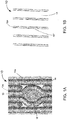
- FIG. 1A illustrates a boiler wall 12 comprising a series of parallel steam tubes 14 separated by a metal membrane 12a. Tube bends 14a, as illustrated in Fig. 1A , are provided to reroute steam tubes 14 around a penetration, which may be for example a 2" (5.08 cm) diameter circular penetration 16'.
- Fig. 1B illustrates an alternative embodiment, which is described in WO 2010/080892 A2 .
- Fig. 1B illustrates a slotted membrane penetration 16" that has approximately a 1 ⁇ 2 inch (1.27 cm) width (equal to the width of the membrane 12a) and is elongate in a direction parallel to the steam pipes 14.
- This arrangement eliminates the need for providing tube bends 14a (as shown in Fig. 1A ), while somewhat aiding in terms of light collection efficiency. Alignment and maintenance of alignment, however, are significantly more difficult than required with the 2 inch (5.08 cm) circular penetration 16' supported by the tube bend approach, as shown in Fig. 1A , and requires a tighter alignment tolerance.
- the embodiments shown in Figs. 1A and 1B are directed to a boiler having steam tubes in the walls of the boiler, the embodiments are not so limited, and may apply to any combustion chamber for which monitoring of combustion properties is desired.
- the shape of the penetration 16 may be any shape (including, but not limited to, circular, substantially circular, elliptical, rectangular, triangular, square, other polygons, etc.), so long as it allows the beam to be effectively projected and received therethrough.
- the invention provides for a steering and alignment system 20 comprising relay lens 22, collimating lens 24, and adjustable stage 26.
- Relay lens 22 is provided in optical communication with collimating lens 24.
- Relay lens 22 is aligned during construction on the axis 30 (shown in, e.g., Fig. 3 ) of penetration 16 (including circular penetration 16', slotted membrane penetration 16", or other-shaped penetrations as described above).
- penetration 16 including circular penetration 16', slotted membrane penetration 16", or other-shaped penetrations as described above.
- steering and alignment system 20 provides for an auto-alignment feature that allows the combination pitch and catch optics to maintain optical alignment with the in-furnace retro-reflector 42 and with itself, even though the steering and alignment system 20 and the retro-reflector 42 are bolted onto a boiler or hostile process chamber which is, itself, subject to movement from thermal effects or wind and vibration.
- Use of the adjustable stage 26 ensures a maximum strength collimated received beam is conveyed to an optically coupled multi-mode fiber 25 (as shown in Figs. 3-5 ).
- the pitch beam is collimated to a diameter of about 5 mm, as opposed to on the order of 20 mm in prior art systems.
- steering and alignment system 20 may be configured to steer the beam toward not only one retro-reflector 42, but each of a plurality of in-furnace retro-reflectors 42 (as shown, e.g., in Figs. 7-9 ), which will be discussed in detail below.
- Fig. 3 schematically illustrates an embodiment of steerable and alignable combination pitch/catch optics that serve as both the transmitter that generates a collimated beam of laser light emerging from an optical fiber 25 and the receiver that captures a collimated beam of light (reflected from one of a plurality of in-furnace retro-reflectors 42), and focuses the beam into the optical fiber 25.
- the combination pitch/catch optics may be mounted in a housing 28 with the leading side having an orifice occupied by a window 21.
- the housing may be an NEMA-4 enclosure to protect the combination pitch/catch optics from the environment.
- the invention includes collimating lens 24 attached to a kinematic tilt stage 26 positioned to tip and tilt the collimating lens 24 about orthogonal axes (i.e., X and Y axes) perpendicular to an optical axis 30 of the steerable and alignable combination pitch/catch optics.
- the collimating lens may be a singlet lens, a doublet lens or include more than two lenses.
- the kinematic tilt stage 26 includes stage 26a, two direct drive stepper motors 26b, and motor drive 26c.
- Stepper motors 26b are configured to tip and tilt the stage 26a about orthogonal axes X and Y that are perpendicular to optical axis 30, and are controlled by a computer via an Ethernet or similar connection. This connection may be through an optical fiber in order to avoid electrical interference.
- the stepper motors 26b hold their positions when power is removed, so optical alignment is not affected by power outages.
- the stepper motors 26b are driven by motor drive 26c.
- the control computer monitors the amount of laser light that is transmitted and detected.
- a discrete alignment wavelength such as a visible or near-infrared light may be provided for continuous or periodic alignment proceedings. Any misalignment will reduce this detected signal.
- the computer measures the detected signal, directs one of the two stepper motors 26b to move a small amount in one direction, then re-measures the detected signal. If the signal increases, the computer directs one of the stepper motors 26b to move again in the same direction until the signal does not increase. The computer then directs the other stepper motor 26b to move along the orthogonal axis to maximize the detected signal, then repeats the whole process for the other sensor head.
- the detector amplifier gain automatically decreases so that the auto-alignment proceeds over several iterations of signal size.
- the auto-alignment system can function with detected powers from nanowatts to milliwatts.
- This "hill-climbing" algorithm is able to align the system after near-total loss of signal, in the presence of substantial noise, and is tolerant of beam blockages, power outages, mechanical shocks, and other disturbances that could cause other alignment systems to misalign to the limits of the control electronics. All that is required for auto alignment is a finite signal with a global maximum in position space. Depending on the specific installation conditions, auto-alignment may occur periodically at set intervals such as every hour or as needed after an extended period, such as days of operation. The control computer may monitor the directed signal and auto-align only when the signal drops below a preset threshold.
- the computer directs the beam to a second in-furnace retro-reflector 42 by directing the stepper motors 26b to "jump" to the second retro-reflector 42, wherein "jumping" is performed in two dimensions by driving stepper motors 26b about the two orthogonal axes (e.g., X and Y axes) that are perpendicular to the optical axis of the steerable and alignable combination pitch/catch optics, in which case the in-furnace retro-reflectors 42 may be arranged so as to lie in multiple planes, in some prearranged pattern, or in arbitrary positions within the furnace.
- the one or more planes may be parallel to a floor of the furnace 10 or parallel with the beam, at a particular time that the beam is being emitted (in such a case, multiple planes would be displaced by predetermined or calculated angles with respect to each other).
- a sight tube 12b has a proximal and a distal end.
- the proximal end is attached to extend normally from an exterior wall 12 of the furnace 10 with penetration 16 communicating with the interior of the sight tube 12b.
- a flange is provided at a distal end of the sight tube 12b. The flange allows the housing 28 to be attached with the leading end abutting the furnace flange with the window 21 in optical communication with the penetration 16.
- a beam may be transmitted into the furnace interior through the penetration 16 and to reflect off at least one in-furnace retro-reflector 42 positioned in furnace 10 back to penetration 16 to pass through the window 21 and be captured by the collimating lens 24.
- multimode optical fiber 25 would be configured to transmit the beam and receive the reflected beam.
- Fig. 4 illustrates an alternative embodiment of steerable and alignable combination pitch/catch optics 20.
- a lens 24 is optically coupled to an optical fiber 25.
- the lens 24 is referred to herein as a "collimating" lens and may be a true collimating lens (that produces a beam of substantially constant diameter).
- the collimating lens 24 may be a "near" collimating lens that provides a slight expansion of the beam 25a.
- the fiber 25 and the collimating lens 24 are mechanically linked together in a fixed relationship and movable by "translation" along orthogonal X-Y axes that are perpendicular to the optical axis 30 of the steerable and alignable combination pitch/catch optics, by a translation mechanism 26.
- the emitted beam 25a is movable by translation to strike select portions of the relay lens 22, which directs the beam through the membrane slot 16 and focuses the beam at about one of a plurality of in-furnace retro-reflectors 42 (as shown, e.g., in Figs. 5-9 ).
- Stepper motors 26b (as shown, e.g., in Fig. 3 ), a computer controller 26c (as also shown, e.g., in Fig. 3 ), and a "hill climbing" algorithm similar to that discussed above with respect to the embodiment of Fig. 3 are operatively associated with the translation mechanism 26 to provide for substantially continuous alignment correction, and to provide for "jumping" between in-furnace retro-reflectors 42.
- Steering and alignment system 20 includes a multimode optical fiber 25, transmit and receive optic 24, adjustable stage 26, noise reduction module 32, optical divider 34, tunable diode laser 36, and detector 38.
- multimode optical fiber 25, transmit and receive optic 24, and adjustable stage 26 may be as described above with respect to any of the embodiments as shown, e.g., in Figs. 2A to 4 .
- the transmit and receive optic 24 may also include only a collimating lens without a relay lens 22.
- Noise reduction module 32 includes any type of noise reduction device.
- noise reduction module 32 may include an averaging component, which may be operatively associated with the multimode optical fiber 25, in order to average modal noise induced signal level variation of light propagating within the multimode optical fiber 25.
- the averaging component 32 is a mechanical vibrator.
- WO 2011/019755 describes various systems and methods for reducing noise in a multimode optical fiber.
- the averaging component may average modal noise induced signal level variations by cyclically varying an index of refraction of the multimode optical fiber over a select period of time, scrambling a light distribution within the multimode optical fiber, or both.
- the index of refraction of the multimode optical fiber may be cyclically varied by cyclically varying the temperature of the multimode optical fiber.
- the index of refraction may be varied or the light distribution within the multimode optical fiber may be scrambled by cyclically and physically manipulating the multimode optical fiber.
- the temperature of the multimode optical fiber may be varied through the action of a thermal element placed in thermal communication with the multimode optical fiber.
- Suitable devices for use as a thermal element include, but are not limited to, a thermoelectric module, a resistive heater, an infrared heater, a chemical heater, a conventional refrigeration device, a chemical cooler, a source of fluid cooled below ambient temperature, or a source of fluid heated above ambient temperature.
- the optical device may include a temperature sensor such as a thermocouple in thermal contact with the multimode optical fiber and a controller receiving input from the temperature sensor and controlling the thermal element.
- the manipulation may include twisting, stretching, or shaking the multimode optical fiber.
- a piezo stretcher may be used to accomplish the cyclical stretching of the multimode optical fiber.
- a motor may be used to cyclically twist a portion of the multimode optical fiber in alternate clockwise and counterclockwise directions with respect to the longitudinal axis of the fiber and relative to a fixed portion of the fiber.
- WO 2005/103781 describes various apparatuses and methods for optical mode noise averaging, including the cyclically varying an index of refraction by one of cyclically varying the temperature of the multimode optical fiber and cyclically manipulating by twisting, stretching, or shaking the multimode optical fiber, as described above.
- the multimode optical fiber 25 is optically coupled to the transmit and receive optic 24.
- the multimode optical fiber 25 is further optically coupled to a tunable diode laser 36, which produces a beam of light at a select wavelength.
- an optical divider 34 is optically associated with the multimode optical fiber 25.
- the optical divider 34 may be, by way of example, a spatial multiplexer or a circulator of the type used in telecommunications applications.
- the function of the optical divider 34 is to divide optical signals received by the transmit and receive optic 24 from an optical signal generated by the tunable diode laser 36 and to deliver the received portion of the signal to a detector 38, which is typically a photo detector sensitive to the frequency of light generated by the tunable diode laser 36.
- the TDLAS sensor 20 is operatively associated with a portion of a combustion furnace 10 with a portion of the furnace 10 including an outer wall 12 and an internal space having at least one in-furnace retro-reflector 42 positioned therein.
- a probe beam 44 generated by the tunable diode laser 36 is directed off the at least one in-furnace retro-reflector 42 so that it reflects back to the transmit and receive optic 24 as illustrated in Fig. 5 .
- a portion of the transmitted beam received by the transmit and receive optic 24 is conveyed by the multimode optical fiber 25 to the optical divider 34 for detection by the detector 38.
- noise reduction component 32 (which may include an averaging component, such as a mechanical vibrator) may be used to reduce modal noise induced signal variation of the light propagating within the multimode optical fiber 25 (e.g., by averaging the modal noise induced signal variations).
- an embodiment 100 is shown in which there is a one-to-one relationship between transmit and receive optics 24 1-to-n and the array of in-furnace retro-reflectors, such that the beam 44 from one transmit and receive optic 24 x is transmitted and reflected off only one of the plurality of in-furnace retro-reflectors 42 back toward said transmit and receive optic 24 x .
- transmit and receive optics 24 1-to-n and 30 in-furnace retro-reflectors 42 would be required.
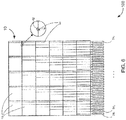
- Each of the plurality of retro-reflectors may be positioned in a grid 11 of the furnace 10 so as to allow monitoring and control of the combustion for each grid 11.
- an embodiment 200 may utilize the steering and "jumping" technique as described above to "jump" the beam 44 from one transmit and receive optic 24 x to a plurality of in-furnace retro-reflectors 42, which may be arranged in a single plane, in multiple planes, in a predetermined pattern, or in arbitrary positions within the furnace 10 (as described above).
- 5 transmit and receive optics 24 1-to-n may be used to monitor and control the combustion process in a 30-grid furnace, in which each grid 11 has positioned therein one of the 30 retro-reflectors 42.
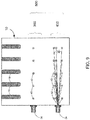
- a plurality of transmit and receive optics 24 (which are each part of a steering and alignment system 20, e.g., as shown and described with respect to Figs. 2A - 5 ) are arranged about half of the perimeter of furnace 10 (e.g., along two walls 12 of a rectangular furnace 10 (as shown, e.g., in Fig. 8 ) or along an arc of a circular or elliptical furnace (not shown)).
- retro-reflectors 42 are positioned in zones or grids 11 among burners 18.
- Embodiments of furnaces wherein the system could be use could include rows of process tubes 50 between the burners 18, for example as is known in Steam Methane Reformer (SMR) furnaces or other similarly designed furnaces with furnace tubes for performing other processes, such as ethylene cracking.
- SMR Steam Methane Reformer
- a schematic plan view of such a furnace is show in Fig. 11 .
- the retro-reflectors are positioned to allow sampling of the combustion zone downstream of a burner or appropriate groupings of burners and adjacent to the process tubes.
- Each transmit and receive optic 24 is configured to steer and "jump" its beam 44 to each of the retro-reflectors 42 in its assigned zones or grids 11.
- the temperature or species concentration is measured along the shortest paths first corresponding to zone 11c.
- transmit and receive optic 24 steers or "jumps" beam 44 to each of the two retro-reflectors 42 in zone or grid 11c.
- the beam 44 can be directed to retro-reflectors 42 that also enable sampling in zone 11b.
- the conditions can be calculated for zone 11b.
- zone 11a conditions can be measured in a similar fashion by directing the measurement beam 44 to retro-reflectors that enable sampling of zones 11a, 11b, and 11c.
- Steering or "jumping" of beam 44 may be in any predetermined order, not necessarily from grid 11c to grid 11b to grid 11a. In such a case, the calculations of the zone conditions may be performed after all the measurements are made.
- the steering or "jumping" of beam 44 by each of the other transmit and receive optics 24 may be performed in a similar manner.
- Fig. 9 illustrates various examples and for monitoring and controlling combustion in a furnace 10, including (in-plane) 1D steerable monitoring as shown in example 300, 2D steerable monitoring as shown in embodiment 400, and multi-plane steerable monitoring as shown in embodiment 500.
- 1D and 2D refers to the dimensional steering from the perspective of the transmit and receive optics 24.
- the transmit and receive optics 24 may be arranged at any desirable height with respect to a floor of the furnace 10, and may be arranged about the sides of the furnace 10 in a similar manner as, e.g., shown in Fig. 8 .
- any combination of 1D steerable monitoring and/or 2D steerable monitoring may be arranged about the furnace 10 (e.g., only 1D steerable monitoring arranged to monitor two or more parallel planes at two or more predetermined heights with respect to the floor of furnace 10; or 2D steerable monitoring arranged to monitor different height zones of furnace 10 with retro-reflectors arranged throughout substantially all or a portion of the interior of furnace 10; etc.).
- burners 18 may be positioned in any location of the interior of the furnace - including on the floor of the furnace 10 with flames emitted toward the ceiling of the furnace 10, and on the side of the furnace 10 with flames emitted toward an opposite side of the furnace 10.
- radiant wall burners may be used in which case flames are directed along the refractory lined furnace walls by burners mounted on these same walls. The purpose of these burners is to heat the refractory which then heats the tubes primarily by radiated heat transfer.
- the retro-reflectors would preferably be arranged generally down-flame of the burners 18 to the extent possible (e.g., on the opposite side of the furnace with respect to the burners) in the various possible configurations as described above or in any configuration that allows for monitoring and control of the combustion process in furnace 10.
- retro-reflectors 42 include that fewer paths are required, thus avoiding complexities of angled paths in a tightly packed furnace.
- the laser beam 44 used to measure each cell must propagate out and back, thereby doubling the path length ("double-pass laser path") and increasing absorption signal strength. Stronger absorption signal reduces the deleterious effects of noise sources, such as modal, etalon, and detector noise.
- "self-aligned laser paths" may be obtained.
- retro-reflecting targets in the furnace redirect the incident laser light back towards the source, where the sensor head collects the return light and sends it on to optical detectors.
- the sensor head needs to direct the transmitted beam towards the retro-reflector, but after that, no additional alignment is required.
- the auto-alignment process discussed above would be to align the beam with one of the retro-reflectors.
- in-furnace retro-reflectors For effective use within a furnace, which can generally reach temperatures of 1000 to 1300 °C near the furnace gas exit, in-furnace retro-reflectors must be able to withstand these high temperatures, as well as being able to withstand an oxidizing environment. Not only does one need an optical element that can survive within that environment, one likely needs mounting or superstructure elements to hold the optical element in place.
- Two potential materials that may be suitable for in-furnace retro-reflectors include sapphire, which has a melting point of 2030 °C, and quartz, which has a melting point of 1670-1713 °C. Thus, both sapphire and quartz can withstand the high temperatures of the furnace. As oxides, both sapphire and quartz are stable in oxidizing environments. Other materials may also work, but may be subject to cost and availability issues.
- a corner cube retro-reflector - a classic retro-reflector element - may be used. Corner cubes made of standard optical materials, including sapphire, are widely commercially available. The corner cube takes advantage of total internal reflection at the back side of the element so that its back reflection efficiency is very high. A corner cube has no optical power, so a diverging beam entering the cube exits as a beam with the same divergence. Thus, the highest retro-reflection efficiency back to the source occurs when the beam incident on the corner cube is collimated (plane wave illumination).
- a cat's eye retro-reflecting sphere may be used.
- a sphere with index of refraction 2.0 also retro-reflects an incident beam.
- the rays from a collimated illumination beam form a focus spot on the back surface of the sphere, where a portion of those rays reflects back along the same angle as the incident ray.
- Optical quality spheres generally cost less than a comparably sized retro-reflector.
- One disadvantage of the cat's eye retro-reflector is lower overall reflectivity compared to that of a corner cube. Unlike in a corner cube, light bouncing off the back surface of the cat's eye is not totally internally reflected. The reflectivity of the back surface of the cat's eye depends on the index of refraction of the material but will be in the range of 4 - 8%. In lower temperature applications, according to some embodiments, partially reflective coatings, such as gold, may be applied to the sphere to increase its back reflectance.
- an array of smaller retro-reflectors may be used.
- An array of retro-reflectors 42' for retro-reflecting a single beam 44 will tend to act more like a phase conjugate mirror. That is, regardless of whether the illuminating beam is collimated, diverging, or converging, the retro-reflected beam will tend to retrace its incident path back to the source. So, a diverging source beam will be retro-reflected as a beam converging back towards the source.
- the smaller retro-reflecting elements will contribute to more scattering on reflection.
- each retro-reflector element will produce an interference pattern on the reflected beam.
- This interference pattern would be observed as intensity fringes in the wavelength-scanned TDLAS signal.
- a single, large retro-reflector would be expected to have large, well-defined fringes because the number of interfering waves would be small.
- An array of small retro-reflectors would produce many more interfering waves, and the resultant fringes in the TDLAS signal would likely be of smaller amplitude, be less stationary in time, and be easier to eliminate through signal averaging and mode scrambling.
- an array of smaller elements may cost less than a single, large element.
- each of discrete retro-reflectors or array retro-reflectors being positioned at discrete locations within the furnace for which one may desire to monitor and/or control combustion processes
- one or more spanning retro-reflecting surfaces comprising an array of discrete small retro-reflector elements may be used where two or more retro-reflecting surfaces of each spanning retro-reflecting surface may cover a first location, a second location, a third location, and so on, in the furnace for which one may desire to monitor and/or control combustion processes.
- the kinematic stage would be configured so as to "jump" the beam from one retro-reflecting surface located at the first location to another retro-reflecting surface located at the second location, and so on.
- a mounting superstructure may be used.
- ceramics are probably the best material as they can withstand both the high temperatures and the oxidizing environment. Ceramics may be machined or molded and fired to the desired shape. A ceramic superstructure could be formed with slots or other features to capture and hold retro-reflector optics.
- adhesives will not withstand furnace temperatures, sapphire or quartz optics may be fused to a ceramic mounting structure, according to one embodiment. Alternatively, according to another embodiment, optics could be captured/held in slots or other features formed into the ceramics.
- nichrome wire may be used.
- a common nichrome alloy includes 80% nickel and 20% chromium, has a melting point of approximately 1400 °C, and is relatively oxidation resistant due to a protective layer of chromium oxide.
- arrays of retro-reflecting optics are wired together through holes in the optics (like beads on a string) or by creating wire cages to capture each element. The nichrome wire could then be tied into mounting features on the furnace or to the ceramic mounts.For down-fired furnaces, according to some embodiments, where the flue gas exits 52 are located at the bottom of the furnace (see Fig.
- a hold-down feature such as a ceramic pin that fits into a corresponding hole in the floor, is provided to mount the retro-reflectors on the bottom or floor of the furnace.
- the retro-reflector mounts may be located opposite the burners, where the flue gas exits are typically located, so that the laser paths are located where combustion is just complete.
- a gird may be close-coupled to the burner wall.
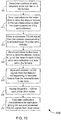
- a flowchart is shown illustrating an example 600 for monitoring and calculating combustion properties for zones within the interior of the furnace.
- a general purpose or application specific computer may be used to determine the location of all the retro-reflectors positioned within the interior of a particular furnace. This may be accomplished, for example, by accessing a database on which is stored the locations of the retro-reflectors.
- a scanning beam could be used to scan the interior of the furnace, where the location of a retro-reflector is determined when a reflected beam (e.g., a back-reflected beam or a beam reflected to a separate detector) is detected.
- Step 610 the computer sends instructions to the motor drive 26c to drive stepper motors 26b to tilt stage 26a so as to "steer" the beam to one of the retro-reflectors 42(either a single, large retro-reflector or an array of smaller retro-reflecting elements). Auto-alignment, as described above, may be performed in order to ensure an optimal signal reflected from the retro-reflector 42.
- Step 615 the computer stores and processes the TDLAS signal from the detector corresponding to the reflected beam from the retro-reflector 42.
- Step 620 the computer sends instructions to the motor drive 26c to drive the stepper motors 26b to tilt stage 26a so as to "jump" the beam to each of the other retro-reflectors 42 in a predetermined zone of the furnace. Auto-alignment may also be performed at this time.
- Step 625 the computer stores and processes the TDLAS signals from the detector corresponding to the reflected beam from all the retro-reflectors 42 in the zone.
- Step 630 Steps 620 - 625 are repeated for each of the other zones for which this particular transmit/receive optic is assigned.
- Step 635 the computer calculates the combustion characteristics for each zone taking into account the calculations for other zones, in a manner similar to that described above with respect to Fig. 8 . Steps 605-635 may subsequently be repeated for each transmit/receive optic.
- Software for controlling the computer may be stored on any recordable medium including, but not limited to, a floppy disk, a flash memory drive, a database, a server, an SD memory drive, a hard drive, etc.
- retro-reflectors including, but not limited to, corner cube, cat's eye, or other types of retro-retroflectors, etc.
- optical mirrors or arrays or small optical mirrors may also be used to reflect the beam either back to the source optic or to a different optic mounted on the exterior of the wall of the furnace.
- such embodiments may be more difficult align a transmitted beam to be directed off the mirrors to the receiving optic than embodiments using a single transmit/receive optic and retro-reflectors.
Landscapes
- Engineering & Computer Science (AREA)
- Physics & Mathematics (AREA)
- Chemical & Material Sciences (AREA)
- General Physics & Mathematics (AREA)
- General Engineering & Computer Science (AREA)
- Mechanical Engineering (AREA)
- Combustion & Propulsion (AREA)
- Spectroscopy & Molecular Physics (AREA)
- Life Sciences & Earth Sciences (AREA)
- General Health & Medical Sciences (AREA)
- Immunology (AREA)
- Pathology (AREA)
- Biochemistry (AREA)
- Analytical Chemistry (AREA)
- Health & Medical Sciences (AREA)
- Optics & Photonics (AREA)
- Investigating Or Analysing Materials By Optical Means (AREA)
Description
- The present disclosure is directed toward a method and a combustion furnace including an apparatus for measuring combustion properties in an interior of the furnace, and more particularly toward a method and a combustion furnace including an apparatus for measuring combustion properties in the furnace utilizing in-furnace retro-reflectors in conjunction with a steerable tunable diode laser absorption spectrometer.
-
U.S. Patent No. 7,469,092 , describes a method and apparatus for the monitoring and control of a process using tunable diode laser absorption spectroscopy (TDLAS). Briefly stated, the TDLAS method and apparatus involves directing a beam of light, which may be a multiplexed beam of a number of distinct wavelengths, into a boiler or furnace combustion chamber to measure boiler or furnace combustion properties such as temperature and the concentration of various combustion species including CO, CO2, O2 and H2O. TDLAS monitoring techniques are based on a predetermined relationship between the quantity and nature of laser light received by a detector after the light has been transmitted through a region of interest and absorbed in specific spectral bands which are characteristic of the gas species resulting from combustion. The absorption spectrum received by the detector may be used to determine the quantity of a gas species under analysis plus associated combustion parameters such as temperature. - The technique requires a line of sight through the boiler or furnace. In fact, many lines of sight are typically required as it is often desirable to measure combustion properties in multiple boiler or furnace locations. Typically a wavelength multiplexed laser beam is transmitted from a pitch optic to a catch optic on the opposite side of the boiler or furnace. Certain applications require up to 15 or more measurement paths, thus requiring 15 or more pitch/catch optic pairs and 30 or more furnace penetrations. However, the use of 15 or more pairs of substantially identical pitch/catch optics and the need for 30 or more corresponding furnace penetrations imposes high costs, not to mention increasing the complexities of the system. In some cases, installation of the system may require waiting years for the scheduled shut-down of the boiler or furnace.
- Because of the costs and complexities of the optics and corresponding furnace penetrations, the practicality of the conventional system is limited in the case where one desires to monitor (and perhaps also control) a larger number of combustion zones within the furnace.
- The present invention is directed toward overcoming one or more of the problems discussed above.
- A first aspect of the disclosure is a method of monitoring combustion properties in an interior of a combustion furnace (including, but not limited to, temperatures and concentrations of various combustion species), as defined in claim 1. The method comprises providing at least one penetration in a wall of the furnace; providing at least two retro-reflecting surfaces within an interior of the furnace; projecting a beam of light through an optic comprising a collimating lens residing outside the interior of the furnace, the collimating lens being optically coupled to the at least one penetration to project the beam into the interior of the furnace toward a first retro-reflecting surfaces of the at least two retro-reflecting surfaces; receiving the beam of light from the first retro-reflecting surfaces with the optic; measuring the combustion properties based on the received beam of light from the first retro-reflecting surfaces; steering the beam of light through the optic to a second retro-reflecting surface of the at least two retro-reflecting surfaces; receiving the beam of light from the second retro-reflecting surface with the optic; and measuring the combustion properties based on at least the received beam of light from the second retro-reflecting surface. As used herein, a retro-reflector is broadly defined as an optical device that redirects incident laser light back towards its source, regardless of the angle of incidence, so long as the beam is incident on an aperture of the retro-reflector.
- According to some embodiments, the beam of light is propagated/projected through a multimode fiber and through the optic comprising the collimating lens, reflected from one of the retro-reflecting surfaces, received by the same collimating lens, and propagated in the reverse direction within the same multimode fiber.
- In some embodiments, the at least one penetration includes one of circular penetrations and penetrations elongated parallel to a plurality of parallel steam tubes separated by metal membranes incorporated in the wall of the furnace. For example, some boilers of coal fired electrical generation plants require parallel steam tubes. For furnaces without the steam tubes, any shape of penetrations (e.g., triangle, square, rectangle, ellipse, other polygons, etc.) may be utilized, so long as the beam can be effectively projected and/or received therethrough.
- According to some embodiments, each of the at least two retro-reflecting surfaces is made of a material selected from the group consisting of sapphire and quartz. In one embodiment, each of the at least two retro-reflecting surfaces is one of a single, large retro-reflector or an array of smaller retro-reflector elements. In some embodiments, the at least two retro-reflecting surfaces includes at least one of a corner cube retro-reflecting optic or a cat's eye retro-reflecting sphere. In some embodiments, the first and second retro-reflecting surfaces are first and second portions of a single retro-reflecting surface comprising an array of discrete retro-reflectors , and wherein steering from the first retro-reflecting surface to the second retro-reflecting surface is steering from the first portion to the second portion of the single retro-reflecting surface.
- As used herein, reference to, or mention of, retro-reflector(s) may mean any of (a) a single, large retro-reflector located at a discrete position in a furnace for which one may desire to monitor and/or control combustion processes (e.g., a "discrete retro-reflector"), (b) an array of smaller discrete retro-reflector elements (i.e., a "retro-reflector array" or "array retro-reflector") that take the place of the single, large retro-reflector described in (a).
- According to some embodiments, the method further includes providing a mounting structure for mounting each retro-reflecting surface within the interior of the furnace positioned on a side of the furnace opposite to a side of the interior of the furnace on which flame-emitting burners are located, wherein each of the at least two retro-reflectors is configured to be secured to a mounting structure. The at least one mounting structure may include a ceramic mounting structure having slots in which each retro-reflector is held. Alternatively, nichrome wire (which may be made of, e.g., nichrome alloy including 80% nickel and 20% chromium) may be used to secure each of the retro-reflectors to a mounting structure. In some embodiments, the furnace includes a ceiling and a floor, the ceiling and floor are substantially perpendicular to the wall of the furnace, and wherein the flame-emitting burners are mounted to the ceiling, while each mounting structure is mounted to the floor. Embodiments could also include more than one retro-reflector attached to a mounting structure. For example, in embodiments where the retro-reflector comprises a plurality of small retro-reflectors, and even in embodiments where two or more larger retro-reflectors are attached to a single mounting structure.
- Based on some embodiments, providing the at least two retro-reflectors within the interior of the furnace includes arranging a plurality of retro-reflectors in at least one of a single-plane configuration, a multi-plane configuration, a pre-arranged configuration, and an arbitrary configuration throughout the interior of the furnace. In some embodiments, each plane of the single-plane configuration and the multi-plane configuration is either perpendicular to the wall of the furnace or parallel to the beam of light projected through the optic.
- According to the invention, steering the beam using the optic includes tilting the optic about at least one of two orthogonal axes that are perpendicular to an optical axis of the at least one penetration.
- According to one embodiment, receiving the beam of light includes receiving the beam in a multimode optical fiber, and wherein measuring the combustion properties includes filtering noise by averaging modal noise induced signal level variation of light propagating within the multimode optical fiber.
- According to some embodiments, providing the at least two retro-reflectors includes providing a plurality of retro-reflectors positioned within the interior of the furnace to monitor combustion zones within the furnace, wherein projecting the beam of light includes projecting the beam toward each of the plurality of retro-reflectors, and wherein measuring the combustion properties includes calculating the combustion properties by taking into account measurements of the beam reflected and received from each zone.
- In some embodiments, the optic further includes a relay lens residing outside the interior of the furnace, the relay lens being optically coupled to the collimating lens and optically coupled to the at least one penetration to project the beam into the interior of the furnace toward each of the first and second retro-reflectors of the at least two retro-reflectors.
- A second aspect of the disclosure is a combustion furnace as defined in claim 5, the combustion furnace comprising a wall surrounding an interior of the furnace, the wall being provided with at least one penetration, the combustion furnace further comprising an apparatus for sensing combustion properties in an interior of a combustion furnace (including, but not limited to, temperatures and concentrations of various combustion species). The apparatus comprises a tunable diode laser, a collimating lens, at least two retro-reflectors; a kinematic tilt stage, and a detector. The diode laser has a select lasing frequency. The collimating lens is optically coupled to a beam generated by the diode laser, the collimating lens being configured to project the beam from the diode laser into a penetration in a wall of the furnace. The at least two retro-reflectors are positioned within an interior of the furnace, and each are configured to reflect the beam from the collimating lens back to the collimating lens. The kinematic tilt stage includes at least one stepper motor, a motor drive, and a stage coupled to the t collimating lens. The at least one stepper motor is configured to tilt the stage about at least one of two orthogonal axes that are perpendicular to an optical axis of the first penetration, so as to steer the beam of light from one to another of the at least two retro-reflectors. The detector is of a type that is sensitive to the select lasing frequency optically coupled to the collimating lens.
- The apparatus, according to some embodiments, further comprises a multimode fiber through which the beam is propagated from the diode laser to the collimating lens. The collimating lens is configured to project the beam from the diode laser and the multimode fiber through a penetration to one of at least two retro-reflecting surfaces positioned in the interior of the furnace. The collimating lens is further configured to receive the reflected beam from said one of at least two retro-reflecting surfaces, and to transmit the reflected beam back through the same multimode fiber, to the detector, which is optically coupled to the multimode fiber.
- According to some embodiments, the first penetration includes one of circular penetrations and penetrations elongated parallel to a plurality of parallel steam tubes separated by metal membranes incorporated in the wall of the furnace. Typically only boilers require the parallel steam tubes. For furnaces without the steam tubes, any shape of penetrations may be utilized, so long as the beam can be effectively projected and/or received therethrough.
- In some embodiments, each of the at least two retro-reflectors is made of a material selected from the group consisting of sapphire and quartz. In one embodiment, each of the at least two retro-reflectors is an array of smaller retro-reflector elements. In some embodiments, the at least two retro-reflectors includes at least one of a corner cube retro-reflecting optic and a cat's eye retro-reflecting sphere.
- According to some embodiments, the apparatus further comprises a a mounting structure for mounting each retro-reflecting surface within the interior of the furnace positioned on a side of the furnace opposite to a side of the interior of the furnace on which flame-emitting burners are located, wherein each of the at least two retro-reflectors is configured to be secured to a mounting structure. In one embodiment, each mounting structure includes a ceramic mounting structure having slots in which each retro-reflector is held. In another embodiment, each of the at least two retro-reflectors is secured a one mounting structure via nichrome wire (which may be made of, e.g., nichrome alloy including 80% nickel and 20% chromium). Embodiments could also include more than one retro-reflector attached to a mounting structure. For example, in embodiments where the retro-reflector comprises a plurality of small retro-reflectors, and even in embodiments where two or more larger retro-reflectors are attached to a single mounting structure.
- Based on some embodiments, the furnace includes a ceiling and a floor, the ceiling and floor are substantially perpendicular to the wall of the furnace, and wherein the flame-emitting burners are mounted to the ceiling, while each mounting structure is mounted to the floor.
- In several embodiments, the at least two retro-reflectors includes a plurality of retro-reflectors arranged in at least one of a single-plane configuration, a multi-plane configuration, a pre-arranged configuration, and an arbitrary configuration throughout the interior of the furnace. In some embodiments, each plane of the single-plane configuration and the multi-plane configuration is either perpendicular to the wall of the furnace or parallel to the beam of light projected through the optic.
- In some embodiments, the at least two retro-reflectors includes a plurality of retro-reflectors positioned within the interior of the furnace for monitoring combustion zones within the furnace, wherein the collimating lens projects the beam toward each of the plurality of retro-reflectors, and wherein the detector calculates the combustion properties by taking into account measurements of the beams reflected and received from each zone.
- The apparatus, according to some embodiments, further includes a relay lens. The relay lens is optically coupled to the collimating lens and the penetration, and is configured to project the beam from the diode laser, through the collimating lens and the penetration, to the at least two retro-reflectors.
- A third aspect of the disclosure is directed to a computer software stored on a recordable medium that when executed by a processor (e.g., one in a general purpose or application specific computer) causes the processor to: access a database to determine locations of retro-reflectors within an interior of a furnace; send instructions to a motor drive for driving at least one stepper motor for tilting a stage on which transmit/receive optics are housed, so as to steer a beam projected from the transmit/receive optics to one of the retro-reflectors based on the determined location of the retro-reflectors; receive and store a signal from a detector optically coupled to the transmit/receive optics that has detected the beam reflected back to the transmit/receive optic from said one of the retro-reflectors; and calculate combustion properties based on the received and stored signal from the detector.
- In some examples, the computer software when executed by the processor further causes the processor to: send instructions to the motor drive, so as to jump the beam to each of the retro-reflectors within a first predetermined zone of the furnace, based on the determined location of the retro-reflectors; receive and store signals from the detector that has detected the beam reflected back to the transmit/receive optic from said each of the retro-reflectors within the first predetermined zone of the furnace; and calculate combustion properties of the first predetermined zone based on the received and stored signals from the detector.
- According to some examples, the computer software when executed by the processor further causes the processor to: send instructions to the motor drive, so as to jump the beam to each of the retro-reflectors within a second predetermined zone of the furnace, based on the determined location of the retro-reflectors; receive and store signals from the detector that has detected the beam reflected back to the transmit/receive optic from said each of the retro-reflectors within the second predetermined zone of the furnace; and calculate combustion properties of the second predetermined zone based on the received and stored signals from the detector, taking into account the calculated combustion properties of the first predetermined zone.
- In some examples, the computer software when executed by the processor further causes the processor to: send instructions to the motor drive, so as to steer the beam to a plurality of portions of said one of the retro-reflectors; receive and store a calibration signal from the detector that has detected the beam reflected back from said plurality of portions of said one of the retro-reflectors; determine an optimal position based on which of the plurality of portions of said one of the retro-reflectors reflects the strongest calibration signal; and send instructions to the motor drive, so as to steer the beam to the optimal position. This auto-alignment feature allows the transmit/receive optics to maintain optical alignment with the in-furnace retro-reflector and with itself, even though the transmit/receive optics and the retro-reflector are bolted onto a furnace or hostile process chamber which is, itself, subject to movement from thermal effects or wind and vibration.
- The method and the furnace comprising the apparatus for measuring combustion properties in an interior of the furnace described herein allows for detection of combustion properties without having to use separate pitch and catch optics, which results in at least half the number of necessary ports and optical setup and alignment equipment. The method and apparatus additionally allows for further reducing the number of optical setup and alignment equipment by utilizing steerable tunable diode laser absorption spectroscopy systems in conjunction with an array of in-furnace retro-reflectors, which together allow for a maximum number of beam paths with a minimum number of optical setup and alignment equipment. The method and apparatus therefore allow the many benefits of combustion monitoring to be enjoyed efficiently, inexpensively, and with less complexity, as compared to systems that do not utilize either a combination pitch/catch optic and/or steerable tunable diode laser absorption spectroscopy systems coupled to in-furnace retro-reflectors.
-
-
Figs. 1A and 1B illustrate alternative penetrations in the wall of a boiler or furnace for providing optical access to the boiler or furnace interior. -
Figs. 2A and 2B illustrate steerable pitch/catch optics for steering the beam within the interior of the boiler or furnace. -
Fig. 3 is a schematic illustration of an embodiment of alignable and steerable pitch/catch optics. -
Fig. 4 is a schematic illustration of an alternative embodiment of alignable and steerable pitch/catch optics. -
Fig. 5 is a schematic illustration of an embodiment of a steerable tunable diode laser absorption spectroscopy system with a combination pitch/catch optic used in conjunction with an array of in-furnace retro-reflectors. -
Fig. 6 is a top-view schematic illustration of an embodiment of an array of combination pitch/catch optics used in conjunction with an array of in-furnace retro-reflectors. -
Fig. 7 is a top-view schematic illustration of an embodiment of a steerable tunable diode laser absorption spectroscopy system with a combination pitch/catch optic used in conjunction with an array of in-furnace retro-reflectors. -
Fig. 8 is a plan-view schematic illustration of an embodiment of a steerable tunable diode laser absorption spectroscopy system with a combination pitch/catch optic used in conjunction with an array of in-furnace retro-reflectors, where combustion monitoring and control are performed on predetermined zones within the furnace. -
Fig. 9 is a side-view schematic illustration of an embodiment of a steerable tunable diode laser absorption spectroscopy system, whereembodiment 300 illustrates (in-plane) 1D steerable monitoring, whileembodiment 400 illustrates 2D steerable monitoring, andembodiment 500 illustrates multi-plane steerable monitoring. -
Fig. 10 is a flowchart illustrating zone-based monitoring and measurement of combustion properties within the interior of the furnace. -
Fig. 11 is a plan view of a furnace with rows of process tubes between rows of burners showing a steerable tunable diode laser absorption spectroscopy system with a combination pitch/catch optic used in conjunction with an array of in-furnace retro-reflectors, where combustion monitoring and control are performed on predetermined zones within the furnace. -
Fig. 12 is side view of down-fired furnace where the flue gas exits are located at the bottom of the furnace, further showing a steerable tunable diode laser absorption spectroscopy system with a combination pitch/catch optic used in conjunction with an array of in-furnace retro-reflectors, where combustion monitoring and control are performed on predetermined zones within the furnace. - Unless otherwise indicated, all numbers expressing quantities of ingredients, dimensions, reaction conditions, and so forth used in the specification and claims are to be understood as being modified in all instances by the term "about."
- In this application and the claims, the use of the singular includes the plural unless specifically stated otherwise. In addition, use of "or" means "and/or" unless stated otherwise. Moreover, the use of the term "including," as well as other forms, such as "includes" and "included," is not limiting. Also, terms such as "element" or "component" encompass both elements and components comprising one unit and elements and components that comprise more than one unit unless specifically stated otherwise.
-
U.S. Patent No. 7,469,092 discloses a method and apparatus for monitoring and control of a combustion process of the type requiring installation of tube bends in the wall of a boiler in order to provide optical access to the boiler.U.S. Patent No. 7,469,092 describes a sensing system which incorporates an auto-alignment feature that allows the pitch and catch optics to maintain optical alignment even though they are bolted onto a boiler or hostile process chamber which is, itself, subject to movement from thermal effects or wind and vibration. The described system provides separate pitch and catch optics including separate pitch and catch collimating lenses that are mounted on feedback-control tilt stages. Multiplexed light is launched across the measurement region by a collimating pitch lens attached directly to an input fiber and the catch collimating lens, located at the opposite end of the measurement region, optically couples transmitted light to an output fiber that is typically a multi-mode fiber. As a result, the catch optic must be oriented so that it is collinear with the beam emanating from the pitch optic. This is necessary so that the focused transmitted beam will arrive within the acceptance cone of the multi-mode fiber. - Hereinafter, the terms "boiler" and "furnace" will be used interchangeably to refer to any combustion chamber for which monitoring and control of the combustion process is desired.
- With reference to
Figs. 1-10 and in contrast to the system described inU.S. Patent No. 7,469,092 , the system according to various embodiments provides a combination pitch/catch optic including pitch/catch collimating lens that is mounted on feedback-control tilt stages. Multiplexed light is launched across the measurement region by a collimating pitch lens attached directly to an input fiber and the collimating catch lens optically couples transmitted light to an output fiber that is typically a multi-mode fiber. Here, the collimating pitch lens and the collimating catch lens are embodied in the same collimating lens. The multiplexed light that is launched across the measurement region is reflected back to the source by at least one retro-reflector that is positioned in the furnace. A retro-reflector is an optical device that redirects incident laser light back towards its source regardless of the angle of incidence, provided the beam hits an entrance to an aperture of the retro-reflector.. -
Figures 1A and 1B illustrate two examples ofpenetrations 16 in thewall 12 of thefurnace 10 for providing optical access to the furnace interior.Fig. 1A illustrates aboiler wall 12 comprising a series ofparallel steam tubes 14 separated by ametal membrane 12a. Tube bends 14a, as illustrated inFig. 1A , are provided to reroutesteam tubes 14 around a penetration, which may be for example a 2" (5.08 cm) diameter circular penetration 16'. -
Fig. 1B illustrates an alternative embodiment, which is described inWO 2010/080892 A2 .Fig. 1B illustrates a slottedmembrane penetration 16" that has approximately a ½ inch (1.27 cm) width (equal to the width of themembrane 12a) and is elongate in a direction parallel to thesteam pipes 14. This arrangement eliminates the need for providingtube bends 14a (as shown inFig. 1A ), while somewhat aiding in terms of light collection efficiency. Alignment and maintenance of alignment, however, are significantly more difficult than required with the 2 inch (5.08 cm) circular penetration 16' supported by the tube bend approach, as shown inFig. 1A , and requires a tighter alignment tolerance. - Although the embodiments shown in
Figs. 1A and 1B are directed to a boiler having steam tubes in the walls of the boiler, the embodiments are not so limited, and may apply to any combustion chamber for which monitoring of combustion properties is desired. In such cases, the shape of thepenetration 16 may be any shape (including, but not limited to, circular, substantially circular, elliptical, rectangular, triangular, square, other polygons, etc.), so long as it allows the beam to be effectively projected and received therethrough. - With reference to
Figs. 2A and 2B , the invention provides for a steering andalignment system 20 comprisingrelay lens 22, collimatinglens 24, andadjustable stage 26.Relay lens 22 is provided in optical communication with collimatinglens 24.Relay lens 22 is aligned during construction on the axis 30 (shown in, e.g.,Fig. 3 ) of penetration 16 (including circular penetration 16', slottedmembrane penetration 16", or other-shaped penetrations as described above). With therelay lens 22 aligned as such, the beam received by therelay lens 22 must go through thepenetration 16 at what is the focal point of therelay lens 22. The angle that the beam goes through thepenetration 16 can be adjusted in two dimensions by steering the beam from the collimating lens to different locations on the relay lens. This allows the beam to be steered through thepenetration 16 to control the angle of incidence of the beam on a retro-reflector 42 (as shown inFigs. 5-9 ) that is provided in the furnace, so as to reflect the beam back toward therelay lens 22 andcollimating lens 24 of the steering andalignment system 20. Embodiments as illustrated inFigs. 2A and 2B incorporating a relay lens would most often be favored in combustion chambers having narrow penetrations, such as illustrated inFig. 1B . - As such, steering and
alignment system 20 provides for an auto-alignment feature that allows the combination pitch and catch optics to maintain optical alignment with the in-furnace retro-reflector 42 and with itself, even though the steering andalignment system 20 and the retro-reflector 42 are bolted onto a boiler or hostile process chamber which is, itself, subject to movement from thermal effects or wind and vibration. Use of theadjustable stage 26 ensures a maximum strength collimated received beam is conveyed to an optically coupled multi-mode fiber 25 (as shown inFigs. 3-5 ). To further provide effective optical coupling, the pitch beam is collimated to a diameter of about 5 mm, as opposed to on the order of 20 mm in prior art systems. - According to various embodiments, steering and
alignment system 20 may be configured to steer the beam toward not only one retro-reflector 42, but each of a plurality of in-furnace retro-reflectors 42 (as shown, e.g., inFigs. 7-9 ), which will be discussed in detail below. -
Fig. 3 schematically illustrates an embodiment of steerable and alignable combination pitch/catch optics that serve as both the transmitter that generates a collimated beam of laser light emerging from anoptical fiber 25 and the receiver that captures a collimated beam of light (reflected from one of a plurality of in-furnace retro-reflectors 42), and focuses the beam into theoptical fiber 25. - The combination pitch/catch optics may be mounted in a
housing 28 with the leading side having an orifice occupied by awindow 21. The housing may be an NEMA-4 enclosure to protect the combination pitch/catch optics from the environment. As shown inFig. 3 , the invention includescollimating lens 24 attached to akinematic tilt stage 26 positioned to tip and tilt the collimatinglens 24 about orthogonal axes (i.e., X and Y axes) perpendicular to anoptical axis 30 of the steerable and alignable combination pitch/catch optics. In various embodiments the collimating lens may be a singlet lens, a doublet lens or include more than two lenses. Thekinematic tilt stage 26 includesstage 26a, two directdrive stepper motors 26b, andmotor drive 26c.Stepper motors 26b are configured to tip and tilt thestage 26a about orthogonal axes X and Y that are perpendicular tooptical axis 30, and are controlled by a computer via an Ethernet or similar connection. This connection may be through an optical fiber in order to avoid electrical interference. Thestepper motors 26b hold their positions when power is removed, so optical alignment is not affected by power outages. Thestepper motors 26b are driven bymotor drive 26c. - During periodic or continuous system alignment, the control computer monitors the amount of laser light that is transmitted and detected. Preferably, a discrete alignment wavelength such as a visible or near-infrared light may be provided for continuous or periodic alignment proceedings. Any misalignment will reduce this detected signal. In auto-alignment mode, the computer measures the detected signal, directs one of the two
stepper motors 26b to move a small amount in one direction, then re-measures the detected signal. If the signal increases, the computer directs one of thestepper motors 26b to move again in the same direction until the signal does not increase. The computer then directs theother stepper motor 26b to move along the orthogonal axis to maximize the detected signal, then repeats the whole process for the other sensor head. As the detected signal increases, the detector amplifier gain automatically decreases so that the auto-alignment proceeds over several iterations of signal size. The auto-alignment system can function with detected powers from nanowatts to milliwatts. - This "hill-climbing" algorithm is able to align the system after near-total loss of signal, in the presence of substantial noise, and is tolerant of beam blockages, power outages, mechanical shocks, and other disturbances that could cause other alignment systems to misalign to the limits of the control electronics. All that is required for auto alignment is a finite signal with a global maximum in position space. Depending on the specific installation conditions, auto-alignment may occur periodically at set intervals such as every hour or as needed after an extended period, such as days of operation. The control computer may monitor the directed signal and auto-align only when the signal drops below a preset threshold.
- The computer directs the beam to a second in-furnace retro-
reflector 42 by directing thestepper motors 26b to "jump" to the second retro-reflector 42, wherein "jumping" is performed in two dimensions by drivingstepper motors 26b about the two orthogonal axes (e.g., X and Y axes) that are perpendicular to the optical axis of the steerable and alignable combination pitch/catch optics, in which case the in-furnace retro-reflectors 42 may be arranged so as to lie in multiple planes, in some prearranged pattern, or in arbitrary positions within the furnace. The one or more planes may be parallel to a floor of thefurnace 10 or parallel with the beam, at a particular time that the beam is being emitted (in such a case, multiple planes would be displaced by predetermined or calculated angles with respect to each other). - Referring back to
Fig. 3 , in one embodiment asight tube 12b has a proximal and a distal end. The proximal end is attached to extend normally from anexterior wall 12 of thefurnace 10 withpenetration 16 communicating with the interior of thesight tube 12b. A flange is provided at a distal end of thesight tube 12b. The flange allows thehousing 28 to be attached with the leading end abutting the furnace flange with thewindow 21 in optical communication with thepenetration 16. In this manner, a beam may be transmitted into the furnace interior through thepenetration 16 and to reflect off at least one in-furnace retro-reflector 42 positioned infurnace 10 back topenetration 16 to pass through thewindow 21 and be captured by the collimatinglens 24. In these embodiments, multimodeoptical fiber 25 would be configured to transmit the beam and receive the reflected beam. -
Fig. 4 illustrates an alternative embodiment of steerable and alignable combination pitch/catch optics 20. In this alternative embodiment, alens 24 is optically coupled to anoptical fiber 25. Thelens 24 is referred to herein as a "collimating" lens and may be a true collimating lens (that produces a beam of substantially constant diameter). Alternatively the collimatinglens 24 may be a "near" collimating lens that provides a slight expansion of thebeam 25a. Thefiber 25 and thecollimating lens 24 are mechanically linked together in a fixed relationship and movable by "translation" along orthogonal X-Y axes that are perpendicular to theoptical axis 30 of the steerable and alignable combination pitch/catch optics, by atranslation mechanism 26. The emittedbeam 25a is movable by translation to strike select portions of therelay lens 22, which directs the beam through themembrane slot 16 and focuses the beam at about one of a plurality of in-furnace retro-reflectors 42 (as shown, e.g., inFigs. 5-9 ).Stepper motors 26b (as shown, e.g., inFig. 3 ), acomputer controller 26c (as also shown, e.g., inFig. 3 ), and a "hill climbing" algorithm similar to that discussed above with respect to the embodiment ofFig. 3 are operatively associated with thetranslation mechanism 26 to provide for substantially continuous alignment correction, and to provide for "jumping" between in-furnace retro-reflectors 42. - With reference to
Fig. 5 , various embodiments of steering andalignment system 20 is shown coupled tofurnace 10 having at least one in-furnace retro-reflector 42 positioned therein. Steering andalignment system 20 includes a multimodeoptical fiber 25, transmit and receiveoptic 24,adjustable stage 26,noise reduction module 32,optical divider 34,tunable diode laser 36, anddetector 38. In one embodiment, multimodeoptical fiber 25, transmit and receiveoptic 24, andadjustable stage 26 may be as described above with respect to any of the embodiments as shown, e.g., inFigs. 2A to 4 . The transmit and receiveoptic 24 may also include only a collimating lens without arelay lens 22.Noise reduction module 32 includes any type of noise reduction device. For example,noise reduction module 32 may include an averaging component, which may be operatively associated with the multimodeoptical fiber 25, in order to average modal noise induced signal level variation of light propagating within the multimodeoptical fiber 25. In one embodiment, the averagingcomponent 32 is a mechanical vibrator.WO 2011/019755 , describes various systems and methods for reducing noise in a multimode optical fiber. - In some embodiments, the averaging component may average modal noise induced signal level variations by cyclically varying an index of refraction of the multimode optical fiber over a select period of time, scrambling a light distribution within the multimode optical fiber, or both. The index of refraction of the multimode optical fiber may be cyclically varied by cyclically varying the temperature of the multimode optical fiber. The index of refraction may be varied or the light distribution within the multimode optical fiber may be scrambled by cyclically and physically manipulating the multimode optical fiber.
- In some embodiments, the temperature of the multimode optical fiber may be varied through the action of a thermal element placed in thermal communication with the multimode optical fiber. Suitable devices for use as a thermal element include, but are not limited to, a thermoelectric module, a resistive heater, an infrared heater, a chemical heater, a conventional refrigeration device, a chemical cooler, a source of fluid cooled below ambient temperature, or a source of fluid heated above ambient temperature. The optical device may include a temperature sensor such as a thermocouple in thermal contact with the multimode optical fiber and a controller receiving input from the temperature sensor and controlling the thermal element.
- In an alternative embodiment, which features an apparatus for cyclically manipulating the multimode optical fiber, the manipulation may include twisting, stretching, or shaking the multimode optical fiber. A piezo stretcher may be used to accomplish the cyclical stretching of the multimode optical fiber. Alternatively, a motor may be used to cyclically twist a portion of the multimode optical fiber in alternate clockwise and counterclockwise directions with respect to the longitudinal axis of the fiber and relative to a fixed portion of the fiber.
-
WO 2005/103781 describes various apparatuses and methods for optical mode noise averaging, including the cyclically varying an index of refraction by one of cyclically varying the temperature of the multimode optical fiber and cyclically manipulating by twisting, stretching, or shaking the multimode optical fiber, as described above. - Referring again to
Fig. 5 , the multimodeoptical fiber 25 is optically coupled to the transmit and receiveoptic 24. The multimodeoptical fiber 25 is further optically coupled to atunable diode laser 36, which produces a beam of light at a select wavelength. In one embodiment, anoptical divider 34 is optically associated with the multimodeoptical fiber 25. Theoptical divider 34 may be, by way of example, a spatial multiplexer or a circulator of the type used in telecommunications applications. The function of theoptical divider 34 is to divide optical signals received by the transmit and receive optic 24 from an optical signal generated by thetunable diode laser 36 and to deliver the received portion of the signal to adetector 38, which is typically a photo detector sensitive to the frequency of light generated by thetunable diode laser 36. In selected embodiments, theTDLAS sensor 20 is operatively associated with a portion of acombustion furnace 10 with a portion of thefurnace 10 including anouter wall 12 and an internal space having at least one in-furnace retro-reflector 42 positioned therein. - A
probe beam 44 generated by thetunable diode laser 36 is directed off the at least one in-furnace retro-reflector 42 so that it reflects back to the transmit and receiveoptic 24 as illustrated inFig. 5 . A portion of the transmitted beam received by the transmit and receiveoptic 24 is conveyed by the multimodeoptical fiber 25 to theoptical divider 34 for detection by thedetector 38. In some embodiments, noise reduction component 32 (which may include an averaging component, such as a mechanical vibrator) may be used to reduce modal noise induced signal variation of the light propagating within the multimode optical fiber 25 (e.g., by averaging the modal noise induced signal variations). - With reference to
Fig. 6 , anembodiment 100 is shown in which there is a one-to-one relationship between transmit and receiveoptics 241-to-n and the array of in-furnace retro-reflectors, such that thebeam 44 from one transmit and receiveoptic 24x is transmitted and reflected off only one of the plurality of in-furnace retro-reflectors 42 back toward said transmit and receiveoptic 24x. In this way, for 30 paths, 30 transmit and receiveoptics reflectors 42 would be required. Each of the plurality of retro-reflectors may be positioned in agrid 11 of thefurnace 10 so as to allow monitoring and control of the combustion for eachgrid 11. - Alternatively, with respect to
Fig. 7 , anembodiment 200 may utilize the steering and "jumping" technique as described above to "jump" thebeam 44 from one transmit and receiveoptic 24x to a plurality of in-furnace retro-reflectors 42, which may be arranged in a single plane, in multiple planes, in a predetermined pattern, or in arbitrary positions within the furnace 10 (as described above). In one embodiment, as illustrated inFig. 7 ,5 transmit and receiveoptics 241-to-n may be used to monitor and control the combustion process in a 30-grid furnace, in which eachgrid 11 has positioned therein one of the 30 retro-reflectors 42. - With reference to
Fig. 8 , an embodiment is shown wherein a plurality of transmit and receive optics 24 (which are each part of a steering andalignment system 20, e.g., as shown and described with respect toFigs. 2A - 5 ) are arranged about half of the perimeter of furnace 10 (e.g., along twowalls 12 of a rectangular furnace 10 (as shown, e.g., inFig. 8 ) or along an arc of a circular or elliptical furnace (not shown)). In some embodiments, retro-reflectors 42 are positioned in zones orgrids 11 amongburners 18. Embodiments of furnaces wherein the system could be use could include rows ofprocess tubes 50 between theburners 18, for example as is known in Steam Methane Reformer (SMR) furnaces or other similarly designed furnaces with furnace tubes for performing other processes, such as ethylene cracking. A schematic plan view of such a furnace is show inFig. 11 . The retro-reflectors are positioned to allow sampling of the combustion zone downstream of a burner or appropriate groupings of burners and adjacent to the process tubes. Each transmit and receiveoptic 24 is configured to steer and "jump" itsbeam 44 to each of the retro-reflectors 42 in its assigned zones orgrids 11. - In some embodiments, with reference with
Fig. 8 , the temperature or species concentration is measured along the shortest paths first corresponding to zone 11c. In such a case, transmit and receiveoptic 24 steers or "jumps"beam 44 to each of the two retro-reflectors 42 in zone orgrid 11c. Once conditions are known inzone 11c, thebeam 44 can be directed to retro-reflectors 42 that also enable sampling in zone 11b. With knowledge of thezone 11c conditions and the absorption measurements including those inzones 11c and 11b, the conditions can be calculated for zone 11b. Once conditions inzones 11b and 11c are known,zone 11a conditions can be measured in a similar fashion by directing themeasurement beam 44 to retro-reflectors that enable sampling ofzones beam 44 may be in any predetermined order, not necessarily fromgrid 11c to grid 11b togrid 11a. In such a case, the calculations of the zone conditions may be performed after all the measurements are made. The steering or "jumping" ofbeam 44 by each of the other transmit and receiveoptics 24 may be performed in a similar manner. - One benefit of this steering or "jumping" approach is that the number of furnace penetrations required decreases by at least a factor of 2; thereby decreasing installation costs. In addition, a single head may make measurements in a single plane as depicted in
Fig. 8 or to locations that are not in the plane defined inFig. 7 . Thus, volumetric spatial information can be obtained.Fig. 9 illustrates various examples and for monitoring and controlling combustion in afurnace 10, including (in-plane) 1D steerable monitoring as shown in example 300, 2D steerable monitoring as shown inembodiment 400, and multi-plane steerable monitoring as shown inembodiment 500. Herein, 1D and 2D refers to the dimensional steering from the perspective of the transmit and receiveoptics 24. Forembodiments optics 24 may be arranged at any desirable height with respect to a floor of thefurnace 10, and may be arranged about the sides of thefurnace 10 in a similar manner as, e.g., shown inFig. 8 . For example 500, any combination of 1D steerable monitoring and/or 2D steerable monitoring may be arranged about the furnace 10 (e.g., only 1D steerable monitoring arranged to monitor two or more parallel planes at two or more predetermined heights with respect to the floor offurnace 10; or 2D steerable monitoring arranged to monitor different height zones offurnace 10 with retro-reflectors arranged throughout substantially all or a portion of the interior offurnace 10; etc.). AlthoughFig. 9 depicts a downward-directed set ofburners 18, which would emit flames downward to the floor of thefurnace 10, the various examples and embodiments are not so limited, and theburners 18 may be positioned in any location of the interior of the furnace - including on the floor of thefurnace 10 with flames emitted toward the ceiling of thefurnace 10, and on the side of thefurnace 10 with flames emitted toward an opposite side of thefurnace 10. In some cases, radiant wall burners may be used in which case flames are directed along the refractory lined furnace walls by burners mounted on these same walls. The purpose of these burners is to heat the refractory which then heats the tubes primarily by radiated heat transfer. In all such cases, the retro-reflectors would preferably be arranged generally down-flame of theburners 18 to the extent possible (e.g., on the opposite side of the furnace with respect to the burners) in the various possible configurations as described above or in any configuration that allows for monitoring and control of the combustion process infurnace 10. - Advantages of the use of retro-
reflectors 42 include that fewer paths are required, thus avoiding complexities of angled paths in a tightly packed furnace. In addition, thelaser beam 44 used to measure each cell must propagate out and back, thereby doubling the path length ("double-pass laser path") and increasing absorption signal strength. Stronger absorption signal reduces the deleterious effects of noise sources, such as modal, etalon, and detector noise. Further, "self-aligned laser paths" may be obtained. In other words, by definition, retro-reflecting targets in the furnace redirect the incident laser light back towards the source, where the sensor head collects the return light and sends it on to optical detectors. The sensor head needs to direct the transmitted beam towards the retro-reflector, but after that, no additional alignment is required. The auto-alignment process discussed above would be to align the beam with one of the retro-reflectors. - For effective use within a furnace, which can generally reach temperatures of 1000 to 1300 °C near the furnace gas exit, in-furnace retro-reflectors must be able to withstand these high temperatures, as well as being able to withstand an oxidizing environment. Not only does one need an optical element that can survive within that environment, one likely needs mounting or superstructure elements to hold the optical element in place.
- Two potential materials that may be suitable for in-furnace retro-reflectors include sapphire, which has a melting point of 2030 °C, and quartz, which has a melting point of 1670-1713 °C. Thus, both sapphire and quartz can withstand the high temperatures of the furnace. As oxides, both sapphire and quartz are stable in oxidizing environments. Other materials may also work, but may be subject to cost and availability issues.
- Aside from the materials for the retro-reflectors, there are various types to consider. For example, in some embodiments, a corner cube retro-reflector - a classic retro-reflector element - may be used. Corner cubes made of standard optical materials, including sapphire, are widely commercially available. The corner cube takes advantage of total internal reflection at the back side of the element so that its back reflection efficiency is very high. A corner cube has no optical power, so a diverging beam entering the cube exits as a beam with the same divergence. Thus, the highest retro-reflection efficiency back to the source occurs when the beam incident on the corner cube is collimated (plane wave illumination).
- In another embodiment, a cat's eye retro-reflecting sphere may be used. A sphere with index of refraction 2.0 also retro-reflects an incident beam. The rays from a collimated illumination beam form a focus spot on the back surface of the sphere, where a portion of those rays reflects back along the same angle as the incident ray. Optical quality spheres generally cost less than a comparably sized retro-reflector.
- One disadvantage of the cat's eye retro-reflector is lower overall reflectivity compared to that of a corner cube. Unlike in a corner cube, light bouncing off the back surface of the cat's eye is not totally internally reflected. The reflectivity of the back surface of the cat's eye depends on the index of refraction of the material but will be in the range of 4 - 8%. In lower temperature applications, according to some embodiments, partially reflective coatings, such as gold, may be applied to the sphere to increase its back reflectance.
- According to some embodiments, rather than a single, large retro-reflector positioned at a particular location in the interior of the furnace, an array of smaller retro-reflectors may be used. An array of retro-reflectors 42' for retro-reflecting a
single beam 44 will tend to act more like a phase conjugate mirror. That is, regardless of whether the illuminating beam is collimated, diverging, or converging, the retro-reflected beam will tend to retrace its incident path back to the source. So, a diverging source beam will be retro-reflected as a beam converging back towards the source. Furthermore, the smaller retro-reflecting elements will contribute to more scattering on reflection. Moreover, each retro-reflector element will produce an interference pattern on the reflected beam. This interference pattern would be observed as intensity fringes in the wavelength-scanned TDLAS signal. A single, large retro-reflector would be expected to have large, well-defined fringes because the number of interfering waves would be small. An array of small retro-reflectors, on the other hand, would produce many more interfering waves, and the resultant fringes in the TDLAS signal would likely be of smaller amplitude, be less stationary in time, and be easier to eliminate through signal averaging and mode scrambling. In addition, for a fixed retro-reflector surface area, an array of smaller elements may cost less than a single, large element. - In some embodiments, instead of each of discrete retro-reflectors or array retro-reflectors being positioned at discrete locations within the furnace for which one may desire to monitor and/or control combustion processes, one or more spanning retro-reflecting surfaces comprising an array of discrete small retro-reflector elements may be used where two or more retro-reflecting surfaces of each spanning retro-reflecting surface may cover a first location, a second location, a third location, and so on, in the furnace for which one may desire to monitor and/or control combustion processes. For such spanning retro-reflecting surfaces, the kinematic stage would be configured so as to "jump" the beam from one retro-reflecting surface located at the first location to another retro-reflecting surface located at the second location, and so on.
- With regard to mounting of the retro-reflectors, according to some embodiments, a mounting superstructure may be used. For the mounting superstructure, ceramics are probably the best material as they can withstand both the high temperatures and the oxidizing environment. Ceramics may be machined or molded and fired to the desired shape. A ceramic superstructure could be formed with slots or other features to capture and hold retro-reflector optics. Although adhesives will not withstand furnace temperatures, sapphire or quartz optics may be fused to a ceramic mounting structure, according to one embodiment. Alternatively, according to another embodiment, optics could be captured/held in slots or other features formed into the ceramics.
- Alternatively, according to one embodiment, nichrome wire may be used. A common nichrome alloy includes 80% nickel and 20% chromium, has a melting point of approximately 1400 °C, and is relatively oxidation resistant due to a protective layer of chromium oxide. In one embodiment, arrays of retro-reflecting optics are wired together through holes in the optics (like beads on a string) or by creating wire cages to capture each element. The nichrome wire could then be tied into mounting features on the furnace or to the ceramic mounts.For down-fired furnaces, according to some embodiments, where the flue gas exits 52 are located at the bottom of the furnace (see
Fig. 12 ), a hold-down feature, such as a ceramic pin that fits into a corresponding hole in the floor, is provided to mount the retro-reflectors on the bottom or floor of the furnace. Generally, since it is desirable to locate the laser paths where combustion is just complete, this arrangement would work well. In alternative embodiments, where up-fired or side-fired furnaces are used, the retro-reflector mounts may be located opposite the burners, where the flue gas exits are typically located, so that the laser paths are located where combustion is just complete. In the case of radiant wall burners, where the combustion is complete very close to the wall on which the burners are mounted since the flames are directed radially outward in a direction parallel to the wall, a gird may be close-coupled to the burner wall. - With reference to
Fig. 10 , a flowchart is shown illustrating an example 600 for monitoring and calculating combustion properties for zones within the interior of the furnace. InStep 605, a general purpose or application specific computer may be used to determine the location of all the retro-reflectors positioned within the interior of a particular furnace. This may be accomplished, for example, by accessing a database on which is stored the locations of the retro-reflectors. Alternatively, a scanning beam could be used to scan the interior of the furnace, where the location of a retro-reflector is determined when a reflected beam (e.g., a back-reflected beam or a beam reflected to a separate detector) is detected. InStep 610, the computer sends instructions to themotor drive 26c to drivestepper motors 26b to tiltstage 26a so as to "steer" the beam to one of the retro-reflectors 42(either a single, large retro-reflector or an array of smaller retro-reflecting elements). Auto-alignment, as described above, may be performed in order to ensure an optimal signal reflected from the retro-reflector 42. InStep 615, the computer stores and processes the TDLAS signal from the detector corresponding to the reflected beam from the retro-reflector 42. InStep 620, the computer sends instructions to themotor drive 26c to drive thestepper motors 26b to tiltstage 26a so as to "jump" the beam to each of the other retro-reflectors 42 in a predetermined zone of the furnace. Auto-alignment may also be performed at this time. InStep 625, the computer stores and processes the TDLAS signals from the detector corresponding to the reflected beam from all the retro-reflectors 42 in the zone. - In
Step 630, Steps 620 - 625 are repeated for each of the other zones for which this particular transmit/receive optic is assigned. InStep 635, the computer calculates the combustion characteristics for each zone taking into account the calculations for other zones, in a manner similar to that described above with respect toFig. 8 . Steps 605-635 may subsequently be repeated for each transmit/receive optic. Software for controlling the computer may be stored on any recordable medium including, but not limited to, a floppy disk, a flash memory drive, a database, a server, an SD memory drive, a hard drive, etc. - Hereinabove, although typical retro-reflectors (including, but not limited to, corner cube, cat's eye, or other types of retro-retroflectors, etc.) may be used in the furnaces, optical mirrors or arrays or small optical mirrors may also be used to reflect the beam either back to the source optic or to a different optic mounted on the exterior of the wall of the furnace. However, such embodiments may be more difficult align a transmitted beam to be directed off the mirrors to the receiving optic than embodiments using a single transmit/receive optic and retro-reflectors.
- While the invention has been particularly shown and described with reference to a number of embodiments, it would be understood by those skilled in the art that changes in the form and details may be made to the various embodiments disclosed herein without departing from the scope of the invention, as defined in the appended claims, and that the various embodiments disclosed herein are not intended to act as limitations on the scope of the claims.
Claims (14)
- A method of monitoring combustion properties in an interior of a combustion furnace (10), the method comprising:providing at least one penetration (16) in a wall (12) of the furnace (10);providing at least two retro-reflecting surfaces (42) within an interior of the furnace (10);providing a tunable diode laser (36) having a select lasing frequency;providing a detector (38) sensitive to the select lasing frequency optically coupled to a collimating lens (24);projecting a beam (44) of light through an optic comprising the collimating lens (24) residing outside the interior of the furnace. (10), the collimating lens (24) being optically coupled to the at least one penetration (16) to project the beam (44) into the interior of the furnace (10) toward a first retro-reflecting surface (24) of the at least two retro-reflecting surfaces (42);receiving the beam (44) of light from the first retro-reflecting surface (42) with the optic and the detector (38);measuring the combustion properties based on the received beam (44) of light from the first retro-reflecting surface (42);tilting a stage (26a) coupled to at least the collimating lens (24) about at least one of two orthogonal axes that are perpendicular to an optical axis of the at least one penetration (16) so as to steer the beam (44) of light through the optic to a second retro-reflecting surface (42) of the at least two retro-reflecting surfaces (42);receiving the beam (44) of light from the second retro-reflecting surface (42) with the optic and the detector (38); andmeasuring the combustion properties based on at least the received beam (44) of light from the second retro-reflecting surface (42).
- The method of claim 1, wherein the first retro-reflecting surface (42) and the second retro-reflecting surface (42) are first and second portions of a single retro-reflecting surface comprising an array of discrete retro-reflectors, and wherein steering from the first retro-reflecting surface (42) to the second retro-reflecting surface (42) is steering from the first portion to the second portion of the single retro-reflecting surface.
- The method of claim 1, wherein receiving the beam (44) of light includes receiving the beam (44) in a multimode optical fiber (25), and wherein measuring the combustion properties includes filtering noise by averaging modal noise induced signal level variation of light propagating within the multimode optical fiber (25).
- The method of claim 1, wherein providing the at least two retro-reflecting surfaces (42) includes providing a plurality of retro-reflectors (42) positioned within the interior of the furnace (10) to monitor combustion zones within the furnace (10); wherein projecting the beam (44) of light includes projecting the beam (44) toward each of the plurality of retro-reflectors (42), and wherein measuring the combustion properties includes calculating the combustion properties by taking into account measurements of the beam (44) reflected and received from each zone.
- A combustion furnace (10) comprising a wall (12) surrounding an interior of the furnace (10), the wall (12) being provided with at least one penetration (16), the combustion furnace (10) further comprising an apparatus for sensing combustion properties in the interior of the combustion furnace (10), the apparatus comprising:a tunable diode laser (36) having a select lasing frequency;a collimating lens (24) optically coupled to a beam (44) generated by the diode laser (36), the collimating lens (24) being configured to project the beam (44) from the diode laser (36) into the at least one penetration (16) in the wall (12) of the furnace (10);at least two retro-reflecting surfaces (42) positioned within the interior of the furnace (10), andeach configured to reflect the beam from the collimating lens (24) back to the collimating lens (24);a kinematic tilt stage (26) including at least one stepper motor (26b), a motor drive (26c), and a stage (26a) coupled to at least the collimating lens (24), wherein the at least one stepper motor (26b) is configured to tilt the stage (26a) about at least one of two orthogonal axes that are perpendicular to an optical axis of the first penetration (16), so as to steer the beam (44) from a first retro-reflecting surface (42) to a second retro-reflecting surface (42) of the at least two retro-reflecting surfaces (42) ; and a detector (38) sensitive to the select lasing frequency optically coupled to the collimating lens (24).
- The combustion furnace (10) of claim 5, wherein each of the at least two retro-reflecting surfaces (42) is made of a material selected from the group consisting of sapphire and quartz.
- The combustion furnace (10) of claim 6, wherein each of the at least two retro-reflecting surfaces (42) is one of a single, large retro-reflector and an array of smaller retro-reflector elements.
- The combustion furnace (10) of claim 6, wherein the at least two retro-reflecting surfaces (42) includes at least one of a corner cube retro-reflecting optic and a cat's eye retro-reflecting sphere.
- The combustion furnace (10) of claim 5, further comprising a mounting structure provided within the interior of the furnace (10) positioned on a side of the furnace (10) opposite to a side of the interior of the furnace (10) on which flame-emitting burners (18) are located, wherein each of the at least two retro-reflecting surfaces (42) is configured to be secured to a mounting structure.
- The combustion furnace (10) of claim 9, wherein the at least one mounting structure includes a ceramic mounting structure having slots in which each of the retro-reflecting surfaces (42) is held.
- The combustion furnace (10) of claim 5, wherein the at least two retro-reflecting surfaces (42) includes a plurality of retro-reflectors arranged in at least one of a single-plane configuration, a multi-plane configuration, a pre-arranged configuration, and an arbitrary configuration throughout the interior of the furnace (10).
- The combustion furnace (10) of claim 11, wherein each plane of the single-plane configuration and the multi-plane configuration is either perpendicular to the wall (12) of the furnace (10) or parallel to the beam (44) projected through the optic.
- The combustion furnace (10) of claim 5, further comprising a multimode optical fiber (25) optically coupled to the collimating lens (24) and the detector (38), and configured to receive the reflected beam from the collimating lens (24) and to transmit the reflected beam (44) to the detector (38).
- The combustion furnace (10) of claim 13, further comprising a noise reduction component that is configured to filter noise by averaging modal noise induced signal level variation of light propagating within the multimode optical fiber (25), and to output a filtered signal to the detector (38).
Applications Claiming Priority (2)
| Application Number | Priority Date | Filing Date | Title |
|---|---|---|---|
| US201261635733P | 2012-04-19 | 2012-04-19 | |
| PCT/US2013/032479 WO2013158311A1 (en) | 2012-04-19 | 2013-03-15 | In-furnace retro-reflectors with steerable tunable diode laser absorption spectrometer |
Publications (3)
| Publication Number | Publication Date |
|---|---|
| EP2839265A1 EP2839265A1 (en) | 2015-02-25 |
| EP2839265A4 EP2839265A4 (en) | 2015-12-30 |
| EP2839265B1 true EP2839265B1 (en) | 2017-07-26 |
Family
ID=49383941
Family Applications (1)
| Application Number | Title | Priority Date | Filing Date |
|---|---|---|---|
| EP13779007.7A Not-in-force EP2839265B1 (en) | 2012-04-19 | 2013-03-15 | In-furnace retro-reflectors with steerable tunable diode laser absorption spectrometer |
Country Status (8)
| Country | Link |
|---|---|
| US (1) | US9366621B2 (en) |
| EP (1) | EP2839265B1 (en) |
| JP (1) | JP6196289B2 (en) |
| KR (1) | KR101994509B1 (en) |
| CN (1) | CN104471376B (en) |
| CA (1) | CA2871072C (en) |
| ES (1) | ES2644601T3 (en) |
| WO (1) | WO2013158311A1 (en) |
Families Citing this family (17)
| Publication number | Priority date | Publication date | Assignee | Title |
|---|---|---|---|---|
| US9983127B2 (en) * | 2013-09-03 | 2018-05-29 | Nanyang Technological University | Optical detection device and optical detection method |
| US10371378B2 (en) | 2013-12-20 | 2019-08-06 | John Zink Company, Llc | Method and apparatus for monitoring port blockage for TDLAS measurements in harsh environments |
| US10508807B2 (en) * | 2014-05-02 | 2019-12-17 | Air Products And Chemicals, Inc. | Remote burner monitoring system and method |
| EP3368910B1 (en) * | 2015-10-29 | 2025-08-20 | Paneratech, Inc. | Life optimization and monitoring system of the lining of an industrial furnace |
| CN105403373A (en) * | 2015-12-20 | 2016-03-16 | 安徽中科智泰光电测控科技有限公司 | Diffusion type natural gas station gas leakage laser online monitoring early warning apparatus |
| CN105841824B (en) * | 2016-03-23 | 2019-01-29 | 东南大学 | A kind of contactless portable real-time measurement device of temperatures |
| CN106017725B (en) * | 2016-05-26 | 2019-07-09 | 中国人民解放军战略支援部队航天工程大学 | A kind of measuring device suitable for Combustion Flow Field gas 2-d reconstruction |
| WO2018005908A1 (en) * | 2016-07-01 | 2018-01-04 | Molex, Llc | Module for gas analysis system |
| US9761113B1 (en) * | 2016-07-20 | 2017-09-12 | Banner Engineering Corp. | Light curtain protection system featuring a passive optical module |
| JP6717337B2 (en) * | 2018-04-06 | 2020-07-01 | 横河電機株式会社 | Gas analyzer |
| EP3811132B1 (en) | 2018-06-18 | 2023-11-15 | Dolby Laboratories Licensing Corporation | Modal-noise mitigator and associated method |
| KR102130341B1 (en) | 2018-09-06 | 2020-07-07 | 한국생산기술연구원 | 2D Measurement of Concentration and Temperature of Fine Particle Precursor and Active Control Thereof |
| WO2020071570A1 (en) | 2018-10-05 | 2020-04-09 | 한국생산기술연구원 | Method for two-dimensional measurement of concentration and temperature of fine dust precursor material and active control thereof |
| KR20210151149A (en) * | 2019-04-15 | 2021-12-13 | 온포인트 테크놀로지스, 엘엘씨 | optical flame sensor |
| KR102226368B1 (en) * | 2019-11-18 | 2021-03-11 | 한국생산기술연구원 | TDLAS gas detection apparatus comprising sonic standing wave |
| JP2023544781A (en) * | 2020-10-09 | 2023-10-25 | オンポイント テクノロジーズ リミテッド ライアビリティ カンパニー | Combustion Zone Chemical Detection System and Related Methods |
| JP7757676B2 (en) * | 2021-09-17 | 2025-10-22 | Jfeエンジニアリング株式会社 | Gas Measuring Devices |
Family Cites Families (165)
| Publication number | Priority date | Publication date | Assignee | Title |
|---|---|---|---|---|
| US2163713A (en) | 1938-04-22 | 1939-06-27 | Soss Joseph | Concealed hinge |
| US2841122A (en) | 1953-03-12 | 1958-07-01 | Babcock & Wilcox Co | Wall tube fluid heater with a releasably anchored enclosure |
| US2930893A (en) * | 1956-05-21 | 1960-03-29 | Lane B Carpenter | Long path infrared detection of atmospheric contaminants |
| US3754533A (en) | 1971-11-24 | 1973-08-28 | Babcock & Wilcox Ltd | Tube support system |
| US3778170A (en) | 1972-11-02 | 1973-12-11 | Gen Electric | Borescope guide tube |
| US4037113A (en) | 1975-04-11 | 1977-07-19 | Forney Engineering Company | Flame detector |
| US4028081A (en) | 1975-12-11 | 1977-06-07 | Bell Telephone Laboratories, Incorporated | Method for manufacturing helical optical fiber |
| US4011403A (en) | 1976-03-30 | 1977-03-08 | Northwestern University | Fiber optic laser illuminators |
| DE2730508A1 (en) | 1977-07-06 | 1979-01-25 | Bbc Brown Boveri & Cie | Contactless gap gauge for moving machine components - uses modulated light beam and pulse width detector to sense variation |
| US4305640A (en) | 1978-11-24 | 1981-12-15 | National Research Development Corporation | Laser beam annealing diffuser |
| US4360372A (en) | 1980-11-10 | 1982-11-23 | Northern Telecom Limited | Fiber optic element for reducing speckle noise |
| US4432286A (en) | 1982-05-19 | 1984-02-21 | The United States Of America As Represented By The United States Department Of Energy | Combustion pinhole camera system |
| JPS58213235A (en) | 1982-06-04 | 1983-12-12 | Fujitsu Ltd | Gas detection system |
| DD219059A3 (en) | 1982-09-14 | 1985-02-20 | Freiberg Brennstoffinst | PERISKOP FOR HIGH-TEMPERATURE REACTORS |
| US4573761A (en) | 1983-09-14 | 1986-03-04 | The Dow Chemical Company | Fiber-optic probe for sensitive Raman analysis |
| SE453017B (en) | 1985-06-13 | 1988-01-04 | Opsis Ab Ideon | SET AND DEVICE FOR DETERMINING PARAMETERS FOR GASFUL SUBSTANCES PRESENT IN THE BURNING PROCESSES AND OTHER PROCESSES AT HIGH TEMPERATURE |
| US4672198A (en) | 1986-01-24 | 1987-06-09 | At&T Company And At&T Bell Laboratories | Signal sampler microbending fiber test clip |
| US4659195A (en) | 1986-01-31 | 1987-04-21 | American Hospital Supply Corporation | Engine inspection system |
| US4712888A (en) | 1986-08-04 | 1987-12-15 | Trw Inc. | Spatial light modulator systems |
| US4741586A (en) | 1987-02-20 | 1988-05-03 | The Board Of Trustees Of The Leland Stanford Junior University | Dynamic coupler using two-mode optical waveguides |
| US4915468A (en) | 1987-02-20 | 1990-04-10 | The Board Of Trustees Of The Leland Stanford Junior University | Apparatus using two-mode optical waveguide with non-circular core |
| JPS63133035U (en) | 1987-02-23 | 1988-08-31 | ||
| JPH0239145U (en) | 1988-09-09 | 1990-03-15 | ||
| US4989979A (en) | 1989-01-17 | 1991-02-05 | Board Of Regents, The University Of Texas System | Optical fiber sensors with full common-mode compensation and measurand sensitivity enhancement |
| US4980763A (en) | 1989-06-12 | 1990-12-25 | Welch Allyn, Inc. | System for measuring objects viewed through a borescope |
| ATE133079T1 (en) | 1989-12-27 | 1996-02-15 | Ciba Geigy Ag | DEVICE FOR HOMOGENIZING THE INHOMOGENEOUS LIGHT DISTRIBUTION OF A LASER BEAM LIGHT BUNDLE |
| US5042905A (en) | 1990-06-15 | 1991-08-27 | Honeywell Inc. | Electrically passive fiber optic position sensor |
| WO1992009877A2 (en) * | 1990-07-16 | 1992-06-11 | Mda Scientific, Inc. | Ftir remote sensor apparatus and method |
| IT1251246B (en) | 1991-08-27 | 1995-05-05 | Sie Systems Spa | DEVICE FOR DETECTION OF THE PRESENCE AND QUALITY OF THE FLAME THROUGH THE COLLECTION AND ANALYSIS OF ELECTROMAGNETIC RADIATIONS OF DIFFERENT WAVELENGTH |
| US5436444A (en) | 1991-12-06 | 1995-07-25 | Alamed Corporation | Multimode optical fiber motion monitor with audible output |
| US5291013A (en) | 1991-12-06 | 1994-03-01 | Alamed Corporation | Fiber optical monitor for detecting normal breathing and heartbeat motion based on changes in speckle patterns |
| FI90469C (en) | 1992-02-25 | 1994-02-10 | Imatran Voima Oy | Arrangement in a hearth camera |
| US5468239A (en) | 1992-04-13 | 1995-11-21 | Sorenson Laboratories, Inc. | Apparatus and methods for using a circumferential light-emitting surgical laser probe |
| WO1993022706A1 (en) | 1992-04-28 | 1993-11-11 | The Furukawa Electric Co., Ltd. | External modulator for optical communication |
| US5298047A (en) | 1992-08-03 | 1994-03-29 | At&T Bell Laboratories | Method of making a fiber having low polarization mode dispersion due to a permanent spin |
| US5798840A (en) | 1992-08-05 | 1998-08-25 | The Aerospace Corporation | Fast optical absorption tomography apparatus and method |
| GB9217705D0 (en) | 1992-08-20 | 1992-09-30 | Ici Plc | Data-recordal using laser beams |
| WO1994011708A1 (en) | 1992-11-06 | 1994-05-26 | Martin Marietta Corporation | Interferometric optical sensor read-out system |
| US5408554A (en) | 1993-12-17 | 1995-04-18 | Porta System Corporation | Fiber optic coupling |
| US5448071A (en) | 1993-04-16 | 1995-09-05 | Bruce W. McCaul | Gas spectroscopy |
| US5396506A (en) | 1993-12-09 | 1995-03-07 | United Technologies Corporation | Coupled multiple output fiber laser |
| US5515158A (en) | 1994-02-01 | 1996-05-07 | The United States Of America As Represented By The Administrator Of The National Aeronautics And Space Administration | Retroreflection focusing schlieren system |
| US5445964A (en) * | 1994-05-11 | 1995-08-29 | Lee; Peter S. | Dynamic engine oil and fuel consumption measurements using tunable diode laser spectroscopy |
| US5627934A (en) | 1994-08-03 | 1997-05-06 | Martin Marietta Energy Systems, Inc. | Concentric core optical fiber with multiple-mode signal transmission |
| DE4446425A1 (en) | 1994-12-23 | 1996-06-27 | Siemens Ag | Method and arrangement for measuring a magnetic field using the Faraday effect with compensation for changes in intensity and temperature |
| CN1163665A (en) | 1994-12-23 | 1997-10-29 | 西门子公司 | Process and arrangement for measuring magnetic field-using faraday effect with compensations in intensity and temperature effects |
| DE19503929A1 (en) | 1995-02-07 | 1996-08-08 | Ldt Gmbh & Co | Color imaging systems |
| US5598264A (en) | 1995-05-18 | 1997-01-28 | Failes; Michael | Noise compensated interferometric measuring device and method using signal and reference interferometers |
| US5621213A (en) | 1995-07-07 | 1997-04-15 | Novitron International Inc. | System and method for monitoring a stack gas |
| JP3860237B2 (en) | 1995-07-26 | 2006-12-20 | 富士通株式会社 | Optical fiber having polarization dispersion suppression characteristic and manufacturing method thereof |
| CA2158516A1 (en) | 1995-07-28 | 1997-01-29 | Shachar Nadler | Method and apparatus for monitoring trace constituents in a fluid |
| DE69608655T2 (en) | 1995-08-16 | 2001-02-01 | Plasma Optical Fibre B.V., Eindhoven | OPTICAL FIBER WITH LOW POLARIZATION FASHION DISPERSION |
| US5748325A (en) | 1995-09-11 | 1998-05-05 | Tulip; John | Gas detector for plural target zones |
| JPH0973020A (en) | 1995-09-05 | 1997-03-18 | Toshiba Corp | Optical multiplexer / demultiplexer |
| EP0766080A1 (en) | 1995-09-29 | 1997-04-02 | FINMECCANICA S.p.A. AZIENDA ANSALDO | System and method for monitoring combustion and pollutants by means of laser diodes |
| JPH09152126A (en) | 1995-11-30 | 1997-06-10 | Tokyo Gas Co Ltd | Flame detector |
| TW337553B (en) | 1995-12-20 | 1998-08-01 | Voest Alpine Ind Anlagen | Method for determination of electromagnetic waves originating from a melt |
| US5742715A (en) | 1995-12-21 | 1998-04-21 | Lucent Technologies Inc. | Optical fiber status analyzer and related methods |
| GB2309317A (en) | 1996-01-17 | 1997-07-23 | Univ Southampton | Optical fibre device |
| US5841546A (en) | 1996-03-01 | 1998-11-24 | Foster-Miller, Inc. | Non-contact spectroscopy system and process |
| US5732166A (en) | 1996-03-11 | 1998-03-24 | Hamann; Oliver | High temperature-resistant optical sensing apparatus and method of making |
| US5717209A (en) | 1996-04-29 | 1998-02-10 | Petrometrix Ltd. | System for remote transmission of spectral information through communication optical fibers for real-time on-line hydrocarbons process analysis by near infra red spectroscopy |
| US5828797A (en) | 1996-06-19 | 1998-10-27 | Meggitt Avionics, Inc. | Fiber optic linked flame sensor |
| US5993194A (en) | 1996-06-21 | 1999-11-30 | Lemelson; Jerome H. | Automatically optimized combustion control |
| US5774610A (en) | 1996-07-08 | 1998-06-30 | Equitech Int'l Corporation | Fiber optic probe |
| EP0918984B1 (en) | 1996-08-16 | 2001-06-27 | Zeptosens AG | Optical detector |
| US6169830B1 (en) | 1996-08-26 | 2001-01-02 | Arroyo Optics, Inc. | Methods of fabricating grating assisted coupler devices |
| US5841915A (en) | 1996-11-04 | 1998-11-24 | Honeywell Inc. | Apparatus for determining the effect of modal noise on a communication system by affecting an optical fiber discontinuity |
| US5805318A (en) | 1996-11-04 | 1998-09-08 | Honeywell Inc. | Apparatus for determining the effect of modal noise on a communication system by flexing an optical fiber |
| GB2320155B (en) * | 1996-12-03 | 2000-11-01 | Chelsea Instr Ltd | Method and apparatus for the imaging of gases |
| US6046809A (en) * | 1998-02-04 | 2000-04-04 | S3 Incorporated | Real-time in situ multiple gas species sensing method |
| JPH10301153A (en) | 1997-04-23 | 1998-11-13 | Sony Corp | Light source device, optical measuring device and exposure device using the same |
| US6787758B2 (en) | 2001-02-06 | 2004-09-07 | Baker Hughes Incorporated | Wellbores utilizing fiber optic-based sensors and operating devices |
| US6124597A (en) | 1997-07-07 | 2000-09-26 | Cedars-Sinai Medical Center | Method and devices for laser induced fluorescence attenuation spectroscopy |
| WO1999006127A1 (en) | 1997-08-02 | 1999-02-11 | Roger Marcel Humbel | Safety binding for a snowboard |
| US6016372A (en) | 1997-10-16 | 2000-01-18 | World Precision Instruments, Inc. | Chemical sensing techniques employing liquid-core optical fibers |
| US5930029A (en) | 1997-12-02 | 1999-07-27 | Sdl, Inc. | Optical fiber amplifier with optimized power conversion |
| US5960129A (en) | 1997-12-22 | 1999-09-28 | Bayer Corporation | Method and apparatus for detecting liquid and gas segment flow through a tube |
| US6434302B1 (en) | 1998-03-04 | 2002-08-13 | Jds Uniphase Corporation | Optical couplers for multimode fibers |
| US6064417A (en) | 1998-03-31 | 2000-05-16 | Eastman Kodak Company | Laser printer using multiple sets of lasers with multiple wavelengths |
| EP0988521A1 (en) | 1998-04-14 | 2000-03-29 | Instrumentarium Corporation | Sensor assembly and method for measuring nitrogen dioxide |
| US7398119B2 (en) | 1998-07-13 | 2008-07-08 | Childrens Hospital Los Angeles | Assessing blood brain barrier dynamics or identifying or measuring selected substances, including ethanol or toxins, in a subject by analyzing Raman spectrum signals |
| JP4038631B2 (en) | 1998-08-28 | 2008-01-30 | 株式会社堀場製作所 | High-speed measurement method and system for temperature, concentration, and chemical species using semiconductor laser spectroscopy |
| US6160255A (en) | 1998-10-05 | 2000-12-12 | The United States Of America As Represented By The Secretary Of The Army | Laser-based photoacoustic sensor and method for trace detection and differentiantion of atmospheric NO and NO2 |
| DE19847832C1 (en) | 1998-10-16 | 1999-11-04 | Siemens Ag | Method for monitoring an optical system with a front lens arranged directly on a combustion chamber and monitoring module |
| JP2000121558A (en) | 1998-10-16 | 2000-04-28 | Mitsubishi Heavy Ind Ltd | Measuring device |
| DE69924639T2 (en) | 1998-11-11 | 2006-02-09 | The University Of Manchester | MONITORING THE DISTRIBUTION AND MIXTURE OF A CHEMICAL SPECIES |
| US6510265B1 (en) | 1999-04-21 | 2003-01-21 | Lucent Technologies Inc. | High-speed multi mode fiber optic link |
| US6263127B1 (en) | 1999-05-13 | 2001-07-17 | Lucent Technologies Inc. | Free-space/arrayed-waveguide router |
| US6042365A (en) | 1999-06-28 | 2000-03-28 | Chen; Yaosheng | Fuel combustion monitoring apparatus and method |
| US6396056B1 (en) * | 1999-07-08 | 2002-05-28 | Air Instruments And Measurements, Inc. | Gas detectors and gas analyzers utilizing spectral absorption |
| US6415080B1 (en) | 1999-09-03 | 2002-07-02 | Zolo Technologies, Inc. | Echelle grating dense wavelength division multiplexer/demultiplexer |
| US6294389B1 (en) * | 1999-11-01 | 2001-09-25 | General Motors Corporation | Furnace for an engine exhaust measurement system |
| US6351587B1 (en) | 1999-11-12 | 2002-02-26 | Lucent Technologies Inc. | Multi-fiber digital delay line |
| US6422043B1 (en) | 1999-11-16 | 2002-07-23 | Fitel Usa Corp. | Method of making an improved multimode optical fiber and fiber made by method |
| CA2398029A1 (en) | 2000-02-08 | 2001-08-16 | Cornell Research Foundation, Inc. | Multiphoton excitation through optical fibers for fluorescence spectroscopy |
| US6363190B1 (en) | 2000-02-11 | 2002-03-26 | New Focus, Inc. | Polarization insensitive fused fiber coupler method and apparatus |
| US20020031737A1 (en) | 2000-03-10 | 2002-03-14 | American Air Liquide, Inc. | Method for continuously monitoring chemical species and temperature in hot process gases |
| KR100353442B1 (en) | 2000-03-22 | 2002-09-19 | 삼성전자 주식회사 | Structure of multimode optical fiber with reduced scattering loss |
| US6455851B1 (en) | 2000-03-28 | 2002-09-24 | Air Instruments And Measurement, Inc. | Spectroscopic remote sensing exhaust emission monitoring system |
| US6385372B1 (en) | 2000-04-19 | 2002-05-07 | Tera Fiberoptics, Inc. | Fiber optical coupler fabrication and system |
| CN1195202C (en) | 2000-09-15 | 2005-03-30 | 饶云江 | Integrated optical fibre strain and temp sensor device |
| US6519385B1 (en) | 2000-09-27 | 2003-02-11 | The Boeing Company | Method and apparatus for controllably positioning an optical fiber to introduce a phase shift |
| US6959129B2 (en) | 2000-12-22 | 2005-10-25 | Metrophotonics Inc. | Bidirectional multiplexer and demultiplexer based on a single echelle waveguide grating |
| US20020158202A1 (en) | 2001-01-08 | 2002-10-31 | Webber Michael E. | Laser-based sensor for measuring combustion parameters |
| US6701753B2 (en) | 2001-02-11 | 2004-03-09 | Fitel Usa Corp. | Method and apparatus for making improved optical fiber preforms and optical fiber therefrom |
| US6766070B2 (en) | 2001-04-27 | 2004-07-20 | The United States Of America As Represented By The Secretary Of The Navy | High power fiber optic modulator system and method |
| JP2003004633A (en) | 2001-06-22 | 2003-01-08 | Nissan Motor Co Ltd | Engine fuel concentration measurement device |
| JP2003084324A (en) | 2001-09-12 | 2003-03-19 | Nippon Telegr & Teleph Corp <Ntt> | Multimode waveguide |
| US6950452B2 (en) | 2001-09-28 | 2005-09-27 | The Furukawa Electric Co., Ltd. | Semiconductor laser module and method for simultaneously reducing relative intensity noise (RIN) and stimulated brillouin scattering (SBS) |
| JP2003156698A (en) | 2001-11-22 | 2003-05-30 | Toshiba Corp | Laser light source device |
| KR100417000B1 (en) | 2001-12-03 | 2004-02-05 | 삼성전자주식회사 | Apparatus for low polarization mode dispersion |
| US6762835B2 (en) | 2002-03-18 | 2004-07-13 | Mississippi State University | Fiber optic laser-induced breakdown spectroscopy sensor for molten material analysis |
| JP3616070B2 (en) | 2002-04-30 | 2005-02-02 | 三菱重工業株式会社 | Gas temperature non-contact measuring device |
| US20030210398A1 (en) | 2002-05-13 | 2003-11-13 | Robert Augustine | System and method for controlling a light source for cavity ring-down spectroscopy |
| JP2004096088A (en) | 2002-07-10 | 2004-03-25 | Fuji Photo Film Co Ltd | Combined laser light source and exposure apparatus |
| US7618825B2 (en) | 2002-07-12 | 2009-11-17 | Alstom Technology Ltd. | Method for influencing and monitoring the oxide layer on metallic components of hot CO2/H20 cycle systems |
| WO2004020789A2 (en) | 2002-08-30 | 2004-03-11 | Sensor Highway Limited | Method and apparatus for logging a well using a fiber optic line and sensors |
| WO2004050573A1 (en) | 2002-09-25 | 2004-06-17 | Giacomo Stefano Roba | Process for producing an optical fiber having a low polarization mode dispersion |
| JP2004117236A (en) | 2002-09-27 | 2004-04-15 | Fuji Photo Film Co Ltd | Optical characteristic measuring device |
| CA2506207A1 (en) | 2002-11-18 | 2004-06-03 | Virginia Tech Intellectual Properties, Inc. | System, device, and method for detecting perturbations |
| KR100469736B1 (en) | 2002-11-21 | 2005-02-02 | 삼성전자주식회사 | Wavelength locked fabry perot laser device with multi wavelength lasing source and optical transmitter using the same |
| FR2847670B1 (en) | 2002-11-26 | 2005-06-10 | Sc2N Sa | OPTICAL DETECTOR FOR THE PRESENCE OF GAS BUBBLES IN A LIQUID |
| JP2004204787A (en) | 2002-12-26 | 2004-07-22 | Toyota Central Res & Dev Lab Inc | Power generator control device |
| US20040160596A1 (en) | 2003-02-19 | 2004-08-19 | Pactonix, Inc. | Apparatus and method to accurately monitor signal quality in optical signal transmission systems |
| AU2004227359B2 (en) | 2003-03-31 | 2009-07-30 | Zolo Technologies, Inc. | Method and apparatus for the monitoring and control of combustion |
| US7075629B2 (en) | 2003-05-12 | 2006-07-11 | Honeywell International Inc. | High temperature pyrometer |
| JP2004354671A (en) | 2003-05-29 | 2004-12-16 | Nikon Corp | Speckle pattern dispersion device and laser light irradiation device |
| EP1541808A1 (en) | 2003-12-11 | 2005-06-15 | Siemens Aktiengesellschaft | Turbine component with a heat- and erosion resistant coating |
| CN100437169C (en) | 2003-12-30 | 2008-11-26 | 普雷斯曼电缆及系统能源有限公司 | Low Polarization Mode Dispersion (PMD) optical fiber link and method of making same |
| US7158552B2 (en) | 2004-02-13 | 2007-01-02 | Lucent Technologies Inc. | Low relative intensity noise fiber grating type laser diode |
| US7787728B2 (en) | 2004-03-31 | 2010-08-31 | Zolo Technologies, Inc. | Optical mode noise averaging device |
| CN1938621B (en) | 2004-03-31 | 2015-04-01 | 佐勒技术公司 | Optical mode noise averaging device |
| US7502110B2 (en) * | 2004-07-21 | 2009-03-10 | Lighthouse Worldwide Solutions, Inc | Design for particle sensor system |
| US7080504B2 (en) | 2004-07-23 | 2006-07-25 | Northrop Grumman Corporation | Laser augmented turbojet propulsion system |
| US7340129B2 (en) | 2004-08-04 | 2008-03-04 | Colorado State University Research Foundation | Fiber laser coupled optical spark delivery system |
| US7324203B2 (en) | 2005-02-08 | 2008-01-29 | General Electric Company | Method and apparatus for optical detection for multi-phase combustion systems |
| US7291856B2 (en) | 2005-04-28 | 2007-11-06 | Honeywell International Inc. | Sensor and methods for measuring select components in moving sheet products |
| US7075653B1 (en) | 2005-04-29 | 2006-07-11 | Heath Consultants Incorporated | Method and apparatus for laser-based remote methane leak detection |
| WO2007007389A1 (en) | 2005-07-11 | 2007-01-18 | Mitsubishi Denki Kabushiki Kaisha | Speckle removing light source and illuminator |
| WO2007087081A2 (en) | 2005-11-04 | 2007-08-02 | Zolo Technologies, Inc. | Method and apparatus for spectroscopic measurements in the combustion zone of a gas turbine engine |
| US7650050B2 (en) | 2005-12-08 | 2010-01-19 | Alstom Technology Ltd. | Optical sensor device for local analysis of a combustion process in a combustor of a thermal power plant |
| US7864322B2 (en) | 2006-03-23 | 2011-01-04 | The Research Foundation Of State University Of New York | Optical methods and systems for detecting a constituent in a gas containing oxygen in harsh environments |
| US7440097B2 (en) | 2006-06-27 | 2008-10-21 | General Electric Company | Laser plasma spectroscopy apparatus and method for in situ depth profiling |
| EP1887343A1 (en) * | 2006-08-11 | 2008-02-13 | Geoservices | Device for quantifying the content of at least one gaseous constituent contained in a gaseous sample from a fluid, related assembly and process |
| GB0623835D0 (en) | 2006-11-29 | 2007-01-10 | Cascade Technologies Ltd | Multi mode fibre perturber |
| RU2336573C1 (en) | 2006-12-14 | 2008-10-20 | Министерство образования и науки Российской Федерации Федеральное агентство по образованию Государственное образовательное учреждение высшего профессионального образования Казанский государственный технический университет им. А.Н.ТУПОЛЕВА (КГТУ-КАИ) | Fire alarm device |
| WO2008103837A1 (en) | 2007-02-22 | 2008-08-28 | Zolo Technologies, Inc. | Method and apparatus for monitoring gases in fluid tanks |
| WO2008121844A1 (en) | 2007-03-30 | 2008-10-09 | The General Hospital Corporation | System and method providing intracoronary laser speckle imaging for the detection of vulnerable plaque |
| US8255169B2 (en) | 2007-05-24 | 2012-08-28 | Zolo Technologies, Inc. | Binning and tomography for high spatial resolution temperature and species concentration measurements |
| US7619742B2 (en) | 2007-06-28 | 2009-11-17 | Wisconsin Alumni Research Foundation | High-speed spectrographic sensor for internal combustion engines |
| WO2009052157A1 (en) | 2007-10-16 | 2009-04-23 | Zolo Technologies, Inc. | Translational laser absorption spectroscopy apparatus and method |
| WO2009061586A2 (en) | 2007-10-16 | 2009-05-14 | Zolo Technologies, Inc. | In situ optical probe and methods |
| CN101849422B (en) | 2007-11-06 | 2013-01-23 | 松下电器产业株式会社 | Connection state reporting method and mobile terminal used in the method |
| GB0801375D0 (en) * | 2008-01-25 | 2008-03-05 | Secr Defence | Fluid-borne particle detector |
| US7646946B2 (en) | 2008-04-03 | 2010-01-12 | The United States Of America As Represented By The Secretary Of The Navy | Intensity modulated fiber optic strain sensor |
| US7994027B2 (en) | 2008-05-09 | 2011-08-09 | George Mason Intellectual Properties, Inc. | Microwave heating for semiconductor nanostructure fabrication |
| RU77441U1 (en) | 2008-06-10 | 2008-10-20 | Федеральное государственное унитарное предприятие "Исследовательский Центр имени М.В. Келдыша" | DEVICE FOR MEASURING THE CONDENSED PHASE CONTENT IN A GENERATOR GAS OF A LIQUID ROCKET ENGINE |
| DE102009009314A1 (en) * | 2008-07-09 | 2010-01-21 | Siemens Aktiengesellschaft | Method and device for controlling or monitoring combustion plants and for monitoring buildings with gas burners |
| US20100171956A1 (en) | 2009-01-07 | 2010-07-08 | Zolo Technologies, Inc. | Alignment Free Single-Ended Optical Probe and Methods for Spectroscopic Measurements in a Gas Turbine Engine |
| CA2748793C (en) | 2009-01-09 | 2016-06-07 | Michael John Estes | Method and apparatus for monitoring combustion properties in an interior of a boiler |
| RU2530686C2 (en) | 2009-08-10 | 2014-10-10 | Золо Текнолоджиз, Инк. | Reduction of optic signal noise using multi-mode transmitting fibre |
| US20110045420A1 (en) * | 2009-08-21 | 2011-02-24 | Alstom Technology Ltd | Burner monitor and control |
| JP2011158384A (en) | 2010-02-02 | 2011-08-18 | Seiko Epson Corp | Particulate detector |
| CN101988845B (en) * | 2010-07-30 | 2012-04-18 | 西安理工大学 | Device and method for detecting fused silica liquid level by laser curved mirror reflection |
-
2013
- 2013-03-15 EP EP13779007.7A patent/EP2839265B1/en not_active Not-in-force
- 2013-03-15 KR KR1020147032490A patent/KR101994509B1/en not_active Expired - Fee Related
- 2013-03-15 CN CN201380029592.3A patent/CN104471376B/en not_active Expired - Fee Related
- 2013-03-15 CA CA2871072A patent/CA2871072C/en active Active
- 2013-03-15 JP JP2015507013A patent/JP6196289B2/en not_active Expired - Fee Related
- 2013-03-15 US US14/395,037 patent/US9366621B2/en not_active Expired - Fee Related
- 2013-03-15 WO PCT/US2013/032479 patent/WO2013158311A1/en not_active Ceased
- 2013-03-15 ES ES13779007.7T patent/ES2644601T3/en active Active
Non-Patent Citations (1)
| Title |
|---|
| None * |
Also Published As
| Publication number | Publication date |
|---|---|
| US20150109618A1 (en) | 2015-04-23 |
| CN104471376B (en) | 2017-05-17 |
| JP2015516575A (en) | 2015-06-11 |
| ES2644601T3 (en) | 2017-11-29 |
| CA2871072A1 (en) | 2013-10-24 |
| EP2839265A1 (en) | 2015-02-25 |
| EP2839265A4 (en) | 2015-12-30 |
| KR20150004864A (en) | 2015-01-13 |
| CN104471376A (en) | 2015-03-25 |
| US9366621B2 (en) | 2016-06-14 |
| JP6196289B2 (en) | 2017-09-13 |
| WO2013158311A1 (en) | 2013-10-24 |
| CA2871072C (en) | 2020-07-14 |
| KR101994509B1 (en) | 2019-06-28 |
Similar Documents
| Publication | Publication Date | Title |
|---|---|---|
| EP2839265B1 (en) | In-furnace retro-reflectors with steerable tunable diode laser absorption spectrometer | |
| JP4927925B2 (en) | Method and apparatus for combustion monitoring and control | |
| US8786856B2 (en) | Method and apparatus for monitoring combustion properties in an interior of a boiler | |
| WO2009061586A2 (en) | In situ optical probe and methods |
Legal Events
| Date | Code | Title | Description |
|---|---|---|---|
| PUAI | Public reference made under article 153(3) epc to a published international application that has entered the european phase |
Free format text: ORIGINAL CODE: 0009012 |
|
| 17P | Request for examination filed |
Effective date: 20141024 |
|
| AK | Designated contracting states |
Kind code of ref document: A1 Designated state(s): AL AT BE BG CH CY CZ DE DK EE ES FI FR GB GR HR HU IE IS IT LI LT LU LV MC MK MT NL NO PL PT RO RS SE SI SK SM TR |
|
| AX | Request for extension of the european patent |
Extension state: BA ME |
|
| DAX | Request for extension of the european patent (deleted) | ||
| RA4 | Supplementary search report drawn up and despatched (corrected) |
Effective date: 20151130 |
|
| RIC1 | Information provided on ipc code assigned before grant |
Ipc: F24H 9/00 20060101ALI20151124BHEP Ipc: F23N 5/08 20060101ALI20151124BHEP Ipc: F23N 5/00 20060101ALI20151124BHEP Ipc: G01N 21/39 20060101AFI20151124BHEP Ipc: F23M 11/04 20060101ALI20151124BHEP Ipc: G01N 21/84 20060101ALI20151124BHEP |
|
| REG | Reference to a national code |
Ref country code: DE Ref legal event code: R079 Ref document number: 602013024102 Country of ref document: DE Free format text: PREVIOUS MAIN CLASS: G01N0021310000 Ipc: G01N0021390000 |
|
| GRAP | Despatch of communication of intention to grant a patent |
Free format text: ORIGINAL CODE: EPIDOSNIGR1 |
|
| STAA | Information on the status of an ep patent application or granted ep patent |
Free format text: STATUS: GRANT OF PATENT IS INTENDED |
|
| RIC1 | Information provided on ipc code assigned before grant |
Ipc: G01J 3/42 20060101ALN20170203BHEP Ipc: F23M 11/04 20060101ALN20170203BHEP Ipc: F23N 5/00 20060101ALI20170203BHEP Ipc: G01N 21/39 20060101AFI20170203BHEP Ipc: G01N 21/84 20060101ALI20170203BHEP Ipc: G02B 5/122 20060101ALI20170203BHEP Ipc: F24H 9/00 20060101ALI20170203BHEP Ipc: G01J 3/02 20060101ALN20170203BHEP Ipc: F23N 5/08 20060101ALI20170203BHEP Ipc: F23M 20/00 20140101ALN20170203BHEP |
|
| INTG | Intention to grant announced |
Effective date: 20170221 |
|
| GRAS | Grant fee paid |
Free format text: ORIGINAL CODE: EPIDOSNIGR3 |
|
| GRAA | (expected) grant |
Free format text: ORIGINAL CODE: 0009210 |
|
| STAA | Information on the status of an ep patent application or granted ep patent |
Free format text: STATUS: THE PATENT HAS BEEN GRANTED |
|
| AK | Designated contracting states |
Kind code of ref document: B1 Designated state(s): AL AT BE BG CH CY CZ DE DK EE ES FI FR GB GR HR HU IE IS IT LI LT LU LV MC MK MT NL NO PL PT RO RS SE SI SK SM TR |
|
| REG | Reference to a national code |
Ref country code: GB Ref legal event code: FG4D |
|
| REG | Reference to a national code |
Ref country code: CH Ref legal event code: EP |
|
| REG | Reference to a national code |
Ref country code: AT Ref legal event code: REF Ref document number: 912774 Country of ref document: AT Kind code of ref document: T Effective date: 20170815 |
|
| REG | Reference to a national code |
Ref country code: IE Ref legal event code: FG4D |
|
| REG | Reference to a national code |
Ref country code: DE Ref legal event code: R096 Ref document number: 602013024102 Country of ref document: DE |
|
| REG | Reference to a national code |
Ref country code: SE Ref legal event code: TRGR |
|
| REG | Reference to a national code |
Ref country code: NL Ref legal event code: MP Effective date: 20170726 |
|
| REG | Reference to a national code |
Ref country code: LT Ref legal event code: MG4D |
|
| REG | Reference to a national code |
Ref country code: AT Ref legal event code: MK05 Ref document number: 912774 Country of ref document: AT Kind code of ref document: T Effective date: 20170726 |
|
| PG25 | Lapsed in a contracting state [announced via postgrant information from national office to epo] |
Ref country code: LT Free format text: LAPSE BECAUSE OF FAILURE TO SUBMIT A TRANSLATION OF THE DESCRIPTION OR TO PAY THE FEE WITHIN THE PRESCRIBED TIME-LIMIT Effective date: 20170726 Ref country code: NL Free format text: LAPSE BECAUSE OF FAILURE TO SUBMIT A TRANSLATION OF THE DESCRIPTION OR TO PAY THE FEE WITHIN THE PRESCRIBED TIME-LIMIT Effective date: 20170726 Ref country code: AT Free format text: LAPSE BECAUSE OF FAILURE TO SUBMIT A TRANSLATION OF THE DESCRIPTION OR TO PAY THE FEE WITHIN THE PRESCRIBED TIME-LIMIT Effective date: 20170726 Ref country code: FI Free format text: LAPSE BECAUSE OF FAILURE TO SUBMIT A TRANSLATION OF THE DESCRIPTION OR TO PAY THE FEE WITHIN THE PRESCRIBED TIME-LIMIT Effective date: 20170726 Ref country code: NO Free format text: LAPSE BECAUSE OF FAILURE TO SUBMIT A TRANSLATION OF THE DESCRIPTION OR TO PAY THE FEE WITHIN THE PRESCRIBED TIME-LIMIT Effective date: 20171026 Ref country code: HR Free format text: LAPSE BECAUSE OF FAILURE TO SUBMIT A TRANSLATION OF THE DESCRIPTION OR TO PAY THE FEE WITHIN THE PRESCRIBED TIME-LIMIT Effective date: 20170726 |
|
| REG | Reference to a national code |
Ref country code: FR Ref legal event code: PLFP Year of fee payment: 6 |
|
| PG25 | Lapsed in a contracting state [announced via postgrant information from national office to epo] |
Ref country code: LV Free format text: LAPSE BECAUSE OF FAILURE TO SUBMIT A TRANSLATION OF THE DESCRIPTION OR TO PAY THE FEE WITHIN THE PRESCRIBED TIME-LIMIT Effective date: 20170726 Ref country code: IS Free format text: LAPSE BECAUSE OF FAILURE TO SUBMIT A TRANSLATION OF THE DESCRIPTION OR TO PAY THE FEE WITHIN THE PRESCRIBED TIME-LIMIT Effective date: 20171126 Ref country code: BG Free format text: LAPSE BECAUSE OF FAILURE TO SUBMIT A TRANSLATION OF THE DESCRIPTION OR TO PAY THE FEE WITHIN THE PRESCRIBED TIME-LIMIT Effective date: 20171026 Ref country code: PL Free format text: LAPSE BECAUSE OF FAILURE TO SUBMIT A TRANSLATION OF THE DESCRIPTION OR TO PAY THE FEE WITHIN THE PRESCRIBED TIME-LIMIT Effective date: 20170726 Ref country code: RS Free format text: LAPSE BECAUSE OF FAILURE TO SUBMIT A TRANSLATION OF THE DESCRIPTION OR TO PAY THE FEE WITHIN THE PRESCRIBED TIME-LIMIT Effective date: 20170726 Ref country code: GR Free format text: LAPSE BECAUSE OF FAILURE TO SUBMIT A TRANSLATION OF THE DESCRIPTION OR TO PAY THE FEE WITHIN THE PRESCRIBED TIME-LIMIT Effective date: 20171027 |
|
| PG25 | Lapsed in a contracting state [announced via postgrant information from national office to epo] |
Ref country code: DK Free format text: LAPSE BECAUSE OF FAILURE TO SUBMIT A TRANSLATION OF THE DESCRIPTION OR TO PAY THE FEE WITHIN THE PRESCRIBED TIME-LIMIT Effective date: 20170726 Ref country code: CZ Free format text: LAPSE BECAUSE OF FAILURE TO SUBMIT A TRANSLATION OF THE DESCRIPTION OR TO PAY THE FEE WITHIN THE PRESCRIBED TIME-LIMIT Effective date: 20170726 Ref country code: RO Free format text: LAPSE BECAUSE OF FAILURE TO SUBMIT A TRANSLATION OF THE DESCRIPTION OR TO PAY THE FEE WITHIN THE PRESCRIBED TIME-LIMIT Effective date: 20170726 |
|
| REG | Reference to a national code |
Ref country code: DE Ref legal event code: R097 Ref document number: 602013024102 Country of ref document: DE |
|
| RAP2 | Party data changed (patent owner data changed or rights of a patent transferred) |
Owner name: JOHN ZINK COMPANY, LLC |
|
| PG25 | Lapsed in a contracting state [announced via postgrant information from national office to epo] |
Ref country code: SK Free format text: LAPSE BECAUSE OF FAILURE TO SUBMIT A TRANSLATION OF THE DESCRIPTION OR TO PAY THE FEE WITHIN THE PRESCRIBED TIME-LIMIT Effective date: 20170726 Ref country code: EE Free format text: LAPSE BECAUSE OF FAILURE TO SUBMIT A TRANSLATION OF THE DESCRIPTION OR TO PAY THE FEE WITHIN THE PRESCRIBED TIME-LIMIT Effective date: 20170726 Ref country code: SM Free format text: LAPSE BECAUSE OF FAILURE TO SUBMIT A TRANSLATION OF THE DESCRIPTION OR TO PAY THE FEE WITHIN THE PRESCRIBED TIME-LIMIT Effective date: 20170726 |
|
| PLBE | No opposition filed within time limit |
Free format text: ORIGINAL CODE: 0009261 |
|
| STAA | Information on the status of an ep patent application or granted ep patent |
Free format text: STATUS: NO OPPOSITION FILED WITHIN TIME LIMIT |
|
| 26N | No opposition filed |
Effective date: 20180430 |
|
| PG25 | Lapsed in a contracting state [announced via postgrant information from national office to epo] |
Ref country code: SI Free format text: LAPSE BECAUSE OF FAILURE TO SUBMIT A TRANSLATION OF THE DESCRIPTION OR TO PAY THE FEE WITHIN THE PRESCRIBED TIME-LIMIT Effective date: 20170726 |
|
| REG | Reference to a national code |
Ref country code: CH Ref legal event code: PL |
|
| PG25 | Lapsed in a contracting state [announced via postgrant information from national office to epo] |
Ref country code: MC Free format text: LAPSE BECAUSE OF FAILURE TO SUBMIT A TRANSLATION OF THE DESCRIPTION OR TO PAY THE FEE WITHIN THE PRESCRIBED TIME-LIMIT Effective date: 20170726 |
|
| REG | Reference to a national code |
Ref country code: BE Ref legal event code: MM Effective date: 20180331 |
|
| REG | Reference to a national code |
Ref country code: IE Ref legal event code: MM4A |
|
| PG25 | Lapsed in a contracting state [announced via postgrant information from national office to epo] |
Ref country code: LU Free format text: LAPSE BECAUSE OF NON-PAYMENT OF DUE FEES Effective date: 20180315 |
|
| PG25 | Lapsed in a contracting state [announced via postgrant information from national office to epo] |
Ref country code: IE Free format text: LAPSE BECAUSE OF NON-PAYMENT OF DUE FEES Effective date: 20180315 |
|
| PG25 | Lapsed in a contracting state [announced via postgrant information from national office to epo] |
Ref country code: CH Free format text: LAPSE BECAUSE OF NON-PAYMENT OF DUE FEES Effective date: 20180331 Ref country code: LI Free format text: LAPSE BECAUSE OF NON-PAYMENT OF DUE FEES Effective date: 20180331 Ref country code: BE Free format text: LAPSE BECAUSE OF NON-PAYMENT OF DUE FEES Effective date: 20180331 |
|
| PG25 | Lapsed in a contracting state [announced via postgrant information from national office to epo] |
Ref country code: MT Free format text: LAPSE BECAUSE OF NON-PAYMENT OF DUE FEES Effective date: 20180315 |
|
| PG25 | Lapsed in a contracting state [announced via postgrant information from national office to epo] |
Ref country code: TR Free format text: LAPSE BECAUSE OF FAILURE TO SUBMIT A TRANSLATION OF THE DESCRIPTION OR TO PAY THE FEE WITHIN THE PRESCRIBED TIME-LIMIT Effective date: 20170726 |
|
| PG25 | Lapsed in a contracting state [announced via postgrant information from national office to epo] |
Ref country code: PT Free format text: LAPSE BECAUSE OF FAILURE TO SUBMIT A TRANSLATION OF THE DESCRIPTION OR TO PAY THE FEE WITHIN THE PRESCRIBED TIME-LIMIT Effective date: 20170726 |
|
| PG25 | Lapsed in a contracting state [announced via postgrant information from national office to epo] |
Ref country code: MK Free format text: LAPSE BECAUSE OF NON-PAYMENT OF DUE FEES Effective date: 20170726 Ref country code: CY Free format text: LAPSE BECAUSE OF FAILURE TO SUBMIT A TRANSLATION OF THE DESCRIPTION OR TO PAY THE FEE WITHIN THE PRESCRIBED TIME-LIMIT Effective date: 20170726 Ref country code: HU Free format text: LAPSE BECAUSE OF FAILURE TO SUBMIT A TRANSLATION OF THE DESCRIPTION OR TO PAY THE FEE WITHIN THE PRESCRIBED TIME-LIMIT; INVALID AB INITIO Effective date: 20130315 |
|
| PG25 | Lapsed in a contracting state [announced via postgrant information from national office to epo] |
Ref country code: AL Free format text: LAPSE BECAUSE OF FAILURE TO SUBMIT A TRANSLATION OF THE DESCRIPTION OR TO PAY THE FEE WITHIN THE PRESCRIBED TIME-LIMIT Effective date: 20170726 |
|
| REG | Reference to a national code |
Ref country code: ES Ref legal event code: PC2A Owner name: ONPOINT TECHNOLOGIES, LLC Effective date: 20201030 |
|
| REG | Reference to a national code |
Ref country code: DE Ref legal event code: R081 Ref document number: 602013024102 Country of ref document: DE Owner name: ONPOINT TECHNOLOGIES LLC (N.D.GES. D. STAATES , US Free format text: FORMER OWNER: ZOLO TECHNOLOGIES, INC., BOULDER, COL., US |
|
| REG | Reference to a national code |
Ref country code: GB Ref legal event code: 732E Free format text: REGISTERED BETWEEN 20201210 AND 20201216 |
|
| PGFP | Annual fee paid to national office [announced via postgrant information from national office to epo] |
Ref country code: SE Payment date: 20210311 Year of fee payment: 9 |
|
| PG25 | Lapsed in a contracting state [announced via postgrant information from national office to epo] |
Ref country code: SE Free format text: LAPSE BECAUSE OF NON-PAYMENT OF DUE FEES Effective date: 20220316 |
|
| PGFP | Annual fee paid to national office [announced via postgrant information from national office to epo] |
Ref country code: FR Payment date: 20230110 Year of fee payment: 11 |
|
| PGFP | Annual fee paid to national office [announced via postgrant information from national office to epo] |
Ref country code: IT Payment date: 20230213 Year of fee payment: 11 Ref country code: GB Payment date: 20230119 Year of fee payment: 11 Ref country code: DE Payment date: 20230117 Year of fee payment: 11 |
|
| PGFP | Annual fee paid to national office [announced via postgrant information from national office to epo] |
Ref country code: ES Payment date: 20230406 Year of fee payment: 11 |
|
| REG | Reference to a national code |
Ref country code: DE Ref legal event code: R119 Ref document number: 602013024102 Country of ref document: DE |
|
| GBPC | Gb: european patent ceased through non-payment of renewal fee |
Effective date: 20240315 |
|
| PG25 | Lapsed in a contracting state [announced via postgrant information from national office to epo] |
Ref country code: DE Free format text: LAPSE BECAUSE OF NON-PAYMENT OF DUE FEES Effective date: 20241001 |
|
| PG25 | Lapsed in a contracting state [announced via postgrant information from national office to epo] |
Ref country code: GB Free format text: LAPSE BECAUSE OF NON-PAYMENT OF DUE FEES Effective date: 20240315 |
|
| PG25 | Lapsed in a contracting state [announced via postgrant information from national office to epo] |
Ref country code: FR Free format text: LAPSE BECAUSE OF NON-PAYMENT OF DUE FEES Effective date: 20240331 |
|
| PG25 | Lapsed in a contracting state [announced via postgrant information from national office to epo] |
Ref country code: GB Free format text: LAPSE BECAUSE OF NON-PAYMENT OF DUE FEES Effective date: 20240315 Ref country code: FR Free format text: LAPSE BECAUSE OF NON-PAYMENT OF DUE FEES Effective date: 20240331 Ref country code: DE Free format text: LAPSE BECAUSE OF NON-PAYMENT OF DUE FEES Effective date: 20241001 |
|
| PG25 | Lapsed in a contracting state [announced via postgrant information from national office to epo] |
Ref country code: IT Free format text: LAPSE BECAUSE OF NON-PAYMENT OF DUE FEES Effective date: 20240315 |
|
| REG | Reference to a national code |
Ref country code: ES Ref legal event code: FD2A Effective date: 20250506 |
|
| PG25 | Lapsed in a contracting state [announced via postgrant information from national office to epo] |
Ref country code: ES Free format text: LAPSE BECAUSE OF NON-PAYMENT OF DUE FEES Effective date: 20240316 |