EP2686313B1 - Benzimidazole derivatives as inhibitors of glutaminyl cyclase - Google Patents
Benzimidazole derivatives as inhibitors of glutaminyl cyclase Download PDFInfo
- Publication number
- EP2686313B1 EP2686313B1 EP12709323.5A EP12709323A EP2686313B1 EP 2686313 B1 EP2686313 B1 EP 2686313B1 EP 12709323 A EP12709323 A EP 12709323A EP 2686313 B1 EP2686313 B1 EP 2686313B1
- Authority
- EP
- European Patent Office
- Prior art keywords
- phenyl
- benzo
- imidazol
- cycloalkyl
- substituted
- Prior art date
- Legal status (The legal status is an assumption and is not a legal conclusion. Google has not performed a legal analysis and makes no representation as to the accuracy of the status listed.)
- Active
Links
- GKFRMCSJTRHDMJ-UHFFFAOYSA-N CN(C)C(C(c(cc1)ccc1N1CCOCC1)N1c(cc2)cc3c2[nH]cn3)=CC1=O Chemical compound CN(C)C(C(c(cc1)ccc1N1CCOCC1)N1c(cc2)cc3c2[nH]cn3)=CC1=O GKFRMCSJTRHDMJ-UHFFFAOYSA-N 0.000 description 4
- YUGTWSDFJSBLRJ-UHFFFAOYSA-N COC(C(c1ccc(C2CCOCC2)cc1)N1c(cc2)cc3c2[nH]cn3)=CC1=O Chemical compound COC(C(c1ccc(C2CCOCC2)cc1)N1c(cc2)cc3c2[nH]cn3)=CC1=O YUGTWSDFJSBLRJ-UHFFFAOYSA-N 0.000 description 3
- CLZRACHULBTJIH-UHFFFAOYSA-N COC(C(c1ccccc1)N1c(cc2)cc3c2[nH]cn3)=CC1=O Chemical compound COC(C(c1ccccc1)N1c(cc2)cc3c2[nH]cn3)=CC1=O CLZRACHULBTJIH-UHFFFAOYSA-N 0.000 description 3
- CTNZVWYGMCMARM-UHFFFAOYSA-N COC(C(c(cc1)ccc1N1CCOCC1)N1c(cc2)cc3c2[nH]cn3)=CC1=O Chemical compound COC(C(c(cc1)ccc1N1CCOCC1)N1c(cc2)cc3c2[nH]cn3)=CC1=O CTNZVWYGMCMARM-UHFFFAOYSA-N 0.000 description 2
- MRCLXKCUMAUXFR-UHFFFAOYSA-N COC(C(c1ccc(C(CC2)CCC2(F)F)cc1)N1c(cc2)cc3c2[nH]cn3)=CC1=O Chemical compound COC(C(c1ccc(C(CC2)CCC2(F)F)cc1)N1c(cc2)cc3c2[nH]cn3)=CC1=O MRCLXKCUMAUXFR-UHFFFAOYSA-N 0.000 description 2
- YPODIEIIAMSIJC-UHFFFAOYSA-N CNC(C(c(cc1)ccc1N1CCOCC1)N1c(cc2)cc3c2[nH]cn3)=CC1=O Chemical compound CNC(C(c(cc1)ccc1N1CCOCC1)N1c(cc2)cc3c2[nH]cn3)=CC1=O YPODIEIIAMSIJC-UHFFFAOYSA-N 0.000 description 1
- DBHAKXPFJMZNCJ-UHFFFAOYSA-N COC(C(c1ccc(C(CC2)CCC2=O)cc1)N1c(cc2)cc3c2[nH]cn3)=CC1=O Chemical compound COC(C(c1ccc(C(CC2)CCC2=O)cc1)N1c(cc2)cc3c2[nH]cn3)=CC1=O DBHAKXPFJMZNCJ-UHFFFAOYSA-N 0.000 description 1
- DWGCJBIKMQYHCT-UHFFFAOYSA-N O=C(C=C(C1c(cc2)ccc2N2CCOCC2)NC2CCCCC2)N1c(cc1)cc2c1[nH]cn2 Chemical compound O=C(C=C(C1c(cc2)ccc2N2CCOCC2)NC2CCCCC2)N1c(cc1)cc2c1[nH]cn2 DWGCJBIKMQYHCT-UHFFFAOYSA-N 0.000 description 1
- YEFZQAOIDUISSQ-UHFFFAOYSA-N O=C(CC1=O)C2N1c(ccc1c3nc[nH]1)c3-c1c2cccc1F Chemical compound O=C(CC1=O)C2N1c(ccc1c3nc[nH]1)c3-c1c2cccc1F YEFZQAOIDUISSQ-UHFFFAOYSA-N 0.000 description 1
Classifications
-
- C—CHEMISTRY; METALLURGY
- C07—ORGANIC CHEMISTRY
- C07D—HETEROCYCLIC COMPOUNDS
- C07D403/00—Heterocyclic compounds containing two or more hetero rings, having nitrogen atoms as the only ring hetero atoms, not provided for by group C07D401/00
- C07D403/02—Heterocyclic compounds containing two or more hetero rings, having nitrogen atoms as the only ring hetero atoms, not provided for by group C07D401/00 containing two hetero rings
- C07D403/04—Heterocyclic compounds containing two or more hetero rings, having nitrogen atoms as the only ring hetero atoms, not provided for by group C07D401/00 containing two hetero rings directly linked by a ring-member-to-ring-member bond
-
- A—HUMAN NECESSITIES
- A61—MEDICAL OR VETERINARY SCIENCE; HYGIENE
- A61K—PREPARATIONS FOR MEDICAL, DENTAL OR TOILETRY PURPOSES
- A61K31/00—Medicinal preparations containing organic active ingredients
- A61K31/33—Heterocyclic compounds
- A61K31/395—Heterocyclic compounds having nitrogen as a ring hetero atom, e.g. guanethidine or rifamycins
- A61K31/41—Heterocyclic compounds having nitrogen as a ring hetero atom, e.g. guanethidine or rifamycins having five-membered rings with two or more ring hetero atoms, at least one of which being nitrogen, e.g. tetrazole
- A61K31/4164—1,3-Diazoles
- A61K31/4184—1,3-Diazoles condensed with carbocyclic rings, e.g. benzimidazoles
-
- A—HUMAN NECESSITIES
- A61—MEDICAL OR VETERINARY SCIENCE; HYGIENE
- A61K—PREPARATIONS FOR MEDICAL, DENTAL OR TOILETRY PURPOSES
- A61K31/00—Medicinal preparations containing organic active ingredients
- A61K31/33—Heterocyclic compounds
- A61K31/395—Heterocyclic compounds having nitrogen as a ring hetero atom, e.g. guanethidine or rifamycins
- A61K31/435—Heterocyclic compounds having nitrogen as a ring hetero atom, e.g. guanethidine or rifamycins having six-membered rings with one nitrogen as the only ring hetero atom
- A61K31/44—Non condensed pyridines; Hydrogenated derivatives thereof
- A61K31/4409—Non condensed pyridines; Hydrogenated derivatives thereof only substituted in position 4, e.g. isoniazid, iproniazid
-
- A—HUMAN NECESSITIES
- A61—MEDICAL OR VETERINARY SCIENCE; HYGIENE
- A61K—PREPARATIONS FOR MEDICAL, DENTAL OR TOILETRY PURPOSES
- A61K31/00—Medicinal preparations containing organic active ingredients
- A61K31/33—Heterocyclic compounds
- A61K31/395—Heterocyclic compounds having nitrogen as a ring hetero atom, e.g. guanethidine or rifamycins
- A61K31/435—Heterocyclic compounds having nitrogen as a ring hetero atom, e.g. guanethidine or rifamycins having six-membered rings with one nitrogen as the only ring hetero atom
- A61K31/44—Non condensed pyridines; Hydrogenated derivatives thereof
- A61K31/445—Non condensed piperidines, e.g. piperocaine
- A61K31/4523—Non condensed piperidines, e.g. piperocaine containing further heterocyclic ring systems
- A61K31/454—Non condensed piperidines, e.g. piperocaine containing further heterocyclic ring systems containing a five-membered ring with nitrogen as a ring hetero atom, e.g. pimozide, domperidone
-
- A—HUMAN NECESSITIES
- A61—MEDICAL OR VETERINARY SCIENCE; HYGIENE
- A61K—PREPARATIONS FOR MEDICAL, DENTAL OR TOILETRY PURPOSES
- A61K31/00—Medicinal preparations containing organic active ingredients
- A61K31/33—Heterocyclic compounds
- A61K31/395—Heterocyclic compounds having nitrogen as a ring hetero atom, e.g. guanethidine or rifamycins
- A61K31/495—Heterocyclic compounds having nitrogen as a ring hetero atom, e.g. guanethidine or rifamycins having six-membered rings with two or more nitrogen atoms as the only ring heteroatoms, e.g. piperazine or tetrazines
- A61K31/496—Non-condensed piperazines containing further heterocyclic rings, e.g. rifampin, thiothixene or sparfloxacin
-
- A—HUMAN NECESSITIES
- A61—MEDICAL OR VETERINARY SCIENCE; HYGIENE
- A61K—PREPARATIONS FOR MEDICAL, DENTAL OR TOILETRY PURPOSES
- A61K31/00—Medicinal preparations containing organic active ingredients
- A61K31/33—Heterocyclic compounds
- A61K31/395—Heterocyclic compounds having nitrogen as a ring hetero atom, e.g. guanethidine or rifamycins
- A61K31/535—Heterocyclic compounds having nitrogen as a ring hetero atom, e.g. guanethidine or rifamycins having six-membered rings with at least one nitrogen and one oxygen as the ring hetero atoms, e.g. 1,2-oxazines
- A61K31/5375—1,4-Oxazines, e.g. morpholine
- A61K31/5377—1,4-Oxazines, e.g. morpholine not condensed and containing further heterocyclic rings, e.g. timolol
-
- A—HUMAN NECESSITIES
- A61—MEDICAL OR VETERINARY SCIENCE; HYGIENE
- A61K—PREPARATIONS FOR MEDICAL, DENTAL OR TOILETRY PURPOSES
- A61K31/00—Medicinal preparations containing organic active ingredients
- A61K31/33—Heterocyclic compounds
- A61K31/395—Heterocyclic compounds having nitrogen as a ring hetero atom, e.g. guanethidine or rifamycins
- A61K31/54—Heterocyclic compounds having nitrogen as a ring hetero atom, e.g. guanethidine or rifamycins having six-membered rings with at least one nitrogen and one sulfur as the ring hetero atoms, e.g. sulthiame
- A61K31/541—Non-condensed thiazines containing further heterocyclic rings
-
- A—HUMAN NECESSITIES
- A61—MEDICAL OR VETERINARY SCIENCE; HYGIENE
- A61K—PREPARATIONS FOR MEDICAL, DENTAL OR TOILETRY PURPOSES
- A61K38/00—Medicinal preparations containing peptides
- A61K38/16—Peptides having more than 20 amino acids; Gastrins; Somatostatins; Melanotropins; Derivatives thereof
- A61K38/17—Peptides having more than 20 amino acids; Gastrins; Somatostatins; Melanotropins; Derivatives thereof from animals; from humans
- A61K38/19—Cytokines; Lymphokines; Interferons
- A61K38/20—Interleukins [IL]
- A61K38/2026—IL-4
-
- A—HUMAN NECESSITIES
- A61—MEDICAL OR VETERINARY SCIENCE; HYGIENE
- A61K—PREPARATIONS FOR MEDICAL, DENTAL OR TOILETRY PURPOSES
- A61K38/00—Medicinal preparations containing peptides
- A61K38/16—Peptides having more than 20 amino acids; Gastrins; Somatostatins; Melanotropins; Derivatives thereof
- A61K38/17—Peptides having more than 20 amino acids; Gastrins; Somatostatins; Melanotropins; Derivatives thereof from animals; from humans
- A61K38/19—Cytokines; Lymphokines; Interferons
- A61K38/21—Interferons [IFN]
-
- A—HUMAN NECESSITIES
- A61—MEDICAL OR VETERINARY SCIENCE; HYGIENE
- A61K—PREPARATIONS FOR MEDICAL, DENTAL OR TOILETRY PURPOSES
- A61K45/00—Medicinal preparations containing active ingredients not provided for in groups A61K31/00 - A61K41/00
- A61K45/06—Mixtures of active ingredients without chemical characterisation, e.g. antiphlogistics and cardiaca
-
- A—HUMAN NECESSITIES
- A61—MEDICAL OR VETERINARY SCIENCE; HYGIENE
- A61P—SPECIFIC THERAPEUTIC ACTIVITY OF CHEMICAL COMPOUNDS OR MEDICINAL PREPARATIONS
- A61P1/00—Drugs for disorders of the alimentary tract or the digestive system
- A61P1/04—Drugs for disorders of the alimentary tract or the digestive system for ulcers, gastritis or reflux esophagitis, e.g. antacids, inhibitors of acid secretion, mucosal protectants
-
- A—HUMAN NECESSITIES
- A61—MEDICAL OR VETERINARY SCIENCE; HYGIENE
- A61P—SPECIFIC THERAPEUTIC ACTIVITY OF CHEMICAL COMPOUNDS OR MEDICINAL PREPARATIONS
- A61P1/00—Drugs for disorders of the alimentary tract or the digestive system
- A61P1/14—Prodigestives, e.g. acids, enzymes, appetite stimulants, antidyspeptics, tonics, antiflatulents
-
- A—HUMAN NECESSITIES
- A61—MEDICAL OR VETERINARY SCIENCE; HYGIENE
- A61P—SPECIFIC THERAPEUTIC ACTIVITY OF CHEMICAL COMPOUNDS OR MEDICINAL PREPARATIONS
- A61P1/00—Drugs for disorders of the alimentary tract or the digestive system
- A61P1/18—Drugs for disorders of the alimentary tract or the digestive system for pancreatic disorders, e.g. pancreatic enzymes
-
- A—HUMAN NECESSITIES
- A61—MEDICAL OR VETERINARY SCIENCE; HYGIENE
- A61P—SPECIFIC THERAPEUTIC ACTIVITY OF CHEMICAL COMPOUNDS OR MEDICINAL PREPARATIONS
- A61P15/00—Drugs for genital or sexual disorders; Contraceptives
- A61P15/08—Drugs for genital or sexual disorders; Contraceptives for gonadal disorders or for enhancing fertility, e.g. inducers of ovulation or of spermatogenesis
-
- A—HUMAN NECESSITIES
- A61—MEDICAL OR VETERINARY SCIENCE; HYGIENE
- A61P—SPECIFIC THERAPEUTIC ACTIVITY OF CHEMICAL COMPOUNDS OR MEDICINAL PREPARATIONS
- A61P17/00—Drugs for dermatological disorders
- A61P17/06—Antipsoriatics
-
- A—HUMAN NECESSITIES
- A61—MEDICAL OR VETERINARY SCIENCE; HYGIENE
- A61P—SPECIFIC THERAPEUTIC ACTIVITY OF CHEMICAL COMPOUNDS OR MEDICINAL PREPARATIONS
- A61P19/00—Drugs for skeletal disorders
- A61P19/02—Drugs for skeletal disorders for joint disorders, e.g. arthritis, arthrosis
-
- A—HUMAN NECESSITIES
- A61—MEDICAL OR VETERINARY SCIENCE; HYGIENE
- A61P—SPECIFIC THERAPEUTIC ACTIVITY OF CHEMICAL COMPOUNDS OR MEDICINAL PREPARATIONS
- A61P25/00—Drugs for disorders of the nervous system
-
- A—HUMAN NECESSITIES
- A61—MEDICAL OR VETERINARY SCIENCE; HYGIENE
- A61P—SPECIFIC THERAPEUTIC ACTIVITY OF CHEMICAL COMPOUNDS OR MEDICINAL PREPARATIONS
- A61P25/00—Drugs for disorders of the nervous system
- A61P25/02—Drugs for disorders of the nervous system for peripheral neuropathies
-
- A—HUMAN NECESSITIES
- A61—MEDICAL OR VETERINARY SCIENCE; HYGIENE
- A61P—SPECIFIC THERAPEUTIC ACTIVITY OF CHEMICAL COMPOUNDS OR MEDICINAL PREPARATIONS
- A61P25/00—Drugs for disorders of the nervous system
- A61P25/14—Drugs for disorders of the nervous system for treating abnormal movements, e.g. chorea, dyskinesia
-
- A—HUMAN NECESSITIES
- A61—MEDICAL OR VETERINARY SCIENCE; HYGIENE
- A61P—SPECIFIC THERAPEUTIC ACTIVITY OF CHEMICAL COMPOUNDS OR MEDICINAL PREPARATIONS
- A61P25/00—Drugs for disorders of the nervous system
- A61P25/14—Drugs for disorders of the nervous system for treating abnormal movements, e.g. chorea, dyskinesia
- A61P25/16—Anti-Parkinson drugs
-
- A—HUMAN NECESSITIES
- A61—MEDICAL OR VETERINARY SCIENCE; HYGIENE
- A61P—SPECIFIC THERAPEUTIC ACTIVITY OF CHEMICAL COMPOUNDS OR MEDICINAL PREPARATIONS
- A61P25/00—Drugs for disorders of the nervous system
- A61P25/18—Antipsychotics, i.e. neuroleptics; Drugs for mania or schizophrenia
-
- A—HUMAN NECESSITIES
- A61—MEDICAL OR VETERINARY SCIENCE; HYGIENE
- A61P—SPECIFIC THERAPEUTIC ACTIVITY OF CHEMICAL COMPOUNDS OR MEDICINAL PREPARATIONS
- A61P25/00—Drugs for disorders of the nervous system
- A61P25/20—Hypnotics; Sedatives
-
- A—HUMAN NECESSITIES
- A61—MEDICAL OR VETERINARY SCIENCE; HYGIENE
- A61P—SPECIFIC THERAPEUTIC ACTIVITY OF CHEMICAL COMPOUNDS OR MEDICINAL PREPARATIONS
- A61P25/00—Drugs for disorders of the nervous system
- A61P25/22—Anxiolytics
-
- A—HUMAN NECESSITIES
- A61—MEDICAL OR VETERINARY SCIENCE; HYGIENE
- A61P—SPECIFIC THERAPEUTIC ACTIVITY OF CHEMICAL COMPOUNDS OR MEDICINAL PREPARATIONS
- A61P25/00—Drugs for disorders of the nervous system
- A61P25/24—Antidepressants
-
- A—HUMAN NECESSITIES
- A61—MEDICAL OR VETERINARY SCIENCE; HYGIENE
- A61P—SPECIFIC THERAPEUTIC ACTIVITY OF CHEMICAL COMPOUNDS OR MEDICINAL PREPARATIONS
- A61P25/00—Drugs for disorders of the nervous system
- A61P25/28—Drugs for disorders of the nervous system for treating neurodegenerative disorders of the central nervous system, e.g. nootropic agents, cognition enhancers, drugs for treating Alzheimer's disease or other forms of dementia
-
- A—HUMAN NECESSITIES
- A61—MEDICAL OR VETERINARY SCIENCE; HYGIENE
- A61P—SPECIFIC THERAPEUTIC ACTIVITY OF CHEMICAL COMPOUNDS OR MEDICINAL PREPARATIONS
- A61P29/00—Non-central analgesic, antipyretic or antiinflammatory agents, e.g. antirheumatic agents; Non-steroidal antiinflammatory drugs [NSAID]
-
- A—HUMAN NECESSITIES
- A61—MEDICAL OR VETERINARY SCIENCE; HYGIENE
- A61P—SPECIFIC THERAPEUTIC ACTIVITY OF CHEMICAL COMPOUNDS OR MEDICINAL PREPARATIONS
- A61P3/00—Drugs for disorders of the metabolism
-
- A—HUMAN NECESSITIES
- A61—MEDICAL OR VETERINARY SCIENCE; HYGIENE
- A61P—SPECIFIC THERAPEUTIC ACTIVITY OF CHEMICAL COMPOUNDS OR MEDICINAL PREPARATIONS
- A61P3/00—Drugs for disorders of the metabolism
- A61P3/04—Anorexiants; Antiobesity agents
-
- A—HUMAN NECESSITIES
- A61—MEDICAL OR VETERINARY SCIENCE; HYGIENE
- A61P—SPECIFIC THERAPEUTIC ACTIVITY OF CHEMICAL COMPOUNDS OR MEDICINAL PREPARATIONS
- A61P31/00—Antiinfectives, i.e. antibiotics, antiseptics, chemotherapeutics
- A61P31/04—Antibacterial agents
-
- A—HUMAN NECESSITIES
- A61—MEDICAL OR VETERINARY SCIENCE; HYGIENE
- A61P—SPECIFIC THERAPEUTIC ACTIVITY OF CHEMICAL COMPOUNDS OR MEDICINAL PREPARATIONS
- A61P35/00—Antineoplastic agents
-
- A—HUMAN NECESSITIES
- A61—MEDICAL OR VETERINARY SCIENCE; HYGIENE
- A61P—SPECIFIC THERAPEUTIC ACTIVITY OF CHEMICAL COMPOUNDS OR MEDICINAL PREPARATIONS
- A61P35/00—Antineoplastic agents
- A61P35/04—Antineoplastic agents specific for metastasis
-
- A—HUMAN NECESSITIES
- A61—MEDICAL OR VETERINARY SCIENCE; HYGIENE
- A61P—SPECIFIC THERAPEUTIC ACTIVITY OF CHEMICAL COMPOUNDS OR MEDICINAL PREPARATIONS
- A61P37/00—Drugs for immunological or allergic disorders
-
- A—HUMAN NECESSITIES
- A61—MEDICAL OR VETERINARY SCIENCE; HYGIENE
- A61P—SPECIFIC THERAPEUTIC ACTIVITY OF CHEMICAL COMPOUNDS OR MEDICINAL PREPARATIONS
- A61P37/00—Drugs for immunological or allergic disorders
- A61P37/02—Immunomodulators
-
- A—HUMAN NECESSITIES
- A61—MEDICAL OR VETERINARY SCIENCE; HYGIENE
- A61P—SPECIFIC THERAPEUTIC ACTIVITY OF CHEMICAL COMPOUNDS OR MEDICINAL PREPARATIONS
- A61P37/00—Drugs for immunological or allergic disorders
- A61P37/02—Immunomodulators
- A61P37/06—Immunosuppressants, e.g. drugs for graft rejection
-
- A—HUMAN NECESSITIES
- A61—MEDICAL OR VETERINARY SCIENCE; HYGIENE
- A61P—SPECIFIC THERAPEUTIC ACTIVITY OF CHEMICAL COMPOUNDS OR MEDICINAL PREPARATIONS
- A61P43/00—Drugs for specific purposes, not provided for in groups A61P1/00-A61P41/00
-
- A—HUMAN NECESSITIES
- A61—MEDICAL OR VETERINARY SCIENCE; HYGIENE
- A61P—SPECIFIC THERAPEUTIC ACTIVITY OF CHEMICAL COMPOUNDS OR MEDICINAL PREPARATIONS
- A61P5/00—Drugs for disorders of the endocrine system
-
- A—HUMAN NECESSITIES
- A61—MEDICAL OR VETERINARY SCIENCE; HYGIENE
- A61P—SPECIFIC THERAPEUTIC ACTIVITY OF CHEMICAL COMPOUNDS OR MEDICINAL PREPARATIONS
- A61P7/00—Drugs for disorders of the blood or the extracellular fluid
-
- A—HUMAN NECESSITIES
- A61—MEDICAL OR VETERINARY SCIENCE; HYGIENE
- A61P—SPECIFIC THERAPEUTIC ACTIVITY OF CHEMICAL COMPOUNDS OR MEDICINAL PREPARATIONS
- A61P9/00—Drugs for disorders of the cardiovascular system
-
- A—HUMAN NECESSITIES
- A61—MEDICAL OR VETERINARY SCIENCE; HYGIENE
- A61P—SPECIFIC THERAPEUTIC ACTIVITY OF CHEMICAL COMPOUNDS OR MEDICINAL PREPARATIONS
- A61P9/00—Drugs for disorders of the cardiovascular system
- A61P9/10—Drugs for disorders of the cardiovascular system for treating ischaemic or atherosclerotic diseases, e.g. antianginal drugs, coronary vasodilators, drugs for myocardial infarction, retinopathy, cerebrovascula insufficiency, renal arteriosclerosis
-
- C—CHEMISTRY; METALLURGY
- C07—ORGANIC CHEMISTRY
- C07D—HETEROCYCLIC COMPOUNDS
- C07D401/00—Heterocyclic compounds containing two or more hetero rings, having nitrogen atoms as the only ring hetero atoms, at least one ring being a six-membered ring with only one nitrogen atom
- C07D401/14—Heterocyclic compounds containing two or more hetero rings, having nitrogen atoms as the only ring hetero atoms, at least one ring being a six-membered ring with only one nitrogen atom containing three or more hetero rings
-
- C—CHEMISTRY; METALLURGY
- C07—ORGANIC CHEMISTRY
- C07D—HETEROCYCLIC COMPOUNDS
- C07D413/00—Heterocyclic compounds containing two or more hetero rings, at least one ring having nitrogen and oxygen atoms as the only ring hetero atoms
- C07D413/14—Heterocyclic compounds containing two or more hetero rings, at least one ring having nitrogen and oxygen atoms as the only ring hetero atoms containing three or more hetero rings
-
- C—CHEMISTRY; METALLURGY
- C07—ORGANIC CHEMISTRY
- C07D—HETEROCYCLIC COMPOUNDS
- C07D417/00—Heterocyclic compounds containing two or more hetero rings, at least one ring having nitrogen and sulfur atoms as the only ring hetero atoms, not provided for by group C07D415/00
- C07D417/14—Heterocyclic compounds containing two or more hetero rings, at least one ring having nitrogen and sulfur atoms as the only ring hetero atoms, not provided for by group C07D415/00 containing three or more hetero rings
Definitions
- the invention relates to novel heterocyclic derivatives as inhibitors of glutaminyl cyclase (QC, EC 2.3.2.5).
- QC catalyzes the intramolecular cyclization of N-terminal glutamine residues into pyroglutamic acid (5-oxo-prolyl, pGlu*) under liberation of ammonia and the intramolecular cyclization of N-terminal glutamate residues into pyroglutamic acid under liberation of water.
- Glutaminyl cyclase catalyzes the intramolecular cyclization of N-terminal glutamine residues into pyroglutamic acid (pGlu*) liberating ammonia.
- pGlu* pyroglutamic acid
- Inhibitors of QC are described in WO 2004/098625 , WO 2004/098591 , WO 2005/039548 , WO 2005/075436 , WO 2008/055945 , WO 2008/055947 , WO 2008/055950 and WO2008/065141 .
- EP 02 011 349.4 discloses polynucleotides encoding insect glutaminyl cyclase, as well as polypeptides encoded thereby and their use in methods of screening for agents that reduce glutaminyl cyclase activity. Such agents are useful as pesticides.
- WO 2008/055955 relates to 3-hydroxy-1,5-dihydro-pyrrol-2-one derivatives as inhibitors of glutaminyl cyclase for the treatment of ulcer, cancer and other diseases.
- the pyrrol-2-one ring of the compounds of WO 2008/055955 is substituted in position 3 by an hydroxy radical while in the compounds formula (I) of the present application, the corresponding position is unsubstituted.
- the definition of the substituent attached in position 4 of the pyrrol-2-one ring of the compounds formula (I) of the present application, i.e. group R2 is different from the definition of the corresponding radical of WO 2008/055955 (group R3).
- WO 2008/055947 discloses inhibitors of glutaminyl cyclase, which do not have a pyrrol-2-one moiety.
- WO 2011/029920 and WO 2011/110613 disclose hetercyclic derivatives as inhibitors of glutaminyl cyclase.
- k i or "k l” and “K D” are binding constants, which describe the binding of an inhibitor to and the subsequent release from an enzyme. Another measure is the “IC 50 " value, which reflects the inhibitor concentration, which at a given substrate concentration results in 50 % enzyme activity.
- DP IV-inhibitor or "dipeptidyl peptidase IV inhibitor” is generally known to a person skilled in the art and means enzyme inhibitors, which inhibit the catalytic activity of DP IV or DP IV-like enzymes.
- DP IV-activity is defined as the catalytic activity of dipeptidyl peptidase IV (DP IV) and DP IV-like enzymes. These enzymes are post-proline (to a lesser extent post-alanine, post-serine or post-glycine) cleaving serine proteases found in various tissues of the body of a mammal including kidney, liver, and intestine, where they remove dipeptides from the N-terminus of biologically active peptides with a high specificity when proline or alanine form the residues that are adjacent to the N-terminal amino acid in their sequence.
- PEP-inhibitor or "prolyl endopeptidase inhibitor” is generally known to a person skilled in the art and means enzyme inhibitors, which inhibit the catalytic activity of prolyl endopeptidase (PEP, prolyl oligopeptidase, POP).
- PEP-activity is defined as the catalytic activity of an endoprotease that is capable to hydrolyze post proline bonds in peptides or proteins where the proline is in amino acid position 3 or higher counted from the N-terminus of a peptide or protein substrate.
- QC as used herein comprises glutaminyl cyclase (QC) and QC-like enzymes.
- QC and QC-like enzymes have identical or similar enzymatic activity, further defined as QC activity.
- QC-like enzymes can fundamentally differ in their molecular structure from QC.
- QC-like enzymes are the glutaminyl-peptide cyclotransferase-like proteins (QPCTLs) from human (GenBank NM_017659), mouse (GenBank BC058181), Macaca fascicularis (GenBank AB168255), Macaca mulatta (GenBank XM_001110995), Canis familiaris (GenBank XM_541552), Rattus norvegicus (GenBank XM_001066591), Mus musculus (GenBank BC058181) and Bos taurus (GenBank BT026254).
- QPCTLs glutaminyl-peptide cyclotransferase-like proteins
- QC activity is defined as intramolecular cyclization of N-terminal glutamine residues into pyroglutamic acid (pGlu*) or of N-terminal L-homoglutamine or L- ⁇ -homoglutamine to a cyclic pyro-homoglutamine derivative under liberation of ammonia. See therefore schemes 1 and 2.
- EC as used herein comprises the activity of QC and QC-like enzymes as glutamate cyclase (EC), further defined as EC activity.
- EC activity as used herein is defined as intramolecular cyclization of N-terminal glutamate residues into pyroglutamic acid (pGlu*) by QC. See therefore scheme 3.
- QC-inhibitor "glutaminyl cyclase inhibitor” is generally known to a person skilled in the art and means enzyme inhibitors, which inhibit the catalytic activity of glutaminyl cyclase (QC) or its glutamyl cyclase (EC) activity.
- the subject method and medical use utilize an agent with an IC 50 for QC inhibition of 10 ⁇ M or less, more preferably of 1 ⁇ M or less, even more preferably of 0.1 ⁇ M or less or 0.01 ⁇ M or less, or most preferably 0.001 ⁇ M or less.
- an agent with an IC 50 for QC inhibition of 10 ⁇ M or less, more preferably of 1 ⁇ M or less, even more preferably of 0.1 ⁇ M or less or 0.01 ⁇ M or less, or most preferably 0.001 ⁇ M or less.
- inhibitors with K i values in the lower micromolar, preferably the nanomolar and even more preferably the picomolar range are contemplated.
- active agents are described herein, for convenience, as "QC inhibitors", it will be understood that such nomenclature is not intending to limit the subject of the invention to a particular mechanism of action.
- the QC inhibitors of the subject method or medical use will be small molecules, e.g., with molecular weights of 500 g/mole or less, 400 g/mole or less, preferably of 350 g/mole or less, and even more preferably of 300 g/mole or less and even of 250 g/mole or less.
- subject refers to an animal, preferably a mammal, most preferably a human, who has been the object of treatment, observation or experiment.
- terapéuticaally effective amount means that amount of active compound or pharmaceutical agent that elicits the biological or medicinal response in a tissue system, animal or human being sought by a researcher, veterinarian, medical doctor or other clinician, which includes alleviation of the symptoms of the disease or disorder being treated.
- the term “pharmaceutically acceptable” embraces both human and veterinary use:
- pharmaceutically acceptable embraces a veterinarily acceptable compound or a compound acceptable in human medicine and health care.
- alkyl denotes a C 1-12 alkyl group, suitably a C 1-8 alkyl group, e.g. C 1-6 alkyl group, e.g. C 1-4 alkyl group.
- Alkyl groups may be straight chain or branched. Suitable alkyl groups include, for example, methyl, ethyl, propyl (e.g. n-propyl and isopropyl), butyl (e.g n-butyl, iso-butyl, sec-butyl and tert-butyl), pentyl (e.g. n-pentyl), hexyl (e.g.
- alk for example in the expressions "alkoxy”, "haloalkyl” and “thioalkyl” should be interpreted in accordance with the definition of "alkyl”.
- alkoxy groups include methoxy, ethoxy, propoxy (e.g. n-propoxy), butoxy (e.g. n-butoxy), pentoxy (e.g. n-pentoxy), hexoxy (e.g. n-hexoxy), heptoxy (e.g.
- n-heptoxy n-heptoxy
- octoxy e.g. n-octoxy
- exemplary thioalkyl groups include methylthio-.
- exemplary haloalkyl groups include fluoroalkyl e.g. CF 3 .
- alkenyl denotes a C 2-12 alkenyl group, suitably a C 2-6 alkenyl group, e.g. a C 2-4 alkenyl group, which contains at least one double bond at any desired location and which does not contain any triple bonds.
- Alkenyl groups may be straight chain or branched.
- Exemplary alkenyl groups including one double bond include propenyl and butenyl.
- Exemplary alkenyl groups including two double bonds include pentadienyl, e.g. (1 E, 3E)-pentadienyl.
- alkynyl denotes a C 2-12 alkynyl group, suitably a C 2-6 alkynyl group, e.g. a C 2-4 alkynyl group, which contains at least one triple bond at any desired location and may or may not also contain one or more double bonds.
- Alkynyl groups may be straight chain or branched.
- Exemplary alkynyl groups include propynyl and butynyl.
- alkylene denotes a chain of formula -(CH 2 ) n - wherein n is an integer e.g. 2-5, unless specifically limited.
- cycloalkyl denotes a C 3-10 cycloalkyl group (i.e. 3 to 10 ring carbon atoms), more suitably a C 3-8 cycloalkyl group, e.g. a C 3-6 cycloalkyl group.
- exemplary cycloalkyl groups include cyclopropyl, cyclobutyl, cyclopentyl, cyclohexyl, cycloheptyl and cyclooctyl.
- a most suitable number of ring carbon atoms is three to six.
- heterocyclyl refers to a carbocyclyl group wherein one or more (e.g. 1, 2 or 3) ring atoms are replaced by heteroatoms selected from N, S and O.
- a specific example of a heterocyclyl group is a cycloalkyl group (e.g. cyclopentyl or more particularly cyclohexyl) wherein one or more (e.g. 1, 2 or 3, particularly 1 or 2, especially 1) ring atoms are replaced by heteroatoms selected from N, S or O.
- heterocyclyl groups containing one hetero atom include pyrrolidine, tetrahydrofuran and piperidine, and exemplary heterocyclyl groups containing two hetero atoms include morpholine, piperazine, dioxolane and dioxane.
- a further specific example of a heterocyclyl group is a cycloalkenyl group (e.g. a cyclohexenyl group) wherein one or more (e.g. 1, 2 or 3, particularly 1 or 2, especially 1) ring atoms are replaced by heteroatoms selected from N, S and O.
- An example of such a group is dihydropyranyl (e.g. 3,4-dihydro-2H-pyran-2-yl-).
- aryl denotes a C 6-12 aryl group, suitably a C 6-10 aryl group, more suitably a C 6-8 aryl group.
- Aryl groups will contain at least one aromatic ring (e.g. one, two or three rings).
- An example of a typical aryl group with one aromatic ring is phenyl.
- An example of a typical aryl group with two aromatic rings is naphthyl.
- heteroaryl denotes an aryl residue, wherein one or more (e.g. 1, 2, 3, or 4, suitably 1, 2 or 3) ring atoms are replaced by heteroatoms selected from N, S and O, or else a 5-membered aromatic ring containing one or more (e.g. 1, 2, 3, or 4, suitably 1, 2 or 3) ring atoms selected from N, S and O.
- exemplary monocyclic heteroaryl groups having one heteroatom include: five membered rings (e.g. pyrrole, furan, thiophene); and six membered rings (e.g.
- pyridine such as pyridin-2-yl, pyridin-3-yl and pyridin-4-yl
- exemplary monocyclic heteroaryl groups having two heteroatoms include: five membered rings (e.g. pyrazole, oxazole, isoxazole, thiazole, isothiazole, imidazole, such as imidazol-1-yl, imidazol-2-yl imidazol-4-yl); six membered rings (e.g. pyridazine, pyrimidine, pyrazine).
- Exemplary monocyclic heteroaryl groups having three heteroatoms include: 1,2,3-triazole and 1,2,4-triazole.
- Exemplary monocyclic heteroaryl groups having four heteroatoms include tetrazole.
- Exemplary bicyclic heteroaryl groups include: indole (e.g. indol-6-yl), benzofuran, benzthiophene, quinoline, isoquinoline, indazole, benzimidazole, benzthiazole, quinazoline and purine.
- alkylaryl unless specifically limited, denotes an aryl residue which is connected via an alkylene moiety e.g. a C 1-4 alkylene moiety.
- alkylheteroaryl unless specifically limited, denotes a heteroaryl residue which is connected via an alkylene moiety e.g. a C 1-4 alkylene moiety.
- halogen or “halo” comprises fluorine (F), chlorine (Cl) and bromine (Br).
- phenyl substituted by phenyl refers to biphenyl.
- benzimidazol-5-yl which is represented as:
- benzimidazol-6-yl which is represented as: is an equivalent structure.
- the two forms of benzimidazolyl are covered by the term "benzimidazol-5-yl".
- the compounds according to this invention may accordingly exist as enantiomers. Where the compounds possess two or more chiral centers, they may additionally exist as diastereomers. It is to be understood that all such isomers and mixtures thereof are encompassed within the scope of the present invention.
- the processes for the preparation of the compounds according to the invention give rise to a mixture of stereoisomers
- these isomers may be separated by conventional techniques such as preparative chromatography.
- the compounds may be prepared in racemic form, or individual enantiomers may be prepared either by enantiospecific synthesis or by resolution.
- the compounds may, for example, be resolved into their components enantiomers by standard techniques, such as the formation of diastereomeric pairs by salt formation with an optically active acid, such as (-)-di-p-toluoyl-d-tartaric acid and/or (+)-di-p-toluoyl-I-tartaric acid followed by fractional crystallization and regeneration of the free base.
- the compounds may also be resolved by formation of diastereomeric esters or amides, followed by chromatographic separation and removal of the chiral auxiliary. Alternatively, the compounds may be resolved using a chiral HPLC column.
- Salts and solvates of the compounds of formula (I) and physiologically functional derivatives thereof which are suitable for use in medicine are those wherein the counter-ion or associated solvent is pharmaceutically acceptable.
- salts and solvates having non-pharmaceutically acceptable counter-ions or associated solvents are within the scope of the present invention, for example, for use as intermediates in the preparation of other compounds and their pharmaceutically acceptable salts and solvates.
- Suitable salts according to the invention include those formed with both organic and inorganic acids or bases.
- Pharmaceutically acceptable acid addition salts include those formed from hydrochloric, hydrobromic, sulfuric, nitric, citric, tartaric, phosphoric, lactic, pyruvic, acetic, trifluoroacetic, triphenylacetic, sulfamic, sulfanilic, succinic, oxalic, fumaric, maleic, malic, mandelic, glutamic, aspartic, oxaloacetic, methanesulfonic, ethanesulfonic, arylsulfonic (for example p-toluenesulfonic, benzenesulfonic, naphthalenesulfonic or naphthalenedisulfonic), salicylic, glutaric, gluconic, tricarballylic, cinnamic, substituted cinnamic (for example, phenyl
- Pharmaceutically acceptable base salts include ammonium salts, alkali metal salts such as those of sodium and potassium, alkaline earth metal salts such as those of calcium and magnesium and salts with organic bases such as dicyclohexylamine and N -methyl-D-glucamine.
- some of the crystalline forms of the compounds may exist as polymorphs and as such are intended to be included in the present invention.
- some of the compounds may form solvates with water (i.e. hydrates) or common organic solvents, and such solvates are also intended to be encompassed within the scope of this invention.
- the compounds, including their salts, can also be obtained in the form of their hydrates, or include other solvents used for their crystallization.
- the present disclosure further relates to prodrugs of the compounds of this invention.
- prodrugs will be functional derivatives of the compounds which are readily convertible in vivo into the desired therapeutically active compound.
- administering shall encompass the use of prodrug versions of one or more of the claimed compounds in the treatment of the various disorders described , but which converts to the above specified compound in vivo after administration to the subject.
- any of the processes for preparation of the compounds of the present invention it may be necessary and/or desirable to protect sensitive or reactive groups on any of the molecules concerned. This may be achieved by means of conventional protecting groups, such as those described in Protective Groups in Organic Chemistry, ed. J.F.W. McOmie, Plenum Press, 1973 ; and T.W. Greene & P.G.M. Wuts, Protective Groups in Organic Synthesis, John Wiley & Sons, 1991 .
- the protecting groups may be removed at a convenient subsequent stage using methods known from the art.
- composition is intended to encompass a product comprising the claimed compounds in the therapeutically effective amounts, as well as any product which results, directly or indirectly, from combinations of the claimed compounds.
- suitable carriers and additives may advantageously include water, glycols, oils, alcohols, flavoring agents, preservatives, coloring agents and the like;
- suitable carriers and additives include starches, sugars, diluents, granulating agents, lubricants, binders, disintegrating agents and the like.
- Carriers which can be added to the mixture, include necessary and inert pharmaceutical excipients, including, but not limited to, suitable binders, suspending agents, lubricants, flavorants, sweeteners, preservatives, coatings, disintegrating agents, dyes and coloring agents.
- Soluble polymers as targetable drug carriers can include polyvinylpyrrolidone, pyran copolymer, polyhydroxypropylmethacrylamidephenol, polyhydroxyethylaspartamide-phenol, or polyethyleneoxidepolyllysine substituted with palmitoyl residue.
- the compounds of the present invention may be coupled to a class of biodegradable polymers useful in achieving controlled release of a drug, for example, polyactic acid, polyepsilon caprolactone, polyhydroxy butyeric acid, polyorthoesters, polyacetals, polydihydropyrans, polycyanoacrylates and cross-linked or amphipathic block copolymers of hydrogels.
- Suitable binders include, without limitation, starch, gelatin, natural sugars such as glucose or betalactose, corn sweeteners, natural and synthetic gums such as acacia, tragacanth or sodium oleate, sodium stearate, magnesium stearate, sodium benzoate, sodium acetate, sodium chloride and the like.
- Disintegrators include, without limitation, starch, methyl cellulose, agar, bentonite, xanthan gum and the like.
- R 1 represents -C 1-6 alkylcycloalkyl, -C 1-6 alkylaryl, -C 1-6 alkyl-heteroaryl or -C 1-6 alkyl-heterocyclyl, examples wherein alkyl is branched include:
- R 1 represents aryl or -C 1-6 alkylaryl
- said aryl suitably represents optionally substituted phenyl.
- exemplary substituted phenyl groups for R 1 include 2-bromophenyl, 2-bromo-4-fluorophenyl-, 2-bromo-5-fluorophenyl-, 2-fluoro-5-bromophenyl, 2-chlorophenyl-, 2-fluorophenyl-, 3-chlorophenyl-, 3-bromophenyl-, 3-fluorophenyl-, 4-chlorophenyl-, 4-fluorophenyl-, 4-bromophenyl-, 4-bromo-2-fluorophenyl, 2-chloro-3,6-difluorophenyl), 2,3-dichlorophenyl-, 2,3-difluorophenyl-, 2,3,4-trifluorophenyl, 2,3,5-trifluorophenyl, 2,4-dich
- R 2 may represent unsubstituted phenyl-.
- substituted phenyl groups include 2,3-difluoro-4-methylphenyl, 2-fluoro-5-(trifluoromethyl)phenyl-, 2-hydroxy-3-methoxyphenyl-, 2-hydroxy-5-methylphenyl-, 3-fluoro-4-(trifluoromethyl)phenyl-, 3-fluoro-5-(trifluoromethyl)phenyl-, 2-fluoro-4-(trifluoromethyl)phenyl-, 2-fluoro-3-(methyl)phenyl-, 3-fluoro-4-(methoxy)phenyl-, 3-hydroxy-4-methoxyphenyl-, 4-chloro-3-(trifluoromethyl)phenyl-, 4-chloro-3-methylphenyl, 4-bromo-4-ethylphenyl, 2,3,5,6-tetrafluoro-4-(methyl)phenyl-, 2,6-difluoro-4-
- R 1 represents aryl or -C 1-6 alkylaryl
- said aryl suitably represents optionally substituted naphthyl.
- Examples include unsubstituted naphthyl (e.g. naphthalen-1-yl, naphthalen-2-yl, naphthalen-3-yl) as well as substituted naphthyl (e.g. 4-methyl-naphthalen-2-yl-, 5-methyl-naphthalen-3-yl-, 7-methyl-naphthalen-3-y- and 4-fluoro-naphthalen-2-yl-).
- unsubstituted naphthyl e.g. naphthalen-1-yl, naphthalen-2-yl, naphthalen-3-yl
- substituted naphthyl e.g. 4-methyl-naphthalen-2-yl-, 5-methyl-naphthalen-3-yl-, 7-methyl-naphthalen-3-y- and
- R 1 represents cycloalkyl or -C 1-6 alkylcycloalkyl said cycloalkyl suitably represents optionally substituted cycloalkyl.
- cycloalkyl include cyclopropyl, cyclobutyl, cyclopentyl, cyclohexyl and cycloheptyl.
- substituted carbocyclyl include 2-methyl-cyclohexyl-, 3-methyl-cyclohexyl-, 4-methyl-cyclohexyl- and 4,4-difluorocyclohexyl.
- R 1 represents optionally substituted heteroaryl
- examples include monocyclic rings (e.g. 5 or 6 membered rings) and bicyclic rings (e.g. 9 or 10 membered rings) which may optionally be substituted.
- Example 5 membered rings include pyrrolyl (e.g. pyrrol-2-yl) and imidazolyl (e.g. 1H-imidazol-2-yl or 1H-imidazol-4-yl), pyrazolyl (e.g. 1H-pyrazol-3-yl), furanyl (e.g. furan-2-yl), thiazolyl (e.g. thiazol-2-yl), thiophenyl (e.g.
- Example 6 membered rings include pyridinyl (e.g. pyridin-2-yl and pyridin-4-yl). Specific substituents that may be mentioned are one or more e.g. 1, 2 or 3 groups selected from halogen, hydroxyl, alkyl (e.g. methyl) and alkoxy- (e.g. methoxy-).
- Example substituted 5 membered rings include 4,5-dimethyl-furan-2-yl-, 5-hydroxymethyl-furan-2-yl-, 5-methylfuran-2-yl- and 6-methyl-pyridin-2-yl-.
- An example substituted 6-membered ring is 1-oxy-pyridin-4-yl-.
- Example 9 membered rings include 1H-indolyl (e.g. 1H-indol-3-yl, 1H-indol-5-yl), benzothiophenyl (e.g. benzo[b]thiophen-3-yl, particularly 2-benzo[b]thiophen-3-yl), benzo[1,2,5]-oxadiazolyl (e.g. benzo[1,2,5]-oxadiazol-5-yl), benzo[1,2,5]-thiadiazolyl (e.g. benzo[1,2,5]-thiadiazol-5-yl, benzo[1,2,5]thiadiazol-6-yl).
- 1H-indolyl e.g. 1H-indol-3-yl, 1H-indol-5-yl
- benzothiophenyl e.g. benzo[b]thiophen
- Example 10 membered rings include quinolinyl (e.g.quinolin-3-yl, quinolin-4-yl, quinolin-8-yl). Specific substituents that may be mentioned are one or more e.g. 1, 2 or 3 groups selected from halogen, hydroxyl, alkyl (e.g. methyl) and alkoxy- (e.g. methoxy-).
- Example substituted 9-membered rings include 1-methyl-1H-indol-3-yl, 2-methyl-1H-indol-3-yl, 6-methyl-1H-indol-3-yl.
- Example substituted 10 membered rings include 2-chloro-quinolin-3-yl, 8-hydroxy-quinolin-2-yl, oxo-chromenyl (e.g. 4-oxo-4H-chromen-3-yl) and 6-methyl-4-oxo-4H-chromen-3-yl.
- oxo-chromenyl e.g. 4-oxo-4H-chromen-3-yl
- 6-methyl-4-oxo-4H-chromen-3-yl 6-methyl-4-oxo-4H-chromen-3-yl.
- R 1 represents heterocyclyl (which may optionally be substituted)
- examples include tetrahydrofuranyl, morpholinyl, piperdinyl, 3,4-dihydro-2H-pyranyl, tetrahydropyranyl, pyrrolidinyl, methyltetrahydrofuranyl- (e.g. 5-methyltetrahydrofuran-2-yl-).
- R 1 represents phenyl substituted by phenyl, phenyl substituted by a heteroaryl group (such as a monocyclic heteroaryl) or phenyl substituted by heterocyclyl (such as a monocyclic heterocyclyl), in which any of aforesaid phenyl, heteroaryl and heterocyclyl groups may optionally be substituted, typically the phenyl ring connected directly to the nitrogen atom is unsubstituted and the terminal phenyl ring or the monocyclic heteroaryl and heterocyclyl ring is optionally substituted by one, two or three substitutents (e.g. one or two, e.g. one).
- a heteroaryl group such as a monocyclic heteroaryl
- heterocyclyl such as a monocyclic heterocyclyl
- the terminal phenyl, monocyclic heteroaryl or monocyclic heterocyclyl group is unsubstituted.
- the terminal phenyl, monocyclic heteroaryl or monocyclic heterocyclyl group substitutes the aryl ring (i.e. phenyl) at the 4-position.
- R 1 represents phenyl substituted by phenyl in which any of aforesaid phenyl groups may optionally be substituted
- examples include -biphenyl-4-yl.
- R 1 represents phenyl substituted by a monocyclic heteroaryl group, in which any of aforesaid phenyl and heteroaryl groups may optionally be substituted, examples include (4-thiophen-2-yl)-benzyl- and (4-(oxazol-5-yl)phenyl-.
- R 1 represents phenyl substituted by a monocyclic heterocyclyl group, in which any of aforesaid phenyl and heterocyclyl groups may optionally be substituted, examples include 4-morpholinophenyl-, 4-(piperidin-1-yl)phenyl-, 4-(1-methylpiperidin-4-yl)phenyl- and 4-(tetrahydro-2H-pyran-4-yl)phenyl-.
- R 1 represents phenyl substituted by phenyloxy in which any of aforesaid phenyl and phenyloxy groups may optionally be substituted
- examples include 4-benzyloxy-phenyl-, 4-(3-methylbenzyloxy)phenyl- and 4-(4-methylbenzyloxy)phenyl-.
- R 1 represents -cycloalkyl substituted by phenyl in which any of aforesaid cycloalkyl and phenyl groups may optionally be substituted, examples include 4-phenylcyclohexyl-.
- R 1 represents -cycloalkyl substituted by phenoxy in which any of aforesaid cycloalkyl and phenoxy groups may optionally be substituted, examples include 4-phenoxycyclohexyl-.
- R 1 represents -phenyl substituted by phenoxy in which any of aforesaid phenyl and phenoxy groups may optionally be substituted, examples include 4-phenoxyphenyl-.
- R 1 represents -heterocyclyl substituted by phenyl in which any of aforesaid phenyl and heterocyclyl groups may optionally be substituted, examples include 1-phenylpiperidin-4-yl-.
- R 1 represents phenyl substituted by -O-cycloalkyl in which any of aforesaid phenyl and cycloalkyl groups may optionally be substituted, examples include 4-cyclohexyloxyphenyl-.
- R 1 represents -phenyl substituted by cycloalkyl in which any of aforesaid phenyl and cycloalkyl groups may optionally be substituted
- examples include 4-cyclohexylphenyl- or 4,4-difluorocyclohexylphenyl-.
- R 1 represents phenyl substituted by -cycloalkyl-heterocyclyl in which any of aforesaid phenyl, cycloalkyl and heterocyclyl groups may optionally be substituted, examples include (4-morpholinocyclohexyl)phenyl-.
- R 1 represents -C 1-6 alkyl, -aryl, -cycloalkyl, -heteroaryl, -heterocyclyl, -cycloalkyl substituted by phenyl, -cycloalkyl substituted by phenoxy, -phenyl substituted by cycloalkyl, - phenyl substituted by phenoxy, -phenyl substituted by phenyl, heterocyclyl substituted by phenyl, heteroaryl substituted by phenyl, phenyl substituted by heterocyclyl, phenyl substituted by heteroaryl, phenyl substituted by -O-cycloalkyl, phenyl substituted by-heterocyclyl-phenyl or phenyl substituted by -cycloalkyl-heterocyclyl.
- R 1 represents -C 1-6 alkyl, -aryl, -cycloalkyl, -heteroaryl, -heterocyclyl, -cycloalkyl substituted by phenyl, -cycloalkyl substituted by phenoxy, -phenyl substituted by cycloalkyl, -phenyl substituted by phenoxy, -phenyl substituted by phenyl, heterocyclyl substituted by phenyl, heteroaryl substituted by phenyl, phenyl substituted by heterocyclyl, phenyl substituted by heteroaryl, phenyl substituted by -O-cycloalkyl or phenyl substituted by -cycloalkyl-heterocyclyl.
- R 1 represents -C 1-6 alkyl, -aryl, -cycloalkyl, -heteroaryl, -cycloalkyl substituted by phenyl, -cycloalkyl substituted by phenoxy, -phenyl substituted by cycloalkyl, -phenyl substituted by phenyl, heterocyclyl substituted by phenyl, phenyl substituted by heterocyclyl, phenyl substituted by -O-cycloalkyl, phenyl substituted by -heterocyclyl-phenyl or phenyl substituted by -cycloalkyl-heterocyclyl.
- R 1 represents -C 1-6 alkyl, -aryl,-cycloalkyl, -heteroaryl, -cycloalkyl substituted by phenyl, -cycloalkyl substituted by phenoxy,-phenyl substituted by cycloalkyl, -phenyl substituted by phenyl, heterocyclyl substituted by phenyl, phenyl substituted by heterocyclyl, phenyl substituted by -O-cycloalkyl or phenyl substituted by -cycloalkyl-heterocyclyl.
- R 1 represents -C 1-6 alkyl, -aryl, -cycloalkyl, -heteroaryl, -phenyl substituted by cycloalkyl, -phenyl substituted by phenyl, phenyl substituted by heterocyclyl, phenyl substituted by -heterocyclyl-phenyl or phenyl substituted by -O-cycloalkyl.
- R 1 represents -C 1-6 alkyl, -aryl, -cycloalkyl, -heteroaryl, -phenyl substituted by phenyl, phenyl substituted by heterocyclyl or phenyl substituted by -O-cycloalkyl.
- R 1 represents -C 1-6 alkyl (e.g. isopropyl), -aryl (e.g. phenyl), -cycloalkyl (e.g. cyclohexyl), -heteroaryl (e.g. quinolinyl), -cycloalkyl substituted by phenyl (e.g.-cyclohexyl-phenyl), -cycloalkyl substituted by phenoxy (e.g. -cyclohexyl-O-phenyl), -phenyl substituted by cycloalkyl (e.g.
- -phenyl-cyclohexyl -phenyl substituted by phenyl
- phenyl substituted by phenyl e.g.-phenyl-phenyl
- heterocyclyl substituted by phenyl e.g. -piperidinyl-phenyl
- phenyl substituted by heterocyclyl e.g.
- phenyl-pyrrolidinyl -phenyl-morpholinyl, -phenyl-thiomorpholinyl, -phenyl-piperidinyl, -phenyl-piperazinyl, -phenyl-tetrahydrothiopyranyl or-phenyl-tetrahydropyranyl
- phenyl substituted by -O-cycloalkyl e.g. -phenyl-O-cyclohexyl
- phenyl substituted by -heterocyclyl-phenyl e.g.
- halogen e.g. fluorine
- R 1 represents -C 1-6 alkyl (e.g. isopropyl), -aryl (e.g. phenyl), - cycloalkyl (e.g. cyclohexyl), -heteroaryl (e.g. quinolinyl), -cycloalkyl substituted by phenyl (e.g. -cyclohexyl-phenyl), -cycloalkyl substituted by phenoxy (e.g. -cyclohexyl-O-phenyl),-phenyl substituted by cycloalkyl (e.g.
- -phenyl-cyclohexyl -phenyl substituted by phenyl (e.g. -phenyl-phenyl), heterocyclyl substituted by phenyl (e.g. -piperidinyl-phenyl), phenyl substituted by heterocyclyl (e.g. -phenyl-morpholinyl, -phenyl-piperidinyl or -phenyl-tetrahydropyranyl), phenyl substituted by -O-cycloalkyl (e.g. -phenyl-O-cyclohexyl) or phenyl substituted by -cycloalkyl-heterocyclyl (e.g.
- phenyl-cyclohexyl-morpholinyl wherein said phenyl group is optionally substituted by one or more halogen (e.g. fluorine, bromine or chlorine) groups; wherein said heterocyclyl group is optionally substituted by one or more C 1-6 alkyl groups (e.g. methyl); and wherein said cycloalkyl group is optionally substituted by one or more halogen (e.g. fluorine) groups.
- halogen e.g. fluorine, bromine or chlorine
- R 1 represents -C 1-6 alkyl (e.g. isopropyl), -aryl (e.g. phenyl),-cycloalkyl (e.g. cyclohexyl), -heteroaryl (e.g. quinolinyl), -phenyl substituted by cycloalkyl (e.g. -phenyl-cyclohexyl), -phenyl substituted by phenyl (e.g. -phenyl-phenyl), phenyl substituted by heterocyclyl (e.g.
- phenyl-pyrrolidinyl -phenyl-morpholinyl, -phenyl-thiomorpholinyl, -phenyl-piperidinyl, -phenyl-piperazinyl, -phenyl-tetrahydrothiopyranyl or-phenyl-tetrahydropyranyl
- phenyl substituted by -heterocyclyl-phenyl e.g. -phenyl-piperazinyl-phenyl
- phenyl substituted by -O-cycloalkyl e.g.
- halogen e.g. fluorine, bromine or chlorine
- C 1-6 alkoxy e.g. butoxy
- C 1-6 haloalkoxy e.g. difluorobutoxy
- R 1 represents -aryl (e.g. phenyl), -phenyl substituted by cycloalkyl (e.g. -phenyl-cyclohexyl), phenyl substituted by heterocyclyl (e.g. -phenyl-pyrrolidinyl,-phenyl-morpholinyl, -phenyl-thiomorpholinyl, -phenyl-piperidinyl, -phenyl-piperazinyl, - phenyl-tetrahydrothiopyranyl or -phenyl-tetrahydropyranyl) or phenyl substituted by-heterocyclyl-phenyl (e.g.
- halogen e.g. fluorine, bromine or chlorine
- C 1-6 alkoxy e.g. butoxy
- C 1-6 haloalkoxy e.g. difluorobutoxy
- R 1 represents -aryl (e.g. phenyl) or phenyl substituted by heterocyclyl (e.g. -phenyl-morpholinyl or -phenyl-piperidinyl); wherein said phenyl group is optionally substituted by one or more halogen (e.g. fluorine, bromine or chlorine) groups.
- halogen e.g. fluorine, bromine or chlorine
- heterocyclyl e.g. -phenyl-pyrrolidinyl, -phenyl-morpholinyl, -phenyl-thiomorpholinyl, -phenyl-piperidinyl, -phenyl-piperaz
- heterocyclyl e.g.-phenyl-morpholinyl or -phenyl-thiomorpholinyl
- R 1 represents - phenyl substituted by heterocyclyl (e.g.-phenyl-morpholinyl).
- R 1 represents -aryl (e.g. phenyl) optionally substituted by one or more halogen (e.g. fluorine, bromine or chlorine), C 1-6 alkoxy (e.g. butoxy) or C 1-6 haloalkoxy (e.g. difluorobutoxy) groups.
- R 1 represents unsubstituted phenyl or phenyl substituted by one or more fluorine (e.g. 2,3-difluorophenyl or 2,3,-5-trifluorophenyl), C 1-6 alkoxy (e.g. 4-butoxyphenyl) or C 1-6 haloalkoxy (e.g. 4-difluorobutoxyphenyl) groups.
- R 1 represents -aryl (e.g. phenyl) optionally substituted by one or more halogen (e.g. fluorine, bromine or chlorine) groups.
- R 1 represents phenyl substituted by one or more fluorine groups (e.g. 2,3-difluorophenyl or 2,3,-5-trifluorophenyl).
- cycloalkyl e.g. -phenyl-cyclohexyl
- halogen e.g. 4,4-difluorocyclohexyl
- O e.g. 4-oxocyclohexyl
- R 1 represents phenyl substituted by -heterocyclyl-phenyl (e.g.-phenyl-piperazinyl-phenyl).
- R 2 represents -O-C 1-6 alkyl (e.g. methoxy).
- R 2 represents NR 3 R 4 (e.g.-NHMe, -N(Me) 2 ), -NH-cyclohexyl or a heterocyclic group such as piperidinyl, piperazinyl or morpholinyl wherein said heterocyclic group is optionally substituted by one or more R b groups such as halogen (e.g. fluorine) or C 1-6 alkyl (e.g. methyl)).
- R b groups such as halogen (e.g. fluorine) or C 1-6 alkyl (e.g. methyl)).
- R 2 represents -O-C 1-6 alkyl (e.g. methoxy) or NR 3 R 4 (e.g.-NHMe, -N(Me) 2 ), -NH-cyclohexyl or a heterocyclic group such as piperidinyl, piperazinyl or morpholinyl wherein said heterocyclic group is optionally substituted by one or more R b groups such as halogen (e.g. fluorine) or C 1-6 alkyl (e.g. methyl)).
- R b groups such as halogen (e.g. fluorine) or C 1-6 alkyl (e.g. methyl)
- R 2 represents -OC 1-6 alkyl (e.g. methoxy) or NR 3 R (e.g. a heterocyclic group such as piperidinyl).
- one of R 3 and R 4 represents hydrogen and the other represents C 1-6 alkyl (e.g. methyl) or C 3-8 cycloalkyl (e.g. cyclohexyl).
- R 3 and R 4 both represent C 1-6 alkyl (e.g. methyl).
- R 3 and R 4 together with the nitrogen atom to which they are attached form a heterocyclyl group (e.g. piperidinyl, piperazinyl or morpholinyl) optionally substituted by one or more R b groups such as halogen (e.g. fluorine) or C 1-6 alkyl (e.g. methyl).
- n represents an integer from 0 to 2, more suitably 0 or 1. In one embodiment, n represents 0.
- R a substituent will be located on the phenyl ring of the benzimidazolyl group.
- the compound of formula (I) is a compound according to any one of examples 1 to 33 or a pharmaceutically acceptable salt, solvate or polymorph thereof, including all tautomers and stereoisomers.
- the compound of formula (I) is a compound according to any one of examples 4, 18 and 27 or a pharmaceutically acceptable salt, solvate or polymorph thereof, including all tautomers and stereoisomers.
- the compound of formula (I) is a compound according to any one of examples 1 to 8 or a pharmaceutically acceptable salt, solvate or polymorph thereof, including all tautomers and stereoisomers.
- Novel intermediates are claimed as an aspect of the present invention.
- Physiological substrates of QC (EC) in mammals are, e.g. amyloid beta-peptides (3-40), (3-42), (11-40 and (11-42), ABri, ADan, Gastrin, Neurotensin, FPP, CCL 2, CCL 7, CCL 8, CCL 16, CCL 18, Fractalkine, Orexin A, [Gln 3 ]-glucagon(3-29), [Gln 5 ]-substance P(5-11) and the peptide QYNAD.
- Table 1 The compounds and/or combinations according to the present invention and pharmaceutical compositions comprising at least one inhibitor of QC (EC) are useful for the treatment of conditions that can be treated by modulation of QC activity.
- Table 1 Amino acid sequences of physiological active peptides with an N-terminal glutamine residue, which are prone to be cyclized to final pGlu Peptide
- Amino acid sequence Function Abeta(1-42) Plays a role in neurodegeneration, e.g. in Alzheimer's Disease, Familial British Dementia, Familial Danish Dementia, Down Syndrome Abeta(1-40) Plays a role in neurodegeneration, e.g. in Alzheimer's Disease, Familial British Dementia, Familial Danish Dementia, Down Syndrome Abeta(3-42) Plays a role in neurodegeneration, e.g.
- Alzheimer's Disease Familial British Dementia, Familial Danish Dementia, Down Syndrome Abeta(3-40) Plays a role in neurodegeneration, e.g. in Alzheimer's Disease, Familial British Dementia, Familial Danish Dementia, Down Syndrome Abeta(11-42) Plays a role in neurodegeneration, e.g. in Alzheimer's Disease, Familial British Dementia, Familial Danish Dementia, Down Syndrome Abeta(11-40) Plays a role in neurodegeneration, e.g.
- TRH QHP amide TRH functions as a regulator of the biosynthesis of TSH in the anterior pituitary gland and as a neurotransmitter/ neuromodulator in the central and peripheral nervous systems.
- Swiss-Prot: P01148 CCL16 small inducible cytokine A16 Shows chemotactic activity for lymphocytes and monocytes but not neutrophils. Also shows potent myelosuppressive activity, suppresses proliferation of myeloid progenitor cells.
- Recombinant SCYA16 shows chemotactic activity for monocytes and THP-1 monocytes, but not for resting lymphocytes and neutrophils. Induces a calcium flux in THP-1 cells that were desensitized by prior expression to RANTES.
- Swiss-Prot P13500 CCL18 (small inducible cytokine A18) Chemotactic factor that attracts lymphocytes but not monocytes or granulocytes. May be involved in B cell migration into B cell follicles in lymph nodes. Attracts naive T lymphocytes toward dendritic cells and activated macrophages in lymph nodes, has chemotactic activity for naive T cells, CD4+ and CD8+ T cells and thus may play a role in both humoral and cell-mediated immunity responses.
- Swiss-Prot P55774 Fractalkine (neurotactin) The soluble form is chemotactic for T cells and monocytes, but not for neutrophils.
- the membrane-bound form promotes adhesion of those leukocytes to endothelial cells. May play a role in regulating leukocyte adhesion and migration processes at the endothelium binds to CX3CR1.
- Swiss-Prot P80098 Orexin A (Hypocretin-1) Neuropeptide that plays a significant role in the regulation of food intake and sleep-wakefulness, possibly by coordinating the complex behavioral and physiologic responses of these complementary homeostatic functions. It plays also a broader role in the homeostatic regulation of energy metabolism, autonomic function, hormonal balance and the regulation of body fluids. Orexin-A binds to both OX1R and OX2R with a high affinity. Swiss-Prot 043612 Substance P RPK PQQFFGLM Belongs to the tachykinins.
- Tachykinins are active peptides which excite neurons, evoke behavioral responses, are potent vasodilators and secretagogues, and contract (directly or indirectly) many smooth muscles.
- QYNAD Gln-Tyr-Asn-Ala-Asp Acts on voltage-gated sodium channels.
- Glutamate is found in positions 3, 11 and 22 of the amyloid ⁇ -peptide.
- the mutation from glutamic acid (E) to glutamine (Q) in position 22 has been described as the so called Dutch type cerebroarterial amyloidosis mutation.
- ⁇ -amyloid peptides with a pyroglutamic acid residue in position 3, 11 and/or 22 have been described to be more cytotoxic and hydrophobic than the amyloid ⁇ -peptides 1-40(42/43) ( Saido T.C. 2000 Medical Hypotheses 54(3): 427-429 ).
- the multiple N-terminal variations e.g. Abeta(3-40), Abeta(3-42), Abeta(11-40) and Abeta (11-42) can be generated by the ⁇ -secretase enzyme ⁇ -site amyloid precursor protein-cleaving enzyme (BACE) at different sites ( Huse J.T. et al. 2002 J. Biol. Chem. 277 (18): 16278-16284 ), and/or by aminopeptidase or dipeptidylaminopeptidase processing from the full lenght peptides Abeta(1-40) and Abeta(1-42). In all cases, cyclization of the then N-terminal occuring glutamic acid residue is catalyzed by QC.
- BACE amyloid precursor protein-cleaving enzyme
- Transepithelial transducing cells particularly the gastrin (G) cell, co-ordinate gastric acid secretion with the arrival of food in the stomach.
- G gastrin
- Biosynthetic precursors and intermediates are putative growth factors; their products, the amidated gastrins, regulate epithelial cell proliferation, the differentiation of acid-producing parietal cells and histamine-secreting enterochromaffin-like (ECL) cells, and the expression of genes associated with histamine synthesis and storage in ECL cells, as well as acutely stimulating acid secretion.
- Gastrin also stimulates the production of members of the epidermal growth factor (EGF) family, which in turn inhibit parietal cell function but stimulate the growth of surface epithelial cells.
- EGF epidermal growth factor
- Plasma gastrin concentrations are elevated in subjects with Helicobacter pylori, who are known to have increased risk of duodenal ulcer disease and gastric cancer ( Dockray, G.J. 1999 J Physiol 15 315-324 ).
- the peptide hormone gastrin released from antral G cells, is known to stimulate the synthesis and release of histamine from ECL cells in the oxyntic mucosa via CCK-2 receptors.
- the mobilized histamine induces acid secretion by binding to the H(2) receptors located on parietal cells.
- gastrin in both its fully amidated and less processed forms (progastrin and glycine-extended gastrin), is also a growth factor for the gastrointestinal tract. It has been established that the major trophic effect of amidated gastrin is for the oxyntic mucosa of stomach, where it causes increased proliferation of gastric stem cells and ECL cells, resulting in increased parietal and ECL cell mass.
- the major trophic target of the less processed gastrin e.g. glycine-extended gastrin
- the colonic mucosa Koh, T.J. and Chen, D. 2000 Regul Pept 9337-44 .
- Neurotensin is a neuropeptide implicated in the pathophysiology of schizophrenia that specifically modulates neurotransmitter systems previously demonstrated to be misregulated in this disorder.
- Clinical studies in which cerebrospinal fluid (CSF) NT concentrations have been measured revealed a subset of schizophrenic patients with decreased CSF NT concentrations that are restored by effective antipsychotic drug treatment.
- CSF cerebrospinal fluid
- Considerable evidence also exists concordant with the involvement of NT systems in the mechanism of action of antipsychotic drugs.
- the behavioral and biochemical effects of centrally administered NT remarkably resemble those of systemically administered antipsychotic drugs, and antipsychotic drugs increase NT neurotransmission. This concatenation of findings led to the hypothesis that NT functions as an endogenous antipsychotic.
- FPP Fertilization promoting peptide
- TRH thyrotrophin releasing hormone
- FPP and adenosine have been shown to stimulate cAMP production in uncapacitated cells but inhibit it in capacitated cells, with FPP receptors somehow interacting with adenosine receptors and G proteins to achieve regulation of AC. These events affect the tyrosine phosphorylation state of various proteins, some being important in the initial "switching on”, others possibly being involved in the acrosome reaction itself.
- Calcitonin and angiotensin II also found in seminal plasma, have similar effects in vitro on uncapacitated spermatozoa and can augment responses to FPP. These molecules have similar effects in vivo, affecting fertility by stimulating and then maintaining fertilizing potential.
- CCL2 (MCP-1), CCL7, CCL8, CCL16, CCL18 and fractalkine play an important role in pathophysiological conditions, such as suppression of proliferation of myeloid progenitor cells, neoplasia, inflammatory host responses, cancer, psoriasis, rheumatoid arthritis, atherosclerosis, vasculitis, humoral and cell-mediated immunity responses, leukocyte adhesion and migration processes at the endothelium, inflammatory bowel disease, restenosis, pulmonary fibrosis, pulmonary hypertention, liver fibrosis, liver cirrhosis, nephrosclerosis, ventricular remodeling, heart failure, arteriopathy after organ transplantations and failure of vein grafts.
- pathophysiological conditions such as suppression of proliferation of myeloid progenitor cells, neoplasia, inflammatory host responses, cancer, psoriasis, rheumatoid arthritis, atherosclerosis, vasculitis, humor
- pancreatitis Bhatia, M., et al., (2005) Am.J Physiol Gastrointest.Liver Physiol 288, G1259-G1265 ); Alzheimer's disease ( Yamamoto, M., et al., (2005) Am.J Pathol. 166, 1475-1485 ); lung fibrosis ( Inoshima, I., et al., (2004) Am.J Physiol Lung Cell Mol.Physiol/286, L1038-L1044 ); renal fibrosis ( Wada, T., et al., (2004) J Am.Soc.Nephrol.
- MCP-1 might also play a role in gestosis ( Katabuchi, H., et al., (2003) Med Electron Microsc. 36, 253-262 ), as a paracrine factor in tumor development ( Ohta, M., et al., (2003) Int.J Oncol. 22, 773-778 ; Li, S., et al., (2005) J Exp.Med 202, 617-624 ), neuropathic pain ( White, F. A., et al., (2005) Proc. Natl.
- MCP-1 levels are increased in CSF of AD patients and patients showing mild cognitive impairment (MCI) ( Galimberti, D., et al., (2006) Arch.Neurol. 63, 538-543 ). Furthermore, MCP-1 shows an increased level in serum of patients with MCI and early AD ( Clerici, F., et al., (2006) Neurobiol.Aging 27, 1763-1768 ).
- MCI mild cognitive impairment
- cytotoxic T lymphocyte peptide-based vaccines against hepatitis B, human immunodeficiency virus and melanoma were recently studied in clinical trials.
- This peptide is a Melan-A/MART-1 antigen immunodominant peptide analog, with an N-terminal glutamic acid. It has been reported that the amino group and gamma-carboxylic group of glutamic acids, as well as the amino group and gamma-carboxamide group of glutamines, condense easily to form pyroglutamic derivatives.
- Orexin A is a neuropeptide that plays a significant role in the regulation of food intake and sleep-wakefulness, possibly by coordinating the complex behavioral and physiologic responses of these complementary homeostatic functions. It plays also a role in the homeostatic regulation of energy metabolism, autonomic function, hormonal balance and the regulation of body fluids.
- QYNAD is a substrate of the enzyme glutaminyl cyclase (QC, EC 2.3.2.5), which is also present in the brain of mammals, especially in human brain. Glutaminyl cyclase catalyzes effectively the formation of pEYNAD from its precursor QYNAD.
- the present invention provides the the claimed compounds for use in the prevention or alleviation or treatment of a disease selected from the group consisting of mild cognitive impairment, Alzheimer's disease, Familial British Dementia, Familial Danish Dementia, neurodegeneration in Down Syndrome, Huntington's disease, Kennedy's disease, ulcer disease, duodenal cancer with or w/o Helicobacter pylori infections, colorectal cancer, Zolliger-Ellison syndrome, gastric cancer with or without Helicobacter pylori infections, pathogenic psychotic conditions, schizophrenia, infertility, neoplasia, inflammatory host responses, cancer, malign metastasis, melanoma, psoriasis, rheumatoid arthritis, atherosclerosis, pancreatitis, restenosis, impaired humoral and cell-mediated immune responses, leukocyte adhesion and migration processes in the endothelium, impaired food intake, impaired sleep-wakefulness, impaired homeostatic regulation of energy metabolism,
- a QC inhibitor according to the present invention can lead to suppression of male fertility.
- the present invention provides the inhibitors of QC (EC) activity in combination with other agents, especially for use in the treatment of neuronal diseases, artherosclerosis and multiple sclerosis.
- said compounds of the present invention are suitable for use in the treatment of a disease selected from the group consisting of mild cognitive impairment, Alzheimer's disease, Familial British Dementia, Familial Danish Dementia, neurodegeneration in Down Syndrome, Parkinson's disease and Chorea Huntington, comprising the administration of a therapeutically active amount of at least one compound of formula (I) to a mammal, preferably a human.
- a disease selected from the group consisting of mild cognitive impairment, Alzheimer's disease, Familial British Dementia, Familial Danish Dementia, neurodegeneration in Down Syndrome, Parkinson's disease and Chorea Huntington, comprising the administration of a therapeutically active amount of at least one compound of formula (I) to a mammal, preferably a human.
- said compounds of the present invention are suitable for use in the treatment of rheumatoid arthritis, atherosclerosis, pancreatitis and restenosis.
- the present invention provides a composition, preferably a pharmaceutical composition, comprising at least one QC inhibitor optionally in combination with at least one other agent selected from the group consisting of nootropic agents, neuroprotectants, antiparkinsonian drugs, amyloid protein deposition inhibitors, beta amyloid synthesis inhibitors, antidepressants, anxiolytic drugs, antipsychotic drugs and anti-multiple sclerosis drugs.
- at least one QC inhibitor optionally in combination with at least one other agent selected from the group consisting of nootropic agents, neuroprotectants, antiparkinsonian drugs, amyloid protein deposition inhibitors, beta amyloid synthesis inhibitors, antidepressants, anxiolytic drugs, antipsychotic drugs and anti-multiple sclerosis drugs.
- said QC inhibitor is a compound of formula (I) of the present invention.
- the aforementioned other agent is selected from the group consisting of beta-amyloid antibodies, cysteine protease inhibitors, PEP-inhibitors, LiCl, acetylcholinesterase (AChE) inhibitors, PIMT enhancers, inhibitors of beta secretases, inhibitors of gamma secretases, inhibitors of aminopeptidases, preferably inhibitors of dipeptidyl peptidases, most preferably DP IV inhibitors; inhibitors of neutral endopeptidase, inhibitors of Phosphodiesterase-4 (PDE-4), TNFalpha inhibitors, muscarinic M1 receptor antagonists, NMDA receptor antagonists, sigma-1 receptor inhibitors, histamine H3 antagonists, immunomodulatory agents, immunosuppressive agents, MCP-1 antagonists or an agent selected from the group consisting of antegren (natalizumab), Neurelan (fampridine-SR), campath (alemtuzumab), IR 208, NBI 57
- the other agent may be, for example, an anti-anxiety drug or antidepressant selected from the group consisting of
- the other agent may be, for example, an anti-multiple sclerosis drug selected from the group consisting of
- compositions e.g. for parenteral, enteral or oral administration, comprising at least one QC inhibitor, optionally in combination with at least one of the other aforementioned agents.
- the method comprises either co-administration of at least one QC inhibitor and at least one of the other agents or the sequential administration thereof.
- Co-administration includes administration of a formulation, which comprises at least one QC inhibitor and at least one of the other agents or the essentially simultaneous administration of separate formulations of each agent.
- Beta-amyloid antibodies and compositions containing the same are described, e.g. in WO 2006/137354 , WO 2006/118959 , WO 2006/103116 , WO 2006/095041 , WO 2006/081171 , WO 2006/066233 , WO 2006/066171 , WO 2006/066089 , WO 2006/066049 , WO 2006/055178 , WO 2006/046644 , WO 2006/039470 , WO 2006/036291 , WO 2006/026408 , WO 2006/016644 , WO 2006/014638 , WO 2006/014478 , WO 2006/008661 , WO 2005/123775 , WO 2005/120571 , WO 2005/105998 , WO 2005/081872 , WO 2005/080435 ,
- WO 2005/028511 WO 2005/025616 , WO 2005/025516 , WO 2005/023858 , WO 2005/018424 , WO 2005/011599 , WO 2005/000193 , WO 2004/108895 , WO 2004/098631 , WO 2004/080419 , WO 2004/071408 , WO 2004/069182 , WO 2004/067561 , WO 2004/044204 , WO 2004/032868 , WO 2004/031400 , WO 2004/029630 , WO 2004/029629 , WO 2004/024770 , WO 2004/024090 , WO 2003/104437 , WO 2003/089460 , WO 2003/086310 , WO 2003/077858 , WO 2003/074081 , WO 2003/070760 , WO 2003/063760 , WO 2003/055514 , WO 2003/0513
- the beta-amyloid antibodies may be selected from, for example, polyclonal, monoclonal, chimenic or humanized antibodies. Furthermore, said antibodies may be useful to develop active and passive immune therapies, i.e. vaccines and monoclonal antibodies.
- Suitable examples of beta-amyloid antibodies are ACU-5A5, huC091 (Acumen/Merck); PF-4360365, RI-1014, RI-1219, RI-409, RN-1219 (Rinat Neuroscience Corp (Pfizer Inc)); the nanobody therapeutics of Ablynx/Boehringer Ingelheim; beta-amyloid-specific humanized monoclonal antibodies of Intellect Neurosciences/IBL; m266, m266.2 (Eli Lilly & Co.); AAB-02 (Elan); bapineuzumab (Elan); BAN-2401 (Bioarctic Neuroscience AB); ABP-102 (Abiogen Pharma SpA); BA-27, BC-05 (Takeda); R-1450
- antibodies which recognize the N-terminus of the Asp peptide.
- a suitable antibody, which recognizes the A ⁇ 3-N-Terminus is, for example Acl-24 (AC Immune SA).
- a monoclonal antibody against beta-amyloid peptide is disclosed in WO 2007/068412 .
- Respective chimeric and humanized antibodies are disclosed in WO 2008/011348 .
- a method for producing a vaccine composition for treating an amyloid-associated disease is disclosed in WO 2007/068411 .
- Suitable cysteine protease inhibitors are inhibitors of cathepsin B.
- Inhibitors of cathepsin B and compositions containing such inhibitors are described, e.g. in WO 2006/060473 , WO 2006/042103 , WO 2006/039807 , WO 2006/021413 , WO 2006/021409 , WO 2005/097103 , WO 2005/007199 , WO2004/084830 , WO 2004/078908 , WO 2004/026851 , WO 2002/094881 , WO 2002/027418 , WO 2002/021509 , WO 1998/046559 , WO 1996/021655 .
- PIMT enhancers are 10-aminoaliphatyl-dibenz[b, f] oxepines described in WO 98/15647 and WO 03/057204 , respectively. Further useful according to the present invention are modulators of PIMT activity described in WO 2004/039773 .
- Inhibitors of beta secretase and compositions containing such inhibitors are described, e.g. in WO03/059346 , WO2006/099352 , WO2006/078576 , WO2006/060109 , WO2006/057983 , WO2006/057945 , WO2006/055434 , WO2006/044497 , WO2006/034296 , WO2006/034277 , WO2006/029850 , WO2006/026204 , WO2006/014944 , WO2006/014762 , WO2006/002004 , US 7,109,217 , WO2005/113484 , WO2005/103043 , WO2005/103020 , WO2005/065195 , WO2005/051914 , WO2005/044830 , WO2005/032471 , WO2005/018545 , WO2005/004803 , WO2005/004802 ,
- beta secretase inhibitors for the purpose of the present invention are WY-25105 (Wyeth); Posiphen, (+)-phenserine (TorreyPines / NIH); LSN-2434074, LY-2070275, LY-2070273, LY-2070102 (Eli Lilly & Co.); PNU-159775A, PNU-178025A, PNU-17820A, PNU-33312, PNU-38773, PNU-90530 (Elan / Pfizer); KMI-370, KMI-358, kmi-008 (Kyoto University); OM-99-2, OM-003 (Athenagen Inc.); AZ-12304146 (AstraZeneca / Astex); GW-840736X (GlaxoSmithKline pic.), DNP-004089 (De Novo Pharmaceuticals Ltd.) and CT-21166 (CoMentis Inc.).
- Inhibitors of gamma secretase and compositions containing such inhibitors are described, e.g. in WO2005/008250 , WO2006/004880 , US 7,122,675 , US 7,030,239 , US 6,992,081 , US 6,982,264 , WO2005/097768 , WO2005/028440 , WO2004/101562 , US 6,756,511 , US 6,683,091 , WO03/066592 , WO03/014075 , WO03/013527 , WO02/36555 , WO01/53255 , US 7,109,217 , US 7,101,895 , US 7,049,296 , US 7,034,182 , US 6,984,626 , WO2005/040126 , WO2005/030731 , WO2005/014553 , US 6,890,956 , EP 1334085 , EP 1263774 ,
- Suitable gamma secretase inhibitors for the purpose of the present invention are GSI-953, WAY-GSI-A, WAY-GSI-B (Wyeth); MK-0752, MRK-560, L-852505, L-685-458, L-852631, L-852646 (Merck & Co. Inc.); LY-450139, LY-411575, AN-37124 (Eli Lilly & Co.); BMS-299897, BMS-433796 (Bristol-Myers Squibb Co.); E-2012 (Eisai Co. Ltd.); EHT-0206, EHT-206 (ExonHit Therapeutics SA); and NGX-555 (TorreyPines Therapeutics Inc.).
- DP IV-inhibitors and compositions containing such inhibitors are described, e.g. in US6,011,155 ; US6,107,317 ; US6,110,949 ; US6,124,305 ; US6,172,081 ; WO99/61431 , WO99/67278 , WO99/67279 , DE19834591 , WO97/40832 , WO95/15309 , WO98/19998 , WO00/07617 , WO99/38501 , WO99/46272 , WO99/38501 , WO01/68603 , WO01/40180 , WO01/81337 , WO01/81304 , WO01/55105 , WO02/02560 , WO01/34594 , WO02/38541 , WO02/083128 , WO03/072556 , WO03/002593 , WO03/000250 , WO03/
- Suitable DP IV-inhibitors for the purpose of the present invention are for example Sitagliptin, des-fluoro-sitagliptin (Merck & Co. Inc.); vildagliptin, DPP-728, SDZ-272-070 (Novartis) ; ABT-279, ABT-341 (Abbott Laboratories); denagliptin, TA-6666 (GlaxoSmithKline plc.); SYR-322 (Takeda San Diego Inc.); talabostat (Point Therapeutics Inc.); Ro-0730699, R-1499, R-1438 (Roche Holding AG); FE-999011 (Ferring Pharmaceuticals); TS-021 (Taisho Pharmaceutical Co.
- GRC-8200 (Glenmark Pharmaceuticals Ltd.); ALS-2-0426 (Alantos Pharmaceuticals Holding Inc.); ARI-2243 (Arisaph Pharmaceuticals Inc.); SSR-162369 (Sanofi-Synthelabo); MP-513 (Mitsubishi Pharma Corp.); DP-893, CP-867534-01 (Pfizer Inc.); TSL-225, TMC-2A (Tanabe Seiyaku Co.
- PHX-1149 Phenomenix Corp.
- saxagliptin Bristol-Myers Squibb Co.
- PSN-9301 ((OSI) Prosidion), S-40755 (Servier); KRP-104 (ActivX Biosciences Inc.); sulphostin (Zaidan Hojin); KR-62436 (Korea Research Institute of Chemical Technology); P32/98 (Probiodrug AG); BI-A, BI-B (Boehringer Ingelheim Corp.); SK-0403 (Sanwa Kagaku Kenkyusho Co. Ltd.); and NNC-72-2138 (Novo Nordisk A/S).
- Suitable beta amyloid synthesis inhibitors for the purpose of the present invention are for example Bisnorcymserine (Axonyx Inc.); (R)-flurbiprofen (MCP-7869; Flurizan) (Myriad Genetics); nitroflurbiprofen (NicOx); BGC-20-0406 (Sankyo Co. Ltd.) and BGC-20-0466 (BTG pic.).
- Suitable amyloid protein deposition inhibitors for the purpose of the present invention are for example SP-233 (Samaritan Pharmaceuticals); AZD-103 (Ellipsis Neurotherapeutics Inc.); AAB-001 (Bapineuzumab), AAB-002, ACC-001 (Elan Corp pic.); Colostrinin (ReGen Therapeutics pic.); Tramiprosate (Neurochem); AdPEDI-(amyloid-betal-6)11) (Vaxin Inc.); MPI-127585, MPI-423948 (Mayo Foundation); SP-08 (Georgetown University); ACU-5A5 (Acumen / Merck); Transthyretin (State University of New York); PTI-777, DP-74, DP 68, Exebryl (ProteoTech Inc.); m266 (Eli Lilly & Co.); EGb-761 (Dr.
- Suitable PDE-4 inhibitors for the purpose of the present invention are for example Doxofylline (Instituto Biologico Chemioterapica ABC SpA.); idudilast eye drops, tipelukast, ibudilast (Kyorin Pharmaceutical Co.
- a preferred PDE-4-inhibitor is Rolipram.
- MAO inhibitors and compositions containing such inhibitors are described, e.g. in WO2006/091988 , WO2005/007614 , WO2004/089351 , WO01/26656 , WO01/12176 , WO99/57120 , WO99/57119 , WO99/13878 , WO98/40102 , WO98/01157 , WO96/20946 , WO94/07890 and WO92/21333 .
- Suitable MAO-inhibitors for the purpose of the present invention are for example Linezolid (Pharmacia Corp.); RWJ-416457 (RW Johnson Pharmaceutical Research Institute); budipine (Altana AG); GPX-325 (BioResearch Ireland); isocarboxazid; phenelzine; tranylcypromine; indantadol (Chiesi Farmaceutici SpA.); moclobemide (Roche Holding AG); SL-25.1131 (Sanofi-Synthelabo); CX-1370 (Burroughs Wellcome Co.); CX-157 (Krenitsky Pharmaceuticals Inc.); desoxypeganine (HF Arzneiffenforschung GmbH & Co.
- Linezolid Pharmacia Corp.
- RWJ-416457 RW Johnson Pharmaceutical Research Institute
- budipine Altana AG
- GPX-325 BioResearch Ireland
- isocarboxazid phenelzine
- Suitable histamine H3 antagonists for the purpose of the present invention are, e.g. ABT-239, ABT-834 (Abbott Laboratories); 3874-H1 (Aventis Pharma); UCL-2173 (Berlin Free University), UCL-1470 (BioProjet, Societe Civile de für); DWP-302 (Daewoong Pharmaceutical Co Ltd); GSK-189254A, GSK-207040A (GlaxoSmith Kline Inc.); cipralisant, GT-2203 (Gliatech Inc.); Ciproxifan (INSERM), 1S , 2S -2-(2-Aminoethyl)-1-(1H-imidazol-4-yl)cyclopropane (Hokkaido University); JNJ-17216498, JNJ-5207852 (Johnson & Johnson); NNC-0038-0000-1049 (Novo Nordisk A/S); and Sch-79687 (Schering-Plough).
- PEP inhibitors and compositions containing such inhibitors are described, e.g. in JP 01042465 , JP 03031298 , JP 04208299 , WO 00/71144 , US 5,847,155 ; JP 09040693 , JP 10077300 , JP 05331072 , JP 05015314 , WO 95/15310 , WO 93/00361 , EP 0556482 , JP 06234693 , JP 01068396 , EP 0709373 , US 5,965,556 , US 5,756,763 , US 6,121,311 , JP 63264454 , JP 64000069 , JP 63162672 , EP 0268190 , EP 0277588 , EP 0275482 , US 4,977,180 , US 5,091,406 , US 4,983,624 , US 5,112,847 , US 5,100,904 , US 5,25
- Suitable prolyl endopeptidase inhibitors for the purpose of the present invention are, e.g. Fmoc-Ala-Pyrr-CN, Z-Phe-Pro-Benzothiazole (Probiodrug), Z-321 (Zeria Pharmaceutical Co Ltd.); ONO-1603 (Ono Pharmaceutical Co Ltd); JTP-4819 (Japan Tobacco Inc.) and S-17092 (Servier).
- NPY neuropeptide Y
- NPY mimetic NPY mimetic
- NPY agonist or antagonist NPY ligand of the NPY receptors.
- Preferred according to the present invention are antagonists of the NPY receptors.
- Suitable ligands or antagonists of the NPY receptors are 3a, 4,5,9b-tetrahydro-1h-benz[e]indol-2-yl amine-derived compounds as disclosed in WO 00/68197 .
- NPY receptor antagonists which may be mentioned include those disclosed in European patent applications EP 0 614 911 , EP 0 747 357 , EP 0 747 356 and EP 0 747 378 ; international patent applications WO 94/17035 , WO 97/19911 , WO 97/19913 , WO 96/12489 , WO 97/19914 , WO 96/22305 , WO 96/40660 , WO 96/12490 , WO 97/09308 , WO 97/20820 , WO 97/20821 , WO 97/20822 , WO 97/20823 , WO 97/19682 , WO 97/25041 , WO 97/34843 , WO 97/46250 , WO 98/03492 , WO 98/03493 , WO 98/03494 and WO 98/07420 ; WO 00/30674
- NPY antagonists include those compounds that are specifically disclosed in these patent documents. More preferred compounds include amino acid and non-peptide-based NPY antagonists.
- Amino acid and non-peptide-based NPY antagonists which may be mentioned include those disclosed in European patent applications EP 0 614 911 , EP 0 747 357 , EP 0 747 356 and EP 0 747 378 ; international patent applications WO 94/17035 , WO 97/19911 , WO 97/19913 , WO 96/12489 , WO 97/19914 , WO 96/22305 , WO 96/40660 , WO 96/12490 , WO 97/09308 , WO 97/20820 , WO 97/20821 , WO 97/20822 , WO 97/20823 , WO 97/19682 , WO 97/25041 , WO 97/34843 , WO 97/46250 , WO 98/03492 , WO 98/03493 , WO 98/03494 , WO 98/07
- Particularly preferred compounds include amino acid-based NPY antagonists.
- Amino acid-based compounds which may be mentioned include those disclosed in international patent applications WO 94/17035 , WO 97/19911 , WO 97/19913 , WO 97/19914 or, preferably, WO 99/15498 .
- Preferred amino acid-based NPY antagonists include those that are specifically disclosed in these patent documents, for example BIBP3226 and, especially, (R)-N2-(diphenylacetyl)-(R)-N-[1-(4-hydroxy- phenyl) ethyl] arginine amide (Example 4 of international patent application WO 99/15498 ).
- M1 receptor agonists and compositions containing such inhibitors are described, e.g. in WO2004/087158 , WO91/10664 .
- Suitable M1 receptor antagonists for the purpose of the present invention are for example CDD-0102 (Cognitive Pharmaceuticals); Cevimeline (Evoxac) (Snow Brand Milk Products Co. Ltd.); NGX-267 (TorreyPines Therapeutics); sabcomeline (GlaxoSmithKline); alvameline (H Lundbeck A/S); LY-593093 (Eli Lilly & Co.); VRTX-3 (Vertex Pharmaceuticals Inc.); WAY-132983 (Wyeth) and CI-101 7/ (PD-151832) (Pfizer Inc.).
- Acetylcholinesterase inhibitors and compositions containing such inhibitors are described, e.g. in WO2006/071274 , WO2006/070394 , WO2006/040688 , WO2005/092009 , WO2005/079789 , WO2005/039580 , WO2005/027975 , WO2004/084884 , WO2004/037234 , WO2004/032929 , WO03/101458 , WO03/091220 , WO03/082820 , WO03/020289 , WO02/32412 , WO01/85145 , WO01/78728 , WO01/66096 , WO00/02549 , WO01/00215 , WO00/15205 , WO00/23057 , WO00/33840 , WO00/30446 , WO00/23057 , WO00/15205 , WO00/09483
- Suitable acetylcholinesterase inhibitors for the purpose of the present invention are for example Donepezil (Eisai Co. Ltd.); rivastigmine (Novartis AG); (-)-phenserine (TorreyPines Therapeutics); ladostigil (Hebrew University of Jerusalem); huperzine A (Mayo Foundation); galantamine (Johnson & Johnson); Memoquin (Universita di Bologna); SP-004 (Samaritan Pharmaceuticals Inc.); BGC-20-1259 (Sankyo Co.
- NMDA receptor antagonists and compositions containing such inhibitors are described, e.g. in WO2006/094674 , WO2006/058236 , WO2006/058059 , WO2006/010965 , WO2005/000216 , WO2005/102390 , WO2005/079779 , WO2005/079756 , WO2005/072705 , WO2005/070429 , WO2005/055996 , WO2005/035522 , WO2005/009421 , WO2005/000216 , WO2004/092189 , WO2004/039371 , WO2004/028522 , WO2004/009062 , WO03/010159 , WO02/072542 , WO02/34718 , WO01/98262 , WO01/94321 , WO01/92204 , WO01/81295 , WO01/32640 , WO01/
- Suitable NMDA receptor antagonists for the purpose of the present invention are for example Memantine (Merz & Co. GmbH); topiramate (Johnson & Johnson); AVP-923 (Neurodex) (Center for Neurologic Study); EN-3231 (Endo Pharmaceuticals Holdings Inc.); neramexane (MRZ-2/579) (Merz and Forest); CNS-5161 (CeNeS Pharmaceuticals Inc.); dexanabinol (HU-211; Sinnabidol; PA-50211) (Pharmos); EpiCept NP-1 (Dalhousie University); indantadol (V-3381; CNP-3381) (Vernalis); perzinfotel (EAA-090, WAY-126090, EAA-129) (Wyeth); RGH-896 (Gedeon Richter Ltd.); traxoprodil (CP-101606), besonprodil (PD-196860, CI-1041) (Pfizer Inc.); CGX-10
- the present invention relates to combination therapies suitable for use in the treatment of atherosclerosis, restenosis or arthritis, administering a QC inhibitor in combination with another therapeutic agent selected from the group consisting of inhibitors of the angiotensin converting enzyme (ACE); angiotensin II receptor blockers; diuretics; calcium channel blockers (CCB); beta-blockers; platelet aggregation inhibitors; cholesterol absorption modulators; HMG-Co-A reductase inhibitors; high density lipoprotein (HDL) increasing compounds; renin inhibitors; IL-6 inhibitors; antiinflammatory corticosteroids; antiproliferative agents; nitric oxide donors; inhibitors of extracellular matrix synthesis; growth factor or cytokine signal transduction inhibitors; MCP-1 antagonists and tyrosine kinase inhibitors providing beneficial or synergistic therapeutic effects over each monotherapy component alone.
- ACE angiotensin converting enzyme
- CB calcium channel blockers
- beta-blockers beta-blockers
- Angiotensin II receptor blockers are understood to be those active agents that bind to the AT1 -receptor subtype of angiotensin II receptor but do not result in activation of the receptor. As a consequence of the blockade of the AT1 receptor, these antagonists can, e.g. be employed as antihypertensive agents.
- Suitable angiotensin II receptor blockers which may be employed in the combination of the present invention include AT 1 receptor antagonists having differing structural features, preferred are those with non-peptidic structures.
- AT 1 receptor antagonists having differing structural features, preferred are those with non-peptidic structures.
- Preferred AT1-receptor antagonists are those agents that have been approved and reached the market, most preferred is valsartan, or a pharmaceutically acceptable salt thereof.
- the interruption of the enzymatic degradation of angiotensin to angiotensin II with ACE inhibitors is a successful variant for the regulation of blood pressure and thus also makes available a therapeutic method for the treatment of hypertension.
- a suitable ACE inhibitor to be employed in the combination of the present invention is, e.g. a compound selected from the group consisting alacepril, benazepril, benazeprilat; captopril, ceronapril, cilazapril, delapril, enalapril, enaprilat, fosinopril, imidapril, lisinopril, moveltopril, perindopril, quinapril, ramipril, spirapril, temocapril and trandolapril, or in each case, a pharmaceutically acceptable salt thereof.
- Preferred ACE inhibitors are those agents that have been marketed, most preferred are benazepril and enalapril.
- a diuretic is, for example, a thiazide derivative selected from the group consisting of chlorothiazide, hydrochlorothiazide, methylclothiazide, and chlorothalidon.
- the most preferred diuretic is hydrochlorothiazide.
- a diuretic furthermore comprises a potassium sparing diuretic such as amiloride or triameterine, or a pharmaceutically acceptable salt thereof.
- the class of CCBs essentially comprises dihydropyridines (DHPs) and non-DHPs, such as diltiazem-type and verapamil-type CCBs.
- DHPs dihydropyridines
- non-DHPs such as diltiazem-type and verapamil-type CCBs.
- a CCB useful in said combination is preferably a DHP representative selected from the group consisting of amlodipine, felodipine, ryosidine, isradipine, lacidipine, nicardipine, nifedipine, niguldipine, niludipine, nimodipine, nisoldipine, nitrendipine and nivaldipine, and is preferably a non-DHP representative selected from the group consisting of flunarizine, prenylamine, diltiazem, fendiline, gallopamil, mibefradil, anipamil, tiapamil and verapamil, and in each case, a pharmaceutically acceptable salt thereof. All these CCBs are therapeutically used, e.g. as anti-hypertensive, anti-angina pectoris or anti-arrhythmic drugs.
- Preferred CCBs comprise amlodipine, diltiazem, isradipine, nicardipine, nifedipine, nimodipine, nisoldipine, nitrendipine and verapamil or, e.g. dependent on the specific CCB, a pharmaceutically acceptable salt thereof.
- DHP is amlodipine or a pharmaceutically acceptable salt thereof, especially the besylate.
- An especially preferred representative of non-DHPs is verapamil or a pharmaceutically acceptable salt, especially the hydrochloride, thereof.
- Beta-blockers suitable for use in the present invention include beta-adrenergic blocking agents (beta-blockers), which compete with epinephrine for beta-adrenergic receptors and interfere with the action of epinephrine.
- beta-blockers are selective for the beta-adrenergic receptor as compared to the alpha-adrenergic receptors, and so do not have a significant alpha-blocking effect.
- Suitable beta-blockers include compounds selected from acebutolol, atenolol, betaxolol, bisoprolol, carteolol, carvedilol, esmolol, labetalol, metoprolol, nadolol, oxprenolol, penbutolol, pindolol, propranolol, sotalol and timolol.
- beta-blocker is an acid or base or otherwise capable of forming pharmaceutically acceptable salts or prodrugs
- these forms are considered to be encompassed herein, and it is understood that the compounds may be administered in free form or in the form of a pharmaceutically acceptable salt or a prodrug, such as a physiologically hydrolyzable and acceptable ester.
- a pharmaceutically acceptable salt or a prodrug such as a physiologically hydrolyzable and acceptable ester.
- metoprolol is suitably administered as its tartrate salt
- propranolol is suitably administered as the hydrochloride salt, and so forth.
- Platelet aggregation inhibitors include PLAVIX® (clopidogrel bisulfate), PLETAL® (cilostazol) and aspirin.
- Cholesterol absorption modulators include ZETIA® (ezetimibe) and KT6-971 (Kotobuki Pharmaceutical Co. Japan).
- HMG-Co-A reductase inhibitors also called beta-hydroxy-beta-methylglutaryl-co-enzyme-A reductase inhibitors or statins
- statins are understood to be those active agents which may be used to lower lipid levels including cholesterol in blood.
- the class of HMG-Co-A reductase inhibitors comprises compounds having differing structural features.
- the compounds which are selected from the group consisting of atorvastatin, cerivastatin, fluvastatin, lovastatin, pitavastatin, pravastatin, rosuvastatin and simvastatin, or in each case, a pharmaceutically acceptable salt thereof.
- HMG-Co-A reductase inhibitors are those agents, which have been marketed, most preferred is atorvastatin, pitavastatin or simvastatin, or a pharmaceutically acceptable salt thereof.
- HDL-increasing compounds include, but are not limited to, cholesterol ester transfer protein (CETP) inhibitors.
- CETP inhibitors include JTT705 disclosed in Example 26 of U.S. Patent No. 6,426,365 issued July 30, 2002 , and pharmaceutically acceptable salts thereof.
- Interleukin 6 mediated inflammation may be achieved indirectly through regulation of endogenous cholesterol synthesis and isoprenoid depletion or by direct inhibition of the signal transduction pathway utilizing interleukin-6 inhibitor/antibody, interleukin-6 receptor inhibitor/antibody, interleukin-6 antisense oligonucleotide (ASON), gp130 protein inhibitor/antibody, tyrosine kinase inhibitors/antibodies, serine/threonine kinase inhibitors/antibodies, mitogen-activated protein (MAP) kinase inhibitors/antibodies, phosphatidylinositol 3-kinase (PI3K) inhibitors/antibodies, Nuclear factor kappaB (NF- ⁇ B) inhibitors/antibodies, I ⁇ B kinase (IKK) inhibitors/antibodies, activator protein-1 (AP-1) inhibitors/antibodies, STAT transcription factors inhibitors/antibodies, altered IL-6, partial peptid
- a suitable antiinflammatory corticosteroid is dexamethasone.
- Suitable antiproliferative agents are cladribine, rapamycin, vincristine and taxol.
- a suitable inhibitor of extracellular matrix synthesis is halofuginone.
- a suitable growth factor or cytokine signal transduction inhibitor is, e.g. the ras inhibitor R115777.
- a suitable tyrosine kinase inhibitor is tyrphostin.
- Suitable renin inhibitors are described, e.g. in WO 2006/116435 .
- a preferred renin inhibitor is aliskiren, preferably in the form of the hemi-fumarate salt thereof.
- MCP-1 antagonists may, e.g. be selected from anti-MCP-1 antibodies, preferably monoclonal or humanized monoclonal antibodies, MCP-1 expression inhibitors, CCR2-antagonists, TNF-alpha inhibitors, VCAM-1 gene expression inhibitors and anti-C5a monoclonal antibodies.
- MCP-1 antagonists and compositions containing such inhibitors are described, e.g. in WO02/070509 , WO02/081463 , WO02/060900 , US2006/670364 , US2006/677365 , WO2006/097624 , US2006/316449 , WO2004/056727 , WO03/053368 , WO00/198289 , WO00/157226 , WO00/046195 , WO00/046196 , WO00/046199 , WO00/046198 , WO00/046197 , WO99/046991 , WO99/007351 , WO98/006703 , WO97/012615 , WO2005/105133 , WO03/037376 , WO2006/125202 , WO2006/085961 , WO2004/024921 , WO2006/074265 .
- Suitable MCP-1 antagonists are, for instance, C-243 (Telik Inc.); NOX-E36 (Noxxon Pharma AG); AP-761 (Actimis Pharmaceuticals Inc.); ABN-912, NIBR-177 (Novartis AG); CC-11006 (Celgene Corp.); SSR-150106 (Sanofi-Aventis); MLN-1202 (Millenium Pharmaceuticals Inc.); AGI-1067, AGIX-4207, AGI-1096 (AtherioGenics Inc.); PRS-211095, PRS-211092 (Pharmos Corp.); anti-C5a monoclonal antibodies, e.g.
- neutrazumab G2 Therapies Ltd.
- AZD-6942 AstraZeneca pic.
- 2-mercaptoimidazoles Johnson & Johnson
- TEI-E00526, TEI-6122 Deltagen
- RS-504393 Roche Holding AG
- SB-282241, SB-380732, ADR-7 GaxoSmithKline
- anti-MCP-1 monoclonal antibodies Johnson & Johnson.
- Combinations of QC-inhibitors with MCP-1 antagonists may be suitable for use in the treatment of inflammatory diseases in general, including neurodegenerative diseases.
- Combinations of QC-inhibitors with MCP-1 antagonists are preferred for use in the treatment of Alzheimer's disease.
- the QC inhibitor is combined with one or more compounds selected from the following group:
- PF-4360365 m266, bapineuzumab, R-1450, Posiphen, (+)-phenserine, MK-0752, LY-450139, E-2012, (R)-flurbiprofen, AZD-103, AAB-001 (Bapineuzumab), Tramiprosate, EGb-761, TAK-070, Doxofylline, theophylline, cilomilast, tofimilast, roflumilast, tetomilast, tipelukast, ibudilast, HT-0712, MEM-1414, oglemilast, Linezolid, budipine, isocarboxazid, phenelzine, tranylcypromine, indantadol, moclobemide, rasagiline, ladostigil, safinamide, ABT-239, ABT-834, GSK-189254A, Ciproxifan
- Such a combination therapy is in particular useful for AD, FAD, FDD and neurodegeneration in Down syndrome as well as atherosclerosis, rheumatoid arthritis, restenosis and pancreatitis.
- Such combination therapies might result in a better therapeutic effect (less proliferation as well as less inflammation, a stimulus for proliferation) than would occur with either agent alone.
- At least one compound of formula (I) optionally in combination with at least one of the other aforementioned agents can be used as the active ingredient(s).
- the active ingredient(s) is intimately admixed with a pharmaceutical carrier according to conventional pharmaceutical compounding techniques, which carrier may take a wide variety of forms depending of the form of preparation desired for administration, e.g., oral or parenteral such as intramuscular.
- a pharmaceutical carrier may take a wide variety of forms depending of the form of preparation desired for administration, e.g., oral or parenteral such as intramuscular.
- any of the usual pharmaceutical media may be employed.
- suitable carriers and additives include water, glycols, oils, alcohols, flavoring agents, preservatives, coloring agents and the like;
- suitable carriers and additives include starches, sugars, diluents, granulating agents, lubricants, binders, disintegrating agents and the like. Because of their ease in administration, tablets and capsules represent the most advantageous oral dosage unit form, in which case solid pharmaceutical carriers are obviously employed. If desired, tablets may be sugar coated or enteric coated by standard techniques.
- the carrier will usually comprise sterile water, though other ingredients, for example, for purposes such as aiding solubility or for preservation, may be included.
- Injectable suspensions may also prepared, in which case appropriate liquid carriers, suspending agents and the like may be employed.
- the pharmaceutical compositions herein will contain, per dosage unit, e.g., tablet, capsule, powder, injection, teaspoonful and the like, an amount of the active ingredient(s) necessary to deliver an effective dose as described above.
- the pharmaceutical compositions herein will contain, per dosage unit, e.g., tablet, capsule, powder, injection, suppository, teaspoonful and the like, from about 0.03 mg to 100 mg/kg (preferred 0.1 - 30 mg/kg) and may be given at a dosage of from about 0.1 - 300 mg/kg per day (preferred 1 - 50 mg/kg per day) of each active ingredient or combination thereof.
- the dosages may be varied depending upon the requirement of the patients, the severity of the condition being treated and the compound being employed. The use of either daily administration or post-periodic dosing may be employed.
- compositions are in unit dosage forms from such as tablets, pills, capsules, powders, granules, sterile parenteral solutions or suspensions, metered aerosol or liquid sprays, drops, ampoules, autoinjector devices or suppositories; for oral parenteral, intranasal, sublingual or rectal administration, or for administration by inhalation or insufflation.
- the composition may be presented in a form suitable for once-weekly or once-monthly administration; for example, an insoluble salt of the active compound, such as the decanoate salt, may be adapted to provide a depot preparation for intramuscular injection.
- a pharmaceutical carrier e.g.
- a solid preformulation composition containing a homogeneous mixture of a compound of the present invention, or a pharmaceutically acceptable salt thereof.
- preformulation compositions as homogeneous, it is meant that the active ingredient is dispersed evenly throughout the composition so that the composition may be readily subdivided into equally effective dosage forms such as tablets, pills and capsules.
- This solid preformulation composition is then subdivided into unit dosage forms of the type described above containing from 0.1 to about 500 mg of each active ingredient or combinations thereof of the present invention.
- the tablets or pills of the compositions of the present invention can be coated or otherwise compounded to provide a dosage form affording the advantage of prolonged action.
- the tablet or pill can comprise an inner dosage and an outer dosage component, the latter being in the form of an envelope over the former.
- the two components can be separated by an enteric layer which serves to resist disintegration in the stomach and permits the inner component to pass intact into the duodenum or to be delayed in release.
- enteric layers or coatings such materials including a number of polymeric acids with such materials as shellac, cetyl alcohol and cellulose acetate.
- Suitable dispersing or suspending agents for aqueous suspensions include synthetic and natural gums such as tragacanth, acacia, alginate, dextran, sodium carboxymethylcellulose, methylcellulose, polyvinylpyrrolidone or gelatin.
- the pharmaceutical composition may contain between about 0.01 mg and 100 mg, preferably about 5 to 50 mg, of each compound, and may be constituted into any form suitable for the mode of administration selected.
- Carriers include necessary and inert pharmaceutical excipients, including, but not limited to, binders, suspending agents, lubricants, flavorants, sweeteners, preservatives, dyes, and coatings.
- Compositions suitable for oral administration include solid forms, such as pills, tablets, caplets, capsules (each including immediate release, timed release and sustained release formulations), granules, and powders, and liquid forms, such as solutions, syrups, elixirs, emulsions, and suspensions.
- Forms useful for parenteral administration include sterile solutions, emulsions and suspensions.
- compounds of the present invention may be administered in a single daily dose, or the total daily dosage may be administered in divided doses of two, three or four times daily.
- compounds for the present invention can be administered in intranasal form via topical use of suitable intranasal vehicles, or via transdermal skin patches well known to those of ordinary skill in that art.
- the dosage administration will, of course, be continuous rather than intermittent throughout the dosage regimen.
- the active drug component can be combined with an oral, non-toxic pharmaceutically acceptable inert carrier such as ethanol, glycerol, water and the like.
- suitable binders include, without limitation, starch, gelatin, natural sugars such as glucose or betalactose, corn sweeteners, natural and synthetic gums such as acacia, tragacanth or sodium oleate, sodium stearate, magnesium stearate, sodium benzoate, sodium acetate, sodium chloride and the like.
- Disintegrators include, without limitation, starch, methyl cellulose, agar, bentonite, xanthan gum and the like.
- liquid forms in suitable flavored suspending or dispersing agents such as the synthetic and natural gums, for example, tragacanth, acacia, methyl-cellulose and the like.
- suitable suspending or dispersing agents such as the synthetic and natural gums, for example, tragacanth, acacia, methyl-cellulose and the like.
- tragacanth for example, tragacanth, acacia, methyl-cellulose and the like.
- methyl-cellulose methyl-cellulose and the like.
- suitable suspending or dispersing agents such as the synthetic and natural gums, for example, tragacanth, acacia, methyl-cellulose and the like.
- sterile suspensions and solutions are desired.
- Isotonic preparations which generally contain suitable preservatives are employed when intravenous administration is desired.
- the compounds or combinations of the present invention can also be administered in the form of liposome delivery systems, such as small unilamellar vesicles, large unilamellar vesicles, and multilamellar vesicles.
- Liposomes can be formed from a variety of phospholipids, such as cholesterol, stearylamine or phosphatidylcholines.
- Compounds or combinations of the present invention may also be delivered by the use of monoclonal antibodies as individual carriers to which the compound molecules are coupled.
- the compounds of the present invention may also be coupled with soluble polymers as targetable drug carriers.
- Such polymers can include polyvinylpyrrolidone, pyran copolymer, polyhydroxypropylmethacrylamidephenol, polyhydroxyethylaspartamid-ephenol, or polyethyl eneoxidepolyllysine substituted with palmitoyl residue.
- the compounds of the present invention may be coupled to a class of biodegradable polymers useful in achieving controlled release of a drug, for example, polyactic acid, polyepsilon caprolactone, polyhydroxy butyeric acid, polyorthoesters, polyacetals, polydihydropyrans, polycyanoacrylates and cross-linked or amphipathic block copolymers of hydrogels.
- biodegradable polymers useful in achieving controlled release of a drug, for example, polyactic acid, polyepsilon caprolactone, polyhydroxy butyeric acid, polyorthoesters, polyacetals, polydihydropyrans, polycyanoacrylates and cross-linked or amphipathic block copolymers of hydrogels.
- Compounds or combinations of this invention may be administered in any of the foregoing compositions and according to dosage regimens established in the art whenever their use in the treatment of the addressed disorders is required.
- the daily dosage of the products may be varied over a wide range from 0.01 to 1.000 mg per mammal per day.
- the compositions are preferably provided in the form of tablets containing, 0.01, 0.05, 0.1, 0.5, 1.0, 2.5, 5.0, 10.0, 15.0, 25.0, 50.0, 100, 150, 200, 250 and 500 milligrams of each active ingredient or combinations thereof for the symptomatic adjustment of the dosage to the patient to be treated.
- An effective amount of the drug is ordinarily supplied at a dosage level of from about 0.1 mg/kg to about 300 mg/kg of body weight per day.
- the range is from about 1 to about 50 mg/kg of body weight per day.
- the compounds or combinations may be administered on a regimen of 1 to 4 times per day.
- Optimal dosages to be administered may be readily determined by those skilled in the art, and will vary with the particular compound used, the mode of administration, the strength of the preparation, the mode of administration, and the advancement of disease condition. In addition, factors associated with the particular patient being treated, including patient age, weight, diet and time of administration, will result in the need to adjust dosages.
- the invention also provides a process for preparing a pharmaceutical composition
- a pharmaceutical composition comprising at least one compound of formula (I), optionally in combination with at least one of the other aforementioned agents and a pharmaceutically acceptable carrier.
- compositions are preferably in a unit dosage form in an amount appropriate for the relevant daily dosage.
- Suitable dosages, including especially unit dosages, of the the compounds of the present invention include the known dosages including unit doses for these compounds as described or referred to in reference text such as the British and US Pharmacopoeias, Remington's Pharmaceutical Sciences (Mack Publishing Co. ), Martindale The Extra Pharmacopoeia (London, The Pharmaceutical Press) (for example see the 31 st Edition page 341 and pages cited therein) or the above mentioned publications.
- the compound was synthesized starting from ethyl 2-[(1H-benzo[d]imidazol-5-yl)[phenyl( ⁇ 2-[(methoxycarbonyl)oxy]-2-methylpropyl ⁇ carbamoyl)methyl]-carbamoyl]- acetate (which may be prepared in accordance with the procedure described for Intermediate 1; 0.3g, 0.588mmol) and potassium tert.-butoxide solution (1 M, 1.18ml, 1.176mmol) according to the method described in step 2.
- the compound was synthesized starting from 1H-benzo[d]imidazol-5-amine (0.620g, 4.6mmol), 4-(4,4-difluorobutoxy)benzaldehyde (1.0g, 4.6mmol), 2-(ethoxycarbonyl)acetic acid (0.61g, 4.6mmol), 1-isocyano-2-methylpropan-2-yl methyl carbonate (0.72g, 4.6mmol) and sodium tert.-butoxide (0.620g, 5.5mmol) according to method 3. Yield: 0.80g (43.6%); MS m/z 400.1 [M+H] +
- the compound was synthesized starting from 1H-benzo[d]imidazol-5-amine (0.798g, 6mmol), 4-butoxybenzaldehyde (1.0g, 6mmol), 2-(ethoxycarbonyl)acetic acid (0.79g, 6mmol), 1-isocyano-2-methylpropan-2-yl methyl carbonate (0.943g, 6mmol) and sodium tert.-butoxide (0.572g, 5mmol) according to method 3. Yield: 0.50g (22.9%); MS m/z 364.1 [M+H] +
- the compound was synthesized starting from 1H-benzo[d]imidazol-5-amine (0.963g, 7.24mmol), 4-thiomorpholinobenzaldehyde (1.5g, 7.24mmol), 2-(ethoxycarbonyl)acetic acid (0.957g, 7.24mmol), 1-isocyano-2-methylpropan-2-yl methyl carbonate (1.13g, 7.24mmol) and sodium tert.-butoxide (0.77g, 6.87mmol) according to method 3. Yield: 0.80g (28.2%); MS m/z 393.0 [M+H] +
- the compound was synthesized starting from 1H-benzo[d]imidazol-5-amine (0.80g, 6.01 mmol), 4-(3,3-difluoropyrrolidin-1-yl)benzaldehyde (1.39g, 6.0 1 mmol), mono-tert-butyl malonate (0.96g, 6.01 mmol), 1-isocyano-2-methylpropan-2-yl methyl carbonate (1.03g, 6.61 mmol) and sodium tert.-butoxide (1.04g, 9.33mmol) according to method 5. Yield: 1.3g (54.6%); MS m/z 397.1 [M+H] +
- the compound was synthesized starting from 1H-benzo[d]imidazol-5-amine (1.04g, 7.89mmol), 4-(tetrahydro-2H-pyran-4-yl)benzaldehyde (1.0g, 5.26mmol), mono-tert-butyl malonate (0.84g, 5.26mmol), 1-isocyano-2-methylpropan-2-yl methyl carbonate (0.83g, 5.26mmol) and sodium tert.-butoxide (0.829g, 7.39mmol) according to method 5. Yield: 1.0g (50.7%); MS m/z 376.1 [M+H] +
- the compound was synthesized starting from 1 H-benzo[d]imidazol-5-amine (0.838g, 6.3mmol), 4-(1,1-dioxo-thian-4-yl)benzaldehyde (1.5g, 6.3mmol), mono-tert-butyl malonate (1.01g, 6.3mmol), 1-isocyano-2-methylpropan-2-yl methyl carbonate (0.99g, 6.3mmol) and sodium tert.-butoxide (0.67g, 5.97mmol) according to method 5. Yield: 1.0g (32.0%); MS m/z 496.0 [M+H] +
- the compound was synthesized starting from 1H-benzo[d]imidazol-5-amine (0.803g, 6.04mmol), 4-(4-oxocyclohexyl)benzaldehyde (1.5g, 6.04mmol), mono-tert-butyl malonate (0.97g, 6.04mmol), 1-isocyano-2-methylpropan-2-yl methyl carbonate (0.95g, 6.04mmol) and sodium tert.-butoxide (0.60mg, 5.35mmol) according to method 5. Yield: 1.5g (64.2%); MS m/z 388.1 [M+H] +
- the compound was synthesized starting from 1H-benzo[d]imidazol-5-amine (0.835g, 6.28mmol), 4-(1,1-dioxo-4-thiomorpholin-4-yl)benzaldehyde (1.5g, 6.28mmol), mono-tert-butyl malonate (1.0g, 6.28mmol), 1-isocyano-2-methylpropan-2-yl methyl carbonate (0.98g, 6.27mmol) and sodium tert.-butoxide (0.66g, 5.36mmol) according to method 5. Yield: 0.90g (33.8%); MS m/z 425.1 [M+H] +
- the compound was synthesized starting from 1H-benzo[d]imidazol-5-amine (1.01g, 8.27mmol), 4-(4-phenylpiperazin-1-yl)benzaldehyde (2.2g, 8.27mmol), mono-tert-butyl malonate (1.98g, 12.40mmol), 1-isocyano-2-methylpropan-2-yl methyl carbonate (1.3g, 8.27mmol) in MeOH/CH 2 Cl 2 1:1 (80ml) with stirring for 4 days and sodium tert.-butoxide (1.0g, 8.59mmol) according to method 5. Yield: 3.0g (80.4%); MS m/z 452.1 [M+H] + ; 226.7 [M+2H] 2+
- the compound was synthesized starting from 1H-benzo[d]imidazol-5-amine (0.85mg, 6.37mmol), 4-(4-methylpiperazin-1-yl)benzaldehyde (1.3g, 6.37mmol), mono-tert-butyl malonate (1.53g, 9.55mmol), 1-isocyano-2-methylpropan-2-yl methyl carbonate (1.1g, 7.01 mmol) in MeOH/CH 2 Cl 2 1:1 (30ml) with stirring for 2.5 days and sodium tert.-butoxide (0.235g, 2.10mmol) according to method 5. Yield: 1.5g (48.2%); MS m/z 388.2 [M-H] -
- the compound was synthesized starting from 1H-benzo[d]imidazol-5-amine (0.86g, 6.5mmol), 4-(4- cyclopropylpiperazin-1-yl)benzaldehyde (1.5g, 6.5mmol), mono-tert-butyl malonate (1.04g, 6.5mmol), 1-isocyano-2-methylpropan-2-yl methyl carbonate (1.02g, 6.5mmol) with stirring for 2 days and sodium tert.-butoxide (0.60g, 5.4mmol) according to method 5. Yield: 0.4g (14.8%); MS m/z 416.3 [M+H] +
- the compound was synthesized starting from 1H-benzo[d]imidazol-5-amine (0.970g, 7.3mmol), 4-(4-hydroxypiperidin-1-yl)benzaldehyde (1.5g, 7.3mmol), mono-tert-butyl malonate (1.17g, 7.3mmol), 1-isocyano-2-methylpropan-2-yl methyl carbonate (1.15g, 7.3mmol) and sodium tert.-butoxide (1.5g, 14.6mmol) according to method 5. Yield: 1.0 (35.1%)
- the compound was synthesized starting from ethyl 1-(1H-benzo[d]imidazol-5-yl)-2,4-dioxo-5-phenylpyrrolidine-3-carboxylate (which may be prepared in accordance with the procedure described for Intermediate 5; 0.1g, 0.196mmol) and 5 N aqueous hydrochloric acid (6 ml) according to the method described in Method 1, step 3.
- the compound was synthesized starting from ethyl 1-(1H-benzo[d]imidazol-5-yl)-2,4-dioxo-5-(2,3-difluorophenyl) pyrrolidine-3-carboxylate (which may be prepared in accordance with the procedure described for Intermediate 6; 0.082g, 0.205mmol) and 5 N aqueous hydrochloric acid (3 ml) according to the method described in Method 1, step 3.
- the compound was synthesized starting from ethyl 1-(1H-benzo[d]imidazol-5-yl)-2,4-dioxo-5-(2,3,5-trifluorophenyl) pyrrolidine-3-carboxylate (which may be prepared in accordance with the procedure described for Intermediate 7; 0.036g, 0.086mmol) and 5 N aqueous hydrochloric acid (3 ml) according to the method described in Method 1, step 3.
- the compound was synthesized starting from 1-(1H-benzo[d]imidazol-5-yl)-5-(2,3-difluorophenyl)pyrrolidine-2,4-dione (0.070 g, 0.214 mmol) according to Method 2 described above.
- the compound was synthesized starting from 1-(1H-benzo[d]imidazol-5-yl)-5-(2,3,5-trifluorophenyl)pyrrolidine-2,4-dione (0.100 g, 0.289 mmol) according to Method 2 described above.
- the compound was synthesized starting from 1-(1H-benzo[d]imidazol-5-yl)-5-(4-morpholinophenyl)pyrrolidine-2,4-dione (0.099 g, 0.264 mmol) according to Method 2 described above.
- the compound was synthesized starting from 1-(1H-benzo[d]imidazol-5-yl)-5-(4-(4,4-difluoropiperidin-1-yl)phenyl)pyrrolidine-2,4-dione (0.350g, 0.853mmol) according to method 4 described above.
- the compound was synthesized starting from 1-(1H-benzo[d]imidazol-5-yl)-5-(4-(4,4-difluorobutoxy)phenyl)pyrrolidine-2,4-dione (0.800g, 2.0mmol) according to method 4 described above.
- the compound was synthesized starting from 1-(1H-benzo[d]imidazol-5-yl)-5-(4-butoxy)phenyl)pyrrolidine-2,4-dione (0.800g, 2.2mmol) according to method 4 described above.
- the compound was synthesized starting from 1-(1H-benzo[d]imidazol-5-yl)-5-(4-thiomorpholino)phenyl)pyrrolidine-2,4-dione (800mg, 3.04mmol) according to method 4 described above.
- the compound was synthesized starting from 1-(1H-benzo[d]imidazol-5-yl)-5-(4-(4,4-difluorocyclohexyl)phenyl)pyrrolidine-2,4-dione (1.5g, 3.65mmol) and thionyl chloride (1.1g, 9.1mmol) according to method 6 described above.
- the compound was synthesized starting from 1-(1H-benzo[d]imidazol-5-yl)-5-(4-(3,3-difluoropyrrolidin-1-yl)phenyl)pyrrolidine-2,4-dione (1.3g, 3.28mmol) and thionyl chloride (0.98g, 8.20mmol) according to method 6 described above.
- the compound was synthesized starting from 1-(1H-benzo[d]imidazol-5-yl)-5-(4-(tetrahydro-2H-pyran-4-yl)phenyl)pyrrolidine-2,4-dione (1.0g, 2.66mmol) and thionyl chloride (0.79g, 6.65mmol) according to method 6 described above.
- the compound was synthesized starting from 1-(1H-benzo[d]imidazol-5-yl)-5-(4-(1,1-dioxo-thian-4-yl)phenyl)pyrrolidine-2,4-dione (1.0g, 2.3mmol) and thionyl chloride (1.69g, 14.18mmol) according to method 6 described above.
- the compound was synthesized starting from 1-(1H-benzo[d]imidazol-5-yl)-5-(4-(4-oxocyclohexyl)phenyl)pyrrolidine-2,4-dione (1.5g, 3.87mmol) and thionyl chloride (1.1g, 9.1mmol) according to method 6 described above.
- the compound was further treated with TFA (5 ml) at room temperature for 1 h. The volatiles were evaporated and the residue was partitioned between sodium bicarbonate solution and MeOH/CHCl 3 (5/95). The organic layer was washed with brine, dried over Na 2 SO 4 and evaporated. The residue was purified by column chromatography to give the title compound.
- the compound was synthesized starting from 1-(1H-benzo[d]imidazol-5-yl)-5-(4-(4-(1,1-dioxo-4-thiomorpholin-4-yl)phenyl)pyrrolidine-2,4-dione (900mg, 2.12mmol) and thionyl chloride (0.51g, 4.24mmol) according to method 6 described above.
- the compound was synthesized starting from 1-(1H-benzo[d]imidazol-5-yl)-5-(4-(4-phenylpiperazin-1-yl)phenyl)pyrrolidine-2,4-dione (3.0g, 6.65mmol) and thionyl chloride (1.58g, 13.30mmol) according to method 6 described above.
- the compound was synthesized starting from crude 1-(1H-benzo[d]imidazol-5-yl)-5-(4-(4-methylpiperazin-1-yl)phenyl)phenyl)pyrrolidine-2,4-dione (1.50g, ⁇ 1.39mmol) and thionyl chloride (0.33g, 2.78mmol) according to method 6 described above and purified by semi-preparative HPLC.
- the compound was synthesized starting from 1-(1H-benzo[d]imidazol-5-yl)-5-(4-(4-cyclopropylpiperazin-1-yl)phenyl)pyrrolidine-2,4-dione (400mg, 0.96mmol) according to method 4 described above.
- the compound was synthesized starting from 1-(1H-benzo[d]imidazol-5-yl)-5-(4-(4-hydroxypiperidin-1-yl)phenyl)pyrrolidine-2,4-dione (1.0g, 2.6mmol) according to method 4 described above.
- the compound was synthesized starting from 1-(1H-benzo[d]imidazol-5-yl)-4-hydroxy-5-phenyl-1H-pyrrol-2(5H)-one (0.120g, 0.366mmol) and cyclohexylamine (0,59ml, 5.13mmol) according to method 7 described above.
- the compound was synthesized starting from 1-(1H-benzo[d]imidazol-5-yl)-4-hydroxy-5-(4-morpholinophenyl)-1H-pyrrol-2(5H)-one (0.124g, 0.3mmol) and cyclohexylamine (0.48ml, 4.2mmol) according to method 7 described above.
- the compound was synthesized starting from 1-(1H-benzo[d]imidazol-5-yl)-4-hydroxy-5-(2,3,5-trifluorophenyl)-1H-pyrrol-2(5H)-one (0.115g, 0.3mmol) and cyclohexylamine (0.48ml, 4.2mmol) according to method 7 described above.
- the compound was synthesized starting from 1-(1H-benzo[d]imidazol-5-yl)-5-(2,3-difluorophenyl)-4-hydroxy-1H-pyrrol-2(5H)-one (0.12g, 0.33mmol) and cyclohexylamine (0.53ml 4.62mmol) according to method 7 described above.
- the compound was synthesized starting from 1-(1H-benzo[d]imidazol-5-yl)-4-hydroxy-5-(4-morpholinophenyl)-1H-pyrrol-2(5H)-one (0.90g, 2.4mmol) and piperidine (4 ml) in toluene/DMF (2:1; 15 ml) according to method 8a described above.
- the compound was synthesized starting from 1-(1H-benzo[d]imidazol-5-yl)-4-hydroxy-5-(4-morpholinophenyl)-1H-pyrrol-2(5H)-one (0.60g, 1.59mmol) and morpholine (3 ml) in toluene/DMF (2:1; 15 ml) according to method 8a described above.
- the compound was synthesized starting from 1-(1H-benzo[d]imidazol-5-yl)-4-hydroxy-5-(4-morpholinophenyl)-1H-pyrrol-2(5H)-one (0.50g, 1.32mmol) and saturated methylamine solution in THF (1 ml) in toluene/DMF (2:1; 5 ml) according to method 8b described above.
- the compound was synthesized starting from 1-(1H-benzo[d]imidazol-5-yl)-4-hydroxy-5-(4-morpholinophenyl)-1H-pyrrol-2(5H)-one (1.0g, 2.65mmol) and Boc-piperazine (0.5g) in toluene/DMF (2:1; 15 ml) according to method 8a described above yielding 0.22g (0.40mmol) of the Boc-protected intermediate. This was further treated with TFA (0.5 ml) in dichloromethane (5 ml) at room temperature for 3h. The volatiles were removed and the residue partitioned between saturated NaHCO 3 solution and dichloromethane.
- the compound was synthesized starting from 1-(1H-benzo[d]imidazol-5-yl)-4-hydroxy-5-(4-morpholinophenyl)-1H-pyrrol-2(5H)-one (1.0g, 2.65mmol) and a saturated solution of dimethylamine in THF (13ml) in toluene/DMF (2:1; 15 ml) according to method 8b described above.
- the compound was synthesized starting from 1-(1H-benzo[d]imidazol-5-yl)-4-hydroxy-5-(4-morpholinophenyl)-1H-pyrrol-2(5H)-one (1.0g, 2.65mmol), 4,4-difluoropiperidine hydrochloride (0.800g, 5.1mmol) and K 2 CO 3 (0.73g, 5.3mmol) in toluene/DMF (2:1; 15 ml) according to method 8a described above.
- the compound was synthesized starting from 1-(1H-benzo[d]imidazol-5-yl)-4-hydroxy-5-(4-morpholinophenyl)-1H-pyrrol-2(5H)-one (1.0g, 2.65mmol) and N-methylpiperazine (4ml) according to method 8b described above.
- the compounds were analyzed using a gradient at a flow rate of 1 mL/min; whereby eluent (A) was acetonitrile. eluent (B) was water. both containing 0.1 % (v/v) trifluoro acetic acid applying the following gradient: Method [A]:0 min - 5 min.
- QC activity was determined from a standard curve of ⁇ -naphthylamine under assay conditions. One unit is defined as the amount of QC catalyzing the formation of 1 ⁇ mol pGlu- ⁇ NA from H-Gln- ⁇ NA per minute under the described conditions.
- QC was activity determined using H-Gln-AMC as substrate. Reactions were carried out at 30 °C utilizing the NOVOStar reader for microplates (BMG labtechnologies). The samples consisted of varying concentrations of the fluorogenic substrate, 0.1 U pyroglutamyl aminopeptidase (Qiagen) in 0.05 M Tris/HCl, pH 8.0 containing 5 mM EDTA and an appropriately diluted aliquot of QC in a final volume of 250 ⁇ l. Excitation/emission wavelengths were 380/460 nm. The assay reactions were initiated by addition of glutaminyl cyclase. QC activity was determined from a standard curve of 7-amino-4-methylcoumarin under assay conditions. The kinetic data were evaluated using GraFit sofware.
- This novel assay was used to determine the kinetic parameters for most of the QC substrates.
- QC activity was analyzed spectrophotometrically using a continuous method, that was derived by adapting a previous discontinuous assay ( Bateman, R. C. J. 1989 J Neurosci Methods 30, 23-28 ) utilizing glutamate dehydrogenase as auxiliary enzyme.
- Samples consisted of the respective QC substrate, 0.3 mM NADH, 14 mM ⁇ -Ketoglutaric acid and 30 U/ml glutamate dehydrogenase in a final volume of 250 ⁇ l. Reactions were started by addition of QC and persued by monitoring of the decrease in absorbance at 340 nm for 8-15 min.
- the initial velocities were evaluated and the enzymatic activity was determined from a standard curve of ammonia under assay conditions. All samples were measured at 30 °C, using either the SPECTRAFluor Plus or the Sunrise (both from TECAN) reader for microplates. Kinetic data was evaluated using GraFit software.
- the sample composition was the same as described above, except of the putative inhibitory compound added.
- samples contained 4 mM of the respective inhibitor and a substrate concentration at 1 K M .
- influence of the inhibitor on the auxiliary enzymes was investigated first. In every case, there was no influence on either enzyme detected, thus enabling the reliable determination of the QC inhibition.
- the inhibitory constant was evaluated by fitting the set of progress curves to the general equation for competitive inhibition using GraFit software.
- Examples 1 to 33 were tested and gave hQC IC 50 and/or hQC K i values of less than 10 ⁇ M. Certain specific values are given in the table below : Example no. hQC K i [nM] hQC IC 50 [nM] 2 18.8 85.8 3 13.9 72.5 4 11.9 73.1 18 4.4 235 27 4.6 46.1
- the compounds were analyzed using a gradient at a flow rate of 1 mL/min; whereby eluent (A) was acetonitrile, eluent (B) was water, both containing 0.1 % (v/v) trifluoro acetic acid applying the following gradient:: 0 min - 5 min ⁇ 5% (A), 5 min - 17 min ⁇ 5 - 15% (A), 15 min - 27 min ⁇ 15 - 95% (A) 27 min - 30 min ⁇ 95% (A), Method [B]: 0 min - 15 min ⁇ 5 - 60 % (A), 15 min - 20 min ⁇ 60 - 95 % (A), 20 min - 23 min ⁇ 95 % (A), Method [C]: 0 min - 20 min ⁇ 5 - 60 % (A), 20 min - 25 min ⁇ 60 - 95 % (A). 25 min - 30 min ⁇ 95 % (A).
- the compounds were analyzed using a gradient at a flow rate of 0.6 mL/min; whereby eluent (A) was acetonitrile, eluent (B) was water and eluent (C) 2% formic acid in acetonitrile applying the following gradient: Time min % Solvent B % Solvent C 0 90 5 2.5 10 5 4 10 5 4.5 90 5 6 90 5
- Matrix-assisted laser desorption/ionization mass spectrometry was carried out using the Hewlett-Packard G2025 LD-TOF System with a linear time of flight analyzer.
- the instrument was equipped with a 337 nm nitrogen laser, a potential acceleration source (5 kV) and a 1.0 m flight tube.
- Detector operation was in the positive-ion mode and signals are recorded and filtered using LeCroy 9350M digital storage oscilloscope linked to a personal computer. Samples (5 ⁇ l) were mixed with equal volumes of the matrix solution.
- DHAP/DAHC For matrix solution DHAP/DAHC was used, prepared by solving 30 mg 2',6'-dihydroxyacetophenone (Aldrich) and 44 mg diammonium hydrogen citrate (Fluka) in 1 ml acetonitrile/0.1% TFA in water (1/1, v/v). A small volume ( ⁇ 1 ⁇ l) of the matrix-analyte-mixture was transferred to a probe tip and immediately evaporated in a vacuum chamber (Hewlett-Packard G2024A sample prep accessory) to ensure rapid and homogeneous sample crystallization.
- Aldrich 2',6'-dihydroxyacetophenone
- Fluka diammonium hydrogen citrate
- a ⁇ -derived peptides were incubated in 100 ⁇ l 0.1 M sodium acetate buffer, pH 5.2 or 0.1 M Bis-Tris buffer, pH 6.5 at 30 °C. Peptides were applied in 0.5 mM [A ⁇ (3-11)a] or 0.15 mM [A ⁇ (3-21)a] concentrations, and 0.2 U QC is added all 24 hours.
- the assays contained 1 % DMSO.
- samples are removed from the assay tube, peptides extracted using ZipTips (Millipore) according to the manufacturer's recommendations, mixed with matrix solution (1:1 v/v) and subsequently the mass spectra recorded. Negative controls either contain no QC or heat deactivated enzyme.
- the sample composition was the same as described above, with exception of the inhibitory compound added (5 mM or 2 mM of a test compound of the invention).
- Compounds and combinations of the invention may have the advantage that they are, for example, more potent, more selective, have fewer side-effects, have better formulation and stability properties, have better pharmacokinetic properties, be more bioavailable, be able to cross blood brain barrier and are more effective in the brain of mammals, are more compatible or effective in combination with other drugs or be more readily synthesized than other compounds of the prior art.
- the invention embraces all combinations of preferred and more preferred groups and embodiments of groups recited above.
Landscapes
- Health & Medical Sciences (AREA)
- Chemical & Material Sciences (AREA)
- Life Sciences & Earth Sciences (AREA)
- Organic Chemistry (AREA)
- Veterinary Medicine (AREA)
- Public Health (AREA)
- General Health & Medical Sciences (AREA)
- Medicinal Chemistry (AREA)
- Animal Behavior & Ethology (AREA)
- Pharmacology & Pharmacy (AREA)
- Engineering & Computer Science (AREA)
- Bioinformatics & Cheminformatics (AREA)
- Chemical Kinetics & Catalysis (AREA)
- General Chemical & Material Sciences (AREA)
- Nuclear Medicine, Radiotherapy & Molecular Imaging (AREA)
- Epidemiology (AREA)
- Biomedical Technology (AREA)
- Neurology (AREA)
- Neurosurgery (AREA)
- Immunology (AREA)
- Proteomics, Peptides & Aminoacids (AREA)
- Zoology (AREA)
- Gastroenterology & Hepatology (AREA)
- Diabetes (AREA)
- Hematology (AREA)
- Psychiatry (AREA)
- Psychology (AREA)
- Heart & Thoracic Surgery (AREA)
- Reproductive Health (AREA)
- Oncology (AREA)
- Pain & Pain Management (AREA)
- Rheumatology (AREA)
- Endocrinology (AREA)
- Obesity (AREA)
- Cardiology (AREA)
- Anesthesiology (AREA)
- Orthopedic Medicine & Surgery (AREA)
- Child & Adolescent Psychology (AREA)
- Nutrition Science (AREA)
- Hospice & Palliative Care (AREA)
Description
- The invention relates to novel heterocyclic derivatives as inhibitors of glutaminyl cyclase (QC, EC 2.3.2.5). QC catalyzes the intramolecular cyclization of N-terminal glutamine residues into pyroglutamic acid (5-oxo-prolyl, pGlu*) under liberation of ammonia and the intramolecular cyclization of N-terminal glutamate residues into pyroglutamic acid under liberation of water.
- Glutaminyl cyclase (QC, EC 2.3.2.5) catalyzes the intramolecular cyclization of N-terminal glutamine residues into pyroglutamic acid (pGlu*) liberating ammonia. A QC was first isolated by Messer from the latex of the tropical plant Carica papaya in 1963 (Messer, M. 1963 Nature 4874, 1299). 24 years later, a corresponding enzymatic activity was discovered in animal pituitary (Busby, W. H. J. et al. 1987 J Biol Chem 262, 8532-8536; Fischer, W. H. and Spiess, J. 1987 Proc Natl Acad Sci U S A 84, 3628-3632). For the mammalian QC, the conversion of Gin into pGlu by QC could be shown for the precursors of TRH and GnRH (Busby, W. H. J. et al. 1987 J Biol Chem 262, 8532-8536; Fischer, W. H. and Spiess, J. 1987 Proc Natl Acad Sci U S A 84, 3628-3632). In addition, initial localization experiments of QC revealed a co-localization with its putative products of catalysis in bovine pituitary, further improving the suggested function in peptide hormone synthesis (Bockers, T. M. et al. 1995 J Neuroendocrinol 7, 445-453). In contrast, the physiological function of the plant QC is less clear. In the case of the enzyme from C. papaya, a role in the plant defense against pathogenic microorganisms was suggested (EI Moussaoui, A. et al.2001 Cell Mol Life Sci 58, 556-570). Putative QCs from other plants were identified by sequence comparisons recently (Dahl, S. W. et al.2000 Protein Expr Purif 20, 27-36). The physiological function of these enzymes, however, is still ambiguous.
- The QCs known from plants and animals show a strict specificity for L-Glutamine in the N-terminal position of the substrates and their kinetic behavior was found to obey the Michaelis-Menten equation (Pohl, T. et al. 1991 Proc Natl Acad Sci U S A 88, 10059-10063; Consalvo, A. P. et al. 1988 Anal Biochem 175, 131-138; Gololobov, M. Y. et al. 1996 Biol Chem Hoppe Seyler 377, 395-398). A comparison of the primary structures of the QCs from C. papaya and that of the highly conserved QC from mammals, however, did not reveal any sequence homology (Dahl, S. W. et al. 2000 Protein Expr Purif 20, 27-36). Whereas the plant QCs appear to belong to a new enzyme family (Dahl, S. W. et al. 2000 Protein Expr Purif 20, 27-36), the mammalian QCs were found to have a pronounced sequence homology to bacterial aminopeptidases (Bateman, R. C. et al. 2001 Biochemistry 40, 11246-11250), leading to the conclusion that the QCs from plants and animals have different evolutionary origins.
- Recently, it was shown that recombinant human QC as well as QC-activity from brain extracts catalyze both, the N-terminal glutaminyl as well as glutamate cyclization. Most striking is the finding, that cyclase-catalyzed Glu1-conversion is favored around pH 6.0 while Gln1-conversion to pGlu-derivatives occurs with a pH-optimum of around 8.0. Since the formation of pGlu-Aβ-related peptides can be suppressed by inhibition of recombinant human QC and QC-activity from pig pituitary extracts, the enzyme QC is a target in drug development for treatment of Alzheimer's disease.
- Inhibitors of QC are described in
WO 2004/098625 ,WO 2004/098591 ,WO 2005/039548 ,WO 2005/075436 ,WO 2008/055945 ,WO 2008/055947 ,WO 2008/055950 andWO2008/065141 . -
EP 02 011 349.4 -
WO 2008/055955 relates to 3-hydroxy-1,5-dihydro-pyrrol-2-one derivatives as inhibitors of glutaminyl cyclase for the treatment of ulcer, cancer and other diseases. The pyrrol-2-one ring of the compounds ofWO 2008/055955 is substituted in position 3 by an hydroxy radical while in the compounds formula (I) of the present application, the corresponding position is unsubstituted. Furthermore, the definition of the substituent attached in position 4 of the pyrrol-2-one ring of the compounds formula (I) of the present application, i.e. group R2, is different from the definition of the corresponding radical ofWO 2008/055955 (group R3). -
WO 2008/055947 discloses inhibitors of glutaminyl cyclase, which do not have a pyrrol-2-one moiety. -
WO 2011/029920 andWO 2011/110613 disclose hetercyclic derivatives as inhibitors of glutaminyl cyclase. - The terms "ki" or "kl" and "KD" are binding constants, which describe the binding of an inhibitor to and the subsequent release from an enzyme. Another measure is the "IC50" value, which reflects the inhibitor concentration, which at a given substrate concentration results in 50 % enzyme activity.
- The term "DP IV-inhibitor" or "dipeptidyl peptidase IV inhibitor" is generally known to a person skilled in the art and means enzyme inhibitors, which inhibit the catalytic activity of DP IV or DP IV-like enzymes.
- "DP IV-activity" is defined as the catalytic activity of dipeptidyl peptidase IV (DP IV) and DP IV-like enzymes. These enzymes are post-proline (to a lesser extent post-alanine, post-serine or post-glycine) cleaving serine proteases found in various tissues of the body of a mammal including kidney, liver, and intestine, where they remove dipeptides from the N-terminus of biologically active peptides with a high specificity when proline or alanine form the residues that are adjacent to the N-terminal amino acid in their sequence.
- The term "PEP-inhibitor" or "prolyl endopeptidase inhibitor" is generally known to a person skilled in the art and means enzyme inhibitors, which inhibit the catalytic activity of prolyl endopeptidase (PEP, prolyl oligopeptidase, POP).
- "PEP-activity" is defined as the catalytic activity of an endoprotease that is capable to hydrolyze post proline bonds in peptides or proteins where the proline is in amino acid position 3 or higher counted from the N-terminus of a peptide or protein substrate.
- The term "QC" as used herein comprises glutaminyl cyclase (QC) and QC-like enzymes. QC and QC-like enzymes have identical or similar enzymatic activity, further defined as QC activity. In this regard, QC-like enzymes can fundamentally differ in their molecular structure from QC. Examples of QC-like enzymes are the glutaminyl-peptide cyclotransferase-like proteins (QPCTLs) from human (GenBank NM_017659), mouse (GenBank BC058181), Macaca fascicularis (GenBank AB168255), Macaca mulatta (GenBank XM_001110995), Canis familiaris (GenBank XM_541552), Rattus norvegicus (GenBank XM_001066591), Mus musculus (GenBank BC058181) and Bos taurus (GenBank BT026254).
- The term "QC activity" as used herein is defined as intramolecular cyclization of N-terminal glutamine residues into pyroglutamic acid (pGlu*) or of N-terminal L-homoglutamine or L-β-homoglutamine to a cyclic pyro-homoglutamine derivative under liberation of ammonia. See therefore schemes 1 and 2.

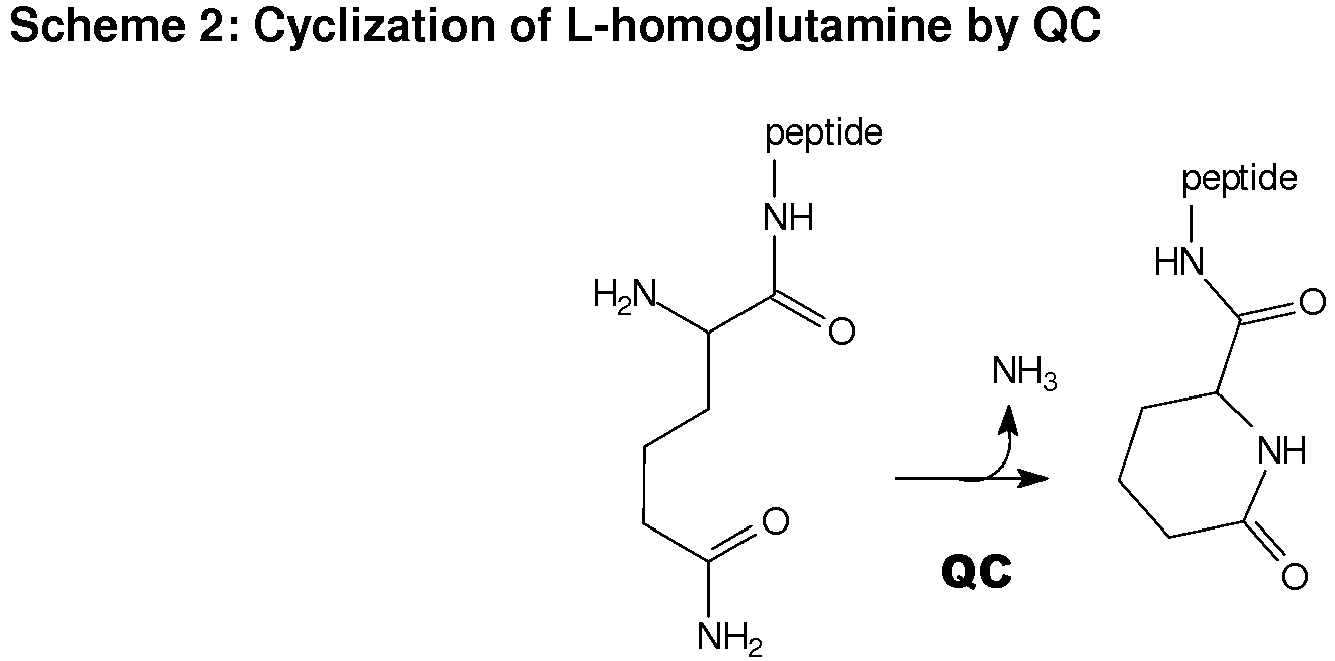
- The term "EC" as used herein comprises the activity of QC and QC-like enzymes as glutamate cyclase (EC), further defined as EC activity.
- The term "EC activity" as used herein is defined as intramolecular cyclization of N-terminal glutamate residues into pyroglutamic acid (pGlu*) by QC. See therefore scheme 3.


- The term "QC-inhibitor" "glutaminyl cyclase inhibitor" is generally known to a person skilled in the art and means enzyme inhibitors, which inhibit the catalytic activity of glutaminyl cyclase (QC) or its glutamyl cyclase (EC) activity.
- In light of the correlation with QC inhibition, in preferred embodiments, the subject method and medical use utilize an agent with an IC50 for QC inhibition of 10 µM or less, more preferably of 1 µM or less, even more preferably of 0.1 µM or less or 0.01 µM or less, or most preferably 0.001 µM or less. Indeed, inhibitors with Ki values in the lower micromolar, preferably the nanomolar and even more preferably the picomolar range are contemplated. Thus, while the active agents are described herein, for convenience, as "QC inhibitors", it will be understood that such nomenclature is not intending to limit the subject of the invention to a particular mechanism of action.
- In general, the QC inhibitors of the subject method or medical use will be small molecules, e.g., with molecular weights of 500 g/mole or less, 400 g/mole or less, preferably of 350 g/mole or less, and even more preferably of 300 g/mole or less and even of 250 g/mole or less.
- The term "subject" as used herein, refers to an animal, preferably a mammal, most preferably a human, who has been the object of treatment, observation or experiment.
- The term "therapeutically effective amount" as used herein, means that amount of active compound or pharmaceutical agent that elicits the biological or medicinal response in a tissue system, animal or human being sought by a researcher, veterinarian, medical doctor or other clinician, which includes alleviation of the symptoms of the disease or disorder being treated.
- As used herein, the term "pharmaceutically acceptable" embraces both human and veterinary use: For example the term "pharmaceutically acceptable" embraces a veterinarily acceptable compound or a compound acceptable in human medicine and health care.
- Throughout the description and the claims the expression "alkyl", unless specifically limited, denotes a C1-12 alkyl group, suitably a C1-8 alkyl group, e.g. C1-6 alkyl group, e.g. C1-4 alkyl group. Alkyl groups may be straight chain or branched. Suitable alkyl groups include, for example, methyl, ethyl, propyl (e.g. n-propyl and isopropyl), butyl (e.g n-butyl, iso-butyl, sec-butyl and tert-butyl), pentyl (e.g. n-pentyl), hexyl (e.g. n-hexyl), heptyl (e.g. n-heptyl) and octyl (e.g. n-octyl). The expression "alk", for example in the expressions "alkoxy", "haloalkyl" and "thioalkyl" should be interpreted in accordance with the definition of "alkyl". Exemplary alkoxy groups include methoxy, ethoxy, propoxy (e.g. n-propoxy), butoxy (e.g. n-butoxy), pentoxy (e.g. n-pentoxy), hexoxy (e.g. n-hexoxy), heptoxy (e.g. n-heptoxy) and octoxy (e.g. n-octoxy). Exemplary thioalkyl groups include methylthio-. Exemplary haloalkyl groups include fluoroalkyl e.g. CF3.
- The expression "alkenyl", unless specifically limited, denotes a C2-12 alkenyl group, suitably a C2-6 alkenyl group, e.g. a C2-4 alkenyl group, which contains at least one double bond at any desired location and which does not contain any triple bonds. Alkenyl groups may be straight chain or branched. Exemplary alkenyl groups including one double bond include propenyl and butenyl. Exemplary alkenyl groups including two double bonds include pentadienyl, e.g. (1 E, 3E)-pentadienyl.
- The expression "alkynyl", unless specifically limited, denotes a C2-12 alkynyl group, suitably a C2-6 alkynyl group, e.g. a C2-4 alkynyl group, which contains at least one triple bond at any desired location and may or may not also contain one or more double bonds. Alkynyl groups may be straight chain or branched. Exemplary alkynyl groups include propynyl and butynyl.
- The expression "alkylene" denotes a chain of formula -(CH2)n- wherein n is an integer e.g. 2-5, unless specifically limited.
- The expression "cycloalkyl", unless specifically limited, denotes a C3-10 cycloalkyl group (i.e. 3 to 10 ring carbon atoms), more suitably a C3-8 cycloalkyl group, e.g. a C3-6 cycloalkyl group. Exemplary cycloalkyl groups include cyclopropyl, cyclobutyl, cyclopentyl, cyclohexyl, cycloheptyl and cyclooctyl. A most suitable number of ring carbon atoms is three to six.
- The expression "heterocyclyl", unless specifically limited, refers to a carbocyclyl group wherein one or more (e.g. 1, 2 or 3) ring atoms are replaced by heteroatoms selected from N, S and O. A specific example of a heterocyclyl group is a cycloalkyl group (e.g. cyclopentyl or more particularly cyclohexyl) wherein one or more (e.g. 1, 2 or 3, particularly 1 or 2, especially 1) ring atoms are replaced by heteroatoms selected from N, S or O. Exemplary heterocyclyl groups containing one hetero atom include pyrrolidine, tetrahydrofuran and piperidine, and exemplary heterocyclyl groups containing two hetero atoms include morpholine, piperazine, dioxolane and dioxane. A further specific example of a heterocyclyl group is a cycloalkenyl group (e.g. a cyclohexenyl group) wherein one or more (e.g. 1, 2 or 3, particularly 1 or 2, especially 1) ring atoms are replaced by heteroatoms selected from N, S and O. An example of such a group is dihydropyranyl (e.g. 3,4-dihydro-2H-pyran-2-yl-).
- The expression "aryl", unless specifically limited, denotes a C6-12 aryl group, suitably a C6-10 aryl group, more suitably a C6-8 aryl group. Aryl groups will contain at least one aromatic ring (e.g. one, two or three rings). An example of a typical aryl group with one aromatic ring is phenyl. An example of a typical aryl group with two aromatic rings is naphthyl.
- The expression "heteroaryl", unless specifically limited, denotes an aryl residue, wherein one or more (e.g. 1, 2, 3, or 4, suitably 1, 2 or 3) ring atoms are replaced by heteroatoms selected from N, S and O, or else a 5-membered aromatic ring containing one or more (e.g. 1, 2, 3, or 4, suitably 1, 2 or 3) ring atoms selected from N, S and O. Exemplary monocyclic heteroaryl groups having one heteroatom include: five membered rings (e.g. pyrrole, furan, thiophene); and six membered rings (e.g. pyridine, such as pyridin-2-yl, pyridin-3-yl and pyridin-4-yl). Exemplary monocyclic heteroaryl groups having two heteroatoms include: five membered rings (e.g. pyrazole, oxazole, isoxazole, thiazole, isothiazole, imidazole, such as imidazol-1-yl, imidazol-2-yl imidazol-4-yl); six membered rings (e.g. pyridazine, pyrimidine, pyrazine). Exemplary monocyclic heteroaryl groups having three heteroatoms include: 1,2,3-triazole and 1,2,4-triazole. Exemplary monocyclic heteroaryl groups having four heteroatoms include tetrazole. Exemplary bicyclic heteroaryl groups include: indole (e.g. indol-6-yl), benzofuran, benzthiophene, quinoline, isoquinoline, indazole, benzimidazole, benzthiazole, quinazoline and purine.
- The expression "-alkylaryl", unless specifically limited, denotes an aryl residue which is connected via an alkylene moiety e.g. a C1-4alkylene moiety.
- The expression "-alkylheteroaryl", unless specifically limited, denotes a heteroaryl residue which is connected via an alkylene moiety e.g. a C1-4alkylene moiety.
- The term "halogen" or "halo" comprises fluorine (F), chlorine (Cl) and bromine (Br).
- The term "amino" refers to the group -NH2.
- The term "phenyl substituted by phenyl" refers to biphenyl.
- The term "" denotes a single bond where the stereochemistry is not defined.

- When benzimidazolyl is shown as benzimidazol-5-yl, which is represented as:

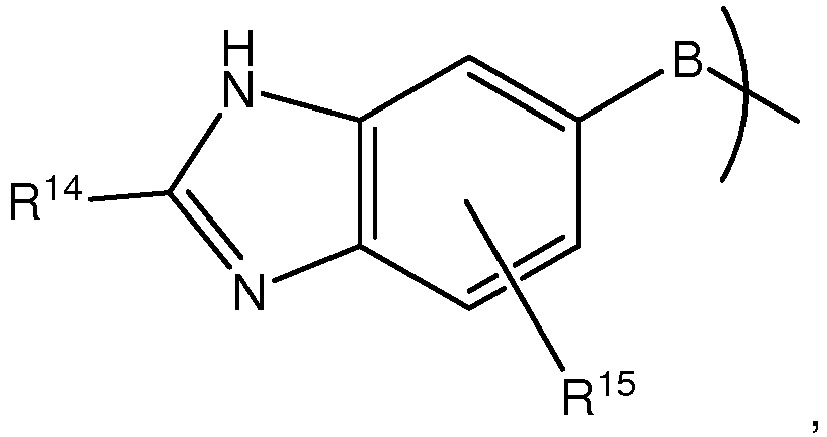
- All possible stereoisomers of the claimed compounds are included in the present invention.
- Where the compounds according to this invention have at least one chiral center, they may accordingly exist as enantiomers. Where the compounds possess two or more chiral centers, they may additionally exist as diastereomers. It is to be understood that all such isomers and mixtures thereof are encompassed within the scope of the present invention.
- Where the processes for the preparation of the compounds according to the invention give rise to a mixture of stereoisomers, these isomers may be separated by conventional techniques such as preparative chromatography. The compounds may be prepared in racemic form, or individual enantiomers may be prepared either by enantiospecific synthesis or by resolution. The compounds may, for example, be resolved into their components enantiomers by standard techniques, such as the formation of diastereomeric pairs by salt formation with an optically active acid, such as (-)-di-p-toluoyl-d-tartaric acid and/or (+)-di-p-toluoyl-I-tartaric acid followed by fractional crystallization and regeneration of the free base. The compounds may also be resolved by formation of diastereomeric esters or amides, followed by chromatographic separation and removal of the chiral auxiliary. Alternatively, the compounds may be resolved using a chiral HPLC column.
- In view of the close relationship between the free compounds and the compounds in the form of their salts or solvates, whenever a compound is referred to in this context, a corresponding salt, solvate or polymorph is also intended, provided such is possible or appropriate under the circumstances.
- Salts and solvates of the compounds of formula (I) and physiologically functional derivatives thereof which are suitable for use in medicine are those wherein the counter-ion or associated solvent is pharmaceutically acceptable. However, salts and solvates having non-pharmaceutically acceptable counter-ions or associated solvents are within the scope of the present invention, for example, for use as intermediates in the preparation of other compounds and their pharmaceutically acceptable salts and solvates.
- Suitable salts according to the invention include those formed with both organic and inorganic acids or bases. Pharmaceutically acceptable acid addition salts include those formed from hydrochloric, hydrobromic, sulfuric, nitric, citric, tartaric, phosphoric, lactic, pyruvic, acetic, trifluoroacetic, triphenylacetic, sulfamic, sulfanilic, succinic, oxalic, fumaric, maleic, malic, mandelic, glutamic, aspartic, oxaloacetic, methanesulfonic, ethanesulfonic, arylsulfonic (for example p-toluenesulfonic, benzenesulfonic, naphthalenesulfonic or naphthalenedisulfonic), salicylic, glutaric, gluconic, tricarballylic, cinnamic, substituted cinnamic (for example, phenyl, methyl, methoxy or halo substituted cinnamic, including 4-methyl and 4-methoxycinnamic acid), ascorbic, oleic, naphthoic, hydroxynaphthoic (for example 1- or 3-hydroxy-2-naphthoic), naphthaleneacrylic (for example naphthalene-2-acrylic), benzoic, 4-methoxybenzoic, 2- or 4-hydroxybenzoic, 4-chlorobenzoic, 4-phenylbenzoic, benzeneacrylic (for example 1,4-benzenediacrylic), isethionic acids, perchloric, propionic, glycolic, hydroxyethanesulfonic, pamoic, cyclohexanesulfamic, salicylic, saccharinic and trifluoroacetic acid. Pharmaceutically acceptable base salts include ammonium salts, alkali metal salts such as those of sodium and potassium, alkaline earth metal salts such as those of calcium and magnesium and salts with organic bases such as dicyclohexylamine and N-methyl-D-glucamine.
- All pharmaceutically acceptable acid addition salt forms of the compounds of the present invention are intended to be embraced by the scope of this invention.
- Furthermore, some of the crystalline forms of the compounds may exist as polymorphs and as such are intended to be included in the present invention. In addition, some of the compounds may form solvates with water (i.e. hydrates) or common organic solvents, and such solvates are also intended to be encompassed within the scope of this invention. The compounds, including their salts, can also be obtained in the form of their hydrates, or include other solvents used for their crystallization.
- Prodrugs:
- The present disclosure further relates to prodrugs of the compounds of this invention. In general, such prodrugs will be functional derivatives of the compounds which are readily convertible in vivo into the desired therapeutically active compound. Furthermore, in the present disclosure, the term "administering" shall encompass the use of prodrug versions of one or more of the claimed compounds in the treatment of the various disorders described , but which converts to the above specified compound in vivo after administration to the subject.
- Conventional procedures for the selection and preparation of suitable prodrug derivatives are described, for example, in "Design of Prodrugs", ed. H. Bundgaard, Elsevier, 1985.
- During any of the processes for preparation of the compounds of the present invention, it may be necessary and/or desirable to protect sensitive or reactive groups on any of the molecules concerned. This may be achieved by means of conventional protecting groups, such as those described in Protective Groups in Organic Chemistry, ed. J.F.W. McOmie, Plenum Press, 1973; and T.W. Greene & P.G.M. Wuts, Protective Groups in Organic Synthesis, John Wiley & Sons, 1991. The protecting groups may be removed at a convenient subsequent stage using methods known from the art.
- As used herein, the term "composition" is intended to encompass a product comprising the claimed compounds in the therapeutically effective amounts, as well as any product which results, directly or indirectly, from combinations of the claimed compounds.
- Thus, for liquid oral preparations, such as for example, suspensions, elixirs and solutions, suitable carriers and additives may advantageously include water, glycols, oils, alcohols, flavoring agents, preservatives, coloring agents and the like; for solid oral preparations such as, for example, powders, capsules, gelcaps and tablets, suitable carriers and additives include starches, sugars, diluents, granulating agents, lubricants, binders, disintegrating agents and the like.
- Carriers, which can be added to the mixture, include necessary and inert pharmaceutical excipients, including, but not limited to, suitable binders, suspending agents, lubricants, flavorants, sweeteners, preservatives, coatings, disintegrating agents, dyes and coloring agents.
- Soluble polymers as targetable drug carriers can include polyvinylpyrrolidone, pyran copolymer, polyhydroxypropylmethacrylamidephenol, polyhydroxyethylaspartamide-phenol, or polyethyleneoxidepolyllysine substituted with palmitoyl residue. Furthermore, the compounds of the present invention may be coupled to a class of biodegradable polymers useful in achieving controlled release of a drug, for example, polyactic acid, polyepsilon caprolactone, polyhydroxy butyeric acid, polyorthoesters, polyacetals, polydihydropyrans, polycyanoacrylates and cross-linked or amphipathic block copolymers of hydrogels.
- Suitable binders include, without limitation, starch, gelatin, natural sugars such as glucose or betalactose, corn sweeteners, natural and synthetic gums such as acacia, tragacanth or sodium oleate, sodium stearate, magnesium stearate, sodium benzoate, sodium acetate, sodium chloride and the like.
- Disintegrators include, without limitation, starch, methyl cellulose, agar, bentonite, xanthan gum and the like.
- According to the invention there is provided a compound of formula (I):

- R1 represents hydrogen, halogen, -C1-6alkyl, C2-6alkenyl, C2-6alkynyl, -aryl, -C1-6alkylaryl,-cycloalkyl, -C1-6alkylcycloalkyl, -heteroaryl, -C1-6alkylheteroaryl, -heterocyclyl, -C1-6alkylheterocyclyl, -cycloalkyl substituted by phenyl, -cycloalkyl substituted by phenoxy, - phenyl substituted by cycloalkyl, -phenyl substituted by phenoxy, -phenyl substituted by phenyl, heterocyclyl substituted by phenyl, heteroaryl substituted by phenyl, phenyl substituted by heterocyclyl, phenyl substituted by heteroaryl, phenyl substituted by -O-cycloalkyl, phenyl substituted by -heterocyclyl-phenyl or phenyl substituted by -cycloalkyl-heterocyclyl;
and in which any of aforesaid aryl, cycloalkyl, heterocyclyl, heteroaryl, phenyl or phenoxy groups may optionally be substituted by one or more Rb groups selected from C1-6alkyl, C2-6alkenyl, C2-6alkynyl, C1-6haloalkyl, -C1-6thioalkyl, -SOC1-4alkyl,-SO2C1-4alkyl, C1-6alkoxy-, C1-6haloalkoxy, -O-C3-8cycloalkyl, C3-8cycloalkyl, -SO2C3-8cycloalkyl, -SOC3-6cycloalkyl, C3-6alkenyloxy-, C3-6alkynyloxy-, -C(O)C1-6alkyl,-C(O)OC1-6alkyl, C1-6alkoxy-C1-6alkyl-, nitro, halogen, cyano, hydroxyl, =O, -C(O)OH,-NH2, -NHC1-4alkyl, -N(C1-4alkyl)(C1-4alkyl), -C(O)N(C1-4alkyl)(C1-4alkyl), -C(O)NH2,-C(O)NH(C1-4alkyl) and -C(O)NH(C3-10cycloalkyl); - R2 represents -O-C1-6alkyl, -NR3R4 or -O-C1-6haloalkyl;
- R3 and R4 independently represent hydrogen, C1-6alkyl or C3-8cycloalkyl; or R3 and R4 together with the nitrogen atom to which they are attached may form a heterocyclyl group optionally substituted by one or more Rb groups;
- n represents an integer selected from 0 to 3; and
- Ra represents C1-6alkyl, C2-6alkenyl, C2-6alkynyl, C1-6haloalkyl, -C1-6thioalkyl, -SOC1-4alkyl,-SO2C1-4alkyl, C1-6alkoxy-, -O-C3-8cycloalkyl, C3-8cycloalkyl, -SO2C3-8cycloalkyl, -SOC3-6cycloalkyl, C3-6alkenyloxy-, C3-6alkynyloxy-, -C(O)C1-6alkyl, -C(O)OC1-6alkyl, C1-6alkoxy-C1-6alkyl-, nitro, halogen, cyano, hydroxyl, -C(O)OH, -NH2, -NHC1-4alkyl, -N(C1-4alkyl)(C1-4alkyl),-C(O)N(C1-4alkyl)(C1-4alkyl), -C(O)NH2, -C(O)NH(C1-4alkyl) and -C(O)NH(C3-10cycloalkyl).
- According to one particular aspect of the invention there is provided a compound of formula (I):
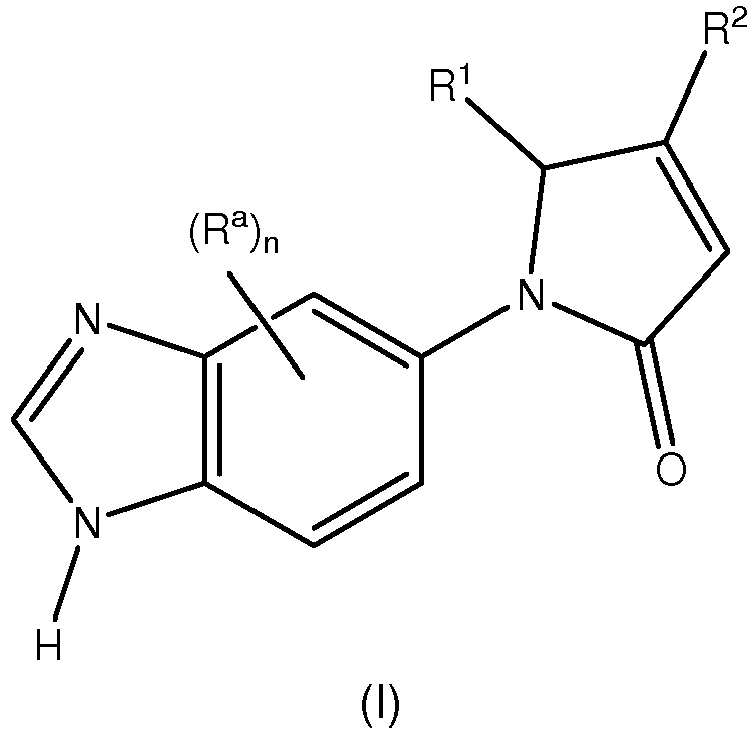
- R1 represents hydrogen, halogen, -C1-6alkyl, C2-6alkenyl, C2-6alkynyl, -aryl, -C1-6alkylaryl,-cycloalkyl, -C1-6alkylcycloalkyl, -heteroaryl, -C1-6alkylheteroaryl, -heterocyclyl, -C1-6alkylheterocyclyl, -cycloalkyl substituted by phenyl, -cycloalkyl substituted by phenoxy,-phenyl substituted by cycloalkyl, -phenyl substituted by phenoxy, -phenyl substituted by phenyl, heterocyclyl substituted by phenyl, heteroaryl substituted by phenyl, phenyl substituted by heterocyclyl, phenyl substituted by heteroaryl, phenyl substituted by -O-cycloalkyl or phenyl substituted by -cycloalkyl-heterocyclyl;
and in which any of aforesaid aryl, cycloalkyl, heterocyclyl, heteroaryl, phenyl or phenoxy groups may optionally be substituted by one or more groups selected from C1-6alkyl, C2-6alkenyl, C2-6alkynyl, C1-6haloalkyl, -C1-6thioalkyl, -SOC1-4alkyl, -SO2C1-4alkyl, C1-6alkoxy-, -O-C3-8cycloalkyl, C3-8cycloalkyl, -SO2C3-8cycloalkyl, -SOC3-6cycloalkyl, C3-6alkenyloxy-, C3-6alkynyloxy-, -C(O)C1-6alkyl, -C(O)OC1-6alkyl, C1-6alkoxy-C1-6alkyl-, nitro, halogen, cyano, hydroxyl, -C(O)OH, -NH2, -NHC1-4alkyl,-N(C1-4alkyl)(C1-4alkyl), -C(O)N(C1-4alkyl)(C1-4alkyl), -C(O)NH2, -C(O)NH(C1-4alkyl) and-C(O)NH(C3-10cycloalkyl); - R2 represents -O-C1-6alkyl or -O-C1-6haloalkyl;
- n represents an integer selected from 0 to 3; and
- Ra represents C1-6alkyl, C2-6alkenyl, C2-6alkynyl, C1-6haloalkyl, -C1-6thioalkyl, -SOC1-4alkyl,-SO2C1-4alkyl, C1-6alkoxy-, -O-C3-8cycloalkyl, C3-8cycloalkyl, -SO2C3-8cycloalkyl, -SOC3-6cycloalkyl, C3-6alkenyloxy-, C3-6alkynyloxy-, -C(O)C1-6alkyl, -C(O)OC1-6alkyl, C1-6alkoxy-C1-6alkyl-, nitro, halogen, cyano, hydroxyl, -C(O)OH, -NH2, -NHC1-4alkyl, -N(C1-4alkyl)(C1-4alkyl),-C(O)N(C1-4alkyl)(C1-4alkyl), -C(O)NH2, -C(O)NH(C1-4alkyl) and -C(O)NH(C3-10cycloalkyl). When cycloalkyl and heterocyclyl are substituted, they are typically substituted by 1 or 2 substituents (e.g. 1 substituent). Typically the substituent is C1-6 alkyl (i.e. methyl) or halogen (i.e. chlorine or fluorine). More typically cycloalkyl and heterocyclyl groups are unsubstituted. When aryl and heteroaryl are substituted, they are typically substituted by 1, 2 or 3 (e.g. 1 or 2) substituents. Substituents for aryl and heteroaryl are selected from C1-6alkyl (e.g. methyl), C2-6alkenyl (e.g. buten-3-yl), C2-6alkynyl (e.g. butyn-3-yl), C1-6haloalkyl (e.g. fluoromethyl, trifluoromethyl), -C1-6thioalkyl (e.g. -S-methyl), -SOC1-4alkyl (e.g. -SOmethyl), -SO2C1-4alkyl (e.g. -SO2methyl), C1-6alkoxy- (e.g. methoxy, ethoxy), -O-C3-8cycloalkyl (e.g. -O-cyclopentyl), C3-8cycloalkyl (e.g. cyclopropyl, cyclohexyl), -SO2C3-8cycloalkyl (e.g. -SO2cyclohexyl), -SOC3-6cycloalkyl (e.g. -SOcyclopropyl), C3-6alkenyloxy- (e.g. -O-buten-2-yl), C3-6alkynyloxy- (e.g.-O-buten-2-yl), -C(O)C1-6alkyl (e.g. -C(O)ethyl), -C(O)OC1-6alkyl (e.g. -C(O)O-methyl), C1-6alkoxy-C1-6alkyl- (e.g. methoxy-ethyl-), nitro, halogen (e.g. fluoro, chloro, bromo), cyano, hydroxyl, -C(O)OH, -NH2, -NHC1-4alkyl (e.g. -NHmethyl), -N(C1-4alkyl)(C1-4alkyl) (e.g.-N(methyl)2), -C(O)N(C1-4alkyl)(C1-4alkyl) (e.g. -C(O)N(methyl)2), -C(O)NH2, -C(O)NH(C1-4alkyl) (e.g. -C(O)NHmethyl), -C(O)NH(C3-10cycloalkyl) (e.g. -C(O)NHcyclopropyl). More typically, substituents will be selected from C1-6alkyl (e.g. methyl), C1-6haloalkyl (e.g. C1-6fluoroalkyl, e.g. CF3), C1-6alkoxy (e.g. OMe), halogen and hydroxy.
- When R1 represents -C1-6alkylcycloalkyl, -C1-6alkylaryl, -C1-6alkyl-heteroaryl or -C1-6alkyl-heterocyclyl, examples wherein alkyl is branched include:

- When R1 represents aryl or -C1-6alkylaryl, said aryl suitably represents optionally substituted phenyl. Exemplary substituted phenyl groups for R1 include 2-bromophenyl, 2-bromo-4-fluorophenyl-, 2-bromo-5-fluorophenyl-, 2-fluoro-5-bromophenyl, 2-chlorophenyl-, 2-fluorophenyl-, 3-chlorophenyl-, 3-bromophenyl-, 3-fluorophenyl-, 4-chlorophenyl-, 4-fluorophenyl-, 4-bromophenyl-, 4-bromo-2-fluorophenyl, 2-chloro-3,6-difluorophenyl), 2,3-dichlorophenyl-, 2,3-difluorophenyl-, 2,3,4-trifluorophenyl, 2,3,5-trifluorophenyl, 2,4-dichlorophenyl-, 2,4-difluororophenyl-, 2,4,6-trifluorophenyl-, 2,5-dichlorophenyl-, 2,6-dichlorophenyl-, 2,6-difluorophenyl-, 3,4-dichlorophenyl-, 3,4-difluorophenyl-, 3,5-difluorophenyl-, 2,4,5-trifluorophenyl-, 3,4,5-trifluorophenyl-, 2,4-dimethylphenyl-, 3-methylphenyl-, 3,4-dimethylphenyl-, 4-methylphenyl-, 4-isopropylphenyl-, 4-tert-butylphenyl-, 2,4,6-trimethylphenyl-, 2-isopropyl-6-methylphenyl-, 2-(trifluoromethyl)phenyl-, 4-(trifluoromethyl)phenyl-, 2,4-bis(trifluoromethyl)phenyl-, 3,5-bis(trifluoromethyl)phenyl-, 2-methoxyphenyl-, 2,4-dimethoxyphenyl-, 2,6-dimethoxyphenyl-, 3-methoxyphenyl-, 4-methoxyphenyl-, 4-ethoxyphenyl-, 4-propoxyphenyl-, 4-butoxyphenyl-, 4-pentoxyphenyl-, 4-isopropyloxyphenyl-, 3-(cyclopentyloxy)-4-methoxyphenyl-, 3,4,5-trimethoxyphenyl-, 3,4-dimethoxyphenyl-, 3,5-dimethoxyphenyl-, 4-tetrafluoroethyloxyphenyl, 4-cyanophenyl-, 4-thiomethylphenyl- and 4-dimethylaminophenyl. Alternatively, R2 may represent unsubstituted phenyl-. Further exemplary substituted phenyl groups include 2,3-difluoro-4-methylphenyl, 2-fluoro-5-(trifluoromethyl)phenyl-, 2-hydroxy-3-methoxyphenyl-, 2-hydroxy-5-methylphenyl-, 3-fluoro-4-(trifluoromethyl)phenyl-, 3-fluoro-5-(trifluoromethyl)phenyl-, 2-fluoro-4-(trifluoromethyl)phenyl-, 2-fluoro-3-(methyl)phenyl-, 3-fluoro-4-(methoxy)phenyl-, 3-hydroxy-4-methoxyphenyl-, 4-chloro-3-(trifluoromethyl)phenyl-, 4-chloro-3-methylphenyl, 4-bromo-4-ethylphenyl, 2,3,5,6-tetrafluoro-4-(methyl)phenyl-, 2,6-difluoro-4-(methoxy)phenyl- and 2-fluoro-4,5-(dimethoxy)phenyl-.
- When R1 represents aryl or -C1-6alkylaryl, said aryl suitably represents optionally substituted naphthyl. Examples include unsubstituted naphthyl (e.g. naphthalen-1-yl, naphthalen-2-yl, naphthalen-3-yl) as well as substituted naphthyl (e.g. 4-methyl-naphthalen-2-yl-, 5-methyl-naphthalen-3-yl-, 7-methyl-naphthalen-3-y- and 4-fluoro-naphthalen-2-yl-).
- When R1 represents cycloalkyl or -C1-6alkylcycloalkyl said cycloalkyl suitably represents optionally substituted cycloalkyl. Examples of cycloalkyl include cyclopropyl, cyclobutyl, cyclopentyl, cyclohexyl and cycloheptyl. Examples of substituted carbocyclyl include 2-methyl-cyclohexyl-, 3-methyl-cyclohexyl-, 4-methyl-cyclohexyl- and 4,4-difluorocyclohexyl.
- When R1 represents optionally substituted heteroaryl, examples include monocyclic rings (e.g. 5 or 6 membered rings) and bicyclic rings (e.g. 9 or 10 membered rings) which may optionally be substituted. Example 5 membered rings include pyrrolyl (e.g. pyrrol-2-yl) and imidazolyl (e.g. 1H-imidazol-2-yl or 1H-imidazol-4-yl), pyrazolyl (e.g. 1H-pyrazol-3-yl), furanyl (e.g. furan-2-yl), thiazolyl (e.g. thiazol-2-yl), thiophenyl (e.g. thiophen-2-yl, thiophen-3-yl). Example 6 membered rings include pyridinyl (e.g. pyridin-2-yl and pyridin-4-yl). Specific substituents that may be mentioned are one or more e.g. 1, 2 or 3 groups selected from halogen, hydroxyl, alkyl (e.g. methyl) and alkoxy- (e.g. methoxy-). Example substituted 5 membered rings include 4,5-dimethyl-furan-2-yl-, 5-hydroxymethyl-furan-2-yl-, 5-methylfuran-2-yl- and 6-methyl-pyridin-2-yl-. An example substituted 6-membered ring is 1-oxy-pyridin-4-yl-. Example 9 membered rings include 1H-indolyl (e.g. 1H-indol-3-yl, 1H-indol-5-yl), benzothiophenyl (e.g. benzo[b]thiophen-3-yl, particularly 2-benzo[b]thiophen-3-yl), benzo[1,2,5]-oxadiazolyl (e.g. benzo[1,2,5]-oxadiazol-5-yl), benzo[1,2,5]-thiadiazolyl (e.g. benzo[1,2,5]-thiadiazol-5-yl, benzo[1,2,5]thiadiazol-6-yl). Example 10 membered rings include quinolinyl (e.g.quinolin-3-yl, quinolin-4-yl, quinolin-8-yl). Specific substituents that may be mentioned are one or more e.g. 1, 2 or 3 groups selected from halogen, hydroxyl, alkyl (e.g. methyl) and alkoxy- (e.g. methoxy-). Example substituted 9-membered rings include 1-methyl-1H-indol-3-yl, 2-methyl-1H-indol-3-yl, 6-methyl-1H-indol-3-yl. Example substituted 10 membered rings include 2-chloro-quinolin-3-yl, 8-hydroxy-quinolin-2-yl, oxo-chromenyl (e.g. 4-oxo-4H-chromen-3-yl) and 6-methyl-4-oxo-4H-chromen-3-yl.
- When R1 represents heterocyclyl (which may optionally be substituted), examples include tetrahydrofuranyl, morpholinyl, piperdinyl, 3,4-dihydro-2H-pyranyl, tetrahydropyranyl, pyrrolidinyl, methyltetrahydrofuranyl- (e.g. 5-methyltetrahydrofuran-2-yl-).
- When R1 represents phenyl substituted by phenyl, phenyl substituted by a heteroaryl group (such as a monocyclic heteroaryl) or phenyl substituted by heterocyclyl (such as a monocyclic heterocyclyl), in which any of aforesaid phenyl, heteroaryl and heterocyclyl groups may optionally be substituted, typically the phenyl ring connected directly to the nitrogen atom is unsubstituted and the terminal phenyl ring or the monocyclic heteroaryl and heterocyclyl ring is optionally substituted by one, two or three substitutents (e.g. one or two, e.g. one). Typically the terminal phenyl, monocyclic heteroaryl or monocyclic heterocyclyl group is unsubstituted. Typically the terminal phenyl, monocyclic heteroaryl or monocyclic heterocyclyl group substitutes the aryl ring (i.e. phenyl) at the 4-position.
- When R1 represents phenyl substituted by phenyl in which any of aforesaid phenyl groups may optionally be substituted, examples include -biphenyl-4-yl.
- When R1 represents phenyl substituted by a monocyclic heteroaryl group, in which any of aforesaid phenyl and heteroaryl groups may optionally be substituted, examples include (4-thiophen-2-yl)-benzyl- and (4-(oxazol-5-yl)phenyl-.
- When R1 represents phenyl substituted by a monocyclic heterocyclyl group, in which any of aforesaid phenyl and heterocyclyl groups may optionally be substituted, examples include 4-morpholinophenyl-, 4-(piperidin-1-yl)phenyl-, 4-(1-methylpiperidin-4-yl)phenyl- and 4-(tetrahydro-2H-pyran-4-yl)phenyl-.
- When R1 represents phenyl substituted by phenyloxy in which any of aforesaid phenyl and phenyloxy groups may optionally be substituted, examples include 4-benzyloxy-phenyl-, 4-(3-methylbenzyloxy)phenyl- and 4-(4-methylbenzyloxy)phenyl-.
- When R1 represents -cycloalkyl substituted by phenyl in which any of aforesaid cycloalkyl and phenyl groups may optionally be substituted, examples include 4-phenylcyclohexyl-.
- When R1 represents -cycloalkyl substituted by phenoxy in which any of aforesaid cycloalkyl and phenoxy groups may optionally be substituted, examples include 4-phenoxycyclohexyl-.
- When R1 represents -phenyl substituted by phenoxy in which any of aforesaid phenyl and phenoxy groups may optionally be substituted, examples include 4-phenoxyphenyl-.
- When R1 represents -heterocyclyl substituted by phenyl in which any of aforesaid phenyl and heterocyclyl groups may optionally be substituted, examples include 1-phenylpiperidin-4-yl-.
- When R1 represents phenyl substituted by -O-cycloalkyl in which any of aforesaid phenyl and cycloalkyl groups may optionally be substituted, examples include 4-cyclohexyloxyphenyl-.
- When R1 represents -phenyl substituted by cycloalkyl in which any of aforesaid phenyl and cycloalkyl groups may optionally be substituted, examples include 4-cyclohexylphenyl- or 4,4-difluorocyclohexylphenyl-.
- When R1 represents phenyl substituted by -cycloalkyl-heterocyclyl in which any of aforesaid phenyl, cycloalkyl and heterocyclyl groups may optionally be substituted, examples include (4-morpholinocyclohexyl)phenyl-.
- Suitably, R1 represents -C1-6alkyl, -aryl, -cycloalkyl, -heteroaryl, -heterocyclyl, -cycloalkyl substituted by phenyl, -cycloalkyl substituted by phenoxy, -phenyl substituted by cycloalkyl, - phenyl substituted by phenoxy, -phenyl substituted by phenyl, heterocyclyl substituted by phenyl, heteroaryl substituted by phenyl, phenyl substituted by heterocyclyl, phenyl substituted by heteroaryl, phenyl substituted by -O-cycloalkyl, phenyl substituted by-heterocyclyl-phenyl or phenyl substituted by -cycloalkyl-heterocyclyl. Also suitably, R1 represents -C1-6alkyl, -aryl, -cycloalkyl, -heteroaryl, -heterocyclyl, -cycloalkyl substituted by phenyl, -cycloalkyl substituted by phenoxy, -phenyl substituted by cycloalkyl, -phenyl substituted by phenoxy, -phenyl substituted by phenyl, heterocyclyl substituted by phenyl, heteroaryl substituted by phenyl, phenyl substituted by heterocyclyl, phenyl substituted by heteroaryl, phenyl substituted by -O-cycloalkyl or phenyl substituted by -cycloalkyl-heterocyclyl.
- More suitably, R1 represents -C1-6alkyl, -aryl, -cycloalkyl, -heteroaryl, -cycloalkyl substituted by phenyl, -cycloalkyl substituted by phenoxy, -phenyl substituted by cycloalkyl, -phenyl substituted by phenyl, heterocyclyl substituted by phenyl, phenyl substituted by heterocyclyl, phenyl substituted by -O-cycloalkyl, phenyl substituted by -heterocyclyl-phenyl or phenyl substituted by -cycloalkyl-heterocyclyl. Also more suitably, R1 represents -C1-6alkyl, -aryl,-cycloalkyl, -heteroaryl, -cycloalkyl substituted by phenyl, -cycloalkyl substituted by phenoxy,-phenyl substituted by cycloalkyl, -phenyl substituted by phenyl, heterocyclyl substituted by phenyl, phenyl substituted by heterocyclyl, phenyl substituted by -O-cycloalkyl or phenyl substituted by -cycloalkyl-heterocyclyl.
- Yet more suitably, R1 represents -C1-6alkyl, -aryl, -cycloalkyl, -heteroaryl, -phenyl substituted by cycloalkyl, -phenyl substituted by phenyl, phenyl substituted by heterocyclyl, phenyl substituted by -heterocyclyl-phenyl or phenyl substituted by -O-cycloalkyl. Also yet more suitably, R1 represents -C1-6alkyl, -aryl, -cycloalkyl, -heteroaryl, -phenyl substituted by phenyl, phenyl substituted by heterocyclyl or phenyl substituted by -O-cycloalkyl.
- In one embodiment, R1 represents -C1-6alkyl (e.g. isopropyl), -aryl (e.g. phenyl), -cycloalkyl (e.g. cyclohexyl), -heteroaryl (e.g. quinolinyl), -cycloalkyl substituted by phenyl (e.g.-cyclohexyl-phenyl), -cycloalkyl substituted by phenoxy (e.g. -cyclohexyl-O-phenyl), -phenyl substituted by cycloalkyl (e.g. -phenyl-cyclohexyl), -phenyl substituted by phenyl (e.g.-phenyl-phenyl), heterocyclyl substituted by phenyl (e.g. -piperidinyl-phenyl), phenyl substituted by heterocyclyl (e.g. -phenyl-pyrrolidinyl, -phenyl-morpholinyl, -phenyl-thiomorpholinyl, -phenyl-piperidinyl, -phenyl-piperazinyl, -phenyl-tetrahydrothiopyranyl or-phenyl-tetrahydropyranyl), phenyl substituted by -O-cycloalkyl (e.g. -phenyl-O-cyclohexyl), phenyl substituted by -heterocyclyl-phenyl (e.g. -phenyl-piperazinyl-phenyl) or phenyl substituted by -cycloalkyl-heterocyclyl (e.g. -phenyl-cyclohexyl-morpholinyl); wherein said phenyl group is optionally substituted by one or more halogen (e.g. fluorine, bromine or chlorine), C1-6alkoxy (e.g. butoxy) or C1-6haloalkoxy (e.g. difluorobutoxy) groups; wherein said heterocyclyl group is optionally substituted by one or more C1-6 alkyl (e.g. methyl), halogen (e.g. fluorine), C3-8 cycloalkyl (e.g. cyclopropyl), hydroxyl or =O groups; and wherein said cycloalkyl group is optionally substituted by one or more halogen (e.g. fluorine) or =O groups.
- In an alternative embodiment, R1 represents -C1-6alkyl (e.g. isopropyl), -aryl (e.g. phenyl), - cycloalkyl (e.g. cyclohexyl), -heteroaryl (e.g. quinolinyl), -cycloalkyl substituted by phenyl (e.g. -cyclohexyl-phenyl), -cycloalkyl substituted by phenoxy (e.g. -cyclohexyl-O-phenyl),-phenyl substituted by cycloalkyl (e.g. -phenyl-cyclohexyl), -phenyl substituted by phenyl (e.g. -phenyl-phenyl), heterocyclyl substituted by phenyl (e.g. -piperidinyl-phenyl), phenyl substituted by heterocyclyl (e.g. -phenyl-morpholinyl, -phenyl-piperidinyl or -phenyl-tetrahydropyranyl), phenyl substituted by -O-cycloalkyl (e.g. -phenyl-O-cyclohexyl) or phenyl substituted by -cycloalkyl-heterocyclyl (e.g. -phenyl-cyclohexyl-morpholinyl); wherein said phenyl group is optionally substituted by one or more halogen (e.g. fluorine, bromine or chlorine) groups; wherein said heterocyclyl group is optionally substituted by one or more C1-6 alkyl groups (e.g. methyl); and wherein said cycloalkyl group is optionally substituted by one or more halogen (e.g. fluorine) groups.
- In a further embodiment, R1 represents -C1-6alkyl (e.g. isopropyl), -aryl (e.g. phenyl),-cycloalkyl (e.g. cyclohexyl), -heteroaryl (e.g. quinolinyl), -phenyl substituted by cycloalkyl (e.g. -phenyl-cyclohexyl), -phenyl substituted by phenyl (e.g. -phenyl-phenyl), phenyl substituted by heterocyclyl (e.g. -phenyl-pyrrolidinyl, -phenyl-morpholinyl, -phenyl-thiomorpholinyl, -phenyl-piperidinyl, -phenyl-piperazinyl, -phenyl-tetrahydrothiopyranyl or-phenyl-tetrahydropyranyl), phenyl substituted by -heterocyclyl-phenyl (e.g. -phenyl-piperazinyl-phenyl) or phenyl substituted by -O-cycloalkyl (e.g. -phenyl-O-cyclohexyl); wherein said phenyl group is optionally substituted by one or more halogen (e.g. fluorine, bromine or chlorine), C1-6alkoxy (e.g. butoxy) or C1-6haloalkoxy (e.g. difluorobutoxy) groups; wherein said heterocyclyl group is optionally substituted by one or more C1-6 alkyl (e.g. methyl), halogen (e.g. fluorine), C3-8 cycloalkyl (e.g. cyclopropyl), hydroxyl or =O groups; and wherein said cycloalkyl group is optionally substituted by one or more halogen (e.g. fluorine) or =O groups.
- In an alternative further embodiment, R1 represents -C1-6alkyl (e.g. isopropyl), -aryl (e.g. phenyl), -cycloalkyl (e.g. cyclohexyl), -heteroaryl (e.g. quinolinyl), -phenyl substituted by phenyl (e.g. -phenyl-phenyl), phenyl substituted by heterocyclyl (e.g. -phenyl-morpholinyl or -phenyl-piperidinyl) or phenyl substituted by -O-cycloalkyl (e.g. -phenyl-O-cyclohexyl); wherein said phenyl group is optionally substituted by one or more halogen (e.g. fluorine, bromine or chlorine) groups.
- In a further embodiment, R1 represents -aryl (e.g. phenyl), -phenyl substituted by cycloalkyl (e.g. -phenyl-cyclohexyl), phenyl substituted by heterocyclyl (e.g. -phenyl-pyrrolidinyl,-phenyl-morpholinyl, -phenyl-thiomorpholinyl, -phenyl-piperidinyl, -phenyl-piperazinyl, - phenyl-tetrahydrothiopyranyl or -phenyl-tetrahydropyranyl) or phenyl substituted by-heterocyclyl-phenyl (e.g. -phenyl-piperazinyl-phenyl); wherein said phenyl group is optionally substituted by one or more halogen (e.g. fluorine, bromine or chlorine), C1-6alkoxy (e.g. butoxy) or C1-6haloalkoxy (e.g. difluorobutoxy) groups; wherein said heterocyclyl group is optionally substituted by one or more C1-6 alkyl (e.g. methyl), halogen (e.g. fluorine), C3-8 cycloalkyl (e.g. cyclopropyl), hydroxyl or =O groups; and wherein said cycloalkyl group is optionally substituted by one or more halogen (e.g. fluorine) or =O groups.
- In an alternative further embodiment, R1 represents -aryl (e.g. phenyl) or phenyl substituted by heterocyclyl (e.g. -phenyl-morpholinyl or -phenyl-piperidinyl); wherein said phenyl group is optionally substituted by one or more halogen (e.g. fluorine, bromine or chlorine) groups.
- In a further embodiment, R1 represents - phenyl substituted by heterocyclyl (e.g. -phenyl-pyrrolidinyl, -phenyl-morpholinyl, -phenyl-thiomorpholinyl, -phenyl-piperidinyl, -phenyl-piperazinyl, -phenyl-tetrahydrothiopyranyl or -phenyl-tetrahydropyranyl) wherein said heterocyclyl group is optionally substituted by one or more C1-6 alkyl (e.g. methyl), halogen (e.g. fluorine), C3-8 cycloalkyl (e.g. cyclopropyl), hydroxyl or =O groups.
- In a yet further embodiment, R1 represents - phenyl substituted by heterocyclyl (e.g.-phenyl-morpholinyl or -phenyl-thiomorpholinyl) wherein said heterocyclyl group is optionally substituted by one or more =O groups (e.g. 1,1-dioxo-4-thiomorpholin-4-yl).
- In a further alternative embodiment, R1 represents - phenyl substituted by heterocyclyl (e.g.-phenyl-morpholinyl).
- In a yet further embodiment, R1 represents -aryl (e.g. phenyl) optionally substituted by one or more halogen (e.g. fluorine, bromine or chlorine), C1-6alkoxy (e.g. butoxy) or C1-6haloalkoxy (e.g. difluorobutoxy) groups. In a still yet further embodiment, R1 represents unsubstituted phenyl or phenyl substituted by one or more fluorine (e.g. 2,3-difluorophenyl or 2,3,-5-trifluorophenyl), C1-6alkoxy (e.g. 4-butoxyphenyl) or C1-6haloalkoxy (e.g. 4-difluorobutoxyphenyl) groups.
- In a yet further alternative embodiment, R1 represents -aryl (e.g. phenyl) optionally substituted by one or more halogen (e.g. fluorine, bromine or chlorine) groups. In a still yet further embodiment, R1 represents phenyl substituted by one or more fluorine groups (e.g. 2,3-difluorophenyl or 2,3,-5-trifluorophenyl).
- In a yet further embodiment, R1 represents -phenyl substituted by cycloalkyl (e.g. -phenyl-cyclohexyl), wherein said cycloalkyl group is optionally substituted by one or more halogen (e.g. 4,4-difluorocyclohexyl) or =O (e.g. 4-oxocyclohexyl) groups.
- In a yet further embodiment, R1 represents phenyl substituted by -heterocyclyl-phenyl (e.g.-phenyl-piperazinyl-phenyl).
- Suitably, R2 represents -O-C1-6alkyl or NR3R4. Also suitably, R2 represents =O or -O-C1-6alkyl.
- In one embodiment, R2 represents =O. In an alternative embodiment, R2 represents -O-C1-6alkyl (e.g. methoxy). In a yet further alternative embodiment, R2 represents NR3R4 (e.g.-NHMe, -N(Me)2), -NH-cyclohexyl or a heterocyclic group such as piperidinyl, piperazinyl or morpholinyl wherein said heterocyclic group is optionally substituted by one or more Rb groups such as halogen (e.g. fluorine) or C1-6 alkyl (e.g. methyl)).
- In a further embodiment, R2 represents -O-C1-6alkyl (e.g. methoxy) or NR3R4 (e.g.-NHMe, -N(Me)2), -NH-cyclohexyl or a heterocyclic group such as piperidinyl, piperazinyl or morpholinyl wherein said heterocyclic group is optionally substituted by one or more Rb groups such as halogen (e.g. fluorine) or C1-6 alkyl (e.g. methyl)).
- In a yet further embodiment, R2 represents -OC1-6alkyl (e.g. methoxy) or NR3R (e.g. a heterocyclic group such as piperidinyl).
- In one embodiment, one of R3 and R4 represents hydrogen and the other represents C1-6 alkyl (e.g. methyl) or C3-8 cycloalkyl (e.g. cyclohexyl). In an alternative embodiment, R3 and R4 both represent C1-6 alkyl (e.g. methyl). In an yet further alternative embodiment, R3 and R4 together with the nitrogen atom to which they are attached form a heterocyclyl group (e.g. piperidinyl, piperazinyl or morpholinyl) optionally substituted by one or more Rb groups such as halogen (e.g. fluorine) or C1-6 alkyl (e.g. methyl).
- Suitably, n represents an integer from 0 to 2, more suitably 0 or 1. In one embodiment, n represents 0. When present, it will be appreciated that the Ra substituent will be located on the phenyl ring of the benzimidazolyl group.
- In one embodiment, the compound of formula (I) is a compound according to any one of examples 1 to 33 or a pharmaceutically acceptable salt, solvate or polymorph thereof, including all tautomers and stereoisomers.
- In a further embodiment, the compound of formula (I) is a compound according to any one of examples 4, 18 and 27 or a pharmaceutically acceptable salt, solvate or polymorph thereof, including all tautomers and stereoisomers.
- In an alternative embodiment, the compound of formula (I) is a compound according to any one of examples 1 to 8 or a pharmaceutically acceptable salt, solvate or polymorph thereof, including all tautomers and stereoisomers.
- According to a further aspect of the invention there is provided a process for preparing a compound of formula (I) which comprises:
- (a) preparing a compound of formula (I) where R2 represents =O from a compound of formula (II)

- (b) interconversion of compounds of formula (I). A non-limiting example of the methodology of process (b) is described in Methods 2, 4 and 6-8 herein, for example which comprises conversion of compounds of formula (I) wherein R2 represents =O to compounds of formula (I) wherein R2 represents -O-C1-6 alkyl or -NR3R4; and/or
- (c) deprotecting a compound of formula (I) which is protected.
- Compounds of formula (I) and intermediate compounds may also be prepared using techniques analogous to those known to a skilled person, or described herein. In particular, compounds of formula (II) are disclosed in
WO 2008/055945 or may be prepared in an analogous manner to the procedures disclosed inWO 2008/055945 . - Novel intermediates are claimed as an aspect of the present invention.
- Physiological substrates of QC (EC) in mammals are, e.g. amyloid beta-peptides (3-40), (3-42), (11-40 and (11-42), ABri, ADan, Gastrin, Neurotensin, FPP, CCL 2, CCL 7, CCL 8, CCL 16, CCL 18, Fractalkine, Orexin A, [Gln3]-glucagon(3-29), [Gln5]-substance P(5-11) and the peptide QYNAD. For further details see table 1. The compounds and/or combinations according to the present invention and pharmaceutical compositions comprising at least one inhibitor of QC (EC) are useful for the treatment of conditions that can be treated by modulation of QC activity.
Table 1: Amino acid sequences of physiological active peptides with an N-terminal glutamine residue, which are prone to be cyclized to final pGlu Peptide Amino acid sequence Function Abeta(1-42) 
Plays a role in neurodegeneration, e.g. in Alzheimer's Disease, Familial British Dementia, Familial Danish Dementia, Down Syndrome Abeta(1-40) 
Plays a role in neurodegeneration, e.g. in Alzheimer's Disease, Familial British Dementia, Familial Danish Dementia, Down Syndrome Abeta(3-42) 
Plays a role in neurodegeneration, e.g. in Alzheimer's Disease, Familial British Dementia, Familial Danish Dementia, Down Syndrome Abeta(3-40) 
Plays a role in neurodegeneration, e.g. in Alzheimer's Disease, Familial British Dementia, Familial Danish Dementia, Down Syndrome Abeta(11-42) 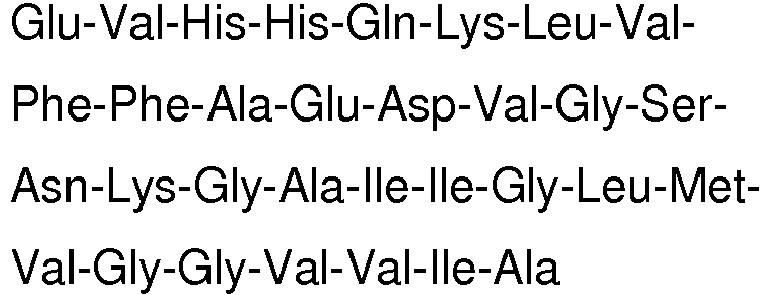
Plays a role in neurodegeneration, e.g. in Alzheimer's Disease, Familial British Dementia, Familial Danish Dementia, Down Syndrome Abeta(11-40) 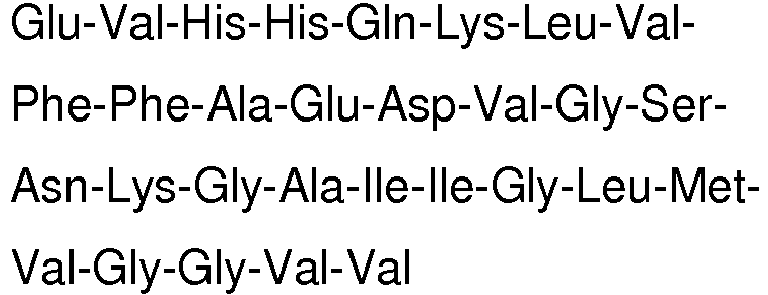
Plays a role in neurodegeneration, e.g. in Alzheimer's Disease, Familial British Dementia, Familial Danish Dementia, Down Syndrome ABri 
Pyroglutamated form plays a role in Familial British Dementia ADan 
Pyroglutamated form plays a role in Familial Danish Dementia Gastrin 17 QGPWL EEEEEAYGWM DF (amide) Gastrin stimulates the stomach mucosa to produce and secrete hydrochloric acid and the pancreas to secrete its digestive enzymes. It also stimulates smooth muscle contraction and increases blood circulation and water secretion in the stomach and intestine. Swiss-Prot: P01350 Neurotensin QLYENKPRRP YIL Neurotensin plays an endocrine or paracrine role in the regulation of fat metabolism. It causes contraction of smooth muscle. Swiss-Prot: P30990 FPP QEP amide A tripeptide related to thyrotrophin releasing hormone (TRH), is found in seminal plasma. Recent evidence obtained in vitro and in vivo showed that FPP plays an important role in regulating sperm fertility. TRH QHP amide TRH functions as a regulator of the biosynthesis of TSH in the anterior pituitary gland and as a neurotransmitter/ neuromodulator in the central and peripheral nervous systems. Swiss-Prot: P20396 GnRH QHWSYGL RP(G) amide Stimulates the secretion of gonadotropins; it stimulates the secretion of both luteinizing and follicle-stimulating hormones. Swiss-Prot: P01148 CCL16 (small inducible cytokine A16) 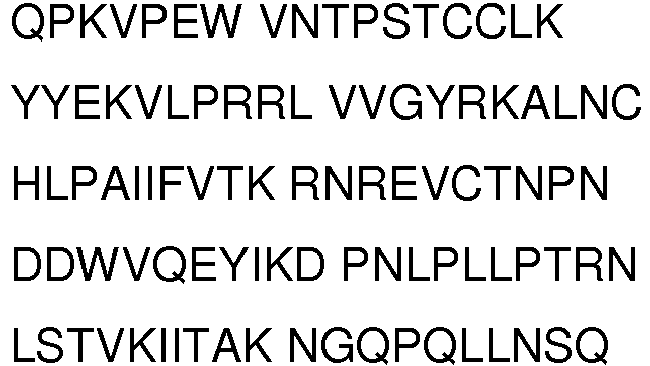
Shows chemotactic activity for lymphocytes and monocytes but not neutrophils. Also shows potent myelosuppressive activity, suppresses proliferation of myeloid progenitor cells. Recombinant SCYA16 shows chemotactic activity for monocytes and THP-1 monocytes, but not for resting lymphocytes and neutrophils. Induces a calcium flux in THP-1 cells that were desensitized by prior expression to RANTES. Swiss-Prot: 015467 CCL8 (small inducible cytokine A8) 
Chemotactic factor that attracts monocytes, lymphocytes, basophils and eosinophils. May play a role in neoplasia and inflammatory host responses. This protein can bind heparin. Swiss-Prot: P80075 CCL2 (MCP-1, small inducible cytokine A2) 
Chemotactic factor that attracts monocytes and basophils but not neutrophils or eosinophils. Augments monocyte anti-tumor activity. Has been implicated in the pathogenesis of diseases characterized by monocytic infiltrates, like psoriasis, rheumatoid arthritis or atherosclerosis. May be involved in the recruitment of monocytes into the arterial wall during the disease process of atherosclerosis. Binds to CCR2 and CCR4. Swiss-Prot: P13500 CCL18 (small inducible cytokine A18) 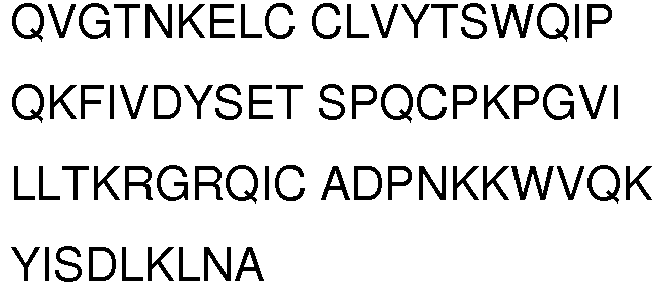
Chemotactic factor that attracts lymphocytes but not monocytes or granulocytes. May be involved in B cell migration into B cell follicles in lymph nodes. Attracts naive T lymphocytes toward dendritic cells and activated macrophages in lymph nodes, has chemotactic activity for naive T cells, CD4+ and CD8+ T cells and thus may play a role in both humoral and cell-mediated immunity responses. Swiss-Prot: P55774 Fractalkine (neurotactin) 
The soluble form is chemotactic for T cells and monocytes, but not for neutrophils. The membrane-bound form promotes adhesion of those leukocytes to endothelial cells. May play a role in regulating leukocyte adhesion and migration processes at the endothelium binds to CX3CR1. Swiss-Prot: P78423 CCL7 (small inducible cytokine A7) 
Chemotactic factor that attracts monocytes and eosinophils, but not neutrophils. Augments monocyte anti-tumor activity. Also induces the release of gelatinase B. This protein can bind heparin. Binds to CCR1, CCR2 and CCR3. Swiss-Prot: P80098 Orexin A (Hypocretin-1) 
Neuropeptide that plays a significant role in the regulation of food intake and sleep-wakefulness, possibly by coordinating the complex behavioral and physiologic responses of these complementary homeostatic functions. It plays also a broader role in the homeostatic regulation of energy metabolism, autonomic function, hormonal balance and the regulation of body fluids. Orexin-A binds to both OX1R and OX2R with a high affinity. Swiss-Prot 043612 Substance P RPK PQQFFGLM Belongs to the tachykinins. Tachykinins are active peptides which excite neurons, evoke behavioral responses, are potent vasodilators and secretagogues, and contract (directly or indirectly) many smooth muscles. QYNAD Gln-Tyr-Asn-Ala-Asp Acts on voltage-gated sodium channels. - Glutamate is found in positions 3, 11 and 22 of the amyloid β-peptide. Among them the mutation from glutamic acid (E) to glutamine (Q) in position 22 (corresponding to amyloid precursor protein APP 693, Swissprot P05067) has been described as the so called Dutch type cerebroarterial amyloidosis mutation.
- The β-amyloid peptides with a pyroglutamic acid residue in position 3, 11 and/or 22 have been described to be more cytotoxic and hydrophobic than the amyloid β-peptides 1-40(42/43) (Saido T.C. 2000 Medical Hypotheses 54(3): 427-429).
- The multiple N-terminal variations, e.g. Abeta(3-40), Abeta(3-42), Abeta(11-40) and Abeta (11-42) can be generated by the β-secretase enzyme β-site amyloid precursor protein-cleaving enzyme (BACE) at different sites (Huse J.T. et al. 2002 J. Biol. Chem. 277 (18): 16278-16284), and/or by aminopeptidase or dipeptidylaminopeptidase processing from the full lenght peptides Abeta(1-40) and Abeta(1-42). In all cases, cyclization of the then N-terminal occuring glutamic acid residue is catalyzed by QC.
- Transepithelial transducing cells, particularly the gastrin (G) cell, co-ordinate gastric acid secretion with the arrival of food in the stomach. Recent work showed that multiple active products are generated from the gastrin precursor, and that there are multiple control points in gastrin biosynthesis. Biosynthetic precursors and intermediates (progastrin and Gly-gastrins) are putative growth factors; their products, the amidated gastrins, regulate epithelial cell proliferation, the differentiation of acid-producing parietal cells and histamine-secreting enterochromaffin-like (ECL) cells, and the expression of genes associated with histamine synthesis and storage in ECL cells, as well as acutely stimulating acid secretion. Gastrin also stimulates the production of members of the epidermal growth factor (EGF) family, which in turn inhibit parietal cell function but stimulate the growth of surface epithelial cells. Plasma gastrin concentrations are elevated in subjects with Helicobacter pylori, who are known to have increased risk of duodenal ulcer disease and gastric cancer (Dockray, G.J. 1999 J Physiol 15 315-324).
- The peptide hormone gastrin, released from antral G cells, is known to stimulate the synthesis and release of histamine from ECL cells in the oxyntic mucosa via CCK-2 receptors. The mobilized histamine induces acid secretion by binding to the H(2) receptors located on parietal cells. Recent studies suggest that gastrin, in both its fully amidated and less processed forms (progastrin and glycine-extended gastrin), is also a growth factor for the gastrointestinal tract. It has been established that the major trophic effect of amidated gastrin is for the oxyntic mucosa of stomach, where it causes increased proliferation of gastric stem cells and ECL cells, resulting in increased parietal and ECL cell mass. On the other hand, the major trophic target of the less processed gastrin (e.g. glycine-extended gastrin) appears to be the colonic mucosa (Koh, T.J. and Chen, D. 2000 Regul Pept 9337-44).
- Neurotensin (NT) is a neuropeptide implicated in the pathophysiology of schizophrenia that specifically modulates neurotransmitter systems previously demonstrated to be misregulated in this disorder. Clinical studies in which cerebrospinal fluid (CSF) NT concentrations have been measured revealed a subset of schizophrenic patients with decreased CSF NT concentrations that are restored by effective antipsychotic drug treatment. Considerable evidence also exists concordant with the involvement of NT systems in the mechanism of action of antipsychotic drugs. The behavioral and biochemical effects of centrally administered NT remarkably resemble those of systemically administered antipsychotic drugs, and antipsychotic drugs increase NT neurotransmission. This concatenation of findings led to the hypothesis that NT functions as an endogenous antipsychotic. Moreover, typical and atypical antipsychotic drugs differentially alter NT neurotransmission in nigrostriatal and mesolimbic dopamine terminal regions, and these effects are predictive of side effect liability and efficacy, respectively (Binder, E. B. et al. 2001 Biol Psychiatry 50 856-872).
- Fertilization promoting peptide (FPP), a tripeptide related to thyrotrophin releasing hormone (TRH), is found in seminal plasma. Recent evidence obtained in vitro and in vivo showed that FPP plays an important role in regulating sperm fertility. Specifically, FPP initially stimulates nonfertilizing (uncapacitated) spermatozoa to "switch on" and become fertile more quickly, but then arrests capacitation so that spermatozoa do not undergo spontaneous acrosome loss and therefore do not lose fertilizing potential. These responses are mimicked, and indeed augmented, by adenosine, known to regulate the adenylyl cyclase (AC)/cAMP signal transduction pathway. Both FPP and adenosine have been shown to stimulate cAMP production in uncapacitated cells but inhibit it in capacitated cells, with FPP receptors somehow interacting with adenosine receptors and G proteins to achieve regulation of AC. These events affect the tyrosine phosphorylation state of various proteins, some being important in the initial "switching on", others possibly being involved in the acrosome reaction itself. Calcitonin and angiotensin II, also found in seminal plasma, have similar effects in vitro on uncapacitated spermatozoa and can augment responses to FPP. These molecules have similar effects in vivo, affecting fertility by stimulating and then maintaining fertilizing potential. Either reductions in the availability of FPP, adenosine, calcitonin, and angiotensin II or defects in their receptors contribute to male infertility (Fraser, L.R. and Adeoya-Osiguwa, S. A. 2001 Vitam Horm 63, 1-28).
- CCL2 (MCP-1), CCL7, CCL8, CCL16, CCL18 and fractalkine play an important role in pathophysiological conditions, such as suppression of proliferation of myeloid progenitor cells, neoplasia, inflammatory host responses, cancer, psoriasis, rheumatoid arthritis, atherosclerosis, vasculitis, humoral and cell-mediated immunity responses, leukocyte adhesion and migration processes at the endothelium, inflammatory bowel disease, restenosis, pulmonary fibrosis, pulmonary hypertention, liver fibrosis, liver cirrhosis, nephrosclerosis, ventricular remodeling, heart failure, arteriopathy after organ transplantations and failure of vein grafts.
- A number of studies have underlined in particular the crucial role of MCP-1 for the development of atherosclerosis (Gu, L., et al., (1998) Mol.Cell 2, 275-281; Gosling, J., et al., (1999) J Clin.Invest 103, 773-778); rheumatoid arthritis (Gong, J. H., et al., (1997) J Exp.Med 186, 131-137; Ogata, H., et al., (1997) J Pathol. 182, 106-114); pancreatitis (Bhatia, M., et al., (2005) Am.J Physiol Gastrointest.Liver Physiol 288, G1259-G1265); Alzheimer's disease (Yamamoto, M., et al., (2005) Am.J Pathol. 166, 1475-1485); lung fibrosis (Inoshima, I., et al., (2004) Am.J Physiol Lung Cell Mol.Physiol/286, L1038-L1044); renal fibrosis (Wada, T., et al., (2004) J Am.Soc.Nephrol. 15, 940-948), and graft rejection (Saiura, A., et al., (2004) Arterioscler. Thromb. Vasc. Biol. 24, 1886-1890). Furthermore, MCP-1 might also play a role in gestosis (Katabuchi, H., et al., (2003) Med Electron Microsc. 36, 253-262), as a paracrine factor in tumor development (Ohta, M., et al., (2003) Int.J Oncol. 22, 773-778; Li, S., et al., (2005) J Exp.Med 202, 617-624), neuropathic pain (White, F. A., et al., (2005) Proc. Natl. Acad.Sci.U.S.A) and AIDS (Park, I. W., Wang, J. F., and Groopman, J. E. (2001) Blood 97, 352-358; Coll, B., et al., (2006) Cytokine 34, 51-55).
- MCP-1 levels are increased in CSF of AD patients and patients showing mild cognitive impairment (MCI) (Galimberti, D., et al., (2006) Arch.Neurol. 63, 538-543). Furthermore, MCP-1 shows an increased level in serum of patients with MCI and early AD (Clerici, F., et al., (2006) Neurobiol.Aging 27, 1763-1768).
- Several cytotoxic T lymphocyte peptide-based vaccines against hepatitis B, human immunodeficiency virus and melanoma were recently studied in clinical trials. One interesting melanoma vaccine candidate alone or in combination with other tumor antigens, is the decapeptide ELA. This peptide is a Melan-A/MART-1 antigen immunodominant peptide analog, with an N-terminal glutamic acid. It has been reported that the amino group and gamma-carboxylic group of glutamic acids, as well as the amino group and gamma-carboxamide group of glutamines, condense easily to form pyroglutamic derivatives. To overcome this stability problem, several peptides of pharmaceutical interest have been developed with a pyroglutamic acid instead of N-terminal glutamine or glutamic acid, without loss of pharmacological properties. Unfortunately compared with ELA, the pyroglutamic acid derivative (PyrELA) and also the N-terminal acetyl-capped derivative (AcELA) failed to elicit cytotoxic T lymphocyte (CTL) activity. Despite the apparent minor modifications introduced in PyrELA and AcELA, these two derivatives probably have lower affinity than ELA for the specific class I major histocompatibility complex. Consequently, in order to conserve full activity of ELA, the formation of PyrELA must be avoided (Beck A. et al. 2001, J Pept Res 57(6):528-38.).
- Orexin A is a neuropeptide that plays a significant role in the regulation of food intake and sleep-wakefulness, possibly by coordinating the complex behavioral and physiologic responses of these complementary homeostatic functions. It plays also a role in the homeostatic regulation of energy metabolism, autonomic function, hormonal balance and the regulation of body fluids.
- Recently, increased levels of the pentapeptide QYNAD were identified in the cerebrospinal fluid (CSF) of patients suffering from multiple sclerosis or Guillain-Barré syndrome compared to healthy individuals (Brinkmeier H. et al. 2000, Nature Medicine 6, 808-811). There is a big controversy in the literature about the mechanism of action of the pentapeptide Gln-Tyr-Asn-Ala-Asp (QYNAD), especially its efficacy to interact with and block sodium channels resulting in the promotion of axonal dysfunction, which are involved in inflammatory autoimmune diseases of the central nervous system. But recently, it could be demonstrated that not QYNAD, but its cyclized, pyroglutamated form, pEYNAD, is the active form, which blocks sodium channels resulting in the promotion of axonal dysfunction. Sodium channels are expressed at high density in myelinated axons and play an obligatory role in conducting action potentials along axons within the mammalian brain and spinal cord. Therefore, it is speculated that they are involved in several aspects of the pathophysiology of inflammatory autoimmune diseases, especially multiple sclerosis, the Guillain-Barré syndrome and chronic inflammatory demyelinizing polyradiculoneuropathy.
- Furthermore, QYNAD is a substrate of the enzyme glutaminyl cyclase (QC, EC 2.3.2.5), which is also present in the brain of mammals, especially in human brain. Glutaminyl cyclase catalyzes effectively the formation of pEYNAD from its precursor QYNAD.
- Accordingly, the present invention provides the the claimed compounds for use in the prevention or alleviation or treatment of a disease selected from the group consisting of mild cognitive impairment, Alzheimer's disease, Familial British Dementia, Familial Danish Dementia, neurodegeneration in Down Syndrome, Huntington's disease, Kennedy's disease, ulcer disease, duodenal cancer with or w/o Helicobacter pylori infections, colorectal cancer, Zolliger-Ellison syndrome, gastric cancer with or without Helicobacter pylori infections, pathogenic psychotic conditions, schizophrenia, infertility, neoplasia, inflammatory host responses, cancer, malign metastasis, melanoma, psoriasis, rheumatoid arthritis, atherosclerosis, pancreatitis, restenosis, impaired humoral and cell-mediated immune responses, leukocyte adhesion and migration processes in the endothelium, impaired food intake, impaired sleep-wakefulness, impaired homeostatic regulation of energy metabolism, impaired autonomic function, impaired hormonal balance or impaired regulation of body fluids, multiple sclerosis, the Guillain-Barré syndrome and chronic inflammatory demyelinizing polyradiculoneuropathy.
- Furthermore, by administration of a compound according to the present invention to a mammal it can be possible to stimulate the proliferation of myeloid progenitor cells.
- In addition, the administration of a QC inhibitor according to the present invention can lead to suppression of male fertility.
- In a preferred embodiment, the present invention provides the inhibitors of QC (EC) activity in combination with other agents, especially for use in the treatment of neuronal diseases, artherosclerosis and multiple sclerosis.
- Most preferably, said compounds of the present invention are suitable for use in the treatment of a disease selected from the group consisting of mild cognitive impairment, Alzheimer's disease, Familial British Dementia, Familial Danish Dementia, neurodegeneration in Down Syndrome, Parkinson's disease and Chorea Huntington, comprising the administration of a therapeutically active amount of at least one compound of formula (I) to a mammal, preferably a human.
- Even preferably, said compounds of the present invention are suitable for use in the treatment of rheumatoid arthritis, atherosclerosis, pancreatitis and restenosis.
- In a preferred embodiment, the present invention provides a composition, preferably a pharmaceutical composition, comprising at least one QC inhibitor optionally in combination with at least one other agent selected from the group consisting of nootropic agents, neuroprotectants, antiparkinsonian drugs, amyloid protein deposition inhibitors, beta amyloid synthesis inhibitors, antidepressants, anxiolytic drugs, antipsychotic drugs and anti-multiple sclerosis drugs.
- Most preferably, said QC inhibitor is a compound of formula (I) of the present invention.
- More specifically, the aforementioned other agent is selected from the group consisting of beta-amyloid antibodies, cysteine protease inhibitors, PEP-inhibitors, LiCl, acetylcholinesterase (AChE) inhibitors, PIMT enhancers, inhibitors of beta secretases, inhibitors of gamma secretases, inhibitors of aminopeptidases, preferably inhibitors of dipeptidyl peptidases, most preferably DP IV inhibitors; inhibitors of neutral endopeptidase, inhibitors of Phosphodiesterase-4 (PDE-4), TNFalpha inhibitors, muscarinic M1 receptor antagonists, NMDA receptor antagonists, sigma-1 receptor inhibitors, histamine H3 antagonists, immunomodulatory agents, immunosuppressive agents, MCP-1 antagonists or an agent selected from the group consisting of antegren (natalizumab), Neurelan (fampridine-SR), campath (alemtuzumab), IR 208, NBI 5788/MSP 771 (tiplimotide), paclitaxel, Anergix.MS (AG 284), SH636, Differin (CD 271, adapalene), BAY 361677 (interleukin-4), matrix-metalloproteinase-inhibitors (e.g. BB 76163), interferon-tau (trophoblastin) and SAIK-MS.
- Furthermore, the other agent may be, for example, an anti-anxiety drug or antidepressant selected from the group consisting of
- (a) Benzodiazepines, e.g. alprazolam, chlordiazepoxide, clobazam, clonazepam, clorazepate, diazepam, fludiazepam, loflazepate, lorazepam, methaqualone, oxazepam, prazepam, tranxene,
- (b) Selective serotonin re-uptake inhibitors (SSRI's), e.g. citalopram, fluoxetine, fluvoxamine, escitalopram, sertraline, paroxetine,
- (c) Tricyclic antidepressants, e.g. amitryptiline, clomipramine, desipramine, doxepin, imipramine
- (d) Monoamine oxidase (MAO) inhibitors,
- (e) Azapirones, e.g. buspirone, tandopsirone,
- (f) Serotonin-norepinephrine reuptake inhibitors (SNRI's), e.g. venlafaxine, duloxetine,
- (g) Mirtazapine,
- (h) Norepinephrine reuptake inhibitors (NRI's), e.g. reboxetine,
- (i) Bupropione,
- (j) Nefazodone,
- (k) beta-blockers,
- (l) NPY-receptor ligands: NPY agonists or antagonists.
- In a further embodiment, the other agent may be, for example, an anti-multiple sclerosis drug selected from the group consisting of
- a) dihydroorotate dehydrogenase inhibitors, e.g. SC-12267, teriflunomide, MNA-715, HMR-1279 (syn. to HMR-1715, MNA-279),
- b) autoimmune suppressant, e.g. laquinimod,
- c) paclitaxel,
- d) antibodies, e.g. AGT-1, anti-granulocyte-macrophage colony-stimulating factor (GM-CSF) monoclonal antibody, Nogo receptor modulators, ABT-874, alemtuzumab (CAMPATH), anti-OX40 antibody, CNTO-1275, DN-1921, natalizumab (syn. to AN-100226, Antegren, VLA-4 Mab), daclizumab (syn. to Zenepax, Ro-34-7375, SMART anti-Tac), J-695, priliximab (syn. to Centara, CEN-000029, cM-T412), MRA, Dantes, anti-I L-12-antibody,
- e) peptide nucleic acid (PNA) preparations, e.g. reticulose,
- f) interferon alpha, e.g. Alfaferone, human alpha interferon (syn. to Omniferon, Alpha Leukoferon),
- g) interferon beta, e.g. Frone, interferon beta-1a like Avonex, Betron (Rebif), interferon beta analogs, interferon beta-transferrin fusion protein, recombinant interferon beta-1 b like Betaseron,
- h) interferon tau,
- i) peptides, e.g. AT-008, AnergiX.MS, Immunokine (alpha-Immunokine-NNS03), cyclic peptides like ZD-7349,
- j) therapeutic enzymes, e.g. soluble CD8 (sCD8),
- k) multiple sclerosis-specific autoantigen-encoding plasmid and cytokine-encoding plasmid, e.g. BHT-3009;
- l) inhibitor of TNF-alpha, e.g. BLX-1002, thalidomide, SH-636,
- m) TNF antagonists, e.g. solimastat, lenercept (syn. to RO-45-2081, Tenefuse), onercept (sTNFR1), CC-1069,
- n) TNF alpha, e.g. etanercept (syn. to Enbrel, TNR-001)
- o) CD28 antagonists, e.g. abatacept,
- p) Lck tyrosine kinase inhibitors,
- q) cathepsin K inhibitors,
- r) analogs of the neuron-targeting membrane transporter protein taurine and the plant-derived calpain inhibitor leupeptin, e.g. Neurodur,
- s) chemokine receptor-1 (CCR1) antagonist, e.g. BX-471,
- t) CCR2 antagonists,
- u) AMPA receptor antagonists, e.g. ER-167288-01 and ER-099487, E-2007, talampanel,
- v) potassium channel blockers, e.g. fampridine,
- w) tosyl-proline-phenylalanine small-molecule antagonists of the VLA-4/VCAM interaction, e.g. TBC-3342,
- x) cell adhesion molecule inhibitors, e.g. TBC-772,
- y) antisense oligonucleotides, e.g. EN-101,
- z) antagonists of free immunoglobulin light chain (IgLC) binding to mast cell receptors, e.g. F-991,
- aa) apoptosis inducing antigens, e.g. Apogen MS,
- bb) alpha-2 adrenoceptor agonist, e.g. tizanidine (syn. to Zanaflex, Ternelin, Sirdalvo, Sirdalud, Mionidine),
- cc) copolymer of L-tyrosine, L-lysine, L-glutamic acid and L-alanine, e.g. glatiramer acetate (syn. to Copaxone, COP-1, copolymer-1),
- dd) topoisomerase II modulators, e.g. mitoxantrone hydrochloride,
- ee) adenosine deaminase inhibitor, e.g. cladribine (syn. to Leustatin, Mylinax, RWJ-26251),
- ff) interleukin-10, e.g. ilodecakin (syn. to Tenovil, Sch-52000, CSIF),
- gg) interleukin-12 antagonists, e.g. lisofylline (syn. to CT-1501 R, LSF, lysofylline),
- hh) Ethanaminum, e.g. SRI-62-834 (syn. to CRC-8605, NSC-614383),
- ii) immunomodulators, e.g. SAIK-MS, PNU-156804, alpha-fetoprotein peptide (AFP), IPDS,
- jj) retinoid receptor agonists, e.g. adapalene (syn. to Differin, CD-271),
- kk) TGF-beta, e.g. GDF-1 (growth and differentiation factor 1),
- II) TGF-beta-2, e.g. BetaKine,
- mm) MMP inhibitors, e.g. glycomed,
- nn) phosphodiesterase 4 (PDE4) inhibitors, e.g. RPR-122818,
- oo) purine nucleoside phosphorylase inhibitors, e.g. 9-(3-pyridylmethyl)-9-deazaguanine, peldesine (syn. to BCX-34, TO-200),
- pp) alpha-4/beta-1 integrin antagonists, e.g. ISIS-104278,
- qq) antisense alpha4 integrin (CD49d), e.g. ISIS-17044, ISIS-27104,
- rr) cytokine-inducing agents, e.g. nucleosides, ICN-17261,
- ss) cytokine inhibitors,
- tt) heat shock protein vaccines, e.g. HSPPC-96,
- uu) neuregulin growth factors, e.g. GGF-2 (syn. to neuregulin, glial growth factor 2),
- vv) cathepsin S - inhibitors,
- ww) bropirimine analogs, e.g. PNU-56169, PNU-63693,
- xx) Monocyte chemoattractant protein-1 inhibitors, e.g. benzimidazoles like MCP-1 inhibitors, LKS-1456, PD-064036, PD-064126, PD-084486, PD-172084, PD-172386.
- Further, the present invention provides pharmaceutical compositions e.g. for parenteral, enteral or oral administration, comprising at least one QC inhibitor, optionally in combination with at least one of the other aforementioned agents.
- These combinations provide a particularly beneficial effect. Such combinations are therefore shown to be effective and suitable for use in the treatment of the aforementioned diseases. Accordingly, the invention provides said combination for use in the treatment of these conditions.
- The method comprises either co-administration of at least one QC inhibitor and at least one of the other agents or the sequential administration thereof.
- Co-administration includes administration of a formulation, which comprises at least one QC inhibitor and at least one of the other agents or the essentially simultaneous administration of separate formulations of each agent.
- Beta-amyloid antibodies and compositions containing the same are described, e.g. in
WO 2006/137354 ,WO 2006/118959 ,WO 2006/103116 ,WO 2006/095041 ,WO 2006/081171 ,WO 2006/066233 ,WO 2006/066171 ,WO 2006/066089 ,WO 2006/066049 ,WO 2006/055178 ,WO 2006/046644 ,WO 2006/039470 ,WO 2006/036291 ,WO 2006/026408 ,WO 2006/016644 ,WO 2006/014638 ,WO 2006/014478 ,WO 2006/008661 ,WO 2005/123775 ,WO 2005/120571 ,WO 2005/105998 ,WO 2005/081872 ,WO 2005/080435 , -
WO 2005/028511 ,WO 2005/025616 ,WO 2005/025516 ,WO 2005/023858 ,WO 2005/018424 ,WO 2005/011599 ,WO 2005/000193 ,WO 2004/108895 ,WO 2004/098631 ,WO 2004/080419 ,WO 2004/071408 ,WO 2004/069182 ,WO 2004/067561 ,WO 2004/044204 ,WO 2004/032868 ,WO 2004/031400 ,WO 2004/029630 ,WO 2004/029629 ,WO 2004/024770 ,WO 2004/024090 ,WO 2003/104437 ,WO 2003/089460 ,WO 2003/086310 ,WO 2003/077858 ,WO 2003/074081 ,WO 2003/070760 ,WO 2003/063760 ,WO 2003/055514 ,WO 2003/051374 ,WO 2003/048204 ,WO 2003/045128 ,WO 2003/040183 ,WO 2003/039467 ,WO 2003/016466 ,WO 2003/015691 ,WO 2003/014162 ,WO 2003/012141 ,WO 2002/088307 ,WO 2002/088306 ,WO 2002/074240 ,WO 2002/046237 ,WO 2002/046222 ,WO 2002/041842 ,WO 2001/062801 ,WO 2001/012598 ,WO 2000/077178 ,WO 2000/072880 ,WO 2000/063250 ,WO 1999/060024 ,WO 1999/027944 ,WO 1998/044955 ,WO 1996/025435 ,WO 1994/017197 ,WO 1990/014840 ,WO 1990/012871 ,WO 1990/012870 ,WO 1989/006242 . - The beta-amyloid antibodies may be selected from, for example, polyclonal, monoclonal, chimenic or humanized antibodies. Furthermore, said antibodies may be useful to develop active and passive immune therapies, i.e. vaccines and monoclonal antibodies. Suitable examples of beta-amyloid antibodies are ACU-5A5, huC091 (Acumen/Merck); PF-4360365, RI-1014, RI-1219, RI-409, RN-1219 (Rinat Neuroscience Corp (Pfizer Inc)); the nanobody therapeutics of Ablynx/Boehringer Ingelheim; beta-amyloid-specific humanized monoclonal antibodies of Intellect Neurosciences/IBL; m266, m266.2 (Eli Lilly & Co.); AAB-02 (Elan); bapineuzumab (Elan); BAN-2401 (Bioarctic Neuroscience AB); ABP-102 (Abiogen Pharma SpA); BA-27, BC-05 (Takeda); R-1450 (Roche); ESBA-212 (ESBATech AG); AZD-3102 (AstraZeneca) and beta-amyloid antibodies of Mindset BioPharmaceuticals Inc.
- Especially preferred are antibodies, which recognize the N-terminus of the Asp peptide. A suitable antibody, which recognizes the Aβ3-N-Terminus is, for example Acl-24 (AC Immune SA).
- A monoclonal antibody against beta-amyloid peptide is disclosed in
WO 2007/068412 . Respective chimeric and humanized antibodies are disclosed inWO 2008/011348 . A method for producing a vaccine composition for treating an amyloid-associated disease is disclosed inWO 2007/068411 . - Suitable cysteine protease inhibitors are inhibitors of cathepsin B. Inhibitors of cathepsin B and compositions containing such inhibitors are described, e.g. in
WO 2006/060473 ,WO 2006/042103 ,WO 2006/039807 ,WO 2006/021413 ,WO 2006/021409 ,WO 2005/097103 ,WO 2005/007199 ,WO2004/084830 ,WO 2004/078908 ,WO 2004/026851 ,WO 2002/094881 ,WO 2002/027418 ,WO 2002/021509 ,WO 1998/046559 ,WO 1996/021655 . - Examples of suitable PIMT enhancers are 10-aminoaliphatyl-dibenz[b, f] oxepines described in
WO 98/15647 WO 03/057204 WO 2004/039773 . - Inhibitors of beta secretase and compositions containing such inhibitors are described, e.g. in
WO03/059346 WO2006/099352 ,WO2006/078576 ,WO2006/060109 ,WO2006/057983 ,WO2006/057945 ,WO2006/055434 ,WO2006/044497 ,WO2006/034296 ,WO2006/034277 ,WO2006/029850 ,WO2006/026204 ,WO2006/014944 ,WO2006/014762 ,WO2006/002004 ,US 7,109,217 ,WO2005/113484 ,WO2005/103043 ,WO2005/103020 ,WO2005/065195 ,WO2005/051914 ,WO2005/044830 ,WO2005/032471 ,WO2005/018545 ,WO2005/004803 ,WO2005/004802 ,WO2004/062625 ,WO2004/043916 ,WO2004/013098 ,WO03/099202 WO03/043987 WO03/039454 US 6,562,783 ,WO02/098849 WO02/096897 - Suitable examples of beta secretase inhibitors for the purpose of the present invention are WY-25105 (Wyeth); Posiphen, (+)-phenserine (TorreyPines / NIH); LSN-2434074, LY-2070275, LY-2070273, LY-2070102 (Eli Lilly & Co.); PNU-159775A, PNU-178025A, PNU-17820A, PNU-33312, PNU-38773, PNU-90530 (Elan / Pfizer); KMI-370, KMI-358, kmi-008 (Kyoto University); OM-99-2, OM-003 (Athenagen Inc.); AZ-12304146 (AstraZeneca / Astex); GW-840736X (GlaxoSmithKline pic.), DNP-004089 (De Novo Pharmaceuticals Ltd.) and CT-21166 (CoMentis Inc.).
- Inhibitors of gamma secretase and compositions containing such inhibitors are described, e.g. in
WO2005/008250 ,WO2006/004880 ,US 7,122,675 ,US 7,030,239 ,US 6,992,081 ,US 6,982,264 ,WO2005/097768 ,WO2005/028440 ,WO2004/101562 ,US 6,756,511 ,US 6,683,091 ,WO03/066592 WO03/014075 WO03/013527 WO02/36555 WO01/53255 US 7,109,217 ,US 7,101,895 ,US 7,049,296 ,US 7,034,182 ,US 6,984,626 ,WO2005/040126 ,WO2005/030731 ,WO2005/014553 ,US 6,890,956 ,EP 1334085 ,EP 1263774 ,WO2004/101538 ,WO2004/00958 WO2004/089911 ,WO2004/073630 ,WO2004/069826 ,WO2004/039370 ,WO2004/031139 ,WO2004/031137 ,US 6,713,276 ,US 6,686,449 ,WO03/091278 US 6,649,196 ,US 6,448,229 ,WO01/77144 WO01/66564 - Suitable gamma secretase inhibitors for the purpose of the present invention are GSI-953, WAY-GSI-A, WAY-GSI-B (Wyeth); MK-0752, MRK-560, L-852505, L-685-458, L-852631, L-852646 (Merck & Co. Inc.); LY-450139, LY-411575, AN-37124 (Eli Lilly & Co.); BMS-299897, BMS-433796 (Bristol-Myers Squibb Co.); E-2012 (Eisai Co. Ltd.); EHT-0206, EHT-206 (ExonHit Therapeutics SA); and NGX-555 (TorreyPines Therapeutics Inc.).
- DP IV-inhibitors and compositions containing such inhibitors are described, e.g. in
US6,011,155 ;US6,107,317 ;US6,110,949 ;US6,124,305 ;US6,172,081 ;WO99/61431 WO99/67278 WO99/67279 DE19834591 ,WO97/40832 WO95/15309 WO98/19998 WO00/07617 WO99/38501 WO99/46272 WO99/38501 WO01/68603 WO01/40180 WO01/81337 WO01/81304 WO01/55105 WO02/02560 WO01/34594 WO02/38541 WO02/083128 WO03/072556 WO03/002593 WO03/000250 WO03/000180 WO03/000181 EP1258476 ,WO03/002553 WO03/002531 WO03/002530 WO03/004496 WO03/004498 WO03/024942 WO03/024965 WO03/033524 WO03/035057 WO03/035067 WO03/037327 WO03/040174 WO03/045977 WO03/055881 WO03/057144 WO03/057666 WO03/068748 WO03/068757 WO03/082817 WO03/101449 WO03/101958 WO03/104229 WO03/74500 WO2004/007446 ,WO2004/007468 ,WO2004/018467 ,WO2004/018468 ,WO2004/018469 ,WO2004/026822 ,WO2004/032836 ,WO2004/033455 ,WO2004/037169 ,WO2004/041795 ,WO2004/043940 ,WO2004/048352 ,WO2004/050022 ,WO2004/052850 ,WO2004/058266 ,WO2004/064778 ,WO2004/069162 ,WO2004/071454 ,WO2004/076433 ,WO2004/076434 ,WO2004/087053 ,WO2004/089362 ,WO2004/099185 ,WO2004/103276 ,WO2004/103993 ,WO2004/108730 ,WO2004/110436 ,WO2004/111041 ,WO2004/112701 ,WO2005/000846 ,WO2005/000848 ,WO2005/011581 ,WO2005/016911 ,WO2005/023762 ,WO2005/025554 ,WO2005/026148 ,WO2005/030751 ,WO2005/033106 ,WO2005/037828 ,WO2005/040095 ,WO2005/044195 ,WO2005/047297 ,WO2005/051950 ,WO2005/056003 ,WO2005/056013 ,WO2005/058849 ,WO2005/075426 ,WO2005/082348 ,WO2005/085246 ,WO2005/087235 ,WO2005/095339 ,WO2005/095343 ,WO2005/095381 ,WO2005/108382 ,WO2005/113510 ,WO2005/116014 ,WO2005/116029 ,WO2005/118555 ,WO2005/120494 ,WO2005/121089 ,WO2005/121131 ,WO2005/123685 ,WO2006/995613 ;WO2006/009886 ;WO2006/013104 ;WO2006/017292 ;WO2006/019965 ;WO2006/020017 ;WO2006/023750 ;WO2006/039325 ;WO2006/041976 ;WO2006/047248 ;WO2006/058064 ;WO2006/058628 ;WO2006/066747 ;WO2006/066770 andWO2006/068978 . - Suitable DP IV-inhibitors for the purpose of the present invention are for example Sitagliptin, des-fluoro-sitagliptin (Merck & Co. Inc.); vildagliptin, DPP-728, SDZ-272-070 (Novartis) ; ABT-279, ABT-341 (Abbott Laboratories); denagliptin, TA-6666 (GlaxoSmithKline plc.); SYR-322 (Takeda San Diego Inc.); talabostat (Point Therapeutics Inc.); Ro-0730699, R-1499, R-1438 (Roche Holding AG); FE-999011 (Ferring Pharmaceuticals); TS-021 (Taisho Pharmaceutical Co. Ltd.); GRC-8200 (Glenmark Pharmaceuticals Ltd.); ALS-2-0426 (Alantos Pharmaceuticals Holding Inc.); ARI-2243 (Arisaph Pharmaceuticals Inc.); SSR-162369 (Sanofi-Synthelabo); MP-513 (Mitsubishi Pharma Corp.); DP-893, CP-867534-01 (Pfizer Inc.); TSL-225, TMC-2A (Tanabe Seiyaku Co. Ltd.); PHX-1149 (Phenomenix Corp.); saxagliptin (Bristol-Myers Squibb Co.); PSN-9301 ((OSI) Prosidion), S-40755 (Servier); KRP-104 (ActivX Biosciences Inc.); sulphostin (Zaidan Hojin); KR-62436 (Korea Research Institute of Chemical Technology); P32/98 (Probiodrug AG); BI-A, BI-B (Boehringer Ingelheim Corp.); SK-0403 (Sanwa Kagaku Kenkyusho Co. Ltd.); and NNC-72-2138 (Novo Nordisk A/S).
- Other preferred DP IV-inhibitors are
- (i) dipeptide-like compounds, disclosed in
WO 99/61431 - (ii) peptide structures, disclosed in
WO 03/002593 - (iii) peptidylketones, disclosed in
WO 03/033524 - (iv) substituted aminoketones, disclosed in
WO 03/040174 - (v) topically active DP IV-inhibitors, disclosed in
WO 01/14318 - (vi) prodrugs of DP IV-inhibitors, disclosed in
WO 99/67278 WO 99/67279 - (vii) glutaminyl based DP IV-inhibitors, disclosed in
WO 03/072556 WO 2004/099134 . - Suitable beta amyloid synthesis inhibitors for the purpose of the present invention are for example Bisnorcymserine (Axonyx Inc.); (R)-flurbiprofen (MCP-7869; Flurizan) (Myriad Genetics); nitroflurbiprofen (NicOx); BGC-20-0406 (Sankyo Co. Ltd.) and BGC-20-0466 (BTG pic.).
- Suitable amyloid protein deposition inhibitors for the purpose of the present invention are for example SP-233 (Samaritan Pharmaceuticals); AZD-103 (Ellipsis Neurotherapeutics Inc.); AAB-001 (Bapineuzumab), AAB-002, ACC-001 (Elan Corp pic.); Colostrinin (ReGen Therapeutics pic.); Tramiprosate (Neurochem); AdPEDI-(amyloid-betal-6)11) (Vaxin Inc.); MPI-127585, MPI-423948 (Mayo Foundation); SP-08 (Georgetown University); ACU-5A5 (Acumen / Merck); Transthyretin (State University of New York); PTI-777, DP-74, DP 68, Exebryl (ProteoTech Inc.); m266 (Eli Lilly & Co.); EGb-761 (Dr. Willmar Schwabe GmbH); SPI-014 (Satori Pharmaceuticals Inc.); ALS-633, ALS-499 (Advanced Life Sciences Inc.); AGT-160 (ArmaGen Technologies Inc.); TAK-070 (Takeda Pharmaceutical Co. Ltd.); CHF-5022, CHF-5074, CHF-5096 and CHF-5105 (Chiesi Farmaceutici SpA.).
- Suitable PDE-4 inhibitors for the purpose of the present invention are for example Doxofylline (Instituto Biologico Chemioterapica ABC SpA.); idudilast eye drops, tipelukast, ibudilast (Kyorin Pharmaceutical Co. Ltd.); theophylline (Elan Corp.); cilomilast (GlaxoSmithKline pic.); Atopik (Barrier Therapeutics Inc.); tofimilast, CI-1044, PD-189659, CP-220629, PDE 4d inhibitor BHN (Pfizer Inc.); arofylline, LAS-37779 (Almirall Prodesfarma SA.); roflumilast, hydroxypumafentrine (Altana AG), tetomilast (Otska Pharmaceutical Co. Ltd.); tipelukast, ibudilast (Kyorin Pharmaceutical), CC-10004 (Celgene Corp.); HT-0712, IPL-4088 (Inflazyme Pharmaceuticals Ltd.); MEM-1414, MEM-1917 (Memory Pharmaceuticals Corp.); oglemilast, GRC-4039 (Glenmark Pharmaceuticals Ltd.); AWD-12-281, ELB-353, ELB-526 (Elbion AG); EHT-0202 (ExonHit Therapeutics SA.); ND-1251 (Neuro3d SA.); 4AZA-PDE4 (4 AZA Bioscience NV.); AVE-8112 (Sanofi-Aventis); CR-3465 (Rottapharm SpA.); GP-0203, NCS-613 (Centre National de la Recherche Scientifique); KF-19514 (Kyowa Hakko Kogyo Co. Ltd.); ONO-6126 (Ono Pharmaceutical Co. Ltd.); OS-0217 (Dainippon Pharmaceutical Co. Ltd.); IBFB-130011, IBFB-150007, IBFB-130020, IBFB-140301 (IBFB Pharma GmbH); IC-485 (ICOS Corp.); RBx-14016 and RBx-11082 (Ranbaxy Laboratories Ltd.). A preferred PDE-4-inhibitor is Rolipram.
- MAO inhibitors and compositions containing such inhibitors are described, e.g. in
WO2006/091988 ,WO2005/007614 ,WO2004/089351 ,WO01/26656 WO01/12176 WO99/57120 WO99/57119 WO99/13878 WO98/40102 WO98/01157 WO96/20946 WO94/07890 WO92/21333 - Suitable MAO-inhibitors for the purpose of the present invention are for example Linezolid (Pharmacia Corp.); RWJ-416457 (RW Johnson Pharmaceutical Research Institute); budipine (Altana AG); GPX-325 (BioResearch Ireland); isocarboxazid; phenelzine; tranylcypromine; indantadol (Chiesi Farmaceutici SpA.); moclobemide (Roche Holding AG); SL-25.1131 (Sanofi-Synthelabo); CX-1370 (Burroughs Wellcome Co.); CX-157 (Krenitsky Pharmaceuticals Inc.); desoxypeganine (HF Arzneimittelforschung GmbH & Co. KG); bifemelane (Mitsubishi-Tokyo Pharmaceuticals Inc.); RS-1636 (Sankyo Co. Ltd.); esuprone (BASF AG); rasagiline (Teva Pharmaceutical Industries Ltd.); ladostigil (Hebrew University of Jerusalem); safinamide (Pfizer) and NW-1048 (Newron Pharmaceuticals SpA.).
- Suitable histamine H3 antagonists for the purpose of the present invention are, e.g. ABT-239, ABT-834 (Abbott Laboratories); 3874-H1 (Aventis Pharma); UCL-2173 (Berlin Free University), UCL-1470 (BioProjet, Societe Civile de Recherche); DWP-302 (Daewoong Pharmaceutical Co Ltd); GSK-189254A, GSK-207040A (GlaxoSmith Kline Inc.); cipralisant, GT-2203 (Gliatech Inc.); Ciproxifan (INSERM), 1S,2S-2-(2-Aminoethyl)-1-(1H-imidazol-4-yl)cyclopropane (Hokkaido University); JNJ-17216498, JNJ-5207852 (Johnson & Johnson); NNC-0038-0000-1049 (Novo Nordisk A/S); and Sch-79687 (Schering-Plough).
- PEP inhibitors and compositions containing such inhibitors are described, e.g. in
JP 01042465 JP 03031298 JP 04208299 WO 00/71144 US 5,847,155 ;JP 09040693 JP 10077300 JP 05331072 JP 05015314 WO 95/15310 WO 93/00361 EP 0556482 ,JP 06234693 JP 01068396 EP 0709373 ,US 5,965,556 ,US 5,756,763 ,US 6,121,311 ,JP 63264454 JP 64000069 JP 63162672 EP 0268190 ,EP 0277588 ,EP 0275482 ,US 4,977,180 ,US 5,091,406 ,US 4,983,624 ,US 5,112,847 ,US 5,100,904 ,US 5,254,550 ,US 5,262,431 ,US 5,340,832 ,US 4,956,380 ,EP 0303434 ,JP 03056486 JP 01143897 JP 1226880 EP 0280956 ,US 4,857,537 ,EP 0461677 ,EP 0345428 ,JP 02275858 US 5,506,256 ,JP 06192298 EP 0618193 ,JP 03255080 EP 0468469 ,US 5,118,811 ,JP 05025125 WO 9313065 JP 05201970 WO 9412474 EP 0670309 ,EP 0451547 ,JP 06339390 US 5,073,549 ,US 4,999,349 ,EP 0268281 ,US 4,743,616 ,EP 0232849 ,EP 0224272 ,JP 62114978 JP 62114957 US 4,757,083 ,US 4,810,721 ,US 5,198,458 ,US 4,826,870 ,EP 0201742 ,EP 0201741 ,US 4,873,342 ,EP 0172458 ,JP 61037764 EP 0201743 ,US 4,772,587 ,EP 0372484 ,US 5,028,604 ,WO 91/18877 JP 04009367 JP 04235162 US 5,407,950 ,WO 95/01352 JP 01250370 JP 02207070 US 5,221,752 ,EP 0468339 ,JP 04211648 WO 99/46272 WO 2006/058720 andPCT/EP2006/061428 - Suitable prolyl endopeptidase inhibitors for the purpose of the present invention are, e.g. Fmoc-Ala-Pyrr-CN, Z-Phe-Pro-Benzothiazole (Probiodrug), Z-321 (Zeria Pharmaceutical Co Ltd.); ONO-1603 (Ono Pharmaceutical Co Ltd); JTP-4819 (Japan Tobacco Inc.) and S-17092 (Servier).
- Other suitable compounds that can be used according to the present invention in combination with QC-inhibitors are NPY, an NPY mimetic or an NPY agonist or antagonist or a ligand of the NPY receptors.
- Preferred according to the present invention are antagonists of the NPY receptors.
- Suitable ligands or antagonists of the NPY receptors are 3a, 4,5,9b-tetrahydro-1h-benz[e]indol-2-yl amine-derived compounds as disclosed in
WO 00/68197 - NPY receptor antagonists which may be mentioned include those disclosed in European patent applications
EP 0 614 911 ,EP 0 747 357 ,EP 0 747 356 andEP 0 747 378 ; international patent applicationsWO 94/17035 WO 97/19911 WO 97/19913 WO 96/12489 WO 97/19914 WO 96/22305 WO 96/40660 WO 96/12490 WO 97/09308 WO 97/20820 WO 97/20821 WO 97/20822 WO 97/20823 WO 97/19682 WO 97/25041 WO 97/34843 WO 97/46250 WO 98/03492 WO 98/03493 WO 98/03494 WO 98/07420 WO 00/30674 US patents Nos. 5,552,411 ,5,663,192 and5,567,714 ;6,114,336 , Japanese patent applicationJP 09157253 WO 94/00486 WO 93/12139 WO 95/00161 WO 99/15498 US Patent No. 5,328,899 ; German patent applicationDE 393 97 97 ; European patent applicationsEP 355 794 EP 355 793 JP 06116284 JP 07267988 EP 0 614 911 ,EP 0 747 357 ,EP 0 747 356 andEP 0 747 378 ; international patent applicationsWO 94/17035 WO 97/19911 WO 97/19913 WO 96/12489 WO 97/19914 WO 96/22305 WO 96/40660 WO 96/12490 WO 97/09308 WO 97/20820 WO 97/20821 WO 97/20822 WO 97/20823 WO 97/19682 WO 97/25041 WO 97/34843 WO 97/46250 WO 98/03492 WO 98/03493 WO 98/03494 WO 98/07420 WO 99/15498 US patents Nos. 5,552,411 ,5,663,192 and5,567,714 ; and Japanese patent applicationJP 09157253 - Particularly preferred compounds include amino acid-based NPY antagonists. Amino acid-based compounds, which may be mentioned include those disclosed in international patent applications
WO 94/17035 WO 97/19911 WO 97/19913 WO 97/19914 WO 99/15498 WO 99/15498 - M1 receptor agonists and compositions containing such inhibitors are described, e.g. in
WO2004/087158 ,WO91/10664 - Suitable M1 receptor antagonists for the purpose of the present invention are for example CDD-0102 (Cognitive Pharmaceuticals); Cevimeline (Evoxac) (Snow Brand Milk Products Co. Ltd.); NGX-267 (TorreyPines Therapeutics); sabcomeline (GlaxoSmithKline); alvameline (H Lundbeck A/S); LY-593093 (Eli Lilly & Co.); VRTX-3 (Vertex Pharmaceuticals Inc.); WAY-132983 (Wyeth) and CI-101 7/ (PD-151832) (Pfizer Inc.).
- Acetylcholinesterase inhibitors and compositions containing such inhibitors are described, e.g. in
WO2006/071274 ,WO2006/070394 ,WO2006/040688 ,WO2005/092009 ,WO2005/079789 ,WO2005/039580 ,WO2005/027975 ,WO2004/084884 ,WO2004/037234 ,WO2004/032929 ,WO03/101458 WO03/091220 WO03/082820 WO03/020289 WO02/32412 WO01/85145 WO01/78728 WO01/66096 WO00/02549 WO01/00215 WO00/15205 WO00/23057 WO00/33840 WO00/30446 WO00/23057 WO00/15205 WO00/09483 WO00/07600 WO00/02549 WO99/47131 WO99/07359 WO98/30243 WO97/38993 WO97/13754 WO94/29255 WO94/20476 WO94/19356 WO93/03034 WO92/19238 - Suitable acetylcholinesterase inhibitors for the purpose of the present invention are for example Donepezil (Eisai Co. Ltd.); rivastigmine (Novartis AG); (-)-phenserine (TorreyPines Therapeutics); ladostigil (Hebrew University of Jerusalem); huperzine A (Mayo Foundation); galantamine (Johnson & Johnson); Memoquin (Universita di Bologna); SP-004 (Samaritan Pharmaceuticals Inc.); BGC-20-1259 (Sankyo Co. Ltd.); physostigmine (Forest Laboratories Inc.); NP-0361 (Neuropharma SA); ZT-1 (Debiopharm); tacrine (Warner-Lambert Co.); metrifonate (Bayer Corp.) and INM-176 (Whanln).
- NMDA receptor antagonists and compositions containing such inhibitors are described, e.g. in
WO2006/094674 ,WO2006/058236 ,WO2006/058059 ,WO2006/010965 ,WO2005/000216 ,WO2005/102390 ,WO2005/079779 ,WO2005/079756 ,WO2005/072705 ,WO2005/070429 ,WO2005/055996 ,WO2005/035522 ,WO2005/009421 ,WO2005/000216 ,WO2004/092189 ,WO2004/039371 ,WO2004/028522 ,WO2004/009062 ,WO03/010159 WO02/072542 WO02/34718 WO01/98262 WO01/94321 WO01/92204 WO01/81295 WO01/32640 WO01/10833 WO01/10831 WO00/56711 WO00/29023 WO00/00197 WO99/53922 WO99/48891 WO99/45963 WO99/01416 WO99/07413 WO99/01416 WO98/50075 WO98/50044 WO98/10757 WO98/05337 WO97/32873 WO97/23216 WO97/23215 WO97/23214 WO96/14318 WO96/08485 WO95/31986 WO95/26352 WO95/26350 WO95/26349 WO95/26342 WO95/12594 WO95/02602 WO95/02601 WO94/20109 WO94/13641 WO94/09016 WO93/25534 - Suitable NMDA receptor antagonists for the purpose of the present invention are for example Memantine (Merz & Co. GmbH); topiramate (Johnson & Johnson); AVP-923 (Neurodex) (Center for Neurologic Study); EN-3231 (Endo Pharmaceuticals Holdings Inc.); neramexane (MRZ-2/579) (Merz and Forest); CNS-5161 (CeNeS Pharmaceuticals Inc.); dexanabinol (HU-211; Sinnabidol; PA-50211) (Pharmos); EpiCept NP-1 (Dalhousie University); indantadol (V-3381; CNP-3381) (Vernalis); perzinfotel (EAA-090, WAY-126090, EAA-129) (Wyeth); RGH-896 (Gedeon Richter Ltd.); traxoprodil (CP-101606), besonprodil (PD-196860, CI-1041) (Pfizer Inc.); CGX-1007 (Cognetix Inc.); delucemine (NPS-1506) (NPS Pharmaceuticals Inc.); EVT-101 (Roche Holding AG); acamprosate (Synchroneuron LLC.); CR-3991, CR-2249, CR-3394 (Rottapharm SpA.); AV-101 (4-CI-kynurenine (4-CI-KYN)), 7-chloro-kynurenic acid (7-CI-KYNA) (VistaGen); NPS-1407 (NPS Pharmaceuticals Inc.); YT-1006 (Yaupon Therapeutics Inc.); ED-1812 (Sosei R&D Ltd.); himantane (hydrochloride N-2-(adamantly)-hexamethylen-imine) (RAMS); Lancicemine (AR-R-15896) (AstraZeneca); EVT-102, Ro-25-6981 and Ro-63-1908 (Hoffmann-La Roche AG / Evotec).
- Furthermore, the present invention relates to combination therapies suitable for use in the treatment of atherosclerosis, restenosis or arthritis, administering a QC inhibitor in combination with another therapeutic agent selected from the group consisting of inhibitors of the angiotensin converting enzyme (ACE); angiotensin II receptor blockers; diuretics; calcium channel blockers (CCB); beta-blockers; platelet aggregation inhibitors; cholesterol absorption modulators; HMG-Co-A reductase inhibitors; high density lipoprotein (HDL) increasing compounds; renin inhibitors; IL-6 inhibitors; antiinflammatory corticosteroids; antiproliferative agents; nitric oxide donors; inhibitors of extracellular matrix synthesis; growth factor or cytokine signal transduction inhibitors; MCP-1 antagonists and tyrosine kinase inhibitors providing beneficial or synergistic therapeutic effects over each monotherapy component alone.
- Angiotensin II receptor blockers are understood to be those active agents that bind to the AT1 -receptor subtype of angiotensin II receptor but do not result in activation of the receptor. As a consequence of the blockade of the AT1 receptor, these antagonists can, e.g. be employed as antihypertensive agents.
- Suitable angiotensin II receptor blockers which may be employed in the combination of the present invention include AT1 receptor antagonists having differing structural features, preferred are those with non-peptidic structures. For example, mention may be made of the compounds that are selected from the group consisting of valsartan (
EP 443983 EP 253310 EP 459136 EP 403159 EP 454511 EP 503785 EP 539086 EP 522314 

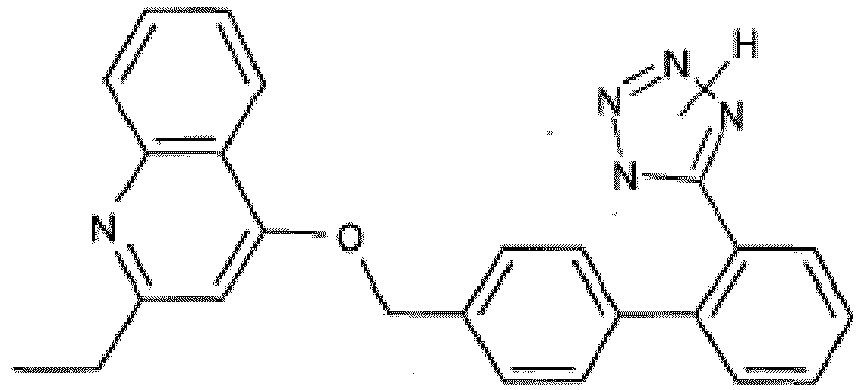
- Preferred AT1-receptor antagonists are those agents that have been approved and reached the market, most preferred is valsartan, or a pharmaceutically acceptable salt thereof.
- The interruption of the enzymatic degradation of angiotensin to angiotensin II with ACE inhibitors is a successful variant for the regulation of blood pressure and thus also makes available a therapeutic method for the treatment of hypertension.
- A suitable ACE inhibitor to be employed in the combination of the present invention is, e.g. a compound selected from the group consisting alacepril, benazepril, benazeprilat; captopril, ceronapril, cilazapril, delapril, enalapril, enaprilat, fosinopril, imidapril, lisinopril, moveltopril, perindopril, quinapril, ramipril, spirapril, temocapril and trandolapril, or in each case, a pharmaceutically acceptable salt thereof.
- Preferred ACE inhibitors are those agents that have been marketed, most preferred are benazepril and enalapril.
- A diuretic is, for example, a thiazide derivative selected from the group consisting of chlorothiazide, hydrochlorothiazide, methylclothiazide, and chlorothalidon. The most preferred diuretic is hydrochlorothiazide. A diuretic furthermore comprises a potassium sparing diuretic such as amiloride or triameterine, or a pharmaceutically acceptable salt thereof.
- The class of CCBs essentially comprises dihydropyridines (DHPs) and non-DHPs, such as diltiazem-type and verapamil-type CCBs.
- A CCB useful in said combination is preferably a DHP representative selected from the group consisting of amlodipine, felodipine, ryosidine, isradipine, lacidipine, nicardipine, nifedipine, niguldipine, niludipine, nimodipine, nisoldipine, nitrendipine and nivaldipine, and is preferably a non-DHP representative selected from the group consisting of flunarizine, prenylamine, diltiazem, fendiline, gallopamil, mibefradil, anipamil, tiapamil and verapamil, and in each case, a pharmaceutically acceptable salt thereof. All these CCBs are therapeutically used, e.g. as anti-hypertensive, anti-angina pectoris or anti-arrhythmic drugs.
- Preferred CCBs comprise amlodipine, diltiazem, isradipine, nicardipine, nifedipine, nimodipine, nisoldipine, nitrendipine and verapamil or, e.g. dependent on the specific CCB, a pharmaceutically acceptable salt thereof. Especially preferred as DHP is amlodipine or a pharmaceutically acceptable salt thereof, especially the besylate. An especially preferred representative of non-DHPs is verapamil or a pharmaceutically acceptable salt, especially the hydrochloride, thereof.
- Beta-blockers suitable for use in the present invention include beta-adrenergic blocking agents (beta-blockers), which compete with epinephrine for beta-adrenergic receptors and interfere with the action of epinephrine. Preferably, the beta-blockers are selective for the beta-adrenergic receptor as compared to the alpha-adrenergic receptors, and so do not have a significant alpha-blocking effect. Suitable beta-blockers include compounds selected from acebutolol, atenolol, betaxolol, bisoprolol, carteolol, carvedilol, esmolol, labetalol, metoprolol, nadolol, oxprenolol, penbutolol, pindolol, propranolol, sotalol and timolol. Where the beta-blocker is an acid or base or otherwise capable of forming pharmaceutically acceptable salts or prodrugs, these forms are considered to be encompassed herein, and it is understood that the compounds may be administered in free form or in the form of a pharmaceutically acceptable salt or a prodrug, such as a physiologically hydrolyzable and acceptable ester. For example, metoprolol is suitably administered as its tartrate salt, propranolol is suitably administered as the hydrochloride salt, and so forth.
- Platelet aggregation inhibitors include PLAVIX® (clopidogrel bisulfate), PLETAL® (cilostazol) and aspirin.
- Cholesterol absorption modulators include ZETIA® (ezetimibe) and KT6-971 (Kotobuki Pharmaceutical Co. Japan).
- HMG-Co-A reductase inhibitors (also called beta-hydroxy-beta-methylglutaryl-co-enzyme-A reductase inhibitors or statins) are understood to be those active agents which may be used to lower lipid levels including cholesterol in blood.
- The class of HMG-Co-A reductase inhibitors comprises compounds having differing structural features. For example, mention may be made of the compounds, which are selected from the group consisting of atorvastatin, cerivastatin, fluvastatin, lovastatin, pitavastatin, pravastatin, rosuvastatin and simvastatin, or in each case, a pharmaceutically acceptable salt thereof.
- Preferred HMG-Co-A reductase inhibitors are those agents, which have been marketed, most preferred is atorvastatin, pitavastatin or simvastatin, or a pharmaceutically acceptable salt thereof.
- HDL-increasing compounds include, but are not limited to, cholesterol ester transfer protein (CETP) inhibitors. Examples of CETP inhibitors include JTT705 disclosed in Example 26 of
U.S. Patent No. 6,426,365 issued July 30, 2002 , and pharmaceutically acceptable salts thereof. - Inhibition of interleukin 6 mediated inflammation may be achieved indirectly through regulation of endogenous cholesterol synthesis and isoprenoid depletion or by direct inhibition of the signal transduction pathway utilizing interleukin-6 inhibitor/antibody, interleukin-6 receptor inhibitor/antibody, interleukin-6 antisense oligonucleotide (ASON), gp130 protein inhibitor/antibody, tyrosine kinase inhibitors/antibodies, serine/threonine kinase inhibitors/antibodies, mitogen-activated protein (MAP) kinase inhibitors/antibodies, phosphatidylinositol 3-kinase (PI3K) inhibitors/antibodies, Nuclear factor kappaB (NF-κB) inhibitors/antibodies, IκB kinase (IKK) inhibitors/antibodies, activator protein-1 (AP-1) inhibitors/antibodies, STAT transcription factors inhibitors/antibodies, altered IL-6, partial peptides of IL-6 or IL-6 receptor, or SOCS (suppressors of cytokine signaling) protein, PPAR gamma and/or PPAR beta/delta activators/ligands or a functional fragment thereof.
- A suitable antiinflammatory corticosteroid is dexamethasone.
- Suitable antiproliferative agents are cladribine, rapamycin, vincristine and taxol.
- A suitable inhibitor of extracellular matrix synthesis is halofuginone.
- A suitable growth factor or cytokine signal transduction inhibitor is, e.g. the ras inhibitor R115777.
- A suitable tyrosine kinase inhibitor is tyrphostin.
- Suitable renin inhibitors are described, e.g. in
WO 2006/116435 . A preferred renin inhibitor is aliskiren, preferably in the form of the hemi-fumarate salt thereof. - MCP-1 antagonists may, e.g. be selected from anti-MCP-1 antibodies, preferably monoclonal or humanized monoclonal antibodies, MCP-1 expression inhibitors, CCR2-antagonists, TNF-alpha inhibitors, VCAM-1 gene expression inhibitors and anti-C5a monoclonal antibodies.
- MCP-1 antagonists and compositions containing such inhibitors are described, e.g. in
WO02/070509 WO02/081463 WO02/060900 US2006/670364 ,US2006/677365 ,WO2006/097624 ,US2006/316449 ,WO2004/056727 ,WO03/053368 WO00/198289 WO00/157226 WO00/046195 WO00/046196 WO00/046199 WO00/046198 WO00/046197 WO99/046991 WO99/007351 WO98/006703 WO97/012615 WO2005/105133 ,WO03/037376 WO2006/125202 ,WO2006/085961 ,WO2004/024921 ,WO2006/074265 . - Suitable MCP-1 antagonists are, for instance, C-243 (Telik Inc.); NOX-E36 (Noxxon Pharma AG); AP-761 (Actimis Pharmaceuticals Inc.); ABN-912, NIBR-177 (Novartis AG); CC-11006 (Celgene Corp.); SSR-150106 (Sanofi-Aventis); MLN-1202 (Millenium Pharmaceuticals Inc.); AGI-1067, AGIX-4207, AGI-1096 (AtherioGenics Inc.); PRS-211095, PRS-211092 (Pharmos Corp.); anti-C5a monoclonal antibodies, e.g. neutrazumab (G2 Therapies Ltd.); AZD-6942 (AstraZeneca pic.); 2-mercaptoimidazoles (Johnson & Johnson); TEI-E00526, TEI-6122 (Deltagen); RS-504393 (Roche Holding AG); SB-282241, SB-380732, ADR-7 (GlaxoSmithKline); anti-MCP-1 monoclonal antibodies(Johnson & Johnson).
- Combinations of QC-inhibitors with MCP-1 antagonists may be suitable for use in the treatment of inflammatory diseases in general, including neurodegenerative diseases.
- Combinations of QC-inhibitors with MCP-1 antagonists are preferred for use in the treatment of Alzheimer's disease.
- Most preferably the QC inhibitor is combined with one or more compounds selected from the following group:
- PF-4360365, m266, bapineuzumab, R-1450, Posiphen, (+)-phenserine, MK-0752, LY-450139, E-2012, (R)-flurbiprofen, AZD-103, AAB-001 (Bapineuzumab), Tramiprosate, EGb-761, TAK-070, Doxofylline, theophylline, cilomilast, tofimilast, roflumilast, tetomilast, tipelukast, ibudilast, HT-0712, MEM-1414, oglemilast, Linezolid, budipine, isocarboxazid, phenelzine, tranylcypromine, indantadol, moclobemide, rasagiline, ladostigil, safinamide, ABT-239, ABT-834, GSK-189254A, Ciproxifan, JNJ-17216498, Fmoc-Ala-Pyrr-CN, Z-Phe-Pro-Benzothiazole, Z-321, ONO-1603, JTP-4819, S-17092, BIBP3226; (R)-N2-(diphenylacetyl)-(R)-N-[1-(4-hydroxyphenyl) ethyl] arginine amide, Cevimeline, sabcomeline, (PD-151832), Donepezil, rivastigmine, (-)-phenserine, ladostigil, galantamine, tacrine, metrifonate, Memantine, topiramate, AVP-923, EN-3231, neramexane, valsartan, benazepril, enalapril, hydrochlorothiazide, amlodipine, diltiazem, isradipine, nicardipine, nifedipine, nimodipine, nisoldipine, nitrendipine, verapamil, amlodipine, acebutolol, atenolol, betaxolol, bisoprolol, carteolol, carvedilol, esmolol, labetalol, metoprolol, nadolol, oxprenolol, penbutolol, pindolol, propranolol, sotalol, timolol, PLAVIX® (clopidogrel bisulfate), PLETAL® (cilostazol), aspirin, ZETIA® (ezetimibe) and KT6-971, statins, atorvastatin, pitavastatin or simvastatin; dexamethasone, cladribine, rapamycin, vincristine, taxol, aliskiren, C-243, ABN-912, SSR-150106, MLN-1202 and betaferon.
- In particular, the following combinations are considered:
- a QC inhibitor, preferably a QC inhibitor of formula (I), more preferably a QC inhibitor selected from any one of examples 1-33, in combination with Atorvastatin for use in the treatment and/or prevention of artherosclerosis,
- a QC inhibitor, preferably a QC inhibitor of formula (I), more preferably a QC inhibitor selected from any one of examples 1-33, in combination with immunosuppressive agents, preferably rapamycin for use in the prevention and/or treatment of restenosis,
- a QC inhibitor, preferably a QC inhibitor of formula (I), more preferably a QC inhibitor selected from any one of examples 1-33, in combination with immunosuppressive agents, preferably paclitaxel for use in the prevention and/or treatment of restenosis,
- a QC inhibitor, preferably a QC inhibitor of formula (I), more preferably a QC inhibitor selected from any one of examples 1-33, in combination with AChE inhibitors, preferably Donepezil, for use in the prevention and/or treatment of Alzheimer's disease,
- a QC inhibitor, preferably a QC inhibitor of formula (I), more preferably a QC inhibitor selected from any one of examples 1-33, in combination with interferones, preferably Aronex, for use in the prevention and/or treatment of multiple sclerosis,
- a QC inhibitor, preferably a QC inhibitor of formula (I), more preferably a QC inhibitor selected from any one of examples 1-33, in combination with interferones, preferably betaferon, for use in the prevention and/or treatment of multiple sclerosis,
- a QC inhibitor, preferably a QC inhibitor of formula (I), more preferably a QC inhibitor selected from any one of examples 1-33, in combination with interferones, preferably Rebif, for use in the prevention and/or treatment of multiple sclerosis
- a QC inhibitor, preferably a QC inhibitor of formula (I), more preferably a QC inhibitor selected from any one of examples 1-33, in combination with Copaxone, for use in the prevention and/or treatment of multiple sclerosis,
- a QC inhibitor, preferably a QC inhibitor of formula (I), more preferably a QC inhibitor selected from any one of examples 1-33, in combination with dexamethasone, for use in the prevention and/or treatment of restenosis,
- a QC inhibitor, preferably a QC inhibitor of formula (I), more preferably a QC inhibitor selected from any one of examples 1-33, in combination with dexamethasone, for use in the prevention and/or treatment of atherosclerosis,
- a QC inhibitor, preferably a QC inhibitor of formula (I), more preferably a QC inhibitor selected from any one of examples 1-33, in combination with dexamethasone, for use in the prevention and/or treatment of rheumatid arthritis,
- a QC inhibitor, preferably a QC inhibitor of formula (I), more preferably a QC inhibitor selected from any one of examples 1-33, in combination with HMG-Co-A-reductase inhibitors, for use in the prevention and/or treatment of restenosis, wherein the HMG-Co-A-reductase inhibitor is selected from atorvastatin, cerivastatin, fluvastatin, lovastatin, pitavastatin, pravastatin, rosuvastatin and simvastatin,
- a QC inhibitor, preferably a QC inhibitor of formula (I), more preferably a QC inhibitor selected from any one of examples 1-33, in combination with HMG-Co-A reductase inhibitors, for use in the prevention and/or treatment of atherosclerosis wherein the HMG-Co-A-reductase inhibitor is selected from atorvastatin, cerivastatin, fluvastatin, lovastatin, pitavastatin, pravastatin, rosuvastatin and simvastatin,
- a QC inhibitor, preferably a QC inhibitor of formula (I), more preferably a QC inhibitor selected from any one of examples 1-33, in combination with HMG-Co-A reductase inhibitors, for use in the prevention and/or treatment of rheumatoid arthritis wherein the HMG-Co-A-reductase inhibitor is selected from atorvastatin, cerivastatin, fluvastatin, lovastatin, pitavastatin, pravastatin, rosuvastatin and simvastatin,
- a QC inhibitor, preferably a QC inhibitor of formula (I), more preferably a QC inhibitor selected from any one of examples 1-33, in combination with amyloid-beta antibodies for use in the prevention and/or treatment of mild cognitive impairment, wherein the amyloid-beta antibody is Acl-24,
- a QC inhibitor, preferably a QC inhibitor of formula (I), more preferably a QC inhibitor selected from any one of examples 1-33, in combination with amyloid-beta antibodies for use in the prevention and/or treatment of Alzheimer's disease, wherein the amyloid-beta antibody is Acl-24,
- a QC inhibitor, preferably a QC inhibitor of formula (I), more preferably a QC inhibitor selected from any one of examples 1-33, in combination with amyloid-beta antibodies for use in the prevention and/or treatment of neurodegeneration in Down Syndrome, wherein the amyloid-beta antibody is Acl-24,
- a QC inhibitor, preferably a QC inhibitor of formula (I), more preferably a QC inhibitor selected from any one of examples 1-33, in combination with beta-secretase inhibitors for use in the prevention and/or treatment of mild cognitive impairment, wherein the beta-secretase inhibitor is selected from WY-25105, GW-840736X and CTS-21166,
- a QC inhibitor, preferably a QC inhibitor of formula (I), more preferably a QC inhibitor selected from any one of examples 1-33, in combination with beta-secretase inhibitors for use in the prevention and/or treatment of Alzheimer's disease, wherein the beta-secretase inhibitor is selected from WY-25105, GW-840736X and CTS-21166,
- a QC inhibitor, preferably a QC inhibitor of formula (I), more preferably a QC inhibitor selected from any one of examples 1-33, in combination with beta-secretase inhibitors for use in the prevention and/or treatment of neurodegeneration in Down Syndrome, wherein the beta-secretase inhibitor is selected from WY-25105, GW-840736X and CTS-21166,
- a QC inhibitor, preferably a QC inhibitor of formula (I), more preferably a QC inhibitor selected from any one of examples 1-33, in combination with gamma-secretase inhibitors for use in the prevention and/or treatment of mild cognitive impairment, wherein the gamma-secretase inhibitor is selected from LY-450139, LY-411575 and AN-37124,
- a QC inhibitor, preferably a QC inhibitor of formula (I), more preferably a QC inhibitor selected from any one of examples 1-33, in combination with gamma-secretase inhibitors for use in the prevention and/or treatment of Alzheimer's disease, wherein the gamma-secretase inhibitor is selected from LY-450139, LY-411575 and AN-37124,
- a QC inhibitor, preferably a QC inhibitor of formula (I), more preferably a QC inhibitor selected from any one of examples 1-33, in combination with gamma-secretase inhibitors for use in the prevention and/or treatment of neurodegeneration in Down Syndrome, wherein the gamma-secretase inhibitor is selected from LY-450139, LY-411575 and AN-37124.
- Such a combination therapy is in particular useful for AD, FAD, FDD and neurodegeneration in Down syndrome as well as atherosclerosis, rheumatoid arthritis, restenosis and pancreatitis.
- Such combination therapies might result in a better therapeutic effect (less proliferation as well as less inflammation, a stimulus for proliferation) than would occur with either agent alone.
- With regard to the specific combination of inhibitors of QC and further compounds it is referred in particular to
WO 2004/098625 in this regard. - To prepare the pharmaceutical compositions of this invention, at least one compound of formula (I) optionally in combination with at least one of the other aforementioned agents can be used as the active ingredient(s). The active ingredient(s) is intimately admixed with a pharmaceutical carrier according to conventional pharmaceutical compounding techniques, which carrier may take a wide variety of forms depending of the form of preparation desired for administration, e.g., oral or parenteral such as intramuscular. In preparing the compositions in oral dosage form, any of the usual pharmaceutical media may be employed. Thus, for liquid oral preparations, such as for example, suspensions, elixirs and solutions, suitable carriers and additives include water, glycols, oils, alcohols, flavoring agents, preservatives, coloring agents and the like; for solid oral preparations such as, for example, powders, capsules, gelcaps and tablets, suitable carriers and additives include starches, sugars, diluents, granulating agents, lubricants, binders, disintegrating agents and the like. Because of their ease in administration, tablets and capsules represent the most advantageous oral dosage unit form, in which case solid pharmaceutical carriers are obviously employed. If desired, tablets may be sugar coated or enteric coated by standard techniques. For parenterals, the carrier will usually comprise sterile water, though other ingredients, for example, for purposes such as aiding solubility or for preservation, may be included.
- Injectable suspensions may also prepared, in which case appropriate liquid carriers, suspending agents and the like may be employed. The pharmaceutical compositions herein will contain, per dosage unit, e.g., tablet, capsule, powder, injection, teaspoonful and the like, an amount of the active ingredient(s) necessary to deliver an effective dose as described above. The pharmaceutical compositions herein will contain, per dosage unit, e.g., tablet, capsule, powder, injection, suppository, teaspoonful and the like, from about 0.03 mg to 100 mg/kg (preferred 0.1 - 30 mg/kg) and may be given at a dosage of from about 0.1 - 300 mg/kg per day (preferred 1 - 50 mg/kg per day) of each active ingredient or combination thereof. The dosages, however, may be varied depending upon the requirement of the patients, the severity of the condition being treated and the compound being employed. The use of either daily administration or post-periodic dosing may be employed.
- Preferably these compositions are in unit dosage forms from such as tablets, pills, capsules, powders, granules, sterile parenteral solutions or suspensions, metered aerosol or liquid sprays, drops, ampoules, autoinjector devices or suppositories; for oral parenteral, intranasal, sublingual or rectal administration, or for administration by inhalation or insufflation. Alternatively, the composition may be presented in a form suitable for once-weekly or once-monthly administration; for example, an insoluble salt of the active compound, such as the decanoate salt, may be adapted to provide a depot preparation for intramuscular injection. For preparing solid compositions such as tablets, the principal active ingredient is mixed with a pharmaceutical carrier, e.g. conventional tableting ingredients such as corn starch, lactose, sucrose, sorbitol, talc, stearic acid, magnesium stearate, dicalcium phosphate or gums, and other pharmaceutical diluents, e.g. water, to form a solid preformulation composition containing a homogeneous mixture of a compound of the present invention, or a pharmaceutically acceptable salt thereof. When referring to these preformulation compositions as homogeneous, it is meant that the active ingredient is dispersed evenly throughout the composition so that the composition may be readily subdivided into equally effective dosage forms such as tablets, pills and capsules. This solid preformulation composition is then subdivided into unit dosage forms of the type described above containing from 0.1 to about 500 mg of each active ingredient or combinations thereof of the present invention.
- The tablets or pills of the compositions of the present invention can be coated or otherwise compounded to provide a dosage form affording the advantage of prolonged action. For example, the tablet or pill can comprise an inner dosage and an outer dosage component, the latter being in the form of an envelope over the former. The two components can be separated by an enteric layer which serves to resist disintegration in the stomach and permits the inner component to pass intact into the duodenum or to be delayed in release. A variety of material can be used for such enteric layers or coatings, such materials including a number of polymeric acids with such materials as shellac, cetyl alcohol and cellulose acetate.
- This liquid forms in which the compositions of the present invention may be incorporated for administration orally or by injection include, aqueous solutions, suitably flavoured syrups, aqueous or oil suspensions, and flavoured emulsions with edible oils such as cottonseed oil, sesame oil, coconut oil or peanut oil, as well as elixirs and similar pharmaceutical vehicles. Suitable dispersing or suspending agents for aqueous suspensions, include synthetic and natural gums such as tragacanth, acacia, alginate, dextran, sodium carboxymethylcellulose, methylcellulose, polyvinylpyrrolidone or gelatin.
- The pharmaceutical composition may contain between about 0.01 mg and 100 mg, preferably about 5 to 50 mg, of each compound, and may be constituted into any form suitable for the mode of administration selected. Carriers include necessary and inert pharmaceutical excipients, including, but not limited to, binders, suspending agents, lubricants, flavorants, sweeteners, preservatives, dyes, and coatings. Compositions suitable for oral administration include solid forms, such as pills, tablets, caplets, capsules (each including immediate release, timed release and sustained release formulations), granules, and powders, and liquid forms, such as solutions, syrups, elixirs, emulsions, and suspensions. Forms useful for parenteral administration include sterile solutions, emulsions and suspensions.
- Advantageously, compounds of the present invention may be administered in a single daily dose, or the total daily dosage may be administered in divided doses of two, three or four times daily. Furthermore, compounds for the present invention can be administered in intranasal form via topical use of suitable intranasal vehicles, or via transdermal skin patches well known to those of ordinary skill in that art. To be administered in the form of transdermal delivery system, the dosage administration will, of course, be continuous rather than intermittent throughout the dosage regimen.
- For instance, for oral administration in the form of a tablet or capsule, the active drug component can be combined with an oral, non-toxic pharmaceutically acceptable inert carrier such as ethanol, glycerol, water and the like. Moreover, when desired or necessary, suitable binders; lubricants, disintegrating agents and coloring agents can also be incorporated into the mixture. Suitable binders include, without limitation, starch, gelatin, natural sugars such as glucose or betalactose, corn sweeteners, natural and synthetic gums such as acacia, tragacanth or sodium oleate, sodium stearate, magnesium stearate, sodium benzoate, sodium acetate, sodium chloride and the like. Disintegrators include, without limitation, starch, methyl cellulose, agar, bentonite, xanthan gum and the like.
- The liquid forms in suitable flavored suspending or dispersing agents such as the synthetic and natural gums, for example, tragacanth, acacia, methyl-cellulose and the like. For parenteral administration, sterile suspensions and solutions are desired. Isotonic preparations which generally contain suitable preservatives are employed when intravenous administration is desired.
- The compounds or combinations of the present invention can also be administered in the form of liposome delivery systems, such as small unilamellar vesicles, large unilamellar vesicles, and multilamellar vesicles. Liposomes can be formed from a variety of phospholipids, such as cholesterol, stearylamine or phosphatidylcholines.
- Compounds or combinations of the present invention may also be delivered by the use of monoclonal antibodies as individual carriers to which the compound molecules are coupled. The compounds of the present invention may also be coupled with soluble polymers as targetable drug carriers. Such polymers can include polyvinylpyrrolidone, pyran copolymer, polyhydroxypropylmethacrylamidephenol, polyhydroxyethylaspartamid-ephenol, or polyethyl eneoxidepolyllysine substituted with palmitoyl residue. Furthermore, the compounds of the present invention may be coupled to a class of biodegradable polymers useful in achieving controlled release of a drug, for example, polyactic acid, polyepsilon caprolactone, polyhydroxy butyeric acid, polyorthoesters, polyacetals, polydihydropyrans, polycyanoacrylates and cross-linked or amphipathic block copolymers of hydrogels.
- Compounds or combinations of this invention may be administered in any of the foregoing compositions and according to dosage regimens established in the art whenever their use in the treatment of the addressed disorders is required.
- The daily dosage of the products may be varied over a wide range from 0.01 to 1.000 mg per mammal per day. For oral administration, the compositions are preferably provided in the form of tablets containing, 0.01, 0.05, 0.1, 0.5, 1.0, 2.5, 5.0, 10.0, 15.0, 25.0, 50.0, 100, 150, 200, 250 and 500 milligrams of each active ingredient or combinations thereof for the symptomatic adjustment of the dosage to the patient to be treated. An effective amount of the drug is ordinarily supplied at a dosage level of from about 0.1 mg/kg to about 300 mg/kg of body weight per day. Preferably, the range is from about 1 to about 50 mg/kg of body weight per day. The compounds or combinations may be administered on a regimen of 1 to 4 times per day.
- Optimal dosages to be administered may be readily determined by those skilled in the art, and will vary with the particular compound used, the mode of administration, the strength of the preparation, the mode of administration, and the advancement of disease condition. In addition, factors associated with the particular patient being treated, including patient age, weight, diet and time of administration, will result in the need to adjust dosages.
- In a further aspect, the invention also provides a process for preparing a pharmaceutical composition comprising at least one compound of formula (I), optionally in combination with at least one of the other aforementioned agents and a pharmaceutically acceptable carrier.
- The compositions are preferably in a unit dosage form in an amount appropriate for the relevant daily dosage.
- Suitable dosages, including especially unit dosages, of the the compounds of the present invention include the known dosages including unit doses for these compounds as described or referred to in reference text such as the British and US Pharmacopoeias, Remington's Pharmaceutical Sciences (Mack Publishing Co.), Martindale The Extra Pharmacopoeia (London, The Pharmaceutical Press) (for example see the 31 st Edition page 341 and pages cited therein) or the above mentioned publications.
-
Example Name Structure [M+H]+ 1 1-(1H-Benzo[d]imidazol-5-yl)-5-phenylpyrrolidine-2,4-dione 
292.2 2 1-(1H-Benzo[d]imidazol-5-yl)-5-(2,3-difluorophenyl)pyrrolidine-2,4-dione 
328.2 3 1-(1H-Benzo[d]imidazol-5-yl)-5-(2,3,5-trifluorophenyl)pyrrolidine-2,4-dione 
346.3 4 1-(1H-Benzo[d]imidazol-5-yl)-5-(4-morpholinophenyl)pyrrolidine -2,4-dione 
377.4 5 1-(1H-Benzo[d]imidazol-5-yl)-4-methoxy-5-phenyl-1H-pyrrol-2(5H)-one 
306.4 6 1-(1H-Benzo[d]imidazol-5-yl)-5-(2,3-difluorophenyl)-4-methoxy-1H-pyrrol-2(5H)-one 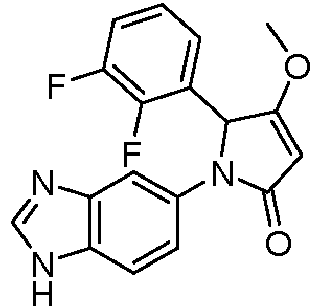
342.1 7 1-(1H-Benzo[d]imidazol-5-yl)-5-(2,3,5-trifluorophenyl)-4-methoxy-1H-pyrrol-2(5H)-one 
360.3 8 1-(1H-Benzo[d]imidazol-5-yl)-4-methoxy-5-(4-morpholinophenyl)-1H-pyrrol-2(5H)-one 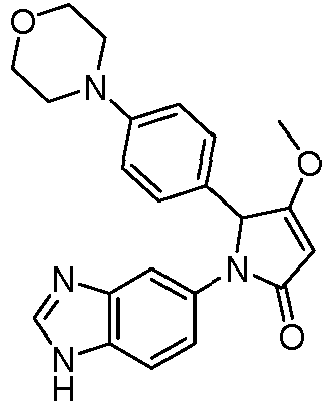
391.3 9 1-(1H-Benzo[d]imidazol-5-yl)-5-(4-(4,4-difluoropiperidin-1-yl)phenyl)-4-methoxy-1H-pyrrol-2(5H)-one 
425.4 10 1-(1H-Benzo[d]imidazol-5-yl)-5-(4-(4,4-difluorobutoxy)phenyl)-4-methoxy-1H-pyrrol-2(5H)-one 
414.3 11 1-(1H-Benzo[d]imidazol-5-yl)-5-(4-butoxyphenyl)-4-methoxy-1H-pyrrol-2(5H)-one 
378.4 12 1-(1H-Benzo[d]imidazol-5-yl)-4-methoxy-5-(4-thiomorpholinophenyl)-1H-pyrrol-2(5H)-one 
407.5 13 1-(1H-Benzo[d]imidazol-5-yl)-5-(4-(4,4-difluorocyclohexyl)phenyl)-4-methoxy-1H-pyrrol-2(5H)-one 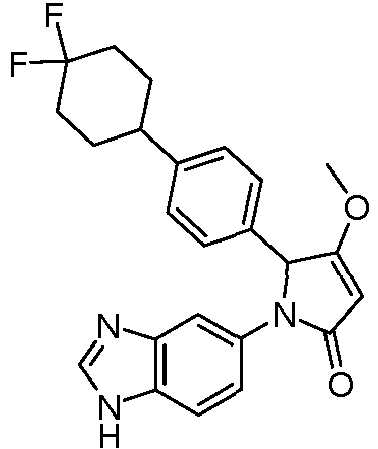
424.4 14 1-(1H-Benzo[d]imidazol-5-yl)-5-(4-(3,3-difluoropyrrolidin-1-yl)phenyl)-4-methoxy-1H-pyrrol-2(5H)-one 
411.5 15 1-(1H-Benzo[d]imidazol-5-yl)-5-(4-(tetrahydro-2H-pyran-4-yl)phenyl)-4-methoxy-1H-pyrrol-2(5H)-one 
390.3 16 1-(1H-Benzo[d]imidazol-5-yl)-5-(4-(1,1-dioxo-thian-4-yl)phenyl)-4-methoxy-1H-pyrrol-2(5H)-one 
438.4 17 1-(1H-Benzo[d]imidazol-5-yl)-5-(4-(4-oxocyclohexyl)phenyl)-4-methoxy-1H-pyrrol-2(5H)-one 
402.4 18 1-(1H-Benzo[d]imidazol-5-yl)-5-(4-(1,1-dioxo-4-thiomorpholin-4-yl)phenyl)-4-methoxy-1H-pyrrol-2(5H)-one 
439.5 19 1-(1H-Benzo[d]imidazol-5-yl)-5-(4-(4-phenylpiperazin-1-yl)phenyl)-4-methoxy-1H-pyrrol-2(5H)-one 
466.6 20 1-(1H-Benzo[d]imidazol-5-yl)-5-(4-(4-methylpiperazin-1-yl)phenyl)-4-methoxy-1H-pyrrol-2(5H)-one 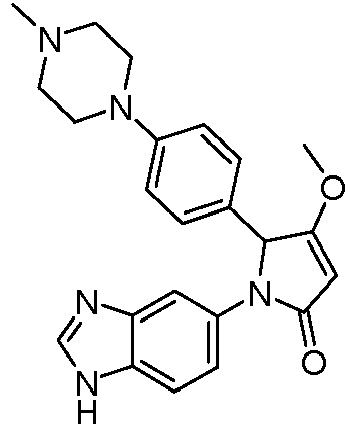
404.5 21 1-(1H-Benzo[d]imidazol-5-yl)-5-(4-(4-cyclopropylpiperazin-1-yl)phenyl)-4-methoxy-1H-pyrrol-2(5H)-one 
430.6 22 1-(1H-Benzo[d]imidazol-5-yl)-5-(4-(4-hydroxypiperidin-1-yl)phenyl)-4-methoxy-1H-pyrrol-2(5H)-one 
404.5 23 1-(1H-Benzo[d]imidazol-5-yl)-4-(cyclohexylamino)-5-phenyl-1H-pyrrol-2(5H)-one 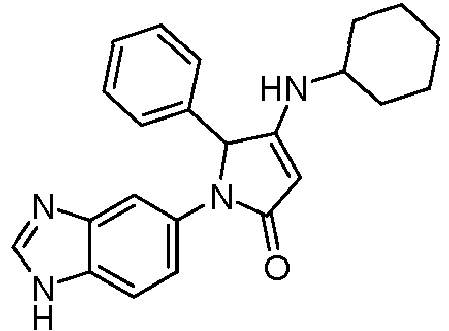
373.4 24 1-(1H-Benzo[d]imidazol-5-yl)-4-(cyclohexylamino)-5-(4-morpholinophenyl)-1H-pyrrol-2(5H)-one 
458.5 25 1-(1H-Benzo[d]imidazol-5-yl)-4-(cyclohexylamino)-5-(2,3,5-trifluorophenyl)-1H-pyrrol-2(5H)-one 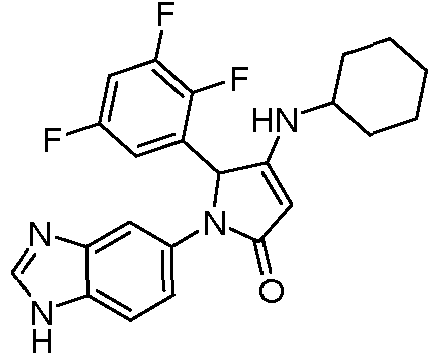
427.4 26 1-(1H-Benzo[d]imidazol-5-yl)-4-(cyclohexylamino)-5-(2,3-difluorophenyl)-1H-pyrrol-2(5H)-one 
409.6 27 1-(1H-Benzo[d]imidazol-5-yl)-5-(4-morpholinophenyl)-4-(piperidin-1-yl)-1H-pyrrol-2(5H)-one 
444.5 28 1-(1H-Benzo[d]imidazol-5-yl)-4-morpholino-5-(4-morpholinophenyl)-1H-pyrrol-2(5H)-one 
446.6 29 1-(1H-Benzo[d]imidazol-5-yl)-4-(methylamino)-5-(4-morpholinophenyl)-1H-pyrrol-2(5H)-one 
390.3 30 1-(1H-Benzo[d]imidazol-5-yl)-5-(4-morpholinophenyl)-4-(piperazin-1-yl)-1H-pyrrol-2(5H)-one 
445.5 31 1-(1H-Benzo[d]imidazol-5-yl)-4-(dimethylamino)-5-(4-morpholinophenyl)-1H-pyrrol-2(5H)-one 
404.3 32 1-(1H-Benzo[d]imidazol-5-yl)-4-(4,4-difluoropiperidin-1-yl)-5-(4-morpholinophenyl)-1H-pyrrol-2(5H)-one 
480.4 33 1-(1H-Benzo[d]imidazol-5-yl)-4-(4-methylpiperazin-1-yl)-5-(4-morpholinophenyl)-1H-pyrrol-2(5H)-one 
459.5 -

- A solution of 1 H-benzo[d]imidazol-5-amine (1 eq.) and the respective aldehyde (1 eq.) in dry methanol (3 ml in case of 1 mmol) was stirred at room temperature for 3 hours. After addition of 2-(ethoxycarbonyl)acetic acid (1 eq.) and 1-isocyano-2-methylpropan-2-yl methyl carbonate (1 eq.) stirring was continued for 16 hours. The solvent was evaporated and the residue was purified by flash chromatography on silica gel using a CHCl3/MeOH gradient.
- The respective 2-[(1H-benzo[d]imidazol-5-yl)[phenyl({2-[(methoxycarbonyl)oxy]-2-methylpropyl}carbamoyl)methyl]carbamoyl]acetate (1 eq.) was dissolved in THF (8 ml in case of 1 mmol) under argon atmosphere. A 1M solution of potassium tert.-butoxide in THF (2 eq.) was added successively and the mixture was stirred at room temperature for 1 hour. After cooling to 0°C the reaction was quenched by addition of ice. Aqueous hydrochloric acid (1 N) was added dropwise until a precipitate was formed. The precipitate was collected by filtration, washed with a small amount of EtOAc and water, dried in vacuo and was used without further purification.
- A suspension of the respective ethyl 1-(1H-benzo[d]imidazol-5-yl)-2,4-dioxo-5-phenylpyrrolidine-3-carboxylate in 5 N aqueous hydrochloric acid (3-6 ml) was heated to 90°C for 1.5 hours. After cooling to ambient temperature, the solution was filtered through a 0.45 µm syringe filter. The solvent was evaporated to give the title compounds without further purification steps.
-
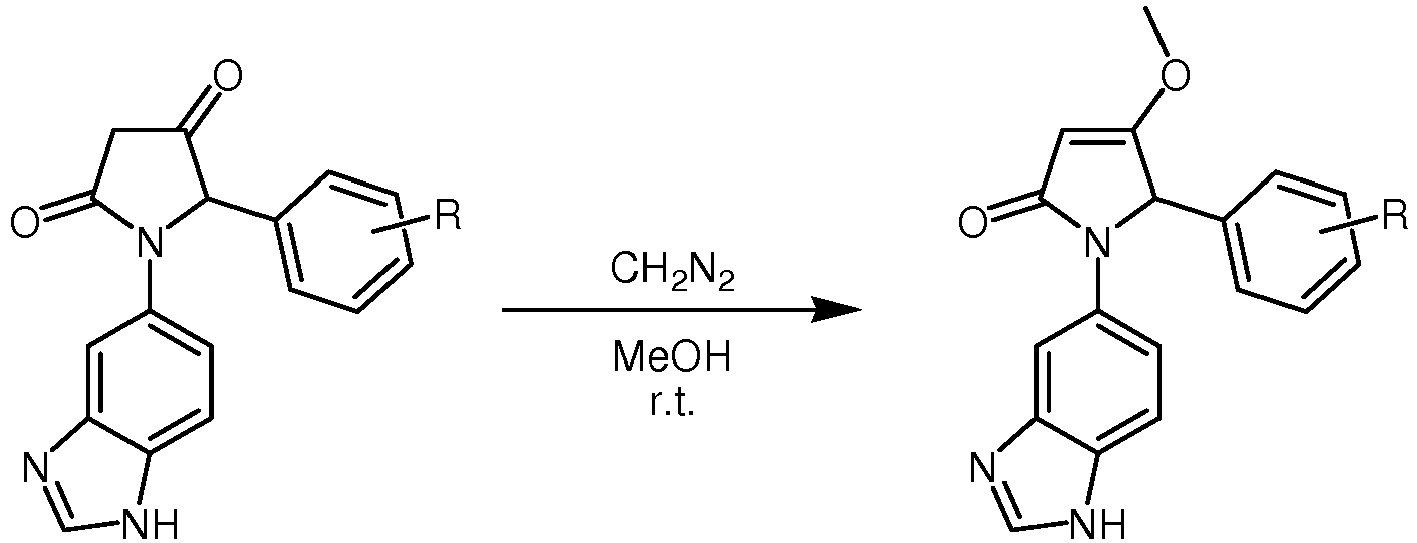
- The respective pyrrolidine-2,4-dione derivative was dissolved in MeOH (20 ml) and water (1ml). Excess diazomethane/Et2O was added and the mixture was stirred at room temperature until the evolution of gas stopped (about 10 min). The reaction was quenched with acetic acid and the volatiles were removed by evaporation. The residue was purified by semi-preparative HPLC.
- A solution of 1 H-benzo[d]imidazol-5-amine (1 eq.) and the respective aldehyde (1 eq.) in dry methanol (2-5 ml per mmoll) was stirred at room temperature for 3 hours. After addition of 2-(ethoxycarbonyl)acetic acid (1 eq.) and 1-isocyano-2-methylpropan-2-yl methyl carbonate (1 eq.) stirring was continued for 16-24 hours. The solvent was evaporated and the residue was purified by flash chromatography.
- A solution of the respective ethyl 2-[(1H-benzo[d]imidazol-5-yl)[phenyl({2-[(methoxycarbonyl)oxy]-2-methylpropyl}carbamoyl)methyl]carbamoyl]acetate (1 eq.) in THF (10 ml) was added dropwise to a suspension of potassium-tert-butoxide in THF (2 eq.) at 0°C. The mixture was stirred at room temperature for 1-3 h. The reaction was quenched by addition of ice water and the volatiles were evaporated. Aqueous hydrochloric acid (1 N) was added dropwise until a precipitate was formed. The precipitate was collected by filtration, dried in vacuo and used without further purification.
- A suspension of the respective ethyl 1-(1H-benzo[d]imidazol-5-yl)-2,4-dioxo-5-phenylpyrrolidine-3-carboxylate in 4 N aqueous hydrochloric acid was heated to 65°C for 4 hours. The solvent was evaporated and the residue was dried in vacuo and used without further purification.
- The respective pyrrolidine-2,4-dione derivative was dissolved in MeOH (5 ml per mmol) and cooled to -30°C. Excess diazomethane/Et2O was added and the mixture was stirred at room temperature for 20-30 min. The volatiles were removed by evaporation. The residue was purified by semi-preparative HPLC.
-

- A solution of 1H-benzo[d]imidazol-5-amine (1 eq.) and the respective aldehyde (1 eq.) in dry methanol (1-3 ml per mmol) was stirred at room temperature for 3 hours. After addition of mono-tert-Butyl malonate (1 eq.) and 1-isocyano-2-methylpropan-2-yl methyl carbonate (1 eq.) stirring was continued for 48 hours. The solvent was evaporated and the residue was purified by flash chromatography on silica gel using a CHCl3/MeOH gradient.
- A solution of the respective tert.-butyl 2-[(1H-benzo[d]imidazol-5-yl)[phenyl({2-[(methoxycarbonyl)oxy]-2-methylpropyl}carbamoyl)methyl]carbamoyl]acetate (1 eq.) was added dropwise to a suspension of potassium-tert- butoxide in THF (2 eq.) at 0°C. The mixture was stirred at room temperature for 1-2 h. The reaction was quenched by addition of ice water and the volatiles were evaporated. Aqueous hydrochloric acid (1 N) was added dropwise until a precipitate was formed. The precipitate was collected by filtration, dried in vacuo and used without further purification.
- A solution of the respective tert-butyl 1-(1H-benzo[d]imidazol-5-yl)-2,4-dioxo-5-phenylpyrrolidine-3-carboxylate in trifluoroacetic acid (5 ml per mmol) was stirred at room temperature for 1-3 h. The solvent was evaporated, co-distilled with toluene and dried in vacuo to give the respective crude 1-(1H-benzo[d]imidazol-5-yl)-5-phenylpyrrolidine-2,4-diones that was used without further purification.
-

- Thionylchloride (2-2.5 eq.) was added dropwise to an ice-cooled solution of the respective 1-(1H-benzo[d]imidazol-5-yl)-5-phenylpyrrolidine-2,4-dione in dry MeOH (5-10 ml). The mixture was heated to reflux for 1-3 h. The volatiles were evaporated and the residue was partitioned between saturated sodium bicarbonate solution and chloroform or dichloromethane containing 0-10% MeOH. The combined organic layers were washed with brine, dried over Na2SO4 and evaporated. The residue was purified by chromatography.
-

- A suspension of the respective 1-(1H-benzo[d]imidazol-5-yl)-4-hydroxy-5-phenyl-1H-pyrrol-2(5H)-one (1eq.) and cyclohexylamine (14 eq.) in dry MeOH (9 ml) was heated to 80°C for 4-15h. The reaction was monitored by MS and TLC. After cooling to room temperature the volatiles were evaporated. The residue was partitioned between water (15 ml) and EtOAc (15 ml). The aqueous layer was extracted with EtOAc (2x15 ml). The combined organic layers were dried over Na2SO4 and evaporated. The residue was purified by semi-preparative HPLC.
-

- A solution of the respective 1-(1H-benzo[d]imidazol-5-yl)-4-hydroxy-5-phenyl-1H-pyrrol-2(5H)-one (1eq.) in DMF/toluene (1:2) was treated with an excess of the respective amine. The mixture was heated to 110°C in a sealed tube for 6-20h. After cooling to room temperature the volatiles were evaporated. The residue was diluted with water and extracted with dichloromethane. The combined organic layers were washed with water and brine, dried over Na2SO4 and evaporated. The remains were subjected to chromatography (method 8a). Alternatively, the residue was directly subjected to column chromatography without extraction
- The compound was synthesized starting from 1H-benzo[d]imidazol-5-amine (0.134g, 1mmol), benzaldehyde (101µl, 0.107g, 1mmol), 2-(ethoxycarbonyl)acetic acid (119µl, 0.133g, 1mmol) and 1-isocyano-2-methylpropan-2-yl methyl carbonate (0.157g, 1mmol) according to the method described in step 1.
Yield: 0.3g (58.8%); MS m/z 364.3, 435.6 [M-OCOOCH3]•, 511.5 8 [M+H]+; HPLC (λ = 214 nm, [A]): rt 11.59 min (68%) - The compound was synthesized starting from 1H-benzo[d]imidazol-5-amine (0.134g, 1mmol), 2,3difluorobenzaldehyde (110µl, 0.142g, 1mmol), 2-(ethoxycarbonyl)acetic acid (119µl, 0.133g, 1mmol) and 1-isocyano-2-methylpropan-2-yl methyl carbonate (0.157g, 1 mmol) according to the method described in step 1.
Yield: 0.134g (24.5%); MS m/z 400.3, 471.4 [M-OCOOCH3]•, 547.5 [M+H]+ ; HPLC (λ = 214 nm, [A]): rt 12.39 min (90%) - The compound was synthesized starting from 1H-benzo[d]imidazol-5-amine (0.134g, 1mmol), 2,3,5-trifluorobenzaldehyde (114µl, 0.160g, 1mmol), 2-(ethoxycarbonyl)-acetic acid (119µl, 0.133g, 1mmol) and 1-isocyano-2-methylpropan-2-yl methyl carbonate (0.157g, 1 mmol) according to the method described in step 1.
Yield: 0.153g 27.1%); MS m/z 418.3, 489.5 [M-OCOOCH3]•, 565.4 [M+H]+ ; HPLC (λ = 214 nm, [A]): rt 12.83 min (82%) - The compound was synthesized starting from 1H-benzo[d]imidazol-5-amine (0.134g, 1mmol), 4-morpholinobenzaldehyde (0.191 g, 1mmol), 2-(ethoxycarbonyl)acetic acid (119µl, 0.133g, 1mmol) and 1-isocyano-2-methylpropan-2-yl methyl carbonate (0.157g, 1mmol) according to the method described in step 1.
Yield: 0.38g (63.8%); MS m/z 349.3, 596.6 [M+H]+ ; HPLC (λ = 214 nm, [A]): rt 11.24 min (81%) - The compound was synthesized starting from ethyl 2-[(1H-benzo[d]imidazol-5-yl)[phenyl({2-[(methoxycarbonyl)oxy]-2-methylpropyl}carbamoyl)methyl]-carbamoyl]- acetate (which may be prepared in accordance with the procedure described for Intermediate 1; 0.3g, 0.588mmol) and potassium tert.-butoxide solution (1 M, 1.18ml, 1.176mmol) according to the method described in step 2.
Yield: 0.11g (51.5%); MS m/z 318.3 [M-OEt]•, 364.3 [M+H]+ ; HPLC (λ = 214 nm, [A]): rt 8.33 min (87%) - The compound was synthesized starting from ethyl 2-[(1H-benzo[d]imidazol-5-yl)[2,3-difluorophenyl({2-[(methoxycarbonyl)oxy]-2-methylpropyl}carbamoyl)-methyl]-carba-moyl] acetate (which may be prepared in accordance with the procedure described for Intermediate 2; 0.134g, 0.245mmol) and potassium tert.-butoxide solution (1M, 0.49ml, 0.49mmol) according to the method described in step 2.
Yield: 0.082g (83.8%); MS m/z 354.3 [M-OEt]•, 400.3 [M+H]+ - The compound was synthesized starting from ethyl 2-[(1H-benzo[d]imidazol-5-yl)[2,3,5-trifluorophenyl({2-[(methoxycarbonyl)oxy]-2-methylpropyl}carbamoyl)methyl]-carbamoyl] acetate (which may be prepared in accordance with the procedure described for Intermediate 3; 0.153g, 0.271mmol) and potassium tert.-butoxide solution (1M, 0.542ml, 0.542mmol) according to the method described in step 2.
Yield: 0.036g (31.8%); MS m/z 372.1 [M-OEt]•, 418.3 [M+H]+ - The compound was synthesized starting from ethyl 2-[(1H-benzo[d]imidazol-5-yl)({[4-(morpholin-4-yl)phenyl]({2-[(methoxycarbonyl)oxy]-2-ethylpropyl}carbamoyl)methyl})-carbamoyl]acetate (which may be prepared in accordance with the procedure described for Intermediate 4; 0.38g, 0.638mmol) and potassium tert.-butoxide solution (1M, 1.276ml, 1.276mmol) according to the method described in Step 2.
Yield: 0.12g (41.9%); MS m/z 202.3, 403.3 [M-OEt]•, 449.2 [M+H]+ - The compound was synthesized starting from 1H-benzo[d]imidazol-5-amine (0.890g, 6.69mmol), 4-(4,4-difluoropiperidin-1-yl)benzaldehyde (1.5g, 6.69mmol), 2-(ethoxycarbonyl)acetic acid (0.883g, 6.69mmol), 1-isocyano-2-methylpropan-2-yl methyl carbonate (1.05g, 6.69mmol) and sodium tert.-butoxide (0.713g, 6.35mmol) according to method 3.
Yield: 0.60g (21.8%); MS m/z 411.2 [M+H]+ - The compound was synthesized starting from 1H-benzo[d]imidazol-5-amine (0.620g, 4.6mmol), 4-(4,4-difluorobutoxy)benzaldehyde (1.0g, 4.6mmol), 2-(ethoxycarbonyl)acetic acid (0.61g, 4.6mmol), 1-isocyano-2-methylpropan-2-yl methyl carbonate (0.72g, 4.6mmol) and sodium tert.-butoxide (0.620g, 5.5mmol) according to method 3.
Yield: 0.80g (43.6%); MS m/z 400.1 [M+H]+ - The compound was synthesized starting from 1H-benzo[d]imidazol-5-amine (0.798g, 6mmol), 4-butoxybenzaldehyde (1.0g, 6mmol), 2-(ethoxycarbonyl)acetic acid (0.79g, 6mmol), 1-isocyano-2-methylpropan-2-yl methyl carbonate (0.943g, 6mmol) and sodium tert.-butoxide (0.572g, 5mmol) according to method 3.
Yield: 0.50g (22.9%); MS m/z 364.1 [M+H]+ - The compound was synthesized starting from 1H-benzo[d]imidazol-5-amine (0.963g, 7.24mmol), 4-thiomorpholinobenzaldehyde (1.5g, 7.24mmol), 2-(ethoxycarbonyl)acetic acid (0.957g, 7.24mmol), 1-isocyano-2-methylpropan-2-yl methyl carbonate (1.13g, 7.24mmol) and sodium tert.-butoxide (0.77g, 6.87mmol) according to method 3.
Yield: 0.80g (28.2%); MS m/z 393.0 [M+H]+ - The compound was synthesized starting from 1H-benzo[d]imidazol-5-amine (0.71g, 5.35mmol), 4-(4,4-difluorocyclohexyl)benzaldehyde (1.2g, 5.35mmol), mono-tert-butyl malonate (0.850mg, 5.35mmol), 1-isocyano-2-methylpropan-2-yl methyl carbonate (0.84g, 5.35mmol) and sodium tert.-butoxide (0.615g, 5.5mmol) according to method 5.
Yield: 1.5g (68.6%); MS m/z 410.2 [M+H]+ - The compound was synthesized starting from 1H-benzo[d]imidazol-5-amine (0.80g, 6.01 mmol), 4-(3,3-difluoropyrrolidin-1-yl)benzaldehyde (1.39g, 6.0 1 mmol), mono-tert-butyl malonate (0.96g, 6.01 mmol), 1-isocyano-2-methylpropan-2-yl methyl carbonate (1.03g, 6.61 mmol) and sodium tert.-butoxide (1.04g, 9.33mmol) according to method 5.
Yield: 1.3g (54.6%); MS m/z 397.1 [M+H]+ - The compound was synthesized starting from 1H-benzo[d]imidazol-5-amine (1.04g, 7.89mmol), 4-(tetrahydro-2H-pyran-4-yl)benzaldehyde (1.0g, 5.26mmol), mono-tert-butyl malonate (0.84g, 5.26mmol), 1-isocyano-2-methylpropan-2-yl methyl carbonate (0.83g, 5.26mmol) and sodium tert.-butoxide (0.829g, 7.39mmol) according to method 5.
Yield: 1.0g (50.7%); MS m/z 376.1 [M+H]+ - The compound was synthesized starting from 1 H-benzo[d]imidazol-5-amine (0.838g, 6.3mmol), 4-(1,1-dioxo-thian-4-yl)benzaldehyde (1.5g, 6.3mmol), mono-tert-butyl malonate (1.01g, 6.3mmol), 1-isocyano-2-methylpropan-2-yl methyl carbonate (0.99g, 6.3mmol) and sodium tert.-butoxide (0.67g, 5.97mmol) according to method 5.
Yield: 1.0g (32.0%); MS m/z 496.0 [M+H]+ - The compound was synthesized starting from 1H-benzo[d]imidazol-5-amine (0.803g, 6.04mmol), 4-(4-oxocyclohexyl)benzaldehyde (1.5g, 6.04mmol), mono-tert-butyl malonate (0.97g, 6.04mmol), 1-isocyano-2-methylpropan-2-yl methyl carbonate (0.95g, 6.04mmol) and sodium tert.-butoxide (0.60mg, 5.35mmol) according to method 5.
Yield: 1.5g (64.2%); MS m/z 388.1 [M+H]+ - The compound was synthesized starting from 1H-benzo[d]imidazol-5-amine (0.835g, 6.28mmol), 4-(1,1-dioxo-4-thiomorpholin-4-yl)benzaldehyde (1.5g, 6.28mmol), mono-tert-butyl malonate (1.0g, 6.28mmol), 1-isocyano-2-methylpropan-2-yl methyl carbonate (0.98g, 6.27mmol) and sodium tert.-butoxide (0.66g, 5.36mmol) according to method 5.
Yield: 0.90g (33.8%); MS m/z 425.1 [M+H]+ - The compound was synthesized starting from 1H-benzo[d]imidazol-5-amine (1.01g, 8.27mmol), 4-(4-phenylpiperazin-1-yl)benzaldehyde (2.2g, 8.27mmol), mono-tert-butyl malonate (1.98g, 12.40mmol), 1-isocyano-2-methylpropan-2-yl methyl carbonate (1.3g, 8.27mmol) in MeOH/CH2Cl2 1:1 (80ml) with stirring for 4 days and sodium tert.-butoxide (1.0g, 8.59mmol) according to method 5.
Yield: 3.0g (80.4%); MS m/z 452.1 [M+H]+; 226.7 [M+2H]2+ - The compound was synthesized starting from 1H-benzo[d]imidazol-5-amine (0.85mg, 6.37mmol), 4-(4-methylpiperazin-1-yl)benzaldehyde (1.3g, 6.37mmol), mono-tert-butyl malonate (1.53g, 9.55mmol), 1-isocyano-2-methylpropan-2-yl methyl carbonate (1.1g, 7.01 mmol) in MeOH/CH2Cl2 1:1 (30ml) with stirring for 2.5 days and sodium tert.-butoxide (0.235g, 2.10mmol) according to method 5.
Yield: 1.5g (48.2%); MS m/z 388.2 [M-H]- - The compound was synthesized starting from 1H-benzo[d]imidazol-5-amine (0.86g, 6.5mmol), 4-(4- cyclopropylpiperazin-1-yl)benzaldehyde (1.5g, 6.5mmol), mono-tert-butyl malonate (1.04g, 6.5mmol), 1-isocyano-2-methylpropan-2-yl methyl carbonate (1.02g, 6.5mmol) with stirring for 2 days and sodium tert.-butoxide (0.60g, 5.4mmol) according to method 5.
Yield: 0.4g (14.8%); MS m/z 416.3 [M+H]+ - The compound was synthesized starting from 1H-benzo[d]imidazol-5-amine (0.970g, 7.3mmol), 4-(4-hydroxypiperidin-1-yl)benzaldehyde (1.5g, 7.3mmol), mono-tert-butyl malonate (1.17g, 7.3mmol), 1-isocyano-2-methylpropan-2-yl methyl carbonate (1.15g, 7.3mmol) and sodium tert.-butoxide (1.5g, 14.6mmol) according to method 5.
Yield: 1.0 (35.1%) - The compound was synthesized starting from ethyl 1-(1H-benzo[d]imidazol-5-yl)-2,4-dioxo-5-phenylpyrrolidine-3-carboxylate (which may be prepared in accordance with the procedure described for Intermediate 5; 0.1g, 0.196mmol) and 5 N aqueous hydrochloric acid (6 ml) according to the method described in Method 1, step 3.
Yield: 0.048g (67.4%); MS m/z 292.2 [M+H]+; HPLC (λ = 214 nm, [A]): rt 9.24 min (94%); 1H-NMR (400 MHz, DMSO-d6): δ 5.05 (s, 1H); 5.97 (s, 1H); 7.16-7.23 (m, 1H); 7.24-7.30 (m, 5H); 7.63 (s, 2H); 8.06 (s, 1H); 9.38 (s, 1H); 12.15 (br s, 1H) - The compound was synthesized starting from ethyl 1-(1H-benzo[d]imidazol-5-yl)-2,4-dioxo-5-(2,3-difluorophenyl) pyrrolidine-3-carboxylate (which may be prepared in accordance with the procedure described for Intermediate 6; 0.082g, 0.205mmol) and 5 N aqueous hydrochloric acid (3 ml) according to the method described in Method 1, step 3.
Yield: 0.049g (65.7%); MS m/z 328.2 [M+H]+; HPLC (λ = 214 nm, [A]): rt 9.49 min (96%); 1H-NMR (400 MHz, DMSO-d6): δ 5.13 (s, 1H); 6.29 (s, 1H); 7.09-7.17 (m, 1H); 7.23-7.27 (m, 1H); 7.35-7.42 (m, 1H); 7.59 (dd, 1H, 3J=8.7 Hz, 4J=1.7 Hz); 7.69 (d, 1H, 3J=9.1 Hz); 7.99 (d, 1H, 4J=1.7 Hz); 9.42 (s, 1H) - The compound was synthesized starting from ethyl 1-(1H-benzo[d]imidazol-5-yl)-2,4-dioxo-5-(2,3,5-trifluorophenyl) pyrrolidine-3-carboxylate (which may be prepared in accordance with the procedure described for Intermediate 7; 0.036g, 0.086mmol) and 5 N aqueous hydrochloric acid (3 ml) according to the method described in Method 1, step 3.
Yield: 0.026g (78.9%); MS m/z 346.3 [M+H]+; HPLC (λ = 214 nm, [A]): rt 9.83 min (96%); 1H-NMR (400 MHz, DMSO-d6): δ 5.13 (s, 1H); 6.32 (s, 1H); 6.99-7.04 (m, 1H); 7.40-7.48 (m, 1H); 7.58 (dd, 1H, 3J=9.1 Hz, 4J=2.1 Hz); 7.70 (d, 1H, J=39.1 Hz); 7.97 (d, 1H, J=1.7 Hz); 9.36 (s, 1H) - The compound was synthesized starting from ethyl 1-(1H-benzo[d]imidazol-5-yl)-5-(4-morpholinophenyl)-2,4-dioxo-pyrrolidine-3-carboxylate (which may be prepared in accordance with the procedure described for Intermediate 8; 0.12g, 0.2676mmol) and 5 N aqueous hydrochloric acid (6 ml) according to the method described in Method 1, step 3. Yield: 0.082g (74.2%); MS m/z 377.4 [M+H]+ ; HPLC (λ = 214 nm, [A]): rt 8.10 min (94%); 1H-NMR (400 MHz, DMSO-d6): δ 3.02-3.09 (m, 4H); 3.64-3.71 (m, 4H); 5.04 (s, 1H); 5.88 (s, 1H); 6.92 (d, 2H, 3J=8.3 Hz); 7.15 (d, 2H, 3J=8.7 Hz); 7.63 (s, 2H); 8.06 (s, 1H); 9.42 (s, 1H)
- The compound was synthesized starting from 1-(1H-benzo[d]imidazol-5-yl)-5-phenylpyrrolidine-2,4-dione (0.100 g, 0.305 mmol) according to Method 2 described above. Yield: 0.015g (16.1%); MS m/z 306.4 [M+H]+; HPLC (λ = 214 nm, [A]): rt 10.13 min (99.3%); 1H-NMR (400 MHz, DMSO-d6): δ 3.74 (s, 3H); 5.38 (s, 1H); 6.03 (s, 1H); 7.17-7.24 (m, 1H); 7.24-7.28 (m, 5H); 7.36-7.44 (m, 1H); 7.67 (s, 1H); 8.09 (s, 1H); 12.23 (br s, 1H)
- 1-(1H-Benzo[d]imidazol-5-yl)-5-(2,3-difluorophenyl)-4-methoxy-1H-pyrrol-2(5H)-one (E6)
- The compound was synthesized starting from 1-(1H-benzo[d]imidazol-5-yl)-5-(2,3-difluorophenyl)pyrrolidine-2,4-dione (0.070 g, 0.214 mmol) according to Method 2 described above.
Yield: 0.015g (20.5%); MS m/z 342.1 [M+H]+; HPLC (λ = 214 nm, [A]): rt 10.52 min (95.7%); 1H-NMR (400 MHz, DMSO-d6): δ 3.78 (s, 3H); 5.47 (s, 1H); 6.32 (s, 1H); 7.06-7.14 (m, 2H); 7.24-7.33 (m, 2H); 7.42-7.44 (m, 1H); 7.63 (s, 1H); 8.12 (s, 1H); 12.41 (br s, 1H) - The compound was synthesized starting from 1-(1H-benzo[d]imidazol-5-yl)-5-(2,3,5-trifluorophenyl)pyrrolidine-2,4-dione (0.100 g, 0.289 mmol) according to Method 2 described above.
Yield: 0.010g (9.6%); MS m/z 360.3 [M+H]+; HPLC (λ = 214 nm, [A]): rt 10.97 min (98.4%); 1H-NMR (400 MHz, DMSO-d6): δ 3.80 (s, 3H); 5.48 (s, 1H); 6.34 (s, 1H); 7.03 (s, 1H); 7.24-7.26 (m, 1H); 7.40-7.47 (m, 2H); 7.65 (s, 1H); 8.13 (s, 1H); 12.46 (br s, 1H) - The compound was synthesized starting from 1-(1H-benzo[d]imidazol-5-yl)-5-(4-morpholinophenyl)pyrrolidine-2,4-dione (0.099 g, 0.264 mmol) according to Method 2 described above.
Yield: 0.020 g (19.4%); MS m/z 391.3 [M+H]+; 196.4 [M+2H]+; HPLC (λ = 214 nm, [A]): rt 9.19 min (96.5%); 1H-NMR (400 MHz, DMSO-d6): δ 2.99-3.01 (m, 4H); 3.62-3.65 (m, 4H); 3.72 (s, 3H); 5.33 (s, 1H); 5.89 (s, 1H); 6.80 (d, 2H, 3J=8.2 Hz); 7.09 (d, 2H, 3J=8.2 Hz); 7.30 (d, 1H; 3J=8.6 Hz); 7.40 (d, 1H; 3J=8.6 Hz); 7.65 (s, 1H); 8.12 (s, 1H); 12.39 (br s, 1H) - The compound was synthesized starting from 1-(1H-benzo[d]imidazol-5-yl)-5-(4-(4,4-difluoropiperidin-1-yl)phenyl)pyrrolidine-2,4-dione (0.350g, 0.853mmol) according to method 4 described above.
Yield: 0.080g (22.1%); MS m/z 425.4 [M+H]+; HPLC (λ = 214 nm, [A]): rt 11.8 min (94.63%); 1H-NMR (400 MHz, CDCl3): δ 1.97-2.17 (m, 4H); 3.75 (t, 4H); 3.94 (s, 3H); 5.24 (s, 1H); 5.45 (s, 1H); 6.80 (d, 2H); 7.11-7.18 (m, 3H); 7.45 (d, 1H); 7.73 (s, 1H); 7.84(s, 1H) - The compound was synthesized starting from 1-(1H-benzo[d]imidazol-5-yl)-5-(4-(4,4-difluorobutoxy)phenyl)pyrrolidine-2,4-dione (0.800g, 2.0mmol) according to method 4 described above.
Yield: 0.070g (8.5%); MS m/z 414.3 [M+H]+; HPLC (λ = 214 nm, [A]): rt 12.45 min (98.23 %); 1H-NMR (400 MHz, DMSO-d6): δ 1.95-1.72 (m, 4H); 3.74 (s, 3H); 3.91 (t, 1H); 5.36 (s, 1H); 5.96 (s, 1H); 6.09-6.24 (m, 1H); 6.82 (d, 2H); 7.17 (d, 2H); 7.41-7.29 (m, 2H); 7.66 (s, 1H); 8.11 (s, 1H); 12.34 (s, 1H) - The compound was synthesized starting from 1-(1H-benzo[d]imidazol-5-yl)-5-(4-butoxy)phenyl)pyrrolidine-2,4-dione (0.800g, 2.2mmol) according to method 4 described above.
Yield: 0.045g (6%); MS m/z 378.4 [M+H]+; HPLC (λ = 214 nm, [A]): rt 13.32 min (100%); 1H-NMR (400 MHz, DMSO-d6): δ 0.87 (t, 3H); 1.33-1.39 (m, 2H); 1.61-1.63 (m, 2H); 3.85-3.74 (m, 5H); 5.36 (s, 1H); 5.95 (s, 1H); 6.81 (d, 2H); 7.15-7.46 (m, 3H); 7.66 (d, 1H); 8.10 (d, 1H); 12.29 (s, 1H) - The compound was synthesized starting from 1-(1H-benzo[d]imidazol-5-yl)-5-(4-thiomorpholino)phenyl)pyrrolidine-2,4-dione (800mg, 3.04mmol) according to method 4 described above.
Yield: 0.100g (8.1%); MS m/z 407.5 [M+H]+; HPLC (λ = 214 nm, [A]): rt 11.00 min (98.2%); 1H-NMR (400 MHz, DMSO-d6): δ 2.58 (q, 4H); 3.42 (t, 4H); 3.74(s, 3H); 5.33 (s, 1H); 5.89 (s, 1H); 6.79 (d, 2H); 7.09 (d, 2H); 7.38-7.22 (m, 2H); 7.66 (s, 1H); 8.10 (s, 1H); 12.29 (s, 1H) - The compound was synthesized starting from 1-(1H-benzo[d]imidazol-5-yl)-5-(4-(4,4-difluorocyclohexyl)phenyl)pyrrolidine-2,4-dione (1.5g, 3.65mmol) and thionyl chloride (1.1g, 9.1mmol) according to method 6 described above.
Yield: 0.120g (7.8%); MS m/z 424.4 [M+H]+; HPLC (λ = 214 nm, [A]): rt 13.97 min (98.5%); 1H-NMR (400 MHz, DMSO-d6): δ 1.53-1.59 (m, 2H); 1.76-2.03 (m, 6H); 2.50-2.59 (m, 1H); 3.74 (s, 3H); 5.37 (s, 1H); 6.04 (s, 1H); 7.15-7.41 (m, 6H); 7.69 (s, 2H); 8.12 (s, 1H); 12.35 (s, 1H) - The compound was synthesized starting from 1-(1H-benzo[d]imidazol-5-yl)-5-(4-(3,3-difluoropyrrolidin-1-yl)phenyl)pyrrolidine-2,4-dione (1.3g, 3.28mmol) and thionyl chloride (0.98g, 8.20mmol) according to method 6 described above.
Yield: 0.120g (8.9%); MS m/z 411.5 [M+H]+; HPLC (λ = 214 nm, [A]): rt 12.75 min (97.3%); 1H-NMR (400 MHz, CDCl3): δ 2.37-2.46 (m, 2H)); 3.43 (t, 2H); 3.57 (t, 2H); 3.79 (s, 3H); 5.24 (s, 1H); 5.43 (s, 1H); 6.42 (d, 2H); 7.11-7.16 (m, 3H); 7.43 (d, 1H); 7.70 (s, 1H); 7.80 (s, 1H) - The compound was synthesized starting from 1-(1H-benzo[d]imidazol-5-yl)-5-(4-(tetrahydro-2H-pyran-4-yl)phenyl)pyrrolidine-2,4-dione (1.0g, 2.66mmol) and thionyl chloride (0.79g, 6.65mmol) according to method 6 described above.
Yield: 0.080g (7.7%); MS m/z 390.3 [M+H]+; HPLC (λ = 214 nm, [A]): rt 9.95 min (98.5%); 1H-NMR (400 MHz, DMSO-d6): δ 1.14-1.62 (m, 4H) ); 2.66 (q, 1H); 3.35 (q, 2H); 3.74 (s, 3H); 3.88 (t, 2H); 5.37 (d, 1H); 6.00 (d, 1H); 7.15-7.31 (m, 4H); 7.40 (t, 2H); 7.68 (s, 1H); 8.10 (s, 1H); 12.31 (s, 1H) - The compound was synthesized starting from 1-(1H-benzo[d]imidazol-5-yl)-5-(4-(1,1-dioxo-thian-4-yl)phenyl)pyrrolidine-2,4-dione (1.0g, 2.3mmol) and thionyl chloride (1.69g, 14.18mmol) according to method 6 described above.
Yield: 0.070g (6.9%); MS m/z 438.4 [M+H]+; HPLC (λ = 214 nm, [A]): rt 8.28 min (100%); 1H-NMR (400 MHz, DMSO-d6): δ 1.94-2.01 (m, 4H); 2.79-2.87 (m, 1H); 3.02 (d, 2H); 3.16-3.31 (m, 2H); 3.74 (s, 3H); 5.37 (s, 1H); 6.03 (s, 1H); 7.16-7.42 (m, 6H); 7.69 (s, 1H); 8.11 (s, 1H); 12.33 (s, 1H) - The compound was synthesized starting from 1-(1H-benzo[d]imidazol-5-yl)-5-(4-(4-oxocyclohexyl)phenyl)pyrrolidine-2,4-dione (1.5g, 3.87mmol) and thionyl chloride (1.1g, 9.1mmol) according to method 6 described above. The compound was further treated with TFA (5 ml) at room temperature for 1 h. The volatiles were evaporated and the residue was partitioned between sodium bicarbonate solution and MeOH/CHCl3 (5/95). The organic layer was washed with brine, dried over Na2SO4 and evaporated. The residue was purified by column chromatography to give the title compound.
Yield: 0.070g (4.5%); MS m/z 402.4 [M+H]+; HPLC (λ = 214 nm, [A]): rt 9.83 min (95.97%); 1H-NMR (400 MHz, DMSO-d6): δ 1.72-1.81 (m, 2H); 1.98-2.01 (m, 2H); 2.20 (d, 2H); 2.47-2.55 (m, 2H); 2.96-2.99 (m, 1H); 3.75 (s, 1H); 6.00 (s, 1H); 7.11-7.21 (m,4H); 7.40 (br s, 2H); 7.68 (s, 1H); 8.10 (s, 1H); 12.30 (s, 1H) - The compound was synthesized starting from 1-(1H-benzo[d]imidazol-5-yl)-5-(4-(4-(1,1-dioxo-4-thiomorpholin-4-yl)phenyl)pyrrolidine-2,4-dione (900mg, 2.12mmol) and thionyl chloride (0.51g, 4.24mmol) according to method 6 described above.
Yield: 0.100g (10.8%); MS m/z 439.5 [M+H]+; HPLC (λ = 214 nm, [A]): rt 7.97 min (100%); 1H-NMR (400 MHz, DMSO-d6): δ 3.04 (br s, 4H); 3.67 (br s, 4H); 3.74 (s, 3H); 5.34 (s, 1H); 5.92 (s, 1H); 6.89 (d, 2H); 7.12 (d, 2H); 7.40 (d, 2H); 7.66 (s, 1H); 8.10 (s, 1H); 12.29 (s, 1H) - The compound was synthesized starting from 1-(1H-benzo[d]imidazol-5-yl)-5-(4-(4-phenylpiperazin-1-yl)phenyl)pyrrolidine-2,4-dione (3.0g, 6.65mmol) and thionyl chloride (1.58g, 13.30mmol) according to method 6 described above.
Yield: 0.300g (9.7%); MS m/z 466.6 [M+H]+; 233.9 [M+2H]2+; HPLC (λ = 214 nm, [A]): rt 11.32 min (98.08%); 1H-NMR (400 MHz, DMSO-d6): δ 3.20 (s, 4H); 3.30 (s, 4H); 3.74 (s, 3H); 5.35 (d, 1H); 5.91 (s, 1H); 6.76-6.96 (m, 5H); 7.11-7.46 (m, 6H); 7.67 (d, 2H); 8.10 (d, 1H); 12.29-12.30 (m, 1H) - The compound was synthesized starting from crude 1-(1H-benzo[d]imidazol-5-yl)-5-(4-(4-methylpiperazin-1-yl)phenyl)phenyl)pyrrolidine-2,4-dione (1.50g, ∼1.39mmol) and thionyl chloride (0.33g, 2.78mmol) according to method 6 described above and purified by semi-preparative HPLC.
Yield: 0.100g (17.86%); MS m/z 404.5 [M+H]+; 203.0 [M+2H]2+; HPLC (λ = 214 nm, [A]): rt 5.07 min (100%); 1H-NMR (400 MHz, DMSO-d6): δ 2.16 (s, 3H); 3.03 (s, 4H); 2.36 (s, 4H); ; 3.73 (s, 3H) ; 5.34 (d, 1H) ; 5.91 (d, 1H) ; 6.87 (t, 1H) ; 7.07 (t, 2H); 7.23-7.21 (m, 1H); 7.46-7.33 (m, 2H); 7.68-7.62 (m, 1H); 8.11 (d, 1H) - The compound was synthesized starting from 1-(1H-benzo[d]imidazol-5-yl)-5-(4-(4-cyclopropylpiperazin-1-yl)phenyl)pyrrolidine-2,4-dione (400mg, 0.96mmol) according to method 4 described above.
Yield: 0.050g (12.1%); MS m/z 430.6 [M+H]+; 216.1 [M+2H]2+; HPLC (λ = 214 nm, [A]): rt 6.35 min (100%); 1H-NMR (400 MHz, DMSO-d6): δ 0.28-0.42 (m, 4H); 1.59-1.61 (m, 1H); 2.54-2.59 (m, 4H); 3.00 (s, 4H); 3.73 (s, 3H); 5.34 (d, 1H); 5.90 (s, 1H); 6.80 (t, 2H); 7.08 (d, 2H); 7.21-7.46 (m, 2H); 7.66 (d, 1H); 8.11 (d, 1H); 12.31-12.33 (m, 1H) - The compound was synthesized starting from 1-(1H-benzo[d]imidazol-5-yl)-5-(4-(4-hydroxypiperidin-1-yl)phenyl)pyrrolidine-2,4-dione (1.0g, 2.6mmol) according to method 4 described above.
Yield: 0.012g (1.1%); MS m/z 405.6 [M+H]+; HPLC (λ = 214 nm, [A]): double peak rt 4.27 min (39.2%); 4.64 min (59.3%); 1H-NMR (400 MHz, DMSO-d6): δ 1.55-1.62 (m, 3H); 1.93-2.02 (m, 2H); 2.87 (t, 2H); 3.49-3.53 (m, 2H); 3.78 (s, 3H); 5.22 (s, 1H); 5.43 (s, 1H); 7.12 (d, 2H); 7.51 (br s, 1H); 7.79 (br s, 1H); 7.93 (s, 1H) - The compound was synthesized starting from 1-(1H-benzo[d]imidazol-5-yl)-4-hydroxy-5-phenyl-1H-pyrrol-2(5H)-one (0.120g, 0.366mmol) and cyclohexylamine (0,59ml, 5.13mmol) according to method 7 described above.
Yield: 0.005g (3.5%); MS m/z 373.4 [M+H]+; HPLC (λ = 214 nm, [A]): rt 13.15 min (94.1%); 1H-NMR (400 MHz, DMSO-d6): δ 0.90-1.12 (m, 2H); 1.15-1.31 (m, 3H); 1.48-1.58 (m, 2H); 1.61-1.71 (m, 2H); 1.76-1.92 (m, 1H); 3.00-3.10 (m, 1H); 3.29 (s, 1H); 4.73 (s, 1H); 5.71 (s, 1H); 6.21-6.37 (m, 1H); 7.17-7.28 (m, 4H); 7.31-7.34 (m, 2H); 7.36-7.42 (m, 1H); 7.56-7.68 (m, 1H); 8.02-8.08 (m, 1H); 12.14-12.25 (m, 1H) - The compound was synthesized starting from 1-(1H-benzo[d]imidazol-5-yl)-4-hydroxy-5-(4-morpholinophenyl)-1H-pyrrol-2(5H)-one (0.124g, 0.3mmol) and cyclohexylamine (0.48ml, 4.2mmol) according to method 7 described above.
Yield: 0.002g (1.47%); MS m/z 458.5 [M+H]+; HPLC (λ = 214 nm, [A]): rt 12.45 min (97.21%); 1H-NMR (400 MHz, DMSO-d6): δ 0.95-1.12 (m, 2H); 1.14-1.33 (m, 3H); 1.50-1.62 (m, 2H); 1.62-1.73 (m, 2H); 1.78-1.90 (m 1H); 2.99-3.09 (m, 5H); 3.28-3.29 (m, 3H); 3.64-3.67 (m, 4H); 4.68-4.71 (m, 1H); 5.60 (s, 1H); 6.11-6.24 (m, 1H); 6.81 (d, 2H); 7.15-7.28 (m, 3H); 7.39 (d, 1H); 7.52-7.68 (m, 1H); 8.02-8.08 (m, 1H); 12.14-12.23 (m, 1H) - The compound was synthesized starting from 1-(1H-benzo[d]imidazol-5-yl)-4-hydroxy-5-(2,3,5-trifluorophenyl)-1H-pyrrol-2(5H)-one (0.115g, 0.3mmol) and cyclohexylamine (0.48ml, 4.2mmol) according to method 7 described above.
Yield: 0.013g (10.4%); MS m/z 427.4 [M+H]+; HPLC (λ = 214 nm, [A]): rt 13.95 min (92.0%); 1H-NMR (400 MHz, DMSO-d6): δ 0.97-1.17 (m, 2H); 1.19-1.36 (m, 3H); 1.53-1.72 (m, 3H); 1.75-1.90 (m, 2H); 3.05-3.14 (m, 1H); 3.29 (s, 1H); 4.83 (s, 1H); 6.07 (s, 1H); 6.68 (m, 1H); 6.90-7.00 (br s, 1H); 7.10-7.30 (m, 1H); 7.31-7.48 (m, 2H); 7.54 (s, 1H); 8.09 (s, 1H); 12.30 (br s, 1H) - The compound was synthesized starting from 1-(1H-benzo[d]imidazol-5-yl)-5-(2,3-difluorophenyl)-4-hydroxy-1H-pyrrol-2(5H)-one (0.12g, 0.33mmol) and cyclohexylamine (0.53ml 4.62mmol) according to method 7 described above.
Yield: 0.003g (2.32%); MS m/z 409.6 [M+H]+; HPLC (λ = 214 nm, [A]): rt 13.57 min (85.59%); 1H-NMR (400 MHz, DMSO-d6): δ 0.96-1.34 (m, 6H); 1.51-1.90 (m, 6H); 2.07 (s, 1H); 3.03-3.13 (m, 1H); 3.29 (s, 2H); 4.81-4.84 (m, 1H); 6.02-6.07 (m, 1H); 6.58-6.67 (m, 1H); 7.01-7.29 (m, 4H); 7.39-7.45 (m, 1H); 7.49-7.56 (m, 1H); 8.05-8.10 (m, 1H); 12.29 (br s, 1H) - The compound was synthesized starting from 1-(1H-benzo[d]imidazol-5-yl)-4-hydroxy-5-(4-morpholinophenyl)-1H-pyrrol-2(5H)-one (0.90g, 2.4mmol) and piperidine (4 ml) in toluene/DMF (2:1; 15 ml) according to method 8a described above.
Yield: 0.110g (11.8%); MS m/z 444.5 [M+H]+; HPLC (λ = 214 nm, [A]): rt 11.08 min (100%); 1H-NMR (400 MHz, DMSO-d6): δ 1.23-2.48 (m, 7H); 2.99-3.21 (m, 8H); 3.64 (t, 4H); 4.91 (s, 1H); 6.05 (s, 1H); 6.80 (d, 2H); 7.20 (d, 2H); 7.35 (br s, 2H); 7.66 (s, 1H); 8.01 (s, 1H) - The compound was synthesized starting from 1-(1H-benzo[d]imidazol-5-yl)-4-hydroxy-5-(4-morpholinophenyl)-1H-pyrrol-2(5H)-one (0.60g, 1.59mmol) and morpholine (3 ml) in toluene/DMF (2:1; 15 ml) according to method 8a described above.
Yield: 0.080g (11.3%); MS m/z 446.6 [M+H]+; HPLC (λ = 214 nm, [A]): rt 8.23 min (100%); 1H-NMR (400 MHz, DMSO-d6): δ 3.02-3.23 (m, 8H); 3.38-3.42 (m, 2H); 3.49-3.65 (m, 6H); 5.03 (s, 1H); 6.13 (s, 1H); 6.80 (d, 2H); 7.20 (d, 2H); 7.40 (br s, 2H); 7.64 (s, 1H); 8.08 (s, 1H) - The compound was synthesized starting from 1-(1H-benzo[d]imidazol-5-yl)-4-hydroxy-5-(4-morpholinophenyl)-1H-pyrrol-2(5H)-one (0.50g, 1.32mmol) and saturated methylamine solution in THF (1 ml) in toluene/DMF (2:1; 5 ml) according to method 8b described above.
Yield: 0.050g (9.7%); MS m/z 390.3 [M+H]+; HPLC (λ = 214 nm, [A]): rt 7.35 min (90.95%); 1H-NMR (400 MHz, CDCl3): δ 2.79 (t, 3H); 2.94 (q, 1H); 3.10 (t, 4H); 3.80 (t, 4H); 4.00 (d, 1H); 4.91 (s, 1H); 5.34 (s, 1H); 6.80 (d, 2H); 7.15 (d, 2H); 7.46 (d, 1H); 7.69 (s, 1H); 7.87 (s, 1H) - The compound was synthesized starting from 1-(1H-benzo[d]imidazol-5-yl)-4-hydroxy-5-(4-morpholinophenyl)-1H-pyrrol-2(5H)-one (1.0g, 2.65mmol) and Boc-piperazine (0.5g) in toluene/DMF (2:1; 15 ml) according to method 8a described above yielding 0.22g (0.40mmol) of the Boc-protected intermediate. This was further treated with TFA (0.5 ml) in dichloromethane (5 ml) at room temperature for 3h. The volatiles were removed and the residue partitioned between saturated NaHCO3 solution and dichloromethane. The combined organic layers were washed with water and brine, dried over Na2SO4 and evaporated.
Yield: 0.070g (5.9% over 2 steps); MS m/z 445.5 [M+H]+; HPLC (λ = 214 nm, [A]): rt 4.50 min (83.3%); 1H-NMR (400 MHz, DMSO-d6): δ 2.50-2.80 (merged with DMSO, 3H); 2.88-3.19 (m, 8H); 3.64 (q, 4H); 4.94 (s, 1H); 6.09 (d, 1H); 6.98 (t, 2H); 7.13-7.41 (m, 4H); 7.64 (s, 1H); 8.07 (s, 1H); 12.26 (s, 1H) - The compound was synthesized starting from 1-(1H-benzo[d]imidazol-5-yl)-4-hydroxy-5-(4-morpholinophenyl)-1H-pyrrol-2(5H)-one (1.0g, 2.65mmol) and a saturated solution of dimethylamine in THF (13ml) in toluene/DMF (2:1; 15 ml) according to method 8b described above.
Yield: 0.150g (14.0%); MS m/z 404.3 [M+H]+; HPLC (λ = 214 nm, [A]): rt 8.67 min (99.08%); 1H-NMR (400 MHz, DMSO-d6): δ 2.75 (br s, 6H); 3.00 (br s, 4H); 3.65 (br s, 4H); 4.79 (s, 1H); 6.06 (s, 1H); 6.79 (d, 2H); 7.19 (d, 2H); 7.38 (br s, 2H); 7.64 (s, 1H); 8.06 (s, 1H); 12.20 (s, 1H) - The compound was synthesized starting from 1-(1H-benzo[d]imidazol-5-yl)-4-hydroxy-5-(4-morpholinophenyl)-1H-pyrrol-2(5H)-one (1.0g, 2.65mmol), 4,4-difluoropiperidine hydrochloride (0.800g, 5.1mmol) and K2CO3 (0.73g, 5.3mmol) in toluene/DMF (2:1; 15 ml) according to method 8a described above.
Yield: 0.045g (3.5%); MS m/z 480.4 [M+H]+; HPLC (λ = 214 nm, [A]): rt 11.25 min (85.84 %); 1H-NMR (400 MHz, DMSO-d6): δ 1.67 (br s, 2H); 1.89 (br s, 2H); 3.01 (t, 4H); 3.65 (t, 4H); 5.13 (s, 1H); 6.16 (s, 1H); 6.81 (d, 2H); 7.23 (d, 2H); 7.40 (q, 2H); 7.69 (s, 1H); 8.02 (s, 1H); 12.45 (br s, 1H) - The compound was synthesized starting from 1-(1H-benzo[d]imidazol-5-yl)-4-hydroxy-5-(4-morpholinophenyl)-1H-pyrrol-2(5H)-one (1.0g, 2.65mmol) and N-methylpiperazine (4ml) according to method 8b described above.
Yield: 0.070g (5.8%); MS m/z 459.5 [M+H]+; 230.5 [M+2H]2+; HPLC (λ = 214 nm, [A]): double peak rt 1.44 min (58.7%); 4.72 min (37.3%); 1H-NMR (400 MHz, DMSO-d6): δ 2.11 (br s, 5H); 2.21 (br s, 2H); 3.01 (br s, 4H); 3.11 (br s, 2H); 3.18 (br s, 2H); 3.64 (br s, 4H); 4.94 (s, 1H); 6.09 (s, 1H); 6.80 (d, 2H); 7.19 (d, 2H); 7.36 (br s, 2H); 7.64 (s, 1H); 8.07 (s, 1H); 12.20 (s, 1H) - The analytical HPLC-system consisted of a Merck-Hitachi device (model LaChrom®) utilizing a Li-Chrospher® 100 RP 18 (5 µm). analytical column (length: 125 mm. diameter: 4 mm). and a diode array detector (DAD) with λ = 214 nm as the reporting wavelength. The compounds were analyzed using a gradient at a flow rate of 1 mL/min; whereby eluent (A) was acetonitrile. eluent (B) was water. both containing 0.1 % (v/v) trifluoro acetic acid applying the following gradient: Method [A]:0 min - 5 min. 5 % (A); 5 min - 17 min, 5 - 15 % (A); 17 min - 29 min, 15 -95 % (A); 29 min - 32 min, 95 % (A); 32 min - 33 min, 95 - 5 % (A); 33 min - 38 min, 5 % (A); Method [B]: 0 min - 25 min. 20 -80 % (A); 25 min - 30 min. 80 -95 % (A); 30 min - 31 min. 95 - 20 % (A); 31 min - 40 min 20 % (A). The purities of all reported compounds were determined by the percentage of the peak area at 214 nm.
ESI-Mass spectra were obtained with a SCIEX API 365 spectrometer (Perkin Elmer) utilizing the positive ionization mode. - All measurements were performed with a BioAssay Reader HTS-7000Plus for microplates (Perkin Elmer) at 30 °C. QC activity was evaluated fluorometrically using H-Gln-βNA. The samples consisted of 0.2 mM fluorogenic substrate, 0.25 U pyroglutamyl aminopeptidase (Unizyme, Hørsholm, Denmark) in 0.2 M Tris/HCl, pH 8.0 containing 20 mM EDTA and an appropriately diluted aliquot of QC in a final volume of 250 µl. Excitation/emission wavelengths were 320/410 nm. The assay reactions were initiated by addition of glutaminyl cyclase. QC activity was determined from a standard curve of β-naphthylamine under assay conditions. One unit is defined as the amount of QC catalyzing the formation of 1 µmol pGlu-βNA from H-Gln-βNA per minute under the described conditions.
- In a second fluorometric assay, QC was activity determined using H-Gln-AMC as substrate. Reactions were carried out at 30 °C utilizing the NOVOStar reader for microplates (BMG labtechnologies). The samples consisted of varying concentrations of the fluorogenic substrate, 0.1 U pyroglutamyl aminopeptidase (Qiagen) in 0.05 M Tris/HCl, pH 8.0 containing 5 mM EDTA and an appropriately diluted aliquot of QC in a final volume of 250 µl. Excitation/emission wavelengths were 380/460 nm. The assay reactions were initiated by addition of glutaminyl cyclase. QC activity was determined from a standard curve of 7-amino-4-methylcoumarin under assay conditions. The kinetic data were evaluated using GraFit sofware.
- This novel assay was used to determine the kinetic parameters for most of the QC substrates. QC activity was analyzed spectrophotometrically using a continuous method, that was derived by adapting a previous discontinuous assay (Bateman, R. C. J. 1989 J Neurosci Methods 30, 23-28) utilizing glutamate dehydrogenase as auxiliary enzyme. Samples consisted of the respective QC substrate, 0.3 mM NADH, 14 mM α-Ketoglutaric acid and 30 U/ml glutamate dehydrogenase in a final volume of 250 µl. Reactions were started by addition of QC and persued by monitoring of the decrease in absorbance at 340 nm for 8-15 min.
- The initial velocities were evaluated and the enzymatic activity was determined from a standard curve of ammonia under assay conditions. All samples were measured at 30 °C, using either the SPECTRAFluor Plus or the Sunrise (both from TECAN) reader for microplates. Kinetic data was evaluated using GraFit software.
- For inhibitor testing, the sample composition was the same as described above, except of the putative inhibitory compound added. For a rapid test of QC-inhibition, samples contained 4 mM of the respective inhibitor and a substrate concentration at 1 KM. For detailed investigations of the inhibition and determination of Ki-values, influence of the inhibitor on the auxiliary enzymes was investigated first. In every case, there was no influence on either enzyme detected, thus enabling the reliable determination of the QC inhibition. The inhibitory constant was evaluated by fitting the set of progress curves to the general equation for competitive inhibition using GraFit software.
- Examples 1 to 33 were tested and gave hQC IC50 and/or hQC Ki values of less than 10µM. Certain specific values are given in the table below :
Example no. hQC Ki [nM] hQC IC50 [nM] 2 18.8 85.8 3 13.9 72.5 4 11.9 73.1 18 4.4 235 27 4.6 46.1 - Method [A]: The analytical HPLC-system consisted of a Merck-Hitachi device (model LaChrom®) utilizing a LUNA® RP 18 (5 µm), analytical column (length: 125 mm, diameter: 4 mm), and a diode array detector (DAD) with λ = 214 nm as the reporting wavelength. The compounds were analyzed using a gradient at a flow rate of 1 mL/min; whereby eluent (A) was acetonitrile, eluent (B) was water, both containing 0.1 % (v/v) trifluoro acetic acid applying the following gradient:: 0 min - 5 min → 5% (A), 5 min - 17 min → 5 - 15% (A), 15 min - 27 min → 15 - 95% (A) 27 min - 30 min → 95% (A), Method [B]: 0 min - 15 min → 5 - 60 % (A), 15 min - 20 min → 60 - 95 % (A), 20 min - 23 min → 95 % (A), Method [C]: 0 min - 20 min → 5 - 60 % (A), 20 min - 25 min → 60 - 95 % (A). 25 min - 30 min → 95 % (A).
- Method [B]: The analytical HPLC-system consisted of a Agilent MSD 1100 utilizing a Waters SunFire RP 18 (2,5 µm), analytical column (length: 50 mm, diameter: 2.1 mm), and a diode array detector (DAD) with λ = 254 nm as the reporting wavelength. The compounds were analyzed using a gradient at a flow rate of 0.6 mL/min; whereby eluent (A) was acetonitrile, eluent (B) was water and eluent (C) 2% formic acid in acetonitrile applying the following gradient:
Time min % Solvent B % Solvent C 0 90 5 2.5 10 5 4 10 5 4.5 90 5 6 90 5 - The purities of all reported compounds were determined by the percentage of the peak area at 214 nm.
- ESI-Mass spectra were obtained with a SCIEX API 365 spectrometer (Perkin Elmer) utilizing the positive ionization mode.
- The 1H NMR-Spectra (500 MHz) were recorded at a BRUKER AC 500. The solvent was DMSO-D6, unless otherwise specified. Chemial shifts are expressed as parts per million (ppm) downfiled from tetramethylsilan. Splitting patterns have been designated as follows: s (singulet), d (doublet), dd (doublet of doublet), t (triplet), m (multiplet) and br (broad signal).
- Matrix-assisted laser desorption/ionization mass spectrometry was carried out using the Hewlett-Packard G2025 LD-TOF System with a linear time of flight analyzer. The instrument was equipped with a 337 nm nitrogen laser, a potential acceleration source (5 kV) and a 1.0 m flight tube. Detector operation was in the positive-ion mode and signals are recorded and filtered using LeCroy 9350M digital storage oscilloscope linked to a personal computer. Samples (5 µl) were mixed with equal volumes of the matrix solution. For matrix solution DHAP/DAHC was used, prepared by solving 30 mg 2',6'-dihydroxyacetophenone (Aldrich) and 44 mg diammonium hydrogen citrate (Fluka) in 1 ml acetonitrile/0.1% TFA in water (1/1, v/v). A small volume (≈ 1 µl) of the matrix-analyte-mixture was transferred to a probe tip and immediately evaporated in a vacuum chamber (Hewlett-Packard G2024A sample prep accessory) to ensure rapid and homogeneous sample crystallization.
- For long-term testing of Glu'-cyclization, Aβ-derived peptides were incubated in 100µl 0.1 M sodium acetate buffer, pH 5.2 or 0.1 M Bis-Tris buffer, pH 6.5 at 30 °C. Peptides were applied in 0.5 mM [Aβ(3-11)a] or 0.15 mM [Aβ(3-21)a] concentrations, and 0.2 U QC is added all 24 hours. In case of Aβ(3-21)a, the assays contained 1 % DMSO. At different times, samples are removed from the assay tube, peptides extracted using ZipTips (Millipore) according to the manufacturer's recommendations, mixed with matrix solution (1:1 v/v) and subsequently the mass spectra recorded. Negative controls either contain no QC or heat deactivated enzyme. For the inhibitor studies the sample composition was the same as described above, with exception of the inhibitory compound added (5 mM or 2 mM of a test compound of the invention).
- Compounds and combinations of the invention may have the advantage that they are, for example, more potent, more selective, have fewer side-effects, have better formulation and stability properties, have better pharmacokinetic properties, be more bioavailable, be able to cross blood brain barrier and are more effective in the brain of mammals, are more compatible or effective in combination with other drugs or be more readily synthesized than other compounds of the prior art.
- Throughout the specification and the claims which follow, unless the context requires otherwise, the word 'comprise', and variations such as 'comprises' and 'comprising', will be understood to imply the inclusion of a stated integer, step, group of integers or group of steps but not to the exclusion of any other integer, step, group of integers or group of steps.
- The invention embraces all combinations of preferred and more preferred groups and embodiments of groups recited above.
-
- (DHQ)2PHAL
- hydroquinine 1,4-phthalazinediyl diether
- AcOH
- acetic acid
- DAD
- diode array detector
- DCC
- dicyclohexyl carbodiimide
- DEA
- Diethylamine
- DHAP/DAHC
- dihydroxyacetone phosphate/dihydro-5-azacytidine
- DMF
- dimethylformamide
- DMSO
- dimethylsulfoxide
- EDTA
- ethylenediamine-N,N,N',N'-tetraacetic acid
- EtOAc
- ethyl acetate
- EtOH
- ethanol
- FPLC
- fast performance liquid chromatography
- HPLC
- high performance liquid chromatography
- IPA
- isopropanole
- LD-TOF
- laser-desorption time-of-flight mass spectrometry
- ML
- mother lye
- MS
- mass spectromtry
- NMR
- nuclear magnetic resonance
- Pd2dba3
- tris(dibenzylideneacetone)dipalladium
- TEA
- triethyl amine
- TFA
- trifluoroacetic acid
- THF
- tetrahydrofuran
- TLC
- thin layer chromatography
- TMSCN
- trimethylsilyl cyanide
-
- <110> Probiodrug AG
- <120> Novel Inhibitors
- <130> PBD086EP
- <150>
US 61/453,333
<151> 2011-03-16 - <160> 20
- <170> PatentIn version 3.5
- <210> 1
<211> 42
<212> PRT
<213> Homo sapiens - <400> 1
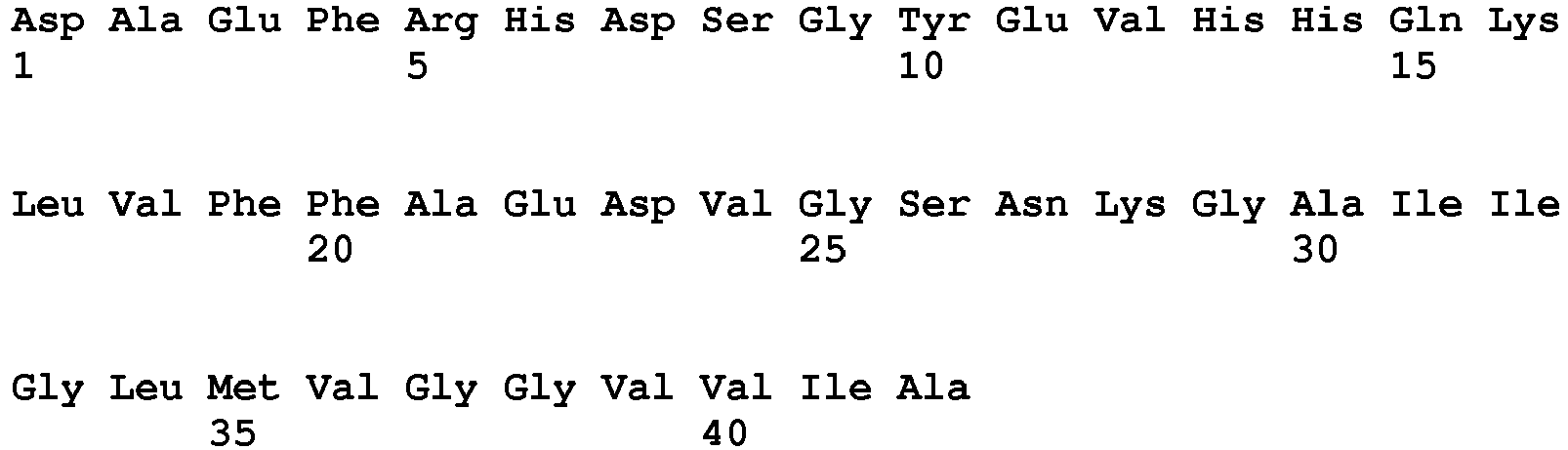
- <210> 2
<211> 40
<212> PRT
<213> Homo sapiens - <400> 2

- <210> 3
<211> 40
<212> PRT
<213> Homo sapiens - <400> 3


- <210> 4
<211> 38
<212> PRT
<213> Homo sapiens - <400> 4
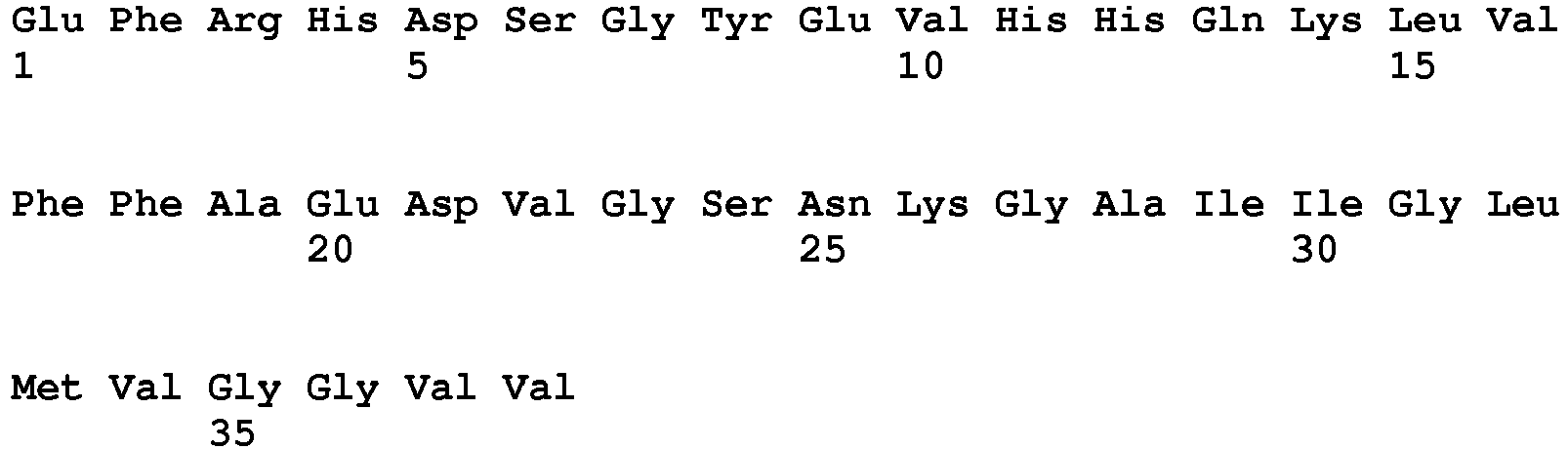
- <210> 5
<211> 17
<212> PRT
<213> Homo sapiens - <220>
<221> MOD_RES
<222> (17)..(17)
<223> AMIDATION - <400> 5

- <210> 6
<211> 13
<212> PRT
<213> Homo sapiens - <400> 6

- <210> 7
<211> 10
<212> PRT
<213> Homo sapiens - <220>
<221> MOD_RES
<222> (10)..(10)
<223> AMIDATION - <400> 7

- <210> 8
<211> 97
<212> PRT
<213> Homo sapiens - <400> 8

- <210> 9
<211> 76
<212> PRT
<213> Homo sapiens - <400> 9

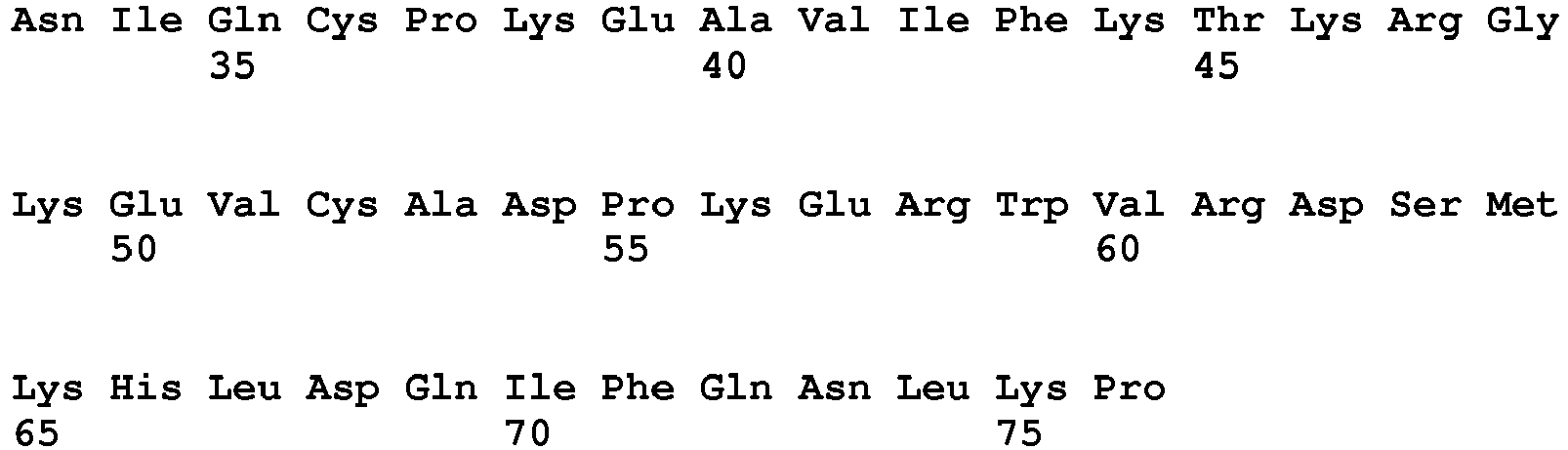
- <210> 10
<211> 76
<212> PRT
<213> Homo sapiens - <400> 10

- <210> 11
<211> 68
<212> PRT
<213> Homo sapiens - <400> 11


- <210> 12
<211> 373
<212> PRT
<213> Homo sapiens - <400> 12


- <210> 13
<211> 76
<212> PRT
<213> Homo sapiens - <400> 13


- <210> 14
<211> 33
<212> PRT
<213> Homo sapiens - <400> 14

- <210> 15
<211> 11
<212> PRT
<213> Homo sapiens - <400> 15

- <210> 16
<211> 32
<212> PRT
<213> Artificial sequence - <220>
<223> Synthetic peptide - <400> 16

- <210> 17
<211> 30
<212> PRT
<213> Artificial sequence - <220>
<223> Synthetic peptide - <400> 17

- <210> 18
<211> 34
<212> PRT
<213> Artificial sequence - <220>
<223> Synthetic peptide - <400> 18

- <210> 19
<211> 34
<212> PRT
<213> Artificial sequence - <220>
<223> Synthetic peptide - <400> 19

- <210> 20
<211> 5
<212> PRT
<213> Artificial sequence - <220>
<223> Synthetic peptide - <400> 20



Claims (16)
- A compound of formula (I):
 R1 represents hydrogen, halogen, -C1-6alkyl, C2-6alkenyl, C2-6alkynyl, -aryl, -C1-6alkylaryl, - cycloalkyl, -C1-6alkylcycloalkyl, -heteroaryl, -C1-6alkylheteroaryl, -heterocyclyl, -C1-6alkylheterocyclyl, -cycloalkyl substituted by phenyl, -cycloalkyl substituted by phenoxy, - phenyl substituted by cycloalkyl, -phenyl substituted by phenoxy, -phenyl substituted by phenyl, heterocyclyl substituted by phenyl, heteroaryl substituted by phenyl, phenyl substituted by heterocyclyl, phenyl substituted by heteroaryl, phenyl substituted by -O-cycloalkyl, phenyl substituted by -heterocyclyl-phenyl or phenyl substituted by -cycloalkyl-heterocyclyl;
and in which any of aforesaid aryl, cycloalkyl, heterocyclyl, heteroaryl, phenyl or phenoxy groups may optionally be substituted by one or more Rb groups selected from C1-6alkyl, C2-6alkenyl, C2-6alkynyl, C1-6haloalkyl, -C1-6thioalkyl, -SOC1-4alkyl, -SO2C1-4alkyl, C1-6alkoxy-, C1-6haloalkoxy, -O-C3-8cycloalkyl, C3-8cycloalkyl, -SO2C3-8cycloalkyl, -SOC3-6cycloalkyl, C3-6alkenyloxy-, C3-6alkynyloxy-, -C(O)C1-6alkyl, -C(O)OC1-6alkyl, C1-6alkoxy-C1-6alkyl-, nitro, halogen, cyano, hydroxyl, =O, -C(O)OH, -NH2, -NHC1-4alkyl,-N(C1-4alkyl)(C1-4alkyl), -C(O)N(C1-4alkyl)(C1-4alkyl), -C(O)NH2, -C(O)NH(C1-4alkyl) and-C(O)NH(C3-10cycloalkyl);R2 represents -O-C1-6alkyl, -NR3R4 or -O-C1-6haloalkyl;R3 and R4 independently represent hydrogen, C1-6alkyl or C3-8cycloalkyl; or R3 and R4 together with the nitrogen atom to which they are attached may form a heterocyclyl group optionally substituted by one or more Rb groups;n represents an integer selected from 0 to 3; andRa represents C1-6alkyl, C2-6alkenyl, C2-6alkynyl, C1-6haloalkyl, -C1-6thioalkyl, -SOC1-4alkyl,-SO2C1-4alkyl, C1-6alkoxy-, -O-C3-8cycloalkyl, C3-8cycloalkyl, -SO2C3-8cycloalkyl, -SOC3-6cycloalkyl, C3-6alkenyloxy-, C3-6alkynyloxy-, -C(O)C1-6alkyl, -C(O)OC1-6alkyl, C1-6alkoxy-C1-6alkyl-, nitro, halogen, cyano, hydroxyl, -C(O)OH, -NH2, -NHC1-4alkyl, -N(C1-4alkyl)(C1-4alkyl),-C(O)N(C1-4alkyl)(C1-4alkyl), -C(O)NH2, -C(O)NH(C1-4alkyl) and -C(O)NH(C3-10cycloalkyl). - A compound according to claim 1, wherein R1 represents -C1-6alkyl, -aryl, -cycloalkyl,-heteroaryl, -heterocyclyl, -cycloalkyl substituted by phenyl, -cycloalkyl substituted by phenoxy, -phenyl substituted by cycloalkyl, -phenyl substituted by phenoxy, -phenyl substituted by phenyl, heterocyclyl substituted by phenyl, heteroaryl substituted by phenyl, phenyl substituted by heterocyclyl, phenyl substituted by heteroaryl, phenyl substituted by -O-cycloalkyl, phenyl substituted by -heterocyclyl-phenyl or phenyl substituted by -cycloalkyl-heterocyclyl.
- A compound according to claim 2, wherein R1 represents -C1-6alkyl, -aryl, -cycloalkyl, - heteroaryl, -cycloalkyl substituted by phenyl, -cycloalkyl substituted by phenoxy, -phenyl substituted by cycloalkyl, -phenyl substituted by phenyl, heterocyclyl substituted by phenyl, phenyl substituted by heterocyclyl, phenyl substituted by -O-cycloalkyl, phenyl substituted by -heterocyclyl-phenyl or phenyl substituted by -cycloalkyl-heterocyclyl.
- A compound according to claim 3, wherein R1 represents -C1-6alkyl, -aryl, -cycloalkyl, - heteroaryl, -phenyl substituted by cycloalkyl, -phenyl substituted by phenyl, phenyl substituted by heterocyclyl, phenyl substituted by -heterocyclyl-phenyl or phenyl substituted by -O-cycloalkyl, wherein said phenyl group is optionally substituted by one or more halogen, C1-6alkoxy or C1-6haloalkoxy groups, wherein said heterocyclyl group is optionally substituted by one or more C1-6 alkyl, halogen, C3-8 cycloalkyl, hydroxyl or =O groups, and wherein said cycloalkyl group is optionally substituted by one or more halogen or =O groups.
- A compound according to claim 4, wherein R1 represents -aryl (e.g. phenyl), -phenyl substituted by cycloalkyl (e.g. -phenyl-cyclohexyl), phenyl substituted by heterocyclyl (e.g.-phenyl-pyrrolidinyl, -phenyl-morpholinyl, -phenyl-thiomorpholinyl, -phenyl-piperidinyl,-phenyl-piperazinyl, -phenyl-tetrahydrothiopyranyl or -phenyl-tetrahydropyranyl) or phenyl substituted by -heterocyclyl-phenyl (e.g. -phenyl-piperazinyl-phenyl); wherein said phenyl group is optionally substituted by one or more halogen (e.g. fluorine, bromine or chlorine), C1-6alkoxy (e.g. butoxy) or C1-6haloalkoxy (e.g. difluorobutoxy) groups; wherein said heterocyclyl group is optionally substituted by one or more C1-6 alkyl (e.g. methyl), halogen (e.g. fluorine), C3-8 cycloalkyl (e.g. cyclopropyl), hydroxyl or =O groups; and wherein said cycloalkyl group is optionally substituted by one or more halogen (e.g. fluorine) or =O groups.
- A compound according to any of claims 1 to 5, wherein R2 represents -O-C1-6alkyl (e.g. methoxy) or NR3R4 (e.g. -NHMe, -N(Me)2), -NH-cyclohexyl or a heterocyclic group such as piperidinyl, piperazinyl or morpholinyl wherein said heterocyclic group is optionally substituted by one or more Rb groups such as halogen (e.g. fluorine) or C1-6 alkyl (e.g. methyl)).
- A compound according to any of claims 1 to 6, wherein n represents 0.
- A compound according to claim 1, which is selected from the group consisting of:
5 1-(1H-Benzo[d]imidazol-5-yl)-4-methoxy-5-phenyl-1H-pyrrol-2(5H)-one 
6 1-(1H-Benzo[d]imidazol-5-yl)-5-(2,3-difluorophenyl)-4-methoxy-1H-pyrrol-2(5H)-one 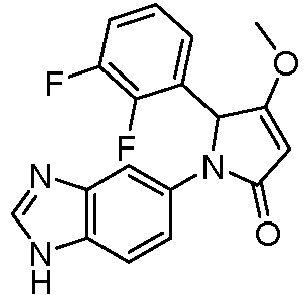
7 1-(1H-Benzo[d]imidazol-5-yl)-5-(2,3,5-trifluorophenyl)-4-methoxy-1H-pyrrol-2(5H)-one 
8 1-(1H-Benzo[d]imidazol-5-yl)-4-methoxy-5-(4-morpholinophenyl)-1H-pyrrol-2(5H)-one 
9 1-(1H-Benzo[d]imidazol-5-yl)-5-(4-(4,4-difluoropiperidin-1-yl)phenyl)-4-methoxy-1H-pyrrol-2(5H)-one 
10 1-(1H-Benzo[d]imidazol-5-yl)-5-(4-(4,4-difluorobutoxy)phenyl)-4-methoxy-1H-pyrrol-2(5H)-one 
11 1-(1H-Benzo[d]imidazol-5-yl)-5-(4-butoxyphenyl)-4-methoxy-1H-pyrrol-2(5H)-one 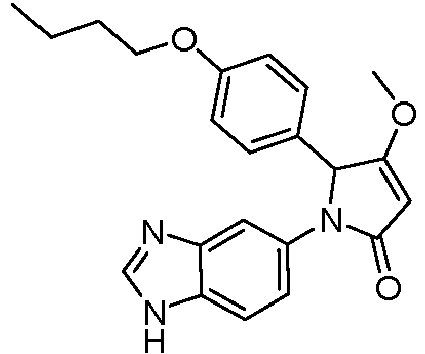
12 1-(1H-Benzo[d]imidazol-5-yl)-4-methoxy-5-(4-thiomorpholinophenyl)-1H-pyrrol-2(5H)-one 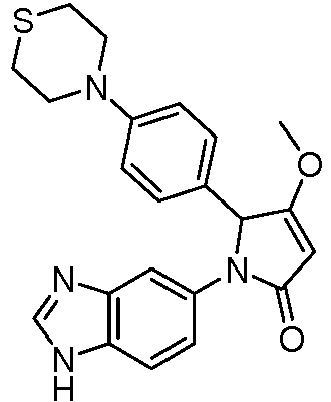
13 1-(1H-Benzo[d]imidazol-5-yl)-5-(4-(4,4-difluorocyclohexyl)phenyl)-4-methoxy-1H-pyrrol-2(5H)-one 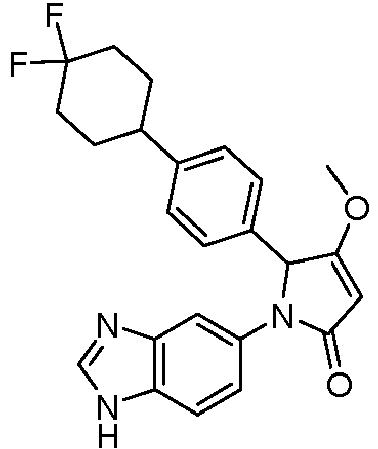
14 1-(1H-Benzo[d]imidazol-5-yl)-5-(4-(3,3-difluoropyrrolidin-1-yl)phenyl)-4-methoxy-1H-pyrrol-2(5H)-one 
15 1-(1H-Benzo[d]imidazol-5-yl)-5-(4-(tetrahydro-2H-pyran-4-yl)phenyl)-4-methoxy-1H-pyrrol-2(5H)-one 
16 1-(1H-Benzo[d]imidazol-5-yl)-5-(4-(1,1-dioxothian-4-yl)phenyl)-4-methoxy-1H-pyrrol-2(5H)-one 
17 1-(1H-Benzo[d]imidazol-5-yl)-5-(4-(4-oxocyclohexyl)phenyl)-4-methoxy-1H-pyrrol-2(5H)-one 
18 1-(1H-Benzo[d]imidazol-5-yl)-5-(4-(1,1-dioxo-4-thiomorpholin-4-yl)phenyl)-4-methoxy-1H-pyrrol-2(5H)-one 
19 1-(1H-Benzo[d]imidazol-5-yl)-5-(4-(4-phenylpiperazin-1-yl)phenyl)-4-methoxy-1H-pyrrol-2(5H)-one 
20 1-(1H-Benzo[d]imidazol-5-yl)-5-(4-(4-methylpiperazin-1-yl)phenyl)-4-methoxy-1H-pyrrol-2(5H)-one 
21 1-(1H-Benzo[d]imidazol-5-yl)-5-(4-(4-cyclopropylpiperazin-1-yl)phenyl)-4-methoxy-1H-pyrrol-2(5H)-one 
22 1-(1H-Benzo[d]imidazol-5-yl)-5-(4-(4-hydroxypiperidin-1-yl)phenyl)-4-methoxy-1H-pyrrol-2(5H)-one 
23 1-(1H-Benzo[d]imidazol-5-yl)-4-(cyclohexylamino)-5-phenyl-1H-pyrrol-2(5H)-one 
24 1-(1H-Benzo[d]imidazol-5-yl)-4-(cyclohexylamino)-5-(4-morpholinophenyl)-1H-pyrrol-2(5H)-one 
25 1-(1H-Benzo[d]imidazol-5-yl)-4-(cyclohexylamino)-5-(2,3,5-trifluorophenyl)-1H-pyrrol-2(5H)-one 
26 1-(1H-Benzo[d]imidazol-5-yl)-4-(cyclohexylamino)-5-(2,3-difluorophenyl)-1H-pyrrol-2(5H)-one 
27 1-(1H-Benzo[d]imidazol-5-yl)-5-(4-morpholinophenyl)-4-(piperidin-1-yl)-1H-pyrrol-2(5H)-one 
28 1-(1H-Benzo[d]imidazol-5-yl)-4-morpholino-5-(4-morpholinophenyl)-1H-pyrrol-2(5H)-one 
29 1-(1H-Benzo[d]imidazol-5-yl)-4-(methylamino)-5-(4-morpholinophenyl)-1H-pyrrol-2(5H)-one 
30 1-(1H-Benzo[d]imidazol-5-yl)-5-(4-morpholinophenyl)-4-(piperazin-1-yl)-1H-pyrrol-2(5H)-one 
31 1-(1H-Benzo[d]imidazol-5-yl)-4-(dimethylamino)-5-(4-morpholinophenyl)-1H-pyrrol-2(5H)-one 
32 1-(1H-Benzo[d]imidazol-5-yl)-4-(4,4-difluoropiperidin-1-yl)-5-(4-morpholinophenyl)-1H-pyrrol-2(5H)-one 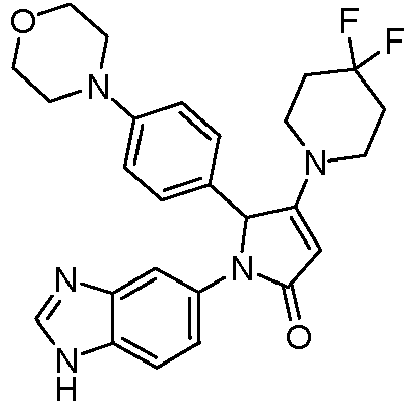
33 1-(1H-Benzo[d]imidazol-5-yl)-4-(4-methylpiperazin-1-yl)-5-(4-morpholinophenyl)-1H-pyrrol-2(5H)-one 
- A compound, which is selected from the group consisting of:
1 1-(1H-Benzo[d]imidazol-5-yl)-5-phenylpyrrolidine-2,4-dione 
2 1-(1H-Benzo[d]imidazol-5-yl)-5-(2,3-difluorophenyl)pyrrolidine-2,4-dione 
3 1-(1H-Benzo[d]imidazol-5-yl)-5-(2,3,5-trifluorophenyl)pyrrolidine-2,4-dione 
4 1-(1H-Benzo[d]imidazol-5-yl)-5-(4-morpholinophenyl)pyrrolidine-2,4-dione 
- A compound according to claims 1 to 9, for use as a medicament.
- A pharmaceutical composition comprising a compound according to any one of claims 1 to 9, optionally in combination with one or more therapeutically acceptable diluents or carriers.
- The pharmaceutical composition of claim 11, which comprises additionally at least one compound, selected from the group consisting of neuroprotectants, antiparkinsonian drugs, amyloid protein deposition inhibitors, beta amyloid synthesis inhibitors, antidepressants, anxiolytic drugs, antipsychotic drugs and anti-multiple sclerosis drugs.
- The pharmaceutical composition of claim 11 or 12, which comprises additionally at least one compound, selected from the group consisting of PEP-inhibitors, LiCl, inhibitors of inhibitors of DP IV or DP IV-like enzymes, acetylcholinesterase (ACE) inhibitors, PIMT enhancers, inhibitors of beta secretases, inhibitors of gamma secretases, inhibitors of neutral endopeptidase, inhibitors of Phosphodiesterase-4 (PDE-4), TNFalpha inhibitors, muscarinic M1 receptor antagonists, NMDA receptor antagonists, sigma-1 receptor inhibitors, histamine H3 antagonists, immunomodulatory agents, immunosuppressive agents or an agent selected from the group consisting of antegren (natalizumab), Neurelan (fampridine-SR), campath (alemtuzumab), IR 208, NBI 5788/MSP 771 (tiplimotide), paclitaxel, Anergix.MS (AG 284), SH636, Differin (CD 271, adapalene), BAY 361677 (interleukin-4), matrix-metalloproteinase-inhibitors, interferon-tau (trophoblastin) and SAIK-MS.
- A compound according to any one of claims 1 to 9, or a pharmaceutical composition according to any one of claims 11 to 13 for use in the treatment of a disease selected from the group consisting of Kennedy's disease, duodenal cancer with or without Helicobacter pylori infections, colorectal cancer, Zolliger-Ellison syndrome, gastric cancer with or without Helicobacter pylori infections, pathogenic psychotic conditions, schizophrenia, infertility, neoplasia, inflammatory host responses, cancer, malign metastasis, melanoma, psoriasis, impaired humoral and cell-mediated immune responses, leukocyte adhesion and migration processes in the endothelium, impaired food intake, impaired sleep-wakefulness, impaired homeostatic regulation of energy metabolism, impaired autonomic function, impaired hormonal balance or impaired regulation of body fluids, multiple sclerosis, the Guillain-Barré syndrome and chronic inflammatory demyelinizing polyradiculoneuropathy.
- A compound according to any one of claims 1 to 9, or a pharmaceutical composition according to any one of claims 11 to 13 for use in the treatment of a disease selected from the group consisting of mild cognitive impairment, Alzheimer's disease, Familial British Dementia, Familial Danish Dementia, neurodegeneration in Down Syndrome and Huntington's disease or of a disease selected from the group consisting of rheumatoid arthritis, atherosclerosis, pancreatitis and restenosis.
- A process for preparation of a compound of formula (I) according to any one of claims 1 to 9, which comprises:(a) preparing a compound of formula (I) where R2 represents =O from a compound of formula (II)
 (b) interconversion of compounds of formula (I); and/or(c) deprotecting a compound of formula (I) which is protected.


Applications Claiming Priority (2)
| Application Number | Priority Date | Filing Date | Title |
|---|---|---|---|
| US201161453333P | 2011-03-16 | 2011-03-16 | |
| PCT/EP2012/054631 WO2012123563A1 (en) | 2011-03-16 | 2012-03-16 | Benz imidazole derivatives as inhibitors of glutaminyl cyclase |
Publications (2)
| Publication Number | Publication Date |
|---|---|
| EP2686313A1 EP2686313A1 (en) | 2014-01-22 |
| EP2686313B1 true EP2686313B1 (en) | 2016-02-03 |
Family
ID=45852540
Family Applications (1)
| Application Number | Title | Priority Date | Filing Date |
|---|---|---|---|
| EP12709323.5A Active EP2686313B1 (en) | 2011-03-16 | 2012-03-16 | Benzimidazole derivatives as inhibitors of glutaminyl cyclase |
Country Status (6)
| Country | Link |
|---|---|
| US (1) | US8530670B2 (en) |
| EP (1) | EP2686313B1 (en) |
| JP (1) | JP6050264B2 (en) |
| DK (1) | DK2686313T3 (en) |
| ES (1) | ES2570167T3 (en) |
| WO (1) | WO2012123563A1 (en) |
Families Citing this family (11)
| Publication number | Priority date | Publication date | Assignee | Title |
|---|---|---|---|---|
| CN105408326B (en) * | 2013-07-19 | 2019-08-27 | 先正达参股股份有限公司 | Novel process for the preparation of spiroheterocyclic pyrrolidinediones |
| WO2016097305A1 (en) | 2014-12-19 | 2016-06-23 | Probiodrug Ag | Novel method for the detection of pglu-abeta peptides |
| DE102015011780A1 (en) * | 2015-09-16 | 2017-03-16 | Hochschule Anhalt | New glutaminyl cyclase inhibitors |
| CN116462666B (en) * | 2017-01-10 | 2025-07-15 | 瑞士苏黎世联邦理工学院 | Cytoprotective compounds and uses thereof |
| US10702495B2 (en) | 2017-02-20 | 2020-07-07 | Nexien Biopharma, Inc. | Method and compositions for treating dystrophies and myotonia |
| ES2812698T3 (en) | 2017-09-29 | 2021-03-18 | Probiodrug Ag | Glutaminyl cyclase inhibitors |
| EP3521308B1 (en) | 2018-01-31 | 2024-03-13 | Vivoryon Therapeutics N.V. | Humanized and de-immunized antibodies |
| EP3543231A1 (en) * | 2018-03-19 | 2019-09-25 | ETH Zurich | Compounds for treating cns- and neurodegenerative diseases |
| CN108611370A (en) * | 2018-05-10 | 2018-10-02 | 江苏天瑞精准医疗科技有限公司 | A kind of PIMT expression plasmids, amplimer, construction method and application |
| EP3750528A1 (en) | 2019-06-11 | 2020-12-16 | Nexien Biopharma, Inc. | Compositions for treating dystrophies and myotonia |
| TW202317549A (en) * | 2021-06-24 | 2023-05-01 | 香港商英科智能有限公司 | Beta-lactam derivatives for the treatment of diseases |
Family Cites Families (551)
| Publication number | Priority date | Publication date | Assignee | Title |
|---|---|---|---|---|
| JPS5736816A (en) | 1980-08-14 | 1982-02-27 | Toshiba Corp | Manufacture of superconductive coil |
| JPS57192573A (en) | 1981-05-25 | 1982-11-26 | Hochiki Co | Fire fighting agent |
| JPS6126111A (en) | 1984-07-16 | 1986-02-05 | Shin Meiwa Ind Co Ltd | Industrial robot |
| JPS6137764A (en) | 1984-07-31 | 1986-02-22 | Suntory Ltd | Novel physiologically active compound having anti-prolyl-endopeptidase activity |
| JPH0623190B2 (en) | 1985-04-16 | 1994-03-30 | サントリー株式会社 | N-acylpyrrolidine derivative having inhibitor activity, process for producing the same and use thereof |
| EP0201743B1 (en) | 1985-04-16 | 1992-04-01 | Suntory Limited | Dipeptide derivatives of fatty acids, process for preparing them, pharmaceutical composition and use |
| CA1309805C (en) | 1985-04-16 | 1992-11-03 | Naoki Higuchi | Dipeptide derivative and synthesis and use thereof |
| JPS62114957A (en) | 1985-11-13 | 1987-05-26 | Suntory Ltd | Novel pyrrolidine derivative having prolylendopeptidase inhibiting action its production and use thereof |
| JPH0714878B2 (en) | 1985-11-14 | 1995-02-22 | サントリー株式会社 | Prolyl endopeptidase inhibitor containing pyrrolidine amide as an active ingredient |
| JPH0764834B2 (en) | 1985-11-29 | 1995-07-12 | サントリー株式会社 | Novel pyrrolidine amide derivative having prolyl endopeptidase inhibitory activity, its production and use |
| US5198458A (en) | 1986-02-04 | 1993-03-30 | Suntory Limited | Pyrrolidineamide derivatives of acylamino acid and pharmaceutical composition containing the same |
| CA1320734C (en) | 1986-02-04 | 1993-07-27 | Suntory Limited | Pyrrolidineamide derivative of acylamino acid and pharmaceutical composition containing the same |
| CA1334092C (en) | 1986-07-11 | 1995-01-24 | David John Carini | Angiotensin ii receptor blocking imidazoles |
| JPS6386485A (en) | 1986-09-30 | 1988-04-16 | Agency Of Ind Science & Technol | Tunnel type josephson junction device |
| US5223482A (en) | 1986-11-17 | 1993-06-29 | Scios Nova Inc. | Recombinant Alzheimer's protease inhibitory amyloid protein and method of use |
| JPH08806B2 (en) | 1986-11-18 | 1996-01-10 | サントリー株式会社 | Novel pyrrolidine amide derivative having prolyl endopeptidase inhibitory action |
| EP0268190B1 (en) | 1986-11-20 | 1993-06-16 | Ono Pharmaceutical Co., Ltd. | Prolinal derivatives |
| US5254550A (en) | 1986-11-20 | 1993-10-19 | Ono Pharmaceutical Co., Ltd. | Prolinal derivatives and pharmaceutical compositions thereof |
| JPS63162672A (en) | 1986-12-25 | 1988-07-06 | Ono Pharmaceut Co Ltd | Novel prolinal derivative, its production and antiamnestic agent containing said derivative |
| EP0275482B1 (en) | 1986-12-29 | 1993-01-20 | Ono Pharmaceutical Co., Ltd. | Proline derivatives |
| JPH089591B2 (en) | 1986-12-29 | 1996-01-31 | 小野薬品工業株式会社 | Novel prolinal derivative |
| US5262431A (en) | 1986-12-29 | 1993-11-16 | Ono Pharmaceutical Co., Ltd. | Prolinal derivatives and pharmaceutical compositions thereof |
| DE3879522T2 (en) | 1987-02-04 | 1993-09-02 | Ono Pharmaceutical Co | PROLINAL DERIVATIVES. |
| ES2103287T3 (en) | 1987-02-23 | 1997-09-16 | Ono Pharmaceutical Co | NEW DERIVATIVES OF THIAZOLIDINE. |
| JPS6442465A (en) | 1987-08-07 | 1989-02-14 | Wakunaga Pharma Co Ltd | N-acylprolylpyrrolidine derivative, production and use thereof |
| US4857524A (en) | 1987-08-08 | 1989-08-15 | Kissei Pharmaceutical Co., Ltd. | Thiazolidine compounds and therapeutic method |
| JP2649237B2 (en) | 1988-03-07 | 1997-09-03 | キッセイ薬品工業 株式会社 | Thiazolidine derivative |
| JP2515558B2 (en) | 1987-09-10 | 1996-07-10 | 株式会社ヤクルト本社 | Novel peptide and anti-amnestic agent containing the same as active ingredient |
| CA1339014C (en) | 1987-10-08 | 1997-03-25 | Ronald E. Majocha | Antibodies to a4 amyloid peptide |
| JPH0742309B2 (en) | 1987-11-30 | 1995-05-10 | キッセイ薬品工業株式会社 | Thiazolidine derivative |
| JPH01250370A (en) | 1987-12-23 | 1989-10-05 | Zeria Pharmaceut Co Ltd | New amino acid imide derivatives, manufacturing methods and uses |
| US5053414A (en) | 1988-04-08 | 1991-10-01 | Ono Pharmaceutical Co., Ltd. | Heterocyclic compounds |
| US5328899A (en) | 1988-07-15 | 1994-07-12 | The Salk Institute For Biological Studies | NPY peptide analogs |
| ZA896374B (en) | 1988-08-26 | 1990-05-30 | Merrell Dow Pharma | Neuropeptide y antagonists |
| ZA896376B (en) | 1988-08-26 | 1990-05-30 | Merrell Dow Pharma | Neuropeptide y agonists |
| JP2531989B2 (en) | 1988-09-14 | 1996-09-04 | 吉富製薬株式会社 | Pyridine compound |
| CA2004028C (en) | 1988-12-08 | 1998-09-22 | Motoki Torizuka | Condensed benzene derivative |
| JPH02207070A (en) | 1989-02-07 | 1990-08-16 | Zeria Pharmaceut Co Ltd | Amino acid imide derivatives, pharmaceuticals containing the same, and intermediates for producing the compounds |
| WO1990012005A1 (en) | 1989-04-13 | 1990-10-18 | Japan Tobacco Inc. | New amino acid derivatives having prolylendopeptidase inhibitor activity |
| WO1990012871A1 (en) | 1989-04-14 | 1990-11-01 | Research Foundation For Mental Hygiene, Inc. | Cerebrovascular amyloid protein-specific monoclonal antibody sv17-6e10 |
| AU5525090A (en) | 1989-04-14 | 1990-11-16 | Research Foundation For Mental Hygiene, Inc. | Monoclonal antibody to amyloid peptide |
| CA2018438C (en) | 1989-06-14 | 2000-08-08 | Joseph Alan Finkelstein | Imidazolyl-alkenoic acids |
| DE3939797A1 (en) | 1989-12-01 | 1991-06-06 | Basf Ag | NEW PEPTIDES DERIVED FROM NEUROPEPTIDE Y |
| US4985560A (en) | 1990-01-12 | 1991-01-15 | American Home Products Corporation | Pyridazino(4,5-b)indolizines |
| IL97219A (en) | 1990-02-19 | 1995-12-08 | Ciba Geigy Ag | Biphenyl substituted aliphatic amino compounds process for their preparation and pharmaceutical compositions containing them |
| JPH04211648A (en) | 1990-07-27 | 1992-08-03 | Nippon Kayaku Co Ltd | Keto-acid amide derivative |
| TW201738B (en) | 1990-03-20 | 1993-03-11 | Sanofi Co | |
| US5073549A (en) | 1990-03-22 | 1991-12-17 | Bristol-Myers Squibb Company | BU-4164E - A and B, prolyl endopeptidase inhibitors and their methods of use |
| US4999349A (en) | 1990-03-22 | 1991-03-12 | Bristol-Myers Squibb Co. | BU-4164E - A and B, prolyl endopeptidase inhibitors |
| US5196444A (en) | 1990-04-27 | 1993-03-23 | Takeda Chemical Industries, Ltd. | 1-(cyclohexyloxycarbonyloxy)ethyl 2-ethoxy-1-[[2'-(1H-tetrazol-5-yl)biphenyl-4-yl]methyl]benzimidazole-7-carboxylate and compositions and methods of pharmaceutical use thereof |
| WO1991018891A1 (en) | 1990-06-04 | 1991-12-12 | Pfizer Inc. | Aromatic pyrrolidine and thiazolidine amides |
| WO1991018877A1 (en) | 1990-06-07 | 1991-12-12 | Zeria Pharmaceutical Co., Ltd. | Novel arylalkanoylamine derivative and drug containing the same |
| EP0468469A2 (en) | 1990-07-27 | 1992-01-29 | Japan Tobacco Inc. | Proline derivatives |
| US5506256A (en) | 1990-07-27 | 1996-04-09 | Yoshitomi Pharmaceutical Industries, Ltd. | Proline derivatives possessing prolyl endopeptidase-inhibitory activity |
| JPH05186498A (en) | 1991-12-27 | 1993-07-27 | Japan Tobacco Inc | Proline derivative |
| IE920540A1 (en) | 1991-02-21 | 1992-08-26 | Sankyo Co | 1-biphenylmethylimidazole derivatives, their preparation and¹their therapetuic use |
| US5104880A (en) | 1991-05-01 | 1992-04-14 | Mayo Foundation For Medical Education And Research | Huperzine a analogs as acetylcholinesterase inhibitors |
| WO1992021333A2 (en) | 1991-05-24 | 1992-12-10 | Pharmavene, Inc. | Treatment of drug withdrawal symptoms and drug craving with type b monoamine oxidase inhibitors |
| DE69222142T2 (en) | 1991-06-20 | 1998-04-09 | Snow Brand Milk Products Co., Ltd., Sapporo, Hokkaido | INNOVATIVE PROLYL ENDOPEPTIDASE INHIBITORS SNA-115 AND SNA-115T, THEIR PRODUCTION, AND STRAINS USED THEREOF |
| DE4121975A1 (en) | 1991-07-03 | 1993-01-07 | Basf Ag | THERMOPLASTIC MOLDING MATERIALS BASED ON POLYCARBONATES, STYROL / ACRYLNITRILE POLYMERISATES AND POLYOLEFINS |
| CZ281628B6 (en) | 1991-07-29 | 1996-11-13 | Warner-Lambert Company | Quinazoline derivatives and pharmaceutical preparations based thereon and their use |
| TW226375B (en) | 1991-10-24 | 1994-07-11 | American Home Prod | |
| JPH08501055A (en) | 1991-12-19 | 1996-02-06 | ガーヴァン インスティチュート オブ メディカル リサーチ | A novel molecule that inhibits the biological function of neuropeptide tyrosine |
| JPH05301826A (en) | 1991-12-24 | 1993-11-16 | Snow Brand Milk Prod Co Ltd | Prolylendopeptidase inhibitor |
| JPH05201970A (en) | 1992-01-24 | 1993-08-10 | Japan Tobacco Inc | New proline derivative |
| JP3318622B2 (en) | 1992-05-27 | 2002-08-26 | 独立行政法人産業技術総合研究所 | Prolyl endopeptidase inhibitor |
| GB9212308D0 (en) | 1992-06-10 | 1992-07-22 | Ici Plc | Therapeutic compositions |
| GB9213215D0 (en) | 1992-06-20 | 1992-08-05 | Wellcome Found | Peptides |
| JPH06116284A (en) | 1992-10-02 | 1994-04-26 | Yamanouchi Pharmaceut Co Ltd | New peptide |
| WO1994007890A1 (en) | 1992-10-05 | 1994-04-14 | Ube Industries, Ltd. | Pyrimidine compound |
| US5260286A (en) | 1992-10-16 | 1993-11-09 | Japan Tobacco, Inc. | 2-piperidinecarboxylic acid derivatives useful as NMDA receptor antagonists |
| US5536737A (en) | 1992-11-20 | 1996-07-16 | Japan Tobacco Inc. | Compound having prolyl endopeptidase inhibitory activity and pharmaceutical use thereof |
| US5354758A (en) | 1992-12-16 | 1994-10-11 | Japan Tobacco Inc. | Benzomorphans useful as NMDA receptor antagonists |
| JPH06192298A (en) | 1992-12-24 | 1994-07-12 | Mitsui Toatsu Chem Inc | Novel function peptide |
| DE4326465A1 (en) | 1993-01-20 | 1995-02-09 | Thomae Gmbh Dr K | Amino acid derivatives, pharmaceutical compositions containing these compounds and process for their preparation |
| EP0683234B2 (en) | 1993-01-25 | 2007-06-06 | Takeda Chemical Industries, Ltd. | Antibody against beta-amyloid or their derivative and use thereof |
| JPH06234693A (en) | 1993-02-09 | 1994-08-23 | Snow Brand Milk Prod Co Ltd | Novel isotetracenone-based substance and its production method |
| FR2701480B1 (en) | 1993-02-15 | 1995-05-24 | Sanofi Elf | Compounds with a sulfamoyl and amidino group, process for their preparation and pharmaceutical compositions containing them. |
| EP0611769A1 (en) | 1993-02-16 | 1994-08-24 | Merrell Dow Pharmaceuticals Inc. | Silylated acetylcholinesterase inhibitors |
| AU4982293A (en) | 1993-03-02 | 1994-09-26 | Fujisawa Pharmaceutical Co., Ltd. | Novel heterocyclic compound |
| FR2702150B1 (en) | 1993-03-03 | 1995-04-07 | Rhone Poulenc Rorer Sa | Application of 2H-1,2-4-benzothiadiazine-3 (4H) -one-1,1-dioxide derivatives as non-competitive NMDA receptor antagonists. |
| FR2703050B1 (en) | 1993-03-24 | 1995-04-28 | Adir | New nitrogenous bicyclic derivatives, process for their preparation and the pharmaceutical compositions containing them. |
| EP0627400A1 (en) | 1993-06-04 | 1994-12-07 | Merrell Dow Pharmaceuticals Inc. | Aromatic acetylcholinesterase inhibitors |
| WO1995000161A1 (en) | 1993-06-18 | 1995-01-05 | University Of Cincinnati | Neuropeptide y antagonists and agonists |
| AU6983894A (en) | 1993-06-30 | 1995-01-24 | Zeria Pharmaceutical Co., Ltd. | Thiazolidine derivative and medicine containing the same |
| FR2707645B1 (en) | 1993-07-16 | 1995-08-11 | Rhone Poulenc Rorer Sa | Imidazo [1,2-a] pirazine-4-one derivatives, their preparation and drugs containing them. |
| FR2707643B1 (en) | 1993-07-16 | 1995-08-11 | Rhone Poulenc Rorer Sa | Imidazo [1,2-a] pyrazine-4-one derivatives, their preparation and drugs containing them. |
| EP0709373B1 (en) | 1993-07-23 | 2001-10-17 | Zaidan Hojin Biseibutsu Kagaku Kenkyu Kai | Pyrrolidine derivative |
| FR2711993B1 (en) | 1993-11-05 | 1995-12-01 | Rhone Poulenc Rorer Sa | Drugs containing 7H-imidazol [1,2-a] pyrazine-8-one derivatives, new compounds and their preparation. |
| KR100341982B1 (en) | 1993-12-02 | 2002-11-30 | 메렐 파마슈티칼스 인크. | Prolyl Endopeptidase Inhibitors |
| IL111785A0 (en) | 1993-12-03 | 1995-01-24 | Ferring Bv | Dp-iv inhibitors and pharmaceutical compositions containing them |
| FR2717813B1 (en) | 1994-03-28 | 1996-05-10 | Rhone Poulenc Rorer Sa | Imidazo [1,2-a] indeno [1,2-e] pyrazine-4-one derivatives, their preparation and drugs containing them. |
| FR2717805B1 (en) | 1994-03-28 | 1996-05-10 | Rhone Poulenc Rorer Sa | 5H-indeno [1,2-b] pyrazine-2,3-dione derivatives, their preparation and drugs containing them. |
| FR2717811B1 (en) | 1994-03-28 | 1996-04-26 | Rhone Poulenc Rorer Sa | Imidazo [1,2-a] pyrazine-4-one derivatives, their preparation and drugs containing them. |
| FR2717812B1 (en) | 1994-03-28 | 1996-05-10 | Rhone Poulenc Rorer Sa | Indeno [1,2-e] pyrazine-4-ones, their preparation and the drugs containing them. |
| JPH07267988A (en) | 1994-03-31 | 1995-10-17 | Yamanouchi Pharmaceut Co Ltd | New peptide |
| GB9410320D0 (en) | 1994-05-24 | 1994-07-13 | Fisons Corp | Novel therapeutic method |
| GB9418443D0 (en) | 1994-09-13 | 1994-11-02 | Pfizer Ltd | Therapeutic agents |
| US6562862B1 (en) | 1994-10-20 | 2003-05-13 | Eli Lilly And Company | Methods of inhibiting physiological conditions associated with an excess of neuropeptide Y |
| IL115613A0 (en) | 1994-10-20 | 1996-01-19 | Lilly Co Eli | Bicyclic neuropeptide y receptor antagonists |
| US5663192A (en) | 1994-10-20 | 1997-09-02 | Eli Lilly And Company | Heterocyclic neuropeptide Y receptor antagonists |
| FR2726275B1 (en) | 1994-11-02 | 1996-12-06 | Rhone Poulenc Rorer Sa | SPIRO HETEROCYCLE-IMIDAZO (1,2-A) INDENO (1,2-E) PYRAZINE) -4'- ONES, THEIR PREPARATION AND THE MEDICINAL PRODUCTS CONTAINING IT |
| IL116584A0 (en) | 1994-12-29 | 1996-03-31 | Res Dev Foundation | Novel flavin adenine dinucleotide analogue inhibitors of monoamine oxidase |
| US5691368A (en) | 1995-01-11 | 1997-11-25 | Hoechst Marion Roussel, Inc. | Substituted oxazolidine calpain and/or cathepsin B inhibitors |
| GB9500601D0 (en) | 1995-01-12 | 1995-03-01 | Wellcome Found | Modified peptides |
| US5786180A (en) | 1995-02-14 | 1998-07-28 | Bayer Corporation | Monoclonal antibody 369.2B specific for β A4 peptide |
| US5552411A (en) | 1995-05-26 | 1996-09-03 | Warner-Lambert Company | Sulfonylquinolines as central nervous system and cardiovascular agents |
| US5668151A (en) | 1995-06-07 | 1997-09-16 | Bristol-Myers Squibb Company | Dihydropyridine NPY antagonists: piperidine derivatives |
| US5554621A (en) | 1995-06-07 | 1996-09-10 | Bristol-Myers Squibb Company | Dihydropyridine NPY antagonists: nitrogen heterocyclic derivatives |
| US5635503A (en) | 1995-06-07 | 1997-06-03 | Bristol-Myers Squibb Company | Dihydropyridine npy antagonists: piperazine derivatives |
| IL117997A0 (en) | 1995-06-07 | 1996-10-31 | Pfizer | Neuropeptide Y1 specific ligands |
| JP3727383B2 (en) | 1995-07-31 | 2005-12-14 | 月桂冠株式会社 | Prolyl endopeptidase inhibitor |
| WO1997009308A1 (en) | 1995-09-01 | 1997-03-13 | Eli Lilly And Company | Indolyl neuropeptide y receptor antagonists |
| WO1997012613A1 (en) | 1995-10-05 | 1997-04-10 | Warner-Lambert Company | Method for treating and preventing inflammation and atherosclerosis |
| ES2100129B1 (en) | 1995-10-11 | 1998-02-16 | Medichem Sa | NEW POLYCLIC AMINOPYRIDINE COMPOUNDS ACETYLCHOLINESTERASE INHIBITORS, PROCEDURE FOR THE PREPARATION AND USE. |
| DE19544686A1 (en) | 1995-11-30 | 1997-06-05 | Thomae Gmbh Dr K | Amino acid derivatives, medicaments containing these compounds and processes for their preparation |
| DE19544687A1 (en) | 1995-11-30 | 1997-06-05 | Thomae Gmbh Dr K | Amino acid derivatives, medicaments containing these compounds and processes for their preparation |
| DE19544685A1 (en) | 1995-11-30 | 1997-06-05 | Thomae Gmbh Dr K | Amino acid derivatives, medicaments containing these compounds and processes for their preparation |
| AU7692996A (en) | 1995-12-01 | 1997-06-27 | Ciba-Geigy Ag | Receptor antagonists |
| WO1997020822A1 (en) | 1995-12-01 | 1997-06-12 | Novartis Ag | Quinazolin-2,4-diazirines as npy receptor antagonist |
| AU7626496A (en) | 1995-12-01 | 1997-06-27 | Ciba-Geigy Ag | Heteroaryl compounds |
| AU1328197A (en) | 1995-12-01 | 1997-06-19 | Synaptic Pharmaceutical Corporation | Aryl sulfonamide and sulfamide derivatives and uses thereof |
| AU7692696A (en) | 1995-12-01 | 1997-06-27 | Novartis Ag | Heteroaryl derivatives |
| JPH09157253A (en) | 1995-12-12 | 1997-06-17 | Yamanouchi Pharmaceut Co Ltd | New amino acid derivative |
| ZA9610745B (en) | 1995-12-22 | 1997-06-24 | Warner Lambert Co | 4-Subsituted piperidine analogs and their use as subtype selective nmda receptor antagonists |
| ZA9610736B (en) | 1995-12-22 | 1997-06-27 | Warner Lambert Co | 2-Substituted piperidine analogs and their use as subtypeselective nmda receptor antagonists |
| ZA9610741B (en) | 1995-12-22 | 1997-06-24 | Warner Lambert Co | 4-Substituted piperidine analogs and their use as subtype selective nmda receptor antagonists |
| EP0871442A1 (en) | 1996-01-09 | 1998-10-21 | Eli Lilly And Company | Benzimidzolyl neuropeptide y receptor antagonists |
| GB9605027D0 (en) | 1996-03-09 | 1996-05-08 | Pfizer Ltd | Quinoxalinediones |
| US5662723A (en) | 1996-03-22 | 1997-09-02 | Libbey Glass Inc. | Apparatus and method for forming a decorative pattern on glassware having an edge |
| CA2252039C (en) | 1996-04-12 | 2002-12-24 | Hoechst Marion Roussel, Inc. | Isatin derivatives as acetylcholinesterase inhibitors and analgesics |
| DE19616486C5 (en) | 1996-04-25 | 2016-06-30 | Royalty Pharma Collection Trust | Method for lowering the blood glucose level in mammals |
| WO1997046250A1 (en) | 1996-06-04 | 1997-12-11 | Synaptic Pharmaceutical Corporation | Methods of modifying feeding behavior, compounds useful in such methods, and dna encoding a hypothalamic atypical neuropeptide y/peptide yy receptor (y5) |
| WO1998001157A1 (en) | 1996-07-05 | 1998-01-15 | The Wwk Trust | Compositions for the treatment of peripheral neuropathies containing antidepressants and/or monoamine oxidase inhibitors and/or vitamin b12 and/or precursors or inducers of a neurotransmitter |
| DK0915859T3 (en) | 1996-07-23 | 2003-03-03 | Neurogen Corp | Certain substituted benzylamine derivatives; a new class of Neuropeptide Y1-specific ligands |
| CA2260982A1 (en) | 1996-07-23 | 1998-01-29 | Neurogen Corporation | Certain substituted benzylamine derivatives; a new class of neuropeptide-y1 specific ligands |
| DK0918761T3 (en) | 1996-07-23 | 2003-08-25 | Neurogen Corp | Certain amido- and amino-substituted benzylamine derivatives, a new class of neuropeptide Y1-specific ligands |
| AU3967297A (en) | 1996-08-01 | 1998-02-25 | Cocensys, Inc. | Use of gaba and nmda receptor ligands for the treatment of migraine headache |
| JP2000516611A (en) | 1996-08-14 | 2000-12-12 | ワーナー―ランバート・コンパニー | 2-Phenylbenzimidazole derivatives as MCP-1 antagonists |
| JP2001502296A (en) | 1996-08-23 | 2001-02-20 | アラネックス コーポレーション | Neuropeptide-Y ligand |
| JP3880664B2 (en) | 1996-09-04 | 2007-02-14 | 月桂冠株式会社 | Prolyl endopeptidase inhibitory peptide |
| WO1998010757A2 (en) | 1996-09-11 | 1998-03-19 | The Government Of The United States Of America, As Represented By The Secretary, Department Of Health And Human Services | The use of functional n-methyl-d-aspartate antagonists to ameliorate or prevent aminoglycoside-induced ototoxicity |
| AU4944297A (en) | 1996-10-08 | 1998-05-05 | Novartis Ag | Modulation of apoptosis |
| FR2754709B1 (en) | 1996-10-23 | 1999-03-05 | Sanofi Sa | COSMETIC COMPOSITION CONTAINING AN ANTAGONIST OF GAMMA NEUROPEPTIDE RECEPTORS AND ALPHA 2 ANTAGONISTS THAT MAY BE INCORPORATED IN SUCH A COMPOSITION |
| TW492957B (en) | 1996-11-07 | 2002-07-01 | Novartis Ag | N-substituted 2-cyanopyrrolidnes |
| US6011155A (en) | 1996-11-07 | 2000-01-04 | Novartis Ag | N-(substituted glycyl)-2-cyanopyrrolidines, pharmaceutical compositions containing them and their use in inhibiting dipeptidyl peptidase-IV |
| WO1998030243A1 (en) | 1997-01-08 | 1998-07-16 | Warner-Lambert Company | Acetylcholinesterase inhibitors in combination with muscarinic agonists for the treatment of alzheimer's disease |
| US20030068316A1 (en) | 1997-02-05 | 2003-04-10 | Klein William L. | Anti-ADDL antibodies and uses thereof |
| JP2894445B2 (en) | 1997-02-12 | 1999-05-24 | 日本たばこ産業株式会社 | Compounds effective as CETP activity inhibitors |
| AU6417198A (en) | 1997-03-13 | 1998-09-29 | Bioresearch Ireland a division of Eolas - The Irish Science and Technology Agency | Cytoprotective agents comprising monoamine oxidase inhibitors |
| EP2006303A1 (en) | 1997-04-09 | 2008-12-24 | Intellect Neurosciences, Inc. | Recombinant antibodies specific for Beta-Amyloid ends, DNA encoding and methods of use thereof |
| US8173127B2 (en) | 1997-04-09 | 2012-05-08 | Intellect Neurosciences, Inc. | Specific antibodies to amyloid beta peptide, pharmaceutical compositions and methods of use thereof |
| WO1998046559A1 (en) | 1997-04-16 | 1998-10-22 | Arqule, Inc. | SYNTHESIS AND USE OF α-KETOAMIDE DERIVATIVES AND ARRAYS |
| WO1998050075A1 (en) | 1997-05-07 | 1998-11-12 | Algos Pharmaceutical Corporation | Cox-2 inhibitors in combination with nmda-blockers for treating pain |
| CA2289190A1 (en) | 1997-05-07 | 1998-11-12 | Algos Pharmaceutical Corporation | Composition and method combining an antidepressant with an nmda receptor antagonist, for treating neuropathic pain |
| JP3255080B2 (en) | 1997-05-28 | 2002-02-12 | 日新電機株式会社 | Gas insulated switchgear |
| JP3031298B2 (en) | 1997-06-18 | 2000-04-10 | 日本電気株式会社 | Current sense type sense amplifier |
| UA61962C2 (en) | 1997-06-30 | 2003-12-15 | Мерц Фарма Гмбх Унд Ко. Кгаа | 1-amino-alkylcyclohexane nmda receptors antagonists |
| GB9716657D0 (en) | 1997-08-07 | 1997-10-15 | Zeneca Ltd | Chemical compounds |
| GB9716879D0 (en) | 1997-08-08 | 1997-10-15 | Shire Int Licensing Bv | Treatment of attention deficit disorders |
| WO1999007413A1 (en) | 1997-08-11 | 1999-02-18 | Algos Pharmaceutical Corporation | Substance p inhibitors in combination with nmda-blockers for treating pain |
| SE9703376D0 (en) | 1997-09-18 | 1997-09-18 | Astra Ab | A new combination |
| SE9703414D0 (en) | 1997-09-23 | 1997-09-23 | Astra Ab | New compounds |
| US7964192B1 (en) | 1997-12-02 | 2011-06-21 | Janssen Alzheimer Immunotherapy | Prevention and treatment of amyloidgenic disease |
| US7179892B2 (en) | 2000-12-06 | 2007-02-20 | Neuralab Limited | Humanized antibodies that recognize beta amyloid peptide |
| TWI239847B (en) | 1997-12-02 | 2005-09-21 | Elan Pharm Inc | N-terminal fragment of Abeta peptide and an adjuvant for preventing and treating amyloidogenic disease |
| AU766219B2 (en) | 1998-02-02 | 2003-10-09 | 1149336 Ontario Inc. | Method of regulating glucose metabolism, and reagents related thereto |
| AU3034299A (en) | 1998-03-09 | 1999-09-27 | Fondatech Benelux N.V. | Serine peptidase modulators |
| US6007841A (en) | 1998-03-13 | 1999-12-28 | Algos Pharmaceutical Corporation | Analgesic composition and method for treating pain |
| GB9805561D0 (en) | 1998-03-16 | 1998-05-13 | Merck Sharp & Dohme | A combination of therapeutic agents |
| US6541208B1 (en) | 1998-03-17 | 2003-04-01 | University Of Maryland Biotechnology Institute | Diagnostic method for distinguishing HIV-associated dementia from other forms of dementia |
| DE19812331A1 (en) | 1998-03-20 | 1999-09-23 | Merck Patent Gmbh | New benzo-heterocyclic substituted piperidine derivatives useful as excitatory aminoacid receptor antagonists, used e.g. for treating neurodegenerative diseases |
| US6054451A (en) | 1998-04-21 | 2000-04-25 | Algos Pharmaceutical Corporation | Analgesic composition and method for alleviating pain |
| US6303617B1 (en) | 1998-05-04 | 2001-10-16 | Neotherapeutics, Inc. | Serotonin-like 9-substituted hypoxanthine and methods of use |
| WO1999057119A1 (en) | 1998-05-04 | 1999-11-11 | Neotherapeutics, Inc. | Novel dopamine-like 9-substituted hypoxanthine and methods of use |
| DE69942274D1 (en) | 1998-05-21 | 2010-06-02 | Univ Tennessee Res Foundation | METHODS FOR AMYLOID REMOVAL WITH ANTI-AMYLOID ANTIBODY |
| DE19823831A1 (en) | 1998-05-28 | 1999-12-02 | Probiodrug Ges Fuer Arzneim | New pharmaceutical use of isoleucyl thiazolidide and its salts |
| DE19828113A1 (en) | 1998-06-24 | 2000-01-05 | Probiodrug Ges Fuer Arzneim | Prodrugs of Dipeptidyl Peptidase IV Inhibitors |
| DE19828114A1 (en) | 1998-06-24 | 2000-01-27 | Probiodrug Ges Fuer Arzneim | Produgs of unstable inhibitors of dipeptidyl peptidase IV |
| PE20000728A1 (en) | 1998-06-26 | 2000-08-21 | Cocensys Inc | HETEROCYCLES 4-BENZYL PIPERIDINE ALKYLSULFOXIDE AND THEIR USE AS SUBTYPE-SELECTIVE NMDA RECEPTOR ANTAGONISTS |
| US6262081B1 (en) | 1998-07-10 | 2001-07-17 | Dupont Pharmaceuticals Company | Composition for and method of treating neurological disorders |
| AU5027299A (en) | 1998-07-31 | 2000-02-28 | Novo Nordisk A/S | Use of glp-1 and analogues for preventing type ii diabetes |
| DE19834591A1 (en) | 1998-07-31 | 2000-02-03 | Probiodrug Ges Fuer Arzneim | Use of substances that decrease the activity of dipeptidyl peptidase IV to increase blood sugar levels, e.g. for treating hypoglycemia |
| JP4009367B2 (en) | 1998-08-04 | 2007-11-14 | 株式会社ディスコ | Spin cleaning / drying method |
| US6218383B1 (en) | 1998-08-07 | 2001-04-17 | Targacept, Inc. | Pharmaceutical compositions for the prevention and treatment of central nervous system disorders |
| IL125809A (en) | 1998-08-17 | 2005-08-31 | Finetech Lab Ltd | Process and intermediates for production of donepezil and related compounds |
| JP4208299B2 (en) | 1998-08-19 | 2009-01-14 | 東レ株式会社 | Polyester film for metal plate lamination molding |
| IT1304904B1 (en) | 1998-09-11 | 2001-04-05 | Eisai Co Ltd | ANTICOLINESTERASIC DERIVATIVES FOR THE TREATMENT OF FUNCTIONAL AND / OR ORGANIC SYNDROME |
| PL348107A1 (en) | 1998-10-16 | 2002-05-06 | Janssen Pharmaceutica Nv | Therapy for improving cognition |
| CA2351224A1 (en) | 1998-11-12 | 2000-05-25 | Algos Pharmaceutical Corporation | Cox-2 inhibitors in combination with nmda-blockers for treating pain |
| WO2000030446A1 (en) | 1998-11-23 | 2000-06-02 | Bonnie Davis | Dosage formulations for acetylcholinesterase inhibitors |
| WO2000030674A1 (en) | 1998-11-26 | 2000-06-02 | Ferring Bv | Neuropeptide y y4 agents in the treatment of reproductive disorders |
| JP2002531502A (en) | 1998-12-11 | 2002-09-24 | デイビス、ボニー | Use of acetylcholinesterase inhibitors in hypothalamic-pituitary-gonad axis modulation |
| GB9902452D0 (en) | 1999-02-05 | 1999-03-24 | Zeneca Ltd | Chemical compounds |
| GB9902459D0 (en) | 1999-02-05 | 1999-03-24 | Zeneca Ltd | Chemical compounds |
| GB9902455D0 (en) | 1999-02-05 | 1999-03-24 | Zeneca Ltd | Chemical compounds |
| GB9902453D0 (en) | 1999-02-05 | 1999-03-24 | Zeneca Ltd | Chemical compounds |
| GB9902461D0 (en) | 1999-02-05 | 1999-03-24 | Zeneca Ltd | Chemical compounds |
| WO2000056711A1 (en) | 1999-03-23 | 2000-09-28 | Sumitomo Pharmaceuticals Co., Ltd. | Tricyclic indole-2-carboxylic acid compound used as nmda receptor antagonist |
| WO2000063250A1 (en) | 1999-04-15 | 2000-10-26 | Merck Frosst Canada & Co. | Antibodies that recognize app cleaved by caspases and methods of use |
| US6121311A (en) | 1999-04-28 | 2000-09-19 | Japan Tobacco Inc. | Method for treating cocainism |
| CA2373035A1 (en) | 1999-05-05 | 2000-11-16 | Scott Dax | 3a,4,5,9b-tetrahydro-1h-benz[e]indol-2-yl amine-derived neuropeptide y receptors ligands useful in the treatment of obesity and other disorders |
| JP3148739B2 (en) | 1999-05-19 | 2001-03-26 | ドーマー株式会社 | Prolyl endopeptidase inhibitor |
| JP3056486B1 (en) | 1999-06-15 | 2000-06-26 | 株式会社東京機械製作所 | Ink rail for printing press |
| WO2000077178A1 (en) | 1999-06-16 | 2000-12-21 | Boston Biomedical Research Institute | IMMUNOLOGICAL CONTROL OF β-AMYLOID LEVELS IN VIVO |
| US6110949A (en) | 1999-06-24 | 2000-08-29 | Novartis Ag | N-(substituted glycyl)-4-cyanothiazolidines, pharmaceutical compositions containing them and their use in inhibiting dipeptidyl peptidase-IV |
| US6107317A (en) | 1999-06-24 | 2000-08-22 | Novartis Ag | N-(substituted glycyl)-thiazolidines, pharmaceutical compositions containing them and their use in inhibiting dipeptidyl peptidase-IV |
| US6172081B1 (en) | 1999-06-24 | 2001-01-09 | Novartis Ag | Tetrahydroisoquinoline 3-carboxamide derivatives |
| US6524616B1 (en) | 1999-06-25 | 2003-02-25 | Wake Forest University Health Services | Compositions and methods for treating or preventing neurodegeneration and cognitive decline and dysfunction associated with alzheimer's disease, aging, other dementia related disorders and estrogen deficiency related conditions |
| DE19936719A1 (en) | 1999-08-06 | 2001-02-15 | Gruenenthal Gmbh | Substituted 1,5-dihydropyrrol-2-one derivatives |
| DE19936521A1 (en) | 1999-08-06 | 2001-02-15 | Gruenenthal Gmbh | Substituted pyrrolidine-2,3,4-trione-3-oxime derivatives |
| EP1307219A4 (en) | 1999-08-13 | 2005-04-06 | Univ Columbia | PROCESS FOR INHIBITING THE BINDING OF BETA FOLDED FIBRILLES TO RAGE (ADVANCED GLYCATION ENDPRODUCT RECEPTOR) |
| EP1078632A1 (en) | 1999-08-16 | 2001-02-28 | Sanofi-Synthelabo | Use of monoamine oxydase inhibitors for the manufacture of drugs intended for the treatment of obesity |
| DE19940130A1 (en) | 1999-08-24 | 2001-03-01 | Probiodrug Ges Fuer Arzneim | New effectors of Dipeptidyl Peptidase IV for topical use |
| TWI283577B (en) | 1999-10-11 | 2007-07-11 | Sod Conseils Rech Applic | Pharmaceutical composition of imidazole derivatives acting as modulators of sodium channels and the use thereof |
| UA72558C2 (en) | 1999-11-01 | 2005-03-15 | Мерц Фарма Гмбх Унд Ко. Кгаа | 1-amino-alkylcyclohexane nmda receptor antagonists |
| EP1228061A4 (en) | 1999-11-12 | 2004-12-15 | Guilford Pharm Inc | DIPEPTIDYL PEPTIDASE IV INHIBITORS, METHOD FOR THE PRODUCTION AND USE THEREOF |
| GB9928330D0 (en) | 1999-11-30 | 2000-01-26 | Ferring Bv | Novel antidiabetic agents |
| CA2397543A1 (en) | 2000-01-24 | 2001-07-26 | Timothy Harrison | Gamma-secretase inhibitors |
| AU2001228309A1 (en) | 2000-01-24 | 2001-08-07 | Novo-Nordisk A/S | N-substituted 2-cyanopyroles and -pyrrolines which are inhibitors of the enzyme dpp-iv |
| BRPI0108676B8 (en) | 2000-02-24 | 2021-05-25 | Lilly Co Eli | humanized antibodies that sequester amyloid beta peptide and their uses in the treatment of conditions characterized by formation of amyloid plaques, as well as a pharmaceutical composition comprising said antibodies |
| GB0005251D0 (en) | 2000-03-03 | 2000-04-26 | Merck Sharp & Dohme | Therapeutic compounds |
| WO2001066096A2 (en) | 2000-03-06 | 2001-09-13 | Immune Network Ltd. | Compositions for prevention and treatment of dementia |
| US6395767B2 (en) | 2000-03-10 | 2002-05-28 | Bristol-Myers Squibb Company | Cyclopropyl-fused pyrrolidine-based inhibitors of dipeptidyl peptidase IV and method |
| DE60124080T2 (en) | 2000-03-23 | 2007-03-01 | Elan Pharmaceuticals, Inc., San Francisco | COMPOUNDS AND METHOD FOR THE TREATMENT OF ALZHEIMER'S DISEASE |
| US6992081B2 (en) | 2000-03-23 | 2006-01-31 | Elan Pharmaceuticals, Inc. | Compounds to treat Alzheimer's disease |
| GB0008710D0 (en) | 2000-04-07 | 2000-05-31 | Merck Sharp & Dohme | Therapeutic compounds |
| JP4150519B2 (en) | 2000-04-13 | 2008-09-17 | エーザイ・アール・アンド・ディー・マネジメント株式会社 | Acetylcholinesterase inhibitor comprising 1-benzylpyridinium salt |
| GB0010183D0 (en) | 2000-04-26 | 2000-06-14 | Ferring Bv | Inhibitors of dipeptidyl peptidase IV |
| EA200200952A1 (en) | 2000-04-26 | 2003-02-27 | Уорнер-Ламберт Компани | CYCLOHEXYLAMINE DERIVATIVES AS SELECTIVE ANTAGONISTS OF NMDA RECEPTORS SUBTIPLES |
| GB0010188D0 (en) | 2000-04-26 | 2000-06-14 | Ferring Bv | Inhibitors of dipeptidyl peptidase IV |
| US20010036949A1 (en) | 2000-05-09 | 2001-11-01 | Coe Jotham Wadsworth | Pharmaceutical composition and method of treatment of diseases of cognitive dysfunction in a mammal |
| WO2001092204A1 (en) | 2000-06-01 | 2001-12-06 | Warner-Lambert Company | Cyclohexylamine derivatives as subtype selective nmda receptor antagonists |
| JP2003535851A (en) | 2000-06-06 | 2003-12-02 | ワーナー−ランバート・カンパニー、リミテッド、ライアビリティ、カンパニー | Bicyclic cyclohexylamines and their use as NMDA receptor antagonists |
| GB0015488D0 (en) | 2000-06-23 | 2000-08-16 | Merck Sharp & Dohme | Therapeutic agents |
| US6713276B2 (en) | 2000-06-28 | 2004-03-30 | Scios, Inc. | Modulation of Aβ levels by β-secretase BACE2 |
| EP1299352B1 (en) | 2000-06-30 | 2005-12-28 | Elan Pharmaceuticals, Inc. | Compounds to treat alzheimer's disease |
| US6686449B2 (en) | 2000-06-30 | 2004-02-03 | Pharmacia & Upjohn Company | Mutant presenilin 1 polypeptides |
| WO2002002560A2 (en) | 2000-07-04 | 2002-01-10 | Novo Nordisk A/S | Purine-2,6-diones which are inhibitors of the enzyme dipeptidyl peptidase iv (dpp-iv) |
| GB0016681D0 (en) | 2000-07-06 | 2000-08-23 | Merck Sharp & Dohme | Therapeutic compounds |
| US6556971B1 (en) | 2000-09-01 | 2003-04-29 | Snap-On Technologies, Inc. | Computer-implemented speech recognition system training |
| WO2002027418A2 (en) | 2000-09-25 | 2002-04-04 | Motorwiz, Inc. | Model-based machine diagnostics and prognostics using theory of noise and communications |
| US20020151591A1 (en) | 2000-10-17 | 2002-10-17 | Anabella Villalobos | Combination use of acetylcholinesterase inhibitors and GABAa inverse agonists for the treatment of cognitive disorders |
| HU227197B1 (en) | 2000-10-24 | 2010-10-28 | Richter Gedeon Nyrt | Nmda receptor antagonist carboxylic acid amide derivatives and pharmaceutical compositions containing them |
| AU2002210747B2 (en) | 2000-11-02 | 2006-06-01 | Merck Sharp & Dohme Limited | Sulfamides as gamma-secretase inhibitors |
| AU2002239765A1 (en) | 2000-11-03 | 2002-06-03 | Proteotech, Inc. | Antibody pti-hs7 for treatment of alzheimer's disease and other amyloidoses and parkinson's disease |
| TWI243162B (en) | 2000-11-10 | 2005-11-11 | Taisho Pharmaceutical Co Ltd | Cyanopyrrolidine derivatives |
| TWI255272B (en) | 2000-12-06 | 2006-05-21 | Guriq Basi | Humanized antibodies that recognize beta amyloid peptide |
| US6495335B2 (en) | 2000-12-07 | 2002-12-17 | Mario Chojkier | Compositions and methods for diagnosing alzheimer's disease |
| US6670364B2 (en) | 2001-01-31 | 2003-12-30 | Telik, Inc. | Antagonists of MCP-1 function and methods of use thereof |
| TWI245761B (en) | 2001-03-01 | 2005-12-21 | Telik Inc | Antagonists of MCP-1 function and methods of use thereof |
| EP1436258A4 (en) | 2001-03-08 | 2005-03-23 | Univ Emory | ANTAGONISTS OF THE NMDA RECEPTOR DEPENDENT OF PH |
| US6649196B2 (en) | 2001-03-12 | 2003-11-18 | Mayo Foundation For Medical Education And Research | Methods of reducing β-amyloid polypeptides |
| US6815175B2 (en) | 2001-03-16 | 2004-11-09 | Cornell Research Foundation, Inc. | Anti-amyloid peptide antibody based diagnosis and treatment of a neurological disease or disorder |
| US6677365B2 (en) | 2001-04-03 | 2004-01-13 | Telik, Inc. | Antagonists of MCP-1 function and methods of use thereof |
| US6573287B2 (en) | 2001-04-12 | 2003-06-03 | Bristo-Myers Squibb Company | 2,1-oxazoline and 1,2-pyrazoline-based inhibitors of dipeptidyl peptidase IV and method |
| ES2437875T3 (en) | 2001-04-30 | 2014-01-14 | Eli Lilly And Company | Humanized antibodies that recognize the beta-amyloid peptide |
| US7320790B2 (en) | 2001-04-30 | 2008-01-22 | Eli Lilly And Company | Humanized antibodies |
| FR2824825B1 (en) | 2001-05-15 | 2005-05-06 | Servier Lab | NOVEL ALPHA-AMINOACID DERIVATIVES, PROCESS FOR THEIR PREPARATION AND PHARMACEUTICAL COMPOSITIONS CONTAINING THEM |
| SI20922A (en) | 2001-05-18 | 2002-12-31 | Krka Tovarna Zdravil, D.D., Novo Mesto | A monoclonal antibody that neutralizes the activity of cathepsin B and its use |
| US20030013177A1 (en) | 2001-05-23 | 2003-01-16 | Ebens Allen J. | Polynucleotides encoding insect glutaminyl cyclase and uses thereof |
| US6562783B2 (en) | 2001-05-30 | 2003-05-13 | Neurologic, Inc. | Phosphinylmethyl and phosphorylmethyl succinic and glutauric acid analogs as β-secretase inhibitors |
| BR0210122A (en) | 2001-06-01 | 2004-06-15 | Elan Pharm Inc | Compound or a pharmaceutically acceptable salt thereof, method for treating or preventing a disease, use of the compound or salt thereof, and method for preparing the same |
| EP1406872B1 (en) | 2001-06-20 | 2007-12-19 | Merck & Co., Inc. | Dipeptidyl peptidase inhibitors for the treatment of diabetes |
| ES2257555T3 (en) | 2001-06-20 | 2006-08-01 | MERCK & CO., INC. | DIPEPTIDILPEPTIDASE INHIBITORS FOR THE TREATMENT OF DIABETES. |
| GB0115517D0 (en) | 2001-06-25 | 2001-08-15 | Ferring Bv | Novel antidiabetic agents |
| ES2296979T3 (en) | 2001-06-27 | 2008-05-01 | Smithkline Beecham Corporation | FLUOROPIRROLIDINS AS INHIBITORS OF DIPEPTIDIL PEPTIDASA. |
| DE10154689A1 (en) | 2001-11-09 | 2003-05-22 | Probiodrug Ag | Substituted amino ketone compounds |
| EP1401452A1 (en) | 2001-06-27 | 2004-03-31 | Elan Pharmaceuticals, Inc. | Beta-hydroxyamine derivatives useful in the treatment of alzheimer's disease |
| JP4300108B2 (en) | 2001-06-27 | 2009-07-22 | スミスクライン ビーチャム コーポレーション | Pyrrolidines as dipeptidyl peptidase inhibitors |
| DE60221983T2 (en) | 2001-06-27 | 2008-05-15 | Smithkline Beecham Corp. | FLUORPYRROLIDINES AS DIPEPTIDYL-PEPTIDASE INHIBITORS |
| CA2418543A1 (en) | 2001-06-27 | 2003-01-09 | Probiodrug Ag | New dipeptidyl peptidase iv inhibitors and their uses as anti-cancer agents |
| RU2299066C2 (en) | 2001-06-27 | 2007-05-20 | Пробиодруг Аг | Novel inhibitors of dipeptidyl peptidase iv and their using as anticancer agents |
| DE10150203A1 (en) | 2001-10-12 | 2003-04-17 | Probiodrug Ag | Use of dipeptidyl peptidase IV inhibitor in treatment of cancer |
| WO2003004496A1 (en) | 2001-07-03 | 2003-01-16 | Novo Nordisk A/S | Dpp-iv-inhibiting purine derivatives for the treatment of diabetes |
| UA74912C2 (en) | 2001-07-06 | 2006-02-15 | Merck & Co Inc | Beta-aminotetrahydroimidazo-(1,2-a)-pyrazines and tetratriazolo-(4,3-a)-pyrazines as inhibitors of dipeptylpeptidase for the treatment or prevention of diabetes |
| ES2312603T3 (en) | 2001-07-24 | 2009-03-01 | Richter Gedeon Nyrt | PIPERIDINE DERIVATIVES AS ANTAGONISTS OF THE NMDA RECEIVER. |
| US20040234990A1 (en) | 2001-07-31 | 2004-11-25 | Hiroto Komano | Method of screening alzheimer's disease-associated gene |
| WO2003014075A2 (en) | 2001-08-03 | 2003-02-20 | Schering Corporation | Novel gamma secretase inhibitors |
| DE60226036T9 (en) | 2001-08-03 | 2016-09-29 | Medical & Biological Laboratories Co., Ltd. | ANTIBODY THAT DETERMINES THE GM1-GANGLIOSID-BOUND AMYLOID-B PROTEIN AND DNA THAT CODES FOR THIS ANTIBODY |
| JP2005504042A (en) | 2001-08-03 | 2005-02-10 | シェーリング コーポレイション | Sulfonamide derivatives such as gamma secretase inhibitors |
| US20060073149A1 (en) | 2001-08-17 | 2006-04-06 | Bales Kelly R | Rapid improvement of cognition in condition related to abeta |
| JP2005503789A (en) | 2001-08-17 | 2005-02-10 | イーライ・リリー・アンド・カンパニー | Anti-Aβ antibody |
| CA2459146A1 (en) | 2001-08-30 | 2003-03-13 | Ortho-Mcneil Pharmaceutical, Inc. | Treatment of dementia and memory disorders with anticonvulsants and acetylcholinesterase inhibitors |
| WO2003024942A1 (en) | 2001-09-14 | 2003-03-27 | Mitsubishi Pharma Corporation | Thiazolidine derivative and medicinal use thereof |
| EP1463727A2 (en) | 2001-09-19 | 2004-10-06 | Novo Nordisk A/S | Heterocyclic compounds that are inhibitors of the enzyme dpp-iv |
| GB0125445D0 (en) | 2001-10-23 | 2001-12-12 | Ferring Bv | Protease Inhibitors |
| CA2464736A1 (en) | 2001-10-23 | 2003-05-15 | Oklahoma Medical Research Foundation | Beta-secretase inhibitors and methods of use |
| GB0125446D0 (en) | 2001-10-23 | 2001-12-12 | Ferring Bv | Novel anti-diabetic agents |
| US6861440B2 (en) | 2001-10-26 | 2005-03-01 | Hoffmann-La Roche Inc. | DPP IV inhibitors |
| WO2003039467A2 (en) | 2001-11-02 | 2003-05-15 | Diagenics International Corporation | Monoclonal antibodies specific for beta-amyloid. |
| WO2003037376A1 (en) | 2001-11-02 | 2003-05-08 | Kensuke Egashira | Preventives and/or remedies for post-transplant arteriosclerosis as rejection of organ transplant |
| US20050208050A1 (en) | 2001-11-09 | 2005-09-22 | Gerd Multhaup | Compounds for the diagnosis/prevention/treatment of alzheimer's disease |
| WO2003043987A2 (en) | 2001-11-19 | 2003-05-30 | Elan Pharmaceuticals, Inc. | (4-phenyl) piperidin-3-yl-phenylcarboxylate derivatives and related compounds as beta-secretase inhibitors for the treatment of alzheimer's disease |
| US7479482B2 (en) | 2001-11-21 | 2009-01-20 | New York University | Synthetic immunogenic but non-deposit-forming polypeptides and peptides homologous to amyloid β, prion protein, amylin, α-synuclein, or polyglutamine repeats for induction of an immune response thereto |
| EP1469873A4 (en) | 2001-11-26 | 2007-10-03 | Tufts College | PEPTIDOMIMETIC INHIBITORS OF POST-PROLINE CLEAVAGE ENZYMES |
| WO2003048204A1 (en) | 2001-12-06 | 2003-06-12 | Takeda Chemical Industries, Ltd. | Alzheimer’s disease-associated gene and protein and use thereof |
| WO2003051374A2 (en) | 2001-12-17 | 2003-06-26 | New York State Office Of Mental Health | SEQUESTRATION OF Aβ IN THE PERIPHERY IN THE ABSENCE OF IMMUNOMODULATING AGENT AS A THERAPEUTIC APPROACH FOR THE TREATMENT OR PREVENTION OF BETA-AMYLOID RELATED DISEASES |
| CN1596240A (en) | 2001-12-19 | 2005-03-16 | 阿特罗吉尼克斯公司 | Chalcone derivatives and their use in treating diseases |
| CA2471092A1 (en) | 2001-12-21 | 2003-07-10 | Antigenics Inc. | Compositions comprising immunoreactive reagents and saponins, and methods of use thereof |
| AU2002360732A1 (en) | 2001-12-26 | 2003-07-24 | Guilford Pharmaceuticals | Change inhibitors of dipeptidyl peptidase iv |
| US6727261B2 (en) | 2001-12-27 | 2004-04-27 | Hoffman-La Roche Inc. | Pyrido[2,1-A]Isoquinoline derivatives |
| WO2003057204A2 (en) | 2002-01-08 | 2003-07-17 | Nordic Bioscience A/S | Modulation of iamt (pimt or pcmt) in immune system |
| WO2003059346A1 (en) | 2002-01-18 | 2003-07-24 | The Genetics Company Inc. | Beta-secretase inhibitors |
| CA2473987C (en) | 2002-01-31 | 2013-11-19 | Tel Aviv University Future Technology Development L.P. | Peptides antibodies directed thereagainst and methods using same for diagnosing and treating amyloid-associated diseases |
| US20040171614A1 (en) | 2002-02-06 | 2004-09-02 | Schering-Plough Corporation | Novel gamma secretase inhibitors |
| TW200302717A (en) | 2002-02-06 | 2003-08-16 | Schering Corp | Novel gamma secretase inhibitors |
| KR100608414B1 (en) | 2002-02-13 | 2006-08-02 | 에프. 호프만-라 로슈 아게 | Novel pyridine- and pyrimidine-derivatives |
| ES2252656T3 (en) | 2002-02-13 | 2006-05-16 | F. Hoffmann-La Roche Ag | NEW DERIVATIVES OF PIRIDINA AND QUINOLINA. |
| AR038568A1 (en) | 2002-02-20 | 2005-01-19 | Hoffmann La Roche | ANTI-A BETA ANTIBODIES AND ITS USE |
| HUP0200849A2 (en) | 2002-03-06 | 2004-08-30 | Sanofi-Synthelabo | N-aminoacetyl-pyrrolidine-2-carbonitrile derivatives, pharmaceutical compositions containing them and process for producing them |
| MY139983A (en) | 2002-03-12 | 2009-11-30 | Janssen Alzheimer Immunotherap | Humanized antibodies that recognize beta amyloid peptide |
| ATE373660T1 (en) | 2002-03-25 | 2007-10-15 | Merck & Co Inc | HETEROCYCLIC BETA-AMINO COMPOUNDS AS INHIBITORS OF DIPEPTIDYLPEPTIDASE FOR TREATMENT OR PREVENTION OF DIABETES |
| WO2003082820A1 (en) | 2002-03-29 | 2003-10-09 | Eisai Co., Ltd. | (1-indanone)-(1,2,3,6-tetrahydropyridine) derivative |
| AU2003226356A1 (en) | 2002-04-12 | 2003-10-27 | Ramot At Tel Aviv University Ltd. | Prevention of brain inflammation as a result of induced autoimmune response |
| JP4662719B2 (en) | 2002-04-19 | 2011-03-30 | ザ ガバニング カウンシル オブ ザ ユニバーシティ オブ トロント | Immunological methods and compositions for the treatment of Alzheimer's disease |
| CN1319987C (en) | 2002-04-24 | 2007-06-06 | 森启 | Gamma-secretase inhibitors |
| CN1649845A (en) | 2002-04-26 | 2005-08-03 | 先灵公司 | Muscarinic antagonists |
| AU2003230392A1 (en) | 2002-05-17 | 2003-12-12 | Merck And Co., Inc. | Beta-secretase inhibitors |
| WO2003101458A1 (en) | 2002-05-31 | 2003-12-11 | H. Lundbeck A/S | A combination of an nmda-antagonist and acetylcholine esterase inhibitors for the treatment of alzheimer's disease |
| WO2003101449A2 (en) | 2002-06-04 | 2003-12-11 | Pfizer Products Inc. | Process for the preparation of 3,3,4,4-tetrafluoropyrrolidine and derivatives thereof |
| JP2005533771A (en) | 2002-06-04 | 2005-11-10 | ファイザー・プロダクツ・インク | Fluorinated cyclic amides as dipeptidyl peptidase IV inhibitors |
| MXPA04012226A (en) | 2002-06-06 | 2005-04-08 | Eisai Co Ltd | Novel fused imidazole derivative. |
| ATE357487T1 (en) | 2002-06-19 | 2007-04-15 | Cytec Surface Specialties Sa | SEMI-GLOSS POWDER COATING COMPOSITIONS |
| WO2004007446A1 (en) | 2002-07-10 | 2004-01-22 | Yamanouchi Pharmaceutical Co., Ltd. | Novel azetidine derivative or salt thereof |
| US7208498B2 (en) | 2002-07-15 | 2007-04-24 | Merck & Co., Inc. | Piperidino pyrimidine dipeptidyl peptidase inhibitors for the treatment of diabetes |
| WO2004009062A2 (en) | 2002-07-19 | 2004-01-29 | Khalid Iqbal | NMDA RECEPTOR ANTAGONISTS AND THEIR USE IN INHIBITING ABNORMAL HYPERPHOSPHORYLATION OF MICROTUBULE ASSOCIATED PROTEIN tau |
| US7557137B2 (en) | 2002-08-05 | 2009-07-07 | Bristol-Myers Squibb Company | Gamma-lactams as beta-secretase inhibitors |
| EP1532149B9 (en) | 2002-08-21 | 2011-04-20 | Boehringer Ingelheim Pharma GmbH & Co. KG | 8-[3-amino-piperidin-1-yl]-xanthines, the production thereof and the use of the same as medicaments |
| DE10238477A1 (en) | 2002-08-22 | 2004-03-04 | Boehringer Ingelheim Pharma Gmbh & Co. Kg | New purine derivatives, their production and their use as medicines |
| DE10238470A1 (en) | 2002-08-22 | 2004-03-04 | Boehringer Ingelheim Pharma Gmbh & Co. Kg | New xanthine derivatives, their production and their use as medicines |
| ES2201929B1 (en) | 2002-09-12 | 2005-05-16 | Araclon Biotech, S.L. | POLYCLONAL ANTIBODIES, METHOD OF PREPARATION AND USE OF THE SAME. |
| WO2004024090A2 (en) | 2002-09-12 | 2004-03-25 | The Regents Of The University Of California | Immunogens and corresponding antibodies specific for high molecular weight aggregation intermediates common to amyloids formed from proteins of differing sequence |
| KR20050042801A (en) | 2002-09-12 | 2005-05-10 | 자이단호진 가가쿠오요비겟세이료호겐쿠쇼 | Human antihuman mcp-1 antibody and antibody fragment thereof |
| ATE368647T1 (en) | 2002-09-19 | 2007-08-15 | Abbott Lab | PHARMACEUTICAL COMPOSITION AND USE THEREOF AS INHIBITORS OF DIPEPTIDYL PEPTIDASE IV (DPP-IV) |
| CA2498149A1 (en) | 2002-09-20 | 2004-04-01 | Axys Pharmaceuticals, Inc. | 3-(3,5-disubstituted-4-hydroxyphenyl)propionamide derivatives as cathepsin b inhibitors |
| US7273889B2 (en) | 2002-09-25 | 2007-09-25 | Innovative Drug Delivery Systems, Inc. | NMDA receptor antagonist formulation with reduced neurotoxicity |
| WO2004029629A1 (en) | 2002-09-27 | 2004-04-08 | Janssen Pharmaceutica N.V. | N-11 truncated amyloid-beta nomoclonal antibodies, compositions, methods and uses |
| WO2004031400A2 (en) | 2002-10-01 | 2004-04-15 | Northwestern University | Amyloid beta-derived diffusible ligands (addls), addl-surrogates, addl-binding molecules, and uses thereof |
| GB0223039D0 (en) | 2002-10-04 | 2002-11-13 | Merck Sharp & Dohme | Therapeutic compounds |
| GB0223038D0 (en) | 2002-10-04 | 2002-11-13 | Merck Sharp & Dohme | Therapeutic compounds |
| ATE370141T1 (en) | 2002-10-07 | 2007-09-15 | Merck & Co Inc | ANTIDIABETIC HETEROCYCLIC BETA-AMINO COMPOUNDS AS INHIBITORS OF DIPEPTIDYLPEPTIDASE |
| AU2003269850A1 (en) | 2002-10-08 | 2004-05-04 | Novo Nordisk A/S | Hemisuccinate salts of heterocyclic dpp-iv inhibitors |
| GB0223494D0 (en) | 2002-10-09 | 2002-11-13 | Neuropharma Sa | Dual binding site acetylcholinesterase inhibitors for the treatment of alzheimer's disease |
| MXPA05003621A (en) | 2002-10-09 | 2005-10-19 | Rinat Neuroscience Corp | Methods of treating alzheimer's disease using antibodies directed against amyloid beta peptide and compositions thereof. |
| KR20050067418A (en) | 2002-10-18 | 2005-07-01 | 머크 앤드 캄파니 인코포레이티드 | Beta-amino heterocyclic dipeptidyl peptidase inhibitors for the treatment or prevention of diabetes |
| KR100777904B1 (en) | 2002-10-24 | 2007-11-28 | 메르츠 파마 게엠베하 운트 코. 카가아 | A pharmaceutical product comprising 1-aminocyclohexane derivatives and acetylcholinesterase inhibitors and combination therapy using these compounds |
| US20040082543A1 (en) | 2002-10-29 | 2004-04-29 | Pharmacia Corporation | Compositions of cyclooxygenase-2 selective inhibitors and NMDA receptor antagonists for the treatment or prevention of neuropathic pain |
| WO2004041795A1 (en) | 2002-10-30 | 2004-05-21 | Guilford Pharmaceuticals Inc. | Novel inhibitors of dipeptidyl peptidase iv |
| WO2004039773A2 (en) | 2002-10-30 | 2004-05-13 | Nordic Bioscience A/S | Coumpounds modulating the activity of gapdh and/or iamt |
| GB0225474D0 (en) | 2002-11-01 | 2002-12-11 | Merck Sharp & Dohme | Therapeutic agents |
| FR2846667B1 (en) | 2002-11-06 | 2004-12-31 | Pasteur Institut | VARIABLE FRAGMENTS OF SINGLE-CHAIN CAMELIDE ANTIBODIES DIRECTED AGAINST BETA-AMYLOID PEPTIDE 1-42 AND THEIR APPLICATIONS FOR DIAGNOSIS AND TREATMENT OF NEUROAGREGATIVE DISEASES |
| EP1562925B1 (en) | 2002-11-07 | 2007-01-03 | Merck & Co., Inc. | Phenylalanine derivatives as dipeptidyl peptidase inhibitors for the treatment or prevention of diabetes |
| CA2505098A1 (en) | 2002-11-12 | 2004-05-27 | Merck & Co., Inc. | Phenylcarboxamide beta-secretase inhibitors for the treatment of alzheimer's disease |
| AU2002952946A0 (en) | 2002-11-27 | 2002-12-12 | Fujisawa Pharmaceutical Co., Ltd. | Dpp-iv inhibitor |
| AU2003297564A1 (en) | 2002-12-04 | 2004-06-23 | Merck & Co., Inc. | Phenylalanine derivatives as dipeptidyl peptidase inhibitors for the treatment or prevention of diabetes |
| US7420079B2 (en) | 2002-12-09 | 2008-09-02 | Bristol-Myers Squibb Company | Methods and compounds for producing dipeptidyl peptidase IV inhibitors and intermediates thereof |
| US20040181075A1 (en) | 2002-12-19 | 2004-09-16 | Weingarten M. David | Process of making chalcone derivatives |
| WO2004058266A1 (en) | 2002-12-20 | 2004-07-15 | Merck & Co., Inc. | 3-amino-4-phenylbutanoic acid derivatives as dipeptidyl peptidase inhibitors for the treatment or prevention of diabetes |
| US7371853B2 (en) | 2003-01-07 | 2008-05-13 | Merck & Co., Inc. | Macrocyclic β-secretase inhibitors for the treatment of Alzheimer's disease |
| WO2004064778A2 (en) | 2003-01-17 | 2004-08-05 | Merck & Co. Inc. | 3-amino-4-phenylbutanoic acid derivatives as dipeptidyl peptidase inhibitors for the treatment or prevention of diabetes |
| WO2004069162A2 (en) | 2003-01-31 | 2004-08-19 | Merck & Co., Inc. | 3-amino-4-phenylbutanoic acid derivatives as dipeptidyl peptidase inhibitors for the treatment or prevention of diabetes |
| DE10303974A1 (en) | 2003-01-31 | 2004-08-05 | Abbott Gmbh & Co. Kg | Amyloid β (1-42) oligomers, process for their preparation and their use |
| MXPA05008156A (en) | 2003-02-01 | 2005-09-30 | Neuralab Ltd | ACTIVE IMMUNIZATION TO GENERATE ANTIBODIES FOR BETA-A SOLUBLE. |
| EP1592684B1 (en) | 2003-02-04 | 2008-07-30 | F. Hoffmann-La Roche Ag | Malonamide derivatives as gamma-secretase inhibitors |
| DE602004027348D1 (en) | 2003-02-10 | 2010-07-08 | Applied Molecular Evolution | ABETA-BINDING MOLECULES |
| WO2004071454A2 (en) | 2003-02-13 | 2004-08-26 | Guilford Pharmaceuticals Inc. | Substituted azetidine compounds as inhibitors of dipeptidyl peptidase iv |
| JP2006517979A (en) | 2003-02-18 | 2006-08-03 | ロスカンプ リサーチ エルエルシー | Anti-angiogenic and anti-tumor properties of β- and γ-secretase inhibitors |
| US8663650B2 (en) | 2003-02-21 | 2014-03-04 | Ac Immune Sa | Methods and compositions comprising supramolecular constructs |
| WO2004076434A1 (en) | 2003-02-28 | 2004-09-10 | Aic | Dipeptidyl peptidase inhibitors |
| AU2003207881A1 (en) | 2003-02-28 | 2004-09-17 | Aic | Dipeptidyl peptidase inhibitors |
| EP1454627A1 (en) | 2003-03-06 | 2004-09-08 | MyoContract Ltd. | Alpha-Keto carbonyl calpain inhibitors |
| WO2004084830A2 (en) | 2003-03-21 | 2004-10-07 | Buck Institute | Method for treating alzheimer’s dementia |
| US20040191334A1 (en) | 2003-03-24 | 2004-09-30 | Pang-Chui Shaw | Use of transhinone derivates as cholinesterase inhibitors in treating related diseases |
| US7550590B2 (en) | 2003-03-25 | 2009-06-23 | Takeda Pharmaceutical Company Limited | Dipeptidyl peptidase inhibitors |
| EP1613657A2 (en) | 2003-03-28 | 2006-01-11 | Centocor, Inc. | Anti-amyloid antibodies, compositions, methods and uses |
| AU2004226430A1 (en) | 2003-03-28 | 2004-10-14 | Acadia Pharmaceuticals Inc. | Muscarinic M1 receptor agonists for pain management |
| CA2521313A1 (en) | 2003-04-09 | 2004-10-28 | Wyeth | Derivatives of 2-(8,9-dioxo-2,6-diazabicyclo(5.2.o)non-1(7)-3n-2-yl)-al kyl phosphonic acid and their use as n-methyl-d-aspartate (nmda) recetor antagonists |
| GB0308382D0 (en) | 2003-04-10 | 2003-05-21 | Univ Cambridge Tech | Therapeutic methods and means |
| GB0308318D0 (en) | 2003-04-10 | 2003-05-14 | Merck Sharp & Dohme | Therapeutic agents |
| WO2004089362A1 (en) | 2003-04-11 | 2004-10-21 | Novo Nordisk A/S | 2-cyanopyrroles and their analogues as ddp-iv inhibitors |
| US20040229848A1 (en) | 2003-05-05 | 2004-11-18 | Hans-Ulrich Demuth | Glutaminyl based DP IV-inhibitors |
| JP5690463B2 (en) | 2003-05-05 | 2015-03-25 | プロビオドルグ エージー | Use of glutaminyl and glutamate cyclase effectors |
| JP4806628B2 (en) | 2003-05-05 | 2011-11-02 | プロビオドルグ エージー | Glutaminyl cyclase inhibitor |
| ES2246105B1 (en) | 2003-05-08 | 2007-03-01 | Araclon Biotech, S.L. | USE OF ANTIBODIES FOR THE TREATMENT OF AMYLOID DISEASES. |
| AU2003902260A0 (en) | 2003-05-09 | 2003-05-29 | Fujisawa Pharmaceutical Co., Ltd. | Dpp-iv inhibitor |
| DE602004015110D1 (en) | 2003-05-13 | 2008-08-28 | Schering Corp | BRIDGED N-ARYLSULFONYLPIPERIDINES AS GAMMA SECRETASE INHIBITORS |
| WO2004103993A1 (en) | 2003-05-14 | 2004-12-02 | Syrrx, Inc. | Dipeptidyl peptidase inhibitors |
| WO2004103276A2 (en) | 2003-05-14 | 2004-12-02 | Merck & Co., Inc. | 3-amino-4-phenylbutanoic acid derivatives as dipeptidyl peptidase inhibitors for the treatment or prevention of diabetes |
| EP1638951B1 (en) | 2003-05-16 | 2008-02-13 | MERCK SHARP & DOHME LTD. | Cyclohexyl sulphones as gamma-secretase inhibitors |
| EP2260844A1 (en) | 2003-05-27 | 2010-12-15 | Merz Pharma GmbH & Co. KGaA | Combination of an NMDA Receptor Antagonist and a Selective Serotonin Reuptake Inhibitor for the Treatment of Depression and other Mood Disorders |
| PE20050627A1 (en) | 2003-05-30 | 2005-08-10 | Wyeth Corp | HUMANIZED ANTIBODIES THAT RECOGNIZE THE BETA AMYLOID PEPTIDE |
| AU2003902828A0 (en) | 2003-06-05 | 2003-06-26 | Fujisawa Pharmaceutical Co., Ltd. | Dpp-iv inhibitor |
| WO2004110436A1 (en) | 2003-06-06 | 2004-12-23 | Merck & Co., Inc. | Fused indoles as dipeptidyl peptidase inhibitors for the treatment or prevention of diabetes |
| AU2003902946A0 (en) | 2003-06-12 | 2003-06-26 | Fujisawa Pharmaceutical Co., Ltd. | Dpp-iv inhibitor |
| CN1809544A (en) | 2003-06-17 | 2006-07-26 | 麦克公司 | Cyclohexylglycine derivatives as dipeptidyl peptidase inhibitors for the treatment or prevention of diabetes |
| ES2355105T3 (en) | 2003-06-20 | 2011-03-22 | F. Hoffmann-La Roche Ag | REQUEST (2,1-A) ISOQUINOLINE AS INHIBITORS OF THE DPP-IV. |
| RU2339636C2 (en) | 2003-06-20 | 2008-11-27 | Ф.Хоффманн-Ля Рош Аг | Hexahydropyridoisoquinolines as dipeptidyl peptidase iv (dppiv) inhibitors |
| CN100430377C (en) | 2003-06-30 | 2008-11-05 | 麦克公司 | N-alkylphenylcarboxamide beta secretase inhibitors for the treatment of alzheimer's disease |
| JP5137400B2 (en) | 2003-06-30 | 2013-02-06 | テル アヴィヴ ユニヴァーシティ フューチャー テクノロジー ディヴェロップメント エル.ピー. | Peptides for diagnosing and treating amyloid-related diseases, antibodies thereto, and methods of use thereof |
| CN1909897A (en) | 2003-07-01 | 2007-02-07 | 默克公司 | Phenylcarboxylate β-secretase inhibitors for the treatment of Alzheimer's disease |
| WO2005007614A1 (en) | 2003-07-03 | 2005-01-27 | The Government Of The United States Of America As Represented By The Secretary, Department Of Health And Human Services 6011 | Monoamine oxidase inhibitors |
| US20050036994A1 (en) | 2003-07-16 | 2005-02-17 | Koichiro Mihara | Compounds and methods for downregulating the effects of TGF-beta |
| WO2005008250A1 (en) | 2003-07-21 | 2005-01-27 | Angiogenetics Sweden Ab | Compounds and methods for promoting angiogenesis by using a gamma-secretase inhibitor or inhibiting the gamma-secretase pathway |
| AU2004258751C1 (en) | 2003-07-28 | 2008-07-17 | Merz Pharma Gmbh & Co. Kgaa | The use of 1-amino-alkylcyclohexane compounds in the treatment of pain hypersensitivity |
| AU2004261186A1 (en) | 2003-07-31 | 2005-02-10 | Merck & Co., Inc. | Hexahydrodiazepinones as dipeptidyl peptidase-IV inhibitors for the treatment or prevention of diabetes |
| WO2005011599A2 (en) | 2003-08-01 | 2005-02-10 | Northwestern University | Antibodies specific for toxic amyloid beta protein oligomers |
| GB0318447D0 (en) | 2003-08-05 | 2003-09-10 | Merck Sharp & Dohme | Therapeutic agents |
| KR20060041309A (en) | 2003-08-13 | 2006-05-11 | 다케다 야쿠힌 고교 가부시키가이샤 | 4-pyrimidone derivatives and their use as peptidyl peptidase inhibitors |
| EP1656359B1 (en) | 2003-08-14 | 2012-11-28 | Merck Sharp & Dohme Corp. | Macrocyclic beta-secretase inhibitors for the treatment of alzheimer's disease |
| WO2005018424A2 (en) | 2003-08-18 | 2005-03-03 | Research Foundation For Mental Hygiene, Inc. | Antibodies specific for fibrillar amyloid and a procedure to detect fibrillar amyloid deposits |
| WO2005023762A1 (en) | 2003-09-04 | 2005-03-17 | Abbott Laboratories | Pyrrolidine-2-carbonitrile derivatives and their use as inhibitors of dipeptidyl peptidase-iv (dpp-iv) |
| WO2005023858A1 (en) | 2003-09-05 | 2005-03-17 | Cellzome Ag | Protein complexes associated with app-processing |
| WO2005030751A2 (en) | 2003-09-08 | 2005-04-07 | Takeda Pharmaceutical Company Limited | Dipeptidyl peptidase inhibitors |
| US7790734B2 (en) | 2003-09-08 | 2010-09-07 | Takeda Pharmaceutical Company Limited | Dipeptidyl peptidase inhibitors |
| AR046330A1 (en) | 2003-09-09 | 2005-12-07 | Japan Tobacco Inc | DIPEPTIDILPEPTIDASA IV INHIBITOR |
| US20070031416A1 (en) | 2003-09-09 | 2007-02-08 | Takeda Pharmaceutical Company Limited | Use of antibody |
| CA2538076A1 (en) | 2003-09-12 | 2005-03-24 | The Regents Of The University Of California | Monoclonal antibodies specific for conformational epitopes of prefibrillar aggregates |
| GB0322140D0 (en) | 2003-09-22 | 2003-10-22 | Pfizer Ltd | Combinations |
| EP1667984B1 (en) | 2003-09-24 | 2011-05-18 | Merck Sharp & Dohme Ltd. | Gamma-secretase inhibitors |
| AU2004277981B2 (en) | 2003-10-03 | 2009-10-01 | Merck & Co., Inc. | Benzylether and benzylamino beta-secretase inhibitors for the treatment of Alzheimer's disease |
| PL380189A3 (en) | 2003-10-06 | 2007-01-08 | Torrent Pharmaceuticals Limited | Azolidinecarbonitriles and their use as dpp-iv inhibitors |
| EP1673347B1 (en) | 2003-10-06 | 2015-08-19 | F. Hoffmann-La Roche AG | Substituted dibenzo-azepine and benzo-diazepine derivatives useful as gamma-secretase inhibitors |
| MXPA06004038A (en) | 2003-10-08 | 2006-06-28 | Pfizer | 1-aC??2-(4-HYDROXYPHENYL)-2-HYDROXYETHYL!-PIPERIDIN-4-OL COMPOUNDS AS NMDA RECEPTOR ANTAGONISTS. |
| BRPI0415409A (en) | 2003-10-15 | 2006-12-05 | Probiodrug Ag | use of glutaminyl and glutamate cyclase effectors |
| GB0324236D0 (en) | 2003-10-16 | 2003-11-19 | Astrazeneca Ab | Chemical compounds |
| JP2007508336A (en) | 2003-10-16 | 2007-04-05 | ニューロサーチ、アクティーゼルスカブ | Pharmaceutical composition comprising a monoamine neurotransmitter reuptake inhibitor and an acetylcholinesterase inhibitor |
| TW200519105A (en) | 2003-10-20 | 2005-06-16 | Lg Life Science Ltd | Novel inhibitors of DPP-IV, methods of preparing the same, and pharmaceutical compositions containing the same as an active agent |
| CN1870984A (en) | 2003-10-22 | 2006-11-29 | 莫茨药物股份两合公司 | Use of 1-aminocyclohexane derivatives to modify deposition of fibrillogenic a-beta peptides in amyloidopathies |
| EP1824846A2 (en) | 2003-11-03 | 2007-08-29 | Probiodrug AG | Novel compounds for the treatment of neurological disorders |
| JP2007510651A (en) | 2003-11-04 | 2007-04-26 | メルク エンド カムパニー インコーポレーテッド | Fused phenylalanine derivatives as dipeptidyl peptidase-IV inhibitors for the treatment or prevention of diabetes |
| PL1685142T3 (en) | 2003-11-11 | 2008-06-30 | Hoffmann La Roche | Phosphinic acid derivatives, beta-secretase inhibitors for the treatment of alzheimer's disease |
| NZ547752A (en) | 2003-11-12 | 2009-12-24 | Phenomix Corp | Heterocyclic boronic acid compounds for inhibiting dipeptidyl peptidase-IV |
| AU2004293416B2 (en) | 2003-11-24 | 2009-09-24 | Merck & Co., Inc. | Benzylether and benzylamino beta-secretase inhibitors for the treatment of Alzheimer's disease |
| DE10355304A1 (en) | 2003-11-27 | 2005-06-23 | Boehringer Ingelheim Pharma Gmbh & Co. Kg | Novel 8- (piperazin-1-yl) and 8 - ([1,4] diazepan-1-yl) xanthines, their preparation and their use as pharmaceuticals |
| UY28650A1 (en) | 2003-12-05 | 2005-02-28 | Forest Laboratories | MEMANTINE FOR THE PREVENTION OR DECREASE OF SUICIDE CONDUCT AND FOR THE TREATMENT OF THE MAJOR DEPRESSION ASSOCIATED WITH THIS CONDUCT |
| EP1541148A1 (en) | 2003-12-09 | 2005-06-15 | Graffinity Pharmaceuticals Aktiengesellschaft | Dpp-iv inhibitors |
| EP1541143A1 (en) | 2003-12-09 | 2005-06-15 | Graffinity Pharmaceuticals Aktiengesellschaft | Dpp-iv inhibitors |
| WO2005058849A1 (en) | 2003-12-15 | 2005-06-30 | Glenmark Pharmaceuticals Ltd. | New dipeptidyl peptidase in inhibitors; process for their preparation and compositions containing them |
| CA2548849A1 (en) | 2003-12-19 | 2005-07-21 | Merck & Co., Inc. | Phenylamide and pyridylamide beta-secretase inhibitors for the treatment of alzheimer's disease |
| AU2005205882A1 (en) | 2004-01-22 | 2005-08-04 | Neurosearch A/S | Pharmaceutical composition comprising a monoamine neurotransmitter re-uptake inhibitor and an N-methyl-D-aspartate (NMDA) receptors antagonist |
| WO2005072705A1 (en) | 2004-01-29 | 2005-08-11 | Neuromolecular, Inc. | Combination of a nmda receptor antagonist and a mao-inhibitor or a gadpf-inhibitor for the treatment of central nervous system-related conditions |
| WO2005075426A1 (en) | 2004-02-03 | 2005-08-18 | Glenmark Pharmaceuticals Ltd. | Novel dipeptidyl peptidase iv inhibitors; processes for their preparation and compositions thereof |
| US7304086B2 (en) | 2004-02-05 | 2007-12-04 | Probiodrug Ag | Inhibitors of glutaminyl cyclase |
| EP1734920A2 (en) | 2004-02-13 | 2006-12-27 | Neuromolecular Inc. | Combination of a nmda receptor antagonist and an mao-inhibitor or a gadph-inhibitor for the treatment of psychiatric conditions |
| US20050182044A1 (en) | 2004-02-17 | 2005-08-18 | Bruinsma Gosse B. | Combinatorial therapy with an acetylcholinesterase inhibitor and (3aR)-1,3a,8-trimethyl-1,2,3,3a,8,8a-hexahydropyrrolo[2,3,-b]indol-5-yl phenylcarbamate |
| JP4733058B2 (en) | 2004-02-18 | 2011-07-27 | ベーリンガー インゲルハイム インターナショナル ゲゼルシャフト ミット ベシュレンクテル ハフツング | 8- [3-Amino-piperidin-1-yl] -xanthine, its preparation and its use in the form of DPP-IV inhibitors |
| WO2005080435A1 (en) | 2004-02-20 | 2005-09-01 | Immuno-Biological Laboratories Co., Ltd. | Monoclonal antibody and use thereof |
| US20050203027A1 (en) | 2004-02-23 | 2005-09-15 | Trustees Of Tufts College | Inhibitors of dipeptidylpeptidase IV |
| EP1593671A1 (en) | 2004-03-05 | 2005-11-09 | Graffinity Pharmaceuticals AG | DPP-IV inhibitors |
| EP1729774A4 (en) | 2004-03-09 | 2009-05-06 | Nat Health Research Institutes | PYRROLIDINE COMPOUNDS |
| CN102127057A (en) | 2004-03-15 | 2011-07-20 | 武田药品工业株式会社 | Dipeptidyl peptidase inhibitors |
| EP1740172A4 (en) | 2004-03-19 | 2007-10-10 | Axonyx Inc | Acetylcholinesterase inhibitors and n-methyl-d-aspartate antagonists useful in the treatment of cognitive disorders |
| JP4211648B2 (en) | 2004-03-22 | 2009-01-21 | 日本電気株式会社 | Software installation method and system |
| WO2005095339A1 (en) | 2004-03-31 | 2005-10-13 | Pfizer Products Inc. | Dicyanopyrrolidines as dipeptidyl peptidase iv inhibitors |
| WO2005097103A2 (en) | 2004-04-01 | 2005-10-20 | Axys Pharmaceuticals, Inc. | Diabetes and metabolic syndrome therapy utilizing cathepsin b inhibitors |
| TWI300410B (en) | 2004-04-05 | 2008-09-01 | Schering Corp | Novel gamma secretase inhibitors |
| AU2005236063A1 (en) | 2004-04-20 | 2005-11-03 | Merck & Co., Inc. | 2, 4, 6-substituted pyridyl derivative compounds useful as beta-secretase inhibitors for the treatment of Alzheimer's disease |
| WO2005103020A1 (en) | 2004-04-20 | 2005-11-03 | Merck & Co., Inc. | 1,3,5-substituted phenyl derivative compounds useful as beta-secretase inhibitors for the treatment of alzheimer's disease |
| WO2005102390A2 (en) | 2004-04-22 | 2005-11-03 | Pfizer Japan, Inc. | Combinations comprising alpha-2-delta ligands and nmda receptor antagonists |
| WO2005105133A2 (en) | 2004-04-23 | 2005-11-10 | Massachusetts Eye And Ear Infirmary | Methods and compositions for preserving the viability of photoreceptor cells |
| WO2005105998A1 (en) | 2004-04-27 | 2005-11-10 | Juridical Foundation The Chemo-Sero-Therapeutic Research Institute | HUMAN ANTIAMYLOID β PEPTIDE ANTIBODY AND ANTIBODY FRAGMENT THEREOF |
| CN1950349A (en) | 2004-05-04 | 2007-04-18 | 默克公司 | 1,2,4-oxadiazole derivatives as dipeptidyl peptidase-IV inhibitors for treating or preventing diabetes |
| KR100869616B1 (en) | 2004-05-12 | 2008-11-21 | 화이자 프로덕츠 인코포레이티드 | Proline derivatives and their use as dipeptidyl peptidase iv inhibitors |
| AU2005245376A1 (en) | 2004-05-13 | 2005-12-01 | Merck & Co., Inc. | Phenyl carboxamide compounds useful as beta-secretase inhibitors for the treatment of Alzheimer's disease |
| AU2005247895A1 (en) | 2004-05-18 | 2005-12-08 | Merck & Co., Inc. | Cyclohexylalanine derivatives as dipeptidyl peptidase-IV inhibitors for the treatment or prevention of diabetes |
| EP1598341A1 (en) | 2004-05-21 | 2005-11-23 | Santhera Pharmaceuticals (Deutschland) Aktiengesellschaft | DPP-IV inhibitors |
| JP2008501714A (en) | 2004-06-04 | 2008-01-24 | 武田薬品工業株式会社 | Dipeptidyl peptidase inhibitor |
| DE602005022871D1 (en) | 2004-06-07 | 2010-09-23 | Univ Ramot | METHOD FOR THE PASSIVE IMMUNIZATION AGAINST A DISEASE OR DISEASE DETERIENTED BY AMYLOID AGGREGATION WITH REDUCED NERVE IGNITION RISK |
| EP1604980A1 (en) | 2004-06-08 | 2005-12-14 | Santhera Pharmaceuticals (Deutschland) Aktiengesellschaft | DPP-IV inhibitors |
| EP1604989A1 (en) | 2004-06-08 | 2005-12-14 | Santhera Pharmaceuticals (Deutschland) Aktiengesellschaft | DPP-IV inhibitors |
| EP1604662A1 (en) | 2004-06-08 | 2005-12-14 | Santhera Pharmaceuticals (Deutschland) Aktiengesellschaft | 1-[(3R)-Amino-4-(2-fluoro-phenyl)-butyl]-pyrrolidine-(2R)-carboxylic acid benzyl amine derivatives and related compounds as dipeptidyl peptidase IV (DPP-IV) inhibitors for the treatment of type 2 diabetes mellitus |
| CA2570995A1 (en) | 2004-06-15 | 2006-01-05 | Merck & Co., Inc. | Pyrrolidin-3-yl compounds useful as beta-secretase inhibitors for the treatment of alzheimer's disease |
| GB0413389D0 (en) | 2004-06-16 | 2004-07-21 | Astrazeneca Ab | Chemical compounds |
| SE0401601D0 (en) | 2004-06-21 | 2004-06-21 | Bioarctic Neuroscience Ab | Protofibril specific antibodies and uses thereof |
| AU2005265148B2 (en) | 2004-06-21 | 2011-01-20 | Merck Sharp & Dohme Corp. | Aminocyclohexanes as dipeptidyl peptidase-IV inhibitors for the treatment or prevention of diabetes |
| PE20060481A1 (en) | 2004-06-30 | 2006-06-19 | Schering Corp | N-ARYLSULFONYLAMINES SUBSTITUTE HETEROCYCLIC AS INHIBITORS OF GAMMA-SECRETASES |
| CA2572289A1 (en) | 2004-06-30 | 2006-08-17 | Centocor, Inc. | Anti-mcp-1 antibodies, compositions, methods and uses |
| AU2005269940A1 (en) | 2004-07-02 | 2006-02-09 | Northwestern University | Monolocal antibodies that target pathological assemblies of amyloid beta (Abeta) |
| CA2573848A1 (en) | 2004-07-12 | 2006-02-16 | Phenomix Corporation | Constrained cyano compounds |
| WO2006019965A2 (en) | 2004-07-16 | 2006-02-23 | Takeda San Diego, Inc. | Dipeptidyl peptidase inhibitors |
| WO2006014638A2 (en) | 2004-07-19 | 2006-02-09 | The General Hospital Corporation | ANTIBODIES TO CROSS-LINKED AMYLOID β OLIGOMERS |
| US20080038192A1 (en) | 2004-07-19 | 2008-02-14 | Neurochem Inc. | Diagnostic Methods Of Multiple Organ Amyloidosis |
| EP1781625B1 (en) | 2004-07-22 | 2010-12-15 | Schering Corporation | Substituted amide beta secretase inhibitors |
| DE602005007245D1 (en) | 2004-07-28 | 2008-07-10 | Schering Corp | |
| HUP0401523A3 (en) | 2004-07-29 | 2007-05-02 | Richter Gedeon Vegyeszet | Indole-2-carboxamide derivatives, pharmaceutical compositions containing them and process for producing them |
| BRPI0513959A (en) | 2004-07-30 | 2008-05-20 | Rinat Neuroscience Corp | antibodies directed against beta-amyloid peptide, their pharmaceutical compositions, kit and methods of manufacture thereof |
| EP1623983A1 (en) | 2004-08-05 | 2006-02-08 | Santhera Pharmaceuticals (Deutschland) Aktiengesellschaft | Heterocyclic compounds useful as DPP-IV inhibitors |
| WO2006016644A1 (en) | 2004-08-11 | 2006-02-16 | Mitsubishi Chemical Corporation | Antibody and utilization of the same |
| AU2005277283A1 (en) | 2004-08-23 | 2006-03-02 | Merck Sharp & Dohme Corp. | Fused triazole derivatives as dipeptidyl peptidase-IV inhibitors for the treatment or prevention of diabetes |
| CA2577987A1 (en) | 2004-08-25 | 2006-03-02 | Santhera Pharmaceuticals (Schweiz) Ag | Alpha-keto carbonyl calpain inhibitors |
| EP1791856A1 (en) | 2004-08-25 | 2007-06-06 | Santhera Pharmaceuticals (Schweiz) AG | Alpha-keto carbonyl calpain inhibitors |
| US7388007B2 (en) | 2004-08-26 | 2008-06-17 | Bristol-Myers Squibb Company | Gamma-lactams as beta-secretase inhibitors |
| TWI374935B (en) | 2004-08-27 | 2012-10-21 | Pfizer Ireland Pharmaceuticals | Production of α-abeta |
| WO2006029850A1 (en) | 2004-09-14 | 2006-03-23 | The Genetics Company, Inc. | Hydrazone derivatives and their use as beta secretase inhibitors |
| JP2008513495A (en) | 2004-09-17 | 2008-05-01 | コメンティス,インコーポレーテッド | Bicyclic compounds that inhibit beta-secretase activity and methods of use thereof |
| EP1799660A2 (en) | 2004-09-17 | 2007-06-27 | Comentis, Inc. | Amino-containing compounds which inhibit memapsin 2 beta-secretase activity and methods of use thereof |
| US20060246075A1 (en) | 2004-09-29 | 2006-11-02 | Marc Mercken | Anti-amyloid antibodies, compositions, methods and uses |
| AU2005292134B2 (en) | 2004-10-01 | 2010-12-23 | Merck Sharp & Dohme Corp. | Aminopiperidines as dipeptidyl peptidase-IV inhibitors for the treatment or prevention of diabetes |
| WO2006042103A2 (en) | 2004-10-05 | 2006-04-20 | Axys Pharmaceuticals, Inc. | Reversible inhibitors of cathepsin b |
| JP2008515905A (en) | 2004-10-08 | 2008-05-15 | ノバルティス アクチエンゲゼルシャフト | Combination of organic compounds |
| WO2006040688A2 (en) | 2004-10-12 | 2006-04-20 | Ernir Snorrason | Inhibitors of acetylcholinesterase for treating skin diseases |
| WO2006044497A2 (en) | 2004-10-13 | 2006-04-27 | Merck & Co., Inc. | Spiropiperidine compounds useful as beta-secretase inhibitors for the treatment of alzhermer’s disease |
| EP1816996A4 (en) | 2004-10-15 | 2009-08-12 | Biopharmacopae Design Internat | Methods and therapeutic compositions comprising plant extracts for the treatment of cancer |
| US20090253752A1 (en) | 2004-10-25 | 2009-10-08 | Bryan Burkey | Combination of dpp-iv inhibitor, ppar antidiabetic and metmorfin |
| US7780963B2 (en) | 2004-10-25 | 2010-08-24 | Merck & Co., Inc. | Anti-ADDL antibodies and uses thereof |
| KR20070073778A (en) | 2004-10-28 | 2007-07-10 | 산코 준야쿠 가부시키가이샤 | Assay and diagnostic reagents for Alzheimer's disease |
| WO2006060109A1 (en) | 2004-10-29 | 2006-06-08 | Merck & Co., Inc. | 2-aminopyridine compounds useful as beta-secretase inhibitors for the treatment of alzheimer's disease |
| JP2008520670A (en) | 2004-11-17 | 2008-06-19 | メルク エンド カムパニー インコーポレーテッド | Macrocyclic tertiary amine beta-secretase inhibitors for the treatment of Alzheimer's disease |
| JP4235162B2 (en) | 2004-11-18 | 2009-03-11 | 日本電信電話株式会社 | Image encoding apparatus, image encoding method, image encoding program, and computer-readable recording medium |
| EP1827385B1 (en) | 2004-11-23 | 2013-03-27 | Adamas Pharmaceuticals, Inc. | Pharmaceutical composition comprising memantine in an extended dosage release form for use in the treatment of dementias |
| JP2008520718A (en) | 2004-11-23 | 2008-06-19 | メルク エンド カムパニー インコーポレーテッド | 2,3,4,6-substituted pyridyl derivative compounds useful as β-secretase inhibitors for the treatment of Alzheimer's disease |
| AU2005309708A1 (en) | 2004-11-23 | 2006-06-01 | Merck & Co., Inc. | Macrocyclic aminopyridyl beta-secretase inhibitors for the treatment of Alzheimer's disease |
| US8389578B2 (en) | 2004-11-24 | 2013-03-05 | Adamas Pharmaceuticals, Inc | Composition and method for treating neurological disease |
| JP4999698B2 (en) | 2004-11-29 | 2012-08-15 | メルク・シャープ・エンド・ドーム・コーポレイション | Fused aminopiperidines as dipeptidyl peptidase-IV inhibitors for the treatment or prevention of diabetes |
| EP1851216A2 (en) | 2004-11-30 | 2007-11-07 | F.Hoffmann-La Roche Ag | Substituted benzoquinolizines as dpp-iv inhibitors for the treatment of diabetes |
| WO2006060473A2 (en) | 2004-12-03 | 2006-06-08 | Mucosal Therapeutics Llc | Methods of treatment of injured or diseased joints with lubricin compositions |
| WO2006066089A1 (en) | 2004-12-15 | 2006-06-22 | Neuralab Limited | Humanized amyloid beta antibodies for use in improving cognition |
| EP1838349A1 (en) | 2004-12-15 | 2007-10-03 | Neuralab, Ltd. | Amyloid beta antibodies for use in improving cognition |
| WO2006066233A1 (en) | 2004-12-15 | 2006-06-22 | Neuralab Limited | An immunoprecipitation-based assay for predicting in vivo efficacy of beta-amyloid antibodies |
| TW200636066A (en) | 2004-12-15 | 2006-10-16 | Elan Pharm Inc | Humanized antibodies that recognize beta amyloid peptide |
| US7411093B2 (en) | 2004-12-20 | 2008-08-12 | Hoffman-La Roche Inc. | Aminocycloalkanes as DPP-IV inhibitors |
| CN101090888A (en) | 2004-12-20 | 2007-12-19 | 霍夫曼-拉罗奇有限公司 | 4-aminopiperidine derivatives |
| WO2006068978A2 (en) | 2004-12-21 | 2006-06-29 | Takeda Pharmaceutial Company Limited | Dipeptidyl peptidase inhibitors |
| EP1827468B1 (en) | 2004-12-23 | 2012-08-22 | Curaxis Pharmaceutical Corporation | Acetylcholinesterase Inhibitors and leuprolide acetate for the treatment of Alzheimer's disease |
| EP1831172B1 (en) | 2004-12-28 | 2009-02-18 | Council of Scientific and Industrial Research | Substituted carbamic acid quinolin-6-yl esters useful as acetylcholinesterase inhibitors |
| CN101098700A (en) | 2005-01-06 | 2008-01-02 | 默克公司 | Pharmaceutical combination therapy and pharmaceutical composition for the treatment of inflammatory diseases |
| WO2006078576A2 (en) | 2005-01-19 | 2006-07-27 | Merck & Co., Inc. | Aminomethyl beta-secretase inhibitors for the treatment of alzheimer's disease |
| US7906625B2 (en) | 2005-01-24 | 2011-03-15 | Amgen Inc. | Humanized anti-amyloid antibody |
| US20060216331A1 (en) | 2005-02-28 | 2006-09-28 | Lines Thomas C | Composition for treating mental health disorders |
| US20080194698A1 (en) | 2005-03-07 | 2008-08-14 | Michael Hermanussen | Nmda Receptor Antagonists in the Medical Intervention of Metabolic Disorders |
| EP1857523A1 (en) | 2005-03-09 | 2007-11-21 | Konica Minolta Medical & Graphic, Inc. | Rare earth activated alkaline earth metal fluorohalide photostimulable phosphor and radiation image conversion panel using the same |
| ES2259270B1 (en) | 2005-03-09 | 2007-11-01 | Consejo Superior De Investigaciones Cientificas | IN VITRO DIAGNOSTIC METHOD OF ALZHEIMER'S DISEASE BY A MONOCLONAL ANTIBODY. |
| WO2006099352A1 (en) | 2005-03-10 | 2006-09-21 | Bristol-Myers Squibb Company | Novel isophthalates as beta-secretase inhibitors |
| FR2883285B1 (en) | 2005-03-17 | 2007-05-18 | Sanofi Aventis Sa | 7- (2- (4- (3-TRIFLUOROMETHYL-PHENYL) -1,2,3,6-TETRAHUDRO-PYRID-1-YL) ETHYL) ISOQUINOLINE BESYLATE SALT, ITS PREPARATION AND USE IN THERAPEUTICS |
| ES2318918B1 (en) | 2005-04-01 | 2010-02-16 | Biotherapix Molecular Medicines, S.L.U. | HUMAN ANTIBODIES WITH CAPACITY OF UNION TO THE BETA-AMYLOID PEPTIDE AND ITS APPLICATIONS. |
| MX2007013471A (en) | 2005-04-27 | 2008-01-22 | Novartis Ag | Methods of treating atherosclerosis. |
| PE20061323A1 (en) | 2005-04-29 | 2007-02-09 | Rinat Neuroscience Corp | ANTIBODIES TARGETED AGAINST AMYLOID BETA PEPTIDE AND METHODS USING THEM |
| PE20061444A1 (en) | 2005-05-19 | 2007-01-15 | Centocor Inc | ANTI-MCP-1 ANTIBODY, COMPOSITIONS, METHODS AND USES |
| WO2006137354A1 (en) | 2005-06-21 | 2006-12-28 | Medical & Biological Laboratories Co., Ltd. | Antibody having inhibitory effect on amyloid fibril formation |
| SG10201404801YA (en) | 2005-12-12 | 2014-09-26 | Ac Immune Sa | Monoclonal antibody |
| CA2633399C (en) | 2005-12-12 | 2016-01-26 | Ac Immune S.A. | Therapeutic vaccine |
| GB0704100D0 (en) | 2006-03-17 | 2007-04-11 | Vodafone Plc | Improvements in an ehspa architecture |
| NZ574188A (en) | 2006-07-14 | 2012-05-25 | Ac Immune Sa | Humanized antibody against amyloid beta |
| EP2089383B1 (en) * | 2006-11-09 | 2015-09-16 | Probiodrug AG | 3-hydr0xy-1,5-dihydr0-pyrr0l-2-one derivatives as inhibitors of glutaminyl cyclase for the treatment of ulcer, cancer and other diseases |
| JP5599614B2 (en) | 2006-11-09 | 2014-10-01 | プロビオドルグ エージー | Novel inhibitors of glutaminyl cyclase |
| EP2091945B1 (en) | 2006-11-09 | 2014-01-15 | Probiodrug AG | Novel inhibitors of glutaminyl cyclase |
| US9126987B2 (en) | 2006-11-30 | 2015-09-08 | Probiodrug Ag | Inhibitors of glutaminyl cyclase |
| AU2009289238B2 (en) * | 2008-09-04 | 2014-09-04 | Vivoryon Therapeutics N.V. | Novel inhibitors |
| JP5934645B2 (en) | 2009-09-11 | 2016-06-15 | プロビオドルグ エージー | Heterocyclic derivatives as glutaminyl cyclase inhibitors |
| JP5688745B2 (en) | 2010-03-10 | 2015-03-25 | プロビオドルグ エージー | Heterocyclic inhibitor of glutaminyl cyclase (QC, EC 2.3.2.5) |
-
2012
- 2012-03-16 EP EP12709323.5A patent/EP2686313B1/en active Active
- 2012-03-16 JP JP2013558454A patent/JP6050264B2/en active Active
- 2012-03-16 DK DK12709323.5T patent/DK2686313T3/en active
- 2012-03-16 ES ES12709323T patent/ES2570167T3/en active Active
- 2012-03-16 US US13/422,619 patent/US8530670B2/en active Active
- 2012-03-16 WO PCT/EP2012/054631 patent/WO2012123563A1/en not_active Ceased
Also Published As
| Publication number | Publication date |
|---|---|
| EP2686313A1 (en) | 2014-01-22 |
| US8530670B2 (en) | 2013-09-10 |
| ES2570167T3 (en) | 2016-05-17 |
| JP6050264B2 (en) | 2016-12-21 |
| WO2012123563A1 (en) | 2012-09-20 |
| DK2686313T3 (en) | 2016-05-02 |
| US20120237475A1 (en) | 2012-09-20 |
| JP2014508184A (en) | 2014-04-03 |
Similar Documents
| Publication | Publication Date | Title |
|---|---|---|
| EP2118101B1 (en) | Imidazo [1,5-a] pyridine derivatives as inhibitors of glutaminyl cyclase | |
| EP2545047B9 (en) | Heterocyclic inhibitors of glutaminyl cyclase (qc, ec 2.3.2.5) | |
| EP2142513B1 (en) | Nitrovinyl-diamine derivatives as glutaminyl cyclase inhibitors | |
| EP2142514B1 (en) | Thiourea derivatives as glutaminyl cyclase inhibitors | |
| EP2142536B1 (en) | Aminopyrimidine derivatives as glutaminyl cyclase inhibitors | |
| EP2160380B1 (en) | Cyano-guanidine derivatives as glutaminyl cyclase inhibitors | |
| EP2686313B1 (en) | Benzimidazole derivatives as inhibitors of glutaminyl cyclase | |
| EP2142515B1 (en) | Nitrovinyl-diamine derivatives as glutaminyl cyclase inhibitors | |
| EP2344157A1 (en) | Novel inhibitors | |
| EP2560953B1 (en) | Inhibitors of glutaminyl cyclase | |
| EP3461819B1 (en) | Inhibitors of glutaminyl cyclase |
Legal Events
| Date | Code | Title | Description |
|---|---|---|---|
| PUAI | Public reference made under article 153(3) epc to a published international application that has entered the european phase |
Free format text: ORIGINAL CODE: 0009012 |
|
| 17P | Request for examination filed |
Effective date: 20131015 |
|
| AK | Designated contracting states |
Kind code of ref document: A1 Designated state(s): AL AT BE BG CH CY CZ DE DK EE ES FI FR GB GR HR HU IE IS IT LI LT LU LV MC MK MT NL NO PL PT RO RS SE SI SK SM TR |
|
| DAX | Request for extension of the european patent (deleted) | ||
| 17Q | First examination report despatched |
Effective date: 20141212 |
|
| GRAP | Despatch of communication of intention to grant a patent |
Free format text: ORIGINAL CODE: EPIDOSNIGR1 |
|
| INTG | Intention to grant announced |
Effective date: 20150728 |
|
| GRAS | Grant fee paid |
Free format text: ORIGINAL CODE: EPIDOSNIGR3 |
|
| GRAA | (expected) grant |
Free format text: ORIGINAL CODE: 0009210 |
|
| AK | Designated contracting states |
Kind code of ref document: B1 Designated state(s): AL AT BE BG CH CY CZ DE DK EE ES FI FR GB GR HR HU IE IS IT LI LT LU LV MC MK MT NL NO PL PT RO RS SE SI SK SM TR |
|
| REG | Reference to a national code |
Ref country code: GB Ref legal event code: FG4D |
|
| REG | Reference to a national code |
Ref country code: AT Ref legal event code: REF Ref document number: 773651 Country of ref document: AT Kind code of ref document: T Effective date: 20160215 Ref country code: CH Ref legal event code: EP |
|
| REG | Reference to a national code |
Ref country code: IE Ref legal event code: FG4D |
|
| REG | Reference to a national code |
Ref country code: DE Ref legal event code: R096 Ref document number: 602012014366 Country of ref document: DE |
|
| REG | Reference to a national code |
Ref country code: FR Ref legal event code: PLFP Year of fee payment: 5 |
|
| REG | Reference to a national code |
Ref country code: CH Ref legal event code: NV Representative=s name: BRAUNPAT BRAUN EDER AG, CH |
|
| REG | Reference to a national code |
Ref country code: DK Ref legal event code: T3 Effective date: 20160425 |
|
| REG | Reference to a national code |
Ref country code: ES Ref legal event code: FG2A Ref document number: 2570167 Country of ref document: ES Kind code of ref document: T3 Effective date: 20160517 |
|
| REG | Reference to a national code |
Ref country code: NL Ref legal event code: FP |
|
| REG | Reference to a national code |
Ref country code: LT Ref legal event code: MG4D |
|
| PG25 | Lapsed in a contracting state [announced via postgrant information from national office to epo] |
Ref country code: GR Free format text: LAPSE BECAUSE OF FAILURE TO SUBMIT A TRANSLATION OF THE DESCRIPTION OR TO PAY THE FEE WITHIN THE PRESCRIBED TIME-LIMIT Effective date: 20160504 Ref country code: NO Free format text: LAPSE BECAUSE OF FAILURE TO SUBMIT A TRANSLATION OF THE DESCRIPTION OR TO PAY THE FEE WITHIN THE PRESCRIBED TIME-LIMIT Effective date: 20160503 Ref country code: FI Free format text: LAPSE BECAUSE OF FAILURE TO SUBMIT A TRANSLATION OF THE DESCRIPTION OR TO PAY THE FEE WITHIN THE PRESCRIBED TIME-LIMIT Effective date: 20160203 Ref country code: HR Free format text: LAPSE BECAUSE OF FAILURE TO SUBMIT A TRANSLATION OF THE DESCRIPTION OR TO PAY THE FEE WITHIN THE PRESCRIBED TIME-LIMIT Effective date: 20160203 |
|
| PG25 | Lapsed in a contracting state [announced via postgrant information from national office to epo] |
Ref country code: LT Free format text: LAPSE BECAUSE OF FAILURE TO SUBMIT A TRANSLATION OF THE DESCRIPTION OR TO PAY THE FEE WITHIN THE PRESCRIBED TIME-LIMIT Effective date: 20160203 Ref country code: LV Free format text: LAPSE BECAUSE OF FAILURE TO SUBMIT A TRANSLATION OF THE DESCRIPTION OR TO PAY THE FEE WITHIN THE PRESCRIBED TIME-LIMIT Effective date: 20160203 Ref country code: SE Free format text: LAPSE BECAUSE OF FAILURE TO SUBMIT A TRANSLATION OF THE DESCRIPTION OR TO PAY THE FEE WITHIN THE PRESCRIBED TIME-LIMIT Effective date: 20160203 Ref country code: IS Free format text: LAPSE BECAUSE OF FAILURE TO SUBMIT A TRANSLATION OF THE DESCRIPTION OR TO PAY THE FEE WITHIN THE PRESCRIBED TIME-LIMIT Effective date: 20160603 Ref country code: PL Free format text: LAPSE BECAUSE OF FAILURE TO SUBMIT A TRANSLATION OF THE DESCRIPTION OR TO PAY THE FEE WITHIN THE PRESCRIBED TIME-LIMIT Effective date: 20160203 Ref country code: PT Free format text: LAPSE BECAUSE OF FAILURE TO SUBMIT A TRANSLATION OF THE DESCRIPTION OR TO PAY THE FEE WITHIN THE PRESCRIBED TIME-LIMIT Effective date: 20160603 Ref country code: RS Free format text: LAPSE BECAUSE OF FAILURE TO SUBMIT A TRANSLATION OF THE DESCRIPTION OR TO PAY THE FEE WITHIN THE PRESCRIBED TIME-LIMIT Effective date: 20160203 |
|
| PG25 | Lapsed in a contracting state [announced via postgrant information from national office to epo] |
Ref country code: EE Free format text: LAPSE BECAUSE OF FAILURE TO SUBMIT A TRANSLATION OF THE DESCRIPTION OR TO PAY THE FEE WITHIN THE PRESCRIBED TIME-LIMIT Effective date: 20160203 |
|
| REG | Reference to a national code |
Ref country code: DE Ref legal event code: R097 Ref document number: 602012014366 Country of ref document: DE |
|
| PG25 | Lapsed in a contracting state [announced via postgrant information from national office to epo] |
Ref country code: SM Free format text: LAPSE BECAUSE OF FAILURE TO SUBMIT A TRANSLATION OF THE DESCRIPTION OR TO PAY THE FEE WITHIN THE PRESCRIBED TIME-LIMIT Effective date: 20160203 Ref country code: RO Free format text: LAPSE BECAUSE OF FAILURE TO SUBMIT A TRANSLATION OF THE DESCRIPTION OR TO PAY THE FEE WITHIN THE PRESCRIBED TIME-LIMIT Effective date: 20160203 Ref country code: CZ Free format text: LAPSE BECAUSE OF FAILURE TO SUBMIT A TRANSLATION OF THE DESCRIPTION OR TO PAY THE FEE WITHIN THE PRESCRIBED TIME-LIMIT Effective date: 20160203 Ref country code: SK Free format text: LAPSE BECAUSE OF FAILURE TO SUBMIT A TRANSLATION OF THE DESCRIPTION OR TO PAY THE FEE WITHIN THE PRESCRIBED TIME-LIMIT Effective date: 20160203 |
|
| PLBE | No opposition filed within time limit |
Free format text: ORIGINAL CODE: 0009261 |
|
| STAA | Information on the status of an ep patent application or granted ep patent |
Free format text: STATUS: NO OPPOSITION FILED WITHIN TIME LIMIT |
|
| 26N | No opposition filed |
Effective date: 20161104 |
|
| PG25 | Lapsed in a contracting state [announced via postgrant information from national office to epo] |
Ref country code: SI Free format text: LAPSE BECAUSE OF FAILURE TO SUBMIT A TRANSLATION OF THE DESCRIPTION OR TO PAY THE FEE WITHIN THE PRESCRIBED TIME-LIMIT Effective date: 20160203 Ref country code: BG Free format text: LAPSE BECAUSE OF FAILURE TO SUBMIT A TRANSLATION OF THE DESCRIPTION OR TO PAY THE FEE WITHIN THE PRESCRIBED TIME-LIMIT Effective date: 20160503 |
|
| REG | Reference to a national code |
Ref country code: FR Ref legal event code: PLFP Year of fee payment: 6 |
|
| PG25 | Lapsed in a contracting state [announced via postgrant information from national office to epo] |
Ref country code: MT Free format text: LAPSE BECAUSE OF FAILURE TO SUBMIT A TRANSLATION OF THE DESCRIPTION OR TO PAY THE FEE WITHIN THE PRESCRIBED TIME-LIMIT Effective date: 20160203 |
|
| REG | Reference to a national code |
Ref country code: FR Ref legal event code: PLFP Year of fee payment: 7 |
|
| REG | Reference to a national code |
Ref country code: CH Ref legal event code: PCAR Free format text: NEW ADDRESS: HOLEESTRASSE 87, 4054 BASEL (CH) |
|
| PG25 | Lapsed in a contracting state [announced via postgrant information from national office to epo] |
Ref country code: HU Free format text: LAPSE BECAUSE OF FAILURE TO SUBMIT A TRANSLATION OF THE DESCRIPTION OR TO PAY THE FEE WITHIN THE PRESCRIBED TIME-LIMIT; INVALID AB INITIO Effective date: 20120316 Ref country code: CY Free format text: LAPSE BECAUSE OF FAILURE TO SUBMIT A TRANSLATION OF THE DESCRIPTION OR TO PAY THE FEE WITHIN THE PRESCRIBED TIME-LIMIT Effective date: 20160203 |
|
| PG25 | Lapsed in a contracting state [announced via postgrant information from national office to epo] |
Ref country code: MC Free format text: LAPSE BECAUSE OF FAILURE TO SUBMIT A TRANSLATION OF THE DESCRIPTION OR TO PAY THE FEE WITHIN THE PRESCRIBED TIME-LIMIT Effective date: 20160203 Ref country code: TR Free format text: LAPSE BECAUSE OF FAILURE TO SUBMIT A TRANSLATION OF THE DESCRIPTION OR TO PAY THE FEE WITHIN THE PRESCRIBED TIME-LIMIT Effective date: 20160203 Ref country code: MK Free format text: LAPSE BECAUSE OF FAILURE TO SUBMIT A TRANSLATION OF THE DESCRIPTION OR TO PAY THE FEE WITHIN THE PRESCRIBED TIME-LIMIT Effective date: 20160203 Ref country code: MT Free format text: LAPSE BECAUSE OF FAILURE TO SUBMIT A TRANSLATION OF THE DESCRIPTION OR TO PAY THE FEE WITHIN THE PRESCRIBED TIME-LIMIT Effective date: 20160331 Ref country code: LU Free format text: LAPSE BECAUSE OF NON-PAYMENT OF DUE FEES Effective date: 20160316 |
|
| REG | Reference to a national code |
Ref country code: AT Ref legal event code: UEP Ref document number: 773651 Country of ref document: AT Kind code of ref document: T Effective date: 20160203 |
|
| PG25 | Lapsed in a contracting state [announced via postgrant information from national office to epo] |
Ref country code: AL Free format text: LAPSE BECAUSE OF FAILURE TO SUBMIT A TRANSLATION OF THE DESCRIPTION OR TO PAY THE FEE WITHIN THE PRESCRIBED TIME-LIMIT Effective date: 20160203 |
|
| REG | Reference to a national code |
Ref country code: BE Ref legal event code: PD Owner name: VIVORYON THERAPEUTICS N.V.; DE Free format text: DETAILS ASSIGNMENT: CHANGE OF OWNER(S), CHANGE OF LEGAL ENTITY; FORMER OWNER NAME: VIVORYON THERAPEUTICS AG Effective date: 20211026 Ref country code: BE Ref legal event code: HC Owner name: VIVORYON THERAPEUTICS AG; DE Free format text: DETAILS ASSIGNMENT: CHANGE OF OWNER(S), CHANGE OF OWNER(S) NAME; FORMER OWNER NAME: PROBIODRUG AG Effective date: 20211026 |
|
| REG | Reference to a national code |
Ref country code: NL Ref legal event code: PD Owner name: VIVORYON THERAPEUTICS N.V.; DE Free format text: DETAILS ASSIGNMENT: CHANGE OF OWNER(S), CHANGE OF LEGAL ENTITY; FORMER OWNER NAME: VIVORYON THERAPEUTICS AG Effective date: 20211202 Ref country code: NL Ref legal event code: HC Owner name: VIVORYON THERAPEUTICS AG; DE Free format text: DETAILS ASSIGNMENT: CHANGE OF OWNER(S), CHANGE OF OWNER(S) NAME; FORMER OWNER NAME: PROBIODRUG AG Effective date: 20211202 |
|
| REG | Reference to a national code |
Ref country code: ES Ref legal event code: PC2A Owner name: VIVORYON THERAPEUTICS N.V. Effective date: 20220110 |
|
| REG | Reference to a national code |
Ref country code: AT Ref legal event code: HC Ref document number: 773651 Country of ref document: AT Kind code of ref document: T Owner name: VIVORYON THERAPEUTICS N.V., DE Effective date: 20211215 |
|
| REG | Reference to a national code |
Ref country code: DE Ref legal event code: R081 Ref document number: 602012014366 Country of ref document: DE Owner name: VIVORYON THERAPEUTICS N.V., DE Free format text: FORMER OWNER: VIVORYON THERAPEUTICS AG, 06120 HALLE, DE Ref country code: DE Ref legal event code: R081 Ref document number: 602012014366 Country of ref document: DE Owner name: VIVORYON THERAPEUTICS N.V., DE Free format text: FORMER OWNER: PROBIODRUG AG, 06120 HALLE, DE |
|
| P01 | Opt-out of the competence of the unified patent court (upc) registered |
Effective date: 20230517 |
|
| PGFP | Annual fee paid to national office [announced via postgrant information from national office to epo] |
Ref country code: ES Payment date: 20250416 Year of fee payment: 14 |
|
| PGFP | Annual fee paid to national office [announced via postgrant information from national office to epo] |
Ref country code: IT Payment date: 20250331 Year of fee payment: 14 |
|
| PGFP | Annual fee paid to national office [announced via postgrant information from national office to epo] |
Ref country code: CH Payment date: 20250401 Year of fee payment: 14 |
|
| REG | Reference to a national code |
Ref country code: CH Ref legal event code: U11 Free format text: ST27 STATUS EVENT CODE: U-0-0-U10-U11 (AS PROVIDED BY THE NATIONAL OFFICE) Effective date: 20260401 |
|
| PGFP | Annual fee paid to national office [announced via postgrant information from national office to epo] |
Ref country code: GB Payment date: 20260324 Year of fee payment: 15 |
|
| PGFP | Annual fee paid to national office [announced via postgrant information from national office to epo] |
Ref country code: IE Payment date: 20260323 Year of fee payment: 15 Ref country code: DK Payment date: 20260323 Year of fee payment: 15 Ref country code: DE Payment date: 20260320 Year of fee payment: 15 |
|
| PGFP | Annual fee paid to national office [announced via postgrant information from national office to epo] |
Ref country code: AT Payment date: 20260319 Year of fee payment: 15 |
|
| PGFP | Annual fee paid to national office [announced via postgrant information from national office to epo] |
Ref country code: BE Payment date: 20260323 Year of fee payment: 15 |
|
| PGFP | Annual fee paid to national office [announced via postgrant information from national office to epo] |
Ref country code: NL Payment date: 20260323 Year of fee payment: 15 |
|
| PGFP | Annual fee paid to national office [announced via postgrant information from national office to epo] |
Ref country code: FR Payment date: 20260324 Year of fee payment: 15 |