EP2558022B1 - System for treating a patient having an intestinal disorder - Google Patents
System for treating a patient having an intestinal disorder Download PDFInfo
- Publication number
- EP2558022B1 EP2558022B1 EP11702270.7A EP11702270A EP2558022B1 EP 2558022 B1 EP2558022 B1 EP 2558022B1 EP 11702270 A EP11702270 A EP 11702270A EP 2558022 B1 EP2558022 B1 EP 2558022B1
- Authority
- EP
- European Patent Office
- Prior art keywords
- reservoir
- intestinal
- pump
- patient
- intestine
- Prior art date
- Legal status (The legal status is an assumption and is not a legal conclusion. Google has not performed a legal analysis and makes no representation as to the accuracy of the status listed.)
- Active
Links
Images


Classifications
-
- A—HUMAN NECESSITIES
- A61—MEDICAL OR VETERINARY SCIENCE; HYGIENE
- A61N—ELECTROTHERAPY; MAGNETOTHERAPY; RADIATION THERAPY; ULTRASOUND THERAPY
- A61N1/00—Electrotherapy; Circuits therefor
- A61N1/18—Applying electric currents by contact electrodes
- A61N1/32—Applying electric currents by contact electrodes alternating or intermittent currents
- A61N1/36—Applying electric currents by contact electrodes alternating or intermittent currents for stimulation
- A61N1/36007—Applying electric currents by contact electrodes alternating or intermittent currents for stimulation of urogenital or gastrointestinal organs, e.g. for incontinence control
-
- A—HUMAN NECESSITIES
- A61—MEDICAL OR VETERINARY SCIENCE; HYGIENE
- A61F—FILTERS IMPLANTABLE INTO BLOOD VESSELS; PROSTHESES; DEVICES PROVIDING PATENCY TO, OR PREVENTING COLLAPSING OF, TUBULAR STRUCTURES OF THE BODY, e.g. STENTS; ORTHOPAEDIC, NURSING OR CONTRACEPTIVE DEVICES; FOMENTATION; TREATMENT OR PROTECTION OF EYES OR EARS; BANDAGES, DRESSINGS OR ABSORBENT PADS; FIRST-AID KITS
- A61F2/00—Filters implantable into blood vessels; Prostheses, i.e. artificial substitutes or replacements for parts of the body; Appliances for connecting them with the body; Devices providing patency to, or preventing collapsing of, tubular structures of the body, e.g. stents
- A61F2/0004—Closure means for urethra or rectum, i.e. anti-incontinence devices or support slings against pelvic prolapse
- A61F2/0009—Closure means for urethra or rectum, i.e. anti-incontinence devices or support slings against pelvic prolapse placed in or outside the body opening close to the surface of the body
-
- A—HUMAN NECESSITIES
- A61—MEDICAL OR VETERINARY SCIENCE; HYGIENE
- A61F—FILTERS IMPLANTABLE INTO BLOOD VESSELS; PROSTHESES; DEVICES PROVIDING PATENCY TO, OR PREVENTING COLLAPSING OF, TUBULAR STRUCTURES OF THE BODY, e.g. STENTS; ORTHOPAEDIC, NURSING OR CONTRACEPTIVE DEVICES; FOMENTATION; TREATMENT OR PROTECTION OF EYES OR EARS; BANDAGES, DRESSINGS OR ABSORBENT PADS; FIRST-AID KITS
- A61F2/00—Filters implantable into blood vessels; Prostheses, i.e. artificial substitutes or replacements for parts of the body; Appliances for connecting them with the body; Devices providing patency to, or preventing collapsing of, tubular structures of the body, e.g. stents
- A61F2/0004—Closure means for urethra or rectum, i.e. anti-incontinence devices or support slings against pelvic prolapse
- A61F2/0031—Closure means for urethra or rectum, i.e. anti-incontinence devices or support slings against pelvic prolapse for constricting the lumen; Support slings for the urethra
-
- A—HUMAN NECESSITIES
- A61—MEDICAL OR VETERINARY SCIENCE; HYGIENE
- A61F—FILTERS IMPLANTABLE INTO BLOOD VESSELS; PROSTHESES; DEVICES PROVIDING PATENCY TO, OR PREVENTING COLLAPSING OF, TUBULAR STRUCTURES OF THE BODY, e.g. STENTS; ORTHOPAEDIC, NURSING OR CONTRACEPTIVE DEVICES; FOMENTATION; TREATMENT OR PROTECTION OF EYES OR EARS; BANDAGES, DRESSINGS OR ABSORBENT PADS; FIRST-AID KITS
- A61F2/00—Filters implantable into blood vessels; Prostheses, i.e. artificial substitutes or replacements for parts of the body; Appliances for connecting them with the body; Devices providing patency to, or preventing collapsing of, tubular structures of the body, e.g. stents
- A61F2/0004—Closure means for urethra or rectum, i.e. anti-incontinence devices or support slings against pelvic prolapse
- A61F2/0031—Closure means for urethra or rectum, i.e. anti-incontinence devices or support slings against pelvic prolapse for constricting the lumen; Support slings for the urethra
- A61F2/0036—Closure means for urethra or rectum, i.e. anti-incontinence devices or support slings against pelvic prolapse for constricting the lumen; Support slings for the urethra implantable
-
- A—HUMAN NECESSITIES
- A61—MEDICAL OR VETERINARY SCIENCE; HYGIENE
- A61F—FILTERS IMPLANTABLE INTO BLOOD VESSELS; PROSTHESES; DEVICES PROVIDING PATENCY TO, OR PREVENTING COLLAPSING OF, TUBULAR STRUCTURES OF THE BODY, e.g. STENTS; ORTHOPAEDIC, NURSING OR CONTRACEPTIVE DEVICES; FOMENTATION; TREATMENT OR PROTECTION OF EYES OR EARS; BANDAGES, DRESSINGS OR ABSORBENT PADS; FIRST-AID KITS
- A61F2/00—Filters implantable into blood vessels; Prostheses, i.e. artificial substitutes or replacements for parts of the body; Appliances for connecting them with the body; Devices providing patency to, or preventing collapsing of, tubular structures of the body, e.g. stents
- A61F2/02—Prostheses implantable into the body
- A61F2/48—Operating or control means, e.g. from outside the body, control of sphincters
- A61F2/484—Fluid means, i.e. hydraulic or pneumatic
-
- A—HUMAN NECESSITIES
- A61—MEDICAL OR VETERINARY SCIENCE; HYGIENE
- A61N—ELECTROTHERAPY; MAGNETOTHERAPY; RADIATION THERAPY; ULTRASOUND THERAPY
- A61N1/00—Electrotherapy; Circuits therefor
- A61N1/02—Details
- A61N1/04—Electrodes
- A61N1/05—Electrodes for implantation or insertion into the body, e.g. heart electrode
- A61N1/0507—Electrodes for the digestive system
- A61N1/0509—Stomach and intestinal electrodes
-
- A—HUMAN NECESSITIES
- A61—MEDICAL OR VETERINARY SCIENCE; HYGIENE
- A61F—FILTERS IMPLANTABLE INTO BLOOD VESSELS; PROSTHESES; DEVICES PROVIDING PATENCY TO, OR PREVENTING COLLAPSING OF, TUBULAR STRUCTURES OF THE BODY, e.g. STENTS; ORTHOPAEDIC, NURSING OR CONTRACEPTIVE DEVICES; FOMENTATION; TREATMENT OR PROTECTION OF EYES OR EARS; BANDAGES, DRESSINGS OR ABSORBENT PADS; FIRST-AID KITS
- A61F5/00—Orthopaedic methods or devices for non-surgical treatment of bones or joints; Nursing devices ; Anti-rape devices
- A61F5/44—Devices worn by the patient for reception of urine, faeces, catamenial or other discharge; Colostomy devices
- A61F5/445—Colostomy, ileostomy or urethrostomy devices
-
- Y—GENERAL TAGGING OF NEW TECHNOLOGICAL DEVELOPMENTS; GENERAL TAGGING OF CROSS-SECTIONAL TECHNOLOGIES SPANNING OVER SEVERAL SECTIONS OF THE IPC; TECHNICAL SUBJECTS COVERED BY FORMER USPC CROSS-REFERENCE ART COLLECTIONS [XRACs] AND DIGESTS
- Y02—TECHNOLOGIES OR APPLICATIONS FOR MITIGATION OR ADAPTATION AGAINST CLIMATE CHANGE
- Y02A—TECHNOLOGIES FOR ADAPTATION TO CLIMATE CHANGE
- Y02A50/00—TECHNOLOGIES FOR ADAPTATION TO CLIMATE CHANGE in human health protection, e.g. against extreme weather
- Y02A50/30—Against vector-borne diseases, e.g. mosquito-borne, fly-borne, tick-borne or waterborne diseases whose impact is exacerbated by climate change
Definitions
- the present invention relates to a system for treating a patient having a disorder related to the patient's intestine.
- disorder may be caused by injury, birth defect, cancer or other diseases, such as constipation or incontinence. More specifically the invention relates to a system and method of regulating the flow through an intestinal reservoir.
- ileostoma jejunostoma
- jejunostoma jejunostoma
- colostoma colostoma
- rectostoma the small intestine (jejunum or ileum) or the large intestine (colon or rectum) is cut and the open end of the healthy portion of the intestine is reattached either to a surgically created stoma in the patient's abdominal wall or, where possible, to the patient's rectum or anus or to tissue adjacent the patient's anus.
- the patient is typically required to excrete into a colostoma bag. This is obviously inconvenient and, in addition, may cause skin irritation since such a bag arrangement requires an adhesive plate to be attached to the patient's skin in order to render the bag liquid tight.
- US patent no. 4,222,377 suggests the use of an inflatable artificial sphincter comprising a cuff around the anal or urethral canal.
- a manually operated pump is implanted in the patient's scrotum for inflating and deflating the artificial sphincter.
- US patent no. 5,593,443 discloses an artificial hydraulic anal sphincter under voluntary control. More specifically, the patient may actuate a mechanical or electrical pump for inflating and deflating a cuff.
- the cuff consists of two parts positioned on opposite sides of the intestine and pressing the intestinal walls together when inflated.
- US 6,752,754 B1 discloses an artificial rectum for replacing a portion of a patient's rectum.
- An inlet of the artificial rectum is operatively connected to the distal end of the patient's large intestine and communicates fecal matter to a macerator-type pump that discharges the feces through an outlet of the artificial rectum connected to the patient's anus.
- the pump includes a helical screw-type impeller, which when rotated creates shearing effects on the feces, causing it to move down the thread of the screw impeller and discharge through the patient's anus.
- WO2009/046995 comprising a reservoir in the patient's body for receiving and temporarily collecting therein intestinal contents.
- the reservoir is surgically created and formed from a plurality of bent portions of the patient's intestine. Laterally adjacent sections of the intestine are cut open along their mutual contact line and the resulting upper halves and lower halves thereof are interconnected so as to form the reservoir.
- the intestinal reservoir remains within the patient's body when emptying the reservoir.
- the intestine exits the patients abdominal wall through a surgically created stoma.
- An exit valve is implanted within the intestine between the intestinal reservoir and the stoma. The exit valve is normally closed by resilient means.
- An external manually driven suction pump comprising a piston-cylinder-arrangement is used to be temporarily applied from outside the patient's body for emptying the Intestinal reservoir, wherein a conduit on the front end of the suction pump is inserted into the intestine, thereby mechanically urging the exit valve to open.
- WO 2009/046995 A1 discloses a system for treating a patient having a disorder related to the patient's intestine.
- the system comprises an artificial or artificially modified reservoir which is adapted to receive and collect intestinal contents and is further adapted to remain within the patient's body when emptying the reservoir, wherein the reservoir is formed by at least one bent portion of human intestine, with laterally adjacent sections thereof being cut open along their mutual contact line and the resulting upper halves and lower halves thereof being interconnected so as to form the reservoir.
- the system further comprises an implantable flow control device for controlling flow of the intestinal contents from the reservoir.
- the flow control device may comprise an entry valve, an exit valve, a pump, a motor, an energy source, a control unit and sensors.
- the present invention relates to a system as set forth in the appended claims.
- a system acts on an intestinal reservoir, i.e. on a reservoir which is formed from surgically modified intestine that has been cut along a mutual contact line of laterally adjacent sections of a bent portion of intestine and connected so that the resulting upper and lower halves of the intestine form an intestinal wall of the reservoir.
- the system comprises an artificial flow control device implantable in the patient's body and adapted to control flow of the intestinal contents from said reservoir.
- the flow control device comprises at least one pump adapted to act on said intestinal wall so as to reduce the reservoir's volume in order to empty the reservoir.
- the reservoir is made from tissue of the intestine, it is not necessary to connect any artificial piece to living tissue of the patient's natural intestine. Rather is the pump adapted to act on the intestinal wall of the reservoir and can therefore be implanted within the patient's body outside the reservoir. Due to the pump being implanted, an external collecting device need not be attached, removed and cleaned when emptying of the reservoir is desired.
- components of the pump are adapted for implantation in surgically created folds of said intestinal wall of the reservoir. This is particularly advantageous in relation to the electrical stimulation type pump, as will be described hereinafter.
- components of the pump are adapted for implantation inside the patient's body adjacent the reservoir. This is preferable in relation to all three pump types.
- a pump is used in context with the present invention that is adapted to be at least partly placed inside the intestinal reservoir.
- the electrical stimulation type pump comprises at least one electrical stimulation apparatus adapted to electrically stimulate a muscle or neural tissue of said intestinal wall so as to cause at least partial contraction thereof. This is a very gender way of constricting the reservoir.
- the electrical stimulation apparatus is adapted to apply electric pulses to the intestinal wall.
- the electrical stimulation apparatus comprises two or more electrodes adapted to generate the electric pulses.
- An electrical stimulation apparatus is used, which is adapted to stimulate different portions of the intestinal wall over time.
- different parts of the reservoir can be constricted by stimulation of different intestinal wall portions at different times in any predetermined stimulation pattern.
- the pump can be adapted to empty the intestinal reservoir by pumping intestinal contents along a section of the reservoir by, over time, electrically stimulating different portions of said intestinal wall in a direction of natural intestinal contents flow.
- the electrical stimulation type pump comprises two or more electrodes mounted on holding devices.
- the holding devices have a longitudinal, stripe-like or rod-like shape.
- a plurality of electrodes may be arranged in one or more rows along the length of the holding devices.
- the longitudinal holding devices can then be arranged side by side with little or no distance, when implanted, so as to cover substantially the entire intestinal reservoir on one side, preferably on two opposing sides, of the reservoir. This structure and arrangement is particularly suitable for advancing intestinal contents through the reservoir in a controlled manner.
- the "entry”, mutually adjacent portions of the intestinal wall and, thus, mutually adjacent sections of the intestinal reservoir can be stimulated consecutively along the length of the reservoir until the respective other end of the reservoir is reached, the "exit", so that the entire reservoir is in a constricted state at the end of the emptying process.
- the mutually adjacent portions of the intestinal wall can be stimulated in a wave-like manner, i.e. the preceding portion can relax once the next following portion has been stimulated sufficiently.
- the electrodes on the holding devices may likewise be activated all at the same time, thereby simultaneously urging away intestinal contents from all areas of the reservoir.
- the system it is particularly important for the system to comprise an entry valve at the upstream end of the intestinal reservoir which has to be closed to prevent back-flow when the electrical stimulation type pump is activated.
- the length of the holding devices should be sufficient to substantially span the entire width of the intestinal reservoir, in order to facilitate handling and reduce the number of parts.
- the perfect length depends on the size of the intestinal reservoir, but is preferably more than 5 cm and can be more than 8 cm or even more than 10 cm.
- Handling of a plurality of holding devices can be improved when they are embedded in a flexible web, e.g. integrated within a biocompatible, nondegradable polymer film, such as a polytetrafluoroethylene film.
- a flexible web e.g. integrated within a biocompatible, nondegradable polymer film, such as a polytetrafluoroethylene film.
- the flexibility of the web allows the holding devices to follow movements of the intestinal reservoir, in particular when sections thereof are constricted individually due to selective electric stimulation.
- the longitudinal holding devices may be adapted for implantation in surgically created folds of the intestinal wall of the reservoir.
- the open side of the folds may be closed by sewing, bonding and/or stapling the tissue of the intestinal wall together so as to form bags for the longitudinal holding devices carrying the electrodes, preferably after the holding devices have been put in place.
- the pump may comprise a constriction type pump implanted in the patient's body for at least partly constricting the intestinal reservoir mechanically or hydraulically by acting from outside on the intestinal wall.
- the constriction type pump may be adapted to pump intestinal contents along the reservoir by, over time, constricting different sections of the reservoir consecutively or in a wave-like manner in a direction of natural intestinal contents flow.
- the electrodes and the constriction devices preferably act on the same portions of the intestinal wall so as to pump the intestinal contents along the reservoir by, over time, electrically stimulating different portions of said intestinal wall and simultaneously constricting respective sections of the reservoir in the direction of natural intestinal contents flow. It is advantageous when the constriction type pump in operation constricts the intestinal reservoir only partly, in order not to damage the intestinal tissue. Complete constriction and, thus, emptying of the reservoir may then be obtained by additionally stimulating the intestinal wall portions electrically in a manner as described before.
- the electrical stimulation type pump is adapted to pump intestinal contents along the reservoir in a direction of natural intestinal contents flow by, over time, stimulating different portions of the intestinal wall in a wave-like (peristaltic) manner when constriction of the reservoir caused by the constriction type pump is released.
- the filling of the intestinal reservoir with intestinal contents supplied to the reservoir is improved.
- an exit valve should be provided at the downstream end of the intestinal reservoir, which has to be closed while the reservoir is filling up, to prevent that intestinal contents may escape from the reservoir unintentionally.
- constriction type pump is adapted to act on said intestinal wall from the outside of the reservoir so as to empty the reservoir by squeezing the reservoir. This can be achieved either hydraulically or mechanically, i.e. by means of a hydraulic type pump or a mechanic type pump.
- a hydraulic type pump comprises an electrically driven hydraulic pump, a hydraulically acting member for acting on the intestinal wall of the intestinal reservoir from the outside thereof, and an artificial reservoir, wherein the electrically driven hydraulic pump is adapted to pump hydraulic fluid from the artificial reservoir to the hydraulically acting member.
- the hydraulically acting member may be tube-like or bag-like to accommodate the reservoir therein. This facilitates implantation and ensures proper placement of the hydraulically acting member relative to the intestinal reservoir over long time.
- the hydraulically acting member comprises a plurality of hydraulic chambers, each chamber acting on a different section of the intestinal reservoir. By filling the chambers in a predetermined sequence, emptying of the reservoir can be controlled.
- each hydraulic chamber is hydraulically interconnected with two other hydraulic chambers, except the first and last chambers which are hydraulically connected to only one other hydraulic chamber and to the artificial reservoir.
- fluid can flow from the artificial reservoir sequentially through the hydraulic chambers and back into the artificial reservoir.
- the hydraulic chambers are interconnected by holes acting as throttles for the fluid. This way, fluid will slowly through the chambers, thereby filling the first chambers before the last chambers, so that intestinal contents in the intestinal reservoir are slowly squeezed out of the intestinal reservoir.
- one or all of the hydraulic chambers may be arranged either such that they are hydraulically isolated from the respective other chambers and connected only to the hydraulic pump via individual hydraulic control lines, or such that they can be hydraulically isolated from the respective other chambers by individually controlling respective valves within the hydraulic path.
- the electrically driven hydraulic pump is preferably adapted to evacuate the hydraulically acting member by applying negative pressure, once the intestinal reservoir has been emptied. New filling of the reservoir with intestinal contents is thereby facilitated.
- This process can be advantageously supported by means of one or more valves between the hydraulically acting member and the artificial reservoir, which, when in an appropriate operational position, allows fluid to passively flow from the hydraulically acting member back into the artificial reservoir when the reservoir fills with intestinal contents and which, when in an appropriate other position, prevents the fluid to flow from the hydraulically acting member back into the artificial reservoir when the intestinal reservoir is being emptied.
- a mechanical type pump comprises at least one mechanically acting member for acting on the intestinal wall from the outside of the intestinal reservoir and an electrical motor adapted to drive the mechanically acting member for emptying the intestinal reservoir.
- a preferred structure for the mechanically acting member comprises at least one roller adapted to be rolled over the intestinal reservoir for emptying the reservoir from the outside thereof.
- two rollers may act simultaneously on opposite outer surface sides of the intestinal reservoir so as to squeeze the reservoir.
- one roller may act on one outer surface side of the intestinal reservoir against a counteracting plate arranged on an opposite side of the reservoir.
- two tracks may be provided, one on each lateral side of the intestinal reservoir, for guiding the roller or rollers when driven by the electrical motor.
- the length of the rollers must be sufficient to bridge the width of the intestinal reservoir.
- the rollers should have a length of about 10 cm or more and the tracks should preferably also have a length of about 10 cm or more.
- the tracks each have a bent end portion so arranged that it directs away from the reservoir, when implanted.
- the intestinal reservoir is not constricted and, thus, intestinal contents can freely enter the intestinal reservoir.
- the flow control device is advantageously provided further with one or more valves for controlling flow to and/or from the reservoir.
- These valves are preferably implanted inside the patient's body outside a section of the patient's intestine and may comprise at least one element adapted to act on the intestine section from the outside thereof so as to act on and, in particular, prevent intestinal contents flow through the intestine section.
- This valve arrangement is advantageous inasmuch its installment does not require any surgery on the respective part of the intestine.
- an exit valve should be provided downstream of the intestinal reservoir preventing intestinal contents to flow from the reservoir in its closed position.
- the exit valve is a normally closed valve so that no energy is needed to keep the valve closed during the system's inactive periods.
- an entry valve may be provided allowing intestinal contents to flow towards the intestinal reservoir in its open position. This can be advantageous particularly during the emptying of the reservoir in order to prevent back flow, i.e. when the entry valve is closed. Therefore, the entry valve is preferably a normally open valve. Accordingly, the exit valve and the entry valve are preferably adapted to cooperate such that when one of the two valves is closed, the respective other valve is open, and vice versa.
- the exit valve may comprise a hydraulic or mechanical constriction device for constricting the intestine section so as to keep the intestine section closed.
- a hydraulic constriction device may comprise a compartment with a variable volume adapted to open and close the valve by changing the compartment's volume.
- the compartment preferably has at least one flexible wall defining an opening for the intestine section to pass through, the opening being adapted to close upon increase of the compartment's volume.
- the exit valve may comprise at least one electrical stimulation device adapted to electrically stimulate muscle or neural tissue of the intestine section so as to cause at least partial contraction of the intestine section in order to prevent intestinal contents flow through the intestine section.
- the stimulation device of the exit valve may comprise at least one electrode adapted to apply electric pulses to the intestine section. It is particularly advantageous to make use of an electrical stimulation device which is adapted to stimulate different portions of the intestine section over time. Thus, different portions of the intestine section can be constricted by stimulation at different times in any predetermined stimulation pattern, thereby giving the intestine portions currently not stimulated time to recover and, thus, improving the blood circulation in the respective intestine section.
- the electrical stimulation device can specifically be adapted to stimulate, over time, the different portions of the intestine section in a wave like manner in a direction opposite to natural intestinal contents flow.
- the valve counteracts the natural intestinal contents flow, thereby improving the valve's closing function.
- the stimulation device and the constriction device can act on the same intestine section in order to keep the intestine section closed.
- the constriction device is preferably adapted to only partly constrict the intestine section in the valve's normal (closed) condition
- the stimulation device is adapted to stimulate, over time, different portions of the intestine section in a wave like manner in a direction opposite to natural intestinal contents flow so as to urge out-flowing intestinal contents back towards the intestinal reservoir. This is a very gentle way of preventing intestinal contents from exiting the intestinal reservoir.
- the electrical stimulation device is preferably adapted such that it can likewise be used to pump intestinal contents along the intestine section in a direction of natural intestinal contents flow by, over time, stimulating different portions of the intestine section in a wave-like manner. Emptying of the intestinal reservoir can be supported in this manner. During this process, the partial constriction of the intestine section caused by the valve's hydraulic or mechanical constriction device is released.
- the entry valve may be simpler in construction than the exit valve, as the entry valve is preferably a normally open valve.
- the entry valve to be implanted upstream from the reservoir in order to control flow of intestinal contents into the reservoir may substantially consist of a hydraulic or mechanical constriction device for constricting said intestine section at the time when the intestinal reservoir is being emptied.
- the pump could further comprise a mounting device adapted to be mounted to the peritoneum.
- the mounting device could be adapted to pass through the peritoneal wall and hold said intestinal section, comprising a flange intended for placement outside the peritoneum.
- the mounting device could be adapted to hold sutures and staplers passing through the peritoneal wall, when implanted, to hold said artificial intestine section.
- the pump may comprise a motor for automatically driving the pump.
- the motor is preferably arranged to be driven by electric or electromagnetic energy.
- the same or a different motor can be arranged for driving the valve or valves, respectively, between the closed and open positions.
- a motor in the sense of the present invention is a device that transforms energy other than mechanical energy into mechanical energy.
- the motor comprises a servo drive.
- the effect of the servo drive is that a motor with relatively little power and, thus, a relatively small motor can be used, while the time needed to perform the work increases proportionally. However, since the time for emptying the intestinal reservoir is not very critical, this trade off can be accepted.
- a manually operable actuator e.g. a switch
- the switch is preferably arranged for subcutaneous implantation so as to be easily operable from outside the patient's body.
- An energy source may be provided for supplying energy directly or indirectly to at least one energy consuming part of the system, in particular for driving the pump.
- the energy source includes a battery or an accumulator, such as one or more of a rechargeable battery and a capacitor, as an energy storage means.
- the energy storage means is advantageously adapted for being implanted inside the patient's body.
- the energy source may comprise a wireless energy transmitter adapted to wirelessly transmit energy from outside the patient's body to the at least one energy consuming part.
- the energy source may comprise a wireless energy transmitter adapted to wirelessly transmit energy from outside the patient's body to the energy storage means.
- control unit adapted to directly or indirectly control one or more elements of the system, such as for controlling not only the actuation of the pump but also the opening of the exit valve and/or closing of the entry valve, in particular in a manner such that when one of the two valves is closed, the respective other valve is open, and vice versa.
- the control unit is preferably operable by the patient, e.g. particularly in order to empty the reservoir., such as by actuating the afore-mentioned subcutaneously implantable switch.
- control unit may comprise a first part adapted for implantation in the patient's body and a second part adapted to cooperate with the first part from outside the patient's body.
- control unit can be adapted to transmit data from the external second part of the control unit to the implanted first part of the control unit in the same manner as energy is transmitted to the at least one energy consuming part.
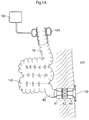
- Figure 1A shows a reservoir 140 formed from human intestine 70.
- a plurality of bent portions of the human's intestine 70 is cut open along the mutual contact lines of laterally adjacent sections thereof.
- the resulting upper halves and lower halves are interconnected so as to form the walls of the intestinal reservoir 140.
- the interconnection can advantageously be made with staplers, possibly including bonding with a biocompatible glue, but sewing is likewise an option.
- an exit valve comprising a plurality of valve sections 61, 62, 63 is provided along and encloses a non-modified terminate section 80 of the patient's intestine.
- the non-modified terminate section 80 is passed through the patient's abdominal wall 101 and forms a surgically created stoma 170.
- the non-modified terminate section 80 could likewise lead to the patient's rectum or anus.
- the valve sections 61, 62, 63 each comprise an electrical stimulation device adapted to electrically stimulate muscle or neutral tissue of the intestine's terminate section 80 so as to cause at least partial contraction of the terminate section. Electrical stimulation is achieved by applying electrical pulses to the terminate section 80.by means of electrodes (not shown).
- Each of the valve sections 61, 62, 63 further comprises at least one constriction device.
- FIG 1A the constriction devices of all three valve sections 61, 62, 63 are activated.
- the constriction devices 61, 62, 63 only partly constrict the intestine's terminate section 80 so that blood circulation in the tissue of the intestinal wall is not negatively affected thereby.
- the electrical stimulation devices of the valve sections 61, 62, 63 are adapted to further constrict the terminate section 80 so that flow through the terminate section 80 is completely prevented.
- only one electrical stimulation device is activated at a time.
- the central valve section 62 is currently activated so as to stimulate and thereby completely constrict the corresponding section of the intestine's terminate section 80.
- the arrangement of the plurality of stimulation devices allows to stimulate different sections of the intestine's terminate section 80 over time.
- the function of the three stimulation devices may also be combined in one integral unit. Since the electrical stimulation in each valve section 61, 62, 63 always occurs for a short time period only, the respective other, non-stimulated sections of the intestine's terminate section 80 have time to recover from a previous constriction so that sufficient blood flow within the intestinal wall is ensured. All in all, the valve sections 61, 62, 63 allow for gentle constriction of the intestine's terminate section 80 at the exit of the reservoir when keeping the exit normally closed. Most preferably, closing is achieved by stimulating different sections of the intestine's terminate section 80 in a wave-like manner in a direction opposite to the natural intestine contents flow.
- the valve at the exit of the reservoir 140 may only be formed by one or a plurality of constriction devices.
- the constriction device is preferably of the hydraulic type, such as in the form of pressure cuffs, but may also be of the mechanical type.
- the constriction device is not described here in more detail, and may correspond to the entry valve 194 provided at the entry of the reservoir 140.
- the entry valve 194 here has the form of a hydraulic cuff. While the valve sections 61, 62, 63 of the exit valve are provided to normally close the exit of the intestinal reservoir 140 in order to keep intestinal contents inside the reservoir 140, the entry valve 194 is normally open to allow intestinal contents to flow into the reservoir 140.
- the cuff of the entry valve 194 can be filled with a hydraulic fluid from an artificial hydraulic reservoir 195 so as to completely constrict the intestine 70 in front of the reservoir 140. This way, backflow of intestinal contents into the intestine 70 may effectively be prevented, when emptying of the reservoir is desired.
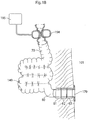
- the valve sections 61, 62, 63 of the exit valve are opened to allow emptying of the intestinal reservoir 140. This is shown in Figure 1B . As can be seen, the partial constriction of the terminal section 80 by means of the constriction devices has been released. Also, electrical stimulation pulses are no longer applied.
- the reservoir 140 may be emptied by means of an electrical stimulation type pump comprising an electrical stimulation apparatus with electrode-carrying holding devices 160 which are adapted to electrically stimulate muscle or neural tissue of the intestinal reservoir 140 so as to cause at least partial contraction of the reservoir 140.
- an electrical stimulation type pump comprising an electrical stimulation apparatus with electrode-carrying holding devices 160 which are adapted to electrically stimulate muscle or neural tissue of the intestinal reservoir 140 so as to cause at least partial contraction of the reservoir 140.
- a second set of electrode-carrying holding devices 161 is arranged on the opposite side of the reservoir 140, as can be seen in Figure 2B .
- the electrodes of the holding devices 160, 161 are arranged substantially in two planes at opposite sides of the reservoir 140.
- the holding devices 160, 161 have a longitudinal shape so as to span over the reservoir 140 when arranged side by side as shown in Figure 2A .
- the holding devices 160, 161 each have a longitudinal or rod-like shape substantially spanning the entire width of the reservoir 140.
- the length is preferable 5 cm or longer, depending on the size of the intestinal reservoir, and cane even have a length of more than 8 cm or even more then 10 cm.
- the overall spanned area would typically be larger than 4.5 cm x 6 cm in plan view.
- the holding devices 160, 161 may each comprise a row of electrodes arranged along the length thereof and adapted to apply electric pulses to the intestinal wall of the reservoir 140.
- each holding device may substantially consist of only one longitudinal electrode.
- the electrodes can be controlled individually.
- the stimulation devices 160, 161 may form plate-like members having a larger width than those shown in Figure 2A , resulting in a decreased number of holding devices.
- the holding devices instead of arranging the holding devices separately side by side, they may be combined in an integral unit, such as a plate, on one side or on opposing sides of the intestinal reservoir.
- the holding device or devices form plate-like members with an enlarged width, a plurality of electrode rows may be arranged in parallel on the holding devices.
- the plate-like or rod-like holding devices may be embedded in a flexible web (not shown) to facilitate implantation and relative fixation of adjacent stimulation devices.
- Emptying of the intestinal reservoir 140 can be activated by the patient pressing a manually operable actuator 99 subcutaneously implanted in the patient's abdominal wall 101 in the form of a switch.
- the actuator 99 is connected to a combined energy storage means and controller device 150.
- the electrodes placed on the holding devices 160, 161 are controlled and supplied with energy via the energy storage means and controller device 150.
- the device 150 is connected to the holding devices 160, 161 via individual lines.
- the electrical stimulation type pump is specifically adapted to stimulate, over time, respectively adjacent portions of the intestinal wall of the reservoir 140 in a consecutive or wave-like manner in a direction towards the stoma 170 (or rectum/anus) to cause the reservoir 140 to be emptied.
- This structure allows for adapting the arrangement of the holding devices 160, 161 and their mode of operation to the individual form of the intestinal reservoir 140. This functionality is further enhanced where each of the holding devices 160, 161 carries a plurality of electrodes that are controlled individually or in groups.
- the entry valve 194 is preferably closed during the emptying of the reservoir. This is particularly important in case that all holding devices 160, 161 are activated simultaneously so as to constrict all sections of the reservoir 140 at the same time. Since the exit valve 194 is closed, intestinal contents cannot flow back from the reservoir into the patient's intestine but are urged towards the exit of the reservoir. An entry valve is not specifically needed when the electrode-carrying holding devices are activated in a consecutive or wave-like manner, as mentioned before, in .
- the electrode-carrying holding devices 160, 161 are specifically provided for being embedded in folds or invaginations 141 surgically created in the intestinal wall of the reservoir 140.
- the holding devices 160, 161 are substantially surrounded by tissue of the reservoir 140 and, thus, contact area is increased. Stimulation of the reservoir 140 can thus be improved.
- surrounding tissue in the abdominal cavity is not contacted by the electrodes of the holding devices and, thus, not influenced by the stimulation process.
- Fixation of the holding devices 160, 161 is also improved, thereby ensuring that the holding devices 160, 161 and, thus, the electrodes are precisely located over long time.
- the holding devices 160, 161 necessarily follow all movements of the intestinal wall of the reservoir 140.
- a constriction type pump may be implanted in the patient's body for constricting the reservoir 140 mechanically or hydraulically from outside the intestinal wall of the reservoir 140.
- Examples of mechanical and hydraulic constriction type pumps will be described in more detail hereinafter in relation to Figures 4A, 4B and Figures 5A, 5B .
- the two pumps preferably act on the same portion of the reservoir 140. In that case, it is advantageous if the constriction type pump constricts the respective portion of the reservoir 140 only partly, in order not to damage the intestine, whereas further constriction is achieved by simultaneous electrical stimulation of the same portion.
- the stimulation type pump may, if accordingly adapted, be used to pump intestinal contents towards the exit of the reservoir 140 by, over time, stimulating different portions of the intestinal wall of the reservoir 140 in a wave-like manner in a direction of natural intestinal contents flow. In this way, filling of the reservoir 140 is supported, since intestinal contents do not remain in the area of the entrance of the reservoir 140 but are transported in the direction towards the exit.
- Figures 4A, 4B show an embodiment of a mechanical type pump comprising mechanically acting members in the form of rollers 180, 181 for emptying the reservoir 140.
- the rollers 180, 181 are arranged on opposite sides of the reservoir 140 and have a length spanning the entire width of the reservoir 140, i.e. 10 cm or more.
- the rollers are each guided by two tracks 182a, 183a and 182b, 183b, respectively, and are driven by a motor integrated in the rollers (not shown) which preferably comprises a servo drive.
- the servo drive reduces the force required to move the rollers 180, 181, so that a relatively small motor can be used in exchange for a longer emptying process.
- the tracks 182a, 183a, 182b, 183b are arranged in pairs on opposite sides of the reservoir 140. As can be seen from Figure 4B , the tracks have bent end portions 184a, 184b directed away from the reservoir 140 so that the rollers 180, 181 can assume an inactive position in which they do not constrict the reservoir 140. When emptying of the reservoir is desired, the rollers 180, 181 are driven along the tracks in the direction of the arrows, thereby approaching each other and constricting the reservoir 140. When the rollers are further guided by the tracks along the length of the reservoir in their proximate position, they mechanically squeeze intestinal contents in the direction towards and out of the exit of the reservoir 140.
- rollers 180, 181 When the rollers 180, 181 have reached their final position and the reservoir 140 is emptied, they are returned to their initial inactive position at the end portions 184a, 184b of the tracks. Instead of rollers on each side of the reservoir 140, it can be sufficient to provide one or more rollers only on one side of the reservoir 140 and place a counteracting plate on the respective opposite side of the reservoir 140.
- emptying of the intestinal reservoir 140 can be activated by the patient pressing the manually operable actuator 99 subcutaneously implanted in the patient's abdominal wall 101, the actuator 99 being connected to the combined energy storage means and controller device 150. Energy is supplied from the device 150 to the motor or motors inside the rollers 180, 181.
- FIGs 5A, 5B show an embodiment of a hydraulic type pump comprising a hydraulically acting member 190 adapted to act on the intestinal wall of the reservoir 140 from the outside thereof.
- the hydraulically acting member 190 is connected to an artificial reservoir 193 supplying the hydraulically acting member 190 with hydraulic fluid.
- the artificial reservoir 193 is of a size sufficiently large to accommodate hydraulic fluid in an amount corresponding to the volume of the intestinal reservoir 140.
- the artificial reservoir 193 has a flexible wall to allow the hydraulic fluid to be drawn off from and to be filled back into the artificial reservoir 193.
- the hydraulically acting member 190 is of flexible material and may be tube-like or bag-like so as to accommodate therein the intestinal reservoir 140. As shown in Figure 5B , the reservoir 140 is surrounded by the hydraulically acting member 190.
- the hydraulically acting member 190 is divided into a plurality of chambers, wherein a first chamber 191 and a last chamber 194 are connected to the artificial reservoir 193 by hydraulic conduits.
- the chambers are interconnected via connections 192, which may be simple holes acting as a throttle or may include one or more valves that are preferably automatically controlled.
- emptying of the intestinal reservoir 140 is started by supplying hydraulic fluid from the artificial reservoir 193 to the first chamber 191.
- the next following chambers are supplied with the hydraulic fluid through the connections 192, thereby causing the hydraulically acting member 190 to be filled slowly from the first chamber 191 to the last chamber 194.
- the filling of the chambers occurs sequentially, with the next following chamber starting to fill before the foregoing chamber is filled completely. In this manner, intestinal contents are hydraulically squeezed out in the direction towards the exit of the reservoir 140.
- the hydraulically acting member 190 is completely filled with hydraulic fluid, the reservoir 140 is completely constricted.
- the hydraulic fluid is then withdrawn from the chambers of the hydraulically acting member 190 back into the artificial reservoir 193 using negative pressure.
- the intestinal reservoir 140 may then start to fill up with intestinal contents again.
- the device 150 which is connected to the artificial reservoir 193.
- an electrically driven pump (not shown) for pumping the hydraulic fluid into and withdrawing the hydraulic fluid from the hydraulically acting member.
- the electrically driven pump is supplied with energy from the combined energy storage means and control device 150.
- each chamber of the hydraulically acting member 190 may have separate fluid connection to the artificial reservoir 193 in order to be able to be filled individually.
- the intestinal reservoir 140 may be emptied by consecutively filling two adjacent chambers of the hydraulically acting member 190, i.e. first filling the first and second chamber, then emptying the first chamber while filling the third chamber, then emptying the second chamber while filling the fourth chamber, and so forth. In this manner intestinal contents are squeezed towards and out of the exit of the intestinal reservoir 140.
- At least one valve may be provided (not shown) between the hydraulically acting member 190 and the artificial reservoir 193 which, when in an appropriate operational position, allows the hydraulic fluid to passively flow from the hydraulically acting member back into the artificial reservoir 193 when the intestinal reservoir 140 fills with intestinal contents and which, when in an appropriate other position, prevents the hydraulic fluid to flow from the hydraulically acting member back into the artificial reservoir when the intestinal reservoir is being emptied.
- emptying of the reservoir 140 is coordinated with the opening and closing of the entry valve 194 and exit valves 61, 62, 63.
- An energy source may be provided for supplying energy directly or indirectly to at least one energy consuming part of the system, in particular for driving the pump or the motor of the pump.
- the energy source includes a battery or an accumulator, such as one or more of a rechargeable battery and a capacitor, as an energy storage means.
- the energy storage means is advantageously adapted for being implanted inside the patient's body, as in the case of the afore mentioned combined energy storage means and control device 150.
- the energy source may comprise a wireless energy transmitter adapted to wirelessly transmit energy from outside the patient's body to the at least one energy consuming part.
- the energy source may comprise a wireless energy transmitter adapted to wirelessly transmit energy from outside the patient's body to the energy storage means.
- galvanic coupling elements may be provided at least between the accumulator and the energy consuming part, in particular the motor, for transmitting energy to the motor in contacting fashion.
- the energy consuming part in particular the motor, can be adapted to directly transform the wirelessly transmitted energy from the accumulator into kinetic energy.
- the energy consuming part will have to comprise a transforming device for transforming the wirelessly transmitted energy from the accumulator into electric energy.
- the system preferably comprises an implantable energy transforming device for transforming the wirelessly transmitted energy from outside the patient's body into energy to be stored in the accumulator of the implanted system and further comprises a wireless energy transmitter adapted to wirelessly transmit energy from outside the patient's body to said implantable energy transforming device.
- the energy transmitter can be adapted to generate an electromagnetic field, a magnetic field or an electrical field.
- the wireless energy may be transmitted by the energy transmission device by at least one wireless signal. More specifically, the energy transmitter may be adapted to transmit the energy by at least one wireless energy signal, which may comprise an electromagnetic wave signal, including at least one of an infrared light signal, a visible light signal, an ultra violet light signal, a laser signal, a microwave signal, an X-ray radiation signal, and a gamma radiation signal. Also, the wireless energy signal may comprise a sound or ultrasound wave signal. Furthermore, the wireless energy signal may comprise a digital or analog signal or a combination thereof.
- a primary energy source may be provided for charging the energy storage means with energy from outside the patient's body.
- the primary energy source is preferably adapted to being mounted on the patient's body.
- a feedback subsystem which can make part of a control device described subsequently, can advantageously be provided to wirelessly send feedback information related to the energy to be stored in the energy storage means from inside the human body to the outside thereof.
- the feedback information is then used for adjusting the amount of wireless energy transmitted by the energy transmitter.
- Such feedback information may relate to an energy balance which is defined as the balance between an amount of wireless energy received inside the human body and an amount of energy consumed by the at least one energy consuming part.
- the feedback information may relate to an energy balance which is defined as the balance between a rate of wireless energy received inside the human body and a rate of energy consumed by an energy consuming part.
- control unit adapted to directly or indirectly control one or more elements of the system, such as for controlling opening of the exit valve and/or closing of the entry valve in combination with the pump, in particular in a manner such that when one of the two valves is closed, the respective other valve is open, and vice versa.
- At least part of the control unit may be adapted to be implantable in the patient's body.
- a manually operable actuator 99 in the form of a switch may be provided for activating the control unit, the switch preferably being arranged for subcutaneous implantation so as to be operable from outside the patient's body.
- the control unit may comprise a first part adapted for implantation in the patient's body and a second part adapted to cooperate with the first part from outside the patient's body.
- the control unit can be adapted to transmit data from the external second part of the control unit to the implanted first part of the control unit in the same manner as energy is transmitted by said wireless energy transmitter from outside the patient's body to said implantable energy transforming device.
- the second part of the control unit may be adapted to wirelessly transmit a control signal to the implantable first part of the control unit for controlling the at least one energy consuming part from outside the patient's body.
- the implantable first part of the control unit may be programmable via the second part of the control unit.
- the implantable first part of the control unit may be adapted to transmit a feedback signal to the second part of the control unit.
- a physical parameter sensor adapted to directly or indirectly sense a physical parameter of the patient.
- the physical parameter sensor may be adapted to sense at least one of the following physical parameters of the patient: a pressure within the artificial intestine section, a pressure within the patient's natural intestine, an expansion of the artificial intestine section, a distension of an intestinal wall of the patient's natural intestine, a movement of the patient's intestinal wall.
- a functional parameter sensor adapted to directly or indirectly sense a functional parameter of the system
- the functional parameter sensor may be adapted to sense at least one of the following functional parameters of the system: a pressure against a part of the system such as the artificial intestine section, a distension of a part of the system such as a wall of the artificial intestine section, an electrical parameter such as voltage, current or energy balance, a position or movement of a movable part of the system.
- an indicator is coupled to the sensor or sensors, the indicator being adapted to provide a signal when a sensor senses a value for the parameter beyond a predetermined threshold value.
- the sensor signal may comprise at least one of the following types of signals: a sound signal, a visual signal.
- the intestinal reservoir has an upstream part with a first intestinal opening and a downstream part with a second intestinal opening.
- the system may include a first intestinal passageway in flow communication with the first intestinal opening arranged for transferring intestinal contents to the reservoir and/or the system may comprise a second intestinal passageway in flow communication with the second intestinal opening, said second intestinal passageway being arranged for transferring intestinal contents from the reservoir.
- the second intestinal passageway may be surgically connected to a surgically created stoma, in which case the pump is adapted to pump intestinal contents from the reservoir out through said stoma.
- the downstream part of the second intestinal passageway may be advanced through the abdominal wall and skin, thereby achieving an intestinal stoma
- the second intestinal passageway may be surgically connected to the patient's anus or to tissue adjacent the patient's anus, in which case the pump is adapted to pump the intestinal contents out through the patient's anus.
- the reservoir may be made of the small intestine or the reservoir may be made of the large intestine. Accordingly, the second intestinal passageway may be made of the small intestine or the large intestine.
- the second intestinal passageway may also be surgically connected to an artificial intestinal piece, wherein said artificial intestinal piece may comprise a valve for controlling the flow of intestinal contents.
- the artificial intestinal piece may be adapted to be connected to the patient's small intestine or to the patient's large intestine or to the patient's anus or to tissue adjacent the patient's anus or to a surgically created stoma.
Landscapes
- Health & Medical Sciences (AREA)
- General Health & Medical Sciences (AREA)
- Veterinary Medicine (AREA)
- Engineering & Computer Science (AREA)
- Biomedical Technology (AREA)
- Public Health (AREA)
- Life Sciences & Earth Sciences (AREA)
- Animal Behavior & Ethology (AREA)
- Urology & Nephrology (AREA)
- Cardiology (AREA)
- Heart & Thoracic Surgery (AREA)
- Transplantation (AREA)
- Vascular Medicine (AREA)
- Oral & Maxillofacial Surgery (AREA)
- Nuclear Medicine, Radiotherapy & Molecular Imaging (AREA)
- Radiology & Medical Imaging (AREA)
- Gastroenterology & Hepatology (AREA)
- Prostheses (AREA)
- External Artificial Organs (AREA)
Description
- The present invention relates to a system for treating a patient having a disorder related to the patient's intestine. Such disorder may be caused by injury, birth defect, cancer or other diseases, such as constipation or incontinence. More specifically the invention relates to a system and method of regulating the flow through an intestinal reservoir.
- In an attempt to overcome such disorders, many different solutions have been proposed. These solutions often include surgery, in particular where a portion of the intestine has to be removed. The reason for such operation may be colorectal cancer, perforated diverticulitis or other kinds of diseases, such as ulceros colitis or Crohns disease. For instance, in the case of ileostoma, jejunostoma, colostoma and rectostoma operations the small intestine (jejunum or ileum) or the large intestine (colon or rectum) is cut and the open end of the healthy portion of the intestine is reattached either to a surgically created stoma in the patient's abdominal wall or, where possible, to the patient's rectum or anus or to tissue adjacent the patient's anus.
- The problem then arises to control the intestinal contents flow and, more particularly, to prevent feces from exiting the patient's body uncontrolled. The patient is typically required to excrete into a colostoma bag. This is obviously inconvenient and, in addition, may cause skin irritation since such a bag arrangement requires an adhesive plate to be attached to the patient's skin in order to render the bag liquid tight.
-
US patent no. 4,222,377 suggests the use of an inflatable artificial sphincter comprising a cuff around the anal or urethral canal. A manually operated pump is implanted in the patient's scrotum for inflating and deflating the artificial sphincter. - Similarly,
US patent no. 5,593,443 discloses an artificial hydraulic anal sphincter under voluntary control. More specifically, the patient may actuate a mechanical or electrical pump for inflating and deflating a cuff. The cuff consists of two parts positioned on opposite sides of the intestine and pressing the intestinal walls together when inflated. -
US 6,752,754 B1 discloses an artificial rectum for replacing a portion of a patient's rectum. An inlet of the artificial rectum is operatively connected to the distal end of the patient's large intestine and communicates fecal matter to a macerator-type pump that discharges the feces through an outlet of the artificial rectum connected to the patient's anus. The pump includes a helical screw-type impeller, which when rotated creates shearing effects on the feces, causing it to move down the thread of the screw impeller and discharge through the patient's anus. - An improved system has been described in
WO2009/046995 comprising a reservoir in the patient's body for receiving and temporarily collecting therein intestinal contents. In one embodiment the reservoir is surgically created and formed from a plurality of bent portions of the patient's intestine. Laterally adjacent sections of the intestine are cut open along their mutual contact line and the resulting upper halves and lower halves thereof are interconnected so as to form the reservoir. The intestinal reservoir remains within the patient's body when emptying the reservoir. The intestine exits the patients abdominal wall through a surgically created stoma. An exit valve is implanted within the intestine between the intestinal reservoir and the stoma. The exit valve is normally closed by resilient means. An external manually driven suction pump comprising a piston-cylinder-arrangement is used to be temporarily applied from outside the patient's body for emptying the Intestinal reservoir, wherein a conduit on the front end of the suction pump is inserted into the intestine, thereby mechanically urging the exit valve to open. - This way of emptying the surgically created intestinal reservoir has been proven unsatisfactory. In particular, although the reservoir remains within the patient's body, an external collecting device has still to be attached, removed and cleaned, similar to the previously described prior art systems.
- Other embodiments described in
WO2009/046995 overcome this problem by implanting an all artificial reservoir along with a pump acting on the reservoir for emptying the reservoir. Entry and exit valves may be provided in addition to the pump to control the flow of intestinal contents into and from the artificial reservoir. The artificial reservoir with implantable pump substantially improves the patient's living circumstances, because an external collecting device is no longer needed when emptying the reservoir. - Incorporating an artificial reservoir within the patient's natural intestine or at the end thereof is critical. The interconnection between the artificial piece and the intestine's natural tissue will always be subject to the intestine's peristaltic contractions and may therefore fail over time.
-
WO 2009/046995 A1 discloses a system for treating a patient having a disorder related to the patient's intestine. The system comprises an artificial or artificially modified reservoir which is adapted to receive and collect intestinal contents and is further adapted to remain within the patient's body when emptying the reservoir, wherein the reservoir is formed by at least one bent portion of human intestine, with laterally adjacent sections thereof being cut open along their mutual contact line and the resulting upper halves and lower halves thereof being interconnected so as to form the reservoir. The system further comprises an implantable flow control device for controlling flow of the intestinal contents from the reservoir. The flow control device may comprise an entry valve, an exit valve, a pump, a motor, an energy source, a control unit and sensors. - The present invention relates to a system as set forth in the appended claims.
- According to the invention, a system is provided that acts on an intestinal reservoir, i.e. on a reservoir which is formed from surgically modified intestine that has been cut along a mutual contact line of laterally adjacent sections of a bent portion of intestine and connected so that the resulting upper and lower halves of the intestine form an intestinal wall of the reservoir. The system comprises an artificial flow control device implantable in the patient's body and adapted to control flow of the intestinal contents from said reservoir. The flow control device comprises at least one pump adapted to act on said intestinal wall so as to reduce the reservoir's volume in order to empty the reservoir.
- Since the reservoir is made from tissue of the intestine, it is not necessary to connect any artificial piece to living tissue of the patient's natural intestine. Rather is the pump adapted to act on the intestinal wall of the reservoir and can therefore be implanted within the patient's body outside the reservoir. Due to the pump being implanted, an external collecting device need not be attached, removed and cleaned when emptying of the reservoir is desired.
- Three basic principles of such pump will be described hereinafter, a mechanical type pump, a hydraulic type pump and an electrical stimulation type pump. These pumps can be combined to cooperate, if desired.
- According to a first preferred embodiment, components of the pump are adapted for implantation in surgically created folds of said intestinal wall of the reservoir. This is particularly advantageous in relation to the electrical stimulation type pump, as will be described hereinafter.
- According to a second preferred embodiment, components of the pump are adapted for implantation inside the patient's body adjacent the reservoir. This is preferable in relation to all three pump types.
- In either case, the components of the pump will not come into contact with intestinal contents. However, it is not entirely excluded that a pump is used in context with the present invention that is adapted to be at least partly placed inside the intestinal reservoir.
- The electrical stimulation type pump comprises at least one electrical stimulation apparatus adapted to electrically stimulate a muscle or neural tissue of said intestinal wall so as to cause at least partial contraction thereof. This is a very gender way of constricting the reservoir. The electrical stimulation apparatus is adapted to apply electric pulses to the intestinal wall. For this purpose, the electrical stimulation apparatus comprises two or more electrodes adapted to generate the electric pulses.
- An electrical stimulation apparatus is used, which is adapted to stimulate different portions of the intestinal wall over time. Thus, different parts of the reservoir can be constricted by stimulation of different intestinal wall portions at different times in any predetermined stimulation pattern. This way, the pump can be adapted to empty the intestinal reservoir by pumping intestinal contents along a section of the reservoir by, over time, electrically stimulating different portions of said intestinal wall in a direction of natural intestinal contents flow.
- For this purpose, the electrical stimulation type pump comprises two or more electrodes mounted on holding devices. The holding devices have a longitudinal, stripe-like or rod-like shape. A plurality of electrodes may be arranged in one or more rows along the length of the holding devices. The longitudinal holding devices can then be arranged side by side with little or no distance, when implanted, so as to cover substantially the entire intestinal reservoir on one side, preferably on two opposing sides, of the reservoir. This structure and arrangement is particularly suitable for advancing intestinal contents through the reservoir in a controlled manner. For instance, beginning at one end of the reservoir, the "entry", mutually adjacent portions of the intestinal wall and, thus, mutually adjacent sections of the intestinal reservoir can be stimulated consecutively along the length of the reservoir until the respective other end of the reservoir is reached, the "exit", so that the entire reservoir is in a constricted state at the end of the emptying process. Alternatively, the mutually adjacent portions of the intestinal wall can be stimulated in a wave-like manner, i.e. the preceding portion can relax once the next following portion has been stimulated sufficiently. However, the electrodes on the holding devices may likewise be activated all at the same time, thereby simultaneously urging away intestinal contents from all areas of the reservoir. In this case it is particularly important for the system to comprise an entry valve at the upstream end of the intestinal reservoir which has to be closed to prevent back-flow when the electrical stimulation type pump is activated.
- The length of the holding devices should be sufficient to substantially span the entire width of the intestinal reservoir, in order to facilitate handling and reduce the number of parts. The perfect length depends on the size of the intestinal reservoir, but is preferably more than 5 cm and can be more than 8 cm or even more than 10 cm.
- Handling of a plurality of holding devices can be improved when they are embedded in a flexible web, e.g. integrated within a biocompatible, nondegradable polymer film, such as a polytetrafluoroethylene film. The flexibility of the web allows the holding devices to follow movements of the intestinal reservoir, in particular when sections thereof are constricted individually due to selective electric stimulation.
- Instead of embedding the longitudinal holding devices in a flexible web, they may be adapted for implantation in surgically created folds of the intestinal wall of the reservoir. The open side of the folds may be closed by sewing, bonding and/or stapling the tissue of the intestinal wall together so as to form bags for the longitudinal holding devices carrying the electrodes, preferably after the holding devices have been put in place.
- In addition to the electrical stimulation type pump, the pump may comprise a constriction type pump implanted in the patient's body for at least partly constricting the intestinal reservoir mechanically or hydraulically by acting from outside on the intestinal wall. Similar to the above described electrical stimulation type pump, the constriction type pump may be adapted to pump intestinal contents along the reservoir by, over time, constricting different sections of the reservoir consecutively or in a wave-like manner in a direction of natural intestinal contents flow. Where individual electrodes of the electrical stimulation type pump, or electrodes carried on one or more holding devices, are combined with constriction devices of the constriction type pump, the electrodes and the constriction devices preferably act on the same portions of the intestinal wall so as to pump the intestinal contents along the reservoir by, over time, electrically stimulating different portions of said intestinal wall and simultaneously constricting respective sections of the reservoir in the direction of natural intestinal contents flow. It is advantageous when the constriction type pump in operation constricts the intestinal reservoir only partly, in order not to damage the intestinal tissue. Complete constriction and, thus, emptying of the reservoir may then be obtained by additionally stimulating the intestinal wall portions electrically in a manner as described before.
- It should be noted that, due to the surgical modifications, the intestinal reservoir itself has lost its natural peristaltic capabilities. Therefore, according to a preferred embodiment, the electrical stimulation type pump is adapted to pump intestinal contents along the reservoir in a direction of natural intestinal contents flow by, over time, stimulating different portions of the intestinal wall in a wave-like (peristaltic) manner when constriction of the reservoir caused by the constriction type pump is released. Thereby, the filling of the intestinal reservoir with intestinal contents supplied to the reservoir is improved. This is even useful in cases where the electrical stimulation type pump is not combined with a constriction type pump or with any other pump device. In either case, an exit valve should be provided at the downstream end of the intestinal reservoir, which has to be closed while the reservoir is filling up, to prevent that intestinal contents may escape from the reservoir unintentionally.
- From the foregoing it becomes clear that the constriction type pump is adapted to act on said intestinal wall from the outside of the reservoir so as to empty the reservoir by squeezing the reservoir. This can be achieved either hydraulically or mechanically, i.e. by means of a hydraulic type pump or a mechanic type pump.
- According to a preferred embodiment, a hydraulic type pump comprises an electrically driven hydraulic pump, a hydraulically acting member for acting on the intestinal wall of the intestinal reservoir from the outside thereof, and an artificial reservoir, wherein the electrically driven hydraulic pump is adapted to pump hydraulic fluid from the artificial reservoir to the hydraulically acting member. The hydraulically acting member may be tube-like or bag-like to accommodate the reservoir therein. This facilitates implantation and ensures proper placement of the hydraulically acting member relative to the intestinal reservoir over long time.
- Preferably, the hydraulically acting member comprises a plurality of hydraulic chambers, each chamber acting on a different section of the intestinal reservoir. By filling the chambers in a predetermined sequence, emptying of the reservoir can be controlled.
- In a relatively simple structure, each hydraulic chamber is hydraulically interconnected with two other hydraulic chambers, except the first and last chambers which are hydraulically connected to only one other hydraulic chamber and to the artificial reservoir. Thus, fluid can flow from the artificial reservoir sequentially through the hydraulic chambers and back into the artificial reservoir. Preferably, the hydraulic chambers are interconnected by holes acting as throttles for the fluid. This way, fluid will slowly through the chambers, thereby filling the first chambers before the last chambers, so that intestinal contents in the intestinal reservoir are slowly squeezed out of the intestinal reservoir.
- However, more sophisticated structures may be used, e.g. involving one or more actively controlled valves between interconnected chambers instead of the passively acting throttles. Also, instead of interconnecting each hydraulic chamber with respective other two of the hydraulic chambers, one or all of the hydraulic chambers may be arranged either such that they are hydraulically isolated from the respective other chambers and connected only to the hydraulic pump via individual hydraulic control lines, or such that they can be hydraulically isolated from the respective other chambers by individually controlling respective valves within the hydraulic path.
- The electrically driven hydraulic pump is preferably adapted to evacuate the hydraulically acting member by applying negative pressure, once the intestinal reservoir has been emptied. New filling of the reservoir with intestinal contents is thereby facilitated.
- Alternatively, instead of using negative pressure, one can also rely on passive evacuation of the hydraulically acting member. That is, as the intestinal reservoir fills with intestinal contents again, the fluid within the hydraulically acting member surrounding the intestinal reservoir is automatically urged back into the reservoir. This process can be advantageously supported by means of one or more valves between the hydraulically acting member and the artificial reservoir, which, when in an appropriate operational position, allows fluid to passively flow from the hydraulically acting member back into the artificial reservoir when the reservoir fills with intestinal contents and which, when in an appropriate other position, prevents the fluid to flow from the hydraulically acting member back into the artificial reservoir when the intestinal reservoir is being emptied.
- According to another preferred embodiment, a mechanical type pump comprises at least one mechanically acting member for acting on the intestinal wall from the outside of the intestinal reservoir and an electrical motor adapted to drive the mechanically acting member for emptying the intestinal reservoir.
- A preferred structure for the mechanically acting member comprises at least one roller adapted to be rolled over the intestinal reservoir for emptying the reservoir from the outside thereof. For instance, two rollers may act simultaneously on opposite outer surface sides of the intestinal reservoir so as to squeeze the reservoir. Alternatively, one roller may act on one outer surface side of the intestinal reservoir against a counteracting plate arranged on an opposite side of the reservoir. For each roller, two tracks may be provided, one on each lateral side of the intestinal reservoir, for guiding the roller or rollers when driven by the electrical motor. Thus, the length of the rollers must be sufficient to bridge the width of the intestinal reservoir. Therefore, similar to the length of the holding devices mentioned before, the rollers should have a length of about 10 cm or more and the tracks should preferably also have a length of about 10 cm or more. Preferably, the tracks each have a bent end portion so arranged that it directs away from the reservoir, when implanted. When the roller or rollers are positioned at the track's bent end portion, the intestinal reservoir is not constricted and, thus, intestinal contents can freely enter the intestinal reservoir.
- As mentioned earlier, in addition to the at least one pump, the flow control device is advantageously provided further with one or more valves for controlling flow to and/or from the reservoir. These valves are preferably implanted inside the patient's body outside a section of the patient's intestine and may comprise at least one element adapted to act on the intestine section from the outside thereof so as to act on and, in particular, prevent intestinal contents flow through the intestine section. This valve arrangement is advantageous inasmuch its installment does not require any surgery on the respective part of the intestine.
- For instance, an exit valve should be provided downstream of the intestinal reservoir preventing intestinal contents to flow from the reservoir in its closed position. Preferably, the exit valve is a normally closed valve so that no energy is needed to keep the valve closed during the system's inactive periods.
- In addition, an entry valve may be provided allowing intestinal contents to flow towards the intestinal reservoir in its open position. This can be advantageous particularly during the emptying of the reservoir in order to prevent back flow, i.e. when the entry valve is closed. Therefore, the entry valve is preferably a normally open valve. Accordingly, the exit valve and the entry valve are preferably adapted to cooperate such that when one of the two valves is closed, the respective other valve is open, and vice versa.
- The exit valve may comprise a hydraulic or mechanical constriction device for constricting the intestine section so as to keep the intestine section closed. For instance, a hydraulic constriction device may comprise a compartment with a variable volume adapted to open and close the valve by changing the compartment's volume. The compartment preferably has at least one flexible wall defining an opening for the intestine section to pass through, the opening being adapted to close upon increase of the compartment's volume.
- Alternatively, or in addition to the hydraulic or mechanical constriction device, the exit valve may comprise at least one electrical stimulation device adapted to electrically stimulate muscle or neural tissue of the intestine section so as to cause at least partial contraction of the intestine section in order to prevent intestinal contents flow through the intestine section. Similar to the stimulation devices of the electrical stimulation type pump described before, the stimulation device of the exit valve may comprise at least one electrode adapted to apply electric pulses to the intestine section. It is particularly advantageous to make use of an electrical stimulation device which is adapted to stimulate different portions of the intestine section over time. Thus, different portions of the intestine section can be constricted by stimulation at different times in any predetermined stimulation pattern, thereby giving the intestine portions currently not stimulated time to recover and, thus, improving the blood circulation in the respective intestine section.
- Furthermore, the electrical stimulation device can specifically be adapted to stimulate, over time, the different portions of the intestine section in a wave like manner in a direction opposite to natural intestinal contents flow. As a result, the valve counteracts the natural intestinal contents flow, thereby improving the valve's closing function.
- In particular, where the exit valve comprises a constriction device and an electrical stimulation device in combination, the stimulation device and the constriction device can act on the same intestine section in order to keep the intestine section closed. In this case, the constriction device is preferably adapted to only partly constrict the intestine section in the valve's normal (closed) condition, whereas the stimulation device is adapted to stimulate, over time, different portions of the intestine section in a wave like manner in a direction opposite to natural intestinal contents flow so as to urge out-flowing intestinal contents back towards the intestinal reservoir. This is a very gentle way of preventing intestinal contents from exiting the intestinal reservoir.
- In addition, the electrical stimulation device is preferably adapted such that it can likewise be used to pump intestinal contents along the intestine section in a direction of natural intestinal contents flow by, over time, stimulating different portions of the intestine section in a wave-like manner. Emptying of the intestinal reservoir can be supported in this manner. During this process, the partial constriction of the intestine section caused by the valve's hydraulic or mechanical constriction device is released.
- The entry valve may be simpler in construction than the exit valve, as the entry valve is preferably a normally open valve. Thus, there is only little danger that the tissue of the intestine section could be damaged due to an unduly long time period of interrupted blood flow. Therefore, the entry valve to be implanted upstream from the reservoir in order to control flow of intestinal contents into the reservoir may substantially consist of a hydraulic or mechanical constriction device for constricting said intestine section at the time when the intestinal reservoir is being emptied.
- According to one embodiment of the system, the pump could further comprise a mounting device adapted to be mounted to the peritoneum. The mounting device could be adapted to pass through the peritoneal wall and hold said intestinal section, comprising a flange intended for placement outside the peritoneum. The mounting device could be adapted to hold sutures and staplers passing through the peritoneal wall, when implanted, to hold said artificial intestine section.
- It was already mentioned before, that the pump may comprise a motor for automatically driving the pump. The motor is preferably arranged to be driven by electric or electromagnetic energy. The same or a different motor can be arranged for driving the valve or valves, respectively, between the closed and open positions. A motor in the sense of the present invention is a device that transforms energy other than mechanical energy into mechanical energy.
- Preferably, the motor comprises a servo drive. The effect of the servo drive is that a motor with relatively little power and, thus, a relatively small motor can be used, while the time needed to perform the work increases proportionally. However, since the time for emptying the intestinal reservoir is not very critical, this trade off can be accepted.
- A manually operable actuator, e.g. a switch, may be provided for activating the pump or the at least one motor, respectively, from outside the patient's body. The switch is preferably arranged for subcutaneous implantation so as to be easily operable from outside the patient's body.
- An energy source may be provided for supplying energy directly or indirectly to at least one energy consuming part of the system, in particular for driving the pump. Preferably, the energy source includes a battery or an accumulator, such as one or more of a rechargeable battery and a capacitor, as an energy storage means. The energy storage means is advantageously adapted for being implanted inside the patient's body.
- Energy is preferably transmitted wirelessly. Thus, where the energy source is provided for supplying energy directly or indirectly to at least one energy consuming part of the system, the energy source may comprise a wireless energy transmitter adapted to wirelessly transmit energy from outside the patient's body to the at least one energy consuming part. Alternatively, where the energy source includes a battery or an accumulator, in particular one which is implanted in the patient's body, the energy source may comprise a wireless energy transmitter adapted to wirelessly transmit energy from outside the patient's body to the energy storage means.
- It is advantageous to provide a control unit adapted to directly or indirectly control one or more elements of the system, such as for controlling not only the actuation of the pump but also the opening of the exit valve and/or closing of the entry valve, in particular in a manner such that when one of the two valves is closed, the respective other valve is open, and vice versa. The control unit is preferably operable by the patient, e.g. particularly in order to empty the reservoir., such as by actuating the afore-mentioned subcutaneously implantable switch.
- Also, the control unit may comprise a first part adapted for implantation in the patient's body and a second part adapted to cooperate with the first part from outside the patient's body. In this case, the control unit can be adapted to transmit data from the external second part of the control unit to the implanted first part of the control unit in the same manner as energy is transmitted to the at least one energy consuming part.
- The invention will now be described in more detail in context with some preferred embodiments of the invention as shown in the accompanying drawings.
-
Figures 4 and5 do not represent embodiments of the invention. -
Figure 1A shows a surgically modified section of a human intestine forming an intestinal reservoir with a deactivated entry valve in front and an activated exit valve behind the intestinal reservoir. -
Figure 1B shows the intestinal reservoir ofFigure 1A with the entry valve activated and the exit valve deactivated. -
Figure 2A shows a plan view of an electrical type pump for emptying the intestinal reservoir ofFigure 1B with an electrical stimulation apparatus comprising a plurality of rod-like electrode-carrying holding devices placed side by side adjacent the intestinal reservoir. -
Figure 2B shows a side view of the electrical type pump ofFigure 2A . -
Figure 3A shows a side view of a variant of the electrical type pump ofFigure 2B with the plurality of the electrode-carrying holding devices placed side by side in folds formed by the wall of the intestinal reservoir. -
Figure 3B shows the variant of the electrical type pump ofFigure 3A in a different, cross-sectional side view. -
Figure 4A shows a plan view of a mechanical type pump for emptying the intestinal reservoir ofFigure 1B . -
Figure 4B shows a side view of the mechanical type pump ofFigure 4A . -
Figure 5A shows a plan view of a hydraulic type pump for emptying the intestinal reservoir ofFigure 1B . -
Figure 5B shows a side view of the hydraulic type pump ofFigure 5A . -
Figure 1A shows areservoir 140 formed fromhuman intestine 70. A plurality of bent portions of the human'sintestine 70 is cut open along the mutual contact lines of laterally adjacent sections thereof. The resulting upper halves and lower halves are interconnected so as to form the walls of theintestinal reservoir 140. The interconnection can advantageously be made with staplers, possibly including bonding with a biocompatible glue, but sewing is likewise an option. - At the exit of the
intestinal reservoir 140, an exit valve comprising a plurality ofvalve sections 61, 62, 63 is provided along and encloses a non-modified terminatesection 80 of the patient's intestine. The non-modified terminatesection 80 is passed through the patient'sabdominal wall 101 and forms a surgically createdstoma 170. The non-modified terminatesection 80 could likewise lead to the patient's rectum or anus. Thevalve sections 61, 62, 63 each comprise an electrical stimulation device adapted to electrically stimulate muscle or neutral tissue of the intestine's terminatesection 80 so as to cause at least partial contraction of the terminate section. Electrical stimulation is achieved by applying electrical pulses to the terminate section 80.by means of electrodes (not shown). Each of thevalve sections 61, 62, 63 further comprises at least one constriction device. - In
Figure 1A the constriction devices of all threevalve sections 61, 62, 63 are activated. As can be seen, theconstriction devices 61, 62, 63 only partly constrict the intestine's terminatesection 80 so that blood circulation in the tissue of the intestinal wall is not negatively affected thereby. The electrical stimulation devices of thevalve sections 61, 62, 63 are adapted to further constrict the terminatesection 80 so that flow through the terminatesection 80 is completely prevented. However, only one electrical stimulation device is activated at a time. In the situation shown inFigure 1A , the central valve section 62 is currently activated so as to stimulate and thereby completely constrict the corresponding section of the intestine's terminatesection 80. While instead of the three stimulation devices shown, a single stimulation device would be sufficient for opening and closing the intestine, the arrangement of the plurality of stimulation devices allows to stimulate different sections of the intestine's terminatesection 80 over time. The function of the three stimulation devices may also be combined in one integral unit. Since the electrical stimulation in eachvalve section 61, 62, 63 always occurs for a short time period only, the respective other, non-stimulated sections of the intestine's terminatesection 80 have time to recover from a previous constriction so that sufficient blood flow within the intestinal wall is ensured. All in all, thevalve sections 61, 62, 63 allow for gentle constriction of the intestine's terminatesection 80 at the exit of the reservoir when keeping the exit normally closed. Most preferably, closing is achieved by stimulating different sections of the intestine's terminatesection 80 in a wave-like manner in a direction opposite to the natural intestine contents flow. - However, instead of combining electrical stimulation devices with a constriction device, the valve at the exit of the
reservoir 140 may only be formed by one or a plurality of constriction devices. The constriction device is preferably of the hydraulic type, such as in the form of pressure cuffs, but may also be of the mechanical type. The constriction device is not described here in more detail, and may correspond to theentry valve 194 provided at the entry of thereservoir 140. Theentry valve 194 here has the form of a hydraulic cuff. While thevalve sections 61, 62, 63 of the exit valve are provided to normally close the exit of theintestinal reservoir 140 in order to keep intestinal contents inside thereservoir 140, theentry valve 194 is normally open to allow intestinal contents to flow into thereservoir 140. - The cuff of the
entry valve 194 can be filled with a hydraulic fluid from an artificialhydraulic reservoir 195 so as to completely constrict theintestine 70 in front of thereservoir 140. This way, backflow of intestinal contents into theintestine 70 may effectively be prevented, when emptying of the reservoir is desired. At the same time, thevalve sections 61, 62, 63 of the exit valve are opened to allow emptying of theintestinal reservoir 140. This is shown inFigure 1B . As can be seen, the partial constriction of theterminal section 80 by means of the constriction devices has been released. Also, electrical stimulation pulses are no longer applied. However, it can be advantageous to support the emptying process by constricting the different sections of the intestine's terminatesection 80 in a wave-like manner in a direction towards thestoma 170 by means of thevalve sections 61, 62, 63 of the exit valve. - In the following, different embodiments of a system for emptying the
intestinal reservoir 140 are described. - As shown in
Figure 2A , thereservoir 140 may be emptied by means of an electrical stimulation type pump comprising an electrical stimulation apparatus with electrode-carryingholding devices 160 which are adapted to electrically stimulate muscle or neural tissue of theintestinal reservoir 140 so as to cause at least partial contraction of thereservoir 140. This is a very gentle way of constricting the tissue of theintestinal reservoir 140. A second set of electrode-carryingholding devices 161 is arranged on the opposite side of thereservoir 140, as can be seen inFigure 2B . Thus, the electrodes of the holdingdevices reservoir 140. The holdingdevices reservoir 140 when arranged side by side as shown inFigure 2A . - As shown in
Figure 2A , the holdingdevices reservoir 140. The length is preferable 5 cm or longer, depending on the size of the intestinal reservoir, and cane even have a length of more than 8 cm or even more then 10 cm. The overall spanned area would typically be larger than 4.5 cm x 6 cm in plan view. The holdingdevices reservoir 140. Alternatively, each holding device may substantially consist of only one longitudinal electrode. Preferably, the electrodes can be controlled individually. - In another embodiment, not shown, the
stimulation devices Figure 2A , resulting in a decreased number of holding devices. In an even further embodiment, likewise not shown, instead of arranging the holding devices separately side by side, they may be combined in an integral unit, such as a plate, on one side or on opposing sides of the intestinal reservoir. In case that the holding device or devices form plate-like members with an enlarged width, a plurality of electrode rows may be arranged in parallel on the holding devices. The plate-like or rod-like holding devices may be embedded in a flexible web (not shown) to facilitate implantation and relative fixation of adjacent stimulation devices. - Emptying of the
intestinal reservoir 140 can be activated by the patient pressing a manuallyoperable actuator 99 subcutaneously implanted in the patient'sabdominal wall 101 in the form of a switch. Theactuator 99 is connected to a combined energy storage means andcontroller device 150. The electrodes placed on the holdingdevices controller device 150. Thedevice 150 is connected to the holdingdevices - Under the control of the
device 150, different portions of the intestinal wall of thereservoir 140 are stimulated at different times in a predetermined stimulation pattern by means of the electrodes of the holdingdevices intestinal reservoir 140 are constricted by such stimulation. The electrical stimulation type pump is specifically adapted to stimulate, over time, respectively adjacent portions of the intestinal wall of thereservoir 140 in a consecutive or wave-like manner in a direction towards the stoma 170 (or rectum/anus) to cause thereservoir 140 to be emptied. This structure allows for adapting the arrangement of the holdingdevices intestinal reservoir 140. This functionality is further enhanced where each of the holdingdevices - As stated before, the
entry valve 194 is preferably closed during the emptying of the reservoir. This is particularly important in case that all holdingdevices reservoir 140 at the same time. Since theexit valve 194 is closed, intestinal contents cannot flow back from the reservoir into the patient's intestine but are urged towards the exit of the reservoir. An entry valve is not specifically needed when the electrode-carrying holding devices are activated in a consecutive or wave-like manner, as mentioned before, in . - In another embodiment shown in
Figure3A and 3B , the electrode-carryingholding devices invaginations 141 surgically created in the intestinal wall of thereservoir 140. By providing theinvaginations 141 in thereservoir 140, the holdingdevices reservoir 140 and, thus, contact area is increased. Stimulation of thereservoir 140 can thus be improved. Furthermore, surrounding tissue in the abdominal cavity is not contacted by the electrodes of the holding devices and, thus, not influenced by the stimulation process. Fixation of the holdingdevices devices devices reservoir 140. - Alternatively, or even in addition to the electrical stimulation type pump, a constriction type pump may be implanted in the patient's body for constricting the
reservoir 140 mechanically or hydraulically from outside the intestinal wall of thereservoir 140. Examples of mechanical and hydraulic constriction type pumps will be described in more detail hereinafter in relation toFigures 4A, 4B andFigures 5A, 5B . Where the stimulation type pump is combined with a constriction type pump, the two pumps preferably act on the same portion of thereservoir 140. In that case, it is advantageous if the constriction type pump constricts the respective portion of thereservoir 140 only partly, in order not to damage the intestine, whereas further constriction is achieved by simultaneous electrical stimulation of the same portion. - In addition, when constriction of the
reservoir 140 caused by the constriction type pump is released, the stimulation type pump may, if accordingly adapted, be used to pump intestinal contents towards the exit of thereservoir 140 by, over time, stimulating different portions of the intestinal wall of thereservoir 140 in a wave-like manner in a direction of natural intestinal contents flow. In this way, filling of thereservoir 140 is supported, since intestinal contents do not remain in the area of the entrance of thereservoir 140 but are transported in the direction towards the exit. -
Figures 4A, 4B show an embodiment of a mechanical type pump comprising mechanically acting members in the form ofrollers reservoir 140. Therollers reservoir 140 and have a length spanning the entire width of thereservoir 140, i.e. 10 cm or more. The rollers are each guided by twotracks rollers tracks reservoir 140. As can be seen fromFigure 4B , the tracks have bentend portions reservoir 140 so that therollers reservoir 140. When emptying of the reservoir is desired, therollers reservoir 140. When the rollers are further guided by the tracks along the length of the reservoir in their proximate position, they mechanically squeeze intestinal contents in the direction towards and out of the exit of thereservoir 140. When therollers reservoir 140 is emptied, they are returned to their initial inactive position at theend portions reservoir 140, it can be sufficient to provide one or more rollers only on one side of thereservoir 140 and place a counteracting plate on the respective opposite side of thereservoir 140. - Again, emptying of the
intestinal reservoir 140 can be activated by the patient pressing the manuallyoperable actuator 99 subcutaneously implanted in the patient'sabdominal wall 101, theactuator 99 being connected to the combined energy storage means andcontroller device 150. Energy is supplied from thedevice 150 to the motor or motors inside therollers -
Figures 5A, 5B show an embodiment of a hydraulic type pump comprising a hydraulically actingmember 190 adapted to act on the intestinal wall of thereservoir 140 from the outside thereof. The hydraulically actingmember 190 is connected to anartificial reservoir 193 supplying the hydraulically actingmember 190 with hydraulic fluid. Theartificial reservoir 193 is of a size sufficiently large to accommodate hydraulic fluid in an amount corresponding to the volume of theintestinal reservoir 140. Theartificial reservoir 193 has a flexible wall to allow the hydraulic fluid to be drawn off from and to be filled back into theartificial reservoir 193. The hydraulically actingmember 190 is of flexible material and may be tube-like or bag-like so as to accommodate therein theintestinal reservoir 140. As shown inFigure 5B , thereservoir 140 is surrounded by the hydraulically actingmember 190. The hydraulically actingmember 190 is divided into a plurality of chambers, wherein afirst chamber 191 and alast chamber 194 are connected to theartificial reservoir 193 by hydraulic conduits. The chambers are interconnected viaconnections 192, which may be simple holes acting as a throttle or may include one or more valves that are preferably automatically controlled. - Upon activation of the system by the patient using the
subcutaneous actuator 99, emptying of theintestinal reservoir 140 is started by supplying hydraulic fluid from theartificial reservoir 193 to thefirst chamber 191. The next following chambers are supplied with the hydraulic fluid through theconnections 192, thereby causing the hydraulically actingmember 190 to be filled slowly from thefirst chamber 191 to thelast chamber 194. The filling of the chambers occurs sequentially, with the next following chamber starting to fill before the foregoing chamber is filled completely. In this manner, intestinal contents are hydraulically squeezed out in the direction towards the exit of thereservoir 140. When the hydraulically actingmember 190 is completely filled with hydraulic fluid, thereservoir 140 is completely constricted. The hydraulic fluid is then withdrawn from the chambers of the hydraulically actingmember 190 back into theartificial reservoir 193 using negative pressure. Theintestinal reservoir 140 may then start to fill up with intestinal contents again. - Again, this process is controlled by the
device 150, which is connected to theartificial reservoir 193. Connected to or integrally formed with theartificial reservoir 193 is an electrically driven pump (not shown) for pumping the hydraulic fluid into and withdrawing the hydraulic fluid from the hydraulically acting member. The electrically driven pump is supplied with energy from the combined energy storage means andcontrol device 150. - In another embodiment, each chamber of the hydraulically acting
member 190 may have separate fluid connection to theartificial reservoir 193 in order to be able to be filled individually. Theintestinal reservoir 140 may be emptied by consecutively filling two adjacent chambers of the hydraulically actingmember 190, i.e. first filling the first and second chamber, then emptying the first chamber while filling the third chamber, then emptying the second chamber while filling the fourth chamber, and so forth. In this manner intestinal contents are squeezed towards and out of the exit of theintestinal reservoir 140. - Alternatively, instead of applying a negative pressure for evacuating the chambers, at least one valve, preferably two valves, may be provided (not shown) between the hydraulically acting
member 190 and theartificial reservoir 193 which, when in an appropriate operational position, allows the hydraulic fluid to passively flow from the hydraulically acting member back into theartificial reservoir 193 when theintestinal reservoir 140 fills with intestinal contents and which, when in an appropriate other position, prevents the hydraulic fluid to flow from the hydraulically acting member back into the artificial reservoir when the intestinal reservoir is being emptied. - As in all embodiments, emptying of the
reservoir 140 is coordinated with the opening and closing of theentry valve 194 andexit valves 61, 62, 63. - An energy source may be provided for supplying energy directly or indirectly to at least one energy consuming part of the system, in particular for driving the pump or the motor of the pump. Preferably, the energy source includes a battery or an accumulator, such as one or more of a rechargeable battery and a capacitor, as an energy storage means. The energy storage means is advantageously adapted for being implanted inside the patient's body, as in the case of the afore mentioned combined energy storage means and
control device 150. - Energy is preferably transmitted wirelessly. Thus, where the energy source is provided for supplying energy directly or indirectly to at least one energy consuming part of the system, the energy source may comprise a wireless energy transmitter adapted to wirelessly transmit energy from outside the patient's body to the at least one energy consuming part. Alternatively, where the energy source includes a battery or an accumulator, in particular one which is implanted in the patient's body, the energy source may comprise a wireless energy transmitter adapted to wirelessly transmit energy from outside the patient's body to the energy storage means.
- Where energy is not transmitted wirelessly, galvanic coupling elements may be provided at least between the accumulator and the energy consuming part, in particular the motor, for transmitting energy to the motor in contacting fashion.
- Preferably, in order to reduce the number of parts and possibly increase the system's efficiency, the energy consuming part, in particular the motor, can be adapted to directly transform the wirelessly transmitted energy from the accumulator into kinetic energy. In the alternative, the energy consuming part will have to comprise a transforming device for transforming the wirelessly transmitted energy from the accumulator into electric energy.
- Similarly, the system preferably comprises an implantable energy transforming device for transforming the wirelessly transmitted energy from outside the patient's body into energy to be stored in the accumulator of the implanted system and further comprises a wireless energy transmitter adapted to wirelessly transmit energy from outside the patient's body to said implantable energy transforming device.
- It is further preferred to set up the system such that the energy consuming part is driven with the electric energy, as said energy transforming device transforms the wireless energy into the electric energy.
- The energy transmitter can be adapted to generate an electromagnetic field, a magnetic field or an electrical field. The wireless energy may be transmitted by the energy transmission device by at least one wireless signal. More specifically, the energy transmitter may be adapted to transmit the energy by at least one wireless energy signal, which may comprise an electromagnetic wave signal, including at least one of an infrared light signal, a visible light signal, an ultra violet light signal, a laser signal, a microwave signal, an X-ray radiation signal, and a gamma radiation signal. Also, the wireless energy signal may comprise a sound or ultrasound wave signal. Furthermore, the wireless energy signal may comprise a digital or analog signal or a combination thereof.
- A primary energy source may be provided for charging the energy storage means with energy from outside the patient's body. The primary energy source is preferably adapted to being mounted on the patient's body.
- A feedback subsystem, which can make part of a control device described subsequently, can advantageously be provided to wirelessly send feedback information related to the energy to be stored in the energy storage means from inside the human body to the outside thereof. The feedback information is then used for adjusting the amount of wireless energy transmitted by the energy transmitter. Such feedback information may relate to an energy balance which is defined as the balance between an amount of wireless energy received inside the human body and an amount of energy consumed by the at least one energy consuming part. Alternatively, the feedback information may relate to an energy balance which is defined as the balance between a rate of wireless energy received inside the human body and a rate of energy consumed by an energy consuming part.
- It is advantageous to provide a control unit adapted to directly or indirectly control one or more elements of the system, such as for controlling opening of the exit valve and/or closing of the entry valve in combination with the pump, in particular in a manner such that when one of the two valves is closed, the respective other valve is open, and vice versa.
- At least part of the control unit may be adapted to be implantable in the patient's body. For instance, as described before, a manually
operable actuator 99 in the form of a switch may be provided for activating the control unit, the switch preferably being arranged for subcutaneous implantation so as to be operable from outside the patient's body. Alternatively, the control unit may comprise a first part adapted for implantation in the patient's body and a second part adapted to cooperate with the first part from outside the patient's body. In this case, the control unit can be adapted to transmit data from the external second part of the control unit to the implanted first part of the control unit in the same manner as energy is transmitted by said wireless energy transmitter from outside the patient's body to said implantable energy transforming device. - That is, the second part of the control unit may be adapted to wirelessly transmit a control signal to the implantable first part of the control unit for controlling the at least one energy consuming part from outside the patient's body. Also, the implantable first part of the control unit may be programmable via the second part of the control unit. Furthermore, the implantable first part of the control unit may be adapted to transmit a feedback signal to the second part of the control unit.
- Furthermore, a physical parameter sensor adapted to directly or indirectly sense a physical parameter of the patient can be provided. The physical parameter sensor may be adapted to sense at least one of the following physical parameters of the patient: a pressure within the artificial intestine section, a pressure within the patient's natural intestine, an expansion of the artificial intestine section, a distension of an intestinal wall of the patient's natural intestine, a movement of the patient's intestinal wall.
- Similarly, a functional parameter sensor adapted to directly or indirectly sense a functional parameter of the system can be provided, wherein the functional parameter sensor may be adapted to sense at least one of the following functional parameters of the system: a pressure against a part of the system such as the artificial intestine section, a distension of a part of the system such as a wall of the artificial intestine section, an electrical parameter such as voltage, current or energy balance, a position or movement of a movable part of the system.
- Preferably, an indicator is coupled to the sensor or sensors, the indicator being adapted to provide a signal when a sensor senses a value for the parameter beyond a predetermined threshold value. The sensor signal may comprise at least one of the following types of signals: a sound signal, a visual signal.
- The intestinal reservoir has an upstream part with a first intestinal opening and a downstream part with a second intestinal opening.
- The system may include a first intestinal passageway in flow communication with the first intestinal opening arranged for transferring intestinal contents to the reservoir and/or the system may comprise a second intestinal passageway in flow communication with the second intestinal opening, said second intestinal passageway being arranged for transferring intestinal contents from the reservoir. The second intestinal passageway may be surgically connected to a surgically created stoma, in which case the pump is adapted to pump intestinal contents from the reservoir out through said stoma. For instance, the downstream part of the second intestinal passageway may be advanced through the abdominal wall and skin, thereby achieving an intestinal stoma Alternatively, the second intestinal passageway may be surgically connected to the patient's anus or to tissue adjacent the patient's anus, in which case the pump is adapted to pump the intestinal contents out through the patient's anus.
- The reservoir may be made of the small intestine or the reservoir may be made of the large intestine. Accordingly, the second intestinal passageway may be made of the small intestine or the large intestine.
- In yet another embodiment, the second intestinal passageway may also be surgically connected to an artificial intestinal piece, wherein said artificial intestinal piece may comprise a valve for controlling the flow of intestinal contents. The artificial intestinal piece may be adapted to be connected to the patient's small intestine or to the patient's large intestine or to the patient's anus or to tissue adjacent the patient's anus or to a surgically created stoma.
Claims (15)
- A system for treating a patient having a disorder related to a patient's intestine, the patient having a reservoir (140) for receiving and temporarily collecting therein intestinal contents, the reservoir (140) being formed from surgically modified intestine that has been cut along a mutual contact line of laterally adjacent sections of bent portions of intestine and connected so that the resulting upper and lower halves of the intestine form an intestinal wall of the reservoir (140) with surgically created folds (141), said system comprising: an artificial flow control device implantable in the patient's body and adapted to control flow of intestinal contents from said reservoir (140) when implanted in relation thereto, the flow control device comprising at least one pump adapted to act on said intestinal wall so as to reduce the reservoir's volume and, thereby, empty the reservoir (140), characterized in that the at least one pump comprises a pump adapted to be implanted outside the reservoir (140), wherein the at least one pump comprises an electrical stimulation type pump with at least one electrical stimulation apparatus, wherein the electrical stimulation apparatus comprises two or more electrodes adapted to electrically stimulate a muscle or neural tissue of said intestinal wall so as to cause at least partial contraction thereof and wherein said electrical stimulation apparatus comprises one or more longitudinal, stripe-like or rod-like holding device (160, 161) carrying said two or more electrodes at different positions relative to the reservoir (140), when implanted.
- The system according to claim 1, wherein more than one holding devices are present and adapted for being arranged alongside each other when implanted.
- The system according to any of claims 1 or 2, wherein the one or more longitudinal holding devices (160, 161) have a length of 5 cm or more, or wherein the holding devices with the two or more electrodes are adapted to be invaginated in the intestinal wall or embedded in a flexible web or wherein the electrical stimulation apparatus is formed as an integral unit on at least one side of the reservoir or wherein the electrical stimulation type pump is adapted to span an area larger than 4.5 cm x 6 cm or wherein said two or more electrodes of said electrical stimulation apparatus are adapted to be arranged in two planes to accommodate the reservoir between the two planes.
- The system according to any of claims 1 or 2, comprising a constriction type pump for mechanically or hydraulically constricting the reservoir (140) by acting from outside on said intestinal wall, and adapted to pump intestinal contents along a section of the reservoir (140) by, over time, constricting different sections of the reservoir in a direction of natural contents flow, wherein the electrical stimulation type pump is preferably adapted to pump intestinal contents along the reservoir in a direction of natural intestinal contents flow by, over time, stimulating different portions of the intestinal wall in a wave like manner when constriction of the reservoir caused by the constriction device is released.
- The system according to any of claims 1 to 4, wherein the at least one pump comprises a pump adapted to act on said intestinal wall from the outside of the reservoir (140) so as to empty the reservoir by squeezing the reservoir from the outside thereof.
- The system according to claim 5, wherein the at least one pump comprises an electrically driven hydraulic pump, a hydraulically acting member (190) for acting on said intestinal wall from the outside of the reservoir (140), and an artificial reservoir (193), wherein the electrically driven hydraulic pump is adapted to pump hydraulic fluid from the artificial reservoir (193) to the hydraulically acting member (190), and/or wherein the at least one pump comprises at least one mechanically acting member for acting on said intestinal wall from the outside of the reservoir (140) and an electrical motor adapted to drive the mechanically acting member for emptying the reservoir.
- The system according to claim 6, wherein the mechanically acting member is a roller (180, 181) adapted to be rolled over the reservoir (140) for emptying the reservoir.
- The system according to any of claims 1 to 7, wherein the flow control device further comprises an exit valve adapted to be implanted inside the patient's body downstream from the reservoir (140) outside a section of the patient's intestine and wherein the exit valve comprises a hydraulic or mechanical constriction device (61, 62, 63) for constricting the intestine section so as to keep the intestine section closed, and/or wherein the flow control device further comprises at least on exit valve adapted to be implanted inside the patient's body downstream from the reservoir (140) outside a section of the patient's intestine and comprises at least one electrical stimulation device adapted to electrically stimulate muscle or neural tissue of the intestine section so as to cause at least partial contraction of the intestine section in order to prevent intestinal contents flow through the intestine section.
- The system according to any of claims 1 to 8, wherein the pump comprises a motor for driving the pump.
- The system according to claim 9, wherein the motor comprises a servo drive.
- The system according to claim 9 or 10, comprising a manually operable actuator (99) for activating the motor from outside the patient's body, said actuator (99) being adapted for subcutaneous implantation.
- The system according to any of claims 1 to 11, comprising an energy source including energy storage means (150) for supplying energy directly or indirectly to at least one energy consuming part of the system.
- The system according to claim 12, wherein the energy storage means (150) is adapted for being implanted inside the patient's body and/or wherein the energy source comprises a wireless energy transmitter adapted to wirelessly transmit energy from outside the patient's body to the at least on energy consuming part and/or wherein the energy source comprises a wireless energy transmitter adapted to wirelessly transmit energy from outside the patient's body to the energy storage means.
- The system according to any of claims 1 to 13, comprising a control unit adapted to directly or indirectly control one or more elements of the system.
- The system of any of claims 1 to 14, wherein the pump comprises a mounting device adapted to be mounted to the peritoneum.
Priority Applications (2)
| Application Number | Priority Date | Filing Date | Title |
|---|---|---|---|
| EP24223732.9A EP4509166A3 (en) | 2010-04-12 | 2011-02-09 | System for treating a patient having an intestinal disorder |
| EP21199541.0A EP3949901B1 (en) | 2010-04-12 | 2011-02-09 | System for treating a patient having an intestinal disorder |
Applications Claiming Priority (2)
| Application Number | Priority Date | Filing Date | Title |
|---|---|---|---|
| SE1000364 | 2010-04-12 | ||
| PCT/EP2011/051898 WO2011128124A1 (en) | 2010-04-12 | 2011-02-09 | System for treating a patient having an intestinal disorder |
Related Child Applications (3)
| Application Number | Title | Priority Date | Filing Date |
|---|---|---|---|
| EP21199541.0A Division EP3949901B1 (en) | 2010-04-12 | 2011-02-09 | System for treating a patient having an intestinal disorder |
| EP21199541.0A Division-Into EP3949901B1 (en) | 2010-04-12 | 2011-02-09 | System for treating a patient having an intestinal disorder |
| EP24223732.9A Division EP4509166A3 (en) | 2010-04-12 | 2011-02-09 | System for treating a patient having an intestinal disorder |
Publications (3)
| Publication Number | Publication Date |
|---|---|
| EP2558022A1 EP2558022A1 (en) | 2013-02-20 |
| EP2558022B1 true EP2558022B1 (en) | 2021-10-06 |
| EP2558022B8 EP2558022B8 (en) | 2021-11-24 |
Family
ID=43904015
Family Applications (3)
| Application Number | Title | Priority Date | Filing Date |
|---|---|---|---|
| EP24223732.9A Pending EP4509166A3 (en) | 2010-04-12 | 2011-02-09 | System for treating a patient having an intestinal disorder |
| EP21199541.0A Active EP3949901B1 (en) | 2010-04-12 | 2011-02-09 | System for treating a patient having an intestinal disorder |
| EP11702270.7A Active EP2558022B8 (en) | 2010-04-12 | 2011-02-09 | System for treating a patient having an intestinal disorder |
Family Applications Before (2)
| Application Number | Title | Priority Date | Filing Date |
|---|---|---|---|
| EP24223732.9A Pending EP4509166A3 (en) | 2010-04-12 | 2011-02-09 | System for treating a patient having an intestinal disorder |
| EP21199541.0A Active EP3949901B1 (en) | 2010-04-12 | 2011-02-09 | System for treating a patient having an intestinal disorder |
Country Status (6)
| Country | Link |
|---|---|
| US (4) | US10434309B2 (en) |
| EP (3) | EP4509166A3 (en) |
| AU (1) | AU2011240317B2 (en) |
| CA (1) | CA2795975C (en) |
| ES (2) | ES2902785T3 (en) |
| WO (1) | WO2011128124A1 (en) |
Families Citing this family (24)
| Publication number | Priority date | Publication date | Assignee | Title |
|---|---|---|---|---|
| US9066807B2 (en) | 2007-04-24 | 2015-06-30 | Jpmorgan Chase Bank, N.A. | Closure system for a drainable pouch |
| CA2689582C (en) | 2007-06-12 | 2016-08-09 | Convatec Technologies Inc. | Ostomy appliance |
| AU2009316291B2 (en) | 2008-11-19 | 2015-09-17 | Convatec Technologies Inc. | Ostomy pouch appliance |
| US10294317B2 (en) | 2009-07-07 | 2019-05-21 | Convatec Technologies Inc. | Pressure sensitive adhesives with amphiphilic copolymers |
| JP5738866B2 (en) | 2009-09-11 | 2015-06-24 | コンバテック・テクノロジーズ・インコーポレイテッドConvatec Technologies Inc | Emission control ostomy instrument and shield therefor |
| US10285847B2 (en) | 2011-09-29 | 2019-05-14 | Convatec Technologies Inc. | Ostomy pouch with filtering system |
| GB201115160D0 (en) | 2011-09-02 | 2011-10-19 | Trio Healthcare Ltd | Discharge solidifier and malodour control |
| FR3001635B1 (en) * | 2013-02-05 | 2015-02-20 | Chru Lille | DEVICE FOR ALIMENTARY BOWL FLOW BETWEEN TWO STOMIES |
| WO2015164832A1 (en) | 2014-04-24 | 2015-10-29 | Convatec Technologies Inc. | Ostomy pouch filter system |
| FR3038841A1 (en) * | 2015-07-15 | 2017-01-20 | Akse | PROBE DEVICE FOR THE MANAGEMENT OF URINARY INCONTINENCE AT THE EFFORT |
| JP6929838B2 (en) | 2015-10-14 | 2021-09-01 | コンバテック・テクノロジーズ・インコーポレイテッドConvatec Technologies Inc | Medical device with an opening system |
| TWI666008B (en) * | 2017-07-17 | 2019-07-21 | 林志豪 | Ostomy connecting and storing device |
| CN110580847B (en) * | 2018-06-08 | 2024-09-24 | 中粮营养健康研究院有限公司 | Dynamic human stomach-duodenum in-vitro bionic digestive system |
| CN107998471B (en) * | 2017-12-21 | 2021-01-12 | 朱金明 | Gastrointestinal fluid pressure reduction device for gastrointestinal surgery |
| EP3692956A1 (en) | 2019-02-07 | 2020-08-12 | ConvaTec Technologies Inc. | Adjustable convex ostomy device |
| BR112021021315A2 (en) | 2019-04-25 | 2022-01-18 | Convatec Technologies Inc | Ostomy plates incorporating adhesives and foam layers, devices including same and application methods |
| SG11202111675TA (en) | 2019-04-25 | 2021-11-29 | Convatec Technologies Inc | Perforated chamber ostomy wafers,devices including the same, and methods of applying |
| US11590017B2 (en) | 2019-04-25 | 2023-02-28 | Convatec Technologies Inc. | Ostomy wafers incorporating adhesives, ostomy devices including the same, and methods of applying ostomy wafers and ostomy devices |
| WO2022045957A1 (en) | 2020-08-31 | 2022-03-03 | Implantica Patent Ltd | Methods and devices for secure communication with and operation of an implant |
| EP4395705A1 (en) | 2021-08-30 | 2024-07-10 | Implantica Patent Ltd. | Restriction device |
| WO2023031047A1 (en) | 2021-08-30 | 2023-03-09 | Implantica Patent Ltd | A device for secure communication with and operation of an implant |
| WO2024170748A1 (en) | 2023-02-16 | 2024-08-22 | Implantica Patent Ltd | Methods and devices for secure communication with and operation of an implant |
| CA3246806A1 (en) | 2022-02-18 | 2023-08-24 | Implantica Patent Ltd | Methods and devices for secure communication with and operation of an implant |
| WO2025172334A1 (en) | 2024-02-16 | 2025-08-21 | Implantica Patent Ltd | Restriction device |
Family Cites Families (25)
| Publication number | Priority date | Publication date | Assignee | Title |
|---|---|---|---|---|
| US4222377A (en) | 1977-06-27 | 1980-09-16 | American Medical Systems, Inc. | Pressure regulated artificial sphincter systems |
| CA1156003A (en) * | 1979-10-30 | 1983-11-01 | Juan Voltas Baro | Apparatus for the continence of digestive stomas and anal incontinence |
| CA2106100C (en) | 1991-03-13 | 1999-08-17 | Kenneth B. Carter | Prosthetic anal sphincter |
| US5690691A (en) * | 1996-05-08 | 1997-11-25 | The Center For Innovative Technology | Gastro-intestinal pacemaker having phased multi-point stimulation |
| AU4107297A (en) * | 1996-09-05 | 1998-03-26 | Governors Of The University Of Alberta, The | Gastro-intestinal electrical pacemaker |
| EP1779890B8 (en) * | 1997-07-16 | 2009-07-08 | Metacure Limited | Smooth muscle controller |
| US9101765B2 (en) * | 1999-03-05 | 2015-08-11 | Metacure Limited | Non-immediate effects of therapy |
| US6684104B2 (en) * | 1999-04-14 | 2004-01-27 | Transneuronix, Inc. | Gastric stimulator apparatus and method for installing |
| US20040087917A1 (en) * | 2000-12-27 | 2004-05-06 | Barakat Mohamed Ali | Method of using an ostomy device |
| US7141071B2 (en) * | 2002-12-23 | 2006-11-28 | Python Medical, Inc. | Implantable digestive tract organ |
| US7037343B2 (en) * | 2002-12-23 | 2006-05-02 | Python, Inc. | Stomach prosthesis |
| US6752754B1 (en) | 2003-02-04 | 2004-06-22 | Imagine Enterprise, Inc. | Artificial rectum and related method |
| AU2003902303A0 (en) * | 2003-05-14 | 2003-05-29 | Protech Research Pty Ltd | Extracting and purifying enzymes |
| US7458930B2 (en) * | 2004-12-29 | 2008-12-02 | Nitinol Development Corporation | Artificial sphincter with variable viscosity fluid-filled collar |
| US8398668B2 (en) * | 2006-04-19 | 2013-03-19 | Vibrynt, Inc. | Devices and methods for treatment of obesity |
| US7881797B2 (en) * | 2006-04-25 | 2011-02-01 | Valentx, Inc. | Methods and devices for gastrointestinal stimulation |
| US20070255336A1 (en) * | 2006-04-28 | 2007-11-01 | Medtronic, Inc. | Gastric constriction device with selectable electrode combinations |
| WO2009036519A1 (en) * | 2007-09-20 | 2009-03-26 | Continence Control Systems International Pty Ltd | System, method and apparatus for control of enterostomies |
| PL2211796T3 (en) * | 2007-10-11 | 2021-12-20 | Implantica Patent Ltd. | Apparatus for controlling flow of eggs in an uterine tube |
| CA2940228C (en) * | 2007-10-11 | 2022-08-09 | Milux Holding S.A. | Implantable intestinal contents flow control device |
| BR122019007027B8 (en) * | 2007-10-12 | 2021-06-22 | Implantica Patent Ltd | apparatus and method for treating bowel disorder |
| EP2211988A1 (en) * | 2007-10-24 | 2010-08-04 | Medtronic, Inc. | Remote titration of therapy delivered by an implantable medical device |
| NL2001208C2 (en) * | 2008-01-23 | 2009-07-27 | Medical Concepts Europ B V | Method for manufacturing a device for positioning and fixing electrodes on body organs, device and collection of parts. |
| US8402958B2 (en) * | 2009-08-21 | 2013-03-26 | Hasbro, Inc. | Toy dart magazine apparatus |
| MX2012001181A (en) * | 2009-09-21 | 2012-04-30 | Medtronic Inc | Waveforms for electrical stimulation therapy. |
-
2011
- 2011-02-09 EP EP24223732.9A patent/EP4509166A3/en active Pending
- 2011-02-09 CA CA2795975A patent/CA2795975C/en active Active
- 2011-02-09 US US13/640,795 patent/US10434309B2/en active Active
- 2011-02-09 EP EP21199541.0A patent/EP3949901B1/en active Active
- 2011-02-09 ES ES11702270T patent/ES2902785T3/en active Active
- 2011-02-09 EP EP11702270.7A patent/EP2558022B8/en active Active
- 2011-02-09 WO PCT/EP2011/051898 patent/WO2011128124A1/en not_active Ceased
- 2011-02-09 ES ES21199541T patent/ES3013625T3/en active Active
- 2011-02-09 AU AU2011240317A patent/AU2011240317B2/en active Active
-
2019
- 2019-10-07 US US16/595,091 patent/US11590347B2/en active Active
-
2023
- 2023-02-24 US US18/113,656 patent/US12097368B2/en active Active
-
2024
- 2024-08-22 US US18/811,807 patent/US20260053612A1/en active Pending
Non-Patent Citations (1)
| Title |
|---|
| None * |
Also Published As
| Publication number | Publication date |
|---|---|
| EP4509166A3 (en) | 2025-04-16 |
| WO2011128124A1 (en) | 2011-10-20 |
| EP4509166A2 (en) | 2025-02-19 |
| US10434309B2 (en) | 2019-10-08 |
| US20130231523A1 (en) | 2013-09-05 |
| US12097368B2 (en) | 2024-09-24 |
| CA2795975A1 (en) | 2011-10-20 |
| EP3949901A1 (en) | 2022-02-09 |
| EP2558022A1 (en) | 2013-02-20 |
| ES3013625T3 (en) | 2025-04-14 |
| AU2011240317B2 (en) | 2015-07-16 |
| AU2011240317A1 (en) | 2012-11-08 |
| ES2902785T3 (en) | 2022-03-29 |
| US20200030603A1 (en) | 2020-01-30 |
| US20260053612A1 (en) | 2026-02-26 |
| EP2558022B8 (en) | 2021-11-24 |
| US11590347B2 (en) | 2023-02-28 |
| CA2795975C (en) | 2018-04-24 |
| EP3949901C0 (en) | 2025-01-08 |
| EP3949901B1 (en) | 2025-01-08 |
| US20230201583A1 (en) | 2023-06-29 |
Similar Documents
| Publication | Publication Date | Title |
|---|---|---|
| US12097368B2 (en) | System for treating a patient having an intestinal disorder | |
| CA2739863C (en) | System for treating a patient having an intestinal disorder | |
| JP6546242B2 (en) | System for treating a patient with intestinal disease | |
| WO2009046997A2 (en) | Artificial intestine section | |
| AU2024204659A1 (en) | System For Treating A Patient Having An Intestinal Disorder | |
| HK1148445B (en) | System for treating a patient having an intestinal disorder |
Legal Events
| Date | Code | Title | Description |
|---|---|---|---|
| PUAI | Public reference made under article 153(3) epc to a published international application that has entered the european phase |
Free format text: ORIGINAL CODE: 0009012 |
|
| 17P | Request for examination filed |
Effective date: 20121109 |
|
| AK | Designated contracting states |
Kind code of ref document: A1 Designated state(s): AL AT BE BG CH CY CZ DE DK EE ES FI FR GB GR HR HU IE IS IT LI LT LU LV MC MK MT NL NO PL PT RO RS SE SI SK SM TR |
|
| DAX | Request for extension of the european patent (deleted) | ||
| RAP1 | Party data changed (applicant data changed or rights of an application transferred) |
Owner name: KIRK PROMOTION LTD. |
|
| STAA | Information on the status of an ep patent application or granted ep patent |
Free format text: STATUS: EXAMINATION IS IN PROGRESS |
|
| 17Q | First examination report despatched |
Effective date: 20171024 |
|
| RAP1 | Party data changed (applicant data changed or rights of an application transferred) |
Owner name: IMPLANTICA PATENT LTD. |
|
| GRAP | Despatch of communication of intention to grant a patent |
Free format text: ORIGINAL CODE: EPIDOSNIGR1 |
|
| STAA | Information on the status of an ep patent application or granted ep patent |
Free format text: STATUS: GRANT OF PATENT IS INTENDED |
|
| RIC1 | Information provided on ipc code assigned before grant |
Ipc: A61F 2/00 20060101AFI20210414BHEP Ipc: A61N 1/36 20060101ALI20210414BHEP |
|
| INTG | Intention to grant announced |
Effective date: 20210430 |
|
| GRAJ | Information related to disapproval of communication of intention to grant by the applicant or resumption of examination proceedings by the epo deleted |
Free format text: ORIGINAL CODE: EPIDOSDIGR1 |
|
| STAA | Information on the status of an ep patent application or granted ep patent |
Free format text: STATUS: EXAMINATION IS IN PROGRESS |
|
| GRAP | Despatch of communication of intention to grant a patent |
Free format text: ORIGINAL CODE: EPIDOSNIGR1 |
|
| STAA | Information on the status of an ep patent application or granted ep patent |
Free format text: STATUS: GRANT OF PATENT IS INTENDED |
|
| INTC | Intention to grant announced (deleted) | ||
| GRAS | Grant fee paid |
Free format text: ORIGINAL CODE: EPIDOSNIGR3 |
|
| INTG | Intention to grant announced |
Effective date: 20210802 |
|
| RIN1 | Information on inventor provided before grant (corrected) |
Inventor name: FORSELL, PETER |
|
| GRAA | (expected) grant |
Free format text: ORIGINAL CODE: 0009210 |
|
| STAA | Information on the status of an ep patent application or granted ep patent |
Free format text: STATUS: THE PATENT HAS BEEN GRANTED |
|
| AK | Designated contracting states |
Kind code of ref document: B1 Designated state(s): AL AT BE BG CH CY CZ DE DK EE ES FI FR GB GR HR HU IE IS IT LI LT LU LV MC MK MT NL NO PL PT RO RS SE SI SK SM TR |
|
| REG | Reference to a national code |
Ref country code: GB Ref legal event code: FG4D |
|
| REG | Reference to a national code |
Ref country code: CH Ref legal event code: EP Ref country code: AT Ref legal event code: REF Ref document number: 1435574 Country of ref document: AT Kind code of ref document: T Effective date: 20211015 |
|
| REG | Reference to a national code |
Ref country code: DE Ref legal event code: R096 Ref document number: 602011071882 Country of ref document: DE |
|
| REG | Reference to a national code |
Ref country code: IE Ref legal event code: FG4D |
|
| REG | Reference to a national code |
Ref country code: CH Ref legal event code: PK Free format text: BERICHTIGUNG B8 |
|
| RBV | Designated contracting states (corrected) |
Designated state(s): AT BE CH DE ES FR GB IE IT LI MT NL SE |
|
| REG | Reference to a national code |
Ref country code: SE Ref legal event code: TRGR |
|
| REG | Reference to a national code |
Ref country code: NL Ref legal event code: FP |
|
| REG | Reference to a national code |
Ref country code: ES Ref legal event code: FG2A Ref document number: 2902785 Country of ref document: ES Kind code of ref document: T3 Effective date: 20220329 |
|
| REG | Reference to a national code |
Ref country code: DE Ref legal event code: R097 Ref document number: 602011071882 Country of ref document: DE |
|
| PLBE | No opposition filed within time limit |
Free format text: ORIGINAL CODE: 0009261 |
|
| STAA | Information on the status of an ep patent application or granted ep patent |
Free format text: STATUS: NO OPPOSITION FILED WITHIN TIME LIMIT |
|
| 26N | No opposition filed |
Effective date: 20220707 |
|
| PGFP | Annual fee paid to national office [announced via postgrant information from national office to epo] |
Ref country code: NL Payment date: 20240122 Year of fee payment: 14 |
|
| PGFP | Annual fee paid to national office [announced via postgrant information from national office to epo] |
Ref country code: IE Payment date: 20240116 Year of fee payment: 14 |
|
| PGFP | Annual fee paid to national office [announced via postgrant information from national office to epo] |
Ref country code: AT Payment date: 20240117 Year of fee payment: 14 |
|
| PGFP | Annual fee paid to national office [announced via postgrant information from national office to epo] |
Ref country code: SE Payment date: 20240115 Year of fee payment: 14 Ref country code: MT Payment date: 20240124 Year of fee payment: 14 Ref country code: BE Payment date: 20240117 Year of fee payment: 14 |
|
| PGFP | Annual fee paid to national office [announced via postgrant information from national office to epo] |
Ref country code: CH Payment date: 20250301 Year of fee payment: 15 |
|
| PG25 | Lapsed in a contracting state [announced via postgrant information from national office to epo] |
Ref country code: SK Free format text: LAPSE BECAUSE OF FAILURE TO SUBMIT A TRANSLATION OF THE DESCRIPTION OR TO PAY THE FEE WITHIN THE PRESCRIBED TIME-LIMIT Effective date: 20211006 |
|
| PG25 | Lapsed in a contracting state [announced via postgrant information from national office to epo] |
Ref country code: MC Free format text: LAPSE BECAUSE OF FAILURE TO SUBMIT A TRANSLATION OF THE DESCRIPTION OR TO PAY THE FEE WITHIN THE PRESCRIBED TIME-LIMIT Effective date: 20211006 |
|
| PG25 | Lapsed in a contracting state [announced via postgrant information from national office to epo] |
Ref country code: PT Free format text: LAPSE BECAUSE OF FAILURE TO SUBMIT A TRANSLATION OF THE DESCRIPTION OR TO PAY THE FEE WITHIN THE PRESCRIBED TIME-LIMIT Effective date: 20211006 |
|
| PG25 | Lapsed in a contracting state [announced via postgrant information from national office to epo] |
Ref country code: GR Free format text: LAPSE BECAUSE OF FAILURE TO SUBMIT A TRANSLATION OF THE DESCRIPTION OR TO PAY THE FEE WITHIN THE PRESCRIBED TIME-LIMIT; INVALID AB INITIO Effective date: 20110209 |
|
| REG | Reference to a national code |
Ref country code: SE Ref legal event code: EUG |
|
| REG | Reference to a national code |
Ref country code: NL Ref legal event code: MM Effective date: 20250301 |
|
| REG | Reference to a national code |
Ref country code: AT Ref legal event code: MM01 Ref document number: 1435574 Country of ref document: AT Kind code of ref document: T Effective date: 20250209 Ref country code: AT Ref legal event code: UEP Ref document number: 1435574 Country of ref document: AT Kind code of ref document: T Effective date: 20211006 |
|
| PG25 | Lapsed in a contracting state [announced via postgrant information from national office to epo] |
Ref country code: AT Free format text: LAPSE BECAUSE OF NON-PAYMENT OF DUE FEES Effective date: 20250209 |
|
| PG25 | Lapsed in a contracting state [announced via postgrant information from national office to epo] |
Ref country code: NL Free format text: LAPSE BECAUSE OF NON-PAYMENT OF DUE FEES Effective date: 20250301 |
|
| REG | Reference to a national code |
Ref country code: BE Ref legal event code: MM Effective date: 20250228 |
|
| PG25 | Lapsed in a contracting state [announced via postgrant information from national office to epo] |
Ref country code: BE Free format text: LAPSE BECAUSE OF NON-PAYMENT OF DUE FEES Effective date: 20250228 |
|
| PG25 | Lapsed in a contracting state [announced via postgrant information from national office to epo] |
Ref country code: IE Free format text: LAPSE BECAUSE OF NON-PAYMENT OF DUE FEES Effective date: 20250209 |
|
| REG | Reference to a national code |
Ref country code: CH Ref legal event code: U11 Free format text: ST27 STATUS EVENT CODE: U-0-0-U10-U11 (AS PROVIDED BY THE NATIONAL OFFICE) Effective date: 20260301 |
|
| PGFP | Annual fee paid to national office [announced via postgrant information from national office to epo] |
Ref country code: GB Payment date: 20260115 Year of fee payment: 16 |
|
| PGFP | Annual fee paid to national office [announced via postgrant information from national office to epo] |
Ref country code: ES Payment date: 20260302 Year of fee payment: 16 |
|
| PGFP | Annual fee paid to national office [announced via postgrant information from national office to epo] |
Ref country code: DE Payment date: 20260116 Year of fee payment: 16 |
|
| PGFP | Annual fee paid to national office [announced via postgrant information from national office to epo] |
Ref country code: IT Payment date: 20260116 Year of fee payment: 16 |
|
| PGFP | Annual fee paid to national office [announced via postgrant information from national office to epo] |
Ref country code: FR Payment date: 20260113 Year of fee payment: 16 |