EP0190215B1 - Gel for preventing adhesion between body tissues and process for its production - Google Patents
Gel for preventing adhesion between body tissues and process for its production Download PDFInfo
- Publication number
- EP0190215B1 EP0190215B1 EP85903721A EP85903721A EP0190215B1 EP 0190215 B1 EP0190215 B1 EP 0190215B1 EP 85903721 A EP85903721 A EP 85903721A EP 85903721 A EP85903721 A EP 85903721A EP 0190215 B1 EP0190215 B1 EP 0190215B1
- Authority
- EP
- European Patent Office
- Prior art keywords
- acid
- gel
- acids
- process according
- polysaccharide
- Prior art date
- Legal status (The legal status is an assumption and is not a legal conclusion. Google has not performed a legal analysis and makes no representation as to the accuracy of the status listed.)
- Expired
Links
- 238000000034 method Methods 0.000 title claims abstract description 26
- 238000004519 manufacturing process Methods 0.000 title claims abstract 3
- 150000004676 glycans Chemical class 0.000 claims abstract description 15
- 229920001282 polysaccharide Polymers 0.000 claims abstract description 15
- 239000005017 polysaccharide Substances 0.000 claims abstract description 15
- 125000003178 carboxy group Chemical group [H]OC(*)=O 0.000 claims abstract description 12
- 150000002118 epoxides Chemical class 0.000 claims abstract description 6
- 239000002253 acid Substances 0.000 claims description 16
- 229920002674 hyaluronan Polymers 0.000 claims description 12
- KIUKXJAPPMFGSW-DNGZLQJQSA-N (2S,3S,4S,5R,6R)-6-[(2S,3R,4R,5S,6R)-3-Acetamido-2-[(2S,3S,4R,5R,6R)-6-[(2R,3R,4R,5S,6R)-3-acetamido-2,5-dihydroxy-6-(hydroxymethyl)oxan-4-yl]oxy-2-carboxy-4,5-dihydroxyoxan-3-yl]oxy-5-hydroxy-6-(hydroxymethyl)oxan-4-yl]oxy-3,4,5-trihydroxyoxane-2-carboxylic acid Chemical group CC(=O)N[C@H]1[C@H](O)O[C@H](CO)[C@@H](O)[C@@H]1O[C@H]1[C@H](O)[C@@H](O)[C@H](O[C@H]2[C@@H]([C@@H](O[C@H]3[C@@H]([C@@H](O)[C@H](O)[C@H](O3)C(O)=O)O)[C@H](O)[C@@H](CO)O2)NC(C)=O)[C@@H](C(O)=O)O1 KIUKXJAPPMFGSW-DNGZLQJQSA-N 0.000 claims description 11
- 229960003160 hyaluronic acid Drugs 0.000 claims description 11
- 150000007513 acids Chemical class 0.000 claims description 8
- QAOWNCQODCNURD-UHFFFAOYSA-N Sulfuric acid Chemical compound OS(O)(=O)=O QAOWNCQODCNURD-UHFFFAOYSA-N 0.000 claims description 7
- 238000006243 chemical reaction Methods 0.000 claims description 7
- 239000007943 implant Substances 0.000 claims description 7
- 229920002307 Dextran Polymers 0.000 claims description 6
- 229920002134 Carboxymethyl cellulose Polymers 0.000 claims description 5
- 239000001768 carboxy methyl cellulose Substances 0.000 claims description 5
- 235000010948 carboxy methyl cellulose Nutrition 0.000 claims description 5
- 239000008112 carboxymethyl-cellulose Substances 0.000 claims description 5
- -1 hydrogen salts Chemical class 0.000 claims description 5
- NBIIXXVUZAFLBC-UHFFFAOYSA-N Phosphoric acid Chemical compound OP(O)(O)=O NBIIXXVUZAFLBC-UHFFFAOYSA-N 0.000 claims description 4
- WPYMKLBDIGXBTP-UHFFFAOYSA-N benzoic acid group Chemical group C(C1=CC=CC=C1)(=O)O WPYMKLBDIGXBTP-UHFFFAOYSA-N 0.000 claims description 4
- 229910052739 hydrogen Inorganic materials 0.000 claims description 4
- 239000001257 hydrogen Substances 0.000 claims description 4
- VEXZGXHMUGYJMC-UHFFFAOYSA-N Hydrochloric acid Chemical compound Cl VEXZGXHMUGYJMC-UHFFFAOYSA-N 0.000 claims description 3
- 229920002472 Starch Polymers 0.000 claims description 3
- 239000008107 starch Substances 0.000 claims description 3
- 235000019698 starch Nutrition 0.000 claims description 3
- GRYLNZFGIOXLOG-UHFFFAOYSA-N Nitric acid Chemical compound O[N+]([O-])=O GRYLNZFGIOXLOG-UHFFFAOYSA-N 0.000 claims description 2
- 125000001931 aliphatic group Chemical group 0.000 claims description 2
- 229910000147 aluminium phosphate Inorganic materials 0.000 claims description 2
- 125000003118 aryl group Chemical group 0.000 claims description 2
- 150000007522 mineralic acids Chemical class 0.000 claims description 2
- 229910017604 nitric acid Inorganic materials 0.000 claims description 2
- 150000003460 sulfonic acids Chemical class 0.000 claims description 2
- 125000002057 carboxymethyl group Chemical group [H]OC(=O)C([H])([H])[*] 0.000 claims 2
- 238000000862 absorption spectrum Methods 0.000 claims 1
- 150000007524 organic acids Chemical class 0.000 claims 1
- 235000005985 organic acids Nutrition 0.000 claims 1
- 125000005489 p-toluenesulfonic acid group Chemical class 0.000 claims 1
- 235000011044 succinic acid Nutrition 0.000 claims 1
- 150000003444 succinic acids Chemical class 0.000 claims 1
- 238000004132 cross linking Methods 0.000 abstract description 3
- 239000000499 gel Substances 0.000 description 45
- QTBSBXVTEAMEQO-UHFFFAOYSA-N Acetic acid Chemical compound CC(O)=O QTBSBXVTEAMEQO-UHFFFAOYSA-N 0.000 description 22
- SHKUUQIDMUMQQK-UHFFFAOYSA-N 2-[4-(oxiran-2-ylmethoxy)butoxymethyl]oxirane Chemical compound C1OC1COCCCCOCC1CO1 SHKUUQIDMUMQQK-UHFFFAOYSA-N 0.000 description 12
- 229960000583 acetic acid Drugs 0.000 description 11
- 239000012362 glacial acetic acid Substances 0.000 description 11
- 210000002435 tendon Anatomy 0.000 description 11
- WCDDVEOXEIYWFB-VXORFPGASA-N (2s,3s,4r,5r,6r)-3-[(2s,3r,5s,6r)-3-acetamido-5-hydroxy-6-(hydroxymethyl)oxan-2-yl]oxy-4,5,6-trihydroxyoxane-2-carboxylic acid Chemical compound CC(=O)N[C@@H]1C[C@H](O)[C@@H](CO)O[C@H]1O[C@@H]1[C@@H](C(O)=O)O[C@@H](O)[C@H](O)[C@H]1O WCDDVEOXEIYWFB-VXORFPGASA-N 0.000 description 9
- 241001465754 Metazoa Species 0.000 description 9
- 229940014041 hyaluronate Drugs 0.000 description 9
- 210000001519 tissue Anatomy 0.000 description 9
- XLYOFNOQVPJJNP-UHFFFAOYSA-N water Chemical compound O XLYOFNOQVPJJNP-UHFFFAOYSA-N 0.000 description 9
- 238000001356 surgical procedure Methods 0.000 description 8
- 229920002385 Sodium hyaluronate Polymers 0.000 description 7
- 229940010747 sodium hyaluronate Drugs 0.000 description 7
- YWIVKILSMZOHHF-QJZPQSOGSA-N sodium;(2s,3s,4s,5r,6r)-6-[(2s,3r,4r,5s,6r)-3-acetamido-2-[(2s,3s,4r,5r,6r)-6-[(2r,3r,4r,5s,6r)-3-acetamido-2,5-dihydroxy-6-(hydroxymethyl)oxan-4-yl]oxy-2-carboxy-4,5-dihydroxyoxan-3-yl]oxy-5-hydroxy-6-(hydroxymethyl)oxan-4-yl]oxy-3,4,5-trihydroxyoxane-2- Chemical compound [Na+].CC(=O)N[C@H]1[C@H](O)O[C@H](CO)[C@@H](O)[C@@H]1O[C@H]1[C@H](O)[C@@H](O)[C@H](O[C@H]2[C@@H]([C@@H](O[C@H]3[C@@H]([C@@H](O)[C@H](O)[C@H](O3)C(O)=O)O)[C@H](O)[C@@H](CO)O2)NC(C)=O)[C@@H](C(O)=O)O1 YWIVKILSMZOHHF-QJZPQSOGSA-N 0.000 description 7
- 239000007787 solid Substances 0.000 description 7
- 239000003054 catalyst Substances 0.000 description 6
- 241000700159 Rattus Species 0.000 description 5
- 239000003431 cross linking reagent Substances 0.000 description 5
- 239000000243 solution Substances 0.000 description 5
- UJOBWOGCFQCDNV-UHFFFAOYSA-N 9H-carbazole Chemical compound C1=CC=C2C3=CC=CC=C3NC2=C1 UJOBWOGCFQCDNV-UHFFFAOYSA-N 0.000 description 4
- RTZKZFJDLAIYFH-UHFFFAOYSA-N Diethyl ether Chemical compound CCOCC RTZKZFJDLAIYFH-UHFFFAOYSA-N 0.000 description 4
- 108010025899 gelatin film Proteins 0.000 description 4
- JVTAAEKCZFNVCJ-UHFFFAOYSA-N lactic acid Chemical compound CC(O)C(O)=O JVTAAEKCZFNVCJ-UHFFFAOYSA-N 0.000 description 4
- SQDAZGGFXASXDW-UHFFFAOYSA-N 5-bromo-2-(trifluoromethoxy)pyridine Chemical compound FC(F)(F)OC1=CC=C(Br)C=N1 SQDAZGGFXASXDW-UHFFFAOYSA-N 0.000 description 3
- 229920001287 Chondroitin sulfate Polymers 0.000 description 3
- 210000001015 abdomen Anatomy 0.000 description 3
- 230000002378 acidificating effect Effects 0.000 description 3
- 229940059329 chondroitin sulfate Drugs 0.000 description 3
- 230000007547 defect Effects 0.000 description 3
- 230000002401 inhibitory effect Effects 0.000 description 3
- 239000000203 mixture Substances 0.000 description 3
- 230000002980 postoperative effect Effects 0.000 description 3
- 239000000126 substance Substances 0.000 description 3
- IAZDPXIOMUYVGZ-UHFFFAOYSA-N Dimethylsulphoxide Chemical compound CS(C)=O IAZDPXIOMUYVGZ-UHFFFAOYSA-N 0.000 description 2
- 210000002159 anterior chamber Anatomy 0.000 description 2
- 230000015572 biosynthetic process Effects 0.000 description 2
- WERYXYBDKMZEQL-UHFFFAOYSA-N butane-1,4-diol Chemical compound OCCCCO WERYXYBDKMZEQL-UHFFFAOYSA-N 0.000 description 2
- XBDQKXXYIPTUBI-UHFFFAOYSA-N dimethylselenoniopropionate Natural products CCC(O)=O XBDQKXXYIPTUBI-UHFFFAOYSA-N 0.000 description 2
- 238000002474 experimental method Methods 0.000 description 2
- 239000004310 lactic acid Substances 0.000 description 2
- 235000014655 lactic acid Nutrition 0.000 description 2
- 239000000463 material Substances 0.000 description 2
- BDAGIHXWWSANSR-UHFFFAOYSA-N methanoic acid Natural products OC=O BDAGIHXWWSANSR-UHFFFAOYSA-N 0.000 description 2
- JAYXSROKFZAHRQ-UHFFFAOYSA-N n,n-bis(oxiran-2-ylmethyl)aniline Chemical compound C1OC1CN(C=1C=CC=CC=1)CC1CO1 JAYXSROKFZAHRQ-UHFFFAOYSA-N 0.000 description 2
- OIPPWFOQEKKFEE-UHFFFAOYSA-N orcinol Chemical compound CC1=CC(O)=CC(O)=C1 OIPPWFOQEKKFEE-UHFFFAOYSA-N 0.000 description 2
- 230000001575 pathological effect Effects 0.000 description 2
- WXZMFSXDPGVJKK-UHFFFAOYSA-N pentaerythritol Chemical class OCC(CO)(CO)CO WXZMFSXDPGVJKK-UHFFFAOYSA-N 0.000 description 2
- 206010034674 peritonitis Diseases 0.000 description 2
- 238000002360 preparation method Methods 0.000 description 2
- 230000002265 prevention Effects 0.000 description 2
- 239000011541 reaction mixture Substances 0.000 description 2
- 230000035484 reaction time Effects 0.000 description 2
- 150000003839 salts Chemical class 0.000 description 2
- 159000000000 sodium salts Chemical class 0.000 description 2
- YNJBWRMUSHSURL-UHFFFAOYSA-N trichloroacetic acid Chemical compound OC(=O)C(Cl)(Cl)Cl YNJBWRMUSHSURL-UHFFFAOYSA-N 0.000 description 2
- AZUYLZMQTIKGSC-UHFFFAOYSA-N 1-[6-[4-(5-chloro-6-methyl-1H-indazol-4-yl)-5-methyl-3-(1-methylindazol-5-yl)pyrazol-1-yl]-2-azaspiro[3.3]heptan-2-yl]prop-2-en-1-one Chemical compound ClC=1C(=C2C=NNC2=CC=1C)C=1C(=NN(C=1C)C1CC2(CN(C2)C(C=C)=O)C1)C=1C=C2C=NN(C2=CC=1)C AZUYLZMQTIKGSC-UHFFFAOYSA-N 0.000 description 1
- AOBIOSPNXBMOAT-UHFFFAOYSA-N 2-[2-(oxiran-2-ylmethoxy)ethoxymethyl]oxirane Chemical compound C1OC1COCCOCC1CO1 AOBIOSPNXBMOAT-UHFFFAOYSA-N 0.000 description 1
- OSWFIVFLDKOXQC-UHFFFAOYSA-N 4-(3-methoxyphenyl)aniline Chemical compound COC1=CC=CC(C=2C=CC(N)=CC=2)=C1 OSWFIVFLDKOXQC-UHFFFAOYSA-N 0.000 description 1
- XOBTWQWSFMZPNQ-UHFFFAOYSA-N 5-(oxiran-2-ylmethyl)-7-oxabicyclo[4.1.0]heptane Chemical compound C1CCC2OC2C1CC1CO1 XOBTWQWSFMZPNQ-UHFFFAOYSA-N 0.000 description 1
- 206010002091 Anaesthesia Diseases 0.000 description 1
- 229920001342 Bakelite® Polymers 0.000 description 1
- 239000005711 Benzoic acid Substances 0.000 description 1
- 239000004593 Epoxy Substances 0.000 description 1
- 206010063560 Excessive granulation tissue Diseases 0.000 description 1
- 208000018522 Gastrointestinal disease Diseases 0.000 description 1
- 208000010412 Glaucoma Diseases 0.000 description 1
- 229920002971 Heparan sulfate Polymers 0.000 description 1
- HTTJABKRGRZYRN-UHFFFAOYSA-N Heparin Chemical compound OC1C(NC(=O)C)C(O)OC(COS(O)(=O)=O)C1OC1C(OS(O)(=O)=O)C(O)C(OC2C(C(OS(O)(=O)=O)C(OC3C(C(O)C(O)C(O3)C(O)=O)OS(O)(=O)=O)C(CO)O2)NS(O)(=O)=O)C(C(O)=O)O1 HTTJABKRGRZYRN-UHFFFAOYSA-N 0.000 description 1
- 108010003272 Hyaluronate lyase Proteins 0.000 description 1
- 102000001974 Hyaluronidases Human genes 0.000 description 1
- 239000004677 Nylon Substances 0.000 description 1
- 241000283973 Oryctolagus cuniculus Species 0.000 description 1
- 206010034650 Peritoneal adhesions Diseases 0.000 description 1
- 229920005372 Plexiglas® Polymers 0.000 description 1
- 206010060932 Postoperative adhesion Diseases 0.000 description 1
- FAPWRFPIFSIZLT-UHFFFAOYSA-M Sodium chloride Chemical compound [Na+].[Cl-] FAPWRFPIFSIZLT-UHFFFAOYSA-M 0.000 description 1
- 208000004350 Strabismus Diseases 0.000 description 1
- KDYFGRWQOYBRFD-UHFFFAOYSA-N Succinic acid Natural products OC(=O)CCC(O)=O KDYFGRWQOYBRFD-UHFFFAOYSA-N 0.000 description 1
- 230000003187 abdominal effect Effects 0.000 description 1
- 206010000269 abscess Diseases 0.000 description 1
- QPMSXSBEVQLBIL-CZRHPSIPSA-N ac1mix0p Chemical compound C1=CC=C2N(C[C@H](C)CN(C)C)C3=CC(OC)=CC=C3SC2=C1.O([C@H]1[C@]2(OC)C=CC34C[C@@H]2[C@](C)(O)CCC)C2=C5[C@]41CCN(C)[C@@H]3CC5=CC=C2O QPMSXSBEVQLBIL-CZRHPSIPSA-N 0.000 description 1
- NOSIYYJFMPDDSA-UHFFFAOYSA-N acepromazine Chemical compound C1=C(C(C)=O)C=C2N(CCCN(C)C)C3=CC=CC=C3SC2=C1 NOSIYYJFMPDDSA-UHFFFAOYSA-N 0.000 description 1
- 229960005054 acepromazine Drugs 0.000 description 1
- DPXJVFZANSGRMM-UHFFFAOYSA-N acetic acid;2,3,4,5,6-pentahydroxyhexanal;sodium Chemical compound [Na].CC(O)=O.OCC(O)C(O)C(O)C(O)C=O DPXJVFZANSGRMM-UHFFFAOYSA-N 0.000 description 1
- 238000005903 acid hydrolysis reaction Methods 0.000 description 1
- 230000002411 adverse Effects 0.000 description 1
- 238000013019 agitation Methods 0.000 description 1
- 238000001949 anaesthesia Methods 0.000 description 1
- 230000037005 anaesthesia Effects 0.000 description 1
- 235000010233 benzoic acid Nutrition 0.000 description 1
- KDYFGRWQOYBRFD-NUQCWPJISA-N butanedioic acid Chemical compound O[14C](=O)CC[14C](O)=O KDYFGRWQOYBRFD-NUQCWPJISA-N 0.000 description 1
- 150000001735 carboxylic acids Chemical class 0.000 description 1
- 230000015556 catabolic process Effects 0.000 description 1
- 238000006555 catalytic reaction Methods 0.000 description 1
- 150000001875 compounds Chemical class 0.000 description 1
- 210000004087 cornea Anatomy 0.000 description 1
- 238000006731 degradation reaction Methods 0.000 description 1
- 239000012153 distilled water Substances 0.000 description 1
- 230000000694 effects Effects 0.000 description 1
- 239000003822 epoxy resin Substances 0.000 description 1
- 238000001914 filtration Methods 0.000 description 1
- 239000012530 fluid Substances 0.000 description 1
- 210000004744 fore-foot Anatomy 0.000 description 1
- 235000019253 formic acid Nutrition 0.000 description 1
- 210000001126 granulation tissue Anatomy 0.000 description 1
- 210000000569 greater omentum Anatomy 0.000 description 1
- 230000035876 healing Effects 0.000 description 1
- 229920000669 heparin Polymers 0.000 description 1
- 229960002897 heparin Drugs 0.000 description 1
- 229960002773 hyaluronidase Drugs 0.000 description 1
- 230000008105 immune reaction Effects 0.000 description 1
- 238000001727 in vivo Methods 0.000 description 1
- 238000002329 infrared spectrum Methods 0.000 description 1
- 208000003243 intestinal obstruction Diseases 0.000 description 1
- 210000000936 intestine Anatomy 0.000 description 1
- 210000000713 mesentery Anatomy 0.000 description 1
- 210000003205 muscle Anatomy 0.000 description 1
- 210000005036 nerve Anatomy 0.000 description 1
- 229920001778 nylon Polymers 0.000 description 1
- 210000003101 oviduct Anatomy 0.000 description 1
- 210000004303 peritoneum Anatomy 0.000 description 1
- 239000008363 phosphate buffer Substances 0.000 description 1
- 239000002504 physiological saline solution Substances 0.000 description 1
- 239000004033 plastic Substances 0.000 description 1
- 229920003023 plastic Polymers 0.000 description 1
- 229920000647 polyepoxide Polymers 0.000 description 1
- 238000006116 polymerization reaction Methods 0.000 description 1
- 229920001296 polysiloxane Polymers 0.000 description 1
- 235000019260 propionic acid Nutrition 0.000 description 1
- 238000000746 purification Methods 0.000 description 1
- IUVKMZGDUIUOCP-BTNSXGMBSA-N quinbolone Chemical compound O([C@H]1CC[C@H]2[C@H]3[C@@H]([C@]4(C=CC(=O)C=C4CC3)C)CC[C@@]21C)C1=CCCC1 IUVKMZGDUIUOCP-BTNSXGMBSA-N 0.000 description 1
- 229920000260 silastic Polymers 0.000 description 1
- 210000000813 small intestine Anatomy 0.000 description 1
- 239000011780 sodium chloride Substances 0.000 description 1
- 238000001228 spectrum Methods 0.000 description 1
- 239000007858 starting material Substances 0.000 description 1
- 238000006467 substitution reaction Methods 0.000 description 1
- 230000008961 swelling Effects 0.000 description 1
- 230000001225 therapeutic effect Effects 0.000 description 1
- 231100000331 toxic Toxicity 0.000 description 1
- 230000002588 toxic effect Effects 0.000 description 1
- 210000000626 ureter Anatomy 0.000 description 1
- 210000004291 uterus Anatomy 0.000 description 1
- 238000005406 washing Methods 0.000 description 1
Classifications
-
- C—CHEMISTRY; METALLURGY
- C08—ORGANIC MACROMOLECULAR COMPOUNDS; THEIR PREPARATION OR CHEMICAL WORKING-UP; COMPOSITIONS BASED THEREON
- C08L—COMPOSITIONS OF MACROMOLECULAR COMPOUNDS
- C08L5/00—Compositions of polysaccharides or of their derivatives not provided for in groups C08L1/00 or C08L3/00
- C08L5/08—Chitin; Chondroitin sulfate; Hyaluronic acid; Derivatives thereof
-
- A—HUMAN NECESSITIES
- A61—MEDICAL OR VETERINARY SCIENCE; HYGIENE
- A61L—METHODS OR APPARATUS FOR STERILISING MATERIALS OR OBJECTS IN GENERAL; DISINFECTION, STERILISATION OR DEODORISATION OF AIR; CHEMICAL ASPECTS OF BANDAGES, DRESSINGS, ABSORBENT PADS OR SURGICAL ARTICLES; MATERIALS FOR BANDAGES, DRESSINGS, ABSORBENT PADS OR SURGICAL ARTICLES
- A61L31/00—Materials for other surgical articles, e.g. stents, stent-grafts, shunts, surgical drapes, guide wires, materials for adhesion prevention, occluding devices, surgical gloves, tissue fixation devices
- A61L31/04—Macromolecular materials
- A61L31/042—Polysaccharides
-
- A—HUMAN NECESSITIES
- A61—MEDICAL OR VETERINARY SCIENCE; HYGIENE
- A61L—METHODS OR APPARATUS FOR STERILISING MATERIALS OR OBJECTS IN GENERAL; DISINFECTION, STERILISATION OR DEODORISATION OF AIR; CHEMICAL ASPECTS OF BANDAGES, DRESSINGS, ABSORBENT PADS OR SURGICAL ARTICLES; MATERIALS FOR BANDAGES, DRESSINGS, ABSORBENT PADS OR SURGICAL ARTICLES
- A61L31/00—Materials for other surgical articles, e.g. stents, stent-grafts, shunts, surgical drapes, guide wires, materials for adhesion prevention, occluding devices, surgical gloves, tissue fixation devices
- A61L31/14—Materials characterised by their function or physical properties, e.g. injectable or lubricating compositions, shape-memory materials, surface modified materials
- A61L31/145—Hydrogels or hydrocolloids
-
- C—CHEMISTRY; METALLURGY
- C08—ORGANIC MACROMOLECULAR COMPOUNDS; THEIR PREPARATION OR CHEMICAL WORKING-UP; COMPOSITIONS BASED THEREON
- C08B—POLYSACCHARIDES; DERIVATIVES THEREOF
- C08B37/00—Preparation of polysaccharides not provided for in groups C08B1/00 - C08B35/00; Derivatives thereof
- C08B37/006—Heteroglycans, i.e. polysaccharides having more than one sugar residue in the main chain in either alternating or less regular sequence; Gellans; Succinoglycans; Arabinogalactans; Tragacanth or gum tragacanth or traganth from Astragalus; Gum Karaya from Sterculia urens; Gum Ghatti from Anogeissus latifolia; Derivatives thereof
- C08B37/0063—Glycosaminoglycans or mucopolysaccharides, e.g. keratan sulfate; Derivatives thereof, e.g. fucoidan
- C08B37/0072—Hyaluronic acid, i.e. HA or hyaluronan; Derivatives thereof, e.g. crosslinked hyaluronic acid (hylan) or hyaluronates
Definitions
- This invention is concerned with a degradable gel of a crosslinked polysaccharide containing carboxyl groups. preventing adhesions or accretions of body tissues inter se.
- the invention also comprises a process for producing that gel product.
- Tubular implants may be employed for obtaining an improved flow from the anterior chamber, for thwarting obstruction of the lachrymal duct, and for improving the result of dacryocystorhinostomy.
- the present invention is thus concerned with a novel degradable gel for use as an implant for preventing accretions and adhesions of body tissues inter se consisting of a polysaccharide which contains carboxyl groups - carboxymethyl starch, carboxymethyl dextran, carboxymethyl cellulose and glucosaminoglycans such as e.g. heparin, heparan sulfate, chondroitin sulfate and hyaluronic acid - and which has been crosslinked with a di- or polyfunctional epoxide of a pH of 2 to 5.
- a polysaccharide which contains carboxyl groups - carboxymethyl starch, carboxymethyl dextran, carboxymethyl cellulose and glucosaminoglycans such as e.g. heparin, heparan sulfate, chondroitin sulfate and hyaluronic acid - and which has been crosslinked with a di- or polyfunctional
- epoxides examples include 1,4-butanediol diglycidal ether (BDDE), 1,2-ethanediol diglycidyl ether (EDDE), 1-(2,3-epoxypropyl)-2,3-epoxycyclohexane (Bakerlite epoxy resin ERL 4206, Union Carbide), N,N-diglycidyl aniline (Leuktherm @ X 50, Bayer), and epoxy-substituted pentaerythritol (Shell 162).
- BDDE 1,4-butanediol diglycidal ether
- EDDE 1,2-ethanediol diglycidyl ether
- 1-(2,3-epoxypropyl)-2,3-epoxycyclohexane Bakerlite epoxy resin ERL 4206, Union Carbide
- N,N-diglycidyl aniline Leuktherm @ X 50, Bayer
- the sample applies to the choice of polysaccharides available which either contain carboxyl groups from the outset or may be derivatized so as to then contain such groups.
- the crosslinking has been carried out in an acidic medium, in the presence of an acidic catalyst.
- a great number of substances have been found to act as catalysts in the crosslinking reaction. Examples of such substances are inorganic acids such as e.g. sulfuric acid, nitric acid, hydrochloric acid and phosphoric acid; furthermore organic mono- and polycarboxylic acids, e.g.
- lower aliphatic acids such as for instance formic acid, ecetic acid, propionic acid, lactic acid, trichloroacetic acid, succinic acid, and aromatic mono- or polyfunctional carboxylic acids or sulfonic acids, e.g. benzoic, salicylic and paratoluenesulfonic acids.
- polycarboxylic acids comprises all acids having more than one carboxyl group. It is possible to replace the free acids employed by their hydrogen salts in those cases where such salts can be formed.
- the present invention also relates to a process for producing a degradable gel by means of reacting a said carboxyl-containing polysaccharide with a bi- or polyfunctional epoxide at a pH of from 2 to 5, preferably from 2.5 to 4.5, in the presence of an acidic catalyst of the aforesaid type.
- the carboxyl-containing polysaccharide is hyaluronic acid or a salt thereof such as the sodium salt.
- Hyaluronic acid exists in a wide range of forms of different molecular weights depending on its source and on the purification methods employed. Products within the range of 20,000 to 5,000,000, in particular 500,000 to 3,000,000, are suitable for producing gels according to this invention. In cases where the molecular weight exceeds 10 6 the concentrations of such hyaluronic acids in the reaction mixture may suitably be 5 to 10% by weight. Considerably higher concentrations have to be employed for achieving gel formation with low molecular polysaccharide starting materials.
- the amount of crosslinking agent may be varied within a very broad range, from about 10 to about 500% by weight of the hyaluronic acid, depending on the particular properties desired in the gel.
- the reaction may advantageously be performed at an elevated temperature of 30 to 80°C, although temperatures of 30-50°C are preferred for minimizing the risk of acid hydrolysis.
- the reaction time this is usually chosen within the range of from 3 to 20 hours, a preferred range being 5 to 15 hours.
- the dry solid content of a gel swelled in physiological saline will preferably be within the range of from 0.5 to 10% by weight.
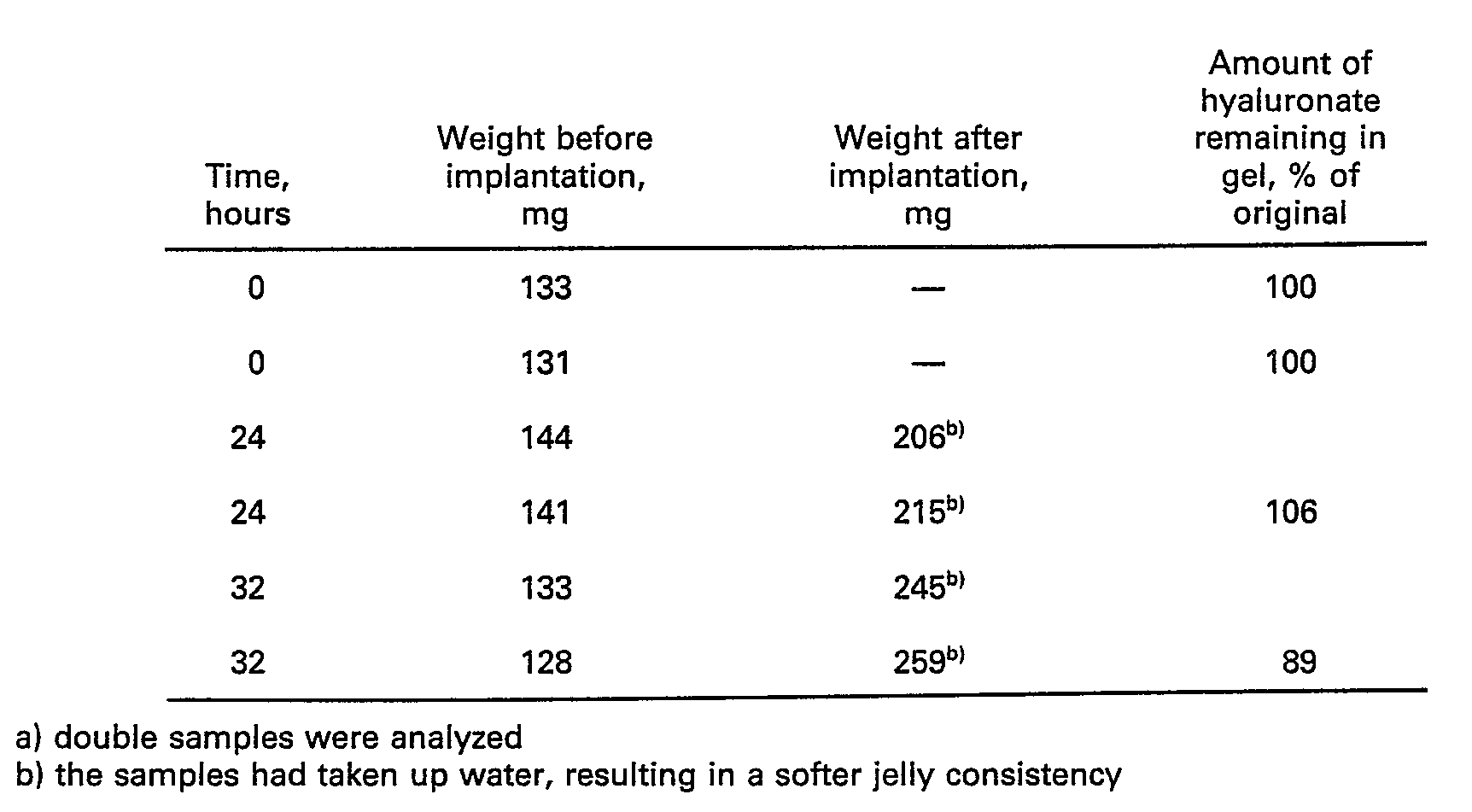
- novel gels of this invention are degradable; a hyaluronate gel implanted in a rat was found to undergo slow swelling while at the same time gradually losing its shape and rigidity. After 32 hours the gel had lost its integrity (intactness). Such gels therefore are suitable to be used in cases where the contact-inhibiting effect is to be upheld for several days.
- the gels may be prepared in many different forms depending on the particular use to which they are to be put.
- the reaction mixture is transferred to a suitable container in which the polymerized product will be given its desired form, e.g. thin layers, rods, tubes.
- the gel may be crushed if desired; this will result in a product suitable to be injected into the space or cavity to be filled out by the gel.
- a gel produced in the same manner as in Example 1 was shredded into small pieces. These were weighed and inserted into small Plexiglas@ chambers which were then covered with nylon net and implanted subcutaneously in rats. After suitable periods of time the gel pieces were removed, weighed and analyzed with respect to their hyaluronate contents, with the results a ) as set forth below.
- the hyaluronate content was determined in accordance with three mutually independent methods: The orcinol method (Mejbaum W., Physiol. Chem. 258 (1939), 117), the hyaluronidase method (Dische Z., J. Biol. Chem. 167 (1974), 189), and the carbazole method (Jourdian G. W.
- a hyaluronate gel film prepared according to example 1a with the dimensions 2 x 2 cm was introduced between the exposed tissue surfaces.
Landscapes
- Health & Medical Sciences (AREA)
- Chemical & Material Sciences (AREA)
- Life Sciences & Earth Sciences (AREA)
- General Health & Medical Sciences (AREA)
- Vascular Medicine (AREA)
- Animal Behavior & Ethology (AREA)
- Polymers & Plastics (AREA)
- Medicinal Chemistry (AREA)
- Veterinary Medicine (AREA)
- Public Health (AREA)
- Organic Chemistry (AREA)
- Epidemiology (AREA)
- Chemical Kinetics & Catalysis (AREA)
- Heart & Thoracic Surgery (AREA)
- Surgery (AREA)
- Dispersion Chemistry (AREA)
- Materials Engineering (AREA)
- Biochemistry (AREA)
- Engineering & Computer Science (AREA)
- Molecular Biology (AREA)
- Materials For Medical Uses (AREA)
- Polysaccharides And Polysaccharide Derivatives (AREA)
- Pharmaceuticals Containing Other Organic And Inorganic Compounds (AREA)
Abstract
Description
- This invention is concerned with a degradable gel of a crosslinked polysaccharide containing carboxyl groups. preventing adhesions or accretions of body tissues inter se. The invention also comprises a process for producing that gel product.
- In many instances of practical surgery, it is highly desirable to have a simple means and method for preventing direct contact between tissues and for maintaining this contact-inhibiting effect also during a postoperative period the length of which will vary according to the actual type of surgery involved. Examples of such surgical procedures are manifold, spanning over a wide field: e.g. operations performed in abdominal regions where it is important to prevent adhesions of the intestine or the mesentery with concomitant gastrointestinal disorders; operations performed in the urogenital apparatus where it is important to ward off adverse effects on the ureter and bladder, and on the functioning of the oviduct and uterus; and nerve surgery operations where it is important to minimize the development of granulation tissue. When tendons are operated on there is generally a tendency towards adhesion between the tendon and the surrounding sheath or other surrounding tissue during the immobilization period following the operation. Essentially unsuccessful attempts have been made to solve this problem by using various kinds of sutures and by means of passive movements of the tendon during the healing process. In ophthalmological surgery it is often desirable to have degradable implants at one's disposal which are to be applied in the angle of the anterior chamber of the eye for the purpose of preventing synechiae between the cornea and the iris; this applies especially in cases of reconstructions after severe damaging events. Moreover degradable or permanent implants are often desirable means of preventing adhesion in e.g. glaucoma surgery contexts (preventing adhesion in the subconjunctival filtration space) and in strabismus surgery.
- Tubular implants may be employed for obtaining an improved flow from the anterior chamber, for thwarting obstruction of the lachrymal duct, and for improving the result of dacryocystorhinostomy.
- In one particular type of articular surgery described by Engkvist et al. in Scand. J. Plast. Reconstr. Surg. 14 (1980), 71-87, silicone plates Silastic 1/2 (Dow Corning) are introduced surgically in order to prevent accretions of cartilaginous tissue. After some 12 to 16 weeks, however, it is necessary to again remove the implant surgically. Thus, the techniques presently available necessitate removal of the inserted material after a suitable period of time in all cases where this material has to be of a rigid type for the sake of securing a high degree of mechanical stability. In other cases, where mechanical stability is not a major factor, it has been customary to use non-crosslinked dextran or hyaluronic acid. But even if a substance of such high viscosity as hyaluronic acid is used for application to contact surfaces the protection period thus obtained is too short to be satisfactory.
- What is needed is therefore a product which is applicable in a suitable form for preventing adhesions and accretions between tissues and which optionally is to have the property of being degradable after a desired period of time.
- We have now found that a gel of a crosslinked carboxyl-containing polysaccharide is exceedingly suitable for being used as a degradable implant.
- The present invention is thus concerned with a novel degradable gel for use as an implant for preventing accretions and adhesions of body tissues inter se consisting of a polysaccharide which contains carboxyl groups - carboxymethyl starch, carboxymethyl dextran, carboxymethyl cellulose and glucosaminoglycans such as e.g. heparin, heparan sulfate, chondroitin sulfate and hyaluronic acid - and which has been crosslinked with a di- or polyfunctional epoxide of a pH of 2 to 5. Examples of such epoxides are 1,4-butanediol diglycidal ether (BDDE), 1,2-ethanediol diglycidyl ether (EDDE), 1-(2,3-epoxypropyl)-2,3-epoxycyclohexane (Bakerlite epoxy resin ERL 4206, Union Carbide), N,N-diglycidyl aniline (Leuktherm@ X 50, Bayer), and epoxy-substituted pentaerythritol (Shell 162). These crosslinking reagents and other suitable epoxy compounds are well knwon to persons skilled in the art. The sample applies to the choice of polysaccharides available which either contain carboxyl groups from the outset or may be derivatized so as to then contain such groups. The crosslinking has been carried out in an acidic medium, in the presence of an acidic catalyst. A great number of substances have been found to act as catalysts in the crosslinking reaction. Examples of such substances are inorganic acids such as e.g. sulfuric acid, nitric acid, hydrochloric acid and phosphoric acid; furthermore organic mono- and polycarboxylic acids, e.g. lower aliphatic acids such as for instance formic acid, ecetic acid, propionic acid, lactic acid, trichloroacetic acid, succinic acid, and aromatic mono- or polyfunctional carboxylic acids or sulfonic acids, e.g. benzoic, salicylic and paratoluenesulfonic acids. The term "polycarboxylic acids" comprises all acids having more than one carboxyl group. It is possible to replace the free acids employed by their hydrogen salts in those cases where such salts can be formed.
- The present invention also relates to a process for producing a degradable gel by means of reacting a said carboxyl-containing polysaccharide with a bi- or polyfunctional epoxide at a pH of from 2 to 5, preferably from 2.5 to 4.5, in the presence of an acidic catalyst of the aforesaid type.
- In a preferred embodiment of the invention the carboxyl-containing polysaccharide is hyaluronic acid or a salt thereof such as the sodium salt. Hyaluronic acid exists in a wide range of forms of different molecular weights depending on its source and on the purification methods employed. Products within the range of 20,000 to 5,000,000, in particular 500,000 to 3,000,000, are suitable for producing gels according to this invention. In cases where the molecular weight exceeds 106 the concentrations of such hyaluronic acids in the reaction mixture may suitably be 5 to 10% by weight. Considerably higher concentrations have to be employed for achieving gel formation with low molecular polysaccharide starting materials. Similarly, the amount of crosslinking agent may be varied within a very broad range, from about 10 to about 500% by weight of the hyaluronic acid, depending on the particular properties desired in the gel. The reaction may advantageously be performed at an elevated temperature of 30 to 80°C, although temperatures of 30-50°C are preferred for minimizing the risk of acid hydrolysis. As regards the reaction time, this is usually chosen within the range of from 3 to 20 hours, a preferred range being 5 to 15 hours.
- The dry solid content of a gel swelled in physiological saline will preferably be within the range of from 0.5 to 10% by weight.
- IR analysis of a gel produced in a manner analogous to that of Example 1 below showed a significant peak in its IR spectrum at about 1745 cm-1, which is characteristic of an O-ester group. This peak remained in the spectrum also after the gel has been treated with phosphate buffer (pH 6.8); in that stage most of the carboxyl groups are ionized and thus unable to contribute to the aforesaid peak. These results indicate, thus, that the acid-catalyzed gels do contain O-ester bridges. Gels produced by means of alkaline catalysis (see for instance Laurent et al., Acta Chim. Scand. 18 (1964) 274-275) do not show such a peak at 1745 cm-1. Crosslinked gels of carboxyl group containing polysaccharides prepared under alkaline conditions are also described in for instance GB 854715 (corresponding to US 3042667) and WO 86/0079. Their therapeutic use is also known from these publications.
- The novel gels of this invention are degradable; a hyaluronate gel implanted in a rat was found to undergo slow swelling while at the same time gradually losing its shape and rigidity. After 32 hours the gel had lost its integrity (intactness). Such gels therefore are suitable to be used in cases where the contact-inhibiting effect is to be upheld for several days.
- The gels may be prepared in many different forms depending on the particular use to which they are to be put. When the individual components have been added, the reaction mixture is transferred to a suitable container in which the polymerized product will be given its desired form, e.g. thin layers, rods, tubes. After the polymerization step, the gel may be crushed if desired; this will result in a product suitable to be injected into the space or cavity to be filled out by the gel.
- It is imperative to have the polysaccharide duly purified from components that might otherwise cause toxic or undesired immunological reactions. Similarly, it is necessary that the final gel be liberated by careful washing from e.g. unreacted crosslinking reagent. The gel may be sterilized and autoclaved.
- Use of products according to this invention for preventing mutual adhesion or accretion (synechia) of body tissues is carried out by introducing, one or more pieces of the gel during the course of the surgical operation, into the interstice between the tissues to be maintained in a separated conditions. The get that is thus introduced may be partially swollen in a physioligically acceptable solution. Alternatively, the swollen gel may be injected in a crushed form into the site where the adhesion-inhibiting effect is desired.
- 1. Preparation of gels of crosslinked hyaluronic acid
- 1 (a) 400 mg of sodium hyaluronate having a molecular weight of about 3 x 10⁶ was dissolved in 4 ml of distilled water in a plastic test tube. After about 2 hours, 600 µl of 1,4-butanediol diglycidyl ether (BDDE) was added and then, after agitation, 150 ut of glacial acetic acid. The mixture was left standing for 15 hours at 60 to 70°C, whereupon the gel thus formed was washed with water. The solids content of the swollen gel was 3.3% (% by weight of swollen gel in physioligical saline).
- 1 (b) The process of Example 1 (a) was repeated but with 200 µl of BDDE and 200 ut of glacial acetic acid, and with a reaction time and temperature of 5 hours and 50°C respectively. The gel had a solids content of 5.0%.
- 1 (c) The process of Example 1 (a) was repeated but with 600 mg of sodium hyaluronate, 400 µl of BDDE and 200 pl of glacial acetic acid. The gel had a solids content of 8.4%.
- 1 (d) The process of Example 1 (a) was repeated but with 400 mg of sodium hyaluronate having a molecular weight of about 1 x 10⁶ and with 150 mg of lactic acid as the catalyst. The resultant gel had a solids content of 1.6%.
- 1 (e) The procedure of Example 1 (a) was also repeated with the following catalyst: 400 µl of 2N sulfuric acid, 200 µl of 50% trichloroacetic acid and, respectively, 200 pl of a solution of 1.5 g of benzoic acid in 1.5 ml water and 1.5 ml dimethyl sulfoxide.
- In all of these cases a gel of crosslinked hyaluronate was obtained.
- 1 (f) 150 mg of sodium hyaluronate having a molecular weight of about 3 x 10⁶ was dissolved in 1.5 ml of water. When the solution was homogeneous 75 µl of glacial acetic acid and 75 mg of epoxy-substituted pentaerythritol (Shell 162, degree of substitution about 3.5) were added. The mixture was left standing overnight at 60°C, whereupon the gel thus formed was washed with water. The swollen gel had a solids content of 2.4%.
- 1 (g) The procedure according to Example 1 (a) was repeated, but with 75 mg of N,N-diglycidyl aniline (Leuktherm® X50, Bayer) as the crosslinking reagent and with 400 µl of 2N sulfuric acid as the catalyst. The gel had a solids content of 3.7%.
- 1 (h) The procedure of Example 1 (a) was repeated, but with 200 mg of sodium hyaluronate of molecular weight about 500,000, 250 µl BDDE and 100 µl glacial acetic acid. The reaction was allowed to proceed overnight at 50°C. This experiment resulted in the formation of a crosslinked hyaluronic acid gel, and the same applies to another run where 200 mg of hyaluronic acid (free acid form) having a molecular weight of about 3 x 10⁶ was reacted with 200 µl of BDDE in the presence of 100 µl glacial acetic acid.
- 1 (i) Experiments were run in a manner analogous to that of Example 1 (a) but employing in one case 300 mg of sodium hyaluronate and 150 µl of BDDE in the presence of 150 pl of glacial acetic acid and in the other case 300 mg of sodium hyaluronate and 250 ul of BDDE in the presence of 250 pl of glacial acetic acid. Gels were obtained in which the content of crosslinking agent amounted to 9 and 21% by weight respectively as measured by GLC.
- 2. Preparation of gels of crosslinked carboxymethyl dextran, carboxymethyl cellulose, and chondroitin sulfate
- 2 (a) 600 mg of carboxymethyl dextran having a molecular weight of about 2 x 10⁶ was dissolved in 3 ml of water. Next 300 µl of BDDE and 300 µl of glacial acetic acid were added, whereupon the mixture was left standing overnight at 50°C. the gel that had formed by then was washed with water.
- 2 (b) 400 mg of carboxymethyl cellulose (Fluka CMC sodium salt) was dissolved in 3 ml of water, whereafter the reaction was carried out as in Example 2 (a) but with 200 µl of BDDE and 200 µl of glacial acetic acid. An opalescent elastic gel was obtained.
- 2 (c) 800 mg of chondroitin sulfate (sodium salt, Sigma) was dissolved in 2 ml of water, whereafter the reaction was carried out as in Example 2 (a) but with 200 µl of BDDE and 100 µl of glacial acetic acid. A gel of firm consistency was obtained.
- A gel produced in the same manner as in Example 1 was shredded into small pieces. These were weighed and inserted into small Plexiglas@ chambers which were then covered with nylon net and implanted subcutaneously in rats. After suitable periods of time the gel pieces were removed, weighed and analyzed with respect to their hyaluronate contents, with the resultsa) as set forth below. The hyaluronate content was determined in accordance with three mutually independent methods: The orcinol method (Mejbaum W., Physiol. Chem. 258 (1939), 117), the hyaluronidase method (Dische Z., J. Biol. Chem. 167 (1974), 189), and the carbazole method (Jourdian G. W. et al., Anal. Biochem. 96 (1979), 474). The results obtained with these three methods were in good agreement inter se, and for this reason only those obtained with the carbazole method are set forth below.
- Forty-eight Wistar male rats (250-300 g each) were used. Of these were three animals excluded because they did not survive the operation (one animal in the test group) or died from peritonitis during the first postoperative day (two animals in the control group).
- Anaesthesia was accomplished with a 10% solution of etorfine and acepromazine (Immobilon®, Pharmacia A/S) i.m. and postoperative reversal was achieved with a 10% solution of diprenofine (Reuivon@, Pharmacia A/S). Coeliotomy was performed through a 4-cm median incision. One cm to the right of the midline 1 x 3 cm of peritoneum and underlying muscle was excised. The peritoneal defect was then closed with seven atraumatic 3/0 single silk sutures. At this point of the procedure the animals were randomly allocated to a test group or a control group.
- In the test group a hyaluronate gel film prepared according to example 1a with the dimensions 2 x 2 cm was introduced between the exposed tissue surfaces.
- On the seventh day all rats were sacrificed by ether exposure and the abdomen was opened through a left-sided curved incision. The sutured 3 cm long periforeal defect to the right of the midline was visualized and the part of the defect occupied by adhesions was measured in mm. The abdomen was then examined for pathological conditions other than adhesions.
- In the test group, that is the hyaluronate gel film treated group, no adhesions were found.
- In the control group adhesions involving the greater omentum, and in eight animals the small intestine as well, were present in all animals. The median length of attachment being 27 mm.
- No pathological conditions other than adhesions, i.e. bowel obstruction , peritonitis, abscesses or fluid in the abdomen, were found.
- Six rabbits wer used divided into a test group and a control group with three animals in each. In each animal two tendons in the fore paw were divided and the hyaluronate gel film, prepared according to example 1 b, were folded around the tendon after that it had been rejoined with sutures. The tendon sheath was partly sealed. After four weeks, the animals were sacrificed and the operated tendons were inspected.
- In the control group, most of the operated tendons presented adhesions to the surrounding tendon sheath. In the test group, however, the adhesions were very rare and of small size.

Claims (10)
Priority Applications (1)
| Application Number | Priority Date | Filing Date | Title |
|---|---|---|---|
| AT85903721T ATE47400T1 (en) | 1984-07-23 | 1985-07-16 | GEL FOR THE PREVENTION OF ADHAESION OF BODY TISSUES AND ITS MANUFACTURE. |
Applications Claiming Priority (2)
| Application Number | Priority Date | Filing Date | Title |
|---|---|---|---|
| SE8403817 | 1984-07-23 | ||
| SE8403817A SE456346B (en) | 1984-07-23 | 1984-07-23 | GEL TO PREVENT ADHESION BETWEEN BODY TISSUE AND SET FOR ITS PREPARATION |
Publications (2)
| Publication Number | Publication Date |
|---|---|
| EP0190215A1 EP0190215A1 (en) | 1986-08-13 |
| EP0190215B1 true EP0190215B1 (en) | 1989-10-18 |
Family
ID=20356585
Family Applications (1)
| Application Number | Title | Priority Date | Filing Date |
|---|---|---|---|
| EP85903721A Expired EP0190215B1 (en) | 1984-07-23 | 1985-07-16 | Gel for preventing adhesion between body tissues and process for its production |
Country Status (7)
| Country | Link |
|---|---|
| US (1) | US4886787A (en) |
| EP (1) | EP0190215B1 (en) |
| JP (1) | JPH0669490B2 (en) |
| CA (1) | CA1263647A (en) |
| DE (1) | DE3573785D1 (en) |
| SE (1) | SE456346B (en) |
| WO (1) | WO1986000912A1 (en) |
Families Citing this family (195)
| Publication number | Priority date | Publication date | Assignee | Title |
|---|---|---|---|---|
| EP0345370A1 (en) * | 1988-06-08 | 1989-12-13 | Malliner Laboratories Inc. | Use of transparent membranes made of hydrogel polymers as a cover for various organs during surgery |
| SE452469B (en) * | 1986-06-18 | 1987-11-30 | Pharmacia Ab | MATERIALS CONSISTING OF A CROSS-BONDED CARBOXYL-GROUPED POLYSACCHARIDE AND PROCEDURE IN THE PREPARATION OF THE SAME |
| US5080893A (en) * | 1988-05-31 | 1992-01-14 | University Of Florida | Method for preventing surgical adhesions using a dilute solution of polymer |
| US6174999B1 (en) | 1987-09-18 | 2001-01-16 | Genzyme Corporation | Water insoluble derivatives of polyanionic polysaccharides |
| US5527893A (en) * | 1987-09-18 | 1996-06-18 | Genzyme Corporation | Water insoluble derivatives of polyanionic polysaccharides |
| US4937270A (en) * | 1987-09-18 | 1990-06-26 | Genzyme Corporation | Water insoluble derivatives of hyaluronic acid |
| US5017229A (en) * | 1990-06-25 | 1991-05-21 | Genzyme Corporation | Water insoluble derivatives of hyaluronic acid |
| US6235726B1 (en) * | 1987-09-18 | 2001-05-22 | Genzyme Corporation | Water insoluble derivatives of polyanionic polysaccharides |
| US6610669B1 (en) | 1987-09-18 | 2003-08-26 | Genzyme Corporation | Water insoluble derivatives of polyanionic polysaccharides |
| US6010692A (en) * | 1988-05-31 | 2000-01-04 | University Of Florida Research Foundation, Inc. | Method and composition for preventing surgical adhesions and tissue damage |
| US5140016A (en) * | 1988-05-31 | 1992-08-18 | University Of Florida | Method and composition for preventing surgical adhesions using a dilute solution of polymer |
| SE8900586L (en) * | 1989-02-21 | 1990-08-22 | Pharmacia Ab | COMPOSITION AND PROCEDURES TO PREVENT ADHESION BETWEEN BODY TISSUE |
| US5356883A (en) | 1989-08-01 | 1994-10-18 | Research Foundation Of State University Of N.Y. | Water-insoluble derivatives of hyaluronic acid and their methods of preparation and use |
| US4994277A (en) * | 1989-10-31 | 1991-02-19 | Pfizer Hospital Products Group, Inc. | Use of xanthan gum for preventing adhesions |
| DK0426368T3 (en) * | 1989-10-31 | 1995-03-13 | Howmedica | Preparations containing chitin derivatives to prevent adhesion |
| US5093319A (en) * | 1989-10-31 | 1992-03-03 | Pfizer Hospital Products Group, Inc. | Use of derivatives of chitin soluble in aqueous solutions for preventing adhesions |
| US5059123A (en) * | 1990-05-14 | 1991-10-22 | Jernberg Gary R | Periodontal barrier and method for aiding periodontal tissue regeneration |
| US5290271A (en) * | 1990-05-14 | 1994-03-01 | Jernberg Gary R | Surgical implant and method for controlled release of chemotherapeutic agents |
| US5143724A (en) * | 1990-07-09 | 1992-09-01 | Biomatrix, Inc. | Biocompatible viscoelastic gel slurries, their preparation and use |
| GR920100122A (en) * | 1991-04-05 | 1993-03-16 | Ethicon Inc | Ionically crosslinked carboxyl-containing polysaccharides for adhension prevention. |
| US5705178A (en) * | 1991-05-31 | 1998-01-06 | Gliatech, Inc. | Methods and compositions based on inhibition of cell invasion and fibrosis by anionic polymers |
| US5605938A (en) * | 1991-05-31 | 1997-02-25 | Gliatech, Inc. | Methods and compositions for inhibition of cell invasion and fibrosis using dextran sulfate |
| EP0610441A4 (en) * | 1991-10-29 | 1996-01-10 | Clover Cons Ltd | Crosslinkable polysaccharides, polycations and lipids useful for encapsulation and drug release. |
| JP2855307B2 (en) * | 1992-02-05 | 1999-02-10 | 生化学工業株式会社 | Photoreactive glycosaminoglycans, cross-linked glycosaminoglycans and methods for producing them |
| DE4209160A1 (en) * | 1992-03-20 | 1993-09-30 | Bauer Kurt Heinz Prof Dr | Crosslinked polysaccharides, process for their preparation and their use |
| CA2114290C (en) * | 1993-01-27 | 2006-01-10 | Nagabushanam Totakura | Post-surgical anti-adhesion device |
| US5585361A (en) | 1994-06-07 | 1996-12-17 | Genzyme Corporation | Methods for the inhibition of platelet adherence and aggregation |
| US6294202B1 (en) | 1994-10-06 | 2001-09-25 | Genzyme Corporation | Compositions containing polyanionic polysaccharides and hydrophobic bioabsorbable polymers |
| US5690961A (en) * | 1994-12-22 | 1997-11-25 | Hercules Incorporated | Acidic polysaccharides crosslinked with polycarboxylic acids and their uses |
| US5677276A (en) * | 1994-12-23 | 1997-10-14 | La Jolla Cancer Research Foundation | Immobilization of peptides to hyaluronate |
| US5888988A (en) * | 1995-05-08 | 1999-03-30 | Chitogenics, Inc. | Covalently linked N,O-carboxymethylchitosan and uses thereof |
| US5679658A (en) * | 1995-05-08 | 1997-10-21 | Chitogenics, Inc. | N,O-carbonxymethylchitosan for prevention of surgical adhesions |
| US5807833A (en) * | 1995-06-07 | 1998-09-15 | University Of Southern California | Hydroxyethyl starch and use thereof as an absorbable mechanical barrier and intracavity carrier device |
| US6150581A (en) * | 1995-06-07 | 2000-11-21 | United States Surgical Corporation | Chitosan/alginate anti-adhesion barrier |
| JPH11507697A (en) * | 1995-06-09 | 1999-07-06 | エヌ. ドロハン,ウィリアム | Chitin hydrogels, their preparation and use |
| US5612321A (en) * | 1995-06-22 | 1997-03-18 | Hercules Incorporated | Antioxidant grafted polysaccharides |
| SI9620106B (en) | 1995-08-29 | 2005-12-31 | Fidia Advanced Biopolymers Srl | Biological materials for the prevention of post-surgical adhesions consisting of hyaluronic acid derivatives |
| US5897880A (en) | 1995-09-29 | 1999-04-27 | Lam Pharmaceuticals, Llc. | Topical drug preparations |
| US6066325A (en) * | 1996-08-27 | 2000-05-23 | Fusion Medical Technologies, Inc. | Fragmented polymeric compositions and methods for their use |
| US6063061A (en) * | 1996-08-27 | 2000-05-16 | Fusion Medical Technologies, Inc. | Fragmented polymeric compositions and methods for their use |
| US7871637B2 (en) | 1996-08-27 | 2011-01-18 | Baxter International Inc. | Dry hemostatic compositions and methods for their preparation |
| US20050090662A1 (en) * | 1997-01-15 | 2005-04-28 | Beavers Ellington M. | Method of making free acids from polysaccharide salts |
| US7192984B2 (en) | 1997-06-17 | 2007-03-20 | Fziomed, Inc. | Compositions of polyacids and polyethers and methods for their use as dermal fillers |
| US6869938B1 (en) | 1997-06-17 | 2005-03-22 | Fziomed, Inc. | Compositions of polyacids and polyethers and methods for their use in reducing adhesions |
| US5906997A (en) * | 1997-06-17 | 1999-05-25 | Fzio Med, Inc. | Bioresorbable compositions of carboxypolysaccharide polyether intermacromolecular complexes and methods for their use in reducing surgical adhesions |
| US6123957A (en) * | 1997-07-16 | 2000-09-26 | Jernberg; Gary R. | Delivery of agents and method for regeneration of periodontal tissues |
| US6117979A (en) * | 1997-08-18 | 2000-09-12 | Medtronic, Inc. | Process for making a bioprosthetic device and implants produced therefrom |
| US6514534B1 (en) | 1998-08-14 | 2003-02-04 | Incept Llc | Methods for forming regional tissue adherent barriers and drug delivery systems |
| US6818018B1 (en) | 1998-08-14 | 2004-11-16 | Incept Llc | In situ polymerizable hydrogels |
| GB9826658D0 (en) * | 1998-12-03 | 1999-01-27 | Univ London | Tissue repair |
| US7083777B1 (en) * | 1999-04-02 | 2006-08-01 | The Brigham And Women's Hospital, Inc. | Immunomodulating polymers |
| US6645947B1 (en) * | 1999-05-20 | 2003-11-11 | Chitogenics, Inc. | Adhesive N, O-carboxymethylchitosan coatings which inhibit attachment of substrate-dependent cells and proteins |
| WO2001006973A1 (en) * | 1999-07-28 | 2001-02-01 | United States Surgical Corporation | Hyaluronic acid anti-adhesion barrier |
| US6566345B2 (en) | 2000-04-28 | 2003-05-20 | Fziomed, Inc. | Polyacid/polyalkylene oxide foams and gels and methods for their delivery |
| US6392257B1 (en) | 2000-02-10 | 2002-05-21 | Motorola Inc. | Semiconductor structure, semiconductor device, communicating device, integrated circuit, and process for fabricating the same |
| US6521223B1 (en) * | 2000-02-14 | 2003-02-18 | Genzyme Corporation | Single phase gels for the prevention of adhesions |
| KR20030011083A (en) | 2000-05-31 | 2003-02-06 | 모토로라 인코포레이티드 | Semiconductor device and method for manufacturing the same |
| WO2002009187A2 (en) | 2000-07-24 | 2002-01-31 | Motorola, Inc. | Heterojunction tunneling diodes and process for fabricating same |
| KR100375299B1 (en) | 2000-10-10 | 2003-03-10 | 주식회사 엘지생명과학 | Crosslinked derivatives of hyaluronic acid by amide formation and their preparation methods |
| DE60130253D1 (en) | 2000-11-21 | 2007-10-11 | Michael P Diamond | COMPOSITIONS FOR PREVENTING ADHESION |
| SV2003000753A (en) | 2000-12-05 | 2003-06-16 | Brigham & Womens Hospital | USE OF ZWITTERIONIC POLYSACARIDS FOR THE SPECIFIC MODULATION OF IMMUNE PROGRESS |
| US20020096683A1 (en) | 2001-01-19 | 2002-07-25 | Motorola, Inc. | Structure and method for fabricating GaN devices utilizing the formation of a compliant substrate |
| ATE312076T1 (en) | 2001-02-22 | 2005-12-15 | Anika Therapeutics Inc | THIOL-MODIFIED HYALURONAN DERIVATIVES |
| US20020172712A1 (en) * | 2001-03-19 | 2002-11-21 | Alan Drizen | Antiemetic, anti-motion sustained release drug delivery system |
| WO2002082551A1 (en) | 2001-04-02 | 2002-10-17 | Motorola, Inc. | A semiconductor structure exhibiting reduced leakage current |
| US6992321B2 (en) | 2001-07-13 | 2006-01-31 | Motorola, Inc. | Structure and method for fabricating semiconductor structures and devices utilizing piezoelectric materials |
| US7019332B2 (en) | 2001-07-20 | 2006-03-28 | Freescale Semiconductor, Inc. | Fabrication of a wavelength locker within a semiconductor structure |
| US6855992B2 (en) | 2001-07-24 | 2005-02-15 | Motorola Inc. | Structure and method for fabricating configurable transistor devices utilizing the formation of a compliant substrate for materials used to form the same |
| US20030034491A1 (en) | 2001-08-14 | 2003-02-20 | Motorola, Inc. | Structure and method for fabricating semiconductor structures and devices for detecting an object |
| US20030071327A1 (en) | 2001-10-17 | 2003-04-17 | Motorola, Inc. | Method and apparatus utilizing monocrystalline insulator |
| US6916717B2 (en) | 2002-05-03 | 2005-07-12 | Motorola, Inc. | Method for growing a monocrystalline oxide layer and for fabricating a semiconductor device on a monocrystalline substrate |
| US7338433B2 (en) | 2002-08-13 | 2008-03-04 | Allergan, Inc. | Remotely adjustable gastric banding method |
| US7265097B2 (en) * | 2002-08-20 | 2007-09-04 | Chitogenics, Inc. | Methods of drug delivery using sulphated chitinous polymers |
| ES2617452T3 (en) | 2002-08-28 | 2017-06-19 | Apollo Endosurgery, Inc | Fatigue resistant gastric band device |
| US7169619B2 (en) | 2002-11-19 | 2007-01-30 | Freescale Semiconductor, Inc. | Method for fabricating semiconductor structures on vicinal substrates using a low temperature, low pressure, alkaline earth metal-rich process |
| US6885065B2 (en) | 2002-11-20 | 2005-04-26 | Freescale Semiconductor, Inc. | Ferromagnetic semiconductor structure and method for forming the same |
| US7020374B2 (en) | 2003-02-03 | 2006-03-28 | Freescale Semiconductor, Inc. | Optical waveguide structure and method for fabricating the same |
| US6965128B2 (en) | 2003-02-03 | 2005-11-15 | Freescale Semiconductor, Inc. | Structure and method for fabricating semiconductor microresonator devices |
| CA2520865A1 (en) | 2003-03-31 | 2004-10-21 | The Brigham And Women's Hospital, Inc. | Zwitterionic immunomodulators for the treatment of asthma and allergy |
| FR2861734B1 (en) * | 2003-04-10 | 2006-04-14 | Corneal Ind | CROSSLINKING OF LOW AND HIGH MOLECULAR MASS POLYSACCHARIDES; PREPARATION OF INJECTABLE SINGLE PHASE HYDROGELS; POLYSACCHARIDES AND HYDROGELS OBTAINED |
| US8834864B2 (en) | 2003-06-05 | 2014-09-16 | Baxter International Inc. | Methods for repairing and regenerating human dura mater |
| US7927626B2 (en) | 2003-08-07 | 2011-04-19 | Ethicon, Inc. | Process of making flowable hemostatic compositions and devices containing such compositions |
| BRPI0507075B1 (en) | 2004-01-23 | 2016-02-23 | Allergan Inc | detachable one-piece adjustable gastric band |
| WO2005087147A1 (en) | 2004-03-08 | 2005-09-22 | Endoart S.A. | Closure system for tubular organs |
| KR101244519B1 (en) | 2004-03-17 | 2013-03-18 | 젠자임 코포레이션 | Anti-adhesion spraying |
| AU2004317849B2 (en) | 2004-03-18 | 2011-03-31 | Allergan, Inc. | Apparatus and method for volume adjustment of intragastric balloons |
| US8367099B2 (en) | 2004-09-28 | 2013-02-05 | Atrium Medical Corporation | Perforated fatty acid films |
| US8312836B2 (en) | 2004-09-28 | 2012-11-20 | Atrium Medical Corporation | Method and apparatus for application of a fresh coating on a medical device |
| US9801982B2 (en) | 2004-09-28 | 2017-10-31 | Atrium Medical Corporation | Implantable barrier device |
| US8263102B2 (en) | 2004-09-28 | 2012-09-11 | Atrium Medical Corporation | Drug delivery coating for use with a stent |
| US9012506B2 (en) | 2004-09-28 | 2015-04-21 | Atrium Medical Corporation | Cross-linked fatty acid-based biomaterials |
| WO2006036984A2 (en) | 2004-09-28 | 2006-04-06 | Atrium Medical Corporation | Stand-alone film and methods for making the same |
| US9000040B2 (en) | 2004-09-28 | 2015-04-07 | Atrium Medical Corporation | Cross-linked fatty acid-based biomaterials |
| US8251888B2 (en) | 2005-04-13 | 2012-08-28 | Mitchell Steven Roslin | Artificial gastric valve |
| US9427423B2 (en) | 2009-03-10 | 2016-08-30 | Atrium Medical Corporation | Fatty-acid based particles |
| US9278161B2 (en) | 2005-09-28 | 2016-03-08 | Atrium Medical Corporation | Tissue-separating fatty acid adhesion barrier |
| CA2626030A1 (en) | 2005-10-15 | 2007-04-26 | Atrium Medical Corporation | Hydrophobic cross-linked gels for bioabsorbable drug carrier coatings |
| US8043206B2 (en) | 2006-01-04 | 2011-10-25 | Allergan, Inc. | Self-regulating gastric band with pressure data processing |
| US7798954B2 (en) | 2006-01-04 | 2010-09-21 | Allergan, Inc. | Hydraulic gastric band with collapsible reservoir |
| WO2007092451A2 (en) | 2006-02-06 | 2007-08-16 | The Brigham And Women's Hospital, Inc. | Zwitterionic polysaccharides for promotion of immune system maturation and health |
| WO2007120818A2 (en) * | 2006-04-12 | 2007-10-25 | Massachusetts Institute Of Technology | Compositions and methods for inhibiting adhesions |
| TWI436793B (en) | 2006-08-02 | 2014-05-11 | 巴克斯特國際公司 | Quick acting dry sealant and use and manufacturing method thereof |
| US9492596B2 (en) | 2006-11-06 | 2016-11-15 | Atrium Medical Corporation | Barrier layer with underlying medical device and one or more reinforcing support structures |
| WO2008057328A2 (en) | 2006-11-06 | 2008-05-15 | Atrium Medical Corporation | Tissue separating device with reinforced support for anchoring mechanisms |
| FR2909285A1 (en) * | 2006-12-01 | 2008-06-06 | Anteis Sa | Use of an injectable or implantable antiadhesive antifibrotic gel based on a crosslinked natural or synthetic polymer for treating glaucoma or surgical wounds |
| US20080293637A1 (en) | 2007-05-23 | 2008-11-27 | Allergan, Inc. | Cross-linked collagen and uses thereof |
| US20110077737A1 (en) * | 2007-07-30 | 2011-03-31 | Allergan, Inc. | Tunably Crosslinked Polysaccharide Compositions |
| US8318695B2 (en) | 2007-07-30 | 2012-11-27 | Allergan, Inc. | Tunably crosslinked polysaccharide compositions |
| US20090062233A1 (en) | 2007-08-09 | 2009-03-05 | Xin Ji | Modified starch material of biocompatible hemostasis |
| US8697044B2 (en) | 2007-10-09 | 2014-04-15 | Allergan, Inc. | Crossed-linked hyaluronic acid and collagen and uses thereof |
| JP5670196B2 (en) | 2007-11-16 | 2015-02-18 | バイセプト セラピューティクス、インク. | Compositions and methods for treating purpura |
| US8394782B2 (en) * | 2007-11-30 | 2013-03-12 | Allergan, Inc. | Polysaccharide gel formulation having increased longevity |
| US8394784B2 (en) | 2007-11-30 | 2013-03-12 | Allergan, Inc. | Polysaccharide gel formulation having multi-stage bioactive agent delivery |
| RU2366665C1 (en) * | 2007-12-03 | 2009-09-10 | Институт синтетических полимерных материалов (ИСПМ) им. Н.С. Ениколопова РАН | Method for preparation of cured hyaluronic acid salts |
| RU2366666C1 (en) * | 2007-12-20 | 2009-09-10 | Институт синтетических полимерных материалов (ИСПМ) им. Н.С. Ениколопова РАН | Method for preparation of cured hyaluronic acid salts in water medium |
| CN104888264B (en) * | 2008-01-14 | 2018-01-09 | 北京环球利康科技有限公司 | Biocompatible hemostatic, prevent adhesion, the modified starch material of promoting healing, surgery closing |
| EP2095832A1 (en) | 2008-02-28 | 2009-09-02 | Bayer MaterialScience AG | Post-operative adhesion barriers |
| CN102014973A (en) | 2008-02-29 | 2011-04-13 | 弗罗桑医疗设备公司 | Device for promotion of hemostasis and/or wound healing |
| US8932622B2 (en) * | 2008-06-03 | 2015-01-13 | Actamax Surgical Materials, Llc | Tissue coating for preventing undesired tissue-to-tissue adhesions |
| RU2386640C2 (en) * | 2008-06-25 | 2010-04-20 | Институт синтетических полимерных материалов (ИСПМ) им. Н.С. Ениколопова РАН | Method for synthesis of cross-linked riboflavin-modified salt of hyaluronic acid |
| RU2386641C2 (en) * | 2008-07-09 | 2010-04-20 | Институт синтетических полимерных материалов (ИСПМ) им. Н.С. Ениколопова РАН | Method for synthesis of cross-linked retinol-modified salt of hyaluronic acid |
| RU2387670C1 (en) * | 2008-07-30 | 2010-04-27 | Институт синтетических полимерных материалов (ИСПМ) им. Н.С. Ениколопова РАН | Method for synthesis of cross-linked hyaluronic acid salt modified with folic acid |
| RU2387671C1 (en) * | 2008-07-30 | 2010-04-27 | Институт синтетических полимерных материалов (ИСПМ) им. Н.С. Ениколопова РАН | Method for synthesis of cross-linked salt of hyaluronic acid, modified with vitamines |
| US8357795B2 (en) | 2008-08-04 | 2013-01-22 | Allergan, Inc. | Hyaluronic acid-based gels including lidocaine |
| ES2658609T3 (en) | 2008-09-02 | 2018-03-12 | Tautona Group Lp | Threads of hyaluronic acid and / or derivatives thereof, methods for manufacturing them, and uses thereof |
| EP2362762A1 (en) | 2008-10-06 | 2011-09-07 | Allergan Medical Sàrl | Mechanical gastric band with cushions |
| US20100305397A1 (en) * | 2008-10-06 | 2010-12-02 | Allergan Medical Sarl | Hydraulic-mechanical gastric band |
| US20100185049A1 (en) | 2008-10-22 | 2010-07-22 | Allergan, Inc. | Dome and screw valves for remotely adjustable gastric banding systems |
| CZ301555B6 (en) | 2008-11-06 | 2010-04-14 | Cpn S. R. O. | Process for preparing DTPA crosslinked derivatives of hyaluronic acid and modification thereof |
| EP2404162B1 (en) | 2009-03-03 | 2017-12-27 | Access Medical System Co., Ltd. | Detection system and method for high sensitivity fluorescent assays |
| US9039783B2 (en) | 2009-05-18 | 2015-05-26 | Baxter International, Inc. | Method for the improvement of mesh implant biocompatibility |
| BRPI1015979A8 (en) | 2009-06-16 | 2018-06-19 | Baxter Healthcare Sa | Hemostatic porous sponge and method for making a hemostatic porous sponge |
| US20110038910A1 (en) | 2009-08-11 | 2011-02-17 | Atrium Medical Corporation | Anti-infective antimicrobial-containing biomaterials |
| US8771258B2 (en) | 2009-12-16 | 2014-07-08 | Baxter International Inc. | Hemostatic sponge |
| US9114188B2 (en) | 2010-01-13 | 2015-08-25 | Allergan, Industrie, S.A.S. | Stable hydrogel compositions including additives |
| US20110172180A1 (en) | 2010-01-13 | 2011-07-14 | Allergan Industrie. Sas | Heat stable hyaluronic acid compositions for dermatological use |
| US8758221B2 (en) | 2010-02-24 | 2014-06-24 | Apollo Endosurgery, Inc. | Source reservoir with potential energy for remotely adjustable gastric banding system |
| US8840541B2 (en) | 2010-02-25 | 2014-09-23 | Apollo Endosurgery, Inc. | Pressure sensing gastric banding system |
| KR101764451B1 (en) | 2010-03-12 | 2017-08-02 | 알러간 인더스트리 에스에이에스 | A Fluid Composition Comprising A Hyaluronan Polymer and Mannitol For Improving Skin Condition |
| EP3078388B1 (en) | 2010-03-22 | 2019-02-20 | Allergan, Inc. | Cross-linked hydrogels for soft tissue augmentation |
| SA111320355B1 (en) | 2010-04-07 | 2015-01-08 | Baxter Heathcare S A | Hemostatic sponge |
| US9028394B2 (en) | 2010-04-29 | 2015-05-12 | Apollo Endosurgery, Inc. | Self-adjusting mechanical gastric band |
| US20110270024A1 (en) | 2010-04-29 | 2011-11-03 | Allergan, Inc. | Self-adjusting gastric band having various compliant components |
| US9044298B2 (en) | 2010-04-29 | 2015-06-02 | Apollo Endosurgery, Inc. | Self-adjusting gastric band |
| US20110270025A1 (en) | 2010-04-30 | 2011-11-03 | Allergan, Inc. | Remotely powered remotely adjustable gastric band system |
| KR101327083B1 (en) * | 2010-05-07 | 2013-11-07 | (주)아모레퍼시픽 | Method for preparing water non-soluble gels and water non-soluble gels prepared by same method |
| KR101316401B1 (en) * | 2010-05-07 | 2013-10-10 | (주)아모레퍼시픽 | Method for preparing water non-soluble gels in solid state and water non-soluble gels prepared by same method |
| ES2676208T3 (en) | 2010-06-01 | 2018-07-17 | Baxter International Inc. | Process for the production of dry and stable hemostatic compositions |
| KR101957625B1 (en) | 2010-06-01 | 2019-03-12 | 백스터 인터내셔널 인코포레이티드 | Process for making dry and stable hemostatic compositions |
| CA2801120C (en) | 2010-06-01 | 2019-08-20 | Baxter International Inc. | Process for making dry and stable hemostatic compositions |
| US8517915B2 (en) | 2010-06-10 | 2013-08-27 | Allergan, Inc. | Remotely adjustable gastric banding system |
| WO2012009707A2 (en) | 2010-07-16 | 2012-01-19 | Atrium Medical Corporation | Composition and methods for altering the rate of hydrolysis of cured oil-based materials |
| US8697057B2 (en) | 2010-08-19 | 2014-04-15 | Allergan, Inc. | Compositions and soft tissue replacement methods |
| US8883139B2 (en) | 2010-08-19 | 2014-11-11 | Allergan Inc. | Compositions and soft tissue replacement methods |
| US8889123B2 (en) | 2010-08-19 | 2014-11-18 | Allergan, Inc. | Compositions and soft tissue replacement methods |
| US9005605B2 (en) | 2010-08-19 | 2015-04-14 | Allergan, Inc. | Compositions and soft tissue replacement methods |
| US20120059216A1 (en) | 2010-09-07 | 2012-03-08 | Allergan, Inc. | Remotely adjustable gastric banding system |
| US8961393B2 (en) | 2010-11-15 | 2015-02-24 | Apollo Endosurgery, Inc. | Gastric band devices and drive systems |
| US9999500B2 (en) | 2011-03-10 | 2018-06-19 | University Of Florida Research Foundation, Inc. | Anti thrombogenic heart valve and medical implements |
| KR102238406B1 (en) | 2011-06-03 | 2021-04-08 | 알러간 인더스트리 에스에이에스 | Dermal filler compositions including antioxidants |
| US9393263B2 (en) | 2011-06-03 | 2016-07-19 | Allergan, Inc. | Dermal filler compositions including antioxidants |
| US20130096081A1 (en) | 2011-06-03 | 2013-04-18 | Allergan, Inc. | Dermal filler compositions |
| US9408797B2 (en) | 2011-06-03 | 2016-08-09 | Allergan, Inc. | Dermal filler compositions for fine line treatment |
| EP2731617A4 (en) | 2011-07-12 | 2015-07-01 | Brigham & Womens Hospital | LIPID-CONTAINING PSA COMPOSITIONS, METHODS OF ISOLATION AND METHODS OF USING SAME |
| US20130244943A1 (en) | 2011-09-06 | 2013-09-19 | Allergan, Inc. | Hyaluronic acid-collagen matrices for dermal filling and volumizing applications |
| US9662422B2 (en) | 2011-09-06 | 2017-05-30 | Allergan, Inc. | Crosslinked hyaluronic acid-collagen gels for improving tissue graft viability and soft tissue augmentation |
| JP6195569B2 (en) | 2011-10-11 | 2017-09-13 | バクスター・インターナショナル・インコーポレイテッドBaxter International Incorp0Rated | Hemostatic composition |
| ES2938566T3 (en) | 2011-10-11 | 2023-04-12 | Baxter Int | hemostatic compositions |
| PT2771027E (en) | 2011-10-27 | 2015-11-26 | Baxter Healthcare Sa | Hemostatic compositions |
| US8876694B2 (en) | 2011-12-07 | 2014-11-04 | Apollo Endosurgery, Inc. | Tube connector with a guiding tip |
| US8961394B2 (en) | 2011-12-20 | 2015-02-24 | Apollo Endosurgery, Inc. | Self-sealing fluid joint for use with a gastric band |
| EP2612846A1 (en) | 2012-01-09 | 2013-07-10 | Bayer MaterialScience AG | Beta amino acid esters and use of same |
| RU2657955C2 (en) | 2012-03-06 | 2018-06-18 | Ферросан Медикал Дивайсиз А/С | Pressurised container containing haemostatic paste |
| KR101240518B1 (en) | 2012-03-26 | 2013-03-11 | 주식회사 제네웰 | Raw materials for transplantation using biocompatible polymers |
| EP2977066A3 (en) | 2012-06-12 | 2016-07-27 | Ferrosan Medical Devices A/S | Dry haemostatic composition |
| US9867880B2 (en) | 2012-06-13 | 2018-01-16 | Atrium Medical Corporation | Cured oil-hydrogel biomaterial compositions for controlled drug delivery |
| US20140275340A1 (en) | 2013-03-15 | 2014-09-18 | Lake Region Manufacturing, Inc. d/b/a Lake Region Medical | Modified hyaluronate hydrophilic compositions, coatings and methods |
| US9623157B2 (en) | 2013-03-15 | 2017-04-18 | Lake Region Manufacturing, Inc. | Modified hyaluronate hydrophilic compositions, coatings and methods |
| AU2014283170B2 (en) | 2013-06-21 | 2017-11-02 | Ferrosan Medical Devices A/S | Vacuum expanded dry composition and syringe for retaining same |
| US10047172B2 (en) * | 2013-09-30 | 2018-08-14 | Galderma S.A. | Single step functionalization and cross-linking of hyaluronic acid |
| JP6489485B2 (en) | 2013-12-11 | 2019-03-27 | フェロサン メディカル デバイシーズ エイ/エス | Dry composition containing an extrusion enhancing factor |
| SG11201609593RA (en) * | 2014-05-16 | 2016-12-29 | Ultrast Inc | Phase-shifting formulations |
| EP3200838B1 (en) | 2014-09-30 | 2019-09-18 | Allergan Industrie, SAS | Stable hydrogel compositions including additives |
| AU2015333206B2 (en) | 2014-10-13 | 2019-07-11 | Ferrosan Medical Devices A/S. | Dry composition for use in haemostasis and wound healing |
| RU2705905C2 (en) | 2014-12-24 | 2019-11-12 | Ферросан Медикал Дивайсиз А/С | Syringe for holding and mixing first and second substances |
| WO2016128783A1 (en) | 2015-02-09 | 2016-08-18 | Allergan Industrie Sas | Compositions and methods for improving skin appearance |
| HUE047971T2 (en) | 2015-02-13 | 2020-05-28 | Allergan Ind Sas | Implants for sculpting, augmenting or correcting facial features such as the chin |
| CN107771093B (en) | 2015-07-03 | 2021-06-15 | 弗罗桑医疗设备公司 | Syringe for mixing two components and for maintaining vacuum under storage conditions |
| JP6918365B2 (en) | 2015-08-19 | 2021-08-11 | プレジデント アンド フェローズ オブ ハーバード カレッジ | Lipidized PSA Compositions and Methods |
| EP3484441A4 (en) | 2016-07-15 | 2020-03-18 | President and Fellows of Harvard College | GLYCOLIPID COMPOSITIONS AND METHODS OF USE |
| EP3606565A4 (en) | 2017-04-05 | 2020-12-30 | Gelesis, LLC. | IMPROVED SUPERABSORBENT MATERIALS AND MANUFACTURING METHODS FOR THEM |
| US11801324B2 (en) | 2018-05-09 | 2023-10-31 | Ferrosan Medical Devices A/S | Method for preparing a haemostatic composition |
| RU2750000C1 (en) * | 2019-12-25 | 2021-06-21 | Акционерное общество «Медтехнопроект» | Method for synthesis of modified hyaluronan and application thereof in medicine, including in endoprosthetics |
| US11980699B2 (en) | 2021-09-01 | 2024-05-14 | Shanghai Qisheng Biological Preparation Co., Ltd. | Cartilage regeneration using injectable, in situ polymerizable collagen compositions containing chondrocytes or stem cells |
| WO2023125689A1 (en) | 2021-12-28 | 2023-07-06 | Shanghai Qisheng Biological Preparation Co., Ltd. | Hyaluronic acid-collagen copolymer compositions and medical applications thereof |
Family Cites Families (15)
| Publication number | Priority date | Publication date | Assignee | Title |
|---|---|---|---|---|
| SE169293C1 (en) * | 1958-03-13 | 1959-11-10 | ||
| US3042667A (en) * | 1959-03-10 | 1962-07-03 | Pharmacia Ab | Process for producing dextran derivatives and products resulting therefrom |
| NL126243C (en) * | 1959-06-12 | |||
| SE319903B (en) * | 1964-01-31 | 1970-01-26 | Pharmacia Ab | |
| SE452109B (en) * | 1973-01-29 | 1987-11-16 | Pharmacia Ab | SCIENTIFIC CLEANER EXTENDED SARYTOR |
| US4002173A (en) * | 1974-07-23 | 1977-01-11 | International Paper Company | Diester crosslinked polyglucan hydrogels and reticulated sponges thereof |
| US4152170A (en) * | 1975-06-18 | 1979-05-01 | Sumitomo Chemical Company, Ltd. | Cross-linked pullulan |
| GB1515963A (en) * | 1975-07-15 | 1978-06-28 | Massachusetts Inst Technology | Crosslinked collagen-mucopolysaccharide composite materials |
| US4011392A (en) * | 1975-09-02 | 1977-03-08 | The Sherwin-Williams Company | Mixed starch esters and the use thereof |
| DE2707308C2 (en) * | 1977-02-19 | 1982-07-01 | Hoechst Ag, 6000 Frankfurt | Shaped bodies with a spongy structure based on regenerated cellulose for medical purposes |
| JPS5844084B2 (en) * | 1977-04-01 | 1983-09-30 | 住友化学工業株式会社 | Manufacturing method of ionic pullulan gel |
| US4470975A (en) * | 1977-10-21 | 1984-09-11 | The Johns Hopkins University | Method and composition for the elimination of water from an animal body |
| FI793150A7 (en) * | 1978-10-12 | 1981-01-01 | Battelle Memorial Institute | Method for crosslinking carboxymethylcellulose and the products obtained. |
| JPS60130601A (en) * | 1983-12-15 | 1985-07-12 | バイオマトリツクス,インコ−ポレイテツド | Manufacture of hyaluronic acid water-insoluble composition |
| US4605691A (en) * | 1984-12-06 | 1986-08-12 | Biomatrix, Inc. | Cross-linked gels of hyaluronic acid and products containing such gels |
-
1984
- 1984-07-23 SE SE8403817A patent/SE456346B/en not_active IP Right Cessation
-
1985
- 1985-07-05 CA CA000486349A patent/CA1263647A/en not_active Expired
- 1985-07-16 EP EP85903721A patent/EP0190215B1/en not_active Expired
- 1985-07-16 DE DE8585903721T patent/DE3573785D1/en not_active Expired
- 1985-07-16 WO PCT/SE1985/000282 patent/WO1986000912A1/en not_active Ceased
- 1985-07-16 JP JP60503288A patent/JPH0669490B2/en not_active Expired - Lifetime
- 1985-07-16 US US06/847,171 patent/US4886787A/en not_active Expired - Lifetime
Also Published As
| Publication number | Publication date |
|---|---|
| SE8403817D0 (en) | 1984-07-23 |
| JPH0669490B2 (en) | 1994-09-07 |
| SE8403817L (en) | 1986-01-24 |
| US4886787A (en) | 1989-12-12 |
| CA1263647A (en) | 1989-12-05 |
| DE3573785D1 (en) | 1989-11-23 |
| JPS61502729A (en) | 1986-11-27 |
| WO1986000912A1 (en) | 1986-02-13 |
| SE456346B (en) | 1988-09-26 |
| EP0190215A1 (en) | 1986-08-13 |
Similar Documents
| Publication | Publication Date | Title |
|---|---|---|
| EP0190215B1 (en) | Gel for preventing adhesion between body tissues and process for its production | |
| US5093319A (en) | Use of derivatives of chitin soluble in aqueous solutions for preventing adhesions | |
| US4716154A (en) | Gel of crosslinked hyaluronic acid for use as a vitreous humor substitute | |
| US7226972B2 (en) | Process for cross-linking hyaluronic acid to polymers | |
| JP2002536466A (en) | Method for producing multiple crosslinked hyaluronic acid derivatives | |
| WO1993013136A1 (en) | Ultra-pure polysaccharide materials for medical use | |
| Matsuda et al. | Photoinduced prevention of tissue adhesion | |
| EP0426368B1 (en) | Compositions containing derivatives of chitin for preventing adhesion | |
| CZ296842B6 (en) | Cross-linked hyaluronic acids | |
| KR20010102231A (en) | Hyaluronic acid gel composition, process for producing the same, and medical material containing the same | |
| EA026886B1 (en) | Process for the simultaneous substitution and crosslinking of a polysaccharide via its hydroxyl functional groups | |
| KR100395723B1 (en) | Anti-Adhesion Agent | |
| JP2012082428A (en) | Composition of semi-interpenetrating polymer network | |
| WO2021051778A1 (en) | Disulfide bond-linked hyaluronic acid gel for preventing tissue adhesion after abdominal or pelvic cavity surgery and preparation method therefor | |
| RU1824197C (en) | Method for preparing radiopaque composition | |
| KR102103180B1 (en) | Anti-adhesion Composition Including Hyaluronic Acid Derivative, Pullulan and Carboxymethyl Cellulose and Manufacturing Method Thereof | |
| JPH0826081B2 (en) | Method for insolubilizing N-carboxyalkyl derivative of chitosan | |
| CN115177780A (en) | Anti-adhesion injectable hemostatic hydrogel, preparation method and application | |
| CN1556116A (en) | Application of O-substituted carboxymethyl chitosan in anti-adhesion materials for surgical operations | |
| CN118717653B (en) | Hyaluronic acid-tripeptide molecule electrostatic co-assembled injectable hydrogel and preparation method thereof | |
| CN114516923B (en) | Double bond functionalized modified hyaluronic acid (sodium) and synthetic method and application thereof | |
| CN119505032A (en) | A bifunctionalized pyran ring derivative and its preparation method and application | |
| CN121401505A (en) | A surgical anti-adhesion biopolysaccharide irrigation solution and its preparation method | |
| Sparer | THE SYNTHESIS AND CHARACTERIZATION OF CROSSLINKED CHONDROITIN-4-SULFATE HYDROGELS: POTENTIAL BIOMATERIALS. | |
| JPH0360272B2 (en) |
Legal Events
| Date | Code | Title | Description |
|---|---|---|---|
| PUAI | Public reference made under article 153(3) epc to a published international application that has entered the european phase |
Free format text: ORIGINAL CODE: 0009012 |
|
| 17P | Request for examination filed |
Effective date: 19860311 |
|
| AK | Designated contracting states |
Kind code of ref document: A1 Designated state(s): AT BE CH DE FR GB IT LI LU NL SE |
|
| 17Q | First examination report despatched |
Effective date: 19870625 |
|
| GRAA | (expected) grant |
Free format text: ORIGINAL CODE: 0009210 |
|
| AK | Designated contracting states |
Kind code of ref document: B1 Designated state(s): AT BE CH DE FR GB IT LI LU NL SE |
|
| PG25 | Lapsed in a contracting state [announced via postgrant information from national office to epo] |
Ref country code: SE Effective date: 19891018 |
|
| REF | Corresponds to: |
Ref document number: 47400 Country of ref document: AT Date of ref document: 19891115 Kind code of ref document: T |
|
| ET | Fr: translation filed | ||
| REF | Corresponds to: |
Ref document number: 3573785 Country of ref document: DE Date of ref document: 19891123 |
|
| ITF | It: translation for a ep patent filed | ||
| PLBE | No opposition filed within time limit |
Free format text: ORIGINAL CODE: 0009261 |
|
| STAA | Information on the status of an ep patent application or granted ep patent |
Free format text: STATUS: NO OPPOSITION FILED WITHIN TIME LIMIT |
|
| 26N | No opposition filed | ||
| ITTA | It: last paid annual fee | ||
| EPTA | Lu: last paid annual fee | ||
| REG | Reference to a national code |
Ref country code: GB Ref legal event code: 732E |
|
| REG | Reference to a national code |
Ref country code: CH Ref legal event code: PUE Owner name: PHARMACIA BIOSYSTEMS AKTIEBOLAG TRANSFER- PHARMACI Ref country code: CH Ref legal event code: PFA Free format text: PHARMACIA AB TRANSFER- PHARMACIA BIOSYSTEMS AKTIEBOLAG |
|
| BECH | Be: change of holder |
Free format text: 20001024 *PHARMACIA & UPJOHN A.B. |
|
| NLS | Nl: assignments of ep-patents |
Owner name: PHARMACIA & UPJOHN AB |
|
| NLT1 | Nl: modifications of names registered in virtue of documents presented to the patent office pursuant to art. 16 a, paragraph 1 |
Owner name: PHARMACIA BIOSYSTEMS AB |
|
| REG | Reference to a national code |
Ref country code: GB Ref legal event code: IF02 |
|
| REG | Reference to a national code |
Ref country code: FR Ref legal event code: TP Ref country code: FR Ref legal event code: CD Ref country code: FR Ref legal event code: CA |
|
| PGFP | Annual fee paid to national office [announced via postgrant information from national office to epo] |
Ref country code: GB Payment date: 20040615 Year of fee payment: 20 Ref country code: AT Payment date: 20040615 Year of fee payment: 20 |
|
| PGFP | Annual fee paid to national office [announced via postgrant information from national office to epo] |
Ref country code: NL Payment date: 20040621 Year of fee payment: 20 |
|
| PGFP | Annual fee paid to national office [announced via postgrant information from national office to epo] |
Ref country code: LU Payment date: 20040624 Year of fee payment: 20 |
|
| PGFP | Annual fee paid to national office [announced via postgrant information from national office to epo] |
Ref country code: FR Payment date: 20040702 Year of fee payment: 20 |
|
| PGFP | Annual fee paid to national office [announced via postgrant information from national office to epo] |
Ref country code: BE Payment date: 20040728 Year of fee payment: 20 |
|
| PGFP | Annual fee paid to national office [announced via postgrant information from national office to epo] |
Ref country code: DE Payment date: 20040730 Year of fee payment: 20 |
|
| PGFP | Annual fee paid to national office [announced via postgrant information from national office to epo] |
Ref country code: CH Payment date: 20040914 Year of fee payment: 20 |
|
| PG25 | Lapsed in a contracting state [announced via postgrant information from national office to epo] |
Ref country code: GB Free format text: LAPSE BECAUSE OF EXPIRATION OF PROTECTION Effective date: 20050715 |
|
| PG25 | Lapsed in a contracting state [announced via postgrant information from national office to epo] |
Ref country code: NL Free format text: LAPSE BECAUSE OF EXPIRATION OF PROTECTION Effective date: 20050716 |
|
| BE20 | Be: patent expired |
Owner name: *PHARMACIA & UPJOHN A.B. Effective date: 20050716 |
|
| REG | Reference to a national code |
Ref country code: GB Ref legal event code: PE20 |
|
| REG | Reference to a national code |
Ref country code: CH Ref legal event code: PL |
|
| NLV7 | Nl: ceased due to reaching the maximum lifetime of a patent |
Effective date: 20050716 |
|
| BE20 | Be: patent expired |
Owner name: *PHARMACIA & UPJOHN A.B. Effective date: 20050716 |