


A Hadamard matrix is a square matrix whose entries are 1 and  and whose rows are mutually orthogonal invented by
Sylvester (1867) under the name of anallagmatic pavement, 26 years before Hadamard
(1893) considered them. In a Hadamard matrix, placing any two columns or rows side
by side gives half the adjacent cells the same sign
and half the other sign. When viewed
as pavements, cells with 1s are colored black and those with
and whose rows are mutually orthogonal invented by
Sylvester (1867) under the name of anallagmatic pavement, 26 years before Hadamard
(1893) considered them. In a Hadamard matrix, placing any two columns or rows side
by side gives half the adjacent cells the same sign
and half the other sign. When viewed
as pavements, cells with 1s are colored black and those with  s are colored white. The total numbers of black and white
squares depend on the chosen matrix.
s are colored white. The total numbers of black and white
squares depend on the chosen matrix.
A Hadamard matrix of order  is a solution to Hadamard's
maximum determinant problem, i.e., has the maximum possible determinant
(in absolute value) of any
is a solution to Hadamard's
maximum determinant problem, i.e., has the maximum possible determinant
(in absolute value) of any  complex matrix with
elements
complex matrix with
elements  (Brenner and Cummings 1972), namely
  . An equivalent definition of the Hadamard matrices is
given by
. An equivalent definition of the Hadamard matrices is
given by
 |
(1)
|
where  is the
  identity matrix.
A Hadamard matrix of order  corresponds to a Hadamard
design (
corresponds to a Hadamard
design ( ,
,
 ,
,  ), and a Hadamard matrix
  gives a graph on
  vertices known as a Hadamard
graph.
vertices known as a Hadamard
graph.

A complete set of  Walsh functions of order
  gives a Hadamard matrix
  (Thompson et al. 1986, p. 204; Wolfram 2002,
p. 1073).
Hadamard matrices can be used to make error-correcting
codes, in particular, the Reed-Muller error-correcting code.
(Thompson et al. 1986, p. 204; Wolfram 2002,
p. 1073).
Hadamard matrices can be used to make error-correcting
codes, in particular, the Reed-Muller error-correcting code.
If  and
and  are known, then
  can be obtained by replacing all 1s in
  by
by  and all
  s by
s by  . For
. For  , Hadamard matrices with
  , 20, 28, 36, 44, 52, 60, 68, 76, 84, 92, and 100 cannot
be built up from lower order Hadamard matrices.
, 20, 28, 36, 44, 52, 60, 68, 76, 84, 92, and 100 cannot
be built up from lower order Hadamard matrices.
 |  | ![[1 1; -1 1]](https://mathworld.wolfram.com/images/equations/HadamardMatrix/Inline29.svg) |
(2)
|
 |  | ![[H_2 H_2; -H_2 H_2]](https://mathworld.wolfram.com/images/equations/HadamardMatrix/Inline32.svg) |
(3)
|
 |  | ![[[1 1; -1 1] [1 1; -1 1]; -[1 1; -1 1] [1 1; -1 1]]](https://mathworld.wolfram.com/images/equations/HadamardMatrix/Inline35.svg) |
(4)
|
 |  | ![[1 1 1 1; -1 1 -1 1; -1 -1 1 1; 1 -1 -1 1].](https://mathworld.wolfram.com/images/equations/HadamardMatrix/Inline38.svg) |
(5)
|
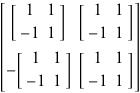 can be similarly generated from
  .
.

Hadamard (1893) remarked that a necessary condition for a Hadamard matrix to exist is that  , 2, or a positive multiple
of 4 (Brenner and Cummings 1972). Paley's theorem
guarantees that there always exists a Hadamard matrix
, 2, or a positive multiple
of 4 (Brenner and Cummings 1972). Paley's theorem
guarantees that there always exists a Hadamard matrix 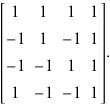 when
when  is divisible by 4 and of the form
  for some positive
integer
for some positive
integer  ,
nonnegative integer
,
nonnegative integer  , and
, and  an odd prime. In such cases,
the matrices can be constructed using a Paley
construction, as illustrated above (Wolfram 2002, p. 1073).
The number of Paley classes for
an odd prime. In such cases,
the matrices can be constructed using a Paley
construction, as illustrated above (Wolfram 2002, p. 1073).
The number of Paley classes for  , 8, ... are 2, 3, 2, 3, 2, 3, 2, 4, 1, ... (OEIS A074070).
The values of
, 8, ... are 2, 3, 2, 3, 2, 3, 2, 4, 1, ... (OEIS A074070).
The values of  for which there are no Paley classes (and hence cannot
be constructed using a Paley construction)
are 92, 116, 156, 172, 184, 188, 232, 236, 260, 268, ... (OEIS A046116).
for which there are no Paley classes (and hence cannot
be constructed using a Paley construction)
are 92, 116, 156, 172, 184, 188, 232, 236, 260, 268, ... (OEIS A046116).
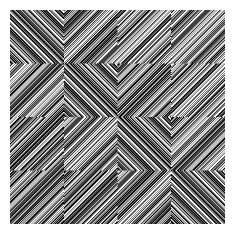
It is conjectured that  exists for all
  divisible by 4. Sawade (1985) constructed
  . Brouwer et al. (1989, p. 20) and van Lint
and Wilson (1993) reported constructions for all
. Brouwer et al. (1989, p. 20) and van Lint
and Wilson (1993) reported constructions for all  divisible by 4 up to
  . Kharaghani and Tayfeh-Rezaie (2005) subsequently constructed
 , illustrated above, leaving 668
as the smallest unknown order. However, the proof of the general conjecture
remains an important problem in coding theory.
, illustrated above, leaving 668
as the smallest unknown order. However, the proof of the general conjecture
remains an important problem in coding theory.
Epoch AI (2026) reported that L. Alpöge, P. Voinov, and S. Reynolds-Haertle had announced constructions obtained with Claude for the twelve previously unresolved orders below 2000: 668, 716, 892, 1132, 1244, 1388, 1436, 1676, 1772, 1916, 1948, and 1964. Thus constructions are now available for every positive order below 2000 divisible by 4. This finite set of constructions does not resolve the general conjecture.
The number of distinct Hadamard matrices of orders  for
for  , 2, ... are 1, 1, 1, 5, 3, 60, 487, ... (OEIS A007299;
Wolfram 2002, p. 1073).
Djoković (2009) corrected the list in Colbourn and Dinitz (2007) and found four
previously unknown orders divisible by 4 for which it is possible to construct a
Hadamard matrix: 764, 23068, 28324, 32996.
, 2, ... are 1, 1, 1, 5, 3, 60, 487, ... (OEIS A007299;
Wolfram 2002, p. 1073).
Djoković (2009) corrected the list in Colbourn and Dinitz (2007) and found four
previously unknown orders divisible by 4 for which it is possible to construct a
Hadamard matrix: 764, 23068, 28324, 32996.

 Kitis, L. "Paley's Construction of Hadamard Matrices."