The WordPress coreCoreCore is the set of software required to run WordPress. The Core Development Team builds WordPress. development team builds WordPress! Follow this site for general updates, status reports, and the occasional code debate. There’s lots of ways to contribute:
Found a bugbugA bug is an error or unexpected result. Performance improvements, code optimization, and are considered enhancements, not defects. After feature freeze, only bugs are dealt with, with regressions (adverse changes from the previous version) being the highest priority.?Create a ticket in the bug tracker.
This post summarizes the feedback received from the WordPress 7.1 retrospective. Thank you to those who contributed their feedback via the retrospective survey and comments on the post!
For ease of reading, feedback has been synthesized. Full feedback is available for review in the anonymized form responses and comments to the original post.
Please remember that the following feedback are suggestions to bear in mind for future releases rather than action items for implementation.
What would you keep?
The usual release parties and weekly check-in rituals.
Good communication throughout the release cycle, including security updates.
Security auditing, including handling all known high-risk HackerOne issues before deployDeployLaunching code from a local development environment to the production web server, so that it's available to visitors..
Task lists for every role.
What would you add?
A kick-off call for the release squad, which helped the group work together and could be continued when time zones allow.
More emphasis on user documentation and on completing it on time.
Earlier visibility into user-facing blockBlockBlock is the abstract term used to describe units of markup that, composed together, form the content or layout of a webpage using the WordPress editor. The idea combines concepts of what in the past may have achieved with shortcodes, custom HTML, and embed discovery into a single consistent API and user experience. editor UIUIUser interface changes. Some changes, such as the Elements panel and the GIF video block variation, were mainly documented in dev notesdev noteEach important change in WordPress Core is documented in a developers note, (usually called dev note). Good dev notes generally include a description of the change, the decision that led to this change, and a description of how developers are supposed to work with that change. Dev notes are published on Make/Core blog during the beta phase of WordPress release cycle. Publishing dev notes is particularly important when plugin/theme authors and WordPress developers need to be aware of those changes.In general, all dev notes are compiled into a Field Guide at the beginning of the release candidate phase. or GitHubGitHubGitHub is a website that offers online implementation of git repositories that can easily be shared, copied and modified by other developers. Public repositories are free to host, private repositories require a paid subscription. GitHub introduced the concept of the ‘pull request’ where code changes done in branches by contributors can be reviewed and discussed before being merged by the repository owner. https://github.com/ PRs, which made it harder for documentation contributors and for people supporting site editors to prepare.
Developers marking their tickets for dev notes or the field guideField guideThe field guide is a type of blogpost published on Make/Core during the release candidate phase of the WordPress release cycle. The field guide generally lists all the dev notes published during the beta cycle. This guide is linked in the about page of the corresponding version of WordPress, in the release post and in the HelpHub version page. where appropriate, and writing their own dev notes.
Wider testing, for example by inviting hosts to test in their own environments and providing them with AI prompts to use on their setups.
What would you change, reduce, or remove?
Launching live at an event. One respondent felt it was not worth the added stress, and other members of the release squad agreed. If a release is tied to an event again, it helps when everyone involved follows the agreed schedule and arrangements during the event.
Better time zone overlap among release squad members where possible.
A request to bring back the official Docs role. Documentation work during a release is substantial, and only a few contributors currently have the experience to cover it.
More Learn content related to the release.
What else would you like to express about any part of the release cycle or release squad?
More contributors who can follow many parts of the project at once would help. This gap was noticeable in several places during the cycle.
More awareness of concerns in the pluginPluginA plugin is a piece of software containing a group of functions that can be added to a WordPress website. They can extend functionality or add new features to your WordPress websites. WordPress plugins are written in the PHP programming language and integrate seamlessly with WordPress. These can be free in the WordPress.org Plugin Directory https://wordpress.org/plugins/ or can be cost-based plugin from a third-party. and theme ecosystem.
More automation, given how often the release process has been carried out.
The release squad communicated thoughtfully and was open to feedback, and respondents thanked the squad for their work.
Did you have an official role on the release squad during the 7.1 release?
This section describes if the survey participants are part of release squad or observer.
Did you contribute to the 7.1 release?
This section describes if the participants actually contributed to 7.1 release or not.
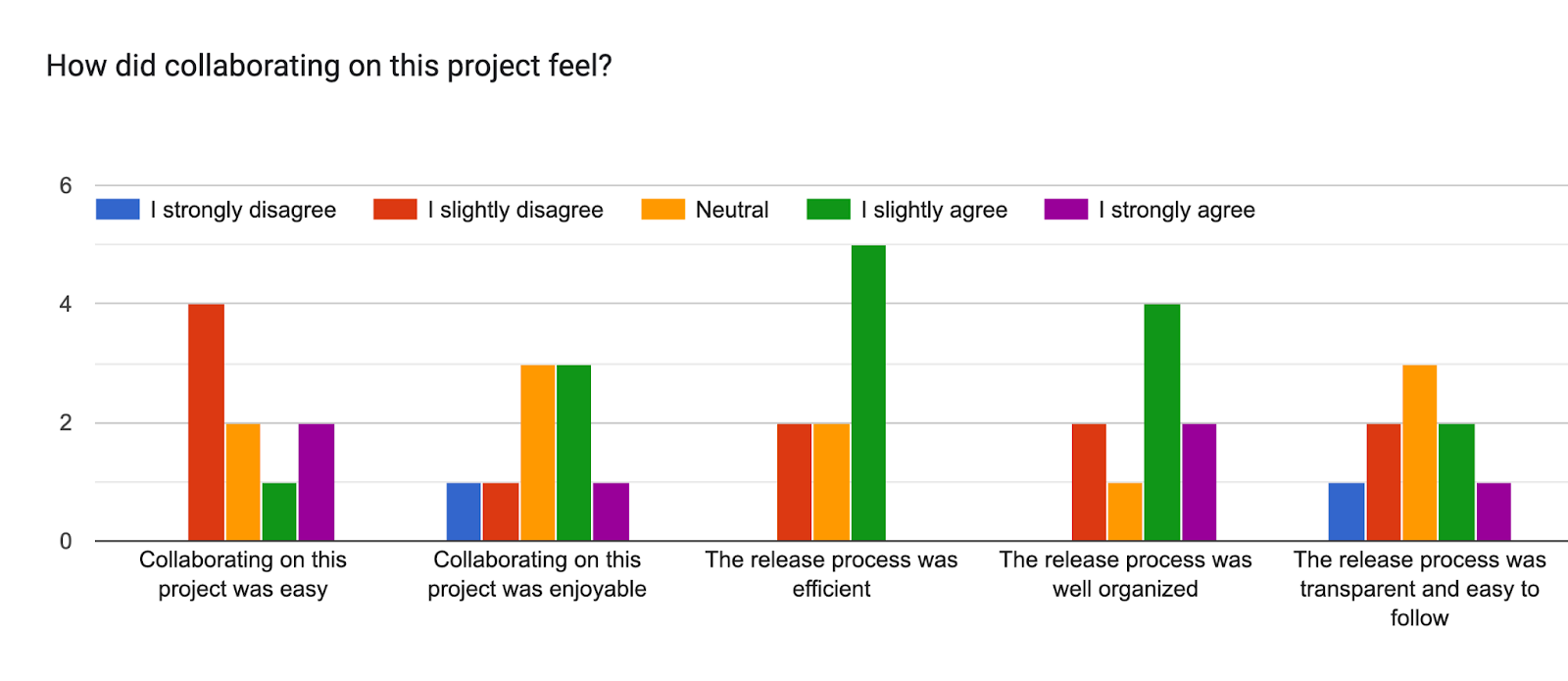
How did collaborating on this project feel?
This section included ways for one to indicate how much they agreed or disagreed with a statement around collaboration.
Would you like to be part of future release squads?
25%: I have been part of a release squad and I will gladly repeat.
50%: I haven’t been part of a squad but I would like to try in the future.
25%: I have been part of a release squad but will not repeat in the near future.
0%: I haven’t been part of a release squad and currently have no interest in it.
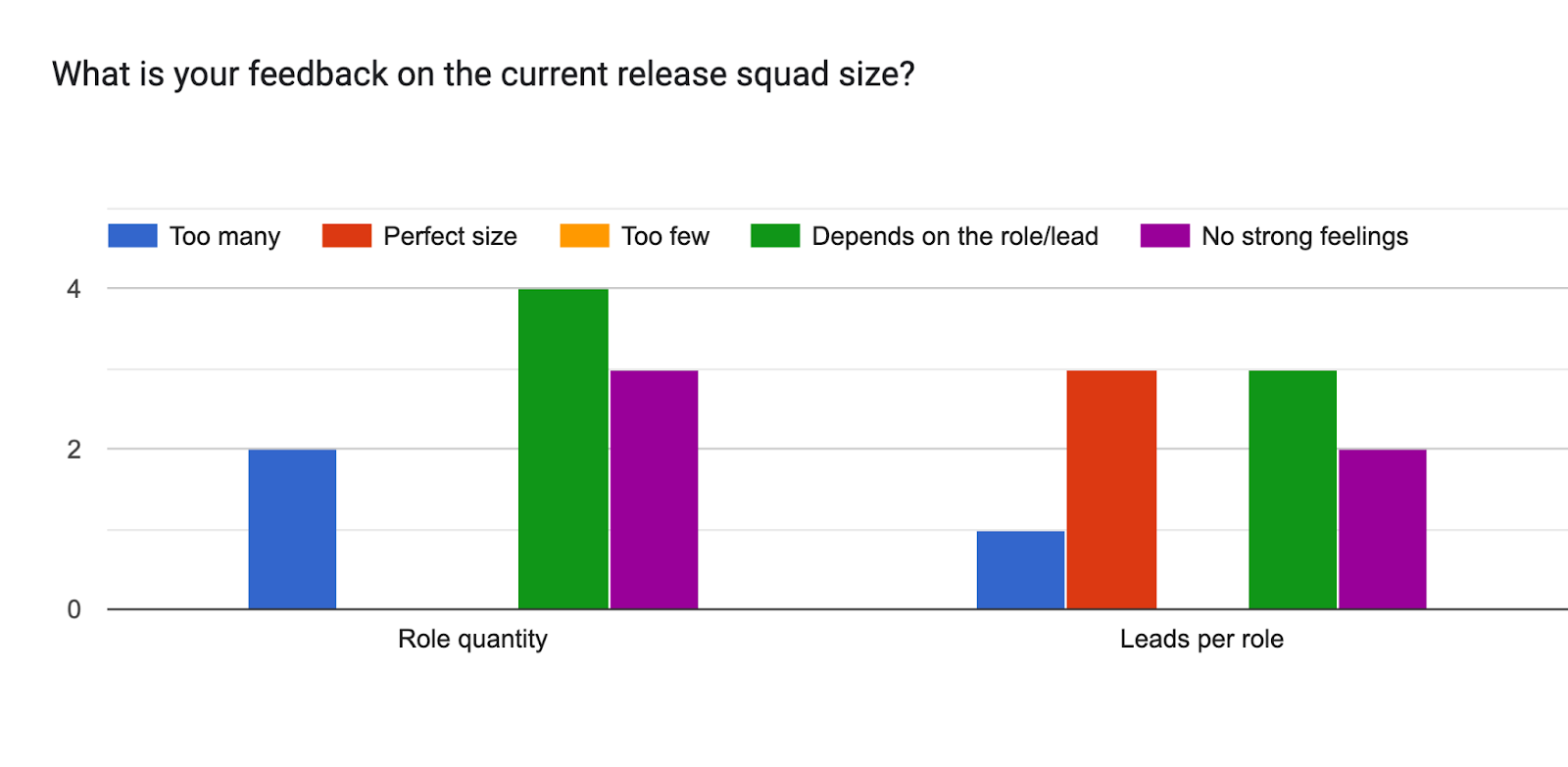
What is your feedback on the current release squad size?
Takeaways and next steps
Consider the impact before tying a release to a live event, and agree early on a schedule that everyone involved can follow.
Continue holding a kick-off call for the release squad, and consider time zone overlap when assembling the squad.
Find ways to share user-facing editor UI changes earlier with documentation and support contributors.
Encourage developers to mark tickets for dev notes or the field guide and to write their own dev notes.
Investigate which parts of the release process could be automated.
Find new ways to encourage wider testing during the betaBetaA pre-release of software that is given out to a large group of users to trial under real conditions. Beta versions have gone through alpha testing in-house and are generally fairly close in look, feel and function to the final product; however, design changes often occur as part of the process. and RCrelease candidateOne of the final stages in the version release cycle, this version signals the potential to be a final release to the public. Also see alpha (beta). period, for example together with hosts.
Make it clearer which contributors can follow many parts of the project and are available to help with specific areas.
Look at ways to connect more Learn content to each release.
Find ways to raise awareness of concerns from the plugin and theme ecosystem during the cycle.
This post summarizes the feedback received from the WordPress 6.9 retrospective. Thank you to those who contributed their feedback via the retrospective survey and comments on the post!
For ease of reading, feedback has been synthesized. Full feedback is available for review in the anonymized form responses and comments to the original post.
Please remember that the following feedback are suggestions to bear in mind for future releases rather than action items for implementation.
What would you keep?
Having two triagetriageThe act of evaluating and sorting bug reports, in order to decide priority, severity, and other factors. leads in different parts of the globe seemed to work well getting more contributors involved.
Clearer test instructions.
Long-term planning, regular check-ins, commit freeze, and a consistent cadence made the release feel stable and well-managed.
What would you add?
More automation for defined, common steps within the release cycle could help reduce stress.
Better documentation for the tasks required by the different release leads.
More community suggestions into CoreCoreCore is the set of software required to run WordPress. The Core Development Team builds WordPress..
Earlier on boarding for release squad members.
What would you change, reduce, or remove?
Release Candidates should be tested more extensively.
Points of contact and ownership should be more clear, especially for new contributors.
Reduce manual work by increasing automation where possible.
What else would you like to express about any part of the release cycle or release squad?
The 6.9 release was well coordinated despite its size and complexity, reflecting significant effort from contributors and release leads.
There is a need for better communication with teams indirectly involved with the release, especially Documentation.
Releasing during a major event (SOTW in this case) was exciting but can limit who is able to take part due to various logistical factors (travel funds, VISAs, time differences, etc). Also requires planning further in advance.
The release squad was highly collaborative. Leads were trusted to complete the work required of their role.
Lots of contributors and committers were around and made themselves available to answer any questions the squad members had.
Tracking and guiding all release-related activity across TracTracAn open source project by Edgewall Software that serves as a bug tracker and project management tool for WordPress. and GitHubGitHubGitHub is a website that offers online implementation of git repositories that can easily be shared, copied and modified by other developers. Public repositories are free to host, private repositories require a paid subscription. GitHub introduced the concept of the ‘pull request’ where code changes done in branches by contributors can be reviewed and discussed before being merged by the repository owner. https://github.com/ is a huge undertaking due to the volume of activity. This can place a lot of strain on the team.
Did you have an official role on the release squad during the 6.9 release?
This section describes if the survey participants are part of release squad or observer.
Did you contribute to the 6.9 release?
This section describes if the participants actually contributed to 6.9 release or not.
How did collaborating on this project feel?
This section included ways for one to indicate how much they agreed or disagreed with a statement around collaboration.
Would you like to be part of future release squads?
17.6%: I haven’t been part of a release squad and currently have no interest in it.
11.8%: I haven’t been part of a squad but I would like to try in the future.
5.9%: I have been part of a release squad but will not repeat in the near future.
67.4%: I have been part of a release squad and I will gladly repeat
What is your feedback on the current release squad size?
Takeaways and next steps
Find ways to assemble and onboard a squad for the next release earlier.
Review the Core Handbook for missing documentation.
Figure out how to make responsibilities for release-related tasks more clear.
Investigate how parts of the release process could possibly be automated.
Find new ways to encourage wider testing during the betaBetaA pre-release of software that is given out to a large group of users to trial under real conditions. Beta versions have gone through alpha testing in-house and are generally fairly close in look, feel and function to the final product; however, design changes often occur as part of the process./RCrelease candidateOne of the final stages in the version release cycle, this version signals the potential to be a final release to the public. Also see alpha (beta). period.
Make it more clear which contributors are knowledgeable and available to help for specific tasks or areas of the project.
Pairing up an experienced and inexperienced contributor in each role is a good way to “level up” those who are looking to participate in a release squad for the first time.
Props to @akshayar & @desrosj for compiling responses, authoring, and @jeffpaul, @jorbin for reviewing this post.
Congratulations to all who helped make WordPress 6.9 possible!
Now that the release cycle is complete, you’re invited to reflect and share your thoughts on the release cycle, release processes, release squad, or whatever else is on your mind. Feedback loops are critical to learning what works and what doesn’t so that the teams involved can iterate on the processes to improve for future releases.
Everyone is welcome to submit feedback about the release using this form, even contributors who did not contribute directly to the release itself.
A member of the community that casually observes a release cycle will have very different thoughts and opinions than someone who was heavily involved on a weekly or daily basis. The more viewpoints and backgrounds represented within this feedback loopLoopThe Loop is PHP code used by WordPress to display posts. Using The Loop, WordPress processes each post to be displayed on the current page, and formats it according to how it matches specified criteria within The Loop tags. Any HTML or PHP code in the Loop will be processed on each post. https://codex.wordpress.org/The_Loop the better. So please take a moment to complete the form or leave public feedback in the comments below.
Please note: the survey is not anonymous, but anything submitted will be anonymized before being shared in a post summarizing the results. Your wordpress.orgWordPress.orgThe community site where WordPress code is created and shared by the users. This is where you can download the source code for WordPress core, plugins and themes as well as the central location for community conversations and organization. https://wordpress.org/ username is required just case the person processing the responses needs to reach out to you for further clarification.
The form and comments will be open until January 15, 2026. A follow-up post with the collected, anonymized results will be published shortly after.
Again, thank you for your contributions to 6.9 “Gene,” and for taking the time to provide valuable feedback to help make future releases even better!
Props to @amykamala, @desrosj for the peer review.
[Editor’s note: This survey was only answered by 3 people, only 2 of which were on the release squad. It’s useful as seeing three people’s distinct opinion, but not extrapolation.]
This post summarizes the feedback received from the WordPress 6.7 retrospective. Thank you to those who contributed their feedback via the retrospective survey and comments on the post. For ease of reading, feedback has been synthesized. Full feedback is available for review in the anonymized form responses and comments to the original post.
Please remember that the following feedback are suggestions to bear in mind for future releases rather than action items for implementation.
What would you keep?
Aligning Dev Chats to the time where Tech Release leads could attend was useful and should be considered in the future.
Release process.
What would you add?
Future release leads should be announced earlier—prior to the end of the previous release.
More robust testing around new features in conjunction with plugins.
What would you change, reduce, or remove?
The squad was announced too late.
The climate of contributing.
How did the collaboration feel?
This section included ways for one to indicate how much they agreed or disagreed with a statement around collaboration.
Would you like to be part of future release squads?
What is your feedback on the current release squad size?
Takeaways and next steps
One lead felt they and their co-leads were not appropriately respected by a sponsored non-lead and indicated their intent to not volunteer for another lead role without assurances that lead roles are to be respect by non-leads.
Another contributor indicated a general sense that release testing throughout the cycle was less that usual.
Congratulations to all who helped make WordPress 6.7! Now that it has launched, you’re invited to reflect and share your thoughts on the release process and squad to learn, iterate, and improve for future releases.
Whether you led, contributed, tested, followed along—whatever your role, even if you didn’t have one—you are welcome to participate in this retrospective. So please take a moment to complete the form or leave public feedback in the comments below.
Please note: the survey is not anonymous. That’s in case a relevant person wants to reach you for further clarification. But your email address will not be shared publicly, and nobody is going to use it for any other purpose.
The form and comments will be open until January 13, 2025. Shortly thereafter, you’ll see a follow-up post with collected, anonymized results.
Again, thank you for your contributions to 6.7 “Rollins,” and for taking the time to help make future releases even better!
This post summarizes the feedback received from the WordPress 6.5 retrospective. Thank you to those who contributed their feedback via the retrospective survey and comments on the post. For ease of reading, feedback has been synthesized. Full feedback is available for review in the anonymized form responses and comments to the original post.
Please remember that the following feedback are suggestions to bear in mind for future releases rather than action items for implementation.
What would you keep?
More than one Editor tech lead
24-hour Comitter freeze before the release party
Run the release party by release coordinators
What would you add?
A lead dev, specifically identified for each feature project. More lead dev or coreCoreCore is the set of software required to run WordPress. The Core Development Team builds WordPress.committercommitterA developer with commit access. WordPress has five lead developers and four permanent core developers with commit access. Additionally, the project usually has a few guest or component committers - a developer receiving commit access, generally for a single release cycle (sometimes renewed) and/or for a specific component. feedback for feature projects
Transparency of “leadership” decisions.
Increase in our release cadence. Docs lead & design team collaboration increase for Dev notedev noteEach important change in WordPress Core is documented in a developers note, (usually called dev note). Good dev notes generally include a description of the change, the decision that led to this change, and a description of how developers are supposed to work with that change. Dev notes are published on Make/Core blog during the beta phase of WordPress release cycle. Publishing dev notes is particularly important when plugin/theme authors and WordPress developers need to be aware of those changes.In general, all dev notes are compiled into a Field Guide at the beginning of the release candidate phase. & Field GuideField guideThe field guide is a type of blogpost published on Make/Core during the release candidate phase of the WordPress release cycle. The field guide generally lists all the dev notes published during the beta cycle. This guide is linked in the about page of the corresponding version of WordPress, in the release post and in the HelpHub version page.. A field guide can be made simpler as GutenbergGutenbergThe Gutenberg project is the new Editor Interface for WordPress. The editor improves the process and experience of creating new content, making writing rich content much simpler. It uses ‘blocks’ to add richness rather than shortcodes, custom HTML etc.
https://wordpress.org/gutenberg/ releases updates posts.
Form the upcoming release squad early. Provide heads-up to selected squad members before x.y Release squad post gets published. Also, Allow them to set the Roadmap.
Improve Gutenberg feature merges into Core. If a feature satisfies the MVPMinimum Viable Product"A minimum viable product (MVP) is a product with just enough features to satisfy early customers, and to provide feedback for future product development." - WikiPedia, include it; half-baked features should wait until they, too, work at the MVP level.
Automate some parts of the Release process to avoid errors & reduce release party time.
What would you change, reduce, or remove?
Sync GB packages more often. Make Gutenberg follow the same rules as TracTracAn open source project by Edgewall Software that serves as a bug tracker and project management tool for WordPress. for commit.
Document Release LeadRelease LeadThe community member ultimately responsible for the Release. role rights. The person should:
Give the squad a clear vision/structure.
Be the final arbiter of what gets included or punted from a release.
In the absence of a release lead, clearly delegate that responsibility to other roles.
Include the Theme Wrangler role in the Squad if major changes will come to themes (and not otherwise).
Publish major feature architecture early, to accommodate changes easily.
Improve the release-process documentation to include communication with other teams. For example:
Notify Theme Wrangler to work on changes that impact Default themes.
Collaborate with Themes and Plugins teams to keep extenders aware of breaking changes and other docs they need to prepare for the release. At the moment, this consists mostly of an email to pluginPluginA plugin is a piece of software containing a group of functions that can be added to a WordPress website. They can extend functionality or add new features to your WordPress websites. WordPress plugins are written in the PHP programming language and integrate seamlessly with WordPress. These can be free in the WordPress.org Plugin Directory https://wordpress.org/plugins/ or can be cost-based plugin from a third-party. developers and, lately, one to theme authors,
We need to be better at sticking to feature deadlines for releases. Update Project philosophies to include exception criteria for Release delay.
The “Source of Truth” post that Anne publishes for each release is super helpful. If we can make it a process to publish this on make/core, it will save a lot of duplicated effort. It will also give the Marketing/Media Relations, Docs and Training better information and more time to get the wider ecosystem prepared for new features.
How did the collaboration feel?
This section included ways for one to indicate how much they agreed or disagreed with a statement around collaboration.
Would you like to be part of future release squads?
11.1%: I haven’t been part of the squad but I would like to try in the future.
66.7%: I have been part of a release squad and I will gladly repeat.
0%: I have been part of the release squad but will not repeat in the near future
0%: I haven’t been part of the squad but I would like to try in the future
11.1%: Day job doesn’t allow for the consistent time.
11.1%: I have been part of a release squad and I will repeat, However perhaps in some time.
What is your feedback on the current release squad size?
Takeaways and next steps
Several very long-term contributors mentioned that the current process for adding new editor features diverges significantly from traditional processes, and they found it hard to influence direction before those features incurred predictable consequences.
The fixes they propose echo those of other respondents:
More frequent syncing of the editor package to the wordpress-dev repo
More posts on Make that highlight important discussions on the Gutenberg repo
Contributors across the board would like to see more communication with extenders about new features and breaking changes.
Contributors value the Source of Truth documentation that comes from Anne McCarthy and have come to rely on it.
That said, they would like information about new features even more often, earlier, and in more media.
Contributors would also like more information on the roles of release leads (not just coordinators) and what decisions the lead makes versus what decisions are the purview of the tech leads.
Finally, respondents would like to see updates in the Handbook that specify what issues can legitimately delay a release and that a squad will follow the principle that deadlines are not arbitrary the rest of the time.
Congratulations to all who helped make WordPress 6.5! Now that it has launched, I invite you to reflect and share your thoughts on the release process and squad to learn, iterate, and improve for future releases.
Whether you led, contributed, tested, followed along—whatever your role, even if you didn’t have one—you are welcome to participate in this retrospective. So please take a moment to complete the form or leave public feedback in the comments below.
Please note: the survey is not anonymous. That’s in case a relevant person wants to reach you for further clarification. But your email address will not be shared publicly, and nobody is going to use it for any other purpose.
The form and comments will be open until April 26th, 2024. Shortly thereafter, you’ll see a follow-up post with collected, anonymized results.
Again, thank you for your contributions to 6.5 “Regina,” and for taking the time to help make future releases even better!
This post summarizes the feedback received from the WordPress 6.4 retrospective. Thank you to those who contributed their feedback via the retrospective survey and comments on the post. For ease of reading, feedback has been synthesized. Full feedback is available for review in the anonymized form responses and comments to the original post.
Please remember that the following feedback are suggestions to bear in mind for future releases rather than action items for implementation.
What would you keep?
The Community needs/“wishlist.”
Blogblog(versus network, site) post per new feature or major change, e.g., performance improvements or the HTMLHTMLHyperText Markup Language. The semantic scripting language primarily used for outputting content in web browsers. Tag processor.
Release team formation and announcement during the previous release cycle for easy coordination.
Having a co-lead per release focus to allow for complimentary time-zone coverage.
Weekly health checks.
What would you add?
Additional minor releases between majors.
Iteration on Twenty Twenty-Four for Twenty Twenty-Five to reduce fragmentation.
Earlier merging of stable GutenbergGutenbergThe Gutenberg project is the new Editor Interface for WordPress. The editor improves the process and experience of creating new content, making writing rich content much simpler. It uses ‘blocks’ to add richness rather than shortcodes, custom HTML etc.
https://wordpress.org/gutenberg/ features into WordPress trunktrunkA directory in Subversion containing the latest development code in preparation for the next major release cycle. If you are running "trunk", then you are on the latest revision..
Equal focus on old tickets and bugbugA bug is an error or unexpected result. Performance improvements, code optimization, and are considered enhancements, not defects. After feature freeze, only bugs are dealt with, with regressions (adverse changes from the previous version) being the highest priority. fixes with new features.
Feature the Pattern Directory in the BlockBlockBlock is the abstract term used to describe units of markup that, composed together, form the content or layout of a webpage using the WordPress editor. The idea combines concepts of what in the past may have achieved with shortcodes, custom HTML, and embed discovery into a single consistent API and user experience. Editor.
A dedicated session in CoreCoreCore is the set of software required to run WordPress. The Core Development Team builds WordPress. for testing the release.
A focus on cohort involvement for sustained contribution beyond a major releasemajor releaseA release, identified by the first two numbers (3.6), which is the focus of a full release cycle and feature development. WordPress uses decimaling count for major release versions, so 2.8, 2.9, 3.0, and 3.1 are sequential and comparable in scope.’s development cycle.
More underrepresented release squads and opportunities for synchronous meetings in different time zones.
What would you remove?
Underrepresented release squads.
Minimum Core code contribution for Editor Tech role.
Increased documentation and training for new contributors to the release process.
Allow only “blessed tasks,” with enhancements/features that have received a first commit before BetaBetaA pre-release of software that is given out to a large group of users to trial under real conditions. Beta versions have gone through alpha testing in-house and are generally fairly close in look, feel and function to the final product; however, design changes often occur as part of the process. 1 to continue to Beta 2 et al.
How did the collaboration feel?
This section included ways for one to indicate how much they agreed or disagreed with a statement around collaboration.
Would you like to be part of future release squads?
16.7%: I haven’t been part of the squad but I would like to try in the future.
8.3%: I have been part of a release squad and I will gladly repeat.
41.5%: I have been part of a release squad before and will do so again, although maybe not next year.
8.3%: I am reluctant to participate again, but I would be open to it if responsibilities and processes were clearer.
8.3%: Maybe later, I’m not sufficiently experienced yet.
8.3%: I have been part of a release squad and would like to repeat, but unfortunately I don’t have the time for near/midterm future.
Takeaways and next steps
Respondents felt that following the development cycle as a new contributor was challenging.
Future WordPress Contributor Mentorship programs will mirror major releases so new contributors have mentored experience with ample documentation and support to find contribution onboarding opportunities.
The shorter development cycle, while previously requested, felt too short for ample feature development and testing.
6.4 was, for all intents and purposes, a success in bringing underrepresented gender voices, skill sets, and points of view into WordPress’s development cycle. 2024 will not include specific release squads to allow for more broad contributor involvement.
Maintenance will be one focus alongside new features for the WordPress 6.6 release in response to a call for more maintenance in major releases.
Congratulations to all who helped make WordPress 6.4 available! Now that it has been successfully released, I invite all who contributed to reflect and share our thoughts on the release process to learn, iterate, and improve for future releases.
Anyone is welcome to participate in this retrospective, so please take a few moments to complete the form or leave public feedback in the comments below. The survey is not anonymous, allowing for outreach should further clarification be needed; please note that your email address will not be shared or used for any other purpose.
The form and comments will be open until November 30th, 2023, with anonymized results available in a follow-up post in December 2023.
Again, thank you for your contributions to 6.4 “Shirley,” and for taking the time to help make future releases even better!
With WordPress 6.2 released and available to the world, it would be very helpful to this and future release squads if all those who contributed could take the time to reflect and share thoughts on the release process to learn, iterate, and make future releases smoother. ✨
Anyone is welcome to participate in this retro, so please take a few moments to complete the form or leave public feedback in the comments below. The survey is not anonymous, allowing for outreach should further clarification be needed; please note that your email address will not be shared or used for any other purpose.
The form and comments will be open until April 30th, 2023, with anonymized results available in a follow-up post in May 2023.
Thank you, everyone, for your contribution to this release, and thanks in advance for taking the time to help make future releases even better!
Props to @cbringmann, @chanthaboune for the peer review




You must be logged in to post a comment.