


Abstract
When the first asteroid in an Earth-like orbit, 1991 VG, was found in 1991 December by the Spacewatch Project, it was argued that it was a candidate interstellar space probe, but it is now thought to be natural. Over three decades later, the number of known asteroids in Earth-like orbits exceeds 100, forming the so-called Arjuna secondary asteroid belt, the closest to Earth. Out of the Arjunas and not counting those which can be temporarily captured as mini-moons of Earth, quasi-satellites are our closest companions. Here we show that 2025 PN7 is a quasi-satellite, alongside known objects Cardea, Kamo‘oalewa, 277810, 2013 LX28, 2014 OL339, 2023 FW13. They are all engaged in a 1:1 mean-motion resonance with our planet, but they are not gravitationally bound to it.

Original content from this work may be used under the terms of the Creative Commons Attribution 4.0 licence. Any further distribution of this work must maintain attribution to the author(s) and the title of the work, journal citation and DOI.
1. Introduction
Finding a new class of objects always prompts diverse and sometimes speculative hypotheses that may or may not be confirmed later on when more data become available. The discovery of the first asteroid in an Earth-like orbit, 1991 VG, in 1991 December by the Spacewatch Project was no exception. The fact that it moved close to our planet, in a similar path, was then used to argue that it was a candidate interstellar space probe (see, e.g., discussion in C. de la Fuente Marcos & R. de la Fuente Marcos 2018). Over three decades later, it is now widely accepted that such objects are natural and constitute a secondary asteroid belt that occupies the region in which the Earth–Moon system orbits around the Sun, defining the Arjuna dynamical class (see, e.g., D. L. Rabinowitz et al. 1993; C. de la Fuente Marcos & R. de la Fuente Marcos 2013). The Arjunas with the most Earth-like orbits can experience temporary captures as mini-moons of our planet (see, e.g., T. Kwiatkowski et al. 2009; C. de la Fuente Marcos & R. de la Fuente Marcos 2020; G. Fedorets et al. 2020; R. de la Fuente Marcos et al. 2023). The quasi-satellites are objects which are capable of longer engagements with Earth, trapped in a 1:1 mean-motion resonance as their mean longitudes relative to Earth, λr = λ − λ⊕ oscillate around the value 0°—where λ and λ⊕ are the mean longitudes of the object and Earth, respectively, λ = M + Ω + ω, where M is the mean anomaly, Ω is the longitude of the ascending node, and ω is the argument of perihelion (see, e.g., C. D. Murray & S. F. Dermott 1999). Quasi-satellites are in a resonant orbit but are not gravitationally bound to Earth, allowing for more sustained, though unbound, proximity; while mini-moons are characterized by temporary gravitational captures by Earth, meaning they are gravitationally bound, albeit for a limited time. The list of known current quasi-satellites of Earth includes 164207 Cardea (2004 GU9), 469219 Kamo‘oalewa (2016 HO3), 277810 (2006 FV35), 2013 LX28, 2014 OL339, and 2023 FW13 (see, e.g., T. Wiegert et al. 2005; P. Wajer 2010; M. Connors 2014; C. de la Fuente Marcos & R. de la Fuente Marcos 2014, 2016; S. Hu et al. 2023). Here, we present the newest member of this class, 2025 PN7.
2. Data and Tools
Apollo asteroid 2025 PN7 was discovered on 2025 August 2 by Pan-STARRS 1, Haleakala.3
It has H = 26.4 ± 0.3 mag and, as of 2025 August 31, its heliocentric orbit determination (based on 27 observations spanning 4279 days) is: semimajor axis, a = 1.003019631 ± 0.000000013 au, eccentricity, e = 0.10750419 ± 0.00000014, inclination,  , longitude of the ascending node,
  , and argument of perihelion,
  . Such orbital elements are consistent with those of the Arjunas. The Arjunas are a group of near-Earth asteroids with orbits that are Earth-like that have (i) a ∈ (0.985, 1.013) au (very close to Earth’s) (ii) Low eccentricity (e < 0.1, nearly circular orbits), and (iii) Low inclination i < 8° (close to Earth’s orbital plane).
In our analysis, we use data computed by Jet Propulsion Laboratory’s (JPL) Horizons on-line solar system data and ephemeris computation service4 (J. D. Giorgini 2015). Data queries were made via the Python package Astroquery (A. Ginsburg et al. 2019). Our input data sample was retrieved from JPL’s Small-Body Database (SBDB).5 It includes 402 objects with semimajor axis a ∈ (0.985, 1.015) au and eccentricity e < 0.5 (see Figure 1, bottom panel), 207 have e < 0.2. Statistical analyses were carried out using NumPy (C. R. Harris et al. 2020) and visualized using the Matplotlib library (J. D. Hunter 2007).
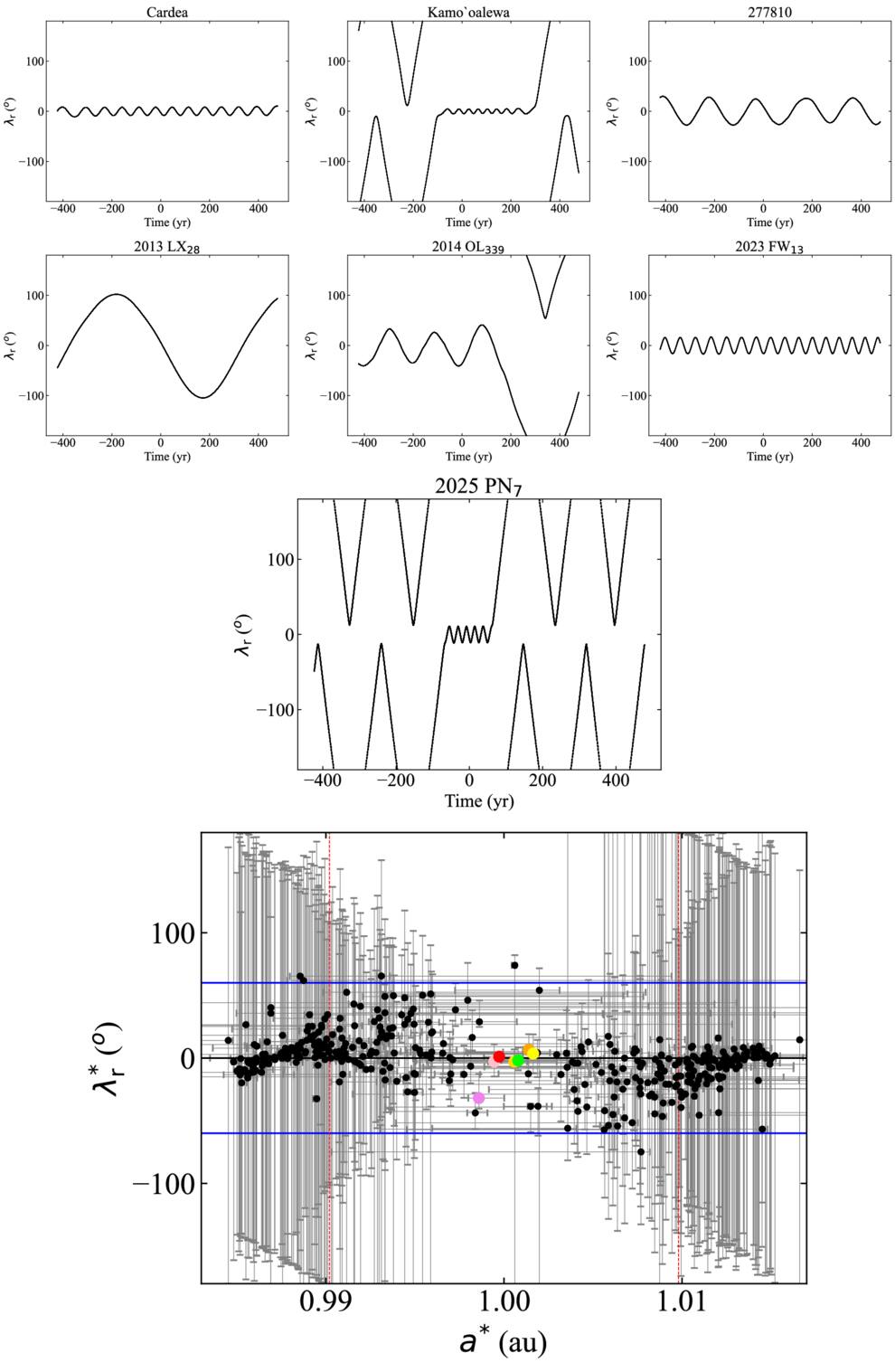
Figure 1. The top panels show the time evolution of the relative mean longitude with respect to Earth, λr, for Cardea, Kamo‘oalewa, 277810, 2013 LX28, 2014 OL339, 2023 FW13, and 2025 PN7. The origin of time is the epoch 2460800.5 JD Barycentric Dynamical Time (2025 May 05.0 00:00:00.0 TDB), which is the epoch of the orbit, and the output step is 15 days. The bottom panel maps the known quasi-satellites within the dynamic context of the Arjuna asteroid belt: Cardea (gold point), Kamo‘oalewa (red), 277810 (orange), 2013 LX28 (yellow), 2014 OL339 (violet), 2023 FW13 (pink), and 2025 PN7 (lime). The median value of λr in the year interval (2000, 2050) is displayed as  , the equivalent value for the semimajor axis is a*. Error bars correspond to the 16th and 84th percentile values of the distributions. The two red dashed vertical lines show the Hill radius, the black horizontal line shows the angle 0°and the blue ones signal ±60°. Data source: JPL’s Horizons and SBDB.
Download figure:
Standard image High-resolution image3. Arjuna Asteroid Belt
The top panels in Figure 1 show the short-term evolution of λr for the six previously known quasi-satellites of Earth and 2025 PN7, and confirm its resonant nature. Its evolution is comparable to the one of Kamo‘oalewa but its time of residence in the quasi-satellite state is shorter, 128 yr versus 381 yr. Only 2013 LX28, 2014 OL339, and 2023 FW13 are not affected by the Yarkovsky effect (W. F. Bottke et al. 2006). The bottom panel in Figure 1 shows the median value of λr in the year range 2000–2050 ( ) as a function of the equivalent value for the semimajor axis (a*). Known quasi-satellites reside inside the innermost section of the Arjuna belt, 2025 PN7 appears close to Cardea in Figure 1, bottom panel. True Arjunas have short error bars in a*.
4. Discussion and Conclusions
The available data indicate that 2025 PN7 is a relatively short-lived quasi-satellite of Earth and its short-term evolution resembles the one of Kamo‘oalewa although it is found close to Cardea in the (a*,  ) diagram.