Hungry Hippo: ‘World-first’ rocket fairing passes tests ahead of reusable Neutron launch
The fairing can open and close in just 1.5 seconds under flight-like conditions.

A US aerospace manufacturer and launch provider has successfully finished final qualification testing of the “Hungry Hippo” fairing, which will sit atop its partially reusable Neutron launch vehicle.
California-based Rocket Lab recently announced that the captive fairing system has completed an intensive qualification campaign and is now en route to Rocket Lab’s Launch Complex 3 at the Mid-Atlantic Regional Spaceport in Virginia.
There, it is expected to be integrated with Neutron’s first stage. According to the firm, the partially reusable, medium-lift two-stage launch vehicle is scheduled to make its debut flight in 2026 following pre-launch testing.
“Dubbed the Hungry Hippo, Neutron’s fairing halves remain attached to the rocket’s first stage throughout launch and landing back to Earth – a world-first for a reusable commercial rocket,” the company noted.
Neutron fairing qualified
Compared to traditional rocket fairings, which are jettisoned during ascent and either discarded or recovered separately, the new fairing remains attached to the launch vehicle throughout the entire mission – the launch, payload deployment and return to Earth.
Rocket Lab revealed that the system opens in flight to release the rocket’s second stage and payload. It then closes again so the entire first stage can be recovered as a single, fully reusable unit.
It design supports rapid reuse and helps reduce launch costs for commercial, civil and national security missions. The qualification marked an important point in the development of the reusable Neutron rocket, which is the world’s largest carbon-composite launch vehicle.
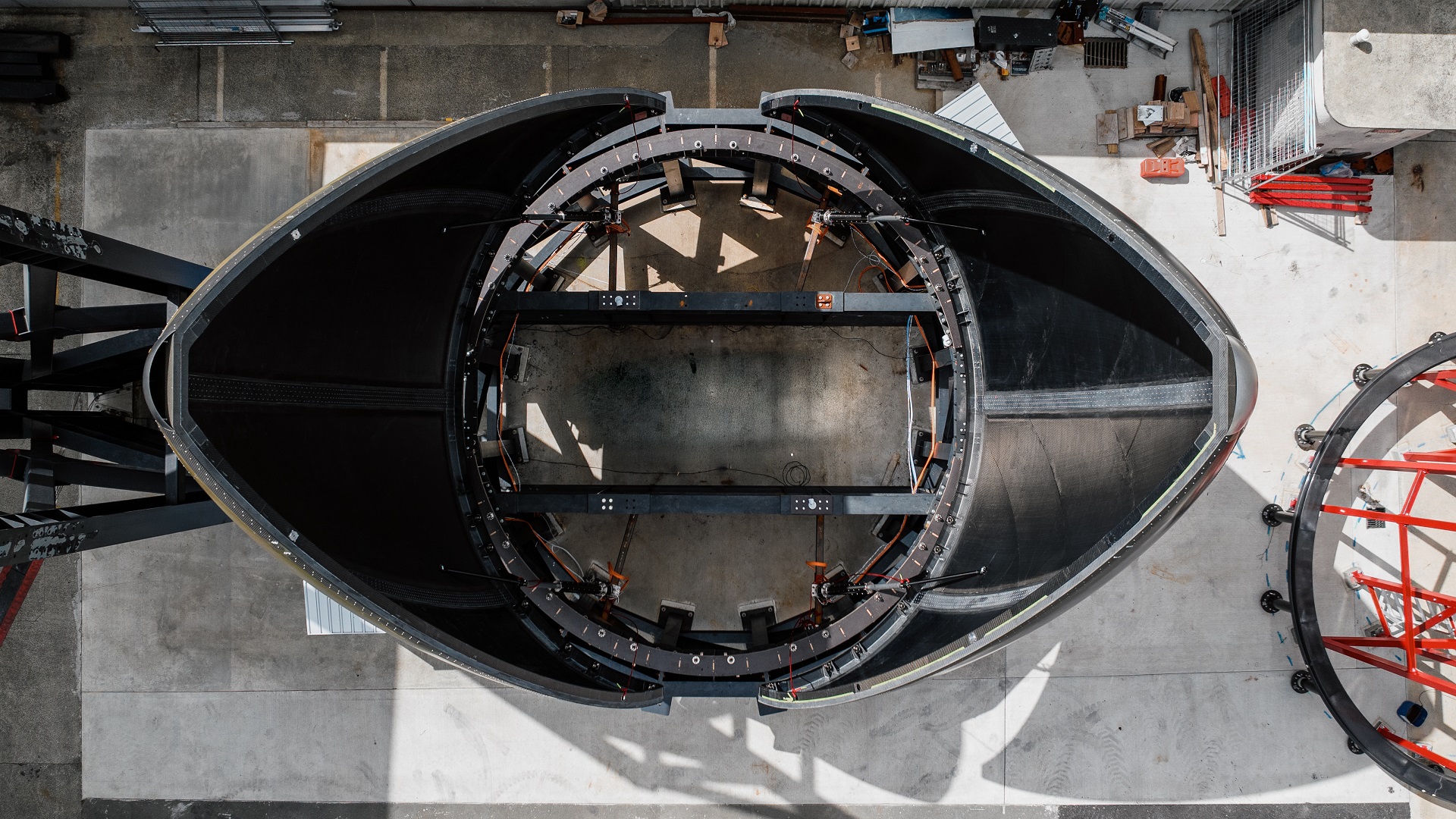
Credit: Rocket Lab
The rocket can carry up to 33,000 pounds (13,000 kilograms) of payload and is positioned in the medium-lift class for constellation deployment and defense-related launches.
“A rocket like Neutron has never been built before, and we’re doing it at a pace and price point that’s going to bring the innovation and competition needed in today’s industry,” Shaun D’Mello, Rocket Lab Vice President for Neutron, said.
Reusable design
To qualify the “Hungry Hippo” fairing for flight, Rocket Lab carried out a series of full-scale and sub-component tests to replicate the most extreme conditions the structure will face. These included applying 275,000 pounds of force to simulate Max Q, the phase of flight when aerodynamic pressure peaks.
The fairing was also repeatedly opened and closed under flight-like conditions in just 1.5 seconds, which is less than half the time needed for stage separation and vehicle reorientation during descent.
Additional tests combined flight software, avionics, guidance, control systems and navigation, along with mechanical hardware, to validate real-world operation of both the fairing and Neutron’s aerodynamic control surfaces, known as canards.
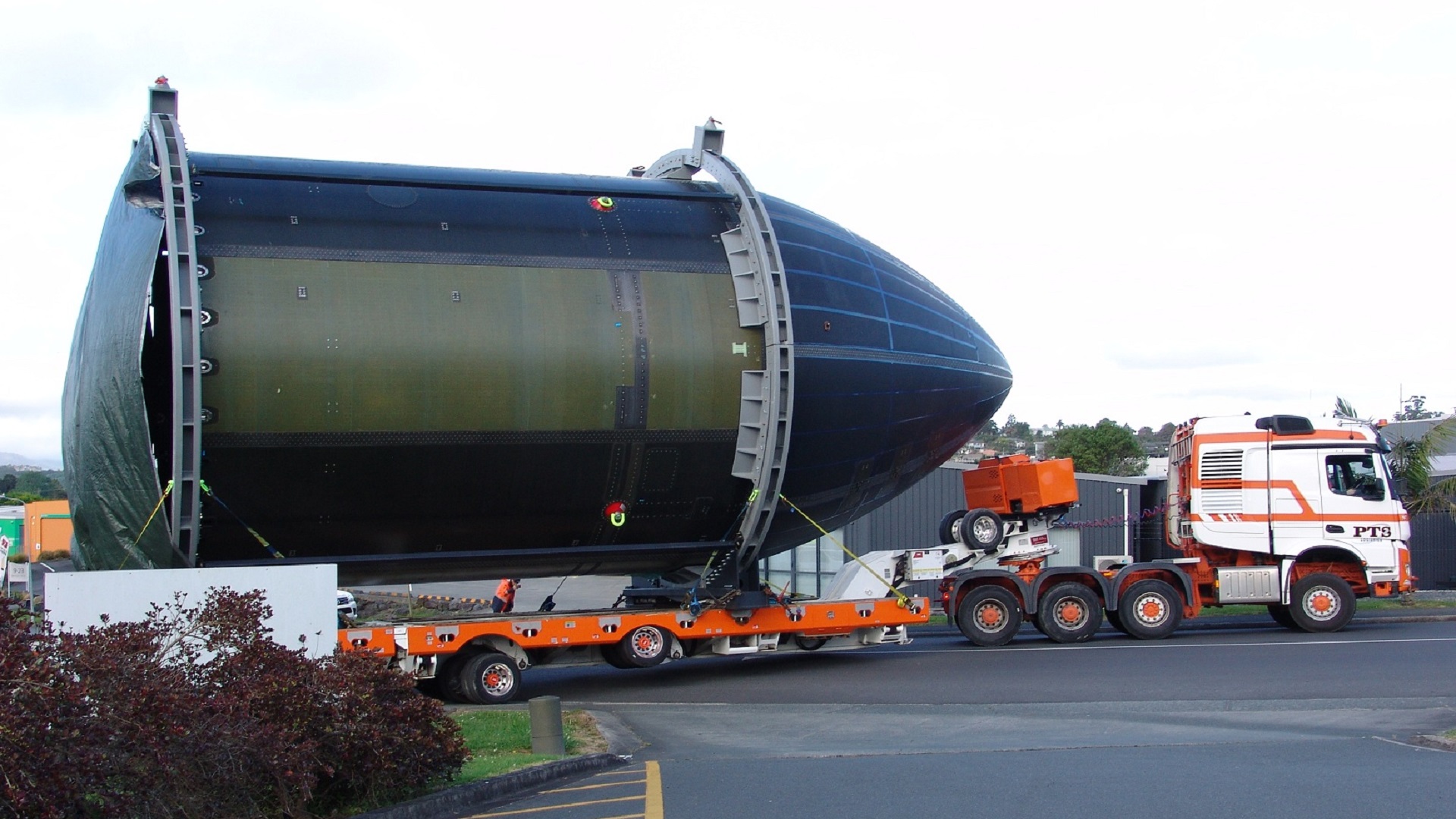
Credit: Rocket Lab
The firm further subjected the structure to combined torque and bending loads at the canard hubs, exceeding 125 per cent of the forces expected across all phases of flight.
“Building, qualifying, and shipping Hungry Hippo is a fantastic marker of progress toward Neutron’s first launch, and I’m proud of the team for their attention to detail and pulling off this significant milestone,” D’Mello stated in a press release.
Neutron is the world’s largest carbon composite launch vehicle. Its development began in 2021. The “Hungry Hippo” fairing will be integrated in the rocket’s first stage in its final flight configuration once it reaches Virginia. The vehicle will then undergo static fire tests and a wet dress rehearsal before launch.
Recommended Articles

Get the latest in engineering, tech, space & science - delivered daily to your inbox.
0COMMENT
Based in Skopje, North Macedonia. Her work has appeared in Daily Mail, Mirror, Daily Star, Yahoo, NationalWorld, Newsweek, Press Gazette and others. She covers stories on batteries, wind energy, sustainable shipping and new discoveries. When she's not chasing the next big science story, she's traveling, exploring new cultures, or enjoying good food with even better wine.
- 1Allag-E: Interceptor aircraft can hunt and kill drones flying at 124 mph like an eagle
- 2Modernized nuclear warheads ready for deployment on 18,750-ton US missile submarines
- 37 of the world’s most powerful tidal turbines generating megawatts under sea
- 4US firm unveils low-cost exoatmospheric interceptor to kill missiles mid-flight
- 5Sodium EV battery beats lithium in charging speed and temperature stability: Study