US firm plans 50,000-strong humanoid robot army for defense, industrial work
When the “first body in” isn’t human anymore, the rules of the battlefield start to shift.

San Francisco–based robotics startup Foundation is accelerating its push into military humanoid robotics, outlining plans to manufacture up to 50,000 humanoid robots by the end of 2027.
The company’s Phantom MK-1 humanoid is designed for both industrial work and battlefield deployment, positioning Foundation as one of the few robotics firms openly targeting both defense and commercial applications.
The Phantom MK-1 stands about 5 feet 9 inches tall and weighs roughly 175–180 pounds. The robot was explicitly designed for combat-adjacent roles, including reconnaissance, bomb disposal, and high-risk ground operations.
Foundation CEO Sankaet Pathak has since reinforced that intent, telling Forbes that humanoid robots should act as the “first body in” during dangerous missions, potentially carrying lethal weapons while keeping human soldiers out of immediate harm’s way.
Aggressive scaling backed by manufacturing experience
Foundation’s production timeline has grown more ambitious since our earlier coverage, which cited a target of 10,000 units by 2026. According to Forbes, Pathak now aims to deploy 40 robots this year, scale to 10,000 in 2026, and reach 50,000 humanoids by the end of 2027.
While Pathak describes the plan as aggressive, he says that there is a “non-zero chance” the company can achieve it.
The company attributes this rapid pace to early acquisitions in artificial intelligence and actuator technology, which shortened development cycles, as well as a leadership team drawn from Tesla, Boston Dynamics, SpaceX, and 1X. As noted in the Forbes interview, the Foundation’s head of manufacturing previously worked on Tesla’s Model X and Model Y ramp-ups, shaping a strategy that avoids excessive automation too early in production.
Foundation plans to lease its robots rather than sell them outright. Each humanoid could be leased for around $100,000 per year. But the near-continuous operation enables a single robot to replace multiple human shifts, potentially delivering cost savings once uptime and maintenance are factored in.
However, these projections assume productivity levels that humanoid robots have not yet consistently demonstrated in real-world deployments.
Built for the battlefield, restrained autonomy
Phantom MK-1 relies primarily on cameras rather than complex sensor arrays such as LiDAR, a deliberate design choice intended to simplify data integration and improve reliability in harsh environments. The robot is powered by proprietary cycloid actuators that provide strength, quiet operation, and backdrivability, enabling safer interaction around humans despite its combat-oriented role.
Pathak has emphasized that Phantom will not operate as a fully autonomous killing machine. Instead, Foundation envisions a human-in-the-loop model similar to current military drone operations, where robots manage movement and navigation while human operators retain control over lethal decisions.
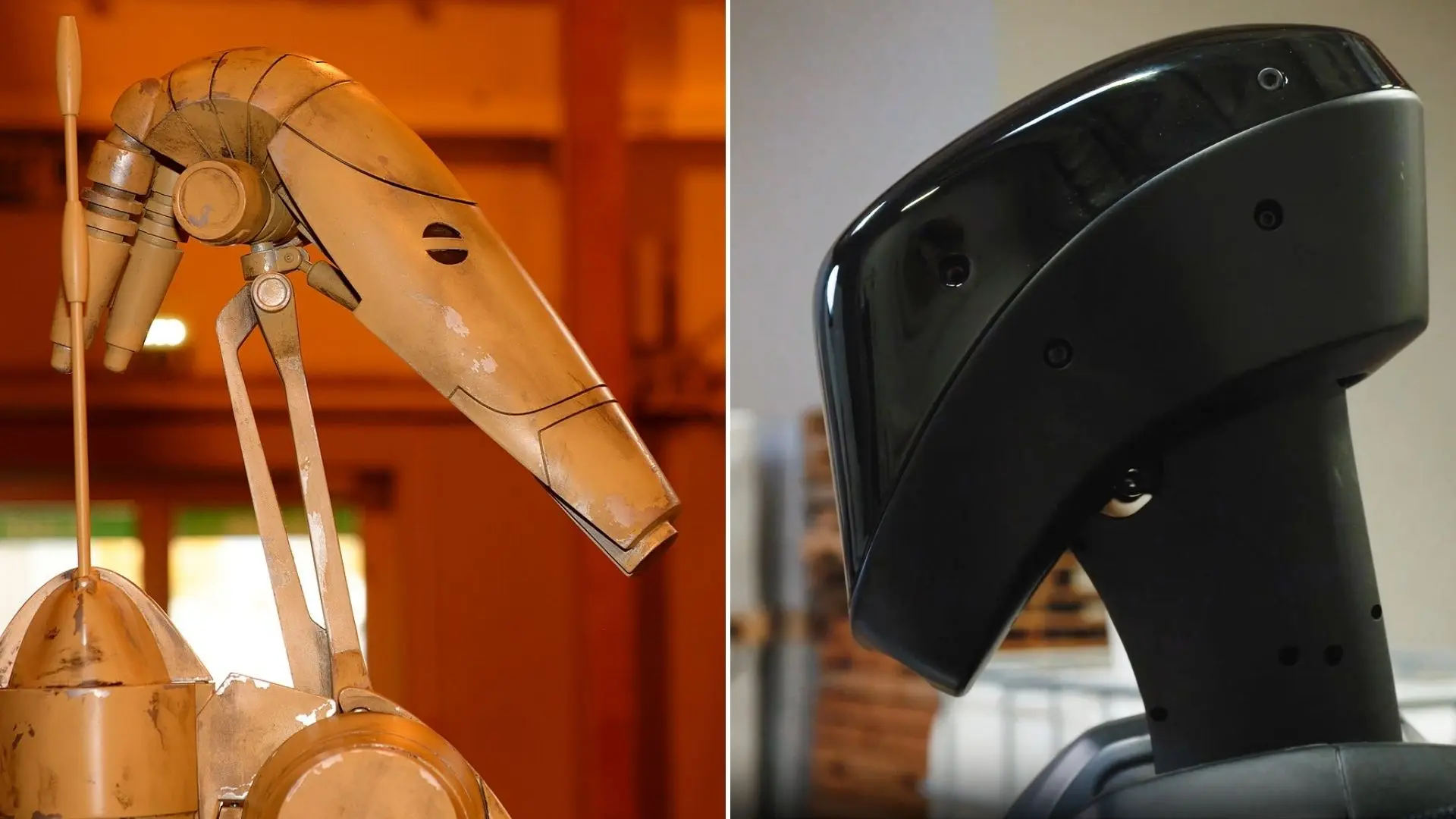
With its blacked-out frame, broad shoulders, and a featureless face embedded with cameras, the Phantom MK-1 presents a sleek, utilitarian appearance. In our previous coverage, we likened the robot to a Star Wars-style battle droid.
Strategic promise and unresolved risks
Pathak has repeatedly emphasized that humanoid robots could reduce reliance on airstrikes or heavy weapons by enabling precise, ground-level interventions, potentially lowering collateral damage. At the same time, the company has stressed the importance of keeping a human in the loop, with operators retaining final authority over lethal decisions.
However, the Forbes piece notes that the opposite outcome is also possible. By removing soldiers from direct risk, such systems could lower political barriers to deploying force, making military action more likely rather than less.
It remains unclear whether Foundation’s robots will meaningfully reduce casualties or reshape escalation dynamics, but the company’s aggressive production plans indicate that weaponized humanoids may reach operational use sooner than previously anticipated.
Recommended Articles

Get the latest in engineering, tech, space & science - delivered daily to your inbox.
0COMMENT
Kaif Shaikh is a journalist and writer passionate about turning complex information into clear, impactful stories. His writing covers technology, sustainability, geopolitics, and occasionally fiction. A graduate in Journalism and Mass Communication, his work has appeared in the Times of India and beyond. After a near-fatal experience, Kaif began seeing both stories and silences differently. Outside work, he juggles far too many projects and passions, but always makes time to read, reflect, and hold onto the thread of wonder.
- 1US scientists fix EV batteries' capacity degradation issue, boost cells' lifespan
- 2US firm plans 50,000-strong humanoid robot army for defense, industrial work
- 3Google's quantum processor could perform 1,000 times better with Princeton's new qubit
- 4US: Last Energy raises funds to mass produce steel-encased micro nuclear reactors
- 5Pentagon study shows how China could use hypersonic arsenal to defeat US aircraft carriers against US carriers