


Black Hawk down, Valor Up — but how does it compare to the Osprey?
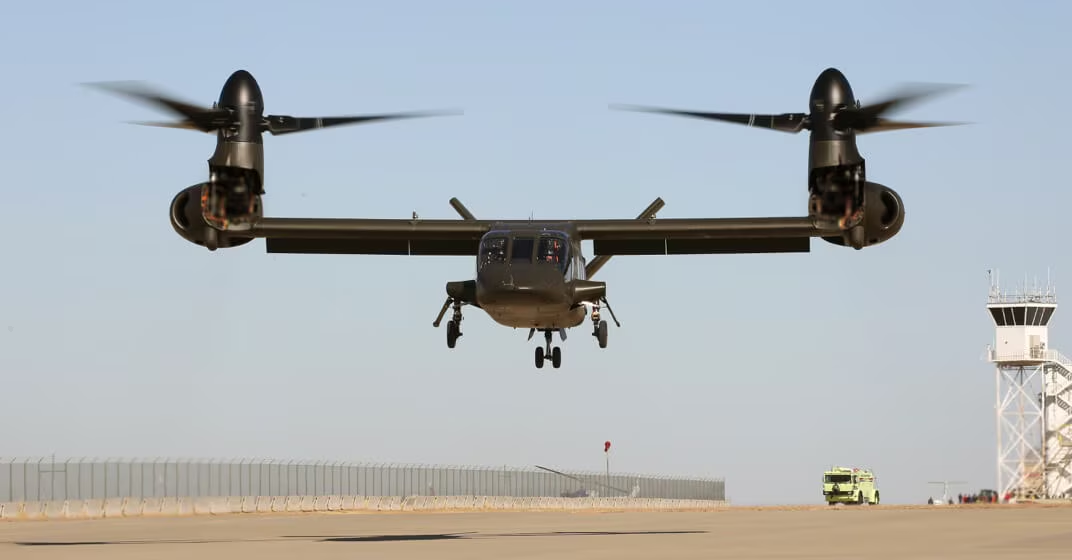
Bell’s V-280 Valor has naturally been compared to the V-22 Osprey, but they are very different beasts.

0:00 / 0:00
‘Front Lines,’ Christopher McFadden’s’ column, examines warfare past, present, and future. McFadden analyzes cutting-edge military tech, and global defense policies, highlighting the forces shaping our world’s security landscape.
The US Army has announced that it plans to finalize the design of its Future Long-Range Assault Aircraft (FLRAA), which will replace the venerable but aging UH-60 Black Hawk utility helicopter. If all goes according to plan, the Army’s prime choice, the Bell V-280 Valor, should be operational as early as 2030.
This tiltrotor utility helicopter beat other Lockheed Martin’s Sikorsky and Boeing for the FLRAA in 2022. Since then, Bell has been working hard to get its Valor up to the exacting standards and requirements of the Army to fulfill its promise to deliver the Black Hawk’s replacement as soon as possible.
For any aircraft enthusiast, a cursory look at the V-280 Valor will draw comparisons with another famous tiltrotor aircraft, the Bell Boeing V-22 Osprey. They will also note that the Osprey has faced trouble since its inception in 2007.
High-profile fatal crashes, high maintenance costs, and complex mechanical issues have raised concerns about its safety and reliability. So, you might wonder, could this foreshadow the future of the Valor?
Let’s find out.
Standing in the shadow of a legend
Bell (now a subsidiary of Textron) was contracted by the US Army to develop and deliver around 2,000 aircraft to replace the existing Black Hawk fleet by the end of the decade. Its offering, the second-generation tiltrotor V-280 Valor, is set to replace these aircraft piecemeal as they are sequentially retired by 2030.
As per US Army needs, this chopper has a top speed of around 300 knots (345 mph/556 kph) and should have a maximum range of 2,100 nautical miles (2,400 miles/3,900 km) before refueling. Its speed is roughly twice that of the Black Hawk, making it a very attractive replacement.
When used in battle, its anticipated combat range will be much lower, somewhere between 580 and 920 miles (930 and 1,480 km). The V-280 has a declared takeoff weight of around 30,000 pounds (14,000 kg), enabling it to carry 14 soldiers and gear.
It will also come with dual cargo hooks, which can externally lift a 10,000 lb (4,500 kg) M777A2 Howitzer at speeds up to 150 knots (170 mph/280 kph). The V-280 Valor is to be the US Army’s first new large helicopter purchase in over 40 years.
Cutting-edge helicopter
It’s all very impressive, but its standout feature is its specially designed tilt rotors. Unlike the V-22 Osprey, only its propellers tilt (not the entire engine nacelle), giving it a distinctive look.
However, this feature is not just about cosmetics; it should reduce mechanical complexity and improve maintainability. The aircraft will also have a fully digital, Modular Open Systems Architecture (MOSA), allowing for faster tech updates and integration of advanced systems.
It also differs from the Osprey in its cutting-edge use of digital engineering, system integration labs (SIL), and 200+ demo hours to avoid past pitfalls. Bell has announced that this enables test cycle compression to just 2 years versus the more typical 4 to 10 years in older programs.
Valor’s bigger cousin, the V-22 Osprey
The Valor’s more famous big cousin, the V-22 Osprey, is a revolutionary tiltrotor aircraft that Bell Helicopter and Boeing developed for the U.S. military. This aircraft combines a helicopter’s vertical lift capability with a fixed-wing aircraft’s speed and range.
Introduced into service in 2007, it currently serves the Marine Corps (MV-22), Air Force Special Operations (CV-22), and the Navy (CMV-22B) for various roles including troop transport, medevac, and logistics.
Powered by two Rolls-Royce AE 1107C turboshaft engines, the Osprey’s entire nacelles rotate between vertical and horizontal flight modes. It can reach a top speed of approximately 274 knots (315 mph/507 kph) and has a combat range of 270 and 580 miles (453 and 933 km).
It can carry up to 24 fully equipped troops or 10,000 pounds (4,536 kg) of internal cargo. Despite its cutting-edge design, the Osprey has faced a controversial service history due to fatal crashes, high maintenance requirements, and mechanical complexity, particularly related to its tilting nacelles and gearbox systems.
Nevertheless, it has proven invaluable in missions requiring speed, reach, and vertical takeoff and landing (VTOL) capability, operating from both land and sea. As one of the first operational tiltrotors, the V-22 paved the way for next-gen aircraft like the V-280 Valor.
How do they compare?
While the V-22 Osprey and V-280 Valor share the fundamental tiltrotor concept—combining vertical takeoff with high-speed forward flight—they were built with different missions, eras, and design philosophies in mind.
Both aircraft aim to bridge the gap between helicopters and fixed-wing planes, enabling rapid troop movement over long distances without runways. However, the Osprey was a pioneering effort that pushed the limits of 1980s–90s engineering.
Conversely, the Valor benefits from decades of lessons learned and modern digital development tools.

The Osprey features rotating engine nacelles, which, while effective, introduce maintenance-heavy complexity. Bell’s Valor improves on this by keeping engines fixed and tilting only the rotors, simplifying the design and improving reliability.
Operationally, the Osprey is a multi-branch asset, used by the Marines, Air Force, and Navy for strategic roles including ship-to-shore transport and special operations. In contrast, the V-280 is designed specifically for the Army’s tactical air assault missions, replacing the Black Hawk for rapid insertion and maneuver warfare.
The V-280 also incorporates open-systems architecture and modular components, making it more adaptable to future upgrades. The Valor is not just a technological successor—it’s a tiltrotor reimagined for speed, flexibility, and sustainable battlefield logistics.
Valor versus Osprey: apples versus oranges
The V-280 Valor is shaping up to be an incredible piece of hardware for the US Army and a worthy replacement for the Black Hawk. However, comparisons to its troubled cousin, the Osprey, are only natural, if slightly unfair.
Since the V-22 Osprey’s inception, lessons have been learned, and it is clear that the US Army is not taking any chances with its new expensive toy.
“We’re not going to find big, expensive things. [We are] not going to find safety things. We’re going to find small things that we must tweak,” Col. Jeffrey Poquette explained to Defense News when discussing the latest developments of the FLRAA program.
“We found things in PDR, and they fixed it, and now we know that we’re going to have the architecture right to meet [the modular open system architecture] and that kind of thing,” he added.
Recommended Articles
0COMMENT
Christopher graduated from Cardiff University in 2004 with a Masters Degree in Geology. Since then, he has worked exclusively within the Built Environment, Occupational Health and Safety and Environmental Consultancy industries. He is a qualified and accredited Energy Consultant, Green Deal Assessor and Practitioner member of IEMA. Chris’s main interests range from Science and Engineering, Military and Ancient History to Politics and Philosophy.
- 1Paralyzed man controls robots with mind as China outpaces Elon Musk vision
- 2Allag-E: Interceptor aircraft can hunt and kill drones flying at 124 mph like an eagle
- 3Modernized nuclear warheads ready for deployment on 18,750-ton US missile submarines
- 4'World's largest' suction sail fitted to cargo ship in Spain, offers 7x more lifting force
- 5US firm's reconfigurable space station could fly to orbit in a single Falcon 9 launch


