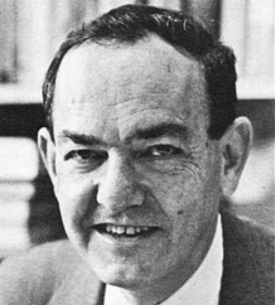
Herbert A. Simon
1916 - 2001
Created: February 19, 2025•
Updated: February 24, 2025
Born on June 15, 1916, in Milwaukee, Wisconsin, Herbert Alexander Simon was one of the founding fathers of AI. He was a revolutionary figure in numerous academic fields, including economics, computer science, and cognitive psychology. His intellectual contributions spanned the development of theories like "bounded rationality" and "satisficing," which have profoundly influenced the understanding of human decision-making processes within organizations and the limits of human rationality.
His distinguished career was marked by numerous prestigious awards, including the Turing Award in 1975 and the Nobel Memorial Prize in Economic Sciences in 1978. Simon's tenure at Carnegie Mellon University from 1949 until his death in 2001 saw him play a pivotal role in establishing the School of Computer Science, positioning him as a central figure in the evolution of both digital and economic systems worldwide.
Early life and education
Herbert Simon was born to Arthur Simon, a Jewish electrical engineer who immigrated from Germany, and Edna Marguerite Merkel, a pianist of Jewish, Lutheran, and Catholic descent. His father’s engineering background and his mother’s musical talents provided Simon with a diverse cultural heritage that influenced his academic interests.
Simon’s education began in the public schools of Milwaukee, where he developed an early interest in science. However, his academic pursuits were not confined to the natural sciences alone. Influenced by his mother’s brother, Harold Merkel, an economist, Simon grew fascinated with the possibilities of applying scientific methods to the study of human behavior and social sciences.
This exposure led him to read extensively in the fields of economics and psychology, drawing inspiration from notable thinkers like Norman Angell and Henry George.
In 1933, Simon commenced his higher education at the University of Chicago, where he initially intended to study biology. However, his plans changed due to his color blindness and a self-perceived lack of aptitude for laboratory work, redirecting his focus towards political science and economics. Under Henry Schultz, an influential econometrician and mathematical economist, Simon began to cultivate a profound understanding of quantitative methods in economics, which would later help him with much of his scholarly work.
His doctoral research, which culminated in the groundbreaking book "Administrative Behavior," began to take shape during this period, setting the stage for his future contributions to administrative theory and economic decision-making.
Career and contributions
Herbert Simon's professional journey began with a research assistantship in municipal administration at the University of California, Berkeley, where he quickly rose to become the director of an operations research group. His work during this period, from 1939 to 1942, involved extensive collaboration on projects that would foreshadow his later contributions to the field of public administration.
In 1942, Simon transitioned to the Illinois Institute of Technology in Chicago, where he served as a professor of political science and later as the department chairman. It was here that he deepened his engagement with economics through interactions with members of the Cowles Commission.
This period was crucial for Simon as he began integrating rigorous mathematical methods into his studies of economic and organizational behavior, setting the groundwork for his future theoretical developments.
Simon's career took a definitive turn in 1949 when he joined the faculty of Carnegie Mellon University (then Carnegie Institute of Technology). His tenure at Carnegie Mellon was distinguished by his efforts to establish and develop the School of Computer Science, one of the first of its kind, where he remained until his death in 2001.
During these years, Simon was not only a prolific writer and researcher but also a key figure in transforming higher education in management and computer science.
Research and findings
Simon's most notable intellectual contributions lie in his theories of "bounded rationality" and "satisficing" which challenged the prevailing notions of perfect rationality in economic decision-making.
His seminal work, "Administrative Behavior," first published in 1947, articulated these concepts, emphasizing the cognitive limits of human decision-makers and the impact of these limits on administrative organizations. This book became a cornerstone in the study of organizational behavior and decision-making processes.
Beyond administrative theory, Simon was instrumental in the early development of artificial intelligence. Alongside Allen Newell, he developed the Logic Theorist and the General Problem Solver, early AI programs that demonstrated the potential of computers to simulate human problem-solving processes. These efforts were foundational to the field of AI and led to significant advancements in understanding human cognitive processes through computational methods.
Simon's interdisciplinary approach also extended to his work in economics, where he applied complexity theory and computer simulations to understand economic behavior under conditions of uncertainty and incomplete information. His research in this area further solidified the concepts of bounded rationality and satisficing, illustrating their applicability across various disciplines, including economics and psychology.
Throughout his career, Simon's work was characterized by a commitment to interdisciplinary study, often bridging the gap between theoretical research and practical application. His contributions have left a lasting impact on several fields, particularly in how complex human behaviors and organizational dynamics are understood and studied in the context of economics and cognitive science.
Later life and personal life
In his later years, Herbert Simon continued to contribute to various academic fields while maintaining an active role at Carnegie Mellon University. He was deeply involved in teaching and research until his death, mentoring numerous students who would go on to have distinguished careers.
Simon's personal life was rich and full, marked by a deep commitment to his family and a range of interests outside academia. He married Dorothea Pye in 1938, and together they raised three children. His interests included playing the piano and mountain climbing, activities that showcased his affinity for both the arts and physical challenge.
Simon was also known for his broad intellectual curiosity. He taught courses on subjects as varied as the French Revolution, showcasing his wide-ranging knowledge and love for teaching. His engagement with the arts and sciences made him a well-rounded scholar who brought a diverse perspective to his research and teachings.
Awards and honors
Herbert Simon's contributions to multiple fields were recognized with numerous prestigious awards. Among the most notable were the Turing Award in 1975, which he received for his foundational work in artificial intelligence and cognitive psychology, and the Nobel Memorial Prize in Economic Sciences in 1978, awarded for his pioneering research into the decision-making processes within economic organizations.
Simon was also a recipient of the National Medal of Science in 1986, which underscored his broad impact on social science and management.
Throughout his career, Simon was honored with several other accolades, reflecting his multidisciplinary impact. These included the APA Award for Distinguished Scientific Contributions to Psychology in 1969 and again in 1993 for Lifetime Contributions to Psychology.
He was also inducted as a Fellow of the American Academy of Arts and Sciences and became a Member of the National Academy of Sciences.
Death
Herbert Simon passed away on February 9, 2001, at the age of 84, following complications from surgery to remove a cancerous tumor. His death marked the end of a prolific career that left a lasting legacy in numerous academic disciplines.
His work continues to influence the fields of economics, computer science, artificial intelligence, and cognitive psychology, reflecting the remarkable breadth of his scholarly contributions. His wife, Dorothea, died a year later, closing a significant chapter in the history of American intellectual life.