The Infinite Zenith

Where insights on anime, games and life converge

Tag Archives: Terrible Anime Challenge

Terrible Anime Challenge: Kanojo, Okarishimasu Season Four and Contemplating A House of Card’s Structural Viability

How can I fight a love that shouldn’t be?
When it’s so deep, so deep, deep inside of me
My love reaches so high I can’t get over it
It’s so wide I can’t get around it, no
Nowhere to run, nowhere to hide from you, baby
Just can’t get away from you, baby (nowhere to run, nowhere to hide)
No matter how I try to
I know you’re no good for me
But free of you I’ll never be

–Martha and the Vandellas, Nowhere to Run

In the aftermath of a successful première, the relationship between Kazuya and Chizuru does not appear to have made any meaningful progress, and Kazuya ends up renting Chizuru out again, hoping to confess his feelings for her. When a number of professional filmmakers invite Chizuru to a gathering, she extends the invitation to Kazuya, who feels out of his depth at the event. Meanwhile, frustrated that Kazuya hasn’t been paying much attention to her, Ruka tries to spend more time with him but continues to encounter difficulties; to try and get Chizuru to back off, Ruka suggests she and Kazuya have taken their relationship to the next level, and Mami, who’s worked with Kazuya’s grandmother as an advisor of sorts, reveals to Chizuru that she’s aware of the truth behind her ersatz relationship with Kazuya. When Kazuya’s grandmother invites him, Chizuru and Ruka to Spa Resort Hawaiians. The prospect of a large trip opens the floor to new misunderstandings – Chizuru and Kazuya struggle to work out how to inform the latter’s grandmother that their relationship is a sham. At the resort, Chizuru has fun in spite of herself, and realises that Kazuya’s family is legitimately grateful that Kazuya has someone like her by his side. The lie becomes increasingly difficult to sustain, and complicating things are Mami, who tries to persuade Chizuru that Kazuya is trouble. Mami corners Chizuru and forces an ultimatum; either be upfront about what the situation is, or she will escalate further. Quite separately, Mami also persuades Ruka that it is possible for her to have Kazuya to herself, and after Kazuya works up the courage to attempt a kokuhaku, a distracted Chizuru runs off: although she’s concerned about Mami and her machinations, Kazuya takes this to mean he’d been rejected. Kanojo, Okarishimasu‘s fourth season, airing two years after the third season back during the autumn of 2025, continues with the curiosity of a story that began back in 2020, and forty-eight full episodes into its run, Kanojo, Okarishimasu appears be dead-set on testing the limits of viewer patience: pacing in the fourth season grinds to a seeming halt as Chizuru grapples with the threat Mami holds over her head, and Kazuya’s efforts to overcome his own doubts are consistently met with failure. Circumstances itself continues to introduce new setbacks for the pair, and as the build-up continues, one cannot help but wonder when this house of cards will finally reach a tipping point and fail catastrophically, once the truth does get out.

At first blush, the events of Kanojo, Okarishimasu‘s fourth season feel like a frustrating “do not pass Go”: having spent the entirety of the third season seeing Kazuya supporting Chizuru in producing an independent film, it felt that there had at least been some progress on Kazuya’s front. However, when it became clear that Chizuru is still at a crossroads, Kanojo, Okarishimasu not only appears to have stalled, but instead, even comes across as taking several steps backwards, negating any progress that the third season had made. From a strict romance perspective, this is understandably frustrating – audiences correctly expect a payoff from effort because this is the primary aim of most stories. Kanojo, Okarishimasu‘s fourth season, curiously enough, is taking a brief detour to deal with the elephant in the room: at the onset, Kanojo, Okarishimasu appeared to be a story of how an ersatz, transactional relationship might grow into something legitimate, and on those premises, the series would’ve spoken to the familiar notion of persevering to achieve one’s goals. Instead, by taking viewers on a ride, Kanojo, Okarishimasu reminds viewers that the lie Chizuru and Kazuya had built, of being in a real relationship, to keep their grandmothers happy, is not an inherently sustainable one. Until now, i suggested that this uneasy status quo could be maintained indefinitely, and further to this, there was merit in doing so for the sake of Kazuya’s grandmother. By throwing Mami back into the mix, and having her holding this knowledge over both Chizuru and Kazuya’s head, Kanojo, Okarishimasu is able to catalyse a different sort of conflict – there is no more runway for Chizuru, who risks being outed as a rental girlfriend during a time when Kazuya’s grandparents and parents alike are more than prepared to welcome her into the family. Chizuru is, in short, being pulled in opposite directions now, and the metaphorical house of cards she and Kazuya have unwittingly created now have clear consequences. Chizuru had been portrayed as being quite indecisive in her actions during the fourth season’s first half: she insists she has no feelings for Kazuya and wishes him well with Ruka, but simultaneously feels compelled to keep up appearances for Kazuya’s family until such a time when he can be truthful, but in doing so, Chizuru offloads the responsibility of her own feelings onto Kazuya, as well. In this way, Mami’s actions, however unsavoury they are to watch, ends up serving an important role in Kanojo, Okarishimasu: her blunt and demanding intervention is forcing Chizuru to re-evaluate what she’s been doing all this time, and this might provide a boot to the rear for Chizuru, who has, insofar, been avoidant of the matter of how she feels about Kazuya: neither accepting his feelings or rejecting them, Chizuru’s own lack of conviction brought Kanojo, Okarishimasu to a standstill, and with Mami now taking matter into her own hands, Kanojo, Okarishimasu appears to be heating up.

Screenshots and Commentary

  • Kanojo, Okarishimasu holds the rather dubious distinction of being the only anime I’ve stuck into the “Terrible Anime Challenge” bucket on four different occasions. When I picked up the first season back in 2021, I had an inkling of what the premise entailed, but no idea of what followed – the assumption I had coming in was that Kazuya and Chizuru would have a somewhat predictable outcome, where Kazuya’s renting Chizuru would either help him identify what he wanted, or produce a more confident man who could sway Chiziru’s heart. When Kanojo, Okarishimasu did not do this, I knew that I would need to take a different approach to this series to understand why five years later, I’m still writing about Kazuya and Chizuru’s mishaps.

  • My own reception towards Kanojo, Okarishimasu is an intermediate between what Japanese viewers experience and what English-speaking viewers feel – on one hand, I completely agree with Western perspectives that the lack of a clear progression and character indecisiveness prevents the story from advancing in a way that makes for a satisfactory experience. However, on the flipside, I also appreciate that Kanojo, Okarishimasu is doing something different, and to Japanese viewers, who relate to the characters and their experiences, Kanojo, Okarishimasu can be seen as being another way of exploring the messy, uncertain nature of relationships.

  • One must therefore allow for the fact that, since we are now finished the fourth season of Kanojo, Okarishimasu and are near the airing of a fifth season, Japanese studios and producers are able to produce this because the market forces make it viable. That is to say, Japanese viewers clearly like Kanojo, Okarishimasu enough to buy the disks and read the source material, and as such, Kanojo, Okarishimasu correspondingly must be doing something that draws in Japanese viewers and readers. We cannot always just disparage or critique a work from one cultural or personal lens, and this is why it’s so important to understand what leads series like Kanojo, Okarishimasu (and similarly, things like Gundam SEED: Destiny) to endure.

  • My approach as a blogger is not to tell readers what to watch and what to skip – I respect my readers’ agency and judgement enough that this is not one of my objectives. Rather, as a writer, my objectives simply are to explore what a work is doing and whether or not the outcomes made a given experience a worthwhile one. I understand that my methods stand contrary to how the majority of people view a given work, and as an example, when Kanojo, Okarishimasu finished airing back in 2020, one of MyAnimeList’s most infamous and well-known reviewers, “Stark700”, openly disparaged the series in a review and opens with the comment that he’d like nothing more than to “throw [Kazuya] off a bridge, or…simply want to say ‘you’re pathetic’ to [his] face”.

  • While this makes it clear Stark700 disliked Kanojo, Okarishimasu, to claim that “this anime itself is one that’s is deceptive to the core…because we’re not getting a real storyteller” is egregious – Stark700 has completely failed to understand that Kanojo, Okarishimasu is not a conventional romance. It is, as he already mentioned, about how “fake relationships almost always have its consequences”, but rather than doing so elegantly, Kanojo, Okarishimasu deliberately and willfully disables safeguards so viewers can see just what happens if things are allowed to play out in a simulated space. We viewers are not meant to envy or emulate Kazuya, but rather, appreciate how certain actions are unsustainable. In other words, Kanojo, Okarishimasu willfully renders Kazuya to be a difficult protagonist to accommodate the series’ intended themes.

  • In creating frustration amongst Western viewers, Kanojo, Okarishimasu was quite successful, and I concede that even I’m not immune to this feeling. However, it is not my place, or Stark700’s, to say that Kanojo, Okarishimasu was deceptive in any way: the author and studios have an objective, they stuck to it, and the result paints a clear picture. In this regard, Stark700 appears to have rejected the lesson, too: Kanojo, Okarishimasu isn’t about teaching viewers to “not to be like Kazuya”, but rather, eliminates safeties that prevent such scenarios from getting out of hand to illustrate a very specific message – the further one gets into a lie, the harder one will fall when the truth does come out.

  • In the West, the lessons of allowing a small fib to escalate into something unsustainable is captured by the children’s rhyme, There Was an Old Lady Who Swallowed a Fly, and this simple lesson has been applied in things like Gundam Unicorn – Laplace’s Box and the last clause of the Universal Century Charter, in dealing with Spacenoid Rights, was papered over and turned into a justification for oppressing people in space, but its legacy and reputation far outstrip its actual meaning, giving the EFSF of U.C. 0096 the sense that if the truth got out, it would render the EFSF government illegitimate. Gundam Unicorn takes a more conventional and realistic approach in portraying how lies can set up undesirable scenarios.

  • On the other hand, Kanojo, Okarishimasu is more similar to 100 Kano: once one accepts that Kanojo, Okarishimasu is a thought experiment, of what happens when a premise is pushed to its logical conclusion without realism intervening, the messages become quite clear, and characterisation follows. One must therefore be willing to accept that Kazuya, Chizuru, Ruka and Mami are not role models or people to aspire to be like, and instead, view their stories as cautionary tales. Once this perspective is taken, Kanojo, Okarishimasu becomes considerably more enjoyable because rather than rooting for the characters or hoping for improvement, one can kick back and view things as one might a simulation gone wrong.

  • This is why Kanojo, Okarishimasu does not end up being a total waste of time for me, and by the fourth season’s halfway point, apparent stagnation in the story is dislodged when Kazuya’s grandmother stops by with a surprise: a family trip to the Spa Resort Hawaiian. This inn is described as being in Fukushima and a spot that Kazuya’s grandmother holds dear, and while it was originally meant to be a family trip, things spiral out of hand when Kazuya’s grandmother extends an invitation to Ruka, reasoning that the more there are, the merrier things will be in a bit of dramatic irony.

  • While this is introduced, Ruka throws another wrench into things by trying to aggressively push Chizuru out of the picture by saying she and Kazuya had done the horizontal tango. While Chizuru had been the one to encourage Kazuya and Ruka to get together, I found that her response in this moment suggests things aren’t quite so cut-and-dried: had Chizuru completely lacked feelings for Kazuya, she wouldn’t be fazed by Ruka’s comment and would, in fact, express happiness that things for Ruka and Kazuya are working out. Chizuru’s response here would therefore confound things, and one could be reasonably confident that Chizuru’s words do not mirror what’s in her heart.

  • Assuming this were the case, things in Kanojo, Okarishimasu would be kicked upstairs – the entire premise was dependent on the lingering tensions between Kazuya and Chizuru, and had the former committed to Ruka, there’d be no conflict or challenge. Many of the things viewers take exception to in Kanojo, Okarishimasu are deliberate, present so viewers to see how far Kazuya’s unenviable situation can be pushed before things reach a breaking point. The sheer number of things that go wrong in Kanojo, Okarishimasu is reminiscent of how the Chernobyl Nuclear Disaster as a consequence of a willful neglect of procedure, deliberate deactivation of safeguards and unexpected interactions coming together to produce a catastrophe.

  • Kanojo, Okarishimasu is going down a similar path, and once Kazuya’s party arrives at the Resort Spa Hawaiian, I consented to kick back and let things unfold. The pacing in this fourth season was significantly slower than anything we’d previously seen: over half the series is set in the days during the vacation, and attention is paid to individual moments, moments that really accentuate how after three-and-a-half seasons, the lie between Chizuru and Kazuya is not something that can be easily concealed. In the close quarters of the resort, there is really nowhere left for Chizuru to run.

  • As I made my way through Kanojo, Okarishimasu‘s fourth season, I slowly shifted over to the realisation that, while Kazuya’s mannerisms aren’t exactly going to endear him to viewers or garner any sympathy from me, what makes Kanojo, Okarishimasu manageable is the fact that Kazuya’s intentions and objectives are clear as day. He has only eyes for Chizuru, and the entire fourth season has him trying to confess to Chizuru. If Kazuya had actually succeeded, the status quo between himself and Chizuru would shift, the tensions would evaporate immediately, since the relationship would now be real. Kazuya’s persistence is offset by the fact that circumstance itself seems to disrupt every effort.

  • Since Kazuya is more or less a constant by Kanojo, Okarishimasu‘s fourth season, the only variable is Chizuru. Based on what we’ve seen so far, it’s tricky to determine whether or not she actually returns Kazuya’s feelings. Her cold attitude and avoidance of the issue suggests that she’d rather not enter a relationship with him, but at the same time, there are instances where Chizuru clasps her hands together, covers her mouth and blushes furiously in response to something Kazuya does or says. The ambiguity is, to be frank, quite stressful, and while it is infuriating from a storytelling perspective, I do understand why Kanojo, Okarishimasu elects to present Chiruzu’s perspective from this direction.

  • Every individual will know this to be true: from one’s own perspective, one is fully aware of how they feel about things, but to figure out what someone else is thinking is quite difficult. Thus, as viewers watch Kazauya trying to push forward despite incomplete information, they are also forced into the same position as Kazuya: we have next to no insight as to what’s going through Chizuru’s mind. I imagine that for most viewers, however, once Kanojo, Okarishimasu‘s fourth season enters the pool segments of the Resort Spa Hawaiian chapter, thoughts wander away from individual objectives towards the visuals on the screen. I was a little taken aback at how immature Kazuya and his friends were here – once everyone changes and hits the pool, Kazuya and Shun immediately set about ogling Chizuru and Ruka.

  • In the past, I would’ve likely joined critics in suggesting that Kazuya’s being flustered at being asked to ride tandem with Chizuru is exaggerated and unrealistic: surely, Kazuya could just grit his teeth, take a deep breath and enjoy the ride? However, since “no plan survives contact with the enemy”, and I’ve never done anything of the sort before, I can appreciate how doing something like this could be quite nerve-wracking, even if one is riding alongside a partner. Even in more typical setting, standing beside someone one has a crush on can cause a perceptible tightening in the heart, and while adults are better able to manage these moments, I expect that such a reaction, as Kazuya experiences, is only natural.

  • Confounding the situation further, Chizuri’s bikini suffers a washout; she loses her top during the ride and is confined to a corner until Kazuya helps her to locate her top and secure it. In any other romance story, moments like these serve to close the distance and bring a prospective (or existing) couple closer together, but because of the ambiguity surrounding what Chizuru’s feelings are, one cannot readily work out what the implications of this moment are. On the flipside, the fact that Kazuya pushes through his own embarrassment to help Chizuru out shows that when the chips are down, he’s able to step up.

  • As it was, the Resort Spa Hawaiian chapter was a bit of a see-saw in terms of what it adds to Kanojo, Okarishimasu – on one hand, a resort and swimsuits is merely justification to show off Chizuru and Ruka’s figures for the amusement of viewers, but the cheerful antics of an extended pool party conceals the turbulence that accompanies Ruka and Mami’s presence. Ruka’s role would’ve been benign, but things become much messier when Mami appears. Mami has been widely viewed as Kanojo, Okarishimasu‘s homewrecker: ever since she broke up with Kazuya and set in motions the whole of the series’ events, she’s a recurring character whose knowledge of Chizuru’s ersatz relationship with Kazuya renders her a bit of a rogue element.

  • This is actually what drove Kanojo, Okarishimasu‘s fourth season to become more exciting: the question of when, rather than if, the truth could come out, has long lingered in Kanojo, Okarishimasu, and while Kazuya’s long tried to turn this phoney relationship into a real relationship, Chizuru’s own wavering feelings means that there continues to be a conflict in Kanojo, Okarishimasu. Left alone, the series would stall, and this is why, regardless of one’s impressions of Mami are, one cannot deny that her role in Kanojo, Okarishimasu is essential.

  • While Mami’s function in Kanojo, Okarishimasu is clear, I’ve always wondered what motivated her actions and why she seems so keen on preventing Chizuru from interacting with Kazuya at all. From a storytelling perspective, this isn’t strictly necessary because Mami only needs to serve as an antagonising force, a presence that threatens the status quo and forces Kazuya and Chizuru out of their comfort zone. What makes Mami such an effective presence here in Kanojo, Okarishimasu is the fact that viewers know almost nothing about what motivates her. This is significant because, if one knew why she holds such a warped view on love, one can reason out what she seeks to achieve and how she might go about doing things.

  • As it was, the reason behind Mami’s hostility and yandere-like tendencies are completely unknown to anime-only viewers, and this makes it quite challenging to speculate on what she’ll do next. This uncertainty, combined with the soap opera-like pacing of Kanojo, Okarishimasu, forces viewers to linger on the weight of each moment. I had found myself somewhat irritated by how slowly things in the fourth season were moving, and each episode felt as though it was dragging on, with frames lingering on uncomfortable silences, agonising thoughts and unanswered questions. If Kanojo, Okarishimasu had been a smartly-paced anime, the events of the Resort Spa Hawaiian chapter could’ve been condensed into the space of three episodes.

  • However, I’ve long accepted that pacing in anime is no different than how a photographer can use leading lines and negative space to force a viewer’s attention towards something the creator finds significant. Here in Kanojo, Okarishimasu, portraying the moments of enjoyment with things like the pool and onsen, and juxtaposing them with Mami’s threats, would compel views to keep their eyes on the tensions at hand, and I yield that the sensation is not unlike that created by the Sword of Damocles. Here, Mami tries to manipulate Ruka into believing that, were Chizuru to be removed from the picture, she’d have a clear shot of taking Kazuya for herself.

  • The net result is that Ruka begins to contemplate letting Kazuya’s grandmother know of the truth, and also press Chizuru to be more honest about what’s happening – at some point, Kazuya’s grandmother had even given Chizuru a Kinoshita family heirloom, a ring that has been passed down to women who marry into the family. The ring would become a symbol of the pressure that Chizuru faces – if she keeps up the lie, she’ll be compelled to keep up appearances and build up expectations, making it increasingly difficult to back out. While Kazuya feels the problem can be solved once he confesses his feelings to Chizuru, Kanojo, Okarishimasu makes this an increasingly challenging problem for her because of everyone involved.

  • Framing things like Ruka sharing a conversation with Kazuya’s grandmother to gauge the latter’s reaction on what might happen if Chizuru were to fall in love with and marry someone else besides Kazuya. Kazuya’s grandmother offers a thoughtful reply: while she would be disappointed, she would still respect Chizuru’s decision and wish her all the best. Ruka never really stood a chance in Kanojo, Okarishimasu, and in the past, I have mentioned that I pitied her character for being thrown into a story where she was predestined to fail. Kanojo, Okarishimasu is understandably a difficult series to like or recommend because it fundamentally goes against expectations for what makes an enjoyable romance.

  • However, if we approach Kanojo, Okarishimasu as we did 100 Kano, treating the series as another thought experiment, one where one deliberately creates circumstances and introduce decision-making that contradicts what healthy, well-adjusted individuals do, then Kanojo, Okarishimasu becomes a fascinating case study in how in romance and relationships, one’s worst enemy is ultimately oneself. Moreover, as Kanojo, Okarishimasu‘s fourth season wore on, I began gaining the impression that, all of his negative traits notwithstanding, Kazuya is not the reason why progress has stalled.

  • Chizuru’s indecision is brought to the foreground in the fourth season, and while Mami’s manipulative, scheming nature makes her unlikeable by definition, her role forcibly exposes the fact that Chizuru had been quite ambiguous in regard to her own feelings. Kanojo, Okarishimasu presents Chizuru as maintaining the façade because of concern for Kazuya’s grandmother, and because of the expectations and assumptions the Kinoshita family has made. While this is a plausible account of Chizuru’s actions, I contend that if Chizuru had zero interest in Kazuya, she would not have committed to the lie. The fact that Kazuya does go out of his way for her means that there’s conflict in Chizuru, and this, combined with how earnestly the Kinoshitas see her, is why Chizuru finds it so difficult to answer the questions Mami poses.

  • While it’s easy to say one can commit to a certain course of action, the reality is that multiple confounding factors all interact to create a scenario where she’s immobilised. I would not expect to do any better in her shoes, and I do not expect the more authoritative fans to, either. By painting Chizuru into a corner, Kanojo, Okarishimasu‘s fourth season is creating the scenario where, against her will, Chizuru will have to decide for herself what matters more, and I’d expect that this is where the fifth season will go. I have heard rumours that, surrounding how the Kanojo, Okarishimasu manga concludes, fans were quite disappointed in the outcomes.

  • If, and when Kanojo, Okarishimasu‘s animated adaptation reaches this point, I’d expect the disappointment will reach the anime viewers, as well. For my part, even if Chizuru and Kazuya do not end up together, my aim will be to identify why Kanojo, Okarishimasu decided to take such a route and determine what the author’s intentions had been with such a conclusion. I understand that within the realm of fiction, people understandably will anticipate that effort is met with reward, and a story that shows a journey with a satisfying payoff is one that people best connect with, but in some cases, stories that break the mold usually do so because they seek to say something specific.

  • As it stands, I will try my best to continue being patient and fair with Kanojo, Okarishimasu – as a love story goes, Kanojo, Okarishimasu is not going to have my recommendation, and I remark that the characters are not written in a way I relate to or endorse, but as a concept, Kanojo, Okarishimasu does do a satisfactory job of exploring how certain traits and actions, when applied to a romantic relationship, can create untenable situations. My curiosity in the fifth season, then, is seeing what messages come out of the journey that lies ahead for Kazuya and Chizuru – the fourth season ends on a cliffhanger, with Mami contracting with Chizuru after Chizuru herself declined to respond to Kazuya’s kokuhaku. I expect that Kanojo, Okarishimasus fifth season will hit the ground running, even if it’s unlikely to be any less frustrating than its predecessor.

Irrespective of infuriating Kazuya’s mannerisms and self-doubt might be in Kanojo, Okarishimasu, three seasons has shown that Kazuya has grown since the first season: the Kazuya who sought a rental girlfriend after being dumped by Mami had been lacking in confidence and second-guessed himself at every turn. By the third season, Kazuya is more determined, committed and purposeful: even with Ruka, Kazuya openly acknowledges that he’s not in love with her and desires Chizuru. This is what motivates the effort he puts into realising Chizuru’s dream of making a movie for her grandmother to watch, and the end result removes any doubt about where Kazuya’s heart lies. To viewers, then, Kazuya’s intentions and goals are explicitly clear. This leaves Chizuru’s feelings and intentions as the persistent unknown in Kanojo, Okarishimasu. From this point of view, Mami’s intervention, however mean-spirited it’d be in reality, becomes an essential mode of disrupting this status quo; it becomes clear that far from being the “train wreck” or “dumpster fire” the internet has described, Kanojo, Okarishimasu is, in fact, a creative portrayal of what happens when the complexities of navigating a relationship and romance are taken to their logical extremes. Like 100 Kano, Kanojo, Okarishimasu sets out with an experimental problem (namely, is whether it’s feasible for people can conceal an ersatz relationship before the truth comes out) and deliberately introduces variables and constraints to explore the scenario. The fact that i has reached this stage suggests that even in an environment where authors control outcomes, maintaining the status quo indefinitely is unsustainable, and within the realm of Kanojo, Okarishimasu, Chiziru cannot be undecided about her feelings forever. In this way, while Mami might be viewed as a bit of a home-wrecker, the reality is she’s moving the needle against Chizuru’s wishes, and this will compel her to confront her own feelings: is she apprehensive about returning Kazuya’s feelings because of the unknowns that may follow, or just worried that because she does not return his feelings, she may hurt Kazuya and his family by being honest? Understanding the conundrum Chizuru faces, her indecisiveness because of the potential consequences, and the fact that the fourth season of Kanojo, Okarishimasu now backs Chizuru against a wall, renders the series all the more compelling, and with the fifth season now just a month away, one cannot help but curious to see what follows – Kanojo, Okarishimasu has now created a reality where Chizuru will have no choice but to confront her emotions.

Terrible Anime Challenge – Onii-chan wa Oshimai! and A Praise-Worthy Portrayal of Second Chances As A Driver of Change

Look at me. I’m the captain now.” –Abduwali Muse, Captain Phillips

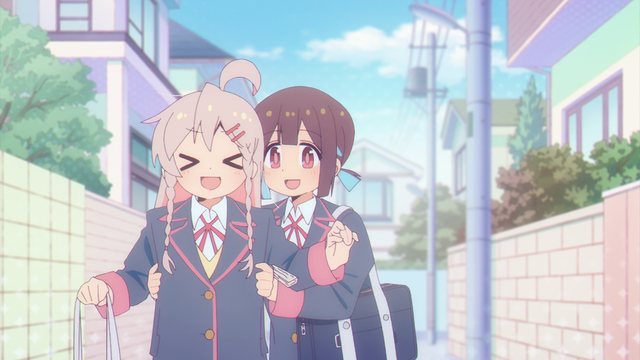
Mahiro Oyama is a shut-in who prefers to while away his days playing video games and collecting manga, but when his prodigy younger sister, Mihari, turns him into a middle school-aged girl for one of her experiments, Mahiro is forced to navigate life from a new perspective. After the initial awkwardness of growing accustomed to his new body, Mahiro learns the nuances of being female from Mihari and her friend, Kaede. When Mihari tasks Mahiro with doing some grocery shopping to get him out of the house, he also runs into Momiji, Kaede’s younger sister. The pair strike up a quick friendship, and after meeting Momiji’s classmates and friends, Miyo and Asahi, Mahiro is persuaded into enrolling at a middle school. As a result of his friendship with Momiji, Miyo and Asahi, Mahiro comes to appreciate the things he once turned away from and begins to enjoy his everyday experiences; while muscle memory causes Mahiro to act more like a boy than a girl at times, he’s also surprised to find his sensibilities and values have begun shifting, as well. From partaking in a slumber party, to making Valentine’s chocolates and discussing horoscopes, Mahiro begins to see that his current life isn’t so bad, and he’s grown fond of hanging out with others. When Mahiro joins Momiji and the others at an onsen, he finds himself wishing to remain as a girl after Mihari’s drug begins wearing out: despite Mihari warning Mahiro that the dosage is long-lived, Mahiro is content to remain this way so he can continue being friends with the others, and Mihari is overjoyed that her project to rehabilitate her older brother was successful. Despite its outwardly raunchy premise and a propensity for fanservice, a natural consequence of an unexpected sex change, Onii-chan wa Oshimai! (Onimai from here on out for brevity) proved to be a story that exceeded all expectations: the first few episodes would intrinsically deal with all of the embarrassment of a new body and its nature. However, such jokes naturally would wear thin very quickly, and in anticipation of this, Onimai would deftly transition over to a more touching story, one which uses Mahiro’s unusual situation to begin exploring topics that are simultaneously more mature and wistful. Although Onimai would still include more risqué moments to drive comedy, wherever more touching moments are involved, Onimai would find itself rising to the occasion and handling these topics gracefully as Mahiro realises that, after getting back out into the world and learning to appreciate the everyday moments spent with friends, his old ways were depriving him of experiences that made him more whole and happy. Further to this, Mahiro would also learn that some of his old hobbies, long believed to be things to conceal from others (least of all members of the opposite sex), were in fact, things that could be shared and enjoyed within the bounds of moderation. In this way, Onimai would prove to be a complete surprise, and after Mahiro acclimatises to the female body, the anime is free to explore its best topics.

In having Mahiro experience things that are common to students and coming to appreciate them, Onimai openly speaks to the idea that living life is about getting out into the world, taking chances on new experiences and accepting oneself as a part of society, rather than existing apart from it. Mahiro’s portrayal as being the stereotypical NEET otaku, someone with no career, aspirations or motivations beyond completing the latest game and being caught up in the latest works of fiction, stands in stark contrast with who he evolves into as a result of Mihari’s experiment. By deliberately de-aging Mahiro in addition to changing his sex, Onimai becomes a tale of second chances, and the precise state Mahiro finds himself in also speaks volumes to his own past. Based on the body Mihari’s experiment leaves him in, one can reason out that Mahiro was probably friendless during at least a portion of his education, and further to this, it is possible that he may have also been rejected by a female classmate in middle school. This corroborates with Mihari’s comment that she pushed herself to excel to impress Mahiro, which implies that long ago, Mahiro was also someone who was very motivated and determined. Something like a rejection in middle school would be a plausible means of devastating his confidence to the point where he became a shut-in. As such, by sending Mahiro back to middle school as a girl, Mihari’s experiment likely aimed to show Mahiro the other side of the fence: when his gaming sense kicks in, Mahiro finds himself speaking quite easily to his male classmates, only for his female classmates to “defend” him from his male classmates when misunderstandings arise: at one point, Mahiro overhears some classmates talking about a game, and he gets into it, but when he accidentally mentions playing a prequel and quiets down, his female classmates assumed the boys must’ve said something to Mahiro. Seeing things from this perspective, along with what friendships amongst females entail, would help him to understand that what previously happened wasn’t necessarily his fault. Further to this, seeing how girls interact would also help him to fill a gap in his past assumptions. However, irrespective of what circumstances led to his becoming a shut-in, Onimai‘s portrayal of Mahiro’s journey suggests that people find their happiness in the company of others – like most slice-of-life anime, Onimai places an emphasis on the ordinary. To Mahiro, going shopping for clothing, having a haircut or getting a friend to apply makeup is something he’s unaccustomed to, but once he gets passed the initial hesitation to partake, he finds that there are things to enjoy about being a middle school girl, and while perhaps a bit dramatic as an example, Mahiro finds that even when dealing with something as foreign to him as girls, he finds himself fitting in surprisingly well when he makes the effort to listen and learn. As such, it is little surprise that Mahiro enjoys his new friendships: through Mahiro, Onimai speaks to the idea that when given second chances, people who take them and put in a sincere effort to make the most of it will find themselves learning the things they previously abhorred may have value, and this leaves one with with a pleasant set of new experiences that serve to improve them in positive fashion.

Onimai represents a very fanciful way of offering an individual a second chance, but the messages were impactful at a personal level – getting a second chance at life by means of an isekai, time travel or supernatural compounds is something that remains confined to the realm of fiction, but the truth is that presenting such exaggerated modes is meant to emphasise that it’s never too late to grasp opportunity and turn things around for oneself. While it may sound cliché, there is merit in the notion that starting fresh and improving has no expiry date. People who’ve made less-than-optimal decisions in their youth may feel they’ve blown their chance at finding success and happiness, and in Onimai, Mahiro’s journey clearly represent this. Based on his manner at the onset, Mahiro was someone who was on the cusp of getting ensnared by idleness, but in spite of this, Mahiro is able to rediscover the joys of companionship because of a combination of family and friends supporting him. This was most visible when Mahiro begins to yearn for something beyond his old life style early in the series: after Mihari leaves for university, Mahiro spends much of the day playing games and eating unhealthily, only to begin feeling empty. Thus, when Mihari’s compound begins wearing off several months later, and Mahiro is faced with the choice of remaining female for longer or reverting to his old self, he finds himself leaning towards staying female so he can continue experiencing the joy-filled days with Momiji, Miyo and Asahi. This is a very dramatic visual metaphor, but in reality, people do indeed feel restless if they’re allowed to idle for too long. In my case, for instance, I’d long expressed a wish to be a photographer, but my own schedule and attendant excuse-making stopped me from taking the plunge. Believing it was too late for me to learn things like how to handle a full-frame camera and the exposure triangle, I satisfied myself with shooting on an iPhone. However, after stopping at a booth the local photography club had at one of the Chinese New Year events downtown, I decided it was time to take those steps forward. In good company, I learned more about composition and exposure basics from veterans who also encouraged me to see how far I could take photography on my phone, and in time, I would learn that my phone’s camera was beginning to hold me back from the things I wanted to do. While I didn’t start photography in my teens or twenties, as many photographers are wont to doing, what’s more important than the length of my experience is the fact I decided to pick up the activity at all: I may not have shot as long as some of my friends have, but the combination of having expert advice available to me, combined with an innate desire to see what a full-frame sensor allows is motivation enough. In fact, with the photos I’ve taken in the past year, I am confident in saying that I’ve “made up” the lost time. In Onimai, Mahiro’s only spent a few months as a middle school girl, but the pronounced changes in his world views similarly speak to how losing time is irrelevant: what matters most is being able to walk a path with conviction and create value for oneself and others through their experiences.

Screenshots and Commentary

  • Onimai aired two years ago, and back then, Onimai hadn’t been a series I was interested in: the premise didn’t appear to be suited for anything more than comedy. At the time, Mō Ippon! was also airing, and that series, with its focus on Judo and a journey to regain one’s interest in a sport, completely held my attention. However, past experience has also indicated that for anime, there’s always merit in going into something with an open mind, and so, I decided to finally make my way through Onimai to see what it was about.

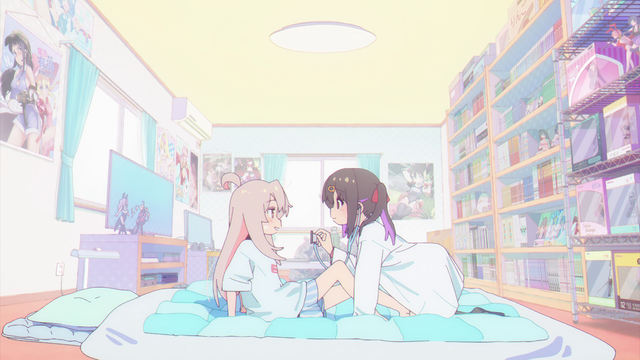
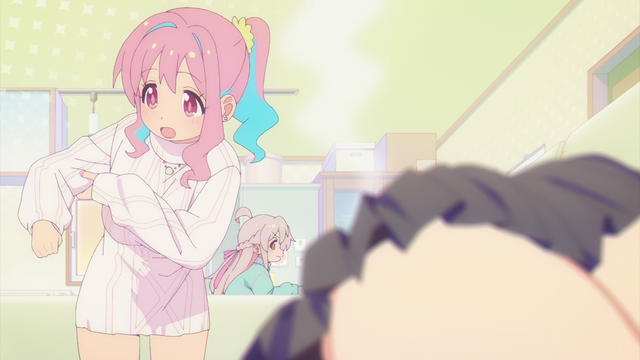
  • At the onset, Onimai opens precisely how I imagined it would – Mahiro’s inexplicable transformation is characterised by awkwardness and embarrassment in dealing with a body he’s unfamiliar with. Simple things like going to the bathroom, dealing with the menstrual cycle and making certain he’s dressed correctly initially are struggles, but because Mahiro now inhabits a middle school-aged girl’s body, moments for lewdness are actually quite limited. Most body-switching stories invariably have boys giving their new bodies a “test drive” (with Makoto Shinkai’s Your Name being a vivid example), so eliminating this allows for Onimai to portray things in a more measured fashion.

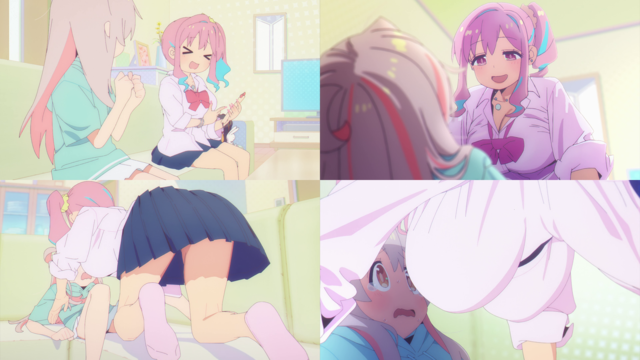
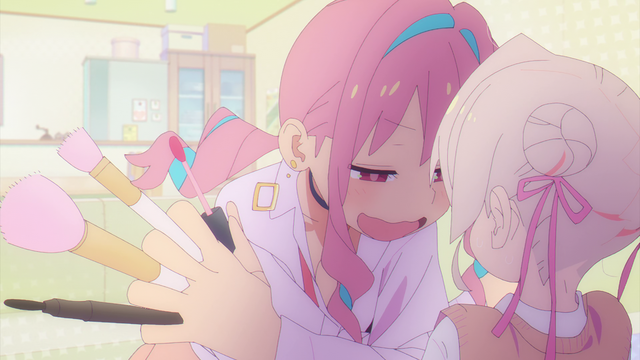
  • However, Onimai is not immune to fanservice, and when Kaede visits, she’s surprised to find that Mihari has an adorable little sister she’d never known about. Excited at the prospect of having someone to apply makeup to, Kaede’s excitement becomes off-putting to Mahiro, who assumes that Kaede’s intentions are less-than-appropriate. Looking through Onomai, the fanservice is, strictly speaking, unnecessary to the plot: even without Kaede’s assets, which appear to inexplicably change size depending on the moment, Onimai would’ve still succeeded in delivering its messages in an effective fashion. However, it is important to always consider why a creator does things in the manner that they do.

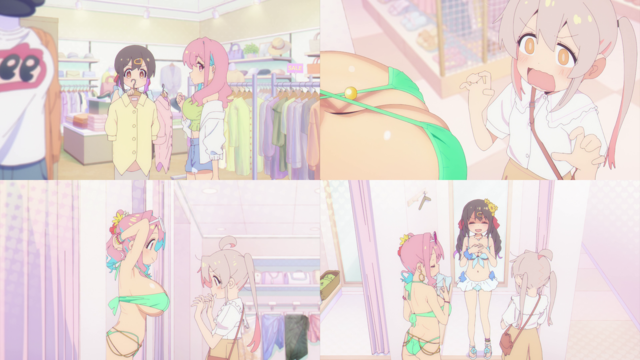
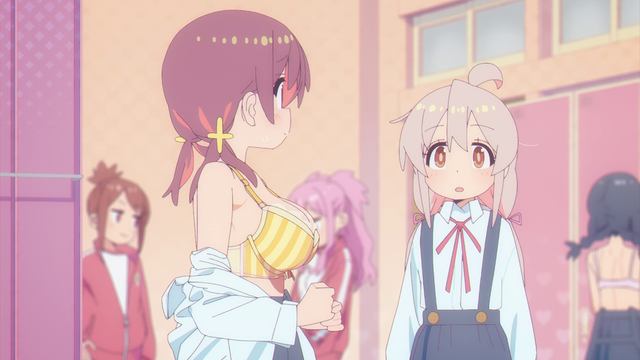
  • In Onimai, then, fanservice is present to accentuate how uncomfortable Mahiro is with women: for viewers, this is done in a comedic fashion and may elicit a few laughs, such as when Mahiro becomes more embarrassed with Kaede’s ample chest while they’re trying swimsuits out. Because Mahiro is shown as being into raunchy games and anime, this contrast becomes ironic because it suggests that, while Mahiro might have hobbies that aren’t seen as socially acceptable, he maintains a sense of decency. In this way, Onimai is suggesting that otaku who enjoy questionable works aren’t necessarily ill-adjusted individuals.

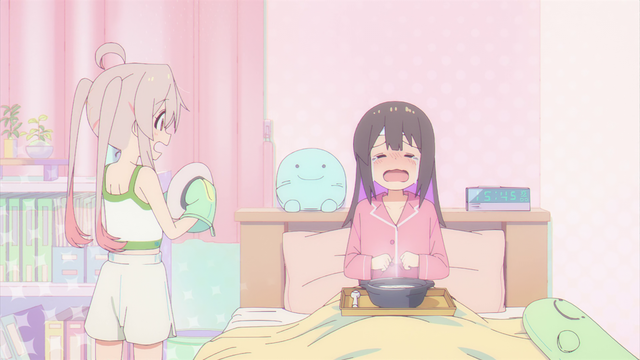
  • This is where Onimai especially excels, and given a chance, Mahiro demonstrates that he’s not completely a lost cause despite lacking any aspirations or career objectives. When Mihari falls ill, Mahiro does his best to look after her, and the fact that he put in the effort at all causes Mihari to burst into tears. Throughout Onimai, Mahiro always have the impression of being someone who ultimately wants to do good, but owing to reasons that haven’t yet been explored, he lost most of his motivation and retreated into the world of video games and anime. After watching Mahiro prepare congee for Mihari, I became a little more relaxed whenever Mahiro attempted something outside of his comfort zone.

  • I admit that for my part, I’m much happier in watching characters succeed when they put in a sincere and genuine effort. Once it’s established that Mahiro isn’t completely hopeless, Onimai reminds viewers that his current lifestyle isn’t sustainable. While out and about one day, Mahiro runs into an officer who wonders why a middle school girl isn’t attending school and becomes determined to figure out where Mahiro’s parents are. Because his body doesn’t line up with his age, Mahiro is now met with a new problem: he can’t go out during weekdays, and this means he’s restricted to lingering at home. This would go against Mihari’s hopes of rehabilitating Mahiro, but speaking to her patience, she doesn’t forcibly make him attend school.

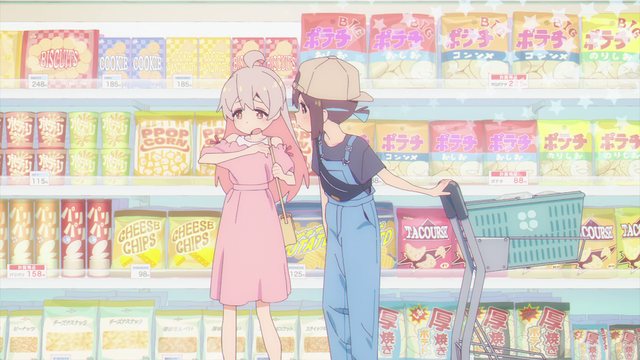
  • Instead, a series of happenstance events would naturally compel Mahiro to decide that there might be merit in returning to middle school. This is set in motion after Mahiro meets Momiji while out picking up some groceries for Mihari. Momiji is fond of dressing in masculine clothing, but despite appearances, she’s also kind. The pair strike up a quick friendship, and while Mahiro is a shade embarrassed that others feel he and Momiji are a cute couple, the two get along very well. It turns out that Momiji is Kaede’s younger sister, and because she’s the same age as Mahiro, it’s evident that she will be instrumental in helping Mahiro consent to return to school.

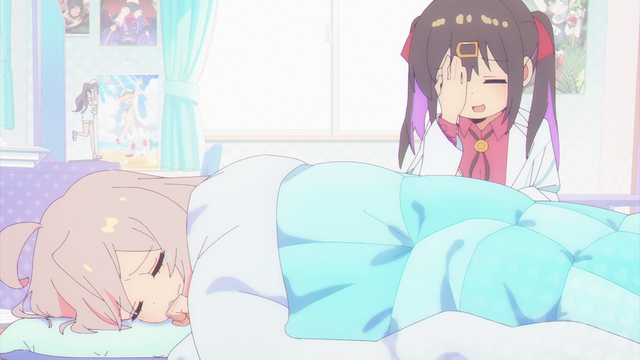
  • What I liked about Momiji’s introduction was how, despite adding her to the growing cast, Onimai wouldn’t ever put Mahiro in a situation where he would be forced to do something against his will. Instead, Onimai allows Mahiro to explore things at his own pace, and this means when he does make a choice, that choice is something that rests purely with him. This was visible in an early episode, when Mahiro is left to laze at home after Mihari heads to university. Revelling in his freedom, he orders takeout and plays games, but quickly grows bored enough that he would accept Mihari’s request to go out for groceries. Moments like these serve to remind viewers of how important it is for people to make their own calls.

  • Thus, even though being a girl might be a bit of a shock for Mahiru, he slowly acclimatises over time, enough to appreciate that it’s not all fun and games. Although Mahiru does take things in stride despite his reservations, suggesting that this is the central theme of Onimai is an answer that wouldn’t earn full credit. One of the reviewers at Anime News Network claimed that Onimai is “is a story about how big personal changes aren’t inherently scary”. However, this theme is incomplete and, quite frankly, is a very superficial take on the topic because it fails to account for how Mahiro’s situation offers him a second chance. Onimai could have been a controversial series had it focused on the lewd elements associated with a body swap and de-aging, but instead, because of what experiences Mahiro has, it becomes clear that Onimai is more than a mere tale of “growing to accept significant personal changes”.

  • Over the years, I’ve found that amateur writers who discuss anime for their own enjoyment tend to be a ways more reliable than those who write in a more “professional” capacity. This is because fans who approach a work from a position of interest, rather than a political agenda, are able to scrutinise a work more fairly and identify what worked, as well as what didn’t. At the opposite end of the spectrum, writers like those of Anime News Network, for instance, believe that because they operate more closely to the industry, they become an authority on anime and therefore, are able to determine 1) who has a voice and 2) what opinions have legitimacy. While some are hoodwinked by anime journalists, most readers are able to dismiss outlets like Anime News Network and make their own judgement calls.

  • As it was, Onimai is about how even the most demotivated and defeated individuals still possess a desire to better themselves, and with the right company, people can pick themselves back up. Because of Onimai‘s portrayal of Mahiro as an otaku with no aspirations and no drive, the changes wrought by Mihari’s experiment are especially visible as Mahiro slowly broadens his horizons. This is why Anime News Network’s claims about Onimai‘s theme is incomplete: if Mahiro had accepted his new situation as being merely “not scary, then it would’ve been sufficient for Onimai to simply have him continue to live his old life, without any significant changes. Instead, Mahiro slowly starts to return to the world, begins making friends and midway through the series, even begins to consider going to school after meeting Momiji’s friends, Asahi and Miyo.

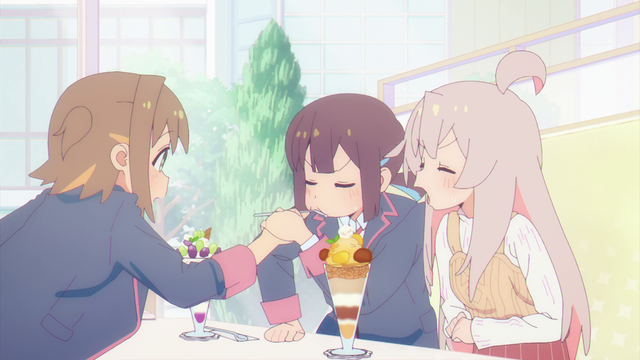
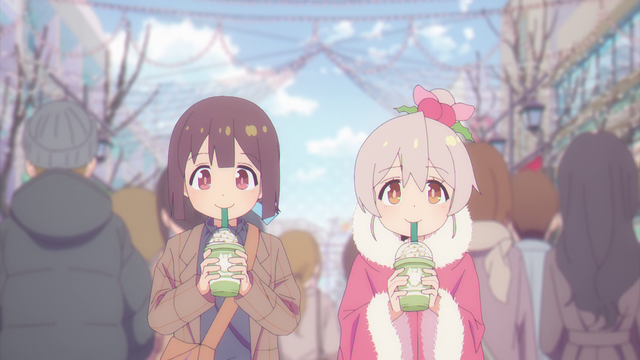
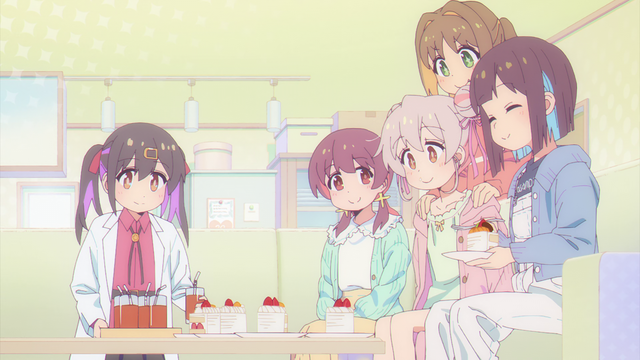
  • After meeting Momiji’s friends, Mahiro decides that there might be worth in going back to middle school: here, he hangs out with the others at a parfait shop, and this gives him a chance to get a measure of Momiji’s friends. Both Asahi and Miyo are colourful characters, and they also bring out a side to Momiji that had hitherto remained unseen: Momiji becomes visibly jealous whenever anyone takes a pass at Mahiro. Here, after Asahi tries to feed Mahiro some of her parfait, Momiji intercepts the spoon with a scowl on her face. Because Momiji is presented as a straight-laced individual, this side of her was quite unexpected and therefore serves to make her more life-like.

  • Of Momiji’s friends, Asahi is energetic and excitable, while Miyo is quiet and privately enjoys yuri. Seeing these contrasting personalities clash makes for some moments that wouldn’t be too out of place in something like YuruYuri or perhaps Kiniro Mosaic: while the fanservice piece in Onimai is quite apparent, the series’ better moments would be counted as adorable rather than questionable. I found myself thinking that, were Onimai to omit the fanservice and premise of Mahiro being a man transported into a female body, the resultant would still be a fun (if unoriginal) slice-of-life comedy. As it was, however, Onimai takes its premise and manages to do something unique, so I accept both the fanservice and premise as being a part of this work.

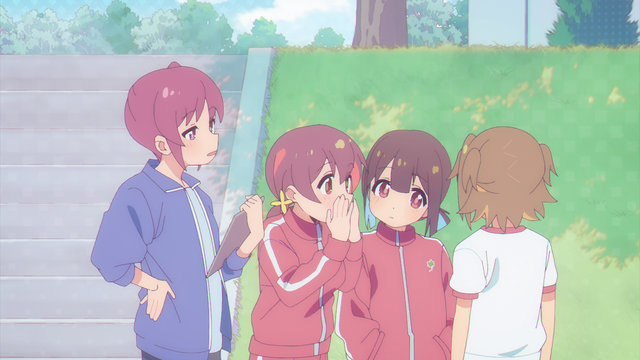
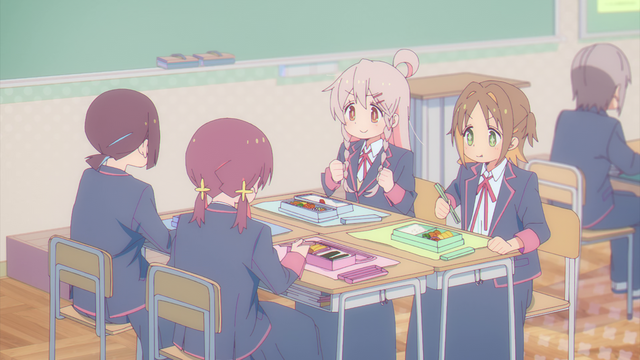
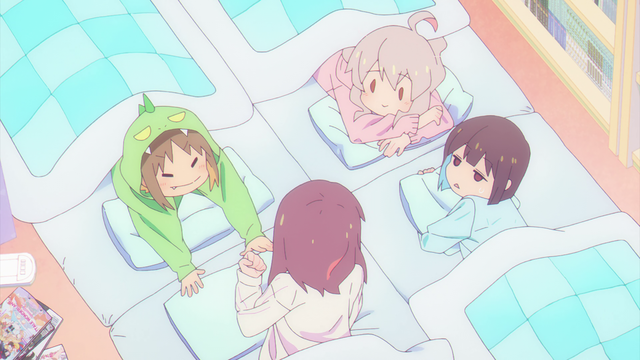
  • One of the earliest signs that Mahiro’s new friends are genuine comes during physical education: because Mahiro’s current body is comparatively frail, he’s unable to exert himself, and to cover for him, Momiji and the others tell the instructor that he was previously home-schooled as a result of illness and is susceptible to fatigue from things that other girls wouldn’t be bothered by. The instructor agrees to let Mahiro rest, and Mahiro is grateful, inwardly thinking to himself that he owes his friends one. While the lingering question of what would happen if Momiji and the others learned the truth always hung over my head, other stories, like Slow Start, in conjunction with how Momiji, Miyo and Asahi treat Mahiro, meant that there weren’t many moments where this was a source of concern.

  • When Mahiro proves suspiciously competent with maths, Momiji wonders what’s going on. Mahiro is less competent in other areas of study, and a thought returned to me: if I were to return to middle school now, I would almost certainly find the coursework trivially easy on the grounds that I’ve done it previously, and a bit of reason would allow me to effortlessly work out answers to things I may not be immediately familiar with (although I may get into shouting matches with instructors if I disagree with what’s being taught in social nowadays). Onimai partially takes advantage of this so Mahiro’s concerns lie outside of his studies, and while he is shown sitting exams and failing due to accidentally falling asleep, I found that allowing Mahiro to retain his old knowledge gives the story some flexibility, allowing it to place reduced emphasis on academics and studies.

  • Mahiro enrols at the same school Momiji, Asahi and Miyo attend, and this marks a turning point in Onimai. Meeting Kaede and Momiji may have catalysed incremental change, but minor mishaps while out and about means that Mahiro would have preferred to laze around at home. However, once peers are introduced, Mahiro is able to experience a side of life he’d once counted frivolous, and in learning to deal with people in an environment that makes no assumptions about his past, Mahiro is able to appreciate how his old assumptions weren’t entirely correct.

  • This is how Onimai‘s central theme comes about: Mahiro is functionally given a second chance, and while Onimai is no isekai, it similarly explores the idea that even the most defeated people can be motivated to turn things around if given a chance, and further to this, having the right support from friends and family is essential to this process. This is specific to Onimai and backed by Mahiro’s experiences. On the other hand, the suggestion that “big personal changes aren’t inherently scary” is generic enough that it cannot be said to be a theme: whether it be moving house and transferring to another school, exploring a new activity outside of one’s comfort zone or stepping up to defend what one holds important, all of those circumstances also entails a great degree of change that can appear intimidating at the onset.

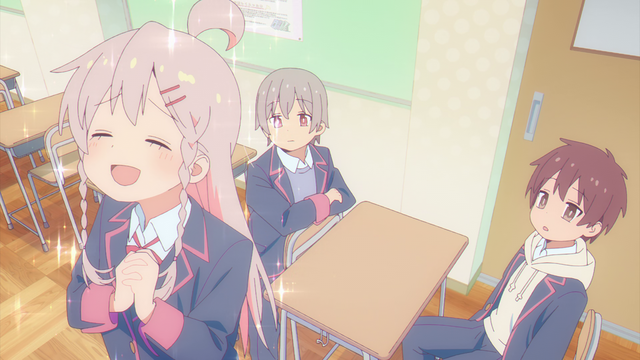
  • Onimai makes it very clear that Mahiro enjoys his life as a student; his new friends are quick to lend a hand whenever muscle memory kicks in, and amongst the boys, Mahiro’s old knowledge of games means he’s able to connect with them without effort. This gives him a bit of joy, and even when Mahiro accidentally lets slip he’s older than he appears by referencing an older game his classmates are unlikely to be familiar with, his female classmates step up and bail him out. Onimai had every opportunity to turn Mahiro into a punching bag and show how out of place he was, so it was pleasing to see that he’s actually getting along with everyone well enough.

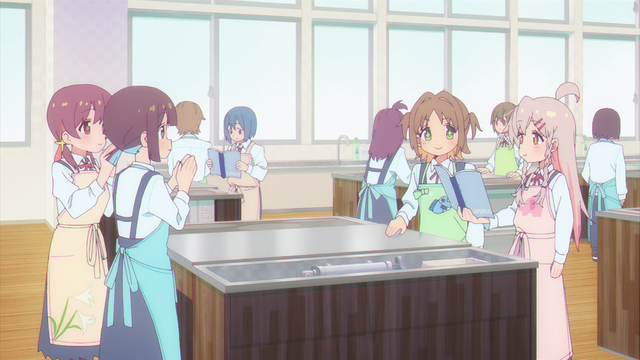
  • Similarly, when Mahiro takes on a home economic class and finds himself unprepared for the task, asking Kaede for help allows him to help contribute to his team’s success, yielding cookies that bring tears to Mihari’s eyes. The events that Mahiro experience are overwhelmingly positive, and this reinforces the idea that, whatever might’ve happened to him previously, his second chance is offering a significantly more positive experience, enough that he begins to genuinely enjoying being a middle school student. Mahiro does have a few moments where things don’t go quite as well as he’d like, such as when he fails his examinations due to carelessness, but setbacks are rare, reiterating that Mahiro was meant to enjoy his time as a middle school student.

  • As I progressed through Onimai, I found that the incidental music was surprisingly well-done. The soundtrack consists of an impressive sixty-three songs, ranging from light-hearted pieces for moments of comedy, to introspective and nostalgic pieces that do much to convey the side of Onimai a majority of  viewers found worthwhile. Onimai‘s soundtrack is composed by Daisuke Achiwa, who is best known for his work on the Atelier Ryza soundtracks. Elements of these fantasy works can be heard in some of the tracks, creating a feeling of yearning that mirrors Mahiro’s conflicting feelings about wanting to remain as a girl or return to his old body.

  • While looking at the audio side of Onimai, I learnt that this series has an all-star cast. Mahiro is voiced by Marika Kōno, whom I know best as Uma Musume Pretty Derby‘s Silence Suzuka, and Minami Tsuda plays Momiji. Tsuda has an impressive resume: besides Yuru Yuri‘s Yui Funami and Yui Ichi of Yuyushiki,  she’s also voiced Locodol‘s Misato Mizumoto (one of Nanako’s friends) and Mayu Amisawa of Comic Girls. Kaori Ishihara (Lan from Rinne no Lagrange, Nagi no Asakura‘s Sayu Hisanuma and Irodoku: The World in Colours‘ Hitomi Tsukishiro) voices Mihari, and Hisako Kanemoto (Ika Musume‘s Squid Girl and Kanata Sorami of Sora no Woto) voices Kaede. Such an illusterious group of voice actresses allows Onimai to be an auditory treat, and some of my favourite moments comes whenever Mahiro calls out Mihari’s name.

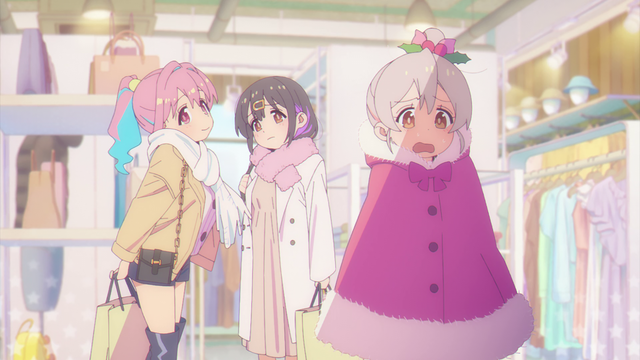
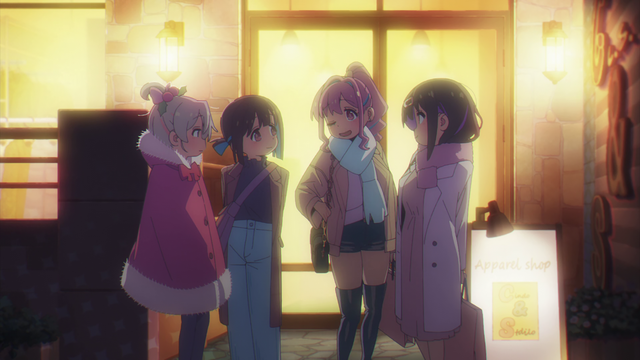
  • Close to Christmas, Momiji and Mahiro end up going on a date of sorts after running into one another: both had been concerned about their sisters’ respective plans for the day and took to tailing them, but along the way, Mahiro and Momiji end up having a great time of things, too. Eventually, the pair become distracted by shopping and get busted after Mihari and Kaede spot them, leading to this adorable moment from Mahiro: Mahiro’s coat makes him resemble a snow angel, and how he acts is actually par the course with his classmates and friends. Throughout Onimai, the precise nature of the compound Mihari’s concocted isn’t explained, and while viewers with a predisposition towards realism may balk at this, I found that how or why Mihari’s compound works is ultimately irrelevant.

  • Looking around the web, I found that Onimai received an unexpectedly warm reception amongst viewers, many of whom would similarly praise the heartwarming story and tale of individual growth. In fact, I was mildly surprised that even one of AnimeSuki’s most vocal and sarcastic critics concluded that Onimai was “the most well-done anime [of Winter 2023] “, citing that “the animation is nice and [Onimai] is fun to watch”, with “cute” characters and satisfactory comedy. Although these praises are generic and fail to articulate where precisely Onimai stands out, the fact that this individual found a satisfactory experience was unexpected because Onimai plainly shows that there’s more to life than anime and video games, and there have been multiple occasions where this individual reacted adversely to any slice-of-life series where the protagonist picks up a new hobby and broads their horizons as a result. Consequently, it is likely the case that this individual completely missed the point regarding Onimai.

  • Misunderstanding themes is not restricted the users at AnimeSuki: a number of people out there have also claimed that Onimai‘s themes lie in inclusion and gender affirmation, because it shows that Mahiro’s life is visibly better as a middle school girl. However, going purely from how Onimai turned out, this is untrue on the virtue that Mahiro’s life is largely free of conflict and worry. A story that deals with these topics in a more substantial manner would be more focused on Mahiro’s struggles to adjust and adapt, but since Onimai chooses to portray the more easygoing parts of Mahiro’s new life, it is clear that the story had not intended to deal with these topics.

  • The reality is that not everything is inherently political: while the abstract definition of politics encompasses any and all interactions between two or more persons, the commonly accepted definition is that politics specifically refers to anything involved in governance of a social group. As such, while “all art is political” holds true with the first definition (even a slice-of-life anime about fishing deals with interactions between two or more people), the definition no longer applies if the second definition is used. Thus, when it comes to art, a work is political if its themes relate to a population or society’s response to its government. Something like Gundam is political, but Onimai would not qualify under this definition

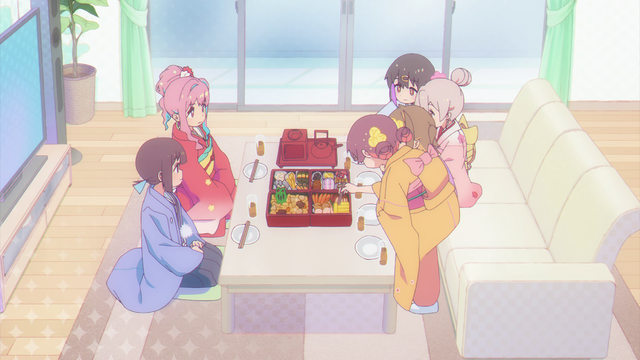
  • For my part, I maintain that there’s nothing wrong with works that aren’t political in nature; not everything needs to challenge a given mode of governance or social structure to be worthwhile, and in Onimai, Mahiro attending New Year’s festivities represents a wonderful chance for him to be out and about during a time of joy, amidst jubilant crowds. These crowds are a little off-putting, but Mahiro comes to enjoy the day, and similarly, despite Mihari becoming a little wild after partaking in some alcohol during lunch with the Hozukis, Mahiro finds himself having fun anyways and, perhaps in spite of himself, Mahiro genuinely looks forwards to what the new year brings.

  • Now that I think about it, Onimai could be considered to be the antithesis to what would be considered Kafkaesque: the term comes from Franz Kafka’s The Metamorphosis, which follows the events befalling Gregor Samsa and his transformation into a gigantic insect. The metaphor in The Metamorphosis parallels how a man’s worth is tied to his ability to provide for and support others, and this story describes how transformation and change is can be frightening and disorienting. Onimai, on the other hand, challenges this by having Mahiro embracing his new life and thriving. The key difference between Mahiro and Samsa is that Mahiro has family members supporting him, and because of this, Mahiro eventually cultivates the resolve to make the most of things, leading him to Momiji, Miyo and Asahi.

  • If Kafka suggests that change is debilitating and crippling when allowed to overtake one’s identity, then Onimai would counter by showing how when one has support and is allowed to incorporate change into their identity, one will flourish. The gap between rejection and support is immense, and in showing the opposite side of the coin, Onimai ends up being a very optimistic story; right from the start, Mahiro’s transformation was the result of his sister intentionally setting up an avenue for his change, and so, viewers were assured that Mahiro would never be shunned, ignored or rejected by those around him. The overwhelmingly positive tone in Onimai works to the series’ advantage, and as Onimai wore on, the story would allow Mahiro to increasingly become a source of support for those around him.

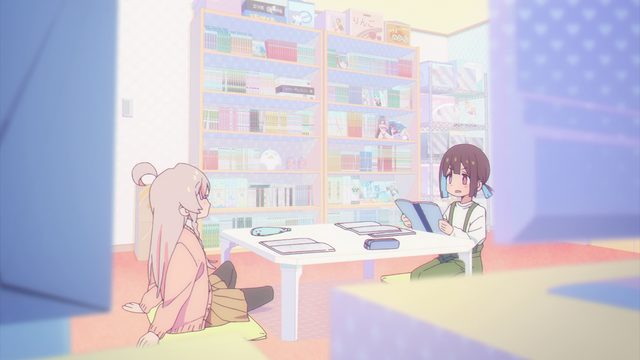
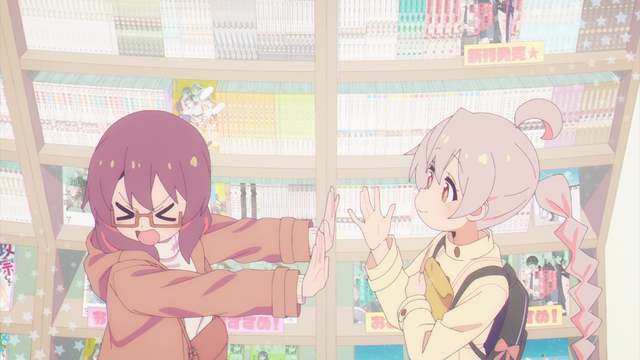
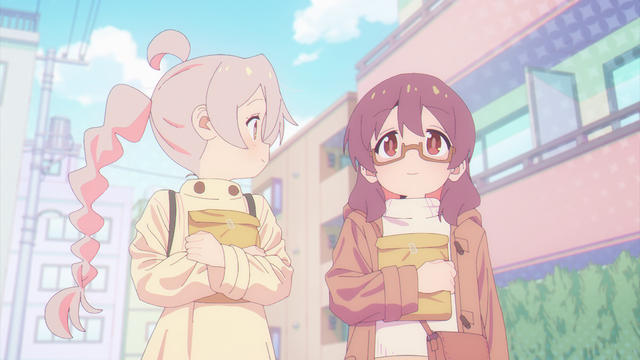
  • This was apparent when Mahiro runs into Miyo at the bookstore. After spotting some boys in his class considering sneaking into the adult section and watching them run off, Mahiro is surprised to learn that Miyo is a yuri fan, but reassures her that it’s acceptable to like anything of her choosing, and further to this, he won’t be judging her in any capacity, agreeing to keep her secret. This allows Miyo to bond with Mahiro – being an otaku, Mahiro would be well familiar with lewd and risqué works, and therefore, accepts that different people can have different tastes.

  • This provides Miyo with the reassurance that she’s okay to pursue her hobby without becoming an outcast. Until now, Mahiro was the recipient of support, so giving him a chance to lift others up was an especially rewarding moment to show – while being an otaku is less stigmatised than it was even a decade earlier, open admission of watching cartoons is still something most folks keep to themselves, and shows like Onimai can potentially lead to misunderstanding if context isn’t provided. For my part, however, I find that people tend to be pretty open-minded about anime, and thanks to Studio Ghibli and Makoto Shinkai, as well as more famous shows like Demon Slayer and Attack on Titan, anime is developing a reputation far improved from how folks perceived it back in the 1990s and early 2000s.

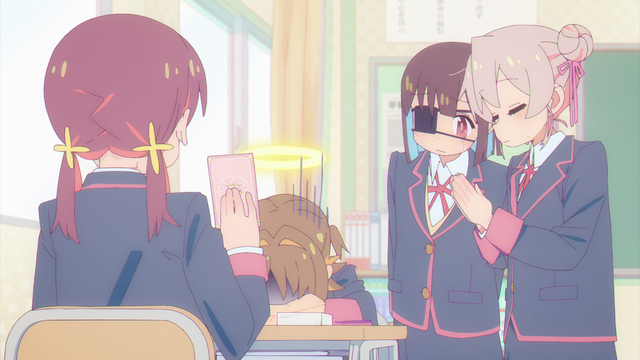
  • After Mahiro joins in on the latest horoscope and occult craze, he arrives at school one day to find Momiji boasting the style of a chuunibyō and Miyo playing with tarot cards. Later, Mahiro begins to lose confidence when his friends ditch him; stung, he retreats to his room, but after receiving some words of support from Mihari, Mahiro learns the truth – Miyo and Momiji had been planning something for his birthday, but also knowing that Asahi is bad with secrets and surprises, gave her a red herring of sorts. Although Mahiro had been on the money with his initial assumptions, the fact that he began doubting himself was a hint of how much he’d come to treasure his new friends.

  • In the end, Mahiro’s hunch had been correct, and his friends had indeed been planning out something for his birthday. Serendipity is a big part of Onimai, and although it feels as though things tend to work out for Mahiro, the reality is that as a middle school girl, Mahiro is much more considerate, thoughtful and observant than he once was. The kindness that he extends to others comes back to reward him, and this is why it is touching to see Mahiro making new memories with his new friends – as a shut-in, Mahiro would’ve been excluding himself from the world and remained unaware of the merits of camaraderie.

  • Beyond the social aspects, Onimai‘s portrayal of the challenges Mahiro faces after his transformation into a middle school girl also hints to viewers the importance of not passing judgement on others until they’ve walked a mile in their shoes. Many romance comedies parody this, with men failing to understand why women take a longer time to prepare – whereas men can just throw a clean shirt and presentable pants on, then comb up their hair and pop on a wristwatch within the space of five minutes, women require time to coordinate their outfits, apply any make-up, double check their hair’s serviceable and a host of other things that men wouldn’t need to consider. The point of highlighting this is to provide insight into why there’s such a gap and remind viewers that things aren’t always fun and games.

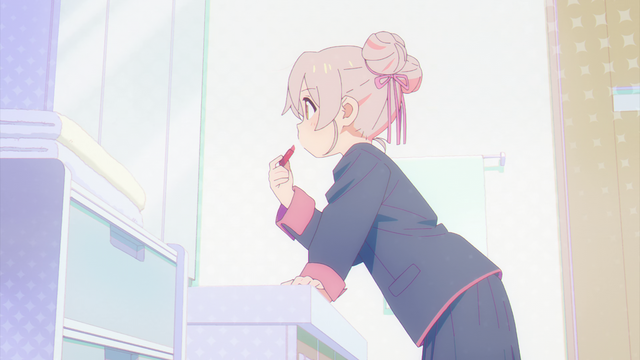
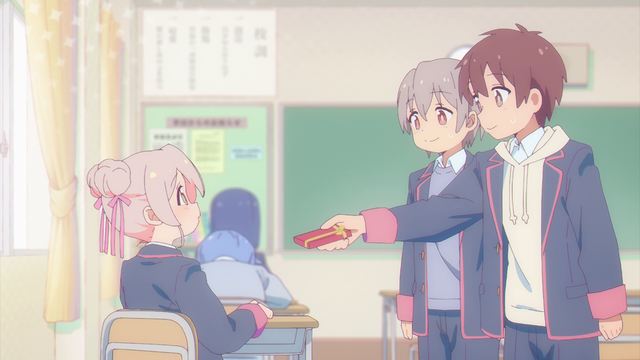
  • At the same time, Mahiro finds that being female changes how the world regards him: when Mahiro receives a pile of chocolates from his female classmates on Valentines’ Day and hands out an equivalent amount to his classmates, he impresses his female classmates and captures the hearts of some male classmates in the process. Showing both sides of the coin invariably leads Onimai to suggest that both men and women have their own share of challenges in life, but at the same time, there are also aspects that make it worthwhile for both. This was visible earlier when Mahiro decides to try a more subtle brand of lipstick that his classmates immediately notice, but while they’re quick to praise him, he also gets a talking-to from his homeroom instructor.

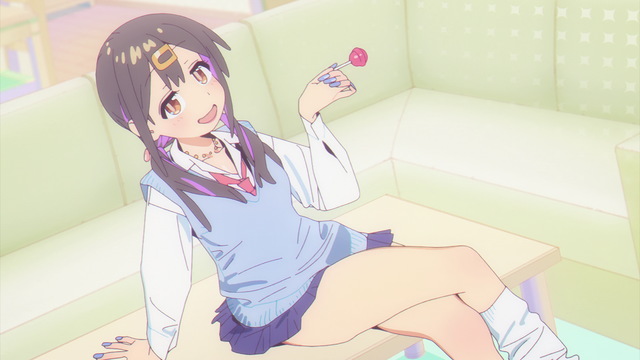
  • Rather than acting as a social commentary, however, Onimai‘s messages are meant to motivate viewers to reflect on things at the individual level. The combination of applicable lessons from Mahiro’s day-to-day life, combined with well-timed comedy, allows Onimai to do more than its premise suggested. In conjunction with surprise moments that allow characters to show off different facets of their personality, such as when Kaede helps Mihari to adopt the look of a gyaruOnimai is able to accentuate the fact that people are multi-faceted. It is therefore unsurprising that amongst Japanese viewers, Onimai was such a hit, and amongst English-speakers, a majority of viewers similarly found enjoyment within the series.

  • The “Terrible Anime Challenge” piece to Onimai came about because I wasn’t certain if that I would enjoy this series to the same extent others had: coming to the party two years later and without having read much on the series, I had a clean slate to approach Onimai with. When I finished, I would conclude that this anime matches expectations the community had set. This is my favourite outcome, since I enjoy seeing 1) whether or not I like things that others sing praises for and 2) whether or not I end up reaching the same conclusions other viewers do. I find that for especially well-written works, 2) usually holds true – for Onimai, most viewers would draw similar conclusions as I did, and this is the case because the work was able to clearly present its themes to viewers

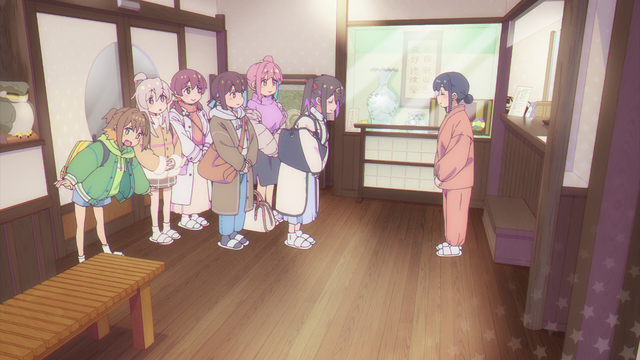
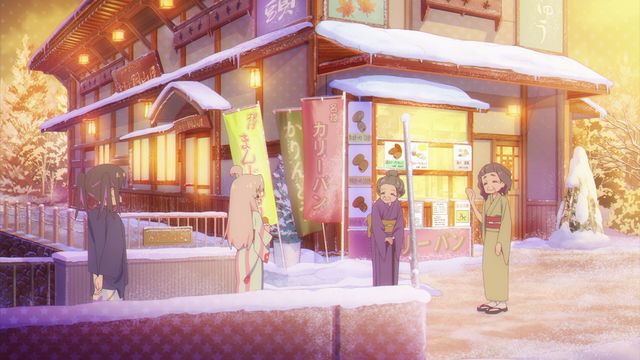
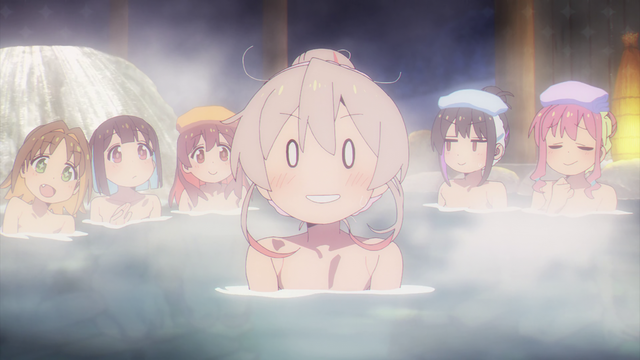
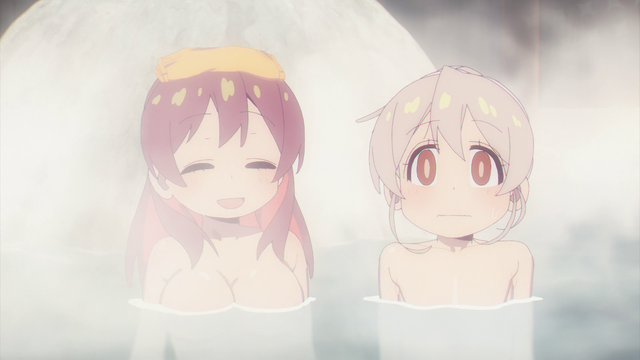
  • Onimai‘s final act has Mahiro joining the others on an outing to the onsen, and this last part, while counted as being somewhat controversial because of the fanservice piece, also acted as a suitable conclusion for the series. The wooden buildings and presence of snow suggests that Mahiro and the others went to Ginzan Onsen, a famous hot spring town located in Yamagata Prefecture. Founded in the fifteenth century when silver was found in the area, the town would slowly transition over to hot springs and presently, Ginzan Onsen is counted as one of Japan’s most picturesque destinations to visit during the winter.

  • With an independent tour of Japan’s Seto Inland Sea area and Kyoto under my belt, it is not lost on me that in the future, there is merit to travelling to Ginzan Onsen and staying a few days here during February. The combination of low-season prices, onsen, peaceful hikes and a storybook townscape would be an ideal return trip, one of many that I’m considering. However, with a Year of the Snake horoscope encouraging me to be more financially prudent and mindful of my digestive health, I see that as a sign to take things easier – just because I can fly to Japan and enjoy their onsen doesn’t mean it’s necessarily a good idea to do so, and looking back at 2024, my horoscope does have some merit: in building up a good kit, I spent too much money on lenses.

  • The plus about this is that I’m now left in a position where I’m not left wanting more glass. During the past week, while volunteering for the Chinese New Year events downtown, I brought my 20mm f/1.8 and a 28-200mm f/2.4-5.6. My prime lens performed consistently, but I found myself surprised at how sharp and versatile the super-zoom was in performance photography. Even at a range of 20 metres from the stage, having a telephoto meant I was able to take photos that looked as though I was standing a few metres from the performers, and while I’m still new to the techniques for shooting sharp photos at range, when things lined up, I found myself with stunning shots. Satisfied my lenses work for me, I should be able to make good on my promise to not purchase more lenses this year.

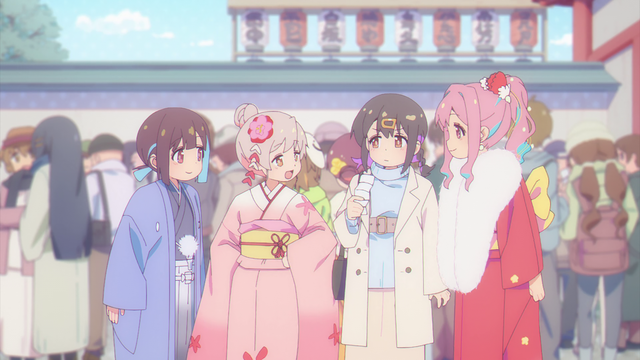
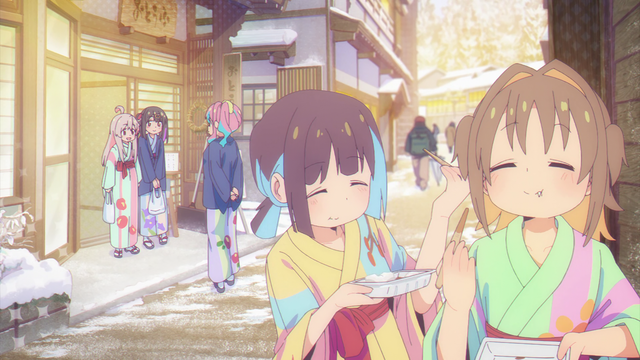
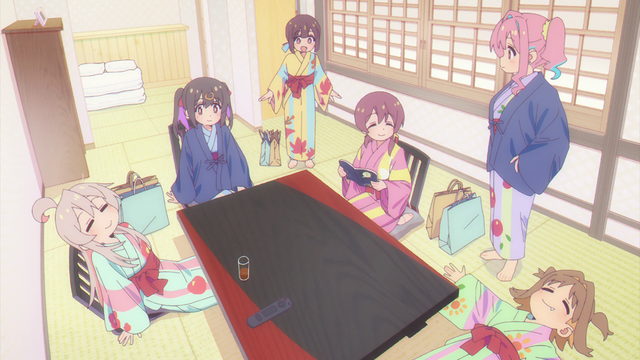
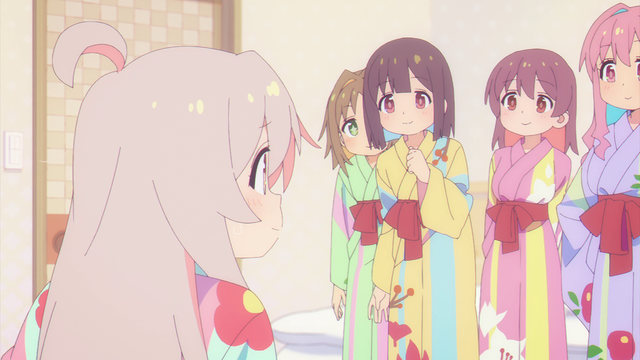
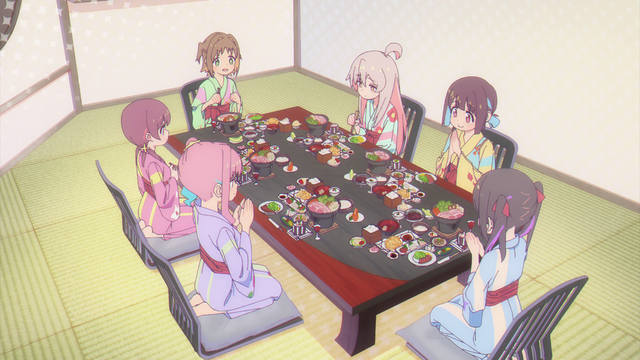
  • Back in Onimai, Mahiro and the others evidently have had a wonderful day exploring the onsen town in traditional attire, checking out shops and sampling the regional street eats. Anime are fond of showing characters eating snacks with nontrivial frequency, and something like this would be unfeasible in North America, where a simple coffee can send one back six bucks. However, when I was in Japan, I would see for myself that snacks actually aren’t all that expensive in some places; one can have an ice cream for 200 Yen, and meat skewers are only 300-400 Yen. When combined with the fact that a bowl of ramen can go for as little as 700 Yen, one can space their meals out over an afternoon, as opposed to eating one larger meal.

  • Onimai understands that it wouldn’t be an onsen episode if the characters didn’t actually get to soak in the hot mineral waters of Ginzan Onsen. Earlier in Onimai, after their water heater fails, Mihari had taken Mahiru to a local sento, but the hour meant that nothing unfortunate would happen. Here, however, Mahiro panics at the thought of seeing Kaede and Miyo in their birthday suits. He becomes flustered at their undressing, and while viewers understand full well why this is the case, one can imagine that for Kaede and the others, Mahiro’s just being shy.

  • For my part, I found that having Mahiro demonstrate decency enough to be shy was a good indicator of his character – in KonoSuba, the same thing had happened to Kazuma after he unintentionally swapped bodies with Iris, and while he wants to enjoy being able to see Darkness and Claire, his own reservations had kicked in. Similarly, while Mahiro is accustomed to his current body at this point in time, he cannot help but feel he’s doing something indecent when he’s looking at Miyo and Kaede.

  • Thus, once Mahiro gets into the onsen itself, things get a little tense, preventing him from relaxing. Asahi and Momiji attempt to get him to lighten up, but it is here that Mihari’s compound begins to wear off. When Momiji grasps something unusual, she begins to wonder what’s going on, and Mahiro falls into a panic, worried about both being found out and losing his friends. While strictly speaking, Momiji needn’t have been the one to find out in this fashion, the notion of Mahiro being forced to make a decision about whether to take another dosage or return to his old self would act as a suitable concluding act for Onimai.

  • The fact that Mahiro doesn’t even hesitate to take a new dosage shows how much he’d come to value Momiji, Asahi and Miyo as friends – faced with the choice of idyllic days with friends, or a solitary lifestyle in front of his computer, Mahiro’s act of picking the former speaks volumes to the author’s thoughts on those who’ve given up. Hinting at how even shut-ins can be encouraged to re-enter the world, Onimai would show that support and friendship are essential parts of the process. This theme is nothing new: in 2018, Slow Start would show Hiroe Hannen going through the same process where, after missing a post-secondary entrance exam, Hiroe would become a recluse until Hana and her friends would eventually lead her to regain her old confidence, enough to reattempt a post-secondary entrance exam.

  • Slow Start was focused on Hana learning how her classmates don’t actually mind she’s a year older than everyone else and lacked anything fanciful: Onimai‘s premise, on the other hand, counts on Mihari’s compound to set things up. Despite the gap in setup and intentions, both Onimai and Slow Start were ultimately successful in conveying its message, acting as yet another source of encouragement for folks who find themselves stumbling in life or know someone who could use a boost; being there for someone and letting them regain their old strengths is the healthiest way, and even thought this process could take some time, it will yield more sustainable, meaningful results than more fast-paced, aggressive methods. Onimai might be centred around Mahiro’s growth as an individual, and because this entails the ordinary side of life, the anime does pay attention to some of the more memorable meals Mahiro shares.

  • This was a perfect way to spend a quiet Sunday, one where temperatures dipped to -22ºC. I ended up spending the morning at a nearby bookstore, where I picked up The Hunt For Red October and Mono, a new manga by Yuru Camp△‘s Afro. Dealing with photography and local exploration, Mono is right up my alley and is scheduled to air in April. Because of its topics, I intend to write about this one episodically – I have an inkling that Tango-Victor-Tango’s WarriorsGate will probably start shooting the breeze about photography and exploring local attractions, but because I have practical experience in these arenas (as readers can attest), it’ll be my pleasure to show the difference between someone who gets out there and is open to learning (i.e. me), versus someone who sits in front of their computer all day trying to be right on the internet.

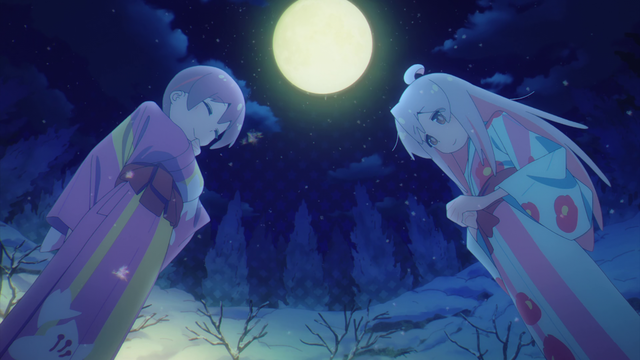
  • Returning to Onimai, after learning he’s slowly reverting back to his male body, Mahiro becomes both concerned the others won’t accept him in his original body and disheartened his enjoyable time with Momiji and the others is drawing to a close. After spending time with everyone under a full moon, Mahiro decides he wants to remain a middle school student for a little while longer and agrees to a second dose, confirming that he has made strides throughout Onimai. When playing around earlier, Momiji had thought she’d gotten a handful of something unusual, and concerned there’s something off about Mahiro, she decides to confirm things for herself. The next morning, Momiji doesn’t remember what happened, to Mahiro’s great relief; this allows for the status quo to be preserved.

  • Altogether, Onimai far exceeded expectations, being a heartwarming and touching series that merits an A grade (4.0 of 4.0, or 9 of 10). Aside from the occasionally gratuitous fanservice, which still served a meaningful function, Onimai was both adorable and instructive in reminding viewers of how important support is towards helping people grasp a second chance and capitalise on it to lift themselves up. Further to this, Studio Bind did an excellent job of bringing the series to life: this newer studio was a joint venture between White Fox (GochiUsa‘s first season) and Egg Firm (Kandagawa Jet Girls, Endro! and Konohana Kitan), and for Onimai, they rose to the occasion. Because of the series’ popularity in Japan, as well as the fact that the original manga is ongoing, it is not unreasonable to suppose that a second season isn’t outside the realm.

  • Rounding out this post is a brief explanation of the page quote – because Onimai‘s English subtitle is “I’m Now Your Sister!”, one could easily surmise that after Mihari turned Mahiro into her younger sister, the moment was similar to an iconic line from Captain Phillips, where after pirate Abduwali Muse (Barkhad Abdi) takes over the Maersk Alabama, he confronts Captain Richard Phillips (Tom Hanks) and declares that he’s in control of the situation. The line quickly became quotable because of its applicability to a range of circumstances, and people tend to use it when the shoe’s on the other foot: in Onimai, Mahiro was once the older brother, but since Mihari becomes the older sister now, she is in effect, the captain. Mahiro doesn’t particularly suffer for this turn of events and finds that living in the moment has merits worth remembering.

That Onimai would ultimately speak to how second chances can give people a new perspective on life, sufficient to appreciate things one previously dismissed, was an unexpectedly pleasant aspect to this series, one which far eclipses its initial impressions as a low-brow comedy. In this way, Onimai far exceeds expectations resulting from its premise; at first glance, Onimai would amount to little more than a fanservice-filled story that would treat Mahiro as a punching bag. However, when the series is watched in whole, it turns out that Mihari’s experiment, seemingly random and in violation of ethics in human subject research, was intended to give her older brother a second chance to live the life he previously shied away from. Seeing the outcomes awaiting Mahiro would show that, rather than being some mean-spirited trial “for science”, Mihari’s choice to turn Mahiro into a middle school girl was her way of trying to remind him that she still cared greatly for him. This would account for why, whenever Mahiro steps up for Mihari despite his previous disinclination to do so (such as trying to cook for Mihari when she develops a cold, and when she gives Mihari some cookies she’d made with friends in home economics), Mihari would dissolve into tears. At the end of the day, folks who can look past the (admittedly extraneous) fanservice will find Onimai to be unexpectedly touching – Onimai is a fantastic example of why it’s so important to avoid judging books by their covers. Despite its dubious premise and unnecessary fanservice, the underlying tale of how Mahiro would come to regard his friendship with Momiji, Asahi and Miyo as treasures, as well developing a newfound appreciation for Mihari, were aspects that allow Onimai to convey a touching and engaging tale, one that is likely to be remembered as adorable and heartwarming than it was unsavoury and crude. With such an outcome, it was no surprise that Japanese viewers thoroughly enjoyed Onimai, which was acclaimed amongst Japanese critics. Even English-speaking critics, normally adverse to fanservice for its propagation of “questionable” morals, reluctantly admit that Onimai was able to do more than its premise would suggest, and as such, despite being the kind of anime that superficially appears to be something that pushes all of the wrong buttons, Onimai would, in fact, end up saying something meaningful in a way that makes it worth watching.

Masterpiece Anime Showcase: Hanayamata and Celebrating Colourful Blooming Flowers – Revisiting A Concrete Example of How Embracing Rejection and Applying the “Do Something” Principle Acts as a Driver of Growth

“It’s not for someone else, but for myself. If I work hard, I can come a little closer to being the person that I want to be.” –Naru Sekiya

Naru Sekiya is an outwardly unremarkable middle school student who spends her days practising iaido and would prefer to lose herself in færietales. A fateful meeting with the enigmatic but spirited Hana Fountainstand spurs her into the world of yosakoi, and while Naru initially resists joining Hana, once she allows herself to accompany Hana, she slowly begins to change as she overcomes her shyness and fear of failure. Along the way, Naru manages to recruit the graceful and refined Tami Nishimikado, the beautiful and talented Yaya Sasame and the proper, serious Machi Tokiwa into the fledgling Yosakoi Club. Doing her best to contribute to the club, Naru and the others come to regard Hana as a dear friend and strive to fulfil a promise to perform together, and while the Yosakoi Club’s journey is fraught with challenges (performances don’t go as planned, and Naru requires a bit of work to improve her physicality), the girls find that their time together has forged them into closest of friends with a shared goal, one that is able to endure even in the face of an unexpected challenge when Hana suddenly moves back to America. 2014’s Hanayamata, a coming-of-age tale of five girls brought together by yosakoi, proved to be a controversial series, accompanied by flippant and superficial discussions that offered limited substance. When I came upon the series for myself, four years after its airing, I found a remarkable and sincere tale of how yosakoi would unify five different individuals, giving them a shared goal that allowed each of Naru, Yaya, Tami and Machi to overcome individual hurdles. This journey is fraught with challenges – Naru doubts herself and is initially quick to discouragement, Tami worries she’ll lose her father’s approval of she should pursue something new and fun, Yaya is jealous of Naru’s growth and becomes despondent when her band dissolves, and Machi is initially reluctant to support her Yosakoi Club because of a feud with her older sister, the club advisor. Watching the girls incrementally overcome their inner dæmons and doubts to achieve something of note proved a remarkable experience, and I found that Hanayamata was far more than what internet reviewers claimed the series to be, an unexpectedly pleasant and touching tale with merit. However, a full decade after Hanayamata‘s airing, a desire to revisit the series manifested, and I would return to watch the series anew. It’s been six years since I watched the series, and in the time that had passed, I’d forgotten most of the details. This allowed me to watch Hanayamata as though it’d been my first time, and this re-watch would, unsurprisingly, bring with it a new set of thoughts that allows Hanayamata to be the first anime I’ve written both as a “Terrible Anime Challenge” and “Masterpiece Anime Showcase”: the messages in Hanayamata have aged quite gracefully, and I found myself thoroughly impressed with what this underrated and under-appreciated series achieved during its twelve episode run.

On this revisit, I found that Hanayamata deals with a critical element that is often forgotten in life: the courage to say “no” and establish firming boundaries. At the onset, three of the Yosakoi Club’s members lack the ability to do this. Hanayamata openly has Tami personify this: she is completely devoted to her father’s happiness and in the past, actively made choices she believed would please her father. Tami was shown as having unhealthy boundaries, believing her father’s happiness was her own, and so, pursued activities for her father’s sake rather than her own. When she sees Naru and Hana having fun, her beliefs are shaken, and she becomes conflicted over whether or not she should pick up yosakoi. A vague remark from her father, indicating potential disappointment, is enough to send Tami back, but she ultimately finds the strength to say “no” and pursue yosakoi anyways. As it turns out, her father was actually more disappointed Tami was quitting something he assumed was dear to her, and open communication would rectify this. Although he does not initially agree with Tami, he allows her to continue, and seeing Tami on stage with Naru and the others puts a smile on his face; Tami has clearly put her all into yosakoi and continues to uphold the values he’d wanted her to learn. Similarly, when Machi reveals her reason for putting in such a serious effort towards academics, it was purely so she could uphold the old promise she made to her sister and work as a doctor at the hospital her family runs. When she was younger, Sari had been a talented student with a bright future – her parents expected her to uphold their wishes, but in tutoring Machi, Sari developed an interest in teaching and eventually ran away from home when her parents refused to allow her to pursue a new career. Outwardly lazy and disorganised, Sari proves to be a competent teacher who’s at peace with her decision, and in learning to say “no”, Sari would come to find a path that she was more comfortable with. Similarly, when Machi learns to say “no” and reject her own misconceptions about Sari, she makes peace with her own doubts and is able to find a newfound freedom in performing yosakoi. The same problem also impacts Naru, who was under the impression that her father would only approve of her practising iaido and ultimately took up yosakoi secretly, only to learn her father was, in fact, okay with this because it allowed her to grow beyond the færietales she lost herself in. Yaya, on the other hand, was bound by her own expectations: accustomed to being the cool, supportive friend for Naru and confident in her ability as a drummer, Yaya is devastated when an failed audition causes her band to fall apart. Without a sense of identity, Yaya becomes withdrawn and touchy. It takes a bold move from Naru and Hana (namely, insulting Yaya at the top of their lungs from the school rooftop) to convince Yaya that she still has a place to belong to, and in time, rejection from her band’s failure would clear a path for something new. For each of Naru, Yaya, Tami and Machi, learning to accept rejection and reject things they do not feel are of value helps everyone to step up and mature; in time, when Hana finds herself facing the same situation, she is able to set her boundaries and declare that, promise to her mother or not, she wants to perform yosakoi alongside Naru, Yaya, Tami and Machi, allowing her to now have the freedom to pursue a path of her choosing.

Beyond learning how to set boundaries and gracefully handle rejection, both of other snad from others, Hanayamata also provides a visceral illustration of something colloquially known as the “Do Something” Principle. This simple premise argues that doing something, anything, creates a positive feedback loop in which action drives inspiration, in turn creating motivation. Traditionally, people will take action when they believe they feel motivation to do something, but this typically results in inaction and apathy; if things don’t feel just right, it’s easier to idle in complacency than it is to do something and risk failure or disappointment. However, the “Do Something” Principle accepts failure as a normal and expected outcome, encouraging people to pick themselves back up and try again. As one incrementally learns and improves, motivation eventually follows and results in action that has positive, tangible outcomes. This most is visible through Naru, who begins her journey as an uninspired and introverted girl who is resigned to routine. Even when she’s granted a chance encounter with the lively and energetic Hana, Naru proved resistant to Hana’s effort to introduce her to yosakoi. Initially, she makes excuses to avoid Hana and yosakoi. However, when Hana comments how having nothing renders Naru a blank slate, Naru realises she has nothing to lose. Seeing how much fun is possible, Naru decides to take that critical first step, and in doing so, she ends up doing something. Granted, her journey will be fraught with setbacks: recruiting isn’t easy, and Naru’s newfound passion initially creates a rift with Yaya, forcing Naru to step up and show her that she’s serious about yosakoi. On this performance, Naru trips and falls. However, despite the falls, trips and stumbles, Naru continues to pick herself back up. Every time she fails, Naru learns, and as she spends more time with Hana, the joys of yosakoi continue revealing themselves to Naru. This theme ends up being a highly encouraging one: from the viewer’s perspective, if someone as clumsy and unremarkable as Naru can reach such heights through support from her friends and her own innate desire to explore further, then it is possible for one to take on a new hobby or skill in a similar fashion, as well. The second of Hanayamata‘s themes is one that is universally relatable: anyone who’s started anything new, in spite of the possibility of failure and disappointment, and persisted because of a desire to learn and improve, will relate to Naru’s journey. In committing to yosakoi, Naru defines a very clear path for her future. She now has something concrete to work towards: dancing on a stage, creating colourful costumes, helping draft choreography and providing feedback on music provides Naru with appreciation of how deep yosakoi can be, and in doing yosakoi, Naru becomes exposed to a wider range of skills. Having a single point of commitment gives Naru focus, and she is now encouraged to learn things that feed back into her desire to continue yosakoi. In the short term, this will improve her yosakoi, but in the long term, the things she picks up could find applicability in other areas of her life, too. All of this happened because Naru was able to take the plunge and try something new, and by the end of Hanayamata, not only has Naru found something concrete to work towards, she’s also encouraged and supported others, in turn allowing others to support her, too. While life isn’t a færie tale of the sort that Naru might be fond of, she’s found a newfound magic that makes life even more fulfilling than what she’d imagined to be possible.

Screenshots and Commentary

  • When Hanayamata aired, it would’ve been back during the summer of 2014, during a time when I’d been completely swamped with work on The Giant Walkthrough Brain and no fewer than four other anime (LocodolGlasslipRail Wars! and Sabagebu!). Although Hanayamata was clearly within my realm of interests, I wouldn’t get around to watching it until some four years later. In the present, it’s now been a full decade since Hanayamata finished airing, and in that time, the series is one that is forgotten to time – as memory serves, reception to the series was mixed to positive, with criticism being directed at the characters for being melodramatic, and because the series was counted as clichéd.

  • On the other hand, Hanayamata was praised for its sincere story, likeable characters and stunning visuals: at first glance, one might imagine that Kyoto Animation, A-1 Pictures or P.A. Works produced Hanayamata, but in reality, Madhouse (Frieren, A Place Further Than The Universe, Death Note and Chobits are but several of many productions in their respectable resume) was the producer. The gorgeous artwork drew viewers in from the start, and while some commented on how the artwork and animation appeared to outshine the characters, the choice to go with such a style was deliberate, meant to give a færietale-like aesthetic to the story surrounding Naru, her chance encounter with Hana and entry into yosakoi. The choice to have Hana and Naru meeting at a moonlight and lantern illuminated shrine under blooming sakura gives the first episode a distinctly Japanese fantasy sense to reiterate how Naru, despite her belief otherwise, ends up stepping into a færietale of her own.

  • In the ten years since Hanayamata aired, the manga has concluded fully. Altogether, a total of ten volumes of Hanayamata were released, with the manga running from 2011 to 2018, and in retrospect, I find it a serendipitous coincidence that I wound up watching and writing about the anime the same year the manga concluded. Because of limited interest and discussion elsewhere on the ‘net, this revisit will focus on re-examining my old perspectives of the series and how the series aligns with what I know.

  • I won’t be alone for this revisit, however – last June, I ended up buying Hanayamata: Colourful Flowers, the official TV animation guidebook for the series. As with other official animation artbooks I buy, Colourful Flowers is filled to the brim with director’s commentaries, character profiles, cast interviews and behind-the-scenes concept art, as well as unreleased key visuals and artwork. Such compendiums are treasure-troves of information, and a read through finds that, like other slice-of-life series, Hanayamata was far deeper and more meaningful than most fans give it credit for.

  • In the first episode alone, the director’s commentary reveals that the directors were very careful to frame thing, like the direction of Naru’s walk through a train crossing, to show that despite her desire to move forward, she was actually going backwards. Similarly, the first episode also establishes the dynamic and focused Yaya, and the polite Tami: through subtle things like speech patterns, and cuts to their activities, Hanayamata was able to give its other characters exposition through short scenes and set the table for what was coming. Insights like these are valuable because they communicate what the staff had intended each scene to achieve within the context of the narrative.

  • In the absence of this additional information, viewers tend to focus on the superficials. In the case of Hanayamata, some discussions ventured into the realm of whether or not Hana is an ancient astronaut given her acrobatic prowess and tried to over-analyse how her open, direct manner was causing Hana to become alienated her from her peers, the director’s commentary shows that the writers were deliberately accentuating Hana’s extraordinary manner to show that despite the contrast between Hana and Naru, Hana’s formative interest in yosakoi parallels Naru’s own love of færietales, and as such, there can be a common ground between two polar opposites. This is what compels Naru to bite the bullet and give yosakoi a go, setting in motion the series’ events.

  • After Naru joins Hana, the consequences on the dynamic between Naru and Yaya become pronounced: outside of dialogue, the staff also spent a considerable effort in using framing to remind viewers of how jealous Yaya was getting – until now, Naru had depended on Yaya, and perhaps as a result of her constantly supporting Naru, Yaya’s become very attached to Naru. Thus, when Hana comes in and encourages Naru to stand of her own accord, Yaya feels as though a part of her is being threatened. The director’s commentary adds that how Yaya, Naru and Hana are placed on the stairs mirrors their moral position – jealousy and resentment causes Yaya to lash out and hit all of Naru’s weak spots, causing Naru to step up and say she’ll prove to Yaya that she can rise above them. Although Yaya resorts to trying to inflict pain, Naru’s newfound determination allows her to find a mature way of hitting back without falling to Yaya’s level, and indeed, she would end up dancing for Yaya despite lacking any experience.

  • Masuru Ōfuna, owner of a yosakoi shop, is a wonderful asset in Hanayamata – despite his appearance, he’s a kind, considerate and enthusiastic individual who’s more than willing to help Hana and her friends. The anime emphasises how despite being 33, he’s still single. In spite of this, Masuru’s character is handled in a mature fashion; he matches Hana in passion for yosakoi, and throughout Hanayamata, he’s seen as being present at different events to volunteer and help out. The production team was fond of how his appearance and characteristics clash, since it acts as a reminder of how looks are not necessarily indicative of one’s traits.

  • The youthful substitute instructor, Sari Tokiwa, is similarly given the same care and attention in her portrayal. Initially disinterested in being a club advisor because of the extra work this comes with, Sari outwardly appears more interested in doing the minimum of her position’s obligations because she knows it’s a temporary position. Because of romanisation, almost all discussions online render Sari’s name as “Sally”, and while this would be true if her name were rendered in katakana サリー, her actual name is in kanji, 沙里. The official animation guidebook similarly spells her name as Sari, so this is the standard I’ll stick with in my own posts.

  • While Naru becomes more involved in yosakoi, a recurring problem she and Hana faces is the difficulty in formally starting the Yosakoi Club – as other anime have (helpfully) indicated, starting a club at a school in Japan requires formal approval and a series of conditions to be satisfied. Giving the budding Yosakoi Club this problem would imply that other characters would necessarily need to join Hana and Naru: while slice-of-life stories can work with a limited number of characters, a large, colourful cast is almost always the norm because it allows different personalities to bounce off of and learn from one another. Thus, when the first episode introduced Tami and Yaya, there was always the expectation that the two would eventually join Naru and Hana.

  • Setting up these characters early on would make it more natural for them to join the Yosakoi Club once it becomes established, and also give a bit of context into how in spite of how everyone has a different background, the shared interest in yosakoi would bring everyone together. Here, Hana and Tami meet for the first time; Naru explains that Tami is a family friend, and Naru’s always looked up to Tami for her graceful, well-mannered presence, even calling her onee-san.

  • Although I’ve got no screenshots of the mini-date that Yaya and Hana go on here, the director’s commentary indicates that this was an opportunity to establish how Yaya becomes a little more tolerant of Hana ahead of what happens subsequently, and how even though Yaya is quick to regard Hana as insensitive and brash, she still is ultimately kind at heart, in providing a change of clothes for Hana when she notices that Hana is inappropriately attired for the day. While they do spend time together, this comes at Naru’s expense, who becomes irate at being shafted.

  • Seeing Tami’s story and her introduction into the fledgling Yosakoi Club would help me to draw a new set of themes from Hanayamata; when I finished six years earlier, I concluded that the theme of this anime was how support from peers would allow one to pick themselves up after stumbling. This is true, especially of Naru, who continues to pursue yosakoi despite being physically limited, and over time, she overcomes her lack of stamina and coordination to become a competent, confidence dancer in her own right. From the other characters’ perspectives, however, this doesn’t really apply. Rewatching the series found a pair of themes that do apply to each of Tami, Yaya, Machi and Hana, as well as Naru.

  • Over the years, I’ve shifted towards the thinking that themes necessarily need to be constructed based on all aspects of a work as the author intended. To this end, I needed to consider each of Naru, Yaya, Hana, Tami and Machi’s circumstances, and this is ultimately what led to a change in what I would get out of Hanayamata this time around: all of the characters share in common the fact that, as youth, there’s a set of expectations weighing on them. However, these expectations are all shown to be internal: Tami believes her father wants her to act a certain way and that his happiness is her happiness. Naru has a similar circumstance, as she feels that she can’t be herself because she also needs to respect her father’s wishes.

  • Yaya feels that her obligations are to her band and built her identity around being a cool, beautiful dummer, while Machi pushes herself to the limit to prove to herself she’s not like her sister, and Hana feels that her parents would be happier if she goes along with their wishes. In all five cases, the question of expectations comes up, and with a little encouragement and communication, everyone learns that their impressions of the expectations on them, from family or peers, is actually not what they thought it to be. Tami’s father simply wants her to commit to something and excel at it, while Naru’s father wanted her to expand her horizons and do more than just having her nose in a book. The parallels between Naru and Tami are why Naru is ideally suited to lift up Tami.

  • It is worth noting that the director’s commentary for Hanayamata mentions that choice of dialogue, artistic directions and framing are used to really draw out the emotional impact of a moment in a manner that is impactful to viewers. Other folks, especially those at TV Tropes, counter that such framing is meant to emphasise yuri and tease viewers in a way that entices them to continue watching. The sharp gap between what the creators intended, and what some fans (namely, TV Tropes’ userbase) believe to be true, accentuates how imposing personal beliefs onto a work can erase its meaning. This is why I’m especially vocal about not regarding TV Tropes or other online discussions as being authoritative; they only represent an individual’s thoughts on a work, but otherwise, are not indicative of what a creator sought to do with said work.

  • Ever my introduction to Manga Time Kirara works a decade earlier, I’ve long wondered why people take their works so seriously, to the point of slinging insults at others for holding different points, vociferously criticising the characters for not acting in a certain way, or otherwise arguing that all Manga Time Kirara works are necessarily yuri even when romance is not a given story’s focus. There is, more unusually, an answer for this phenomenon. With rare exceptions, a majority of Manga Time Kirara works focus on camaraderie as a supporting factor in making new discoveries. Whether it’s moving to a new town and working as a barista, striving to discover a new asteroid, navigating life after an undead outbreak, picking up beach volleyball or being a part of a developer team for a video game, Manga Time Kirara works all share in common their ability to immerse viewers into a given process.

  • Viewers feel connected to the characters as a result, and this is why Manga Time Kirara works command the popularity that they do. For well-adjusted viewers, watching Manga Time Kirara series, especially if they deal in a topic that is something they’re familiar with, can be a nostalgic feeling, reminding them of their own learning journey as they strove to improve in a field. From the anticipation of trying something new, to reassurance when one receives support from a peer, the frustration of failure, and the unparalleled rush of doing something well, Manga Time Kirara series capture these feelings extremely well. However, for folks who lack these experiences, watching cute girls doing difficult things can make them feel uncomfortable or inadequate, and so, those people end up either imposing their own views on a work, or otherwise critique everything in sight to make themselves appear more important.

  • Although an excellent series on all counts, Hanayamata is a series that may test the patience of viewers who don’t have a stomach for moments that are counted as more dramatic. The reason why the tears and doubt in Hanayamata aren’t a concern is because the series is dealing with middle school students – adolescents are still trying to work things out for themselves, and things that might appear to be easily resolved for adults can feel like world-ending problems for girls of that age group. This is why I hold that it’s unreasonable to maintain that adolescents in a cute-girls-doing-difficult things series should be held to the same standard as adults. While I’ve often reiterated there’s not a single right way to watch anime, one of the wrong ways to go about doing so is to expect middle school and secondary school aged girls to handle problems and resolve conflicts with the same finesse as adults might.

  • The fact that the characters in shows like Hanayamata can find their own footing with support from one another, and a little bit of help from adults, is commendable – it reiterates that contrary to beliefs otherwise, the feelings and thoughts of youth are no less valid than those of adults, and they should be given a chance to explore their independence and prove their ability. Outings like these, the Yosakoi’s Club’s first group activity together outside of class, are more than just fun-filled outings; they give characters a chance to explore the world around them and gain a measure of how extensive and nuanced their area is. The director’s commentary helpfully adds here that at this point, while Hana, Naru and Tami are all-in for yosakoi, Sari and Yaya are still unconvinced.

  • Until now, Yaya and Tami haven’t had much of an opportunity to interact, since Naru and Hana are usually present. Left to their own devices, an awkward silence results; both Yaya and Tami have been positive influences on Naru, but now that Naru’s growth has accelerated, she’s beginning to have an impact on those around her, as well. Showing that Tami’s also stepped down a new path, she ends up being the one to break the ice with Yaya. Because Yaya’s yet to undergo change at this point in Hanayamata, having Tami be the one to start the conversation was a deliberate choice meant to accentuate to Yaya that there’s more to Naru than she knows.

  • All of the moments in Hanayamata are carefully crafted, filled with small details that even more observant and open-minded viewers will miss. For instance, the scene of Hana and Naru swapping conversation under the dappled light offered by a pair of trees was framed so that it would emphasise the youthfulness of the moment, showing that since meeting Hana, Naru’s been able to have experiences that characterise this stage in one’s life. In this way, the Colourful Flowers guidebook becomes an indispensable compendium that provides unparalleled insight into the level of effort that went into producing Hanayamata – the team at Madhouse plainly wanted the series to succeed for their viewers.

  • Their efforts were successful: despite TV Tropes’ prediction that the series was underperforming (a consequence of their members misreading the Japanese sources, which should not be too surprising),  Hanayamata‘s first volume exceeded 4500 copies sold, and the opening album reached a total of 20000 sales. Hanayamata was also given exposure at several live events that appeared to have a solid turnout, and tie-in promotional events with Enoshima Railway and Fiat Chrysler Japan featured the characters from the series. Overseas, English-speaking viewers generally reported a similarly positive experience from watching Hanayamata, citing the touching story and emotional payoff to be what made it worthwhile.

  • As it was, when I began watching Hanayamata in 2018, I classified it as a “Terrible Anime Challenge” because I wanted to see if the series lived up to the reputation the community had spun up around it. In particular, AnimeSuki and TV Tropes’ Myssa Rei took to psychoanalysing the characters. I started the series with the intention of seeing whether or not there was any merit behind Myssa Rei’s claims, and when I finished, I found that, while Hanayamata absolutely lived up to the praise it’d received, it was clear that Myssa Rei and others involved in those discussions were totally off the mark – in the realm of slice-of-life anime, psychoanalysis is next to useless because as a discipline, the focus is on understanding where an individual currently is based on their past experiences, but stories seek to show how regardless of where an individual currently is, they can reach new heights as a result of their experiences.

  • For instance, midway through Hanayamata, the shy and reserved Naru ends up giving a speech that captures how she feels about yosakoi and what it means to her now. Previously, Naru wouldn’t have spoken up, but as Naru continues to find new strength within her, her past love of færietales also causes her to be more sentimental than her wont. The symbolism and flower imagery in Hanayamata is deliberate, and in Naru’s case, the use of cherry blossoms as her flower was meant to reflect on new life and vibrance. Naru’s past limitations weren’t defining characteristics that would endure, and instead, become areas of improvement.

  • Thus, seeing the once-hesitant Naru seize opportunity with impassioned vigour was the surest sign that she was undergoing commendable growth. This applies to each of Yaya, Tami, Machi and Hana, but despite the fact that everyone has unique circumstances, everyone’s problems are ultimately bound by expectations they imagine others to have of them. When one approaches Hanayamata this way, the genius in the story becomes apparent, and this is what elevates Hanayamata to masterpiece status. It is not often that a series is able to have all of the characters related by problems originating from the same root cause, and so, when the characters discover yosakoi together, the narrative shows that, one at a time, the girls will find a means of overcoming their problems.

  • Yosakoi thus becomes the ideal activity for this: as Machi later explains, it originates from Kōchi and dates back to 1954, being a free-style interpretation of more structured, traditional dances, and as a result, while all yosakoi share in common the use of the naruko clappers, the interpretation of yosakoi is that teams are able to perform dances in a wide range of styles, with different music and costumes. In this way, yosakoi becomes a symbol of having the freedom to choose one’s path within the constraints of a system, and, in a series where the characters are bound by expectations of some sort, yosakoi comes to represent a casting away of these constraints.

  • As the agent that drives change amongst the characters, then, yosakoi isn’t just an arbitrarily-selected activity chosen for its dramatic choreography, spirited dances and diverse musical accompaniments (all of which are conducive towards album sales and live events), but because it is compatible with Hanayamata‘s objective as a story. Seeing how thoughtfully Hanayamata‘s story was presented, and how thematically relevant yosakoi was, led me to conclude that there’s more to Hanayamata than just a group of middle school girls picking up a new activity and bettering themselves – the very activity is meaningful in that it becomes a metaphor for the girls blooming into mature and independent individuals who aren’t burdened by expectations from others.

  • The me of six years earlier had begun exploring this: I’d written that “the girls’ growth, liberating themselves from their internal conflict, is evident in the series, but the true message is that they find themselves precisely through doing something that is quite open and free”. This is true, but my own assertion that Hanayamata‘s activity “could be anything that invites exploration” is demonstrably false – the very nature of yosakoi was necessary to the series’ themes, and so, it is not appropriate to say that Hanayamata would’ve been effective if one had substituted yosakoi for any other activity.

  • Following the Yosakoi Club’s attendance of a festival, the girls begin eying a performance of their own, but Hana’s poor performance in English and literature precludes participation. Contemporary discussions wondered why Hana would do poorly in English even though she’s American by birth, even after the anime went out of its way to clarify that Japanese English tests entail translating Japanese to English rather than dealing in things like grammar or comprehension. In spite of this, Hana maintains the belief that she must do what she can, and so, while her teammates practise ahead of their first performance, Hana strives to improve her academics, proving to Sari that she takes everything she does, whether it’s her studies or yosakoi. Seeing this would lead Sari to rescind her last, and she gives the Yosakoi Club permission to participate in a festival.

  • While things with the Yosakoi Club are beginning to take shape, Yaya’s band, Need Cool Quality, dissolves after the failed audition: this, coupled with the members’ eventual need to part ways, motivates the decision, and while they feel this is for the best, Yaya is hit especially hard. Myssa Rei would claim that Yaya found herself in this position because she “invested so much time, effort and enthusiasm into something, it’s just hard to see it all end just like that”, but this is only a partial answer – Yaya will openly state that seeing how much fun Naru is having, and how the Yosakoi Club is making rapid progress, caused her to doubt her place in the world. Until now, Yaya’s identity was based around being the cool band member who could support Naru no matter what, and so, when Yaya loses Need Cool Quality on top of feeling like she’s losing Naru, her sense of self is diminished.

  • The director’s commentary indicates the choice to have Tami, Hana and Naru cosplay was meant to give the episode a light-hearted tenour, especially given the direction things would need to head in later on. Madhouse would use this as a chance to show that, despite her bold and energetic character, Hana is actually more adverse to cosplay than Tami, who appears to wear her costume piece with no apparent objections. Even in these moments of levity, subtitles are present to reinforce Yaya’s increasing distance from the group – she stands on the opposite side of the room to Hana and Naru, and while she’s normally prone to throwing retorts back in response to the others’ antics, she’s unusually quiet throughout the episode.

  • Yaya’s story is ultimately one I relate to the most closely – her problems come from the fact that she starts Hanayamata as having the strongest sense of self. Confident and outgoing, Yaya takes pride in knowing she’s always going to be there for Naru, and that Need Cool Quality is going to make it big. Rather than just the loss of Need Cool Quality, Yaya becomes shaken when it is increasingly clear that Naru is able to stand of her own accord and solve problems without needing Yaya: she looks on here as Hana and Naru begin digging through old costumes so that Naru can begin crafting uniforms for the Yosakoi Club. For me, Yaya’s circumstances reminded me of my own: throughout my education, I developed a reputation for being a studious and purposeful individual who appeared to have a clear direction in life.

  • When my first startup began failing, and the paycheques stopped coming, a part of me began wondering what mistakes I made that led to such an outcome: was I suitable as a software developer after all? Like Yaya, I was lost, and there were days where it was difficult to put one foot in front of another. These feelings would ultimately prompt me to draw a line in the sand: if the startup was failing, and the only prospects lay in continuing to work without compensation, it was probably time to take my experiences and move further afield. The decision was made over the course of two weeks, and by the time I got the computational oncology firm’s Xamarin app into the App Store, I decided that I was done with my first startup. Yaya’s slump, then, isn’t unreasonably drawn out, but in her case, it takes some nudging from Naru and Hana to get her unstuck.

  • According to the director’s commentary, Yaya’s worst trait is her stubbornness – by this point in time, the Yosakoi Club was already in a position to help her, and because of her pride, Yaya refuses to believe that there could be another way. As a result, when Hana and Naru try to reach out to her, Yaya continues to push them away, culminating in Yaya crossing a line when she declares that she whole-heartedly hates Naru. While Yaya and Naru are both aware this was something said in the heat of the moment, it does not diminish the pain any less, and in fact, it would accentuate that Yaya is the sort of person who, when angered, would say things deliberately to wound even if she knows she’ll regret it later.

  • The parallels between Yaya and myself had been that, at our lowest, both of us had lost something that we believed to come to define our identities. Moreover, these things weren’t just beliefs, but rather, things we did. I’ve long argued that basing an identity around one’s beliefs and values is a fool’s errand, as people are defined by what they do, so when Yaya is now no longer able to support her best friend and cannot continue directing her passion towards music, it was understandable that she’d become lost. Her earlier refusal to join Hana and Naru comes about because she believes that being a drummer is where she belongs, and that joining the Yosakoi Club would be akin to giving up her ability to look out for Naru. Thus, in both of our situations, Yaya and I only really had one practical recourse – “do something”.

  • For Yaya, this means swallowing her pride and joining the Yosakoi Club – if she’d previously been tied down by her identity, of being the one to support Naru and lead Need Cool Quality to success, then yosakoi would represent Yaya’s willingness to embrace freedom from these old expectations. It ultimately takes a daring move from Hana and Naru to get Yaya to come around: they begin publicly insulting Yaya from the school rooftops, embarrassing her silly. The funny faces in Hanayamata are a distinct feature in the series, and one of the central reasons why I argue that, even if some Manga Time Kirara works might be a little more dramatic, at the end of the day, all manga (and their animated adaptations) from Manga Time Kirara are ultimately positive, optimistic and fluffy slice-of-life works, with even the so-called “transgressive” works still adhere to the same fundamentals that characterise all publications accepted by Manga Time Kirara.

  • In the end, honesty and tears allow Yaya to work out her differences with Naru and Hana. Yaya subsequently joins the Yosakoi Club with the mindset of a full-fledged member rather than someone who’s there in name only. Production notes for this episode offer an explanation for why Hanayamata is such a tearful anime – in reality, subtle changes to things like intonation, facial features and body language are all critical in communication how people are feeling, and live-action works have this as an advantage. However, because Madhouse wanted to leave viewers with the same experience, they needed to find a way of achieving this given the limitations of the anime format. Tears and crying would be the answer the team settled on, and so, while Hanayamata may prima facie appear melodramatic, it turns out there’s a reason for why certain creative decisions were made for this series.

  • As it was, given that the characters are prone to crying during more emotional moments in Hanayamata, the contrast between moments of joy would become even more pronounced, allowing the anime to express the range of emotions that the production team wanted to convey. The broad range of facial features in Hanayamata are one of the series’ many strong points, allowing the characters to fully show viewers how they’re feeling. Here, after Sari compliments Naru and Tami’s “soft, plump thighs” following one practise, the pair are rendered inconsolable and believe they need to go on a diet of sorts to trim down. While both Naru and Tami are technically in a healthy range, Yaya notices the pair does tend to run out of steam during their dances.

  • To this end, Yaya ends up pushing the pair with field exercises, and an observing Machi notes to Yaya that it’s the first time she’d seen Tami pushing herself physically. While Machi has been presented as an obstructive pencil-pusher up until now, constantly challenging the Yosakoi Club’s legitimacy and citing school rules as reasons why their activities need to wind down, Tami’s joining the club does cause Machi to soften up and show more of her true character. After some time spent training, Naru and Tami notice that they’re not actually out of shape, and any weight gains must’ve come from improved muscle density as a result of practising yosakoi, allowing the episode to transition over to Machi’s increased presence in the series; despite having a visible presence in the key visuals, opening and ending credits, her involvement with the Yoisakoi Club is practically nil even  two-thirds of the way into Hanayamata.

  • Although Hanayamata uses yosakoi as its activity of choice, the characters’ experiences lie at the heart of this story; by the time Hanayamata gives Machi focus, two thirds of the series has already elapsed, and this led to questions of how the series could focus on yosakoi if the characters all had things they needed to resolve. Hanayamata steps up to this challenge through more subtle moments – showing secondary elements like Tami and Naru pouring their hearts out into yosakoi shows that the characters aren’t just taking it easy, and similarly, by having Yaya be a member-in-name at the onset, Hanayamata also establishes that she’s got enough familiarity with the basics since she’s already spent so much time with the others.

  • This is how Hanayamata is able to maintain that balance; a series that was intended to focus more on yosakoi than interpersonal interactions would’ve had a novice joining an established club with the aim of learning or trying something new. A story’s framing will, more often than not, provide sufficient explanation as to why things are structured the way they are; while people may have their own impression on what a given anime ought to do, this mode of thinking may cause one to exclude what the creator’s original intentions were. Longtime readers will know that I’m an opponent of the Death of the Author theory – allowing a reader to impose their own interpretation on a text causes the meaning of a work to be lost, and the theory also presupposes that all readers’ opinions and interpretations are equal in weight.

  • This is problematic because there’d be no way to differentiate between valid literary criticisms and opinion from people who may not be qualified to challenge a work. For instance, TV Tropes user “FlowingCotton” wrote that Hanayamata is “K-On! done wrong” because “there’s too much drama and not enough actual yosakoi“. This is just one individual’s opinion, but assuming Death of the Author holds true, the expectation is that I’m to regard FlowingCotton’s opinion as being equally as valid as the staff who’d worked on the project, even though there’s no indicator that FlowingCotton is more knowledgable on Hanayamata than anyone else. As it was,  yosakoi does begin taking centre stage as Hanayamata enters its final quarter, and here, the girls become dejected after learning Sari’s left their music CD back home, displacing the excitement everyone’s had at the prospect of their first performance together.

  • Even back in 2014, pulling the track from Cloud storage would be sufficient to resolve this problem: Hanayamata chooses to go with an older approach to create a scenario where Machi would be forced to deal with the Yosakoi Club. Despite her deep-seated resentment for Sari at this point in time, Machi’s respect for Tami outweighs her dislike for Sari; the director’s commentary notes that seeing Tami putting in her best impressed her, and Machi was willing to go the extra mile for Tami’s sake. Creative use of framing and angles were employed to both ensure the scene wasn’t visually unappealing, and to accentuate the distance between them. For me, I was fond of this shot: the use of a glass case in front of Machi shows she’s still imprisoned by her own beliefs, whereas Sari, whom Machi constantly belittles, is actually on the outside.

  • For their first performance in Hanayamata, the Yosakoi Club is rolling with four members, and even though there aren’t any stakes, nerves do begin to impact Naru. Although Naru never shares with her friends what’d happened in the past that gives her stage fright, the anime implies that some time ago, Naru had made a mistake mid-performance and was immobilised with fright after seeing the audience staring at her in contempt. The specific event is never given, and the audience is depicted as faceless viewers, which leads to the possibility that Naru alone views her failure as being overwhelming. During this first performance, Naru and the others get off to a smooth start, but Naru trips and falls shortly after. Without Naru, Hana, Tami and Yaya fall out of synchronisation on short order.

  • Although Hanayamata has framed this as being a show-stopper by placing it at the end of an episode, the outcomes would also prove quite surprising – undeterred, Hana, Yaya and Tami stop to offer Naru a hand, and the audience doesn’t seem too bothered. The remainder of the presentation isn’t shown, and neither is the audience’s reaction. Again, Madhouse’s choice of framing here is important: from what is said following the performance, what’s important is that Naru was able to pick herself up, and this was achievable because her friends were there for her. Suddenly, tripping no longer seems quite so important, allowing Hanayamata to clear yet another milestone.

  • The idea that Naru’s mistake was inconsequential suggests that for Naru, it was her own expectations and interpretation of past errors that was holding her back – once it’s evident that mistakes or not, she’s always able to keep advancing on, screwing up no longer becomes as daunting a thought as it’d once been, and the fact this problem doesn’t return again in Hanayamata indicates that, while Naru might still be worried about putting on a good show, what’s more important than following a choreography flawlessly is to have fun in the process. Following this performance, Hana develops a fever and recovers, and news of Sari’s eventual departure begins circulating amongst the students.

  • Furious that Sari’s built up the Yosakoi Club as far as she did, only to plan on abandoning them, Machi confronts Sari openly and warns Naru, Hana, Tami and Yaya that placing their faith in Sari will only result in disappointment. While her initial objection to the Yosakoi Club had been out of her duty early in Hanayamata, Machi’s desire to see the club cease activities now comes from the fact she cares enough about Tami and the others that she doesn’t want to see them get hurt as she did. Machi ultimately shares her full story with Tami, explaining that long ago, Sari turned her back on Machi when she went against her parents’ wishes and ran away from home. Devastated, Machi resolved to fulfil her old promise and become a doctor to show Sari it could be done.

  • However, Tami reveals that Sari wasn’t actually planning on going anywhere: being with the Yosakoi Club had, in fact, reinforced her desire to be a teacher, and she was intending on taking a leave of absence to complete her education certification. Realising Sari had stayed true to her word, Machi forgives Sari and consents to join the Yosakoi Club, ostensibly to keep an eye on things, but also because of her envy that Tami had found so much enjoyment from things. With this, the Yosakoi Club now has all of its members, and all eyes now turn towards the big Hanairo Festival, a yosakoi celebration allowing local groups to perform. This had been Hana’s goal from the start, and with both practise and numbers, participating is becoming increasing feasible for Naru and her friends.

  • Once the tensions between Machi and Sari are addressed, Tami and Machi head home together under starry skies. The events of Hanayamata are set in Kamakura, and a glance at the light pollution maps finds that this area, located just south of Yokohama, has a Class 6 Bortle Index. The Milky Way’s core, vividly visible in this scene, would actually be completely washed out towards the horizon, and would only be faintly seen at the zenith. On the topic of the Milky Way, over the past weekend, I ended up going back to Dorothy with the aim of photographing the galactic core once more before winter sets in. The original plan had been to swing by the iconic Last Chance Saloon in Wayne for dinner, but for the second year in a row, we weren’t able to obtain seating here.

  • Back in Hanayamata, Hana and her friends swing by a ryokan Tami’s father is fond of: per Tami, he has a room on reserve here to entertain dignitaries, and as such, when the Yosakoi Club plan out a training camp, this becomes their accommodations. Machi is adamant about practising: having now joined in full, she’s dedicated herself to catching up and mastering the basics well enough to help Tami and the others. A day’s worth of training in the hot summer sun follows, and as the sun sets, Hana’s interest in some Japanese-style oil-paper umbrella prompts her to wonder if they could add these to their choreography. The girls’ excitement is tempered by the fact that umbrellas would require changes to their choreography, and Yaya becomes noticeably quiet: seeing Machi’s drive to catch up reminds her of her own vigour when she finally joined Hana, Naru and Tami.

  • Hanayamata‘s producers are especially effective in using subtle details to nonverbally convey group dynamics: here in the onsen, Machi is a noticeable distance away from Naru, Yaya and Tami. The portrayal of Hana swimming over to Machi suggests a desire to close the distance, but Machi subsequently decides to review the choreography again. At this point in time, Machi’s interpretation of yosakoi isn’t consistent with the mentality the authors wish to convey: she’s doing this in her old way because, even though she does want to be with the others, her main fear is burdening the others and falling behind. When Machi reviews the choreography, she also learns that they’ve missed applications for the Hanairo Festival by three days.

  • While Machi was busy catching up, Tami and Yaya were working on the music, while Hana and Naru were fashioning their costumes, leaving none available to actually submit the application. Overwhelming despair overtakes everyone, and Machi excuses herself from the group, embarrassed that she’d made this mistake. Although Machi might’ve been addressing the group im general, she sees herself as a responsible and organised individual, above making such mistakes. Tami suggests they make an early night of it and unwind a little so their memories of training camp won’t be diminished by this news. Noticing Machi’s gone out, the girls become curious and follow her, spotting that she’d set up to practise more.

  • Although Machi had been in a foul mood following this latest setback, seeing some onsen tamago and an energy drink from Sari, with a message to keep at it, lifts Machi’s spirits, and she turns to find her friends present: if Machi’s going to practise, they reason, it’ll be easier for her to learn the routine when she can see how she fits into the choreography. The girls thus get to work shaping up, even in the knowledge they won’t be performing at the Hanairo Festival, and soon, their performance has drawn a crowd. While the girls assume they’re disrupting the ryokan‘s other guests, it turns out everyone’s been enjoying the evening’s impromptu performance. The confidence and conviction that Naru and her friends dance with hint at how by this point in time, they’re becoming cohesive enough as a unit to perform together.

  • While miracles in real life don’t tend to happen, one must allow for the occasional stroke of fortune to grace events in anime – after an evening spent practising and performing in front of a live audience, Sari has an announcement: one of the applicants at the Hanairo Festival have withdrawn their application, and with assistance from Masaru, Sarai was able to secure Naru and the others a place in the festival. This turn of events reinvigorates everyone, and it seems now, there’s a straight shot towards the performance ahead. By this point in time, Machi’s wholly committed to yosakoi, enjoying the liberation it brings to her otherwise structured life – while Machi continues to believe in organisation and discipline, yosakoi becomes a way to channel these traits into something that is fun.

  • Signifying Machi’s joining the team, Naru’s come up with a flower representing Machi: the sunflower. Citing the sunflower’s height, brilliance and ability to stand out, Naru believes this flower best matches Machi. All of the other girls have flower motifs: Yaya is a rose, symbolising her beauty and passion, while Hana is the bluebell (everlasting love, humility and consistency). Tami favours the lily, a flower associated with purity and rebirth (mirroring a shift in her world after joining yosakoi), and Naru herself is represented by the sakura, which is an iconic Japanese flower that represents firsts and kindness. Hanakotoba is something that anime utilise to convey intangibles more concisely, and while some artistically-inclined fans maintain hanakotoba is a special discipline inaccessible to layman like myself, the reality is that thanks to guides and articles, one can familiarise themselves with what different flowers mean without difficulty.

  • The colours in Hanayamata becomes more vivid after Machi begins to participate in the Yosakoi Clu’s training at school – it’s now the middle of summer, and having everyone present means that those nostalgic days of youthfulness are now in full swing. After the girls train on what looks like the hottest day of the year, even Yaya is rendered exhausted. To see Naru, Hana, Yaya, Tami and Machi doing something that isn’t yosakoi reiterates how everyone is getting closer to one another, and at one point, Yaya tries to encourage Machi to call her by her given name. Yaya-pon sounds adorable, and Yaya-chi has a nice, simple ring to it, but in the end, Yaya settles for no honourifics after Machi skates over the classic chan honorific.

  • While the penultimate episode starts off on a spirited note, however, in classical storytelling fashion, Hanayamata throws a curveball at viewers – Hana discovers that her mother plans to remarry her father and resume their family. It turns out that Hana’s mother and father had separated after the former’s career caused her to doubt her ability to be a mother and wife, but after reflection, decided this wasn’t a good decision after all. To this end, Hana’s mother has flown out to Japan and wants to rebuild their family. According to the director’s commentary, such a turn of events, meant to increase the urgency and emotional impact surrounding the final performance, could easily cause Hana’s parents to be seen as antagonistic, so the producers were careful to use lighting that painted the Fountainstands as being benevolent, acting out of kindness rather than hostility.

  • While Hana had been painted as happy-go-lucky and carefree throughout Hanayamata, her character growth comes late in the story – early in Hanayamata, Hana was the agent of change, so it follows that she needed to be a sturdy source of energy and enthusiasm.  Once this is established, it is logical that Hanayamata would shed some light behind Hana: in the absence of any development, Hana would appear to be as enigmatic as the Anunnaki. Even later in the series, some individuals continued to speculate that Hana’s talent with acrobatics and stature meant she was extraterrestrial, even in light of evidence otherwise. The director’s commentary clarifies that this was meant as a one-time joke to show the imaginative nature of youth.

  • The news that Hana will be separated from her friends is something she struggles to share, and this outwardly manifests as Hana being uncharacteristically quiet even as Yaya, Tami, Machi and Sari begin final preparations for their performance at the Hanairo Festival. For Hana, her concern appears to be that, if she communicates the news now, shock of losing Hana would cause the group to fall apart. Despite her outward manner, Hana is considerate and kind, and this ultimately leads her to keep quiet. In spite of this, Hana knows that she’ll need to come forward eventually, and this is why she seeks out Naru. Even in Naru’s presence, Hana finds it difficult to come forward, but Naru’s kind demenour gives Hana the encouragement she needs.

  • Once the tears settle, Naru and Hana spend one final evening together, reminiscing about the time they’d shared before falling asleep together. The next morning, Hana’s gone, and all that remains is a letter. In this letter, Hana explains her situation, that she wants both yosakoi and her family, but isn’t sure if picking the former will cost her the latter, and thus, she’s choosing her family. While she’d intended to tell everyone, Hana also knew that she’d probably be in tears the whole time, so a letter would make things easier to digest. This news is devastating to the Yosakoi Club, who reel from the news as though they’d taken a punch to the gut.

  • What I appreciated from Hanayamata was that, rather than wasting an entire episode of seeing Naru and the others weighing their options, the story would instead have the girls rushing out to the airport with the aim of at least giving Hana a proper farewell. There isn’t any ruminating on how unfair things are, or how all of their progress was undone – the girls are aware that they’re unlikely to convince Hana’s parents to change their mind, so instead, they resolve to do what they can instead. Knowing their time is short, everyone (even the straight-laced Machi) rush out to the airport, encountering Sari along the way.

  • Having Sari becomes essential in allowing the group to make it to the airport prior to Hana entering the secured area following screening and check-in; she calls Masuru, who’s all too happy to drive the group out. Beyond his yosakoi knowledge, Masuru’s been most helpful for the Yosakoi Club throughout Hanayamata in other areas, and ever since running into Sari at a café, overt hints have been given that he’s head-over-heels despite her thinking out loud that he resembles an octopus – Hana was able to score some free naruko clappers from Masuru by saying that Sari is their advisor, and he’s very keen on stepping in to provide all the support he can whenever Hana asks because he wants to impress Sari.

  • After reaching the airport, Naru and the others are able to part ways with Hana on the best note possible. The mood is noticeably subdued once Hana leaves, and at first glance, it feels as though the Yosakoi Club is in trouble – Yaya appears to be hit the hardest, as evidenced by her distance from the others. However, Naru steps up and expresses that Hana would’ve wanted them to go ahead with the performance. In this way, Naru’s able to lift the others up, who promise to do their best. By now, the music that the group had been working on is done, and they decide to share the music with Hana so she at least has a chance to hear the final product. This has a knock-on effect that sets in motion the events of the finale.

  • The director’s commentary stresses how far Naru’s come – on the eve of the performance, Naru is the one who reassures her friends that as long as they’re dancing, they’ll be together no matter the distance. While Naru had been the one who need a push early on, the end of Hanayamata has her taking the initiative. This is most apparent when Naru finally tells her father what’s going on; throughout the series, her father had become increasingly worried that Naru was up to no good, so the revelation that Naru was engrossed in yosakoi would undoubtedly come as a relief to him. Relief gives way to pride, and when Naru invites him to watch her performance at the Hanairo Festival, her father accepts.

  • Masuru’s spirits on the day of the performance are high – he immediately accepts Sari’s request to film the performance, and impresses upon Machi that if anyone should come up, he’ll be on hand to help. Seing Masuru running a video recorder brings back a memory from last month; at the Chinatown’s Lantern Festival, I’d been invited to be a videographer, and one of the performances I had filmed was a yosakoi dance. Here, Sari can be seen carrying a bag: earlier, Yaya had ended up acquiring Japanese-style umbrellas from her family’s restaurant. Ever since Hana had thought the umbrellas would be nice, and then left, Yaya’s been doing what she could to keep Hana’s yosakoi alive.

  • In classic Manga Time Kirara fashion, a miracle of sorts will await Naru and her friends – after giving Hana’s father the completed song, Hana realised what her friends meant to her, and she decides that in this moment, she can be a little selfish. It turns out that, while Hana’s parents had been excited to resume their life together as a family, they also respect Hana’s wishes. To this end, Hana flies back to Japan ahead of the festival, intent on meeting up with her friends so they can fulfil their promise of performing together. Such an outcome is not inconceivable, although Hanayamata‘s choice to have Hana arriving in the nick of time, rather than a day before the performance, was almost certainly by design, intended to create anticipation and suspense.

  • As this was the final performance of Hanayamata, Madhouse spared no expense in ensuring that every moment was fluidly animated, with sight and sound synchronising to create a memorable, impactful performance. To accentuate this feeling, the finale is accompanied by the same lighting that was present in the first episode – scenes are given a violet tint to mirror the færietale-like atmosphere surrounding this magical moment. Anticipation of seeing Hana turns to concern as Hana reveals she’s stuck in traffic, and without any way to delay the performance further, the girls step onto the stage.

  • The entire performance is accompanied by the opening theme, which has seen a steady evolution throughout Hanayamata: at the onset, Yaya’s arrangement is composed on a synthesiser, but over time, it gains more involved instrumentation and eventually, has a vocal piece, as well. The song wholly captures Naru and her friends’ progress throughout Hanayamata and is a fitting song, but the impact is somewhat diminished by the fact that viewers would hear the song early in the series on account of its usage as the opening theme. The music in Hanayamata is of a very high standard overall: befitting of a Manga Time Kirara work, the incidental pieces range from whimsical and joyful, to nostalgic and melancholic. The latter are especially standout, creating a feeling of yearning that would not feel out of place in a færietale.

  • Naru, Yaya, Tami and Machi step onto the stage for their milestone performance, an act that shows how far everyone’s come. The feeling of accomplishment and pride is something that anyone engaged in learning something new will experience, and here, I reflect back on nearly ten months of shooting on a full-frame camera. When I began using a standalone camera, it felt cumbersome and slow, contrasting the sharp, ready-to-share photos from my iPhone. However, I persisted in learning the ins and outs of the exposure triangle and the focal lengths I prefer most, and the result of this was striking – I’m still a novice with less than a year of experience shooting with a camera, but even in this timeframe, I’ve been able to get the sort of photos I’ve always wanted to take since I was a child.

  • As a case in point, this past weekend saw a G3 geomagnetic storm – the same X9.05 magnitude solar flares that appeared to miss our planet would go on to produce an aurora borealis comparable to the May show. On Sunday evening, after a delicious prime rib dinner with the extended family, I stepped out to try my hand at aurora photography after learning of a KP3/G1 storm. As darkness set in, I drove out to a spot just north of a site I’d done model photography at a year ago, and set up my gear. The skies were dark, and the aurora didn’t appear to be visible. However, having driven this distance, I decided to take a shot anyways, and to my surprise, my camera had caught the aurora filling the northern horizon. For the next hour, I took shots with different exposure settings and landed on several pictures I was happy with: the aurora was quite dim, so I shot most of my photos with sixteen to twenty second exposures, an ISO of 1000-1250 and with my aperture open to f/2.8.

  • However, last night proved to be a surprise: I had planned on taking it easy, but the aurora forecast appeared favourable, and when a friend alerted me to the presence of overhead aurora, I immediately drove out to the same spot. The aurora was plainly visible to the naked eye, with a shimmering band spanning from the western to eastern horizons. I hastened to get a shot, and was shocked that the exposure settings I used the night before were resulting in overexposed photos, because the aurora had been so bright. To compensate for this, I dropped the ISO down to 800 and reduced the exposure time to fifteen seconds. What followed was an hour-and-a-half of going through the steps of shooting the sky, moving to a different spot, making adjustments and taking another photo. I’d never seen a full-sky aurora for myself before, and while it’d looked awe-inspiring to the naked eye, my camera caught photos that were beyond words.

  • As icing on the cake, after I returned home, the aurora intensified to the point where I could see it despite Calgary’s inner city light pollution. I’d never expected to see an aurora, unassisted, from my place. This sort of experience is what’s possible when one takes the effort to improve and explore: much as how yosakoi leads Naru, Hana, Yaya, Tami and Machi to become more fulfilled and mature, photography has been a driver of patience, open-mindedness and creativity for me. While my journey is markedly different than that of Yaya or Naru’s, the outcomes remain the same, and this is where the best Manga Time Kirara works succeed. Putting in the effort to learn and improve is something that should be celebrated, and stories that promote this are to be commended.

  • This screenshot, of Masuru giving Sari a piggyback ride so she can gain a better vantage pint to film with, was one of the most touching in the whole of Hanayamata – the series has not been subtle that something more between the two could happen, and I found myself feeling a sense of contentment at how things unfolded. Hanayamata had opened with the note that Masuru was single, and that Sari was looking for anyone to get married to, but otherwise focused on becoming a licensed teacher, so having Sari and Masuru’s paths cross in such an unexpected fashion was the best sign of how people who are true to themselves may see their fortunes shift. In Sari’s case, the anime portrays her as lazing around at home after a day’s work, so becoming a club advisor and supervising the girls gives her reason to be out and about, and it is this that allows her to run into Masuru early on. Although the anime doesn’t go further than this moment, a relationship between the two is not unrealistic by any stretch.

  • At Hanayamta‘s climax, all worry about finesse and technical excellence becomes eclipsed by the sheer joy. Naru, Yaya, Tami and Machi had been dancing for Hana’s sake, so when they see Hana arrive, they are elated. Back together as a full team, the girls perform their hearts out with joyous smiles on their faces, and for the finale, they break out the traditional umbrellas that Hana had originally wanted to use, wrapping their show up on a high note. Seeing a performance like this really captures how much distance everyone’s covered, and despite being a twelve-episode series, Hanayamata was able to distil out a very cohesive and tight story without ever feeling like it had left things unanswered.

  • Naru’s smile says it all: her original wish to be dazzling is now realised, and it is fitting that she’s performing the dance style that’s based on freedom and creativity, being someone who dazzles others. However, the Hanairo Festival is not the end: things feel only slightly muted and subdued after the performance because Machi steps up and says that to continue keeping their club in good standing. The prospect of needing to perform in more events, including the school’s culture festival, gives the Yosakoi Club new things to look forward to. With the prospect of more on the horizon, Naru, Hana, Tami and Yaya are energised by the fact they’ll get to do more together. This brings Hanayamata to a close; being the first anime I’ve written about for the Terrible Anime Challenge and as a Masterpiece Anime Showcase, this unusual distinction speaks to how compelling Hanayamata was.

  • Altogether, I am glad to have taken the time to revisit Hanayamata at the ten year anniversary of its animated airing. To no one’s surprise, what I got out of Hanayamata was far more substantial than it’d been previously, acting as yet another reminder of how there is far more depth in cute-girls-doing-difficult-things anime than most people give these series credit for. Rewatching the series showed me there was more to Hanayamata than I’d originally thought; the series does a phenomenal job of showcasing valuable life lessons, and while yosakoi might be the topic of choice here, it is evident that the learnings each of Naru, Hana, Yaya, Tami and Machi gain are applicable elsewhere in life. Beyond this, having director’s commentaries and staff interviews from Colourful Flowers really accentuates how much care and thought went into Hanayamata, and together, these elements make this series one worth celebrating.

An immensely effective thematic piece aside, Hanayamata reaches the rank of a masterpiece on the virtue that, in the past six years since I first watched the series, revisiting this anime has led me to spot multiple parallels between Yaya and myself. Six years earlier, I was working with my first start up, and during the July, one of my coworkers had begun conversing with me about mobile development. Upon hearing my thoughts on design patterns and mobile UX, he began wondering why I wasn’t working with a larger, more prestigious company? Although I replied that I was here because I’d sought to improve my skills and gain practical experience, the reality was that I wasn’t confident in my ability as a developer to work for a larger company. Eventually, circumstances would force me to “do something”, to put myself in an uncomfortable position, as my startup’s funds ran dry, and I realised that I would not be compensated despite my success in bringing the American computational oncology company’s mobile app online. Although it’d been a tense time as I put my resume and cover letters out there, and was met with rejections, I would eventually gain an opportunity to join my second startup. This startup would also fail in time, but here, I had the chance to learn how to build iOS apps from scratch. These experiences gave me the confidence to try again, and in the present day, I am grateful that in the darkest moment, when I’d hit bottom, I decided to “do something”. Like Yaya, I was devastated by my failure, but six years earlier, I wouldn’t have seen this because I would’ve been where Yaya was just moments before finding out her band failed to make the audition. Coming back to Hanayamata after I experienced the same, suffering from doubt and uncertainty with my first startup’s collapse, and coming to regain my footing, allowed me to emphasise with Yaya; the devastation and feeling of despair she faced after losing something she’d worked so hard to build was something I knew. Hanayamata suggests that her quick recovery came from having the right people in her corner, and with the right support from her peers, Yaya would become an integral part of the Yosakoi Club, using her musical knowhow to contribute to the Yosakoi Club. Although Yaya might no longer be a drummer in an up-and-coming band, she’s still making use of her musical skill set and still having fun, albeit in a different way. In presenting Yaya’s journey, Hanayamata shows how, with an open mind and support from family and friends, people can turn things around for themselves. In being able to portray Yaya’s journey in a plausible, relatable fashion, it is evident that there is merit to Hanayamata – things are perhaps a little more dramatic than one might expect in reality, given the series was able to parallel my own experiences through Yaya, it is evident that each of Naru, Hana, Tami and Machi’s own journeys throughout Hanayamata are also valid and relevant. In this way, Hanayamata earns its place as a masterpiece in my books, and also compels me to reconsider what counts as a masterpiece. In the past, I’ve held that any anime that can bring tears to my eyes or change my worldview counts, but series that viscerally reaffirm the values I hold, especially values that are becoming increasingly uncommon, also deserve to be counted as a masterpiece.

Worst Anime Challenge – Hina Fukami Saves P.A. Works, or, Finding New Meaning in Navigating Nascent Love, Juxtaposing Kakeru with Albert Camus’ The Stranger, and Celebrating An Unsung Hero At Glasslip’s Ten Year Anniversary

“Learn to light a candle in the darkest moments of someone’s life. Be the light that helps others see; it is what gives life its deepest significance.” –Roy T. Bennett

When Glasslip finished its run in 2014, opinion had been divided on what the series had sought to achieve over the course of thirteen episodes – Glasslip‘s colourful and abstract use of imagery had obscured the series’ themes to the point where most viewers concluded that it was not possible to discern a message from the anime. It is the case that Glasslip‘s choice of metaphors were unusual: the idea of using glass and piano as a conduit for limited precognition as a representation of an inexplicable connection between protagonists Tōko Fukami, an aspiring glassmaker, and Kakeru Okikura, a newcomer whose presence immediately creates a disruption amidst a tightly-knit group of friends. However, the imagery in Glasslip ultimately serves to show how, at the core of this series, the objective had been to convey how love is inexplicable and irrational – the limited precognition that Tōko and Kakeru share is little more than an unusual, distinct commonality that gives the pair a connection despite their lack of prior contact; it is simply something that gives Tōko and Kakeru something that they can relate to. The same phenomenon ends up being a more indirect way of showing that Kakeru has fallen in love with Tōko at first sight – traditionally, this is something that is very difficult to represent, so by incorporating the flashes into the future as a part of its storytelling, Glasslip would provide a more tangible element that shows how romance is. It is not something that Kakeru can explain easily, and for Tōko, she finds herself feeling both intrigued, confused and uncomfortable at what follows. The outward lack of cohesion in Glasslip, something which comes at the detriment to telling a satisfying story, ultimately conveys to viewers the same frustration and uncertainty that accompanies nascent relationships amongst adolescents, and ultimately, provided one accepts that Glasslip is a tale of 1) how chaotic, exhilarating and uncertain love is, as well as 2) how romance and relationships can disrupt the status quo amongst even close-knit individuals, it is evident that despite its reputation for being unclear and unrewarding to watch, Glasslip is an anime that does end up telling a story. Overall, Glasslip‘s themes have not changed dramatically. However, trying to look at the author’s intentions and goals makes the inclusion of supernatural elements more palatable – although there is no denying that the execution in Glasslip was poor, and the resulting criticisms were justified, it is plain that the vague metaphors and symbolism in Glasslip were meant as an attempt to capture the turbulence in one’s heart as they sought to navigate nascent feelings, and the attendant tribulations associated with pursuit of romantic relationships.

Revisiting Glasslip a decade after its release, with a new set of perspectives, did help to address a longstanding grievance I’ve had with the series. This lies in Kakeru: this enigmatic and aloof traveller, who drops into a group of close friends and permanently disrupts their dynamics, is prima facie immensely difficult to relate to and like. At first glance, Kakeru is seen as exhibiting a holier-than-thou attitude, acting as though he knows better than the other characters and refusing to share his thoughts with others. From the viewers’ perspective, this is frustrating because Kakeru gives the impression he holds the answers to the phenomenon he and Tōko observe, but when he refuses to yield any insights, viewers are also left hanging. As it turns out, Kakeru himself barely understands things, and while he’s tried to rationalise it, his failure parallels how love and romance isn’t something that will give up its secrets so easily. Kakeru’s conflicting feelings for Tōko, coupled with his past experiences of being separated from any friends he made, is what leads to his poor attitude. Initially, Kakeru’s aloof and distant attitude contributed greatly to Glasslip‘s poor impression. However, a modicum of patience finds that there is a reason for what makes Kakeru so disagreeable; having gone from place to place without maintaining any meaningful ties, Kakeru himself grew disillusioned with the idea of making friends, only to lose them, and so, when he meets Tōko for the first time, Kakeru realises that he can’t keep people at arms’ length forever. Awkwardness and mistakes result as Kakeru tries to close the distance between himself and the kind-hearted, but scatter-brained Tōko – despite his initial shortcomings, Kakeru does make a concerted effort to change, and this helps Tōko to settle down; having never been in love before, Tōko’s world was thrown into disarray, and while she’s not sure how she should handle things, as Kakeru becomes a little more open and honest with her, Tōko finds his calm, rational presence a reliable panacea against her own turbulent emotions. In this way, while Kakeru began Glasslip as an arrogant asshole, watching him and Tōko navigate those tricky first steps in their relationship together persuades me that there is merit in their romance after all: Kakeru offers stability where Tōko needs it, and Tōko’s cheerful manner helps Kakeru to be more comfortable in her presence, enough to show his true self.

Over the course of discussions surrounding Glasslip, the French author Albert Camus continues to crop up, and viewers who claim to have a complete and total understanding of Glasslip have gone as far as asserting that the anime “does explicitly reference Camus, specifically The Myth of Sisyphus, which if you’re familiar with the book, should clue you in to what is being said about Touko and the ‘“’fragments’.” Condescending tone aside (for one, I’m not about to be “clued in” by anyone who refuses to hold a conversation with me), this little remark did pique my curiosity, and I got to work reading The Myth of Sisyphus, Camus’ 1942 essay on absurdity. Most iconic in The Myth of Sisyphus is the study on Sisyphus, a mythological figure who was condemned to push a boulder up a hill and watch it roll back down for his crimes. Camus had concluded that because life is a struggle, “one must image Sisyphus happy” because joy comes from the challenge the task presents, rather than accomplishing it. In Glasslip, the themes of The Myth of Sisyphus would pertain, not to the so-called “fragments of the future”, as that commenter had stated, but rather, to the idea that Tōko and Kakeru’s pursuit of a relationship would be more meaningful than actually becoming a couple. This particular commenter was ignorant to the fact that The Myth of Sisyphus has nothing to do with the glimpses of the future Tōko and Kakeru periodically spot; the relevance of The Myth of Sisyphus is that it deals with the process of understanding one’s feelings. Although The Myth of Sisyphus is mentioned explicitly in Glasslip, a more interesting juxtaposition comes with Camus’ The Stranger. This novel follows settler Meursault, an indifferent individual who has no qualms in speaking his mind. At the onset, he receives news of his mother’s death and attends her funeral, but otherwise shows no apparent emotion. On the same day, he begins a sexual relationship with one of the former secretaries of his company, but he indicates he has no emotional interest in her. When Meursault kills a man and is arrested, his detachment allows him to take things in stride, and at his trial, Meursault is painted as an emotionless monster who feels no remorse at his actions (in reality, Meursault had been heatstroke-stricken when he killed the man who’d had pulled a knife on him), and ultimately sentenced to death. Faced with death, Meursault finally devolves into a rant about how all life will end in death and so, since nothing matters anyways, indifference is happiness. Kakeru is a parallel to Meursault – both are indifferent individuals, seemingly incapable of emotional connection, and both also speak candidly. The similarities end here: meeting Tōko convinces Kakeru that there might be merit in putting down roots somewhere, and he eventually allows himself to accept his emotions. On the other hand, Meursault faces death with the absurd thought that apathy is the key to contentment; Camus’ show of Meursault’s situation was to satire such a destructive mindset. The contrast between Meursault and Kakeru gives a modicum of insight into P.A. Works’ perspective on The Stranger – the writers appear to agree with Camus and append to The Stranger by suggesting that, through Kakeru, that love is something that can shake people out of indifference. While these elements provide a shade more detail to Glasslip than outwardly apparent, it is worth noting that viewers who did not spot these details will not be left in the dark: Glasslip‘s more approachable themes, of love’s overwhelming and disruptive nature, remain apparent even without a priori knowledge of contemporary French philosophy or literature.
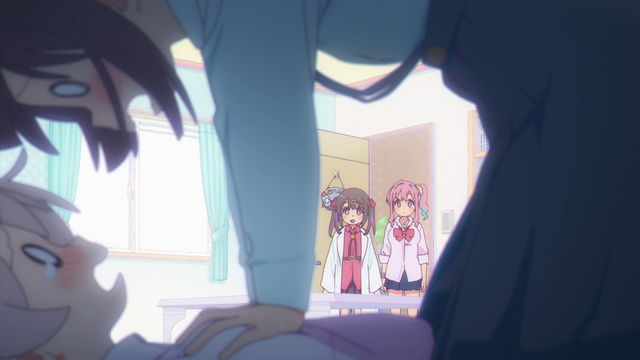
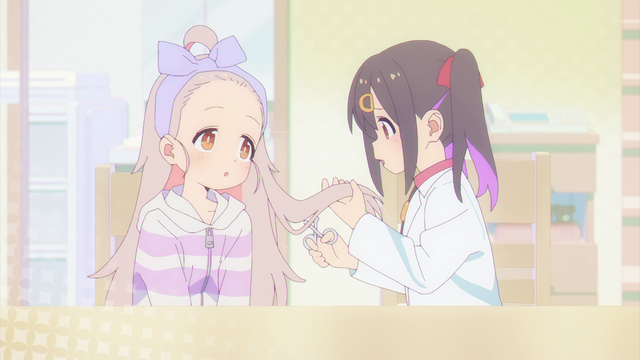
People like Kakeru are not inherently easy to get along with, and it takes someone of Tōko’s disposition to bring out their best. However, Glasslip‘s MVP and Best Girl™ is Tōko’s younger sister, Hina. Although she’s a few years younger than Tōko, Hina is mature for her age. She quickly spots that Tōko is head-over-heels for Kakeru despite limited information and intuitively supports Tōko at every turn. At the same time, Hina also seems more in touch with her own feelings and desires. She seems aware that Yukinari, whom she and the remainder of the swim team have a crush on, has feelings for Yanagi, but rather than feeling jealous, Hina looks up to Yanagi, enough to spur her on and even take fashion advice from. The height of Hina’s consideration and concern for Tōko comes when, one evening, Tōko is late in coming home. Having deduced that Tōko is probably spending time with Kakeru, Hina covers for Tōko in full and even eats a second dinner meant for Tōko to give the impression that her older sister is home. Glasslip emphasises the extent that Hina is willing to go for those she loves – even though the croquettes look delicious, Hina is shown as choking them down with tears in her eyes, likely a show of discomfort at having to eat more than her wont, and this was the moment that completely won me over. In her unequivocal support of Tōko, even though she’s not wholly sure of what’s going on, Hina’s actions in Glasslip have a knock-on effect on the other characters. She helps Tōko to persevere with Kakeru, which helps him to open up and realise that he wants to form meaningful connections with others. In consolidating Tōko’s relationship with Kakeru, Hina also shuts down any chance that Yukinari had with her older sister, but by encouraging both Yukinari and Yanagi to be their best selves, Yukinari finally begins to acknowledge Yanagi and stops taking her for granted. Although it’s clear that Sachi’s heart was being pulled in two directions, seeing Tōko being drawn towards Kakeru also helps Sachi to focus on her own relationship with Hiro. Hina’s actions, seemingly inconsequential, ultimately creates a new status quo within the group, and while Glasslip does not show this directly, everyone cherishes their friendship together; even though relationships have begun manifesting, things eventually stablise to the point where there are no hard feelings, and Glasslip implicitly suggests that the friends even if the chances aren’t as numerous as they once were, they might just still get to see the fireworks together again, in the manner that Tōko has come to cherish. While Hina probably won’t know this, her contributions to Glasslip aren’t trivial, and her unwavering support for Tōko is commendable, enough to keep Glasslip upright.
Screenshots and Commentary

  • While stylised as Glasslip, the anime’s correct naming is implied to be “Glass Lip”, probably after the interface between the world viewed through glass and reality itself. I originally picked up Glasslip during the summer of 2014, amidst work on The Giant Walkthrough Brain, because at that point, I’d been thoroughly impressed with a large majority of P.A. Works’ titles – Angel Beats!Hanasaku Iroha, Tari Tari and Nagi no Asakura had all been slam dunks, and while I’d been less-than-impressed with RDG: Red Data Girl and True Tears, P.A. Works’ track record at that point showed they’d had more hits than misses.

  • If my impressions of Glasslip were anything to go by, immediately after finishing, I gained the measure that the series was about how Tōko had felt pulled apart by her circumstances. On one hand, she greatly treasures her friends and would rather stay with them forever, fearing to lose them. However, when Kakeru arrives, Tōko also finds herself inexplicably drawn to him, even in the knowledge that with Kakeru’s sudden appearance and indifferent, blunt manner, she runs the risk of alienating herself from her friends because of her ties with someone who clearly won’t get along with the others. From the sentiments expressed in my text, I was neutral overall with Glasslip.

  • What changed my perspectives on Glasslip was a contemptible and arrogant analysis from one Helene “Soulelle” Kolpakova, who posted a lengthy rant to MyAnimeList disparaging those who suggested they had a difficult time of making heads or tails of Glasslip. By definition, Glasslip was not an easy anime to watch because it shows outwardly unrelated moments in the characters’ lives, rather than a series of pivotal moments contributing to character growth, and no end-goal was apparent – in stories dealing with a nascent romances, viewers would not be wrong to expect that when everything is said and done, the characters would, at the minimum, be left in a state where they’re more comfortable with one another.

  • Instead of accepting this, Soulelle would argue that everything in Glasslip was “simple”, and the main theme of the show was somehow “feeling oneself at home”, before asserting that the visions were merely “vivid imaginations”. Immediate counterarguments come up: if Glasslip was about finding a place of belonging, it could have been achieved without Tōko and Kakeru being drawn to one another. Similarly, their shared visions being figments of their imaginations would be improbable because Glasslip clearly shows the pair as seeing the same thing, and this was meant to imply that there is, in fact, something connecting Tōko and Kakeru, and that this “something” cannot be callously dismissed.

  • While Sachi and Tōko hang out at Mikuni Ryushokan Museum, a closeup of a copy of M.C. Escher’s “Day and Night” can be seen. This wood carving is praised for presenting a seamless transition from light to dark in the same landscape, in showing how a setting represents how something can change simultaneously stay the same, “Day and Night” is ultimately suggested to be a piece that captures how duality between two opposites can coexist harmoniously. Glasslip uses this piece as an allusion to the fact that Tōko and Kakeru’s differing beliefs can still meet in the middle. Similar pieces were found in Yuri Kuma Arashi, and there, the intention was to show the blurring between man and bear (in doing so, suggesting that human nature and sexuality aren’t so clear cut), indicating that transformations are not black and white.

  • While such topics, and Soulelle’s own incorrect conclusions of Glasslip, would represent an interesting opportunity for dialogue, such a chance has never once arisen in the past ten years. All attempts to strike up a conversation were ignored. In spite of this holier-than-thou attitude, period discussions heaped praise on Soulelle’s “analysis” of Glasslip, and this is where I take exception to Soulelle – in her “analysis”, Soulelle had openly stated that people were missing something obvious and simple if they didn’t enjoy the series. I’d expect most people don’t like to be told they’re ignorant, so it was baffling to see people agree with Soulelle and claim she helped to clear up the meaning behind Glasslip in an “inspired” fashion.

  • Moreover, while Soulelle had clearly instigated a discussion regarding interpretations of Glasslip and its meaning, she never once responded to people on either side of the discussion, whether to express appreciation for the people who found her “analysis” helpful or offer counterarguments towards those who were refuting her. Regardless of what Soulelle’s objectives were, her interpretation of Glasslip gained  more traction than moderate, better-reasoned ones (i.e. mine), and for the past decade, this has been a sticking point for me: I’ve never been offered a satisfactory answer for why my more down-to-earth and accessible perspectives of Glasslip were never afforded the same level of consideration.

  • After this revisit, my fourth, I conclude that Glasslip itself is a serviceable series for those who are willing to look at it with a different perspective, and my disapproval of the series would stem from one curious observation: Soulelle’s arrogant and indifferent attitude towards others bears a direct resemblance to Kakeru, who similarly acted like he held all of the answers even though in reality, he was struggling to work through things for himself. It follows that Soulelle had defended Glasslip because she saw Kakeru in herself – at the time, many viewers were critical of Kakeru because of how aloof he’d been, and their criticisms often spared no quarter. This would suggest to me that Soulelle relates to Kakeru and took attacks on his character as an attack on herself.

  • Knowing this about Soullele, however, does little to diminish the fact that my Glasslip posts have never been very successful, and since this post is really just an expansion of the points I’d previously written about, I remain quite open to hearing why Soulelle’s claims, that Glasslip is about “feeling oneself at home”, should be treated as having more merit than mine (besides actually making an effort to see what P.A. Works’ intentions were, I can also say that at the minimum, I’m not insulting my readers). Looking past Soulelle, Glasslip‘s story is actually an amalgamation of many things, and my leading criticism of the story following this fourth revisit is that, given the number of characters, an additional twelve or thirteen episodes would’ve been helpful in fleshing out their stories. While Kakeru and Tōko’s story receives the most focus, there was enough going on in Yukinari and Yanagi’s chapter to merit additional exploration. On the other hand, Sachi and Hiro’s slower-paced relationship faced conflict from Sachi’s wavering feelings: she loves Hiro, but she also wants Tōko.

  • In my last discussion of Glasslip five years earlier, I’d suggested that a more cordial Kakeru would’ve made Glasslip more palatable. Ironically, this would hold true, provided that Glasslip had actually been about having a place to belong to. Kakeru’s attitude is actually a necessary evil in Glasslip, and while his presence creates rifts amongst Tōko’s group, there was actually another, understated actor in the story who served to counteract all this. Hina Fukami is Glasslip‘s Best Girl™ for this reason. As a third party who’s not entangled in Tōko’s problems, Hina represents an outside perspective who, despite not having all of the information she would need, still tries her very best to support her older sister and her friends.

  • Hina does all of this with a smile on her face, and Glasslip made it every clear that Hina loves her older sister very much. In contrast to Tōko, Hina is forward and direct. Not easily flustered, Hina has no trouble with the feelings of others and demonstrates enough tact to know when she should speak up and act, as well as when to take a step back and leave people to their own devices. She quickly puts together that Tōko’s in love, and when meeting Kakeru for the first time, knows to give the nascent couple-to-be their space. Hina can act coy about things, but she also never teases Tōko or embarrasses her out of malicious intent. Finally, adding to Hina’s stock is the fact that she’s voiced by Nao Tōyama (Kiniro Mosaic‘s Karen Kujō, Oregairu‘s Yui Yuigahama and Shimarin of Yuru Camp△).

  • Because it’s clear Tōko was having a tough time making sense of her feelings, when Yukinari begins feeling threatened by Kakeru and jumps into a kokuhaku with Tōko, his actions also end up throwing Yanagi off. During Glasslip‘s original run, Yanagi was the character that almost all viewers felt symapthy for: Yanagi is tall, attractive and an aspiring model. With a fiery personality, Yanagi is the kind of girl that would appeal to many, and it was baffling to see Yukinari taking her for granted – he’d completely failed to notice that Yanagi had fallen in love with him because of his focus on Tōko. At the granular level, Glasslip was able to portray the tumultuous feelings associated with a nascent romance, and even ten years ago, I’d indicated that this was one of the things Glasslip had done well.

  • The problem, however, was the fact that the individual moments didn’t appear to be tied together by a unifying theme or long-term goal. In most stories, people expect there to be a cohesive series of events that let characters to learn and grow, but here in Glasslip, the characters were often seen as fumbling around. This is bad for storytelling, but having since gone through the process a few more times for myself and seen it with the people around me, I can attest to the fact that Glasslip does, in fact, capture the feeling of falling in love quite well. The sensation of being lost along with the characters in Glasslip is reminiscent of the unusual, floating feeling I’ve encountered when I’ve fallen in love previously.

  • This is not an unpleasant feeling overall: I would liken it to feeling a faint buzzing ache in the heart, combined with a simultaneous feeling of anxiety and being fired up enough to climb a mountain. In my case, however, I’ve never been a “love at first sight” person – when I’d met Bettina, for instance, it took me over a year’s worth of conversations and hanging out to see her in a different light. I’ve come to accept that for me, I’m the kind of person who falls in love the more time I spend getting to know the individual. This holds true in my personal and professional life: when I was an undergraduate student, it took me a few lab tours to decide on the one I wanted to join for summer research, but once I started, I knew the kind of work we did was what I wanted to pursue. Similarly, I picked the Sony brand of mirrorless cameras simply because it happened to offer a good sale, and I’ve only fallen in love with the Sony line because of how compact the lenses are.

  • Having more time to showcase the different relationships in Glasslip would’ve been to the series’ advantage: the series did have intriguing characters, all of whom deserved a little more time to shine, and for me, the Sachi-Hiro pairing was one such example. There was only one major moment of conflict, but beyond this, their time on screen was usually marked by a sort of awkward tenderness as the pair try to accommodate one another, as Hiro picks up books he’d otherwise never read so he can keep up with Sachi’s thoughts, and Sachi tries to improve her physicality so she can accompany the more active Hiro on his outings. Sachi and Hiro’s relationship ends up being a tale of compromise and meeting in the middle, and I would’ve liked to see more moments like these.

  • Hiro’s older sister is a post-secondary student who periodically visits her boyfriend who’s been hospitalised. Outgoing, energetic and spirited, she’s fond of prying into Hiro’s love life and resembles Tamayura‘a Sayomi Hanawa, offering to drive people wherever they’d like to go. Here, she confronts Hiro about a Japanese copy of The Myth of Sisyphus, claiming Hiro would never read these books unless there was a life-changing reason. This moment is quite passing, of limited overall significance at first glance, and I wouldn’t expect even more observant readers to treat it as significant – The Myth of Sisyphus is only mentioned because it’s the kind of book one would expect to pick up only for a literature class.

  • However, a particularly self-important commenter demanded that I “clue myself” to what The Myth of Sisyphus says about Glasslip‘s so-called “fragments of the future” by reading the book for myself. To nobody’s surprise, that commenter was completely wrong. The Myth of Sisyphus speaks to absurdity of existing and how ultimately, the struggle in life is the reward. When applied to Glasslip, The Myth of Sisyphus would suggest that the joy of love is not being in a relationship (the end goal), but rather, in pursuing a relationship (the process). Thus, The Myth of Sisyphus does apply to Glasslip, but beyond this, there is no discernible connection between Camus and the visions that Tōko and Kakeru jointly see.

  • On the flipside, whilst perusing other texts in Camus’ bibliography, I was a shade surprised to find that The Stranger fit in with what Glasslip had been trying to do. The Stranger‘s Meursault is an analogue of Kakeru at a superficial level, but unlike Meursault, whose stubborn refusal to change his world view was meant as a stab at the absurdity of indifference, Kakeru does end up seeing his beliefs challenged in a tangible way. Glasslip presents Kakeru’s distant mannerisms as a result of his constantly moving around, which prevents him from forming any meaningful connection with his peers. Because Kakeru becomes accustomed to disappointment, he ends up concluding that there’s no reason to invest in any connections if it’s only going to result in the pain of separation.

  • Kevin Gillis’ The Raccoons covered this topic in its fourth season’s “Bully For You” episode, when business mogul Knox brings his nephew, Bonneville, with him. Because Bonneville is always “gone in the morning”, he’s had no opportunity to form any connections with the people he meets, and as a defense mechanism, he puts in a bully’s mindset, having his own fun at the expense of others on the grounds that there won’t be consequences. A meeting with Cedric (and hearing Cyril making a note of this) changes his mind. The Raccoons was well ahead of its time: the name Bonneville is French in origin and approximates to “good settlement”, so Bonneville’s actions in the episode contrast his name.

  • Indeed, Kakeru’s cold and know-it-all manner causes him to immediately run afoul of Sachi, Yukinari and Yanagi. Kakeru’s trying to put on the impression he’s got everything figured out to offset his feelings of detachment and loneliness, but to Yukinari and the others, he’s sticking his nose into matters he’s got no right to. Things boil over when Yukinari, pushed too far by Kakeru’s attitude, punches him in the face. Kakeru doesn’t appear to get the message and continues to act as though he knows best for Yukinari and the others: from the viewer’s perspective, he wants to clear things up with the others and hopes to reconcile by nudging Yanagi and Yukinari together so he can have a clear shot at Tōko.

  • Seeing Kakeru getting hit in the face a second time, this time, from Yanagi, was admittedly satisfying. In most anime, I strive to give characters the benefit of the doubt, and to this end, I’ll usually make a judgement of their traits after a series wraps up. Glasslip was a series that tested my patience in this department the first time I watched it, and two rewatches later, it was still quite difficult to get behind Kakeru – I rewatched Glasslip in 2015 and 2019, intending to see if I could produce a proper rebuttal to the popular “analysis” out there, as well as to see if my thoughts had changed. On both occasions, I was none too successful.

  • The question of why Kakeru fancies there to be two of himself, for instance, continued to elude me during those re-watches, and my original joke, that Kakeru was “born in 200 Log Cabins”, never gained much traction. In the present, going from what’s seen in Glasslip, I’d suggest that the three Kakerus show a lack of confidence: the two other apparitions don’t seem to express the same ideas or agreement, and scenes like these can be taken to mean that Kakeru is experiencing a mild internal conflict. Beyond this, three Kakeru’s certainly don’t mean that Glasslip is espousing something like Freud’s “Id, Ego and Super-Ego” model – moments like these don’t last, and the different Kakerus don’t say anything specific as to fit this model.

  • The reason why this rewatch ended up yielding a different outcome was because, rather than going at Glasslip from my perspective (and what I would’ve done to make the series enjoyable), I sought to see how the decisions that P.A. Works made fit into what the series sought to achieve. This required that I check my own ego at the door and re-enter Glasslip with an open mind, to see what the story P.A. Works wanted to tell me, rather than how well (or poorly) P.A. Works was able to produce something to tailor my personal tastes. This shift in perspective yielded a different experience overall, and was ultimately how I landed on the more dramatic of my conclusions in this post.

  • The first outcome of this approach was that I could no longer regard Kakeru’s haughtiness and know-it-all attitude as something that needed to be fixed. P.A. Works has a history of writing stories with disagreeable characters. In Hanasaku Iroha, I began my journey feeling that the whole of Kissuisō was against Ohana. Similarly, Naoko Takakura felt like an antagonist in Tari Tari despite being best friends with Wakana’s mother owing to her constant belittlement of Konatsu. In The Aquatope on White Sands, Tetsuji Suwa’s strict, no-nonsense attitude towards Kukuru, and Chiyu Haebaru’s insistence on professionalism made the pair quite difficult to get behind. However, each and every time, their respective stories revealed a reasoning behind the rudeness.

  • It is a necessary to extend Kakeru the same courtesy, and so, assuming that Kakeru needed to be an asshole, Glasslip was aiming to achieve something here. It turns out that Best Girl™ Hina is the catalyst. It is known that Kakeru is having trouble connecting with people until he meets Tōko, but Tōko’s kindness means she struggles to choose between her existing friendship and pursuit of the novel feelings she experiences. Hina ends up nudging Tōko in the right direction each time, but she’s also someone who takes action for herself when the moment calls for it. Here, Hina learns that her fellow swim club members have taken an interest in Yukinari, whose jogging route takes him past the local pool. While the other girls swoon over Yukinari, Hina is able to look past outward appearances and works out that something’s been bothering him.

  • If Kakeru is to be held responsible for causing the disruption that shakes things up between Tōko and her friends, then Hina should be given credit for steering Tōko and her friends towards a new status quo, one that simultaneously allows for grievances to be rectified, and for Kakeru to be given a chance at growth as a result of her time spent with Tōko. Without Hina, the developments that take place amongst Tōko’s friends and Kakeru are unlikely to have turned out the way they did. It took three additional rewatches of Glasslip for me to ascertain this, but the fourth time’s the charm, and I found myself looking forwards to seeing the moments that Hina was on screen.

  • What makes Hina standout is that she tends to act when she sees fit: compared to her peers in the swim club, who are content to admire Yukinari from afar, Hina quickly determines that Yukinari isn’t his usual self during one of his runs. Feeling something’s off, she takes off after him on her bike, and even though she has no context or knowledge of what’s troubling him, Hina tries to encourage him and tells Yukinari to keep being his best self. Hina does have a slight edge over her peers in that she knows of Yukinari, but even though she could consign herself to the fact that her sister’s friends’ problems aren’t hers, Hina also wants her sister to be happy.

  • Yukinari is surprised by the turn of events and continues his run, leaving Hina to wonder what will happen next. Glasslip has numerous moments of uncertainty, in keeping with the idea that falling in love represents an emotional upheaval. The glimpses into the future ultimately don’t mean anything – although Tōko and Kakeru believe that these moments might foreshadow what comes next (and Tōko mistakenly acts upon them, causing only further strife), the reality is that the future is always in motion, immutable and shifting. Things come to a head when Kakeru invites Tōko out to the beach to meet up, and while Sachi tries to schedule a group event with the aim of disrupting things.

  • Sachi’s attempt fails, and Tōko continues with her meet-up. The “dates” Kakeru and Tōko go on are framed around trying to work out the phenomenon – in a literal sense, discussions of the visions wouldn’t make for an exciting date, but if we take this to be metaphorical, then it is possible to see Tōko and Kakeru as simply swapping stories over a topic they had in common. However, the boundary between metaphor and reality is quickly blurred: Yanagi encounters the pair, and although she’s disappointed by where things are heading, Tōko ends up seeing a vision in which Yanagi ditches them. Tōko panics and faints as a result.

  • Yanagi and Sachi subsequently meet up to discuss what’s going on. Without having experienced the same visions Tōko had, the pair only have guesswork to go on. Their conclusions outwardly appear unrelated to the visions of the future Tōko and Kakeru see, but the fact that the pair land on the supposition that Kakeru and Tōko do like one another speaks volumes to what the phenomenon within Glasslip entails. As a metaphor, the visions are quite visceral, but from a storytelling standpoint, they don’t make the most sense and demand viewers jump through a few hoops to reach the conclusion.

  • This brings the discussion to the question of whether or not works of fiction necessarily need to be clear in their messages or present a cohesive story following the narrative arc model. At one end of the spectrum, Glasslip‘s opponents suggested that a work of fiction’s authors necessarily need to be clear in their intentions, after which people are free to interpret a work within those interpretations, but quite separately, Glasslip‘s proponents claim that the viewer’s interpretation is more important than that of the author’s, and viewers should be free to apply any perspective to a given work.

  • This is how one of the more unusual conclusions about Glasslip came about: there have been notions that Glasslip was about mono no aware and impermanence, rather than change, disruption and its consequences. iblessall of Mage in a Barrel wrote extensively about this approach, arguing that “the modulations of impermanent time are difficult to apprehend; they are small and slight by nature, and go easily unnoticed even by those to whom they impact most. But they are real nonetheless, and they define us whether we wish them to or not”. iblessall’s wording is as obfuscating as it is disagreeable: if Glasslip was really a “passive acceptance of their impermanent state”, then the implications would be that people do not have any control over what happens to them.

  • This stands in direct contrast with Mark Manson’s The Subtle Art of Not Giving A F*ck, which (correctly) argues that life is about making decisions, choosing what one’s priorities are and ultimately, embracing the struggle as a means of incremental growth. Making good decisions and selecting good values is an active response, as is willing oneself to get out of bed in the morning and accepting mistakes as being a necessary part of life. Mono no aware is the appreciation that things are transient and valuing them precisely because nothing they can be taken for granted, and as such, observing mono no aware implies that one must also actively seek things out – nowhere does the philosophy say that one is consigned to passively observe things and letting things go.

  • I prefer a much more responsible, active approach in my life – many internet philosophers waste away their time considering the withertos and whyfores about life, failing to realise that life isn’t about seeing things that no one else does, overanalysing everything as a clue of importance or sitting in front of their computers, asking questions of the stars. As it was, iblessall ‘s conclusion about dealing with life is that “the answer lies in trusting in the significance of the moments that come our way, while striving to never tie ourselves to them completely”. That is incorrect: the point of life is to actively seek out good values, which allows one to incrementally improve to the point where they can accept their impermanence (i.e. death).

  • Not every individual event is going to have a prescribed meaning behind it, and it is the sum of these events, as well as one’s interpretation of events, that creates this incremental growth. Glasslip, then, is ultimately more consistent with my interpretation than it is with this blogger’s. Throughout Glasslip, each of Tōko, Kakeru, Yanagi, Yukinari, Sachi and Hiro are subject to experiences, both individual and shared. On their own, these experiences are not particularly impactful. However, they gradually help each individual to redefine their values and how they handle things. Yanagi decides that, instead of passively hoping for Yukinari to notice her feelings, she’ll do what she can to make herself more standout to him. Yukinari lets go of his feelings for Tōko and resolves to pursue his own goals more whole-heartedly.

  • Sachi, long having had her own feelings for Tōko, realises that Hiro is dedicated and loving, enough that she loves him equally. Spotting that her feelings to Tōko won’t amount to much, Sachi decides to focus on what’s on front of her. Finally, by taking that difficult step forward and making an honest attempt, Hiro is able to pursue Sachi without having any regrets. The sorts of things that the blogger mention about the characters end up missing the mark because they presuppose passivity, and the reality is that the characters, in fact, make an active attempt to shape their futures. They might not know what’s coming, but there is a sincere effort to be, in Manson’s words, “less wrong”.

  • All told, iblessall (despite garnering extensive praise for having put in the effort to analyse Glasslip) is unconvincing for this reason. I tend to strongly disagree with any conclusion where passivity and acceptance is the outcome because, the objective isn’t the end goal, but rather, the process. That Glasslip references The Myth of Sisyphus, which precisely argues that the struggle itself brings joy (consistent with Manson, who helpfully expands that that happiness comes from solving problems), indicates that stepping up and making an effort is what counts. If we, for a moment, suppose that iblessall was in the right, it would be sufficient for one sit back, understand things are impermanent and reach enlightenment.

  • Like a tool, mono no aware is a concept with no inherent metrics attached to it. Instead, one can argue that mono no aware can become a source of inspiration when it leads one to step up and actively shape their futures, and quite similarly, it can also become a source of apathy if one decides that because everything is transient, it has no lingering value. A lot of online interpretations argue that it is sufficient for one to find meaning and identity without having put in a value, but this comes about because people tend to take the easy way out. It’s easy to say something like “I’m a photographer”, and then only spend one’s time reading about camera gear and photography techniques, but the only way to turn an identity into something of value is to take that step forward, pick up a camera and make mistakes.

  • As it was, while I concede that Glasslip is a series that is open to multiple interpretations, I remain steadfast in my belief that interpretations which promote passivity do not have any value. In the analogy the aforementioned blogger brings up, that life’s treasured moments “may have just been the glancing sparkle of sunlight on glass, but is [sic] was still beautiful”, I would counter that a more respectable philosophy in life is to constantly drive myself towards doing things that make me happy to reflect back on, and always have plans for more of those things. This is how I go about photography: photography is the art of painting with light and capturing transience in a single still, and there is a mono no aware about permanently recording moments that would otherwise be missed in the blink of an eye.

  • When I capture an especially rewarding moment, I am moved, but at the same time, I also become made aware of the fact that such moments will always exist, and continue to exist. Although no two moments will be identical, different moments will have different beauty, and this alone makes it worth going out at the crack of dawn or the middle of the night. In my case, the existence and awareness of these moments isn’t enough: I have to make a concerted, active effort to find them. I am certain that people with an arts background will tell me I’m taking myself too seriously, and that art is about the intangibles as much as it is the tangible. To this, I will reply that, being a software developer, my career is rooted in taking action. I do not have the luxury of sitting back and appreciating the transience of a software bug, because my responsibility is to fix it and get updates into a customer’s hands.

  • I allow that artists will have more time to consider these things, but this is not my nature, and my goal with posts like these is to present an alternate perspective: a lot of artistically inclined bloggers can turn out impressive-looking blog posts that deal with an academic exercise in an eloquent fashion, but from a practical standpoint, these posts also offer nothing actionable. For my part, my intention is for readers to see a more action-oriented set of beliefs which, while perhaps not as intelligent-sounding as those bloggers may produce, still yield something that readers may carry with them in their own everyday lives. At the end of the day, I argue that things that generate value for people holds more weight than theoretical “what-ifs”, and this is what motivates my approach.

  • In fact, my stance on the matter can be described as follows:

Philosophy is the domain of those who create good times; philosophy is the refuge of those who create tough times.

  • Quite simply, what I mean by this is that the people who are best qualified to characterise and understand fundamental truths about themselves or those around them are those who act in ways to create value for others. Because people who generate value tend to be kind, empathetic and open, they act in ways that are worth recording and formalising, so when they do share their thoughts, there is merit in hearing them out.  Great philosophers like Plato and Confucius come to mind when I think of the former. On the other hand, people who cannot create value tend to act as though they have it all figured out, and they hide behind big words and obscurity to conceal their ignorance. I look no further than Karl Marx and Sigmund Freud as examples of the latter.

  • Towards the end of Glasslip, the phenomenon Tōko can witness begins taking on a more tangible, and frightening presence – there is no doubt that the visions she encounters are directly tied to the intensity of her emotions, and as she becomes increasingly confused about Kakeru, the visions she sees become more vivid. This manifests as snow, and the metaphor here couldn’t be clearer than if I saw snow in Calgary during the summer; in Japan, summers are unequivocally associated with blue skies and hot weather, so when Tōko fancies snow falling in the summer, she is indicating that meeting Kakeru has turned her world upside-down, to the point where familiar sights feel foreign, and nothing feels certain.

  • During one particularly challenging evening, when Kakeru and Tōko agree to meet up and test the former’s theories further, Tōko ends up being immobilised by what she sees and is unable to come home at a decent hour. Realising she’ll land in hot water for this, Hina spends the entire night covering up for her older sister, from faking the door opening and footfalls up the stairs, to fabricating an entire tale of how Tōko’s not feeling well and needs rest. The lengths that Hina is willing to go for her sister is commendable, and one can work out that Hina very desperately wants Tōko to be happy even if she doesn’t fully understand what’s going on.

  • The moment that broke my heart and directly led me to reach a new conclusion on Glasslip came here, when Hina ends up choking down the dinner meant for Tōko. Through nuances in the animation, the furrow in Hina’s eyebrows and the tears welling up in her eyes, I found myself overcome with a most unusual sensation. I do not believe Hina is reacting negatively or positively to the croquettes themselves, but she does to appear to be in distress here as a result of eating more than she’s normally accustomed to. As it was, seeing this in Hina left me with no doubt that she was Glasslip‘s MVP, someone whose actions, however subtle, would advance things in a meaningful way – even with my metabolism,

  • I’ve found that, when it comes to Glasslip, a lot of the analysis and “analysis” out there on the ‘net tends to fixate on very specific details in the series, ranging from the glass beads and presence of three Kakerus, to the chickens, trains and watercolour-like stills that periodically happen. These same discussions may individually dissect characters and their roles without giving thought to how all of the pieces fit together, and as a result, Hina is almost always overlooked. Having now rewatched Glasslip and True Tears, I concede that while chickens juxtaposed against flight-capable birds to parallel Tōko’s having a home she loves and Kakeru’s travelling nature, it’s a motif that reminds viewers of the gap between Tōko and Kakeru’s backgrounds, rather than a theme that says something significant for viewers.

  • Trains are a popular form of transportation, and P.A. Works is simply fond of flexing their animation prowess, but the kinds of trains shown in Glasslip don’t symbolise transience or fleetingness; the Hinode train is a small, domestic train that characters ride to and from home, mirroring a return to a place of familiarity. Finally, the watercolour-like stills are a respectful callback to True Tears, and there, they’d been used to capture pivotal moments as snapshots, much like how a storybook would. These moments, in Glasslip, are injected to create pause and hint to viewers that the moment frozen in time will have an impact on what happens next, but beyond being an artistic choice, doesn’t have any significance to the narrative.

  • On the flipside, it is necessary to consider all of Glasslip‘s characters as they are presented within the anime: assertions that “Yuki and Yana, Sachi and Hiro are all ancillary to Glasslip‘s musings” is certainly incorrect on the grounds that, if Glasslip had been intended to be “in the characters of Kakeru and Touko, along …that the reflection on impermanence truly finds its voice”, then it is the case that Tōko and Kakeru’s tale would’ve been told without the need to introduce Hina, Yukinari, Sachi, Yanagi and Hiro. Cherry-picking evidence to fit one’s conclusion is a fallacy that inevitably invalidates any and all conclusions drawn because the resultant data points no longer represent the entire sampled population, and in the realm of literary analysis, it is improper form to simply say the some characters are secondary simply because their experiences don’t add to one’s conclusion.

  • In Glasslip, Hina ends up having a direct impact on Yukinari and Yanagi’s story. Both individuals are chasing after someone who doesn’t seem to reciprocate their feelings, and it ends up being intervention from Hina that helps the pair along indirectly. On the other hand, the dynamic between Hiro and Sachi is more subtle and quiet in nature: this couple moves along slowly, almost at a hesitant pace. Because Sachi and Hiro seem far removed from the others, emphasised by Hiro’s love of the mountains and Sachi’s love of books, their presence in Glasslip was to show that once people start seeing one another, their friends may end up taking a lesser significance than before.

  • All of the elements in Glasslip point back towards relationships, not impermanence, because of all the characters present. In literature technique, this is referred to as “Chekhov’s Gun”, in which all introduced elements must play some appreciable part in a story. Since Glasslip introduced Yanagi, Yukinari, Sachi and Hiro alongside Kakeru and Hina, it stands to reason that their roles and contributions must also be considered as a part of a larger story, rather than just the world Kakeru and Tōko find themselves in after their fateful encounter. Had Glasslip been intended to purely make a commentary on mono no aware, the series would’ve done so by eliminating the other characters and having Kakeru and Tōko wholly occupy the spotlight.

  • Towards the end of Glasslip, after a brief disagreement that compels Hiro to become distant with Sachi (and their subsequent reconciliation), and following Hina’s actions, which contribute to Yukinari giving more attention to Yanagi, the narrative does set their chapters aside because they’re sufficiently resolved, allowing Glasslip to deal with the lingering elephant in the room, of the glass beads, piano and the visions that Tōko and Kakeru share. Mono no aware is present in Glasslip, but it is important to note that it is also just a part of Glasslip.

  • It is here that Kakeru mentions his so-called “sudden, expected loneliness”, which, in approachable terms, refers to how because of his travelling nature, he’s never had time to form meaningful connections with others because, by the time he can bond with people, he’s forced to move on, breaking that connection and leaving him feeling lonely. In 2024, “sudden, expected loneliness” shouldn’t be a concern because modern technology allows people to remain in contact even when they part ways, but even back in 2014, smartphones were already becoming commonplace, and feature phones were widespread in Japan – Kakeru’s remarks this came across as a flimsy excuse, his way of saying he doesn’t want to put in the effort to connect with others.

  • The most perplexing moment in Glasslip comes when a piano performance causes Tōko to fancy a world where she’d been the outsider, during which she becomes missed by all. Aside from establishing that Tōko’s biggest fear is to be alone, the moment also gives her insight into what Kakeru experiences all of the time. Glasslip spends an entire episode on the topic, and while the pacing of this episode was much slower to accentuate just how lost Tōko is, I remember how even I became lost upon watching it for the first time. The imagery and symbolism in Glasslip, done purely to accentuate themes of chaos and confusion accompanying first love, is understandably viewed as confusing because the series doesn’t follow any convention with regard to storytelling or symbols.

  • I have the advantage of having seen Glasslip three other times prior to this rewatch, and thus, with a different intention coming in, the conclusion I’ve reached is quite different. As a story and anime, Glasslip is worth watching on the virtue that it attempts to weave a story differently, and from a thematic standpoint, the series does succeed in delivering a message in spite of its more roundabout approach. In a vacuum, and ignoring the more popular, well-received “analysis” out there, my fourth rewatch of Glasslip has me assessing this series to be a C- (1.7 of 4.0, or 5.5 of 10) – as a story, there were strengths and shortcomings to the series. I appreciated the portrayal of chaos resulting from nascent relationships, the portrayal of Fukui was gorgeous, and Hina practically carried the show through its tougher moments. Further to this, Glasslip had an all-star cast: Ai Kayano (Darkness of KonoSuba, GochiUsa‘s Mocha Hoto and Saori Takebe of Girls und Panzer) voices Hiro’s sister, Saori Hayami (Spy × Family‘s Yor Forger, Aoyama Blue Mountain of GochiUsa, Oregairu‘s Yukino Yukinoshita and Tari Tari‘s Sawa Okita) is Yanagi, and Risa Taneda (GochiUsa‘s Rize Tedeza and Aya Komichi of Kiniro Mosaic) plays Sachi.

  • Finally, the music in Glasslip was outstanding: scenes with a classical string accompaniment carry a sense of fragility and emphasise the precariousness of a moment, while piano is used effectively to convey melancholy, wistfulness and hope. Where Glasslip loses points was its runtime (too short to properly flesh out all of the characters) and a willful but botched blurring between real and surreal that obfuscates the metaphors. Similarly, the ending and its payout for viewers is not impressive: an ambiguous and open ending is to the series’ detriment because one cannot be certain what message Glasslip wanted to leave viewers with; Kakeru is implied to have left to accompany his mother, but since one never sees him, it’s not clear if he took any of the lessons resulting from his time with Tōko to heart and become a more open, amicable person. As a result,  Glasslip is not an easy series to recommend, but creative or open-minded folks looking for a completely different look at young love may find Glasslip worthwhile.

  • When Tōko’s mother mentions that she’s also seen visions of what might be the future, the implication here is that Tōko isn’t unique, and when she presses her mother for what she might do in the knowledge that she was in fact, seeing the future, the response she receives is one befitting of an adult: “I’ll take it in stride and enjoy it twice”. A thought occurred to me: had Tōko brought up the visions with her mother earlier, she might’ve been able to bypass all of the confusion and conflict she’d seen up until now. Tōko had been so certain that the visions were something she and Kakeru alone had in common, but never once thought to bring things up, similarly to how in reality, people often keep their problems to themselves out of consideration or worry, and in doing so, they forget that family and friends might’ve experienced the same before and can therefore be of help.

  • The final event in Glasslip is the forecasted meteor shower, and what’s significant about this is that, standing in sharp contrast with the fireworks Tōko and her friends watched together in the first episode, this time around, the entire group is scattered. While everyone does end up seeing the same sights, they do so with different people, and this moment comes to represent the extent of the disruption Kakeru had introduced amongst the group. At the start of said meteor shower, glass beads seemingly rain from the sky, and in response, Tōko and Kakeru throw their own beads into the air to create a meteor shower of their own, one which, while not as spectacular as the ones nature produced, is one that is also more meaningful.

  • With this, I believe I’ve answered the last of the questions I had entering this re-watch – tossing Tōko’s beads skyward signify how couples create their own magic. This act brings Glasslip to a close, but from what’s seen, the ending is quite vague: Kakeru appears to have left town with his mother, and Tōko’s group of friends reach a new status quo, one that may not allow them to see fireworks together per Tōko’s old wish. Whether this is good or bad is something Glasslip leaves as an exercise to the viewer. It is worth noting here that, assuming we allow Glasslip‘s theme to be “disruption of a status quo resulting from nascent love”, the ending is logical because it simply shows that falling in love changes all sorts of things for people. On the other hand, if we suppose the theme was impermanence, then Glasslip would become an abject failure because the ending says nothing about transience: was Kakeru’s arrival and impact on Tōko’s group a good or bad thing?

  • Glasslip does not give up its secrets so easily, and so, in response to the question of  “Can’t [Glasslip] just be allowed to rest as a show too caught up in being abstract to project any sort of significance outside of its own sphere of existence?”, my reply will be a resounding “no”: when creating Glasslip, the objective had likely been to see how viewers responded to an art piece that deviated from what is commonly accepted as good storytelling. However, the fact is that P.A. Works chose to frame Glasslip as a love story, and as a result, the abstract imagery and metaphors do not ultimately obscure the original messages to the point where they are lost. Glasslip was created with meaning in mind, so it is not appropriate to say that “just the hint of having meaning [is] enough” because that’s akin to saying it’s sufficient to have a dream. Much as how life has merit because one can action their dreams and turn them into reality, a work that has meaning will also find a way to convey this to viewers.

  • While Glasslip‘s merit might be debatable, and enjoyment of this series will vary depending on the individual, there was one silver lining that came out of things: it was evident that magic, fireworks and nascent feelings were intriguing elements, and four years later, P.A. Works would take all of their learnings from Glasslip and applied them in Iroduku: The World in Colours. This anime was a veritable masterpiece, a breathtaking and moving tale of discovery, family and self-acceptance. Magic would return in a visceral fashion, but this time, it would be bound by rules and given a conduit that made it something anyone could access. Even in apparent failure, Glasslip‘s legacy would ultimately be one of positivity, and the central lesson learnt here is that, with choice exceptions, most anime created in good faith will have some merit; in the case of Glasslip, I would contend that even detractors may find it worthwhile to sit through this series, if only so they can see how The World in Colours wound up being as compelling as it was.

When I revisited Glasslip five years earlier, I’d already drawn the conclusion that the series was a tale of showing how unpredictable and disruptive falling in love can be, although I’d never quite accepted or appreciated why Kakeru was presented as an asshole: I’d argued that a more approachable, friendly Kakeru (akin to the alternate version seen in Tōko’s vision whilst listening to Kakeru’s mother playing the piano) would’ve made Glasslip more serviceable and easy to follow. If I were in charge of characters or direction, this is the route I would have taken. However, on this revisit, I conclude that, even if I do not agree with P.A. Works’ decision, I understand why they elected to take such a direction with Kakeru’s character, and this direction made an unsung hero in Hina Fukami. Once this element is cleared up, one thing becomes apparent – Glasslip certainly doesn’t do itself any favours with its choice of obscure symbolism or characters, but at the end of the day, there is a message the work sought to convey, and while Glasslip did so in a highly unconventional fashion, the theme remains coherent. A measure of patience is required to draw this out, and a degree of imagination is necessary to conclude that despite the ambiguous ending, Glasslip does leave Tōko and her friends on a positive note. Taken together, Glasslip still stands as the “worst” anime I’ve watched to completion, in the sense that it takes a bit of mental gymnastics to draw out what P.A. Works wanted to achieve with this series, and becasue there were genuinely frustrating moments whenever the so-called “fragments of the future” and Kakeru’s “sudden, expected loneliness” were the subject of discussion. According to literary analysts, superior themes do have an element of ambiguity about them: a work that’s too direct will come across as being preachy or grandstanding. Similarly, if a work is deliberately and willfully ambiguous, it forces the reader to consider different perspectives, which is a positive, but if a work was unintentionally ambiguous, it means that the author hadn’t thought things through. A director’s commentary or similar would be an asset here, but in the absence of this, I got the impression that Glasslip‘s direction was deliberate and intentional, which in turn means that there was indeed some merit behind Glasslip beyond the internet’s impressions of the series. However, one should not allow themselves to be encumbered by the multitude of often-times conflicting opinions and interpretations of the series: at the end of the day, Glasslip is a tale of how tumultuous adolescent romances can be, and lessons learnt from Glasslip would ultimately apply to 2018’s Iroduku: The World in Colours, a masterpiece that incorporated and expanded upon magic to tell a life-changing story of how Hitomi would come to rediscover her love for magic and learn how to make new friends along the way.

Terrible Anime Challenge: Revisiting Rail Wars! At The Ten Year Anniversary and Workplace Merits On The Rails of Japan

“If you don’t like something, change it. If you can’t change it, change your attitude.” –Maya Angelou

In a world where the Japan National Railways (JNR) remained a state-owned enterprise, Naoto Takayama aspires to be a train operator. However, after his enrolment at the central academy, he is assigned to the security force and, despite his wish to transfer out, slowly acclimatises to life as the deputy of the K4 Public Safety Force (PSF) along with the tsundere Aoi Sakurai, gentle but knowledgeable Haruka Kōmi and the upbeat and physical Shō Iwaizumi. Naoto finds himself trying to uphold his own values as he’s thrown into a variety of scenarios where members of the extremist group, known only as RJ, try to harm the JNR operations with the intent of forcibly privatising the organisation. From disarming explosives and acting as security detail for idol Noa Kashima, to delivering a donor’s organs to a hospital following a landslide and providing security for Princess Bernina, royalty of a foreign nation even as assassins seek to bump her off, there’s never a dull moment for the K4, and while Naoto’s dream of becoming a train operator never diminishes, over time, he begins to appreciate the time he’s spent as a member of the PSF even as Haruka, Aoi, Noa and childhood friend Mari Sasshō begin indicating they’d like nothing more than to get closer to Naoto in a romantic sense. This is 2014’s Rail Wars!, a decidedly unusual anime whose premise and execution has not endeared it to viewers – the synopsis that was provided prior to Rail Wars!‘ airing gave the impression that viewers would be predominantly about the PSF’s efforts to thwart the RJ’s terrorist attacks on public infrastructure, and potentially unveiling a Bond-villain level plot to disrupt rail travel in Japan, all the while speaking to themes of open-mindedness, teamwork and acceptance that one’s career path can still be meaningful even if one does not land where they’d hoped at the onset. Coupled with the emphasis on trains and rail transport, Rail Wars! initially appeared to be the perfect show for rail fans – the series makes extensive use of real world trains, and Naoto himself is an unabashed geek whenever it comes to anything related to rails. The actual series itself, however, would ultimately prove to be a disappointment as the main cast bumbled their way through hopelessly incompetent terrorists plots, all the while providing ecchi tropes that had already been quite tiring at the time; Rail Wars! received poor reviews from the community and very quickly became forgotten, with even the retooled home release failing to persuade viewers to give things another shot.

While Rail Wars! had the potential of being a Tom Clancy level thriller about defending the JNR lines and giving Naoto a chance to realise there’s more than one way to fulfil his childhood ambition of serving the public through trains, as well as perhaps speaking to hypothetical period economic and political issues relevant to contemporary Japan, most of these messages wind up being buried in a series of unfortunate events that leave Rail Wars! with similar levels of ecchi as Yosuga no Sora. However, for all of the distraction that the T n’ A provide, there is still a message underlying Rail Wars!, one that can be retrieved so long as one can look past Haruka, Nana, Aoi, Mari and Noa’s admittedly appealing curves. The main theme in Rail Wars! is a strikingly simple one: while Naoto had joined JNR in the hopes of driving trains, his love for the rails and intense devotion to public service as a JNR employee means that, even though he’s not driving a train per se, his passion and commitment still comes through while he’s working as a member of the PSF. From taking the time to walk elderly passengers to their platform and guiding weary passengers off delayed trains, Naoto’s demeanour renders him a suitable member of the team in a real world perspective, where professional and courteous employees can help make a difficult rail journey manageable, even exciting. Naoto’s desire to help passengers and uphold the JNR code puts him in stark contrast with the violent and brash Aoi, who prefers beating people up before asking questions, and over time, despite his own long-term goals, Naoto does come to realise that eccentricities aside, the K4 is a worthy group of people working with. In this way, Rail Wars! indicates that having the patience to understand one’s coworkers, and having opportunities to work alongside people when adversity forces one’s best and worst to materialise, is a swift way for a team to connect with one another. While Naoto might not have made the PSF as his first choice, being able to see the impact of of his work on passengers does make the job worth it, and having a team who has his back makes it easier to make snap decisions even when Naoto finds himself putting his neck on the line. Rail Wars! is by no means a complicated anime from a thematic standpoint – the series suggests that good company can help one to stick around for a bit longer and appreciate their efforts more wholly.

However, from Rail Wars!‘ perspective, the risk of being incinerated by a bomb or rolling down ancient rail lines in a dinky little draisine is also implied to be worth it only because on top of whatever salary Naoto is being paid, one of the perks of the job is ending up in situations where one is feeling up Haruka and Aoi, fawned over by Noa or being teased by Nana. In this area, Rail Wars! is quite brazen about its fanservice to the point where the series spends more effort in creating these moments than telling a meaningful story. At the end of such adventures, a typically story would leave Naoto a little more appreciative of actively making the rails a safer place to be and see how boots-on-the-ground action represents just another avenue of upholding his principles. Similarly, working with the more cautious Naoto would compel the impulsive Aoi to slow down and think her actions through. Haruka might become a little more confident as a result of her experiences, as well. These would represent the minimum of character growth that Rail Wars! would’ve needed to convey a serviceable story for its characters, but instead, viewers are left with fanservice as Naoto finds his face in Haruka’s chest, or Aoi pressing her legs against him. The debate of whether or not fanservice is necessary in an anime is a lingering one, and most members of the community agree that it’s context sensitive – if appropriate for the scenario, or employed strategically, it’s a mindful way of breaking up tensions and introducing a little levity. On the flipside, Rail Wars! exemplifies what excessive or unnecessary fanservice looks like: it is the case that Rail Wars! had all of the ingredients to be a successful story on its own, with Naoto’s journey, the presence of a brash and aggressive teammate, and a world brimming with thriller elements providing enough to tell an action packed detective story. However, rather than allowing Rail Wars! to steam ahead with this premise, the series’ bizarre choice would detract from the more exciting elements in favour of crass jokes, and as it was, Rail Wars! was unable to fully utilise its setting and premise to captivate viewers. A Rail Wars! that gave Naoto and Aoi more time to develop a working professional relationship (minus the awkwardness of a nascent romance), omitting the ecchi in favour of exploring the antagonist’s aims, and focusing on key moments in the K4’s day-to-day all would’ve served to leave Rail Wars! more memorable.

Screenshots and Commentary

  • Whereas one would expect even trainees would get a proper office space, the first hint that Rail Wars! would be unconventional as a workplace anime was the fact that they’re stuck in a room not unlike the student council or messy classrooms used as place of temporary storage. The K4 (K-yon) even feels like a student club, with Nana Iida leading the squad early on: Nana bears all of the traits a youthful instructor who manages her team like a student club advisor might. I had no idea of what to expect when entering Rail Wars! back when the series first started airing, but after the first episode drew to a close, the style and atmosphere made it clear that this series would not be a serious one.

  • Once I took this approach, watching Rail Wars! became a matter of kicking back and seeing where things went, rather than being frustrated at where things weren’t going. Rail Wars! did have noticeable shortcomings in how it chose to execute its story: the anime see-saws between trying to be a workplace anime, police drama and a half-hearted harem comedy. However, for my part, I ended up sticking it out primarily because of Haruka: Naoto briefly runs into her and Aoi on the first day of class at the academy, but when the three are assigned to the same group as Shō for the final exam and end up passing, they graduate and pick up training positions with the PSF together.

  • The love dodecahedron that forms in Rail Wars! becomes messier when Mari, Naoto’s childhood friend, joins the party. An aspiring JNR employee, Mari picks up work as a server at different dining establishments around the JNR and is typically kitted out in a maid outfit. While Mari does occasionally become displeased with how Naoto’s built up a massive harem, for her part, she respects Naoto and his enthusiasm for the rails. More often than not, the presence of Haruka, Aoi and others leads her to become a little pouty, but that’s about it.

  • Mari is very down-to-earth and understands Naoto’s love of trains; she herself enjoys recording train audio with one of her friends. On the flipside, despite her gentle and somewhat shy nature, Haruka is also studious and has an encyclopaedic knowledge of trains, being able to immediately recall facts and procedures. She treats Naoto very kindly, to the point where Aoi indicates that if Haruka continues to do this, Naoto will never grow as a PSF officer. Haruka’s positives are numerous, and besides having a kind and nurturing personality, her figure is also most appealing.

  • On this revisit of Rail Wars!, I did find that the scenarios that the K4 found themselves entangled in were quite dramatic: ransoms and kidnappings are quite common, and in a world where ordinary passengers are subject to this level of risk in their daily commutes, one might wonder why the JNR do not have armed security hanging around. In modern-day Japan, firearms are exceedingly rare, and works of fiction typically imply that only antagonists lacking moral fibre would resort to firearms. Thus, even in something like Rail Wars!, which is set in an alternate timeline, Japan’s retained this aspect – while Aoi is trigger-happy and relishes the thought of going weapons free, Naoto is disapproving of this, and even Nana confiscates Aoi’s service pistol, indicating that the PSF’s duties isn’t to apprehend criminals.

  • When one of Mari’s friends goes missing on a routine train ride, the K4 are forced to use all of their cunning to figure out where the kidnappers might’ve gotten to. While not officially a member of the team, Mari eventually uses audio to figure out which station said adversaries have gotten to, allowing K4 to rescue Mari’s friend. At first glance, the things that take place in Rail Wars! appear contrived, but another way to look at things is that in different lines of work, there’s different ways of employing creative thinking to solve problems. Rail Wars!‘ workplace is markedly different than most places of employment, including real rail companies, but credit must be given where it’s due: the same outlandishness of the scenarios K4 find themselves in avails the series to uncommon ways of resolving things.

  • Rail Wars! is adapted from a light novel and therefore shares the same premise: with twenty volumes, the novels ran from 2012 to 2020. However, I’ve not been able to find much on how significant the differences are between the anime and light novel: discussions on this series is scant, and for the most part, folks overseas only are familiar with the anime adaptation. The cast in Rail Wars! is nothing to sneeze at: Jun Fukuyama (Lelouch Lamperogue of Code GeassValkyria Chronicles’ Maximillian and Yukimasa Sagara of RDG:Red Data Girl) voices Naoto, Manami Numakura (Machi Tokiwa of Hanayamata, Love Lab’s Riko Kurahashi and Hibike! Euphonium‘s Mamiko Oumae) plays Aoi, and Maaya Uchida (Sharo Kirima of GochiUsa, Mari from Yuru Yuri and YU-NO‘s Kanna Hatano) is Haruka.

  • Upon hearing idol Noa speak, my immediate impression was that she sounded similar to Kiniro Mosaic‘s Izami Ōmiya, but it turns out that Minori Chihara plays Noa. I know Chihara best as The Melancholy of Haruhi Suzumiya‘s Yuki Nagato, but Chihara also voices Erica Brown in Violet Evergarden and Hibike! Euphonium‘s Kaori Nakaseko. Here in Rail Wars!, Chihara’s character is a newly-popular idol who is distant and cool towards the JNR: she’s initially taken aback by Naoto’s enthusiasm for the trains and finds him mildly annoying.

  • One of the smaller lessons resulting from Rail Wars! is how Naoto is a magnet for trouble and minor misfortunes. After getting knocked out when attempting to keep an overly-enthusiastic fan from inconveniencing Noa, Naoto is taken to the same tent Noa is using to change in, and he comes to while Noa is still in the process of switching outfits. In contrast with most characters, who would be swift to dispense punishment, Nana quietly advises Naoto to remain still – while Nana’s age is never expressed, she’s evidently older than Naoto and the other members of the K4. Besides possessing the air and manner of the reliable onee-san archetype, Nana is also friends with PSF captain Hitomi, a severe-looking woman who commands the full-fledged security teams. The things that would fluster Aoi and Haruka don’t appear to bother her in the slightest.

  • A quick glance at the calendar finds that on this day a decade earlier, I had written a post on my final impressions of Deus Ex: Human Revolution. I had started the game in June, and throughout July and August, I made considerable progress in the game. I found it a thoroughly enjoyable game that combined innovative and engaging gameplay with a detailed and immersive story about the risks of new technologies, and by the time I reached the ending, I was highly impressed, enough to count it as one of my favourite games. I had originally planned on playing through the game again this year, at the ten year mark to when I first played it, but the game does entail a nontrivial time commitment, and compared to my university self, this is something I no longer have.

  • Thus, I decided to do a post on Rail Wars! in its place: rewatching this series did bring back memories of the summer I’d spent working on The Giant Walkthrough Brain, and while there were moments from Rail Wars! that I recall vividly, other moments have since faded. At the time, I would’ve only had access to the broadcast release of Rail Wars!, and this version was unremarkable in its animation and artwork. However, by 2015, the BD version was released, and this iteration is markedly different from the one I would’ve seen. One Reddit user tallied up a total of 1135 differences between the broadcast and home release edition, even going to the lengths of providing the comparisons to indicate they did their homework.

  • I’m fairly certain that in the broadcast version, viewers would not have been shown Nana’s impressive underbust. Moments like these were likely added to provide viewers with an incentive to purchase the BDs; while it is common practise for home releases to feature polished and improved animation (series that were rushed to production benefit most from BDs), producers also try to encourage fans of a series to pick things up by lessening steam censors or camera angles. At the end of the day, these changes don’t alter the narrative in any way, and viewers who stick with the broadcast version of a show won’t miss out on the story. When fanservice is properly executed, watching an uncensored version of an anime gives one a more complete experience.

  • Ultimately, Rail Wars!‘ use of fanservice was gratuitous – as amusing as moments like these outwardly appear, they actually end up being a disservice to the work. This isn’t based on any moral scruples: anime episodes usually run for 24 minutes, including the opening and ending sequences, plus any previews. In stories where character interaction and world-building are essential, excessive fanservice takes away from time that could otherwise be spent on building things out amongst the characters and/or their world. It is, admittedly, a little surprising to see that this isn’t the reason more mainstream anime publications give – any time nudity becomes a prominent part of a show, these publications tend to fall back on the tired arguments that fanservice is immoral.

  • Anime News Network’s Jacob Chapman, for instance, wrote that Rail Wars! was an anime “fuelled by uninteresting trivia, buffeted by desperate attempts at sex appeal and action-movie excitement on a shoe-string budget”. In a sarcastic and completely uninformative set of reviews, Chapman would lambast Rail Wars! as being “uniquely awkward”, in which “every episode plays against all logic and to the fullest employ [sic] of the most cliché soap opera plotlines”. While Rail Wars! isn’t going to be winning any Pulitzers, there is a gap between watching an anime with the aim of offering a critical examination of where it succeeds and where it fails, and blindly dunking on a series for internet points.

  • Chapman’s review falls clearly into the latter: the faults Rail Wars! has notwithstanding, this anime lacks the excesses of soap operas like Young and the Restless, where tropes abound as characters come back from the dead or relapse into an antagonistic phase despite clearly having made strides at being a better person. Chapman makes no effort to understand Rail Wars!, and sarcastically puts down the series for failing to deliver without ever specifying what it is he sought from the series. Conversely, in my own discussions, I remark that Rail Wars! would’ve benefitted from a greater emphasis on the thriller aspects, and that this could have been achieved simply by dialling back on the fanservice elements.

  • In short, the gap between the so-called “professional” reviewers like Chapman, and myself, is that when I make a criticism, I also offer up a solution. The mark of a good critic is someone who does more than just identify a problem – because one’s impressions of fictional works are subjective, different people will be drawn to (or be displeased by) different things, and this means that as a critic, one has an obligation to also explain how they would like something to be improved. While readers may not necessarily agree, the objective here isn’t to convince others to change their mind, but rather, offer a fair explanation of why one reached the conclusions that they did.

  • Beyond mocking the storyline in Rail Wars!, Chapman also gravitated towards the inconsistent and occasionally noticeable defects in the art and animation. While it is true that Rail Wars! won’t hold a candle to something like Hibike! Euphonium or Your Name, it is worth bringing up that Passione, the studio that produced Rail Wars!, was still a relative newcomer in 2014: they were founded in 2011 and until then, had only produced one other work (Haitai Nanafa). Anime production isn’t a trivial task, being fraught with scheduling challenges, and it is remarkable that Rail Wars! aired in a timely fashion at all. A few off-model characters certainly isn’t enough to justify the disrespectful claim that “all the characters look like they’re coming apart at the subatomic level”.

  • I would imagine that, had Chapman watched Rail Wars! BD version over the broadcast version, complaints about the off-model characters would be replaced by a moral crusade on how anime like this was “harming the industry” or similar. For my part, while both Chapman and myself might not have glowingly positive things to say about Rail Wars!, the difference between us is that, rather than bashing the work with a holier-than-thou attitude, I make an effort to see what the final product leaves viewers with, and provide a commentary on areas of improvement. Objectively, this is the superior way to write reviews, but I will note that my approach, in striving to be fair and comprehensive, isn’t the most exciting to read; in today’s internet, people demand outrage, and scornful reviews loaded with catchphrases tend to be more memorable than calm, reasoned discussion.

  • While I know what drives engagement, I refuse to sink to that level just for the sake of a few more likes. The objective of this blog and anything I write isn’t to manufacture outrage, but rather, to simply provide me with an avenue of sharing my thoughts and recollections. As it was, while I am well aware of Rail Wars! shortcomings, I do not mind admitting that I also found a modicum of fun while watching the series. Rail Wars! does not appear to have ever been intended to be taken seriously, and for Passione, it appears their objective was to make as outlandish and off-the-rails show as possible. The final product says little about the JNR or its real-world counterpart, Japan Rail, and it doesn’t really explore the RJ’s motivations adequately, but it was always fun to see what resolution Naoto and the K4 would find as they sought to preserve the safety of JNR’s patrons.

  • In this area, Rail Wars! proved to be sufficiently enjoyable – one of the outcomes resulting from the storytelling in this series was that the anime would wind up showing how a little bit of improvisation and creativity on the job can allow people to turn a difficult or even deadly situation into something that could be managed. While buried behind the fanservice, Rail Wars! strength was that it is able to show something that people in industry would know – unlike school, the real world is fluid, immutable and ever-changing. Problems aren’t cut-and-dried like the exercises that textbooks provide, and successful people are those who can draw upon both their experiences and knowledge to assemble solutions in response to rapid developments. This is something that Naoto has a knack for, and at Noa’s concert, when an assailiant attempts to knife her, Naoto manages to pass it off as a show for the audience, averting a panic and increasing the authenticity of Noa’s show.

  • As a result of his devotion, Noa finds herself falling head-over-heels for Naoto. From here on out, Rail Wars! began to start taking after Infinite Stratos in that the “oblivious harem protagonist” aspects became more pronounced. This particular trope has long been bothersome for folks – the whole point of a romance isn’t to see how long writers can maintain the status quo and keep viewers guessing, but rather, to show how love and relationships have both their tribulations and moments of joy. A well-written series will give viewers no illusions as to which characters end up in a relationship, and my favourite example is CLANNAD: while Tomoya could potentially start seeing Kyou, Kotomi, Tomoyo or Nagisa in the game, Kyoto Animation’s adaptation made it clear that Nagisa’s story would be told. Use of imagery and framing foreshadows CLANNAD‘s outcome, and this allowed the series to both show what led to this point and what happens after Tomoya gives Nagisa his feelings.

  • Period viewers held that Aoi would be the overall winner in the race to Naoto’s heart. Aoi is the opposite of Naoto in manner and disposition – having been trained in self defense and marksmanship by her policeman father, Aoi is keen on using force to solve problems that Naoto would rather try and negotiate out. The dynamic between Naoto and Aoi is reminiscent of Futrama‘s Fry and Leela. Fry is ordinarily presented as a buffoon who’s actually kind and sensitive, and like Fry, Naoto is outwardly a train fanatic who actually has courage to put himself in harm’s way in the line of duty. Leela and Aoi are both women of action, preferring to let their fists do the talking, and while both are disappointed in their male colleague, Leela and Aoi end up developing feelings for Fry and Naoto, respectively, as a result of their shared experiences.

  • From a personal standpoint, I prefer Nana the most of the members in K4. Nana is a ways older than the others and has a certain maturity about her – whereas Aoi and Haruka tend to get flustered whenever Naoto crops up, Nana handles things with grace and a hint of playfulness. The idea of characters getting flustered with accidental contact is to be a deliberate response meant to evoke a sense of youthful innocence in the context of anime, and while it gets the job done, anyone who’s seen more than one romance will probably tire of this particular trope on short order. As a leader, Nana is very laid back and treats her subordinates as students; even when mistakes are made, she’s content to let everyone off with a not-so-stern reprimand, before promising to take responsibility for things with the higher-ups.

  • Nana is voiced by Yui Horie, a veteran voice actress best known as Love Hina‘s Naru Narusegawa (one of the industry’s best-known tsunderes). Horie’s other roles include Kanon‘s Ayu Tsukimiya, Wiz of KonoSubaAzur Lane‘s Belfast, Misato Honjo of Warlords of Sigrdrfia, Akane Akaza of YuruYuri and Ena Sakura of Sabagebu!. On the topic of Sabagebu!, I did watch that series during its airing – the summer of 2014 was a busy time for me, but in those days, my only responsibility was to ensure the successful delivery of The Giant Walkthrough Brain and start drafting out my proposal for graduate school. As a result, I had a great deal more spare time available to me, and watching an episode a day meant I could still keep up with four series simultaneously, all the while having time to spare.

  • At this point in the summer a decade earlier, The Giant Walkthrough Brain was all but finished, pending a few small adjustments ahead of its September performance, and I remember starting to turn my attention towards my graduate thesis proposal. After my experiences with Unity, I decided that I would use the game engine to provide a 3D visualisation of the animal cell and some of its processes – the component-based approach Unity took proved intuitive, and this allowed me to easily swap out assets and define custom behaviours for them. Unlike The Giant Walkthrough Brain‘s application, my own thesis project would entail use of a wider range of biological computation techniques. I began fleshing this out in the final weeks of August, in between drafting up documentation and collecting screenshots and video as promotional materials for The Giant Walkthrough Brain.

  • While Mari isn’t as stacked as Nana or Haruka, I quickly came around to her character. As Naoto’s childhood friend, Mari has a fondness for the sounds trains make, and she also has aspirations to join the JNR. She’s evidently fond of Naoto and demonstrates acceptance of his mannerisms in ways that Aoi does not. Mari has all of the right traits, and as far as a match for Naoto, I’d hold that in any other series, Mari would be a great choice: she’s more confident than Haruka and less violent than Aoi, but at the same time, she also speaks her mind and is quick to let Naoto know of how she feels. Mari is voiced by Hiromi Igarashi, who would later go on to play The Rolling Girls!‘ Himeko Uotora, Wilhelmina of High School Fleet and Edytha Rossmann of Brave Witches.

  • Amongst Naoto’s peers, Haruka is my favourite of the characters. Although shy and soft-spoken, Haruka’s technical knowledge is unparalleled – she often uses her knowhow to support Naoto, and while Haruka’s insecure about her low physicality, she constantly tries to improve so she can be an asset in the K4. Haruka has a very attractive figure, and in Naoto’s place, I would’ve put in a much greater effort than he did in courting Haruka – having met Naoto when she was a child, she’s since had a crush on him, but is generally too reserved to act on her feelings directly. Instead, Haruka regards Naoto with kindness and provides a comforting presence, acting as a counter for the fiery Aoi.

  • Based on how anime writing typically works out, however, Haruka doesn’t have a chance against Aoi: works of fiction are fond of suggesting that opposites attract. As a result of their actions on an earlier assignment, the K4 are placed on suspension and prohibited from being out and about. Worried that she’s out of shape, Haruka’s taken to training during a day off. However, Haruka ends up running into Nana, and in the locker room, a mischievous Nana asks if Haruka is training up for Naoto’s sake. Haruka’s response is quite telling.

  • Haruka’s plan had been to get a run in before heading home, but when Naoto receives what appears to be a threat letter, Haruka’s mind goes into overdrive. Worried that members of RJ are now after him, this misunderstanding sends Haruka and Naoto on a goose chase across town as they make to escape their imagined assailants. Rail Wars! gives viewers no illusions and leaves plenty of not-so-subtle clues as to why things are unfolding the way they are for the pair, who are so consumed with fear that they fail to stop and think. Ostensibly, this results in a bit of dramatic irony, but in practise, period viewers simply found themselves irritated that the normally organised Haruka would suddenly become so scatter-brained.

  • While this episode appears meaningless at first glance, it also marks a turning point in Haruka’s characterisation – until now, she’d been quite passive, and her desire to be of some use to Naoto (presumably with the aim of winning his heart over) leads her to be a great deal more forward. Rail Wars!‘ portrayal of this misadventure was likely intended to show that there are things that make even Haruka act in ways that outwardly appear to be out-of-character. Far from making Haruka a lesser character for it, this particular episode ended up showing that when it comes to her feelings for Naoto, even someone as gentle as Haruka can cross the line.

  • Haruka and Naoto end up at the same transportation museum that they’d met at as children, and Haruka appears unsettled; she’s hoping that Naoto would remember their first meeting here years earlier. Naoto, for his part, is completely unaware of this – even when she grabs his arm to catch his attention, Naoto’s still busy admiring the transportation museum’s exhibits and finds himself lost down memory lane. For Naoto, the thrill of being at the museum appears to have flushed the fact that he’d helped Haruka from his mind, and in this moment, it was clear which way the winds were blowing in Rail Wars!. From a story perspective, I concede that Aoi is the better match for Naoto because the pair complement one another, allowing the one to learn from the other. However, from a personal perspective, a girl like Haruka would be a better suited for someone of my disposition.

  • Serendipity is what leads Aoi to find Haruka’s discarded clothing: Haruka began shedding her clothing after falling under the impression that the cats following them were trained by an unknown assassin, when in reality, she had fallen into some catnip. To throw the cats off, Haruka gradually lost more clothing, leaving a trail that Aoi ends up following. Even while suspended, Aoi’s sense of duty never wavers, and it is this that leads her and Nana to the transportation museum, where Naoto and Haruka find themselves in actual trouble. Hoping to keep Haruka safe, Naoto tries to confront the criminals, but at the last second, Aoi appears and handily incapacitates them.

  • Rail Wars! sixth episode is par the course for the unstructured adventures that the K4 find themselves in. As memory serves, there’d been no substantial discussion of Rail Wars! during its airing. Both the forums at TV Tropes and AnimeSuki were limited to bullet-point reactions of an episode’s events, offering nothing in the way of insight or analysis. While some proponents of reaction posts and videos argue that such a style is harmless fun and provide a raw opinion to something, the counterargument is that pure reactions represent low-effort content that can be churned out. This, in turn, means that more insightful discussions are drowned out. For my part, I offer a bit of both: I strive to provide reasoning behind my overall thoughts, and then screenshots and their attendant commentary allows me to give a more mature response to individual moments on the screen.

  • By the sixth episode’s end, all of the misunderstandings are cleared up: the “threatening” letter Naoto received was actually just a strongly-worded advertisement, Haruka was being pursued by cats because her clothing was doused in catnip, and the stray shot that frightened Haruka and Naoto winded up being Aoi misfiring in jealousy after spotting the two on what looked like a date. The outlandish events of this episode were meant to show that even while suspended, K4 still have a knack for misadventures. Moreover, despite being separated, their paths converge anyways. At TV Tropes, one Shlugo_the_great posed the question “since when an employer can issue a house arrest on their employee?”. Such a question speaks to how limited Shlugo_the_great’s knowledge is: while ordinary companies do not have the authority to make house arrest, the dialogue in Rail Wars! was not translated correctly: Naoto and the others of the K4 were suspended and asked to keep a low profile, rather than being under house arrest.

  • In Tom Clancy’s Threat Vector, after Jack Ryan Junior and his cousin, Dominic Caruso, go down to Florida to check out a data centre ostensibly being used by foreign adversaries, they come under attack and manage to escape. Campus leadership end up suspending Jack and Dominic for violating the spirit of Sam Granger’s request. Granger asks the pair to “go home and spend a few days thinking” about their actions, similarly to what Rail Wars! had presented. In other words, there’s nothing particularly unusual about K4’s situation, contrary to what Shlugo_the_great claimed. Once the K4’s suspension expires, Rail Wars! has them heading over to an advanced training camp that further cements participants’ future with the PSF.

  • Here, Haruka laces up her shoes ahead of what she expects to be a gruelling run, granting BD viewers with a sight for sore eyes. Shō is most excited about the camp grub, while Naoto agrees to participate simply because there’s a train trainees will get to drive as a part of the examination process, and Aoi looks forwards to gaining the certification needed to take on a more active role in the PSF. Haruka, on the other hand, participates to improve her general usefulness. The camp has something for everyone, and on paper, it’s a suitable avenue for helping the K4 to bolster their practical know-how. The initial conflict at training camp comes when Naoto reveals to Aoi that he has no intention of staying in the PSF and intends on transferring out to become a driver once he’s eligible.

  • Aoi, having hoped to continue working with Naoto (and eventually ask him out), is devastated and spends the difference of the camp in a foul mood – during the train driving exercise, she aggressively pushes the simulated train past unsafe parameters despite Naoto’s protests, causing a derailment that results in the entire team failing the exercise. While this had purely been an exercise, the moment served to show how operating a train is still a team effort, and at this point in time, K4 do not have cohesion from all of its members.

  • I appreciate that calling Rail Wars! a workplace anime can be seen as bit of a stretch: the misadventures Naoto and the K4 find themselves in is hardly what the daily life of a tradesperson, service worker or professional would deal with, and similarly, companies and organisations have regulations and human resources on hand to ensure that federal workplace laws, which protect things like health and safety, are adhered to. The kinds of things Naoto encounters on the job would almost certainly cause headaches for any competent HR department, and Rail Wars! cannot be counted as being a plausible show of what working for Japan Rail would be like.

  • However, realism alone is not the sole indicator of how effective a message is – Rail Wars!‘ strengths might be buried and lost under the love tesseract that Naoto finds himself in (while an expression of displeasure is par the course from Aoi, even Haruka glares at Naoto when Noa begins openly flirting with him), but they are present, and this is ultimately what allowed me to find merit in Rail Wars! beyond what period discussions came up with.

  • Granted, I myself needed to accrue industry experience before these messages became visible – the me of a decade earlier found Rail Wars! to be an anime that struggled to present its intended aims. At times, it was a detective thriller about thwarting terror attacks in a fictional world, but at others, it was Infinite Stratos with trains. In the end, I concluded that Rail Wars! was a droll anime that might have a target audience who would find it entertaining, but otherwise, the series would not have much to offer for folks looking for a conventionally coherent story, characters one could rally behind and an interesting world. Having now worked in software development for north of eight years, however, Rail Wars!‘ outlandish and wild events could, from a certain point of view, be seen as being a hyperbolic metaphor for the things that can happen at the workplace.

  • The rush to deliver a donor’s organs to a hospital is one of the best examples of how, in spite of its crude appearances, Rail Wars! could show that teams can pull together in emergencies when they share a common goal. Seeing how desperate Haruka is to ensure the organs are delivered helps Naoto and Aoi to set aside their previous disagreement and operate a small train down a dangerous set of tracks going through ancient tunnels. The route isn’t easy, and it is here that Aoi has to put her faith in Naoto’s decision-making, doing her best to make sure that everyone can make it to their destination.

  • The journey itself is quite protracted, taking almost two full episodes to complete, and while the execution was not to the viewers’ liking for this reason, Rail Wars! did end up succeeding in conveying how hectic and crazy some workplace challenges can be. In the end, cool heads and determination to see things through allow the K4 to deliver the organs to their destination. With this particular assignment, Rail Wars! also manages to bring to mind how there are situations where, when one is dealt an impossible-looking assignment, it looks daunting until the problem is broken down into manageable pieces: in the moment, Naoto isn’t worried about making the delivery, and instead, is focused on ensuring the train doesn’t pick up excessive speed so it can round the turns and avoid derailment.

  • The assignment with Bernina was also a chance to show what forward thinking looks like. Bernina is presented as being the prince of an unspecified nation and is fifth in line for the throne, but beyond royal duties, has a great interest in trains and rail transportation – Bernina sports knowledge comparable to Naoto and Haruka’s, and is able to immediately nerd out upon meeting the two. The goal of this assignment is simple: JNR must deliver this VIP to a destination in Hokkaido while handling a group of assassins that members of Bernina’s family hired to bump her off. Topics like these are commonplace amongst thriller stories, as the protagonists must fight thwart the assassins with all of the tools and cunning available to them.

  • In something like John Wick or the Jason Bourne trilogy, fighting fire with fire is the name of the game, and this results in suspenseful moments that build up to dramatic firefights and combat sequences. Rail Wars!, in keeping with the PSF’s nonviolent principles, chooses to have the K4 match wits with their adversaries and use only the minimum amount of force necessary to save the day. Aoi’s enthusiasm for shooting to kill is something the anime discourages, and I am reminded of a similar moment in Tom Clancy’s Dead or Alive, where John Clark asks Jack Ryan Junior as to whether or not he could take a life as a field operator, if the situation demanded it. When Jack hesitates, John comments that this is the right response – anyone who’s a little too eager to kick ass might not have the right temperament for the job.

  • Someone like Aoi would probably be more of a hindrance than an asset, whereas Naoto and his preference for caution would allow most situations to be sorted out in a professional fashion. The Bernina assignment, however, does push Naoto to his limits: when assassins are found on the train, Naoto’s initial move is to secure Bernina and set Shō with finding the assassins, but in his haste to uphold the mission, he’s forgotten about Haruka, who’s gone quiet. Haruka is (unintentionally) forgotten as Naoto and the others struggle to figure out a course of action, but Shō suggests that experts probably wouldn’t choose the narrow confines of a train to make a move, deducing that whoever the assassins are, the JSF should be sufficient to manage them.

  • In an Infinite Stratos-like moment, Naoto is shocked to learn that Bernina is a girl – until now, he and Haruka had supposed that because of Bernina’s was male because of her title as a prince. However, when Bernina faints in the shower from shock of the news that her family was in a vehicular accident, Naoto makes to try and rescue her, discovering the truth in the process. The same thing had happened with Charlotte, who transferred to the IS Academy while masquerading as a male. In both cases, Ichika and Naoto’s opinions do not change once the truth gets out, but here in Rail Wars!, Naoto agrees to maintain Bernina’s cover.

  • Things escalate further when the assassins openly try to move on Bernina. Shō manages to keep one of the assassins at bay, leaving Naoto to do what he can to defend Bernina. However, because Naoto lacks physicality, he is overpowered by the other assassin. Aoi is on hand to save Naoto, and subsequently, both of the assassins are secured for an eventual handover to the JSF. In typical Rail Wars! fashion, things aren’t so simple – while Naoto was focused on protecting Bernina, the leader of the assassins ended up taking Haruka hostage, reasoning that he could do an exchange for Bernina. This leaves Naoto in a difficult position.

  • In yet another coincidence, Mari finds herself assigned to the same train that Naoto and the K4 are operating on. While her role is that of a waitress clad in a Victorian maid outfit, Mari ends up being the one to give Naoto the inspiration to solve the problem at hand. She calls Naoto her prince, and this leads Naoto to decide that he could act as a decoy to deceive their adversary. Shō had already suggested that the assassins weren’t especially competent, so it was possible that this ploy would be sufficient for the K4 to get close to the leader and dispatch him, save Haruka and get Bernina to a safe location. The still here is a BD exclusive – even the train savvy Mari isn’t safe from being shown topless. Despite having a lesser role in Rail Wars!, I wound up being quite fond of Mari – like Haruka, she’s not prone to violence and understands Naoto’s love of the rails, and Mari’s also quite supportive of Naoto.

  • It is with Mari’s encouragement that Naoto is able to devise a solution and go forward with a plan that keeps Bernina out of harm’s way, while at the same time, allowing the K4 to rescue the captured Haruka. The way this saga unfolded, prima facie contrived, ends up being a representation of how inspiration can come from anywhere. A chance remark, brought on by Mari’s feelings for Naoto, give him the idea of disguising himself as Bernina to fool the assassins. In reality, it is the case that inspiration can come from anywhere – I myself have devised solutions for a software problem while taking a shower or doing the dishes. Once the plan is laid down, and Naoto summons the courage to execute, all that’s left is to follow through.

  • With support from Shō and Aoi, Naoto proceeds with the exchange. The K4 find their foes in the lead rail car; Aoi and Shō swiftly take down the leader, allowing Naoto to secure Haruka. Their ruse is a success, but the K4 have one final problem on their hands: the lead engines are out of control. In the end, Nana and Hitomi appear with additional engines to bring the wayward train to a halt: while Nana chose to place her faith in her subordinates, the situation did devolve enough that she decided to head out onto the field herself to help out. By the time she arrives, it turns out that the K4 had mostly gotten things under control, and with assistance from Hitomi, the trains are stopped, leaving Aoi and Naoto with another happy landing.

  • The eleventh episode would prove to be Rail Wars!‘ climax, and here, despite Aoi’s general disapproval of Naoto and princes (Aoi holds that women should be free to save themselves from difficult situations and shouldn’t depend on a prince for anything), it becomes clear that she has no objection to be treated to a princess carry from Naoto. As the stress of the assignment wears away, she’s content to laugh alongside Naoto in his arms. This is where Rail Wars! main story draws to a close – Naoto has demonstrated that alongside the K4, they can handle a variety of situations in their day-to-day jobs and find value in doing so.

  • The final episode ended up being a breather episode, giving Naoto a chance to relax after the thrills of the Bernina assignment, and while practically the entire community decried the episode for being unnecessary, I personally saw it as a chance for Rail Wars! to show off the series’ Best Girl™ in a more laid-back fashion. However, even in this context, trouble continues to plague Naoto – while there are no terrorists or adverse conditions, the train he’s riding on suffers from several mechanical problems that bother Naoto enough that he tries to deal with them even though he’s technically on break. It speaks to Nana’s maturity that she’s able to take things in stride.

  • From the “Terrible Anime Challenge” standpoint, Rail Wars! is a series that, while not being an excellent anime worthy of recommendation, does not deserve the hate and derision that much of the community has directed towards it. Returning to watch Rail Wars! again, I found a slightly different experience than I did a decade earlier – the series didn’t miraculously improve as a result of age, but because I came in with a different mindset, I found that, even if Rail Wars! underdelivered on its original premise (there’s rails, but hardly any wars, for instance), the series still had some merits, being able to generally speak to the nuances of workplaces in a colourful fashion.

  • I am left to wonder what the Rail Wars! light novels were like: while the anime never received a continuation, author Takumi Toyoda continued with the novels and the final volume was released in December 2020, six and-a-half years after the anime concluded. Toyoda’s work must be successful: after the original Rail Wars! wrapped up, he would go on to write Rail Wars! A and Exp Keishi ☆ Tropical Front!, both of which are set in the same universe. A raunchy Infinite Stratos-style story wouldn’t perform especially well in the written format, so going from that, and the fact that Toyoda was able to finish his work, one can surmise that Rail Wars! original contents were quite different than the end product viewers got in the anime adaptation.

  • Provided this is true, I am left curious as to why Passione chose to adapt Rail Wars! in the fashion that they did. If the original Rail Wars! was indeed going to be a detective thriller set in the rails, and only Aoi was written to be a love interest, the end result would likely have yielded an unusual, but entertaining story that was far stronger from a thematic standpoint. While Rail Wars! fell short of expectations overall, where I found the series enjoyable was how it still created a curious commentary on the world beyond education, and the fanservice in the series did provide a few laughs. Wrapping Rail Wars! up with Best Girl™ Nana helped to blunt the fact that this series underdelivered, and here, Nana helps Naoto with making impromptu repairs to the train’s failing air conditioner unit.

  • At one point, Nana presses her ample chest into Naoto’s back while trying to get a closer look at the air conditioning unit, and her relative lack of embarrassment suggests Nana’s purposefully doing this to tease Naoto. It hits me that watching a romance series where the female characters are mature enough to mess with the male leads in such a fashion wouldn’t be unwelcome – being able to get past the initial awkwardness of a nascent relationship swiftly would allow a given story to delve into the progression of romance, which is where the real fun is. Admittedly, the tropes of adolescent romance aren’t quite as entertaining to watch in the present, and I gain a great deal more satisfaction in watching relationships moving forward one step at a time in a measured, steady manner.

  • Throughout the day, Naoto encounters a blonde train conductor who offers assistance and reassurance to Naoto when the train driver proves less-than-receptive towards his efforts to help. A decade earlier, I had written that this character was Bernina. When one of my readers pointed this out, I had made it a point to go back and rewatch Rail Wars! to be sure, but owing to the demands of graduate school, I never had the opportunity to do this. By the time Rail Wars! ended, my term was under way: I was enrolled in both a data mining and research methods course. The courses were straightforward, but this did demand my enough of my time so that, together with my TA duties and thesis project, I never got around to ascertaining whether or not the young woman here was, in fact, Bernina.

  • After rewatching both the Bernina story and finale, it is clear that the blonde train conductor isn’t Bernina – she doesn’t recognise Naoto, and further to this, the finale was actually set only a few days after Bernina was safely delivered to her destination. There wouldn’t be enough time for her to suddenly make this drastic a career shift. This puts a decade-old question to rest, and I’m glad to have taken the time to rewatch Rail Wars!. In the end, Naoto and Nana’s journey back home is quiet; they get back to headquarters late, and Naoto decides to swing by the K4’s room to see of Haruka, Aoi and Shō are still around; Haruka and Aoi had proven helpful, doing their best to support Naoto while he tried to sort the train’s issues out.

  • Altogether, Rail Wars! would score a C grade in my books (6.5 of 10, or 2 of 4). To some readers, this may be excessively generous, but over the years, I’ve found that I tend to grade anime using a similar standard as the Net Promoter Score. Series with an A- or higher are those I’ll actively recommend, and I’ll be neutral about series in the B range. Anime below B- (similarly to the minimum pass for graduate school) are those I have quibbles with. This is why I tend to score series quite generously and rarely fall below a B- grade: anime in the Cs are those I’ll struggle to write about, and D anime are those I’ll struggle to finish. With this in mind, these are my personal metrics, and I’ll reiterate that different people have different standards.

  • I am doubtful that I’ll return to watch Rail Wars! a third time in 2034, so readers will most likely be appreciative of the fact that Rail Wars! will no longer be a subject of discussion here in the future. In a curious coincidence, Canadian Pacific Kansas City Ltd. (CPKC) and Canadian National Railway (CN Rail) have recently been engaged in unsuccessful talks regarding contracts, and this meant that earlier today, the national rail lines have shut down wholly. The implications of this are dramatic: it is estimated that ninety percent of Alberta’s grain is exported via rail, and the impact will have knock-on effects on everyone. While the federal government is trying to push for a faster resolution, the consequences in the near future will both hurt Canadians and Canada’s reputation on the international stage.

Overall, Rail Wars! is not an easy anime to recommend, and for a majority of viewers, it’s an anime that is not particularly consequential. However, while I wouldn’t recommend Rail Wars! to people, I also, somewhat paradoxically, had fun watching this series, which is best likened to being an unusual combination of Infinite Stratos (harem elements, ecchi and an uncommonly oblivious protagonist) with The Aquatope on White Sand and Sakura Quest (both of P.A. Works’ anime feature a protagonist who is unsure about their position but grows to appreciate its value, all the while working with a wonderful team that helps them along the way). Not every anime needs to deliver a conventional story detailing individual discovery and growth, and as it was, the zaniness in Rail Wars! also helps the series to communicate to viewers that every team will have its quirks, and all occupations have their own nuances. Rail Wars! is not a particularly accurate portrayal of life in the passenger rail industry, nor is it particularly informative, but even in a series that dropped the ball in several key places, the wild adventures Naoto and the K4 find themselves entangled in meant that during its airing, I still found myself sufficiently engaged as to watch the episode on a weekly basis. There are cases where it’s helpful to kick back and watch something without depth or merit, and for me, I remember that Rail Wars! was a suitable panacea for evenings where my mind was weighted down by thoughts of The Giant Walkthrough Brain and, towards the end of the season, my first term of graduate studies. By this point in the summer a decade earlier, the clock was ticking down for me – The Giant Walkthrough Brain was pending a few minor adjustments, but otherwise, was ready for a showing in front of two sold-out crowds, and this meant my focus began shifting towards graduate school. On days where I wasn’t working on The Giant Walkthrough Brain, I spent time drafting out concepts for my thesis and began writing my proposal, but after the excitement that was The Giant Walkthrough Brain, things began feeling a little more muted and intimidating. Being able to kick back with shows like Rail Wars! would ultimately help me unwind and right my ship, and so, while Rail Wars! might not be anything resembling a series one could easily suggest to others, sometimes, simple-minded entertainment is precisely what one needs in order to unwind and regroup; by the time Rail Wars!‘ run ended in late September, the Beakerhead presentations of The Giant Walkthrough Brain were a resounding success, and I was a week into building out the Unity iteration of my graduate thesis project. In the present day, while a revisit has allowed me to better understand what Rail Wars! was trying to do in its original run, said revisit also helped me to understand why I did not dislike the series to the same extent as reviewers of the time had.