The Infinite Zenith

Where insights on anime, games and life converge

Tag Archives: Kanojo Okarishimasu

Terrible Anime Challenge: Kanojo, Okarishimasu Season Four and Contemplating A House of Card’s Structural Viability

How can I fight a love that shouldn’t be?
When it’s so deep, so deep, deep inside of me
My love reaches so high I can’t get over it
It’s so wide I can’t get around it, no
Nowhere to run, nowhere to hide from you, baby
Just can’t get away from you, baby (nowhere to run, nowhere to hide)
No matter how I try to
I know you’re no good for me
But free of you I’ll never be

–Martha and the Vandellas, Nowhere to Run

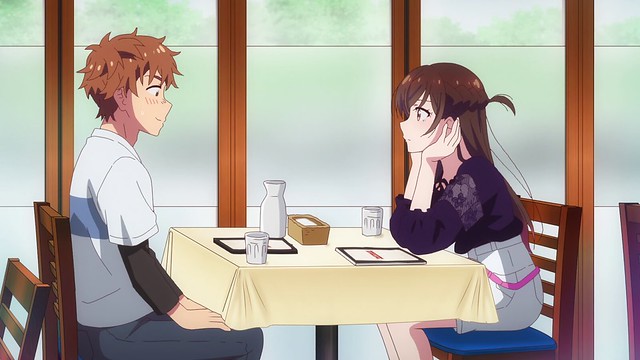
In the aftermath of a successful première, the relationship between Kazuya and Chizuru does not appear to have made any meaningful progress, and Kazuya ends up renting Chizuru out again, hoping to confess his feelings for her. When a number of professional filmmakers invite Chizuru to a gathering, she extends the invitation to Kazuya, who feels out of his depth at the event. Meanwhile, frustrated that Kazuya hasn’t been paying much attention to her, Ruka tries to spend more time with him but continues to encounter difficulties; to try and get Chizuru to back off, Ruka suggests she and Kazuya have taken their relationship to the next level, and Mami, who’s worked with Kazuya’s grandmother as an advisor of sorts, reveals to Chizuru that she’s aware of the truth behind her ersatz relationship with Kazuya. When Kazuya’s grandmother invites him, Chizuru and Ruka to Spa Resort Hawaiians. The prospect of a large trip opens the floor to new misunderstandings – Chizuru and Kazuya struggle to work out how to inform the latter’s grandmother that their relationship is a sham. At the resort, Chizuru has fun in spite of herself, and realises that Kazuya’s family is legitimately grateful that Kazuya has someone like her by his side. The lie becomes increasingly difficult to sustain, and complicating things are Mami, who tries to persuade Chizuru that Kazuya is trouble. Mami corners Chizuru and forces an ultimatum; either be upfront about what the situation is, or she will escalate further. Quite separately, Mami also persuades Ruka that it is possible for her to have Kazuya to herself, and after Kazuya works up the courage to attempt a kokuhaku, a distracted Chizuru runs off: although she’s concerned about Mami and her machinations, Kazuya takes this to mean he’d been rejected. Kanojo, Okarishimasu‘s fourth season, airing two years after the third season back during the autumn of 2025, continues with the curiosity of a story that began back in 2020, and forty-eight full episodes into its run, Kanojo, Okarishimasu appears be dead-set on testing the limits of viewer patience: pacing in the fourth season grinds to a seeming halt as Chizuru grapples with the threat Mami holds over her head, and Kazuya’s efforts to overcome his own doubts are consistently met with failure. Circumstances itself continues to introduce new setbacks for the pair, and as the build-up continues, one cannot help but wonder when this house of cards will finally reach a tipping point and fail catastrophically, once the truth does get out.

At first blush, the events of Kanojo, Okarishimasu‘s fourth season feel like a frustrating “do not pass Go”: having spent the entirety of the third season seeing Kazuya supporting Chizuru in producing an independent film, it felt that there had at least been some progress on Kazuya’s front. However, when it became clear that Chizuru is still at a crossroads, Kanojo, Okarishimasu not only appears to have stalled, but instead, even comes across as taking several steps backwards, negating any progress that the third season had made. From a strict romance perspective, this is understandably frustrating – audiences correctly expect a payoff from effort because this is the primary aim of most stories. Kanojo, Okarishimasu‘s fourth season, curiously enough, is taking a brief detour to deal with the elephant in the room: at the onset, Kanojo, Okarishimasu appeared to be a story of how an ersatz, transactional relationship might grow into something legitimate, and on those premises, the series would’ve spoken to the familiar notion of persevering to achieve one’s goals. Instead, by taking viewers on a ride, Kanojo, Okarishimasu reminds viewers that the lie Chizuru and Kazuya had built, of being in a real relationship, to keep their grandmothers happy, is not an inherently sustainable one. Until now, i suggested that this uneasy status quo could be maintained indefinitely, and further to this, there was merit in doing so for the sake of Kazuya’s grandmother. By throwing Mami back into the mix, and having her holding this knowledge over both Chizuru and Kazuya’s head, Kanojo, Okarishimasu is able to catalyse a different sort of conflict – there is no more runway for Chizuru, who risks being outed as a rental girlfriend during a time when Kazuya’s grandparents and parents alike are more than prepared to welcome her into the family. Chizuru is, in short, being pulled in opposite directions now, and the metaphorical house of cards she and Kazuya have unwittingly created now have clear consequences. Chizuru had been portrayed as being quite indecisive in her actions during the fourth season’s first half: she insists she has no feelings for Kazuya and wishes him well with Ruka, but simultaneously feels compelled to keep up appearances for Kazuya’s family until such a time when he can be truthful, but in doing so, Chizuru offloads the responsibility of her own feelings onto Kazuya, as well. In this way, Mami’s actions, however unsavoury they are to watch, ends up serving an important role in Kanojo, Okarishimasu: her blunt and demanding intervention is forcing Chizuru to re-evaluate what she’s been doing all this time, and this might provide a boot to the rear for Chizuru, who has, insofar, been avoidant of the matter of how she feels about Kazuya: neither accepting his feelings or rejecting them, Chizuru’s own lack of conviction brought Kanojo, Okarishimasu to a standstill, and with Mami now taking matter into her own hands, Kanojo, Okarishimasu appears to be heating up.

Screenshots and Commentary

  • Kanojo, Okarishimasu holds the rather dubious distinction of being the only anime I’ve stuck into the “Terrible Anime Challenge” bucket on four different occasions. When I picked up the first season back in 2021, I had an inkling of what the premise entailed, but no idea of what followed – the assumption I had coming in was that Kazuya and Chizuru would have a somewhat predictable outcome, where Kazuya’s renting Chizuru would either help him identify what he wanted, or produce a more confident man who could sway Chiziru’s heart. When Kanojo, Okarishimasu did not do this, I knew that I would need to take a different approach to this series to understand why five years later, I’m still writing about Kazuya and Chizuru’s mishaps.

  • My own reception towards Kanojo, Okarishimasu is an intermediate between what Japanese viewers experience and what English-speaking viewers feel – on one hand, I completely agree with Western perspectives that the lack of a clear progression and character indecisiveness prevents the story from advancing in a way that makes for a satisfactory experience. However, on the flipside, I also appreciate that Kanojo, Okarishimasu is doing something different, and to Japanese viewers, who relate to the characters and their experiences, Kanojo, Okarishimasu can be seen as being another way of exploring the messy, uncertain nature of relationships.

  • One must therefore allow for the fact that, since we are now finished the fourth season of Kanojo, Okarishimasu and are near the airing of a fifth season, Japanese studios and producers are able to produce this because the market forces make it viable. That is to say, Japanese viewers clearly like Kanojo, Okarishimasu enough to buy the disks and read the source material, and as such, Kanojo, Okarishimasu correspondingly must be doing something that draws in Japanese viewers and readers. We cannot always just disparage or critique a work from one cultural or personal lens, and this is why it’s so important to understand what leads series like Kanojo, Okarishimasu (and similarly, things like Gundam SEED: Destiny) to endure.

  • My approach as a blogger is not to tell readers what to watch and what to skip – I respect my readers’ agency and judgement enough that this is not one of my objectives. Rather, as a writer, my objectives simply are to explore what a work is doing and whether or not the outcomes made a given experience a worthwhile one. I understand that my methods stand contrary to how the majority of people view a given work, and as an example, when Kanojo, Okarishimasu finished airing back in 2020, one of MyAnimeList’s most infamous and well-known reviewers, “Stark700”, openly disparaged the series in a review and opens with the comment that he’d like nothing more than to “throw [Kazuya] off a bridge, or…simply want to say ‘you’re pathetic’ to [his] face”.

  • While this makes it clear Stark700 disliked Kanojo, Okarishimasu, to claim that “this anime itself is one that’s is deceptive to the core…because we’re not getting a real storyteller” is egregious – Stark700 has completely failed to understand that Kanojo, Okarishimasu is not a conventional romance. It is, as he already mentioned, about how “fake relationships almost always have its consequences”, but rather than doing so elegantly, Kanojo, Okarishimasu deliberately and willfully disables safeguards so viewers can see just what happens if things are allowed to play out in a simulated space. We viewers are not meant to envy or emulate Kazuya, but rather, appreciate how certain actions are unsustainable. In other words, Kanojo, Okarishimasu willfully renders Kazuya to be a difficult protagonist to accommodate the series’ intended themes.

  • In creating frustration amongst Western viewers, Kanojo, Okarishimasu was quite successful, and I concede that even I’m not immune to this feeling. However, it is not my place, or Stark700’s, to say that Kanojo, Okarishimasu was deceptive in any way: the author and studios have an objective, they stuck to it, and the result paints a clear picture. In this regard, Stark700 appears to have rejected the lesson, too: Kanojo, Okarishimasu isn’t about teaching viewers to “not to be like Kazuya”, but rather, eliminates safeties that prevent such scenarios from getting out of hand to illustrate a very specific message – the further one gets into a lie, the harder one will fall when the truth does come out.

  • In the West, the lessons of allowing a small fib to escalate into something unsustainable is captured by the children’s rhyme, There Was an Old Lady Who Swallowed a Fly, and this simple lesson has been applied in things like Gundam Unicorn – Laplace’s Box and the last clause of the Universal Century Charter, in dealing with Spacenoid Rights, was papered over and turned into a justification for oppressing people in space, but its legacy and reputation far outstrip its actual meaning, giving the EFSF of U.C. 0096 the sense that if the truth got out, it would render the EFSF government illegitimate. Gundam Unicorn takes a more conventional and realistic approach in portraying how lies can set up undesirable scenarios.

  • On the other hand, Kanojo, Okarishimasu is more similar to 100 Kano: once one accepts that Kanojo, Okarishimasu is a thought experiment, of what happens when a premise is pushed to its logical conclusion without realism intervening, the messages become quite clear, and characterisation follows. One must therefore be willing to accept that Kazuya, Chizuru, Ruka and Mami are not role models or people to aspire to be like, and instead, view their stories as cautionary tales. Once this perspective is taken, Kanojo, Okarishimasu becomes considerably more enjoyable because rather than rooting for the characters or hoping for improvement, one can kick back and view things as one might a simulation gone wrong.

  • This is why Kanojo, Okarishimasu does not end up being a total waste of time for me, and by the fourth season’s halfway point, apparent stagnation in the story is dislodged when Kazuya’s grandmother stops by with a surprise: a family trip to the Spa Resort Hawaiian. This inn is described as being in Fukushima and a spot that Kazuya’s grandmother holds dear, and while it was originally meant to be a family trip, things spiral out of hand when Kazuya’s grandmother extends an invitation to Ruka, reasoning that the more there are, the merrier things will be in a bit of dramatic irony.

  • While this is introduced, Ruka throws another wrench into things by trying to aggressively push Chizuru out of the picture by saying she and Kazuya had done the horizontal tango. While Chizuru had been the one to encourage Kazuya and Ruka to get together, I found that her response in this moment suggests things aren’t quite so cut-and-dried: had Chizuru completely lacked feelings for Kazuya, she wouldn’t be fazed by Ruka’s comment and would, in fact, express happiness that things for Ruka and Kazuya are working out. Chizuru’s response here would therefore confound things, and one could be reasonably confident that Chizuru’s words do not mirror what’s in her heart.

  • Assuming this were the case, things in Kanojo, Okarishimasu would be kicked upstairs – the entire premise was dependent on the lingering tensions between Kazuya and Chizuru, and had the former committed to Ruka, there’d be no conflict or challenge. Many of the things viewers take exception to in Kanojo, Okarishimasu are deliberate, present so viewers to see how far Kazuya’s unenviable situation can be pushed before things reach a breaking point. The sheer number of things that go wrong in Kanojo, Okarishimasu is reminiscent of how the Chernobyl Nuclear Disaster as a consequence of a willful neglect of procedure, deliberate deactivation of safeguards and unexpected interactions coming together to produce a catastrophe.

  • Kanojo, Okarishimasu is going down a similar path, and once Kazuya’s party arrives at the Resort Spa Hawaiian, I consented to kick back and let things unfold. The pacing in this fourth season was significantly slower than anything we’d previously seen: over half the series is set in the days during the vacation, and attention is paid to individual moments, moments that really accentuate how after three-and-a-half seasons, the lie between Chizuru and Kazuya is not something that can be easily concealed. In the close quarters of the resort, there is really nowhere left for Chizuru to run.

  • As I made my way through Kanojo, Okarishimasu‘s fourth season, I slowly shifted over to the realisation that, while Kazuya’s mannerisms aren’t exactly going to endear him to viewers or garner any sympathy from me, what makes Kanojo, Okarishimasu manageable is the fact that Kazuya’s intentions and objectives are clear as day. He has only eyes for Chizuru, and the entire fourth season has him trying to confess to Chizuru. If Kazuya had actually succeeded, the status quo between himself and Chizuru would shift, the tensions would evaporate immediately, since the relationship would now be real. Kazuya’s persistence is offset by the fact that circumstance itself seems to disrupt every effort.

  • Since Kazuya is more or less a constant by Kanojo, Okarishimasu‘s fourth season, the only variable is Chizuru. Based on what we’ve seen so far, it’s tricky to determine whether or not she actually returns Kazuya’s feelings. Her cold attitude and avoidance of the issue suggests that she’d rather not enter a relationship with him, but at the same time, there are instances where Chizuru clasps her hands together, covers her mouth and blushes furiously in response to something Kazuya does or says. The ambiguity is, to be frank, quite stressful, and while it is infuriating from a storytelling perspective, I do understand why Kanojo, Okarishimasu elects to present Chiruzu’s perspective from this direction.

  • Every individual will know this to be true: from one’s own perspective, one is fully aware of how they feel about things, but to figure out what someone else is thinking is quite difficult. Thus, as viewers watch Kazauya trying to push forward despite incomplete information, they are also forced into the same position as Kazuya: we have next to no insight as to what’s going through Chizuru’s mind. I imagine that for most viewers, however, once Kanojo, Okarishimasu‘s fourth season enters the pool segments of the Resort Spa Hawaiian chapter, thoughts wander away from individual objectives towards the visuals on the screen. I was a little taken aback at how immature Kazuya and his friends were here – once everyone changes and hits the pool, Kazuya and Shun immediately set about ogling Chizuru and Ruka.

  • In the past, I would’ve likely joined critics in suggesting that Kazuya’s being flustered at being asked to ride tandem with Chizuru is exaggerated and unrealistic: surely, Kazuya could just grit his teeth, take a deep breath and enjoy the ride? However, since “no plan survives contact with the enemy”, and I’ve never done anything of the sort before, I can appreciate how doing something like this could be quite nerve-wracking, even if one is riding alongside a partner. Even in more typical setting, standing beside someone one has a crush on can cause a perceptible tightening in the heart, and while adults are better able to manage these moments, I expect that such a reaction, as Kazuya experiences, is only natural.

  • Confounding the situation further, Chizuri’s bikini suffers a washout; she loses her top during the ride and is confined to a corner until Kazuya helps her to locate her top and secure it. In any other romance story, moments like these serve to close the distance and bring a prospective (or existing) couple closer together, but because of the ambiguity surrounding what Chizuru’s feelings are, one cannot readily work out what the implications of this moment are. On the flipside, the fact that Kazuya pushes through his own embarrassment to help Chizuru out shows that when the chips are down, he’s able to step up.

  • As it was, the Resort Spa Hawaiian chapter was a bit of a see-saw in terms of what it adds to Kanojo, Okarishimasu – on one hand, a resort and swimsuits is merely justification to show off Chizuru and Ruka’s figures for the amusement of viewers, but the cheerful antics of an extended pool party conceals the turbulence that accompanies Ruka and Mami’s presence. Ruka’s role would’ve been benign, but things become much messier when Mami appears. Mami has been widely viewed as Kanojo, Okarishimasu‘s homewrecker: ever since she broke up with Kazuya and set in motions the whole of the series’ events, she’s a recurring character whose knowledge of Chizuru’s ersatz relationship with Kazuya renders her a bit of a rogue element.

  • This is actually what drove Kanojo, Okarishimasu‘s fourth season to become more exciting: the question of when, rather than if, the truth could come out, has long lingered in Kanojo, Okarishimasu, and while Kazuya’s long tried to turn this phoney relationship into a real relationship, Chizuru’s own wavering feelings means that there continues to be a conflict in Kanojo, Okarishimasu. Left alone, the series would stall, and this is why, regardless of one’s impressions of Mami are, one cannot deny that her role in Kanojo, Okarishimasu is essential.

  • While Mami’s function in Kanojo, Okarishimasu is clear, I’ve always wondered what motivated her actions and why she seems so keen on preventing Chizuru from interacting with Kazuya at all. From a storytelling perspective, this isn’t strictly necessary because Mami only needs to serve as an antagonising force, a presence that threatens the status quo and forces Kazuya and Chizuru out of their comfort zone. What makes Mami such an effective presence here in Kanojo, Okarishimasu is the fact that viewers know almost nothing about what motivates her. This is significant because, if one knew why she holds such a warped view on love, one can reason out what she seeks to achieve and how she might go about doing things.

  • As it was, the reason behind Mami’s hostility and yandere-like tendencies are completely unknown to anime-only viewers, and this makes it quite challenging to speculate on what she’ll do next. This uncertainty, combined with the soap opera-like pacing of Kanojo, Okarishimasu, forces viewers to linger on the weight of each moment. I had found myself somewhat irritated by how slowly things in the fourth season were moving, and each episode felt as though it was dragging on, with frames lingering on uncomfortable silences, agonising thoughts and unanswered questions. If Kanojo, Okarishimasu had been a smartly-paced anime, the events of the Resort Spa Hawaiian chapter could’ve been condensed into the space of three episodes.

  • However, I’ve long accepted that pacing in anime is no different than how a photographer can use leading lines and negative space to force a viewer’s attention towards something the creator finds significant. Here in Kanojo, Okarishimasu, portraying the moments of enjoyment with things like the pool and onsen, and juxtaposing them with Mami’s threats, would compel views to keep their eyes on the tensions at hand, and I yield that the sensation is not unlike that created by the Sword of Damocles. Here, Mami tries to manipulate Ruka into believing that, were Chizuru to be removed from the picture, she’d have a clear shot of taking Kazuya for herself.

  • The net result is that Ruka begins to contemplate letting Kazuya’s grandmother know of the truth, and also press Chizuru to be more honest about what’s happening – at some point, Kazuya’s grandmother had even given Chizuru a Kinoshita family heirloom, a ring that has been passed down to women who marry into the family. The ring would become a symbol of the pressure that Chizuru faces – if she keeps up the lie, she’ll be compelled to keep up appearances and build up expectations, making it increasingly difficult to back out. While Kazuya feels the problem can be solved once he confesses his feelings to Chizuru, Kanojo, Okarishimasu makes this an increasingly challenging problem for her because of everyone involved.

  • Framing things like Ruka sharing a conversation with Kazuya’s grandmother to gauge the latter’s reaction on what might happen if Chizuru were to fall in love with and marry someone else besides Kazuya. Kazuya’s grandmother offers a thoughtful reply: while she would be disappointed, she would still respect Chizuru’s decision and wish her all the best. Ruka never really stood a chance in Kanojo, Okarishimasu, and in the past, I have mentioned that I pitied her character for being thrown into a story where she was predestined to fail. Kanojo, Okarishimasu is understandably a difficult series to like or recommend because it fundamentally goes against expectations for what makes an enjoyable romance.

  • However, if we approach Kanojo, Okarishimasu as we did 100 Kano, treating the series as another thought experiment, one where one deliberately creates circumstances and introduce decision-making that contradicts what healthy, well-adjusted individuals do, then Kanojo, Okarishimasu becomes a fascinating case study in how in romance and relationships, one’s worst enemy is ultimately oneself. Moreover, as Kanojo, Okarishimasu‘s fourth season wore on, I began gaining the impression that, all of his negative traits notwithstanding, Kazuya is not the reason why progress has stalled.

  • Chizuru’s indecision is brought to the foreground in the fourth season, and while Mami’s manipulative, scheming nature makes her unlikeable by definition, her role forcibly exposes the fact that Chizuru had been quite ambiguous in regard to her own feelings. Kanojo, Okarishimasu presents Chizuru as maintaining the façade because of concern for Kazuya’s grandmother, and because of the expectations and assumptions the Kinoshita family has made. While this is a plausible account of Chizuru’s actions, I contend that if Chizuru had zero interest in Kazuya, she would not have committed to the lie. The fact that Kazuya does go out of his way for her means that there’s conflict in Chizuru, and this, combined with how earnestly the Kinoshitas see her, is why Chizuru finds it so difficult to answer the questions Mami poses.

  • While it’s easy to say one can commit to a certain course of action, the reality is that multiple confounding factors all interact to create a scenario where she’s immobilised. I would not expect to do any better in her shoes, and I do not expect the more authoritative fans to, either. By painting Chizuru into a corner, Kanojo, Okarishimasu‘s fourth season is creating the scenario where, against her will, Chizuru will have to decide for herself what matters more, and I’d expect that this is where the fifth season will go. I have heard rumours that, surrounding how the Kanojo, Okarishimasu manga concludes, fans were quite disappointed in the outcomes.

  • If, and when Kanojo, Okarishimasu‘s animated adaptation reaches this point, I’d expect the disappointment will reach the anime viewers, as well. For my part, even if Chizuru and Kazuya do not end up together, my aim will be to identify why Kanojo, Okarishimasu decided to take such a route and determine what the author’s intentions had been with such a conclusion. I understand that within the realm of fiction, people understandably will anticipate that effort is met with reward, and a story that shows a journey with a satisfying payoff is one that people best connect with, but in some cases, stories that break the mold usually do so because they seek to say something specific.

  • As it stands, I will try my best to continue being patient and fair with Kanojo, Okarishimasu – as a love story goes, Kanojo, Okarishimasu is not going to have my recommendation, and I remark that the characters are not written in a way I relate to or endorse, but as a concept, Kanojo, Okarishimasu does do a satisfactory job of exploring how certain traits and actions, when applied to a romantic relationship, can create untenable situations. My curiosity in the fifth season, then, is seeing what messages come out of the journey that lies ahead for Kazuya and Chizuru – the fourth season ends on a cliffhanger, with Mami contracting with Chizuru after Chizuru herself declined to respond to Kazuya’s kokuhaku. I expect that Kanojo, Okarishimasus fifth season will hit the ground running, even if it’s unlikely to be any less frustrating than its predecessor.

Irrespective of infuriating Kazuya’s mannerisms and self-doubt might be in Kanojo, Okarishimasu, three seasons has shown that Kazuya has grown since the first season: the Kazuya who sought a rental girlfriend after being dumped by Mami had been lacking in confidence and second-guessed himself at every turn. By the third season, Kazuya is more determined, committed and purposeful: even with Ruka, Kazuya openly acknowledges that he’s not in love with her and desires Chizuru. This is what motivates the effort he puts into realising Chizuru’s dream of making a movie for her grandmother to watch, and the end result removes any doubt about where Kazuya’s heart lies. To viewers, then, Kazuya’s intentions and goals are explicitly clear. This leaves Chizuru’s feelings and intentions as the persistent unknown in Kanojo, Okarishimasu. From this point of view, Mami’s intervention, however mean-spirited it’d be in reality, becomes an essential mode of disrupting this status quo; it becomes clear that far from being the “train wreck” or “dumpster fire” the internet has described, Kanojo, Okarishimasu is, in fact, a creative portrayal of what happens when the complexities of navigating a relationship and romance are taken to their logical extremes. Like 100 Kano, Kanojo, Okarishimasu sets out with an experimental problem (namely, is whether it’s feasible for people can conceal an ersatz relationship before the truth comes out) and deliberately introduces variables and constraints to explore the scenario. The fact that i has reached this stage suggests that even in an environment where authors control outcomes, maintaining the status quo indefinitely is unsustainable, and within the realm of Kanojo, Okarishimasu, Chiziru cannot be undecided about her feelings forever. In this way, while Mami might be viewed as a bit of a home-wrecker, the reality is she’s moving the needle against Chizuru’s wishes, and this will compel her to confront her own feelings: is she apprehensive about returning Kazuya’s feelings because of the unknowns that may follow, or just worried that because she does not return his feelings, she may hurt Kazuya and his family by being honest? Understanding the conundrum Chizuru faces, her indecisiveness because of the potential consequences, and the fact that the fourth season of Kanojo, Okarishimasu now backs Chizuru against a wall, renders the series all the more compelling, and with the fifth season now just a month away, one cannot help but curious to see what follows – Kanojo, Okarishimasu has now created a reality where Chizuru will have no choice but to confront her emotions.

Terrible Anime Challenge: Kanojo, Okarishimasu Season Three and New Perspectives Through An Unlikely Angle

So he’s not perfect. You don’t wanna end up old and lonely like ZOIDBERG!” –Zoidberg, Futurama

In the resulting commotion from Kazuya’s desire to see Chizuru make a movie, neighbour Mini Yaemori takes an interest in developments. Mini is all too happy to lend her time and know-how after taking a keen interest in seeing Kazyua get together with Chizuru. With Mini’s expertise as an influencer, Kazuya opens a kickstarter and, despite some difficulties early on, he manages to raise the necessary funds. Along the way, he also successfully recruits his college’s film club to assist. Filming proceeds smoothly, and Kazuya himself shoots the final scene on a private retreat with Chizuru. Before the screening, however, Sayuri, Chizuru’s grandmother collapses and is hospitalised. When it appears Chiruzu would be unable to fulfil her promise to Sayuri, of having her watch at least one film, an insistent Kazuya manages to bring a copy of the film and a projector. Sayuri dies shortly after, and although Chizuru is devastated, she tries to put on a brave face. Worried about Chizuru, Kazuya speaks to Sumi, who encourages him to do what he can for Chizuru. Kazuya ends up arranging for another rental date and decides to take charge this time, trying to raise Chizuru’s spirits as best as he can. This date ends up being an ideal one, and when Kazuya breaks out the fireworks, Chizuru’s thoughts stray back to her grandparents. Emotions boil over, and she finally cries her eyes out in Kazuya’s arms. On première day, the film Chiruzu stars in is well-received, and Kazuya wishes he could do more for Chizuru. After the screenings end, Chizuru indicates she genuinely enjoyed every step of the movie-making process, and, with a smile consents to have Kazuya accompany her along the way. With this, three seasons of Kanojo, Okarishimasu are now in the books. This series, known for a seemingly outrageous premise and a protagonist whose mannerisms can be a source of frustration for viewers, has also found itself a fiercly dedicated following for its raw portrayal of how romance may progress. This isn’t always apparent: other viewers find Kazuya a difficult character to relate to, and the inconsistent pacing in Kanojo, Okarishimasu makes it a frustrating experience. Every step forward Kazuya takes is countered by the combination of Chizuru’s stoic and indomitable nature, with Kazuya’s own propensity to second-guess himself, and at first glance, this makes it tricky to gain a measure of what Kanojo, Okarishimasu strives to convey in its story.

There is, however, a most unlikely of comparisons that helps to provide a modicum of grounding in what Kanojo, Okarishimasu seeks to accomplish. There is a parallel between Kazuya and Chizuru in Matt Groening’s Futurama: Kanojo, Okarishimasu presents Kazuya as a loser archetype, similarly to Philip J. Fry. Both Kazuya and Fry are dim-witted, slovenly and impulsive, acting on the spur of the moment without a second thought to the consequences and generally lack the competence to see things through correctly. However, Fry and Kazuya have a kind heart and never hesitate to put others ahead of themselves, as well. Similarly, Chizuru can be seen as Kanojo, Okarishimasu‘s counterpart to Turanga Leela – Leela is smart, competent, hardworking and generally self-reliant, but both also have a short temper. Leela and Fry outwardly seem incompatible, as do Chizuru and Kazuya. In Futurama, Fry and Leela initially connect because of their shared loneliness; Leela was initially thought to be the last of her species, and Fry, having come from a thousand years earlier, has lost all of his family and friends. Through the course of Futurama, Fry becomes drawn to Leela, who would rebuff him, but as Leela sees other men and finds that despite their accomplishments, they all had some significant character flaws. On the other hand, Fry’s good heart and sincerity outweighs his other shortcomings. This is helped by the fact that Fry is admirably persistent: even when Leela’s not interested, Fry goes out of his way to make her feel appreciated and loved. The Fry-Leela relationship is a tale of how persistence and determination can win out, but it also reflects on how it can take time for people to work out their feelings. Here in Kanojo, Okarishimasu, the beginnings of a similar story are visible. Kazuya is head-over-heels for Chizuru, who similarly doesn’t return his feelings initially. However, in spite of herself, Chizuru does regard Kazuya as a friend, someone who, despite his indecision and taste for theatrics, can and will come through when the situation is dire. Having invested so much of his time into helping Chizuru and Sayuri out, Kazuya exits the third season on a much more positive note with Chizuru than anywhere else in the series. The two might not be dating yet, but Chizuru’s opinion of Kazuya has evidently improved, the same way that Fry would eventually win Leela over throughout Futurama. With this comparison in mind, the seemingly inconsistent dynamics between Kazuya and Chizuru become significantly easier to reconcile, and it becomes clear that Kanojo, Okarishimasu intends to portray the two’s relationship as a protracted tale of how it takes a bit of time for some people to learn about one another and cultivate something meaningful.

Screenshots and Commentary

  • I had been quite ready to bin Kanojo, Okarishimasu midway through season two: continuing on with the antics that defined the first season had not advanced the story in any meaningful way, and it was admittedly infuriating that neither Kazuya or Chizuru appeared to grow even as a result of their time together. The conflict as a result of Ruka trying to insert herself into things, and Kazuya’s unwavering feelings for Chizuru didn’t have an apparent goal in the second season. However, once Kanojo, Okarishimasu had established that Sayuri was dying and this gave Chizuru a hell of a time constraint to work under, Kazuya was presented with an iron-clad reason to show Chizuru what he’s made of.

  • That Kazuya goes to such lengths to realise Chizuru’s dream meant that Ruka never had any sort of chance, and give how the story’s presented, one of the things I imagine that viewers will be anticipating is seeing what goes down when Kazuya formally turns Ruka down. This outcome is inevitable, and while it was the only way things could end in Kanojo, Okarishimasu, one cannot help but feel badly for Ruka.

  • I had originally set out with the intention of tearing Kanojo, Okarishimasu a new one – from Kazuya’s standpoint, meeting Chizuru had set in motion a series of events that gave him every opportunity to move on from Mami, and of everyone he meets, Ruka is the first to openly admit she’s into him. I hold that life is a game of making the most of the hand one is dealt, and while many works of romantic fiction indicate that it is noble to hold out for the best, in reality, this may not always be practical.

  • As a result, instead of sitting out other opportunities in hopes of getting something ideal, it is preferable to know what one wants, and then if an opportunity comes up that satisfies a reasonable percentage of one’s expectations, then one should seize it. In the context of Kanojo, Okarishimasu, building a relationship with Ruka would’ve allowed Kazuya to experience the process with someone who had feelings for him and, potentially, fall back in love with Ruka. However, Kanojo, Okarishimasu is not real life, and I’ve long accepted that the story will progress the way author Reiji Miyajima intended it to.

  • Thus, I do not object to seeing Ruka lose in the long run because it is necessary for Miyajima to convey his intentions. The movie-making chapter of Kanojo, Okarishimasu is the best opportunity to establish this – Kazuya finds Ruka attractive, but their interactions always seemed to lack the emotional intensity that Kazuya feels whenever he’s around Chizuru. Far more than the physical elements, it’s this emotional connection that makes a relationship strong, and in the long game, since Kazuya doesn’t return Ruka’s feelings at this level, their relationship was never going to be quite as strong.

  • Besides giving Kazuya a stronger reason for being in Kanojo, Okarishimasu, the other aspect about the third season that I particularly liked was Mini’s appearance. Unlike Ruka or Sumi, who are both rental girlfriends and presented as potential suitors, Mini ends up being a source of support. She doesn’t have any outward interest in Kazuya as a romantic partner, but takes great interest in him for his relationship troubles. Characters like Mini are a refreshing way of adding new people into a romance story without creating unnecessarily complex love triangles, but at the same time, also provides another element that can bring about new humour.

  • Looking back, Kanojo, Okarishimasu was respectable in that the story is very clear about where Kazuya’s heart lies. Even more so than protagonists who lack confidence, viewers most despise protagonists who are ambiguous about who their feelings are for, or those who actively keep things ambiguous. The most infamous example of such a protagonist was Infinite Stratos‘ Ichika Orimura; because of the author’s own inability to settle on a proper romance, Ichika comes across as being clueless and dense wherever relationships are concerned, and in this way, Infinite Stratos‘ romance piece was reviled. On the other hand, Kazuya has eyes only for Chizuru, and this means that viewers don’t need to worry about his feelings wavering, no matter how many new characters are introduced.

  • Seeing how Kanojo, Okarishimasu handled Mini’s character made the third season a great deal more enjoyable – her otaku antics are presented as adorable and, while a little misguided at times, ends up providing Kazuya with solid advice. Whether it be for helping to crowdfund the film or compelling Kazuya to step up, Mini ends up being an asset to Kanojo, Okarishimasu. Mini is voiced by Yū Serizawa, a voice actress with an impressive resume, but having looked around, I can’t say I’m terribly familiar with her roles.

  • With Mini’s advice and support from everyone, Kazuya’s kickstarter is successful, and the filming project moves onto the next phase. Having the funds allows Kazuya to bring the film club on; they bring the knowhow and equipment, allowing the project to fully start. When Kazuya is occupied with directing the movie and managing the other aspects of shooting a movie, viewers have a chance to see him at his best. Kanojo, Okarishimasu had not given viewers much insight into how Kazuya is outside of his romantic pursuits, so being able to observe Kazuya working towards something more tangible paints him in a better light.

  • Although this might be an independent film with a small budget, Chizuru gives the lead role her all. Patience is required for stories like Kanojo, Okarishimasu – the series’ slow start was meant to establish the characters and their traits, but the tradeoff for doing this was that the anime would frustrate some viewers with its early emphasis on comedy over substance. I recall during the first season, some reviewers immediately dismissed the series as being a “dumpster fire” or “train-wreck”, criticising Kanojo, Okarishimasu for being a paint-by-numbers romance with nothing of note.

  • Admittedly, the first two seasons of Kanojo, Okarishimasu had not impressed me: the pacing had been infuriating, and Kazuya seemed to be unreasonably optimistic about his odds with Chizuru. However, I never did share these raw impressions with readers. I strive to be fair in my discussions, and this means that before I put my opinions on paper, I try to appreciate what the author is trying to do for a given work. Additional context is helpful, so I prefer to pass judgement on a series only after I have a better measure of the series. After one season, Kanojo, Okarishimasu had not surrendered any of its mysteries to me, so I refrained from putting forth a single, definitive opinion.

  • This is why it took me all three seasons to gain a solid understanding of why Kanojo, Okarishimasu is structured the way it is, and in turn, provide a more reasoned account of my overall thoughts on the series. As it turns out, the best way for me to approach this was to treat Kanojo, Okarishimasu like Futurama: the parallels are quite striking, and when I began connecting the dots, my disapproval of Kazuya and Chizuru vanished. For me, Kazuya’s biggest shortcoming was the fact that, despite desiring to doing right by those around him, he never gained any more confidence as a result of his experiences. Similarly, Chizuru is incredibly stubborn and insists on soldiering through problems on her own.

  • A major part of any story worth following is seeing the characters grow over time, and for me, I most enjoy stories where initial impressions of a given set of characters are proven inaccurate as one gets to know them (and their backgrounds) better. Over time, as individuals learn more, they grow as individuals, and this growth mirrors what the author intends to say with their themes. The journey is what makes things meaningful for me, and this is why stories without such a goal do not appeal to me. At first, Kanojo, Okarishimasu appeared to be the latter, but because it was so early in the story, I decide to be patient with the story.

  • Having more time to see Kazuya interacting with Chizuru, without any antics from Ruka or Mami, gives viewers a chance to see how things can be without interference from the other characters, and seeing the dynamics between Kanojo, Okarishimasu‘s lead characters led me to feel that, of all of the shows I’ve watched, Chizuru and Kazuya most resemble Futurama‘s lead characters – even though Chizuru and Kazuya aren’t accompanied by a lovable robot rascal voiced by John DiMaggio, making common trips with faster-than-light travel across the universe, there’s enough going on so that the filming process was compelling.

  • The idea of using a project to help Chizuru see a different side of Kazuya is as plausible as it was effective – while I imagine a large number of people will disagree with me, I feel that the best way to really know someone isn’t through having fun with them, but seeing how they operate when things get busy or challenging. Kazuya, for all of his bluster and outward disorganisation, always finds a way to come through. By the end of his private retreat with Chizuru, Kazuya completes filming, and the footage is now handed off to the film club for editing. This leaves Kanojo, Okarishimasu free to return to the problem of Kazuya needing to handle the fallout from Mini’s interference: originally, she and Ruka were supposed to accompany Kazuya and Chizuru, but things didn’t quite proceed as expected.

  • Thus, on his return, Kazuya must handle an irate Ruka. He promises to take her on a date of sorts on her birthday, but on the day of, I found that Kazuya’s heart wasn’t wholly into things because he’s head-over-heels for Chizuru. The events of Kanojo, Okarishimasu are tailored to accommodate the shift between Kazuya and Chizuru, and in this way, I found that the story does a solid job of setting up Ruka’s fall – since Kazuya hasn’t turned Ruka down outright (and Chizuru herself had actually encouraged Kazuya to date Ruka), Ruka’s expectations are still high despite her own understanding that she’s lost to Chizuru. How author Miyajima portrays this outcome is something I’m curious to see in the animated format.

  • While Chizuru might be the star of Kanojo, Okarishimasu, and her background makes Kazuya’s pursuit of her all the more compelling, I found Ruka was more appealing. Unlike Chizuru, who tends to bottle up her feelings and put on a brave face, Ruka is very forward about how she feels – she has no problems with throwing tantrums and has a possessive streak a mile wide. I’m not someone who can readily read between the lines when it comes to people, which is why I tend to favour people who speak their minds. Outside of Ruka’s more negative traits, she is cheerful, persistent and outgoing, and on top of this, is said to only be bested by Chizuru in terms of figure.

  • Altogether, Ruka is someone whom I’d not object to having around, and it is for this reason that as a viewer, I would’ve preferred to see Kazuya adhere to the adage that “a bird in hand is worth two in the bush”. In my own experiences, I have found that making the most of what I have has always worked out better than holding out for something more. This is why when asked the classic question of “take ten dollars now, or flip a coin for double or nothing”, I’d always take the ten. This isn’t something that I was appreciative of when I was younger, and in this way, I ended up giving up things that were quite good because I was sure I could do better.

  • For this reason, and based on the information available to viewers after three seasons, I would pick Ruka each and every time. However, this is strictly my preference, and while the so-called “shippers” take these choices very seriously, I find that when considering relationships and their outcomes in the realm of fiction, one must empathise with the protagonist, rather than forcing their own preferences towards a conclusion. In Kanojo, Okarishimasu, I happen to like Ruka more than I do Chizuru, but from Kazuya’s standpoint, he sees Chizuru as being the better choice. The story would not work if Kazuya decides to take a more practical route, and so, it becomes necessary that he pursue the aloof and stoic Chizuru.

  • Spotting that Kazuya was similar to Fry helped me to warm up to his character: both are quite whiny at times, and in fact, Kazuya’s propensity to wriggle around in fits of self-loathing did not endear him to me. However, I came to respect Fry for his simple and sincere approaches during his pursuit of Leela, and when I began treating Kazuya similarly to Fry, Kanojo, Okarishimasu clicked. If Kazuya was Fry, then Chizuru’s counterpart is Leela; like Chizuru, Leela is competent, intelligent and strong. Both put on a tough act for those around them, but have moments of vulnerability.

  • This comparison is ultimately what led me to the choice of page quote: like Fry, Kazuya isn’t perfect, but unlike the more successful men Leela dates, Fry is genuine. I had hoped that Chizury would’ve spotted the effort Kazuya had put into making her dreams possible for Sayuri’s sake, but Kanojo, Okarishimasu always trundled along slowly in this area. From the timescales of an anime series, Kanojo, Okarishimasu moves along glacially, and this made the series a little trying to watch at times. However, recalling that Leela didn’t really warm up to Fry until about six seasons in, I became more forgiving of Kanojo, Okarishimasu‘s pacing.

  • Sayuri’s unsteady health was the main reason why there had been so much pressure for Chizuru to reach her goal of starring in a film – despite her good spirits, Sayuri’s time was limited enough so that this is what compelled Kazuya to complete the film at all costs. This element was added purely to add drama and a sense of urgency, but because Kanojo, Okarishimasu had started its journey as a comedy, I had assumed that the series wouldn’t actually have Sayuri dying before Chizuru had reached her dreams. As such, when this outcome did come to pass, the story now gave Kazuya an opportunity to show what he’s got.

  • The swings between comedy and tragedy in Kanojo, Okarishimasu aren’t anywhere nearly as pronounced as they were in something like Key’s visual novels, but the intentions are the same: by showing the characters in whacky situations, viewers can see how everyone is under ordinary circumstances, and then, when defecation hits the oscillation, since viewers accompanied characters through good times, tragedy becomes more impactful. The series had hinted that Sayuri wasn’t in the best of health, so this outcome wasn’t outside the realm of possibility, but seeing it happen was nonetheless a shock. In her last moments, Sayuri sees Kazuya step up and show her what Chizuru had accomplished.

  • For me, what was quite maddening was how Chizuru resisted all of Kazuya’s efforts to support her right after she got the news that Sayuri was gone. For all of Chizuru’s positive qualities, her single largest shortcoming is how stubborn she is. In this way, Kazuya is a suitable match for Chizuru purely because he’s equally as unyielding, and while he spends a few days agonising over what the next move is, Kazuya does end up deciding that he’ll support Chizuru in the only way he knows how. I would’ve liked to have seen Kazuya be more decisive with his actions – while perhaps more plausible, watching him writhe about in his apartment doesn’t exactly inspire confidence.

  • In the end, Kazuya finds the resolve to do what he needs to after having a chat with Sumi – Sumi was introduced as another rental girlfriend working at the same agency Chizuru had, and like Ruka, she’s drawn to Kazuya’s kindness. Overwhelmingly shy, Sumi had taken the rental girlfriend position so that she could gain more confidence and become an idol, but even in the company of familiar people, Sumi prefers to type out her conversations. This trait was likely deliberate: when Sumi does give voice to her thoughts, viewers can be sure that she’s serious, and with Sumi’s encouragement, Kazuya finds his answer.

  • Kanojo, Okarishimasu thus joins the ranks of countless other anime in setting one of its scenes in Enoshima; a motivated-and-determined Sumi ends up taking Kazuya here as a part of their date so Kazuya can clear his head, where they climb the stairs to the Enoshima Sea Candle’s iconic observation deck. It is not lost on me that I’d kill multiple birds with one stone if I were to include Enoshima on my proposed Japan trip next year. My friend had been interested in visiting Sagamihara Vending Machine Park, and Enoshima is a manageable two hours away by train. However, after consideration, I would rather stay in the Hiroshima-Kyoto area so I can explore those sights in greater detail.

  • In the end, Kazuya ends up renting out Chizuru and plans an extravagant date for her. Besides taking Chizuru clothes shopping, out to a Nolan-esque film that flies over Kazuya’s head and even the climbing centre, Kazuya also drops serious coin on a luxurious crab dinner, before rounding out the evening with fireworks. Kazuya struggles to determine if Chizuru is genuinely having fun on their date, or if this is her fulfilling her obligations as a rental girlfriend. Although self-doubt occasionally crosses his mind during this date, one admirable change in Kazuya was that he pushes these thoughts aside, and pushes ahead with his objectives.

  • Kanojo, Okarishimasu is not known for its portrayal of food (at least, not to the same level as cooking anime, or series like Yuru Camp△), but seeing details in Kazuya and Chizuru’s evening meal serves to accentuate the fact that Kazuya’s spared no expense in trying to give Chizuru a boost. Good food does act as something that’s universally appreciated, and during the past weekend, I swung by the local Farmer’s Market because it’d been a rainy sort of day. I wound up having Steak Bites from a vendor called the Chuck and Shoulder: it’s basically a steak sandwich with seven ounces of sirloin steak dry-aged for 28 days on garlic bread and house fries, and I found the steak especially flavourful.

  • In the end, after the day’s final activity (fireworks), Chizuru finally breaks down in tears, the full weight of her grief pouring out torrentially – the fireworks reminded her of her grandparent’s words to her, and here, Chizuru finally realises that the last of her family are no longer around. Kazuya does what he can for her, although he wonders if he’d done enough, especially after running into Chizuru the next day and being regarded with a stony silence. I’d hazard a guess and suggest that Chizuru was probably just a little embarrassed – while paying her respects to her grandparents, she admits that Kazuya’s gone to lengths like none other.

  • Once their independent film formally screens and is well-received, Chizuru’s old spirits begin returning, and she resolves to continue acting. This time, however, she seems genuinely happy she’s got Kazuya in her corner, and with this, Kanojo, Okarishimasu‘s third season draws to a close. My overall verdict, in typical “Terrible Anime Challenge”, is that the series doesn’t suck. This is high praise for a series that started off on a very uncertain footing, and while I don’t always agree with how Kazuya or Chizuru handle things, there is a certain charm in how the series manages to make things work out for the two. With this, I’m now done writing for the shows I watched during the summer season and are in a solid position to enter the fall season.

Having now found my answer regarding what Kanojo, Okarishimasu sought to do with its story, my own reservations about the series have been lessened. I had entered Kanojo, Okarishimasu with an interest in seeing how things would unfold given such a dramatic premise, and found myself frustrated at the flow of events. In particular, Kazuya’s single-minded desire to win Chizuru over appeared to come at the expense of other people that came into his life as a result of his experiences, and at first glance, Kanojo, Okarishimasu‘s messages felt like they clashed directly with what I hold to be true. However, from another perspective, this is untrue: Kanojo, Okarishimasu‘s story, if viewed from Chizuru’s point of view, is a reminder to viewers about how sometimes, what one seeks in life has been in front of oneself the whole time. Kazuya’s tendencies to dream big and move mountains to help Chizuru reach her goals resemble those of her grandfather, and while Chizuru still sees her relationship with Kazuya as that of a client and service provider, Kanojo, Okarishimasu makes an effort to show how Chizuru’s grandfather, in encouraging her to dream, is similar to the idealistic optimism that Kazuya has. Although Chizuru’s grandparents, the last of her family, have now passed on, it does feel like, with his mannerisms, Kazuya can act as a reminder of the people she loves very much and anchor her to her family, giving her the strength and encouragement she needs to pursue the future of her choosing. Of course, Kanojo, Okarishimasu can be quite bombastic and blunt about things, but with a successful movie production in the books, Chizuru’s opinion of Kazuya has changed perceptibly. The two might not be dating yet, but seeing how Kazuya treats people around him would doubtlessly give Chizuru a strong measure of how, beneath his disorganised and listless exterior, Kazuya is someone whose heart is in the right place. In this way, Kanojo, Okarishimasu‘s third season stands as the strongest ending to a season yet, and while the first two seasons did not inspire much confidence, now that Kanojo, Okarishimasu has hit its stride, I would not object to seeing another season, which would be valuable in exploring how the relationship between Kazuya and Chizuru matures.

Terrible Anime Challenge: Kanojo, Okarishimasu Season Two, Or, I’m Going To Need a Beer To Put These Flames Out

“You told me not to think!” –Bradley “Rooster” Bradshaw, Top Gun: Maverick

After Chizuru is unsuccessful in an audition, Kazuya vows to do everything he can to support her dreams and promptly arranges for another rental date. He learns from Chizuru’s grandmother that beneath her tough exterior is someone who’s trying to do everything on her own and despite her appearances, needs someone to lean on. Ruka ends up swinging by and cooks for Kazuya, but when a typhoon sweeps into their region and shuts down all mass transit, Ruka happily stays the night. She tries to seduce Kazuya and fails, but despite this, cheerfully announces they’d spent the night together the next morning. While Chizuru seems unperturbed, but Kazuya remains bothered and decides to rent out Sumi to see if he can gain some insight into what might make a suitable birthday gift – he ends up gifting to her some pickled plums. When Kazuya and Chizuru inadvertently end up being invited to the same drinking party, he ends up overdoing things to help Chizuru out. She and Kazuya end up going on another rental date, where Chizuru reveals she’s auditioning for another role. When Kazuya’s grandmother learns Chizuru’s birthday party has already passed, she decides to host a combined party. Ruka ends up accompanying Kazuya, and while she does her best to make a positive impression, after Chizuru arrives, she’s frustrated at being bested so quickly. She ends up ambushing Kazuya and kisses him passionately, saying she doesn’t want to have any regrets. However, Chizuru’s grandmother’s condition worsens, cutting the party short, and Chizuru decides it’ll be easier to leave their false relationship where it is so her grandmother won’t die with the knowledge that Chizuru has no one in her life. Later, Sumi has a request for Kazuya; she’s been wanting to try taking the lead in a rental date so she can be more effective in her role and to this end, has planned out an itinerary for Kazuya. In the process, Kazuya becomes inspired as to what he should do for Chizuru. Chizuru learns that her latest audition was unsuccessful and recalls why she’d gone into acting: she wanted to fulfil her late grandfather’s dream after he died in a vehicular accident when she was still in high school. When it feels as though despair is total, Kazuya knocks on her door with an ambitious goal in mind – he wants to crowd fund an independent film she’ll star in and complete it for Chizuru’s grandmother. This is Kanojo, Okarishimasu‘s second season, continuing on from the story the first season had begun. In its execution, Kanojo, Okarishimasu has become a very busy anime – it simultaneously seeks to be a drama and comedy, only revealing the background for Chizuru’s singular drive for success in the second season’s finale. However, once this reason becomes established, Kanojo, Okarishimasu‘s thematic elements become significantly clearer.

While Chizuru’s attitude towards Kazuya suggests otherwise, and Kazuya’s lingering weak sense of self-esteem continues to be a constraint, Chizuru’s flashback ends up providing answers to the questions surrounding Kanojo, Okarishimasu. Kazuya continues to lack any sort of confidence in his decisions and keeps second-guessing himself. He is indecisive, fickle and short-sighted. However, in being optimistic to a fault, Kazuya actually conveys the same sort of dogged persistence and support that Chizuru’s grandfather had when she announced her desire to be an actress. Chizuru’s grandfather had provided a constant source of encouragement and praise, expressing his desire to one day see her on the silver screen. There are numerous parallels with Kazuya’s single-minded wish to see Chizuru achieve her goals, and seeing this may yield a modicum of insight into why Chizuru is so distant with Kazuya, insisting that they remain at arm’s length – Chizuru has been stated to be quite observant and astute, so it follows that she sees a bit of her grandfather in Kazuya. Despite his clumsy attempts to help her, Kazuya’s motivations are sincere (even if he does display some lust where Chizuru is concerned), and after losing her grandfather, it is probably the case that Chizuru wanted to avoid a repeat of things. However, towards the end of Kanojo, Okarishimasu, Kazuya takes a hitherto unexpected step for Chizuru’s sake in suggesting a crowd-funded movie, and, moved to tears by the offer, decides to accept Kazuya’s help so that she can fulfil her dreams. In doing so, Chizuru has begun to do what her grandmother had wished for – having tried to do everything on her own until now, seeing Kazuya’s dogged persistence leads her to, however reluctantly, accept help from someone else. In this way, Kanojo, Okarishimasu‘s second season indicates that, despite all of the detours taken until now, Chizuru is the real star of the show. By opening up, acknowledging her vulnerability and realising that a little help from others can go a long way, Chizuru’s proven to be the most dynamic character of Kanojo, Okarishimasu. This aspect of Kanojo, Okarishimasu is the series’ strongest, and although it firmly establishes the series direction, my main gripe is that this thematic piece is sufficiently well-written such that the other aspects, such as the love tesseract Kazuya’s entangled in, feels quite unnecessary – from a thematic standpoint, because Kazuya’s desire to support Chizuru is, in effect, a continuation of what her grandfather had done, despite objections from Chizuru, it follows that Kazuya and Chizuru remain the best match in Kanojo, Okarishimasu.

Screenshots and Commentary

  • According to the site archives, the last time I wrote about Kanojo, Okarishimasu was back in May of last year because I had struggled to coherently discuss the series. Right after the first season had ended, the second season was announced, and here at the second season’s conclusion, a third season was immediately announced. Using the existing timeframe as precedence, I would estimate that season three will come out in July 2024. The first season began airing in July 2020, and there is a two-year gap between the two seasons, hence, two years from now appears to be a fair guess.

  • Typically, anime receive continuations based on sales, so Kanojo, Okarishimasu comes across as a bit of a surprise for me: while from a storytelling perspective, the anime is quite inconsistent and does some things better than others, I have heard that in Japan, this work is wildly popular, enough so that merchandise sales and other sources of revenue offset the poor BD sales. I am not one to deny that this series must be successful, since Kanojo, Okarishimasu ended up receiving a live-action drama adaptation, which is no mean feat, considering that Yuru Camp△ also received a live-action adaptation on account of how the overwhelmingly positive reaction for its anime counterpart.

  • The main reason why Kanojo, Okarishimasu was so tricky for me to write about is that the story is wildly inconsistent. One moment, viewers see Kazuya trying to persuade Chizuru to persist and fight on in a moment of emotional build-up, only for something to interrupt said moment. Kanojo, Okarishimasu swings constantly between comedy and drama, which takes away from both aspects; had the series been written to focus on either one, things would’ve ended up stronger for it. For instance, if Kanojo, Okarishimasu purely showed Kazuya’s ineptitude in romance through comedy, then the fun would come from seeing how misfortune slowly helps to improve his game.

  • Conversely, if Kanojo, Okarishimasu had been intended to be about a drama from the start, it would be able to accentuate Chizuru’s story and indicate how her perspectives of Kazuya change over time as she sees bits of her old family in him. This facet was easily the best part of the second season, and I felt that had the story been allowed to focus on this, it would be able to both show Chizuru’s growth as she learns that it’s okay to rely on others, as well as Kazuya’s growth by showing how relationships are more than just the physical piece, and the shared emotional journey with Chizuru would give him fulfilment in ways that his old relationship with Mami could not.

  • With this being said, it is not quite so easy to discard the other characters; Mami had set Kazuya on a course to meeting Chizuru by dumping him, and Ruka is able to help Kazuya see aspects of a relationship that are both good and bad. Sumi, on the other hand, is someone whose shyness requires Kazuya to take the lead. Everyone does help push Kazuya forward in their own way, although things happen at a glacial pace. Kanojo, Okarishimasu is a series that demands patience from the viewers to watch: the second season’s strongest moments and aims are only shown in the finale.
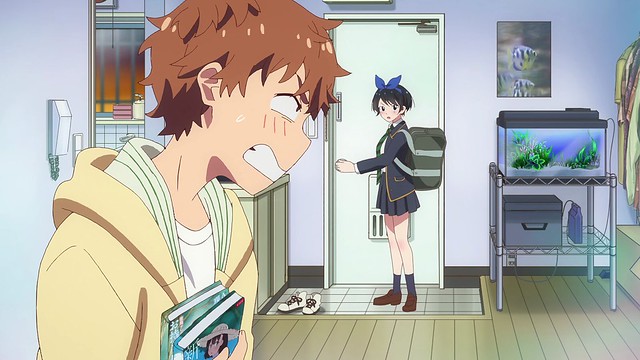
  • I imagine that this design choice was deliberate, meant to establish the dynamics amongst the characters and giving them a chance to bounce off one another before the series really hits its stride. However, this meant that many of the intermediate moments leading up to the finale lacked a good context and as a result, could be infuriating to watch. My favourite example of this in Kanojo, Okarishimasu is how Ruka’s role was portrayed. She’s head-over-heels for Kazuya and goes the extra mile to impress him, but these attempts are always doomed to failure because Kazuya has his heart set on being with Chizuru.

  • Without knowing Chizuru’s story and why she’s so cold towards Kazuya, the logical route would be to turn around and play things pragmatically: rather than pursue Chizuru, it would outwardly seem the better decision for Kazuya to focus on Ruka instead and allow things to progress. Romance and love can come unexpectedly, and while some stories give the impression that doggedly sticking to one’s guns is a measure of heroic resolve, in reality, things don’t always work out so neatly. Having said this, even in the knowledge of Chizuru’s story, I myself are more of a Ruka fan.

  • The reasoning behind why Ruka is my favourite among the main cast is because I empathise with her the most: because of how Kanojo, Okarishimasu is written, and what outcomes must occur in order to convey the story’s main themes, Ruka is predestined to lose Kazuya. Kanojo, Okarishimasu has already shown that she’s madly in love with him and was heartbroken during the first season after it was shown that Kazuya didn’t return her feelings. A sort of status quo is reached after Chizuru asks him to go out with Ruka, feeling that this experience may help him to get over Mami and also stop pining for Chizuru, as she doesn’t return his feelings.

  • While Ruka is my favourite character, in reality, I’m not sure how well I’d get along with someone like Ruka. On one hand, I’m fiercely loyal and commit to wholly to whatever I do, but Ruka also has a bit of a jealous streak about her, as well. Dealing with this might be tricky, but over time, a bit of communication and trust could sort that out, and from what’s shown in Kanojo, Okarishimasu, Ruka’s someone I prefer: she’s quite forward about how she feels and despite being of a smaller stature, has a figure that rivals Chizuru’s. In any other story, anyone who decided to accept what’s in front of them and pick Ruka would not be “settling” by any stretch.

  • On the other hand, Sumi is a bundle of joy, and despite her shy disposition, has no qualms about Kazuya: Chizuru had introduced the two so Kazuya could act as a practise date for her of sorts. While Sumi is shy and struggles to speak at times, her intent with taking up a rental girlfriend position was to gain the confidence she needed to become an idol. At first glance, Sumi and Ruka are secondary to Kanojo, Okarishimasu‘s main story, but looking more closely, their presence serves to drive Kazuya forward by giving him experiences in communicating with women.

  • One trap that Kanojo, Okarishimasu avoids is the indecisive protagonist: back when Infinite Stratos was running, viewers were livid about how Ichika always danced around the question of which of Houki, Cecilia, Charlotte, Lingyin, Laura or Tatenashi caught his fancy, and this created enough dissatisfaction amongst those who watched Infinite Stratos such that the series became quite reviled. Infinite Stratos is said to have become entangled in additional controversy after Izuru Yumizuru got into trouble with Media Factory, resulting in the light novels being expunged from all listings: if the rumours are to be believed, Yumizuru engaged in flame wars with Japanese readers on Twitter who’d been critiquing the series, and Media Factory decided to cut ties with him.

  • Kanojo, Okarishimasu doesn’t have quite as controversial of a story (at least, for the time being), and moreover, Kazuya has made it clear that he only has eyes for Chizuru, eliminating the problem of ambiguity. Kazuya’s tendency to second-guess himself is his largest shortcoming: although kind-hearted and acting in good faith, Kazuya always overthinks things. Being with Ruka and Sumi has dailed this back somewhat by Kanojo, Okarishimasu‘s second season, and with the second season in the books, Kazuya’s single-minded determination in helping Chizuru to achieve her dreams leads Chiruzu to wonder why men are so fixated on doing what’s impossible.

  • Curiously enough, I do have an answer for this. There is an evolutionary piece at work here, to show a prospective partner of one’s qualities and traits, and this is why folks go to extraordinary lengths to impress the people they’re interested in. One of my favourite fictional examples is Top Gun‘s Pete “Maverick” Mitchell, who is a brilliant fighter pilot, but also cocky, immature and a non-team player. Mitchell outwardly is the opposite of Kazuya, being self-assured and smooth, but this actually is a façade: Mitchell flies as recklessly as he does because he lost his father in the Vietnam War, and when Mitchell’s wingman, Nick “Goose” Bradshaw, is accidentally killed during a training exercise, Mitchell loses his confidence to fly for a stretch before regaining his game during a combat situation.

  • Despite their personalities being polar opposites, Kazuya and Mitchell both demonstrate what happens when one tries too hard to impress those around them, but both also have the requisite stubbornness and perseverance to do what they think is best to achieve their goals. Much as how Mitchell would demonstrate to his students in Top Gun: Maverick that it was possible to perform the mission within the tight parameters he’d specified, Kazuya’s grit opens Chizuru’s eyes to the fact that, even though her latest audition failed, and her grandmother’s time is short, they’re not out of options yet. Attitude issues notwithstanding, Mitchell and Kazuya both demonstrate that they are capable of showing, rather than being limited to telling.

  • Unbeknownst to Kazuya, this is why Ruka and Sumi both develop feelings for him. He might be clumsy and inept, but his actions show what’s in his heart. Kanojo, Okarishimasu‘s second season ends up leaving Mami in the dust: a relic of a bygone era, Mami had dated Kazuya briefly before dumping him. The light novels indicate that Mami’s story is a bit of a tragic one, leading her to willfully manipulate those around her in a diabolical sort of game: she doesn’t get along with her family, who had arranged her marriage and forced her to break up with her first partner.

  • While Mami’s actions in Kanojo, Okarishimasu are unjustifiable, knowing her story helps one to understand why she’s keen on manipulating people and taking a wrecking ball to their relationships. These details aren’t shown in the anime, and instead, come later in the light novel. Because the light novel has a lot of moving parts in it, when adapted into the anime format, things do seem to drag on for viewers. I do find it amusing whenever Mami’s eyes dull and she takes on the traits of a yandere, although I also cannot help but wonder what sort of effort and process would be involved in helping people to heal from their past.

  • Between having the whole of Kanojo, Okarishimasu in the books and reading supplementary materials, I do feel as though I’ve got a better measure of what this series is trying to accomplish now. I had been quite ready to send this series an F grade and admit that those who hate Kanojo, Okarishimasu with every fibre of their being might have a point, but it is bad form to throw in the towel early and acquiesce to the opinions that more popular anime reviewers hold without making one’s own call on things. Had Kanojo, Okarishimasu actually failed in my books, I would not be writing about it.
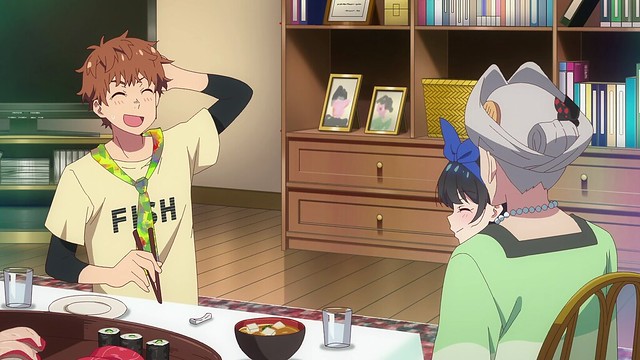
  • I’ve been called out before for only writing positively of the things I experience, and there’s two simple reasons for this. Firstly, I’m not a professional anime critic and have no obligation to sit through series I dislike: if I drop something, I will do so without fanfare, and I won’t write about it. Secondly, at least according to readers, I’ve developed something of a reputation for finding positives even in series that ruffle my feathers. This is where the “Terrible Anime Challenge” series comes in, and in the case of Kanojo, Okarishimasu, while it was the case that I spent eleven episodes of the series in a state of either bemusement or annoyance, the finale suddenly led me to add two and two.

  • While the journey was a tumultuous one, Kanojo, Okarishimasu‘s second season did end in a manner I found satisfactory, and tied together all of the loose ends that had been bothering me. Scenes that prima facie appeared without purpose were now with meaning, and this meant that my irritation vanished on the spot. However, one aspect of Kanojo, Okarishimasu‘s second season that didn’t sit so well with me was the prevalence of scenes like these, where a large amount of text is present on screen to denote asides the characters are having. I appreciate that these are here to give voice to the character’s thoughts, but they also create visual clutter and come across as being overly sarcastic. These were absent during the first season, which allowed the viewer’s attention to focus on the characters’ interactions and movements, but in the second season, they’re distractions.

  • Luckily, during the most pivotal moments of Kanojo, Okarishimasu, these asides are absent. For instance, there’s no text to distract from the scene where Ruka kisses Kazuya. The entire scene conveyed a sense of desperation and resignation in Ruka: she says so as much, and similarly to how Yui broke into tears during the events of Oregairu‘s third season, it is communicated to viewers here that Ruka doesn’t really stand any sort of chance. One must admire Ruka for how direct she is about how she feels about things, and this entire evening could not have been easy for her.

  • Kazuya’s grandmother is thoroughly convinced that she will be welcoming Chizuru into the family and gifts her a family heirloom as a result. Throughout Kanojo, Okarishimasu, Kazuya had entertained the idea of telling her grandmother and parents the truth about Chizuru, that they’re a phony couple, but over time, the lie endured because it became increasingly difficult to come forward, especially in the knowledge both Chizuru and Kazuya’s grandmothers were thrilled that their grandchildren would be family.

  • In the end, it’s Chizuru, who makes the call to perpetuate the lie for a little longer; her grandmother is dying, and she feels that it would be unfair to spring this news on her. At this point in Kanojo, Okarishimasu, glimpses of the series’ real story began appearing, and I found myself wishing that this is the direction the series had taken from the start. I understand the comedic detours are meant to humanise the characters, but because Kanojo, Okarishimasu is limited to twelve episodes per season, the series simply doesn’t have the luxury of slowly fleshing things out. Love stories take time to explore, and this is why more time is almost always needed to tell a compelling, convincing tale.

  • As Kazuya agonises over things during a make-up date with Ruka, Ruka takes a photograph of her gourmet pancake before digging in. Smartphone technology has come quite a long way: although Japan had been a front-runner in feature phones, the industry was disrupted in far-reaching ways when Apple introduced their iPhone back in 2007. Fifteen years after its introduction, the iPhone line has advanced into an industry-leading standard, and I am excited to receive my iPhone 14 Pro because it’s going to be a substantial upgrade over my current iPhone Xʀ. The iPhone Xʀ already takes excellent food photographs, so I’m curious to see how five years’ worth of advancement impacts my food photography, which has become something of a hobby for me.

  • After Kazuya’s birthday passes, Sumi decides to create a customised date based on his interests. Knowing that Kazuya is a big fan of marine life and aquariums, she takes him to the local marine park on an eventful and fun day. Sumi is outfitted in a school uniform, thinking that Kazuya was into that sort of thing after spotting him and Chizuru on a date in their school uniforms earlier. As the day draws to a close, Sumi brings Kazuya to a beautiful lookout providing a view of the city skyline, and to Kazuya’s surprise, happy couples can be seen everywhere.

  • Kazuya’s imagination goes into overdrive, and while it does appear as though Sumi is struggling with a kokuhaku, it turns out she’d been working up the courage to give Kazuya his birthday gift. Subsequently, Kazuya tries his hand at explaining his situation with Chizuru to her (in an indirect manner), and the pair share tears before Sumi does her best to reassure him. The pair part ways on a good note, and in this moment, Kazuya determines what his next move regarding Chizuru is.

  • Kanojo, Okarishimasu‘s second season ends the way it began by covering Chizuru’s latest ambitions to a career as an actress, and she’s unsuccessful in her most recent audition. Flashing back to her time as a middle school student and her decision to become an actress after watching a film starring her grandmother, the specifics behind Chizuru are finally shown to viewers. These moments are the most critical parts of Kanojo, Okarishimasu because they give Chizuru proper exposition, and once her story is known, every part of her character, and her general attitudes towards Kazuya, become logical.

  • With this story in the open, I felt that the reason why Chizuru has been keeping Kazuya at a distance was simply because his determination and optimistic spirit has similarities with her grandfather’s: he was always one to believe that anything is possible, and that specifics can be worked out later. Since her grandfather’s death, Chizuru felt compelled to succeed on her own merits, without any assistance, which leads her to turn down Kazuya’s help. Ordinarily, dusting oneself off and trying again is what’s required, but Chizuru’s on one hell of a deadline because her grandmother’s health is rapidly declining, and she feels duty-bound to succeed to show her grandparents that their wishes for her were also fulfilled. Because of the timelines involved in auditions, Chizuru begins to feel that it might not be possible.

  • This is where Kazuya comes in: typically, his timing and lack of tact earns him admonishment from Chizuru, but because things had reached this point, Chizuru realises that it’s either she cling to her pride and attempt to do things the old-fashioned way, which would certainly mean her grandmother will never see her act, or she accept Kazuya’s help. Chizuru is initially surprised and wonders if it’s even possible for him to pull things off, but Kazuya reminds her that he’s in business administration, and therefore possesses the skills needed to run such a project. Kanojo, Okarishimasu may have presented Kazuya as a loser of sorts up until now, but the series has never once mentioned that his pursuit of Chizuru’s heart (and the collateral damage that tends to accumulate) ever had an impact on his studies.

  • It therefore stands to reason that, where relationships and romance aren’t concerned, Kazuya can hold his own, but since Chizuru was so absorbed in her own world, she never saw this side of Kazuya. In fact, now that I’ve entertained the thought, it does feel as though Kanojo, Okarishimasu‘s portrayal of Kazuya is entirely consistent with how Chizuru sees him, and in this way, it is fair to say that Kanojo, Okarishimasu is every bit as much Chizuru’s story, as it is Kazuya’s. For the first time, Chizuru is flustered, and one hopes that, as Kazuya puts his best forward for her, Chizuru’s opinion of Kazuya will improve, as well.

  • In the event I weren’t being clear, Kanojo, Okarishimasu‘s second season proved a pleasant surprise. I had remained unimpressed with the series during its run, and was quite ready to mark it as a write-off, a series not worth saying anything about, but the finale tied up enough of the loose ends so that all of the lead-up to the finale now had a reasonable context. With Kanojo, Okarishimasu‘s directions now clear, I can say that this series is therefore better than I had anticipated. It does have its moments, and I am glad to have had the patience to sit things through to completion. To be sure, Kanojo, Okarishimasu is a B- (2.7 of 4.0): this series isn’t going to displace any of my favourites, and it doesn’t alter how I see the world, but things cannot be considered to be waste of time, either. While the anime still leaves much to be desired in pacing, the story does appear to be hitting its stride now, enough for me to retain a modicum of interest in where things land. This is a win in my books.

I had been an episode away from pulling the plug on Kanojo, Okarishimasu: until the finale, the series had meandered, unnecessarily creating conflict by returning Mami into the fray even as Ruka tried to pry Kazuya’s eyes from Chizuru. However, in the eleventh hour, Kanojo, Okarishimasu suddenly turned around – this anime adaptation exemplifies why I tend to stick around until the very end, because anything can happen. In the absence of Chizuru’s background, her motivations remain unknown, and Kazuya’s determination to help her appears little more than an unwarranted and unhealthy fixation. Similarly, without knowing why Chizuru wanted to become an actress, Kazuya has no reason in trying to court Chizuru beyond maintaining a promise with his grandmother, and Chizuru’s grandmother. With this additional revelation, additional weight is given to both Chizuru and Kazuya’s reasons for being. The second season had certainly taken its time to reach this point, but now that this is known, it becomes clear that Ruka has no chance at all. This aspect of Kanojo, Okarishimasu is written in stone, necessary for the story to progress, but one cannot help but feel poorly for her. Ruka’s feelings are legitimate, and while she’s clingy, her take-charge personality does seem to be a suitable fit, at least for the present, for Kazuya. His biggest weakness is indecision, and spending time with Ruka has also given Kazuya a glimpse as to what a relationship entails, both in good and bad. While seemingly relegated to heartbreak, Ruka’s role in Kanojo, Okarishimasu is an unfortunate, but necessary one – it provides Kazuya with the stepping stone he needs to press on ahead and show Chizuru that he’s committed to her. This appears to be something that could be covered in the upcoming third season as Kazuya strives to make the crowd-funding project a success for Chizuru. Overall, while Kanojo, Okarishimasu‘s second season had not impressed during most of its run, seeing its conclusion provides a decisive answer as to why things are happening the way they did. This remains a difficult anime to recommend because seeing things unfold at such a pace is frustrating, but for folks with patience to weather this storm, the series does set the stage for what could be a touching story yet. Ultimately, I would probably suggest that Kanojo, Okarishimasu is still a series that should be watched once it’s hit completion – individually, episodes can be painfully slow and drag out longer than they should, but the overarching story winds up being touching enough in spite of the series’ shortcomings. Occurrences such as these are why I am reluctant to drop anime: much as how hockey teams can manage to tie a game after pulling the goaltender with only seconds left in third period and subsequently win in overtime, anime can sometimes find ways to surprise viewers. Similarly, I do hope readers have gone all the way through this post, rather than reading just the title and immediately drawing conclusions on what I made of things – for Kanojo, Okarishimasu, my beer can stay right where it belongs, since this series is not, in the terms  of internet reviewers more popular (but less eloquent and, if I may, more vulgar than myself), a “dumpster fire”.

Terrible Anime Challenge: Kanojo, Okarishimasu, Or, Every Breath I Take Without Your Permission Raises My Self-Esteem

“They’ll just send in some special ops douchebags with pussy-ass heartbeat monitors on their guns, instead of us.” –Terrence Sweetwater, Battlefield: Bad Company 2

After university student Kazuya Kinoshita is dumped by his girlfriend, Mami Nanami, he falls into a depression and signs up for a rental girlfriend programme via smartphone app. He is assigned Chizuru Mizuhara, a kindhearted and beautiful girl, but when he realises that the date felt hollow, rates her poorly. The next date they go on, Chizuru takes Kazuya to the woodshed, but things are cut short when Kazuya learns his grandmother was hospitalised. He brings Chiruzu with him and inadverdently creates a misunderstanding in which his grandmother, and Chizuru’s grandmother, assume the pair are dating. The pair try to break things off while at the same time, remain tactful to their grandmothers, who would be heartbroken to learn that their relationship was a scam. However, things become increasingly complex when other rental girlfriends appear and begin falling for Kazuya, who’s come to genuinely fall in love with Chizuru, who took up the rental girlfriend post to better prepare for her aspiration of being an actress. This is Kanojo, Okarishimasu (Rent-A-Girlfriend, literally “I’d like to rent a girlfriend”), an anime that aired during the summer of 2020, and whose very presence had been lambasted to Hel and back by irate viewers who found the premise outlandish, the progression implausible, and Kazuya himself was infuriatingly single-minded and dense. Based purely on the voice of internet critics, Kanojo, Okarishimasu is an anime that would, on first glance, seem consigned to failure: over the course of twelve episodes, Kazuya continues to grovel at Chiruzu’s feet, disregarding the fact that Ruka and and Sumi have fallen head over heels for him. These critics argue that Kazuya is blind to his realities, and for acting in a way they’d certainly never act in, Kanojo, Okarishimasu has therefore failed as an anime. After all, folks watch stories to get inspired, and to see how people overcome their setbacks to become stronger and better learned, but Kanojo, Okarishimasu seemingly offers none of this. Week after week, Kazuya pursues Chizuru, hoping that his persistence and sincerity might one day change her mind, all the while trying to keep the lie from breaking their grandparents’ hearts and fending off suitors who’ve become attracted to Kazuya following his acts of kindness.

Unfortunately, the picture that some of the anime community’s most well-known members paint, with their tweets and MyAnimeList reviews, would have individuals believe that, on the basis that Kazuya isn’t acting in a rational way (i.e. how’d they’d react), the series is therefore unrealistic and not meritorious of being watched. The criticism that characters act differently to how the individual might given a set of circumstances is one I’ve often seen thrown around, although this approach is one lacking validity. A work of fiction is intended to convey a particular theme, and consequently, if a given character were to respond to something in a way that was rational, or conforming with what might be considered common sense, there’d be no lesson to learn, and no theme to convey. Kazuya’s lengthy list of shortcomings and mistakes drive Kanojo, Okarishimasu, and supposing that he enters the story with a modicum of confidence and self-respect, there’d be nothing to present, and no journey to embark on. The fact that he lacks these is what gives the series a reason to present his story. It is common knowledge that giving credence to internet critics, is the quickest way towards developing an incorrect, cynical and bitter view of the world: these individuals conveniently forget that Kanojo, Okarishimasu portrays a Kazuya at the beginning of his journey, someone indecisive, weak-willed and utterly lacking in confidence, that we see. In the knowledge that this series is to continue, then, there is always the prospect of a pay-off from watching Kazuya navigate the world of relationship and slowly improve his own sense of self-worth as he chases after the sharp-tongued Chizuru: the internet critics are inevitably too hasty in their judgement, and a second season will likely show a Kazuya who is better prepared to impress Chizuru, having learnt from his earlier mistakes. While perhaps a gross exaggeration of an unwillingness to date, Kazuya’s choices after Mami dumps him is not implausible, and his confidence is shaken to the core. It therefore stands to reason that a series of (hilarious) misunderstandings to help Kazuya understand why he desires a relationship, well beyond the physical aspects.

Screenshots and Commentary

  • I’ll preface the discussion with the suggestion that, were such a service to exist in reality, I would be torn between using it and doing things the old-fashioned way. On one hand, being able to basically buy a guided tutorial on how to properly date would be great practise for when the moment comes where said experience would be helpful, but on the other hand, it’s not as though people fall into a list of procedures, and what works in one scenario may utterly fail in another. Relationships and dating requires finesse on a case-by-case basis, although I suppose that periodically shelling out the cash for this experience isn’t too different than practising one’s interviews.

  • With this in mind, I imagine that were I ever to write a mobile app for the purpose of connecting people with rental girlfriends, I likely find myself rejected by Apple’s review team for violating section 1.1.1 of their App Store Review Guidelines under objectionable content: what happens to Kazuya and Chizuru in Kanojo, Okarishimasu might be amusing for viewers, but such misfortune in real life would be very unfortunate. Further to this, my job description as an iOS developer does not entail wrecking peoples’ lives or making them unnecessarily complicated, so such an app would be outside the boundaries of what I’d consider to be ethical.

  • For this Terrible Anime Challenge post, my verdict is “the negative reception to Kanojo, Okarishimasu anime is greatly exaggerated, and while I did not see enough merits in this anime to readily recommend it to my readers, I do not agree with the vitriol that was directed at the series was necessary, either”. In other words, while Kanojo, Okarishimasu isn’t going to be the next CLANNAD (or anything approaching thus), I see no need to belittle the authors or studio for having produced the anime. I had a moderate amount of fun watching this series and have an inkling of where it’s headed. It also helps that Chizuru is voiced by Sora Amamiya (KonoSub‘s very own Aqua and Akemi Sōryūin from Dumbbell Nan-Kilo Moteru?).

  • Kazuya reminds me of Rick and Morty‘s Jerry Smith, being excessively insecure and cowardly, while at the same time, being also kind-hearted and loyal to a fault. However, Jerry is only a secondary character, and his mistakes are typically contained to a given episode’s subplot. Conversely, Kazuya is the lead in Kanojo, Okarishimasu, and I’ve got my answer as to what would happen were Jerry to take a more active role in Rick and Morty. Having said this, much as I am optimistic that writers will have Kazuya undergo enough growth so Chiruzu no longer steps on him, I would hope that Rick and Morty‘s fifth season, at the very least, lessens the frequency where Jerry is made to act as the series’ punching bag: his misadventures are not funny.

  • Mami Nanami proved to be an interesting character: after chucking Kazuya for unknown reasons, she ends up developing a possessive streak a mile wide and forces her way back into his life, becoming genuinely frustrated that Kazuya seems genuinely infatuated with Chiruzu. I usually don’t take joy in watching characters suffer, but seeing Mami go yandere because of jealousy always puts a smile on my face.

  • Kanojo, Okarishimasu would disintigrate in the blink of an eye if Kazuya had any backbone: the reason why the series is able to create wild scenarios is because, out of concern for his and Chizuru’s grandmother, telling them the truth about their bogus relationship would be inconsolably disappointing for both, and he doesn’t have it in them to break their hearts in this fashion. Chizuru agrees to keep up with the façade for similar reasons, and while she plays her role as the girlfriend well when on duty, off-duty, she’s blunt, foul-mouthed and poor-tempered wherever Kazuya is concerned.

  • Kanojo, Okarishimasu certainly takes the pains of reminding viewers every so often how hot Chizuru is, to the point where Mami, herself sporting a good figure, becomes intimidated by Chizuru’s assets. With Kazuya’s personality, a part of me wonders if it would’ve been more effectual to have Kazuya fall in love with Chizuru on personality alone, since this could indicate that he was maturing past looking at a relationship as being purely for physical contact. Having different variables in play can serve to help a series make its point clear, but if too many variables exist, it becomes difficult to ascertain where a series intends to go.

  • One aspect about Kanojo, Okarishimasu that did strike me as a bit strange was the fact that the art quality would shift frequently, and inconsistently. While I understand the use of simplified, chalk-like background artwork for moments where Chizuru is kicking Kazuya’s ass, it becomes a bit more jarring when the lower-quality visuals are seen in more serious moments. At the opposite end of the spectrum, Kanojo, Okarishimasu does demonstrate that it can have above-average artwork as well – this is most noticeable during the beach episodes, where the backgrounds and skies are of a much higher standard.

  • Like any drama, trouble is amplified when Ruka joins the party. Initially, Kazuya is surprised that his friend, Shun Kuribayashi, also seemingly has a girlfriend. Kanojo, Okarishimasu presents most of the males in Kazuya’s circle as being inexperienced with relationships but eager to pursue them for their own reasons, not fully understanding that a proper relationship is built on trust and stability over flashier things – I view a partner as someone whose presence makes me an even greater, more empathetic and understanding individual, someone who I can count on and be relied upon by, whom I listen to and offer suggestions for, and someone who would listen to me and offer me advice where needed.

  • Consequently, when Kanojo, Okarishimasu presents relationships in this shallow manner, it suggests that, at least at this point in time, Kazuya and his friends are not sufficiently mature to find someone who can offer that for them. I imagine that this is why Kazuya got burned by Mami prior to the series’ beginning – Mami had not been looking for the emotional parts of things and in fact, is suggested to mess around with men for kicks. Conversely, when Ruka is introduced, and she immediately deduces that Chizuru is a rental girlfriend, things get tricky for Kazuya real fast.

  • Kazuya is put into a bit of a bind when it turns out Ruka is in love with him: despite expressing open hostility towards him after their first meeting, after Kazuya saves her from a bad fall, Ruka begins to see the real Kazuya. I appreciate that the idea of anyone falling in love with someone as indecisive and cowardly as Kazuya can seem outlandish, but at the same time, the Kazuya we see just took a beating after Mami dumped him, so it is understandable that he would feel like he’s walking on eggshells around women.

  • My choice of page quote comes from Ruka and her unique heart condition: Kazuya’s been the only person able to elevate her heart rate, and for this, Ruka suspects that Kazuya’s special to her, worthy of pursuing. Of course, the joke here is that in a relationship, one doesn’t exactly need a heartbeat monitor to determine if they’re in love or no: it’s a very specific feeling that one would know when they’d experience it – if it were not apparent, I’d also spent the past long weekend playing Battlefield: Bad Company 2: it turns out that after reinstalling my OS, I’d lost my old save files, and so, I resolved to unlock everything again. I still occasionally revisit Bad Company 2‘s campaign for nostalgia’s sake, so I figured it be nice to have all the levels unlocked for that purpose.

  • While I’d love to share my Bad Company 2 adventures anew, this is a Kanojo, Okarishimasu post, and here, after Ruka demonstrates to Kazuya and Chizuru her feelings are authentic, Chiruzu suggests that he at least spend time with Ruka to see where things go. Despite her dislike for Kazuya, Chizuru does care for his well being and promises to keep an eye on him until he can get a proper girlfriend and finally be truthful to his grandmother. This scenario, however, imposes additional challenges for Kazuya: he’s fairly confident that he’s in love with Chizuru and feels it unfair to be leading Ruka on when he doesn’t reciprocate her feelings.

  • I imagine that Chizuru wants Kazuya to first regain his confidence around women, which is why she agrees to let Ruka spend time with him: for her, the best case is that Kazuya comes to appreciate Ruka and can stand on his own two feet. Of course, what this will really do is to help Kazuya rediscover his own confidence and face Chizuru better: Kanojo, Okarishimasu has made it quite clear that there’s a long and difficult road to Chizuru, and that every step of the way, Kazuya’s determination to set things right with her will lead her to come around.

  • With this in mind, there is a limit to what persistence can do, and in reality, if the magic isn’t there, it isn’t there. Fiction is fond of suggesting that enough grit can turn things around, but this is wishful thinking: relationships have an intangible component to them that isn’t readily quantified, and it can be difficult to put this in words. Consequently, I do feel bad for Ruka: she’s genuinely in love with Kazuya, but as the story dictates, heartbreak will likely await her. Ruka is voiced by none other than Nao Tōyama, whom my readers should know as Shimarin from Yuru Camp△ and Kiniro Mosaic‘s Karen Kujō, amongst other well-known roles.

  • Late in the series, Sumi Sakurasawa is introduced to Kanojo, Okarishimasu. Despite being uncommonly shy, she decides to take on the rental girlfriend job to prepare herself for a career as an idol and figures doing this would get her more comfortable with people. At Chizuru’s behest, Sumi goes on a few trial dates with Kazuya to better her skills. Their first date is fraught with challenges, including a couple of shady guys hassling her, and then Mami’s sudden arrival. In spite of Kazuya’s feeble efforts in fending them off, the sincerity of his actions convince Sumi that Kazuya’s the real deal.

  • Another familiar face from KonoSuba returns: Rie Takahashi (Megumin) voices Sumi. I also know her previous roles as Yuru Camp△‘s Ena Saitō. Altogether, while Kanojo, Okarishimasu does have a setup that could yield a worthwhile payoff later down the line, the challenge this series faced during its run is the fact that Kazuya’s growth happens very slowly: there’s no indicator that he’s more confident in himself by the series’ end, as he even ditches a date with Ruka to tail Chiruzu closer to Christmas when she hangs out with a coworker. A Kazyua coming to his own would have a little more faith in Chizuru and not do such things.

  • With everything in mind, Kanojo, Okarishimasu is very much an incomplete work, and the series would’ve likely worked better as a full-cour series spanning twenty four episodes, rather than be split into two seasons. This would’ve presented a much more complete picture than the current setup did, and while some words folks have thrown at Kanojo, Okarishimasu are unreasonably harsh, I appreciate that this series has been uncommonly frustrating owing to its pacing and Kazuya’s apparent lack of growth. However, it’s not all bad news bears for Kanojo, Okarishimasu: other viewers, likely those who empathise with Kazuya and his situation, found the series relatable.

  • As for where I sit on things, I would tend to believe that Kanojo, Okarishimasu is a series where viewers would be better served if they waited for the second season before beginning their journey, although as I’ve noted earlier, I did find some enjoyment out of this chaotic, hectic series. While I concede that this series is not for a majority of viewers who are looking for a meaningful or moving romance, the series certainly doesn’t merit the insults directed at it, either. Concerning those who feel strongly about anime opinions enough to resort to such crude means, this post’s title is representative of my response to them, in addition to acting as a metaphor for Kazuya’s journey throughout Kanojo, Okarishimasu after Mami dumped him.

  • The line is inspired by a moment from Rick and Morty‘s fourth season, during which Rick begrudgingly attends a heist movie themed convention and publicly insults a figure known for heists in-universe during a panel. When the crowd boos him, Rick responds with this gem of a line: it is a clever and hilarious stab at certain fandoms, where some of the more vocal individuals vehemently object to any opinion not in alignment with their own. In this sense, my whole blog’s existence is an insult to them, and very much like Rick, every breath that I take without their permission raises my self-esteem. Moreover, said individuals’ criticisms of the anime that I find passable or enjoyable mean nothing, for I’ve seen what makes them cheer 😛

Unsurprisingly, twelve episodes is clearly not sufficient a timeframe to properly illustrate everything: at this point in time, it remains too early to determine whether or not Kanojo, Okarishimasu is worth watching. On one hand, watching Kazuya’s failures is fairly challenging: he acts in a way contrary to what one would expect, but on the flipside, the fact that there will be a second season somewhere in 2022 means that Kanojo, Okarishimasu is by no means complete, and to review the series at this point would be akin to discussing a hockey game when one team is leading 4-1 after two periods of play. Much as how anything can happen in the final period (most recently, the Edmonton Oilers were handed a devastating blow when they blew a 4-1 lead against the Winnipeg Jets and lost in overtime), anime can occasionally still find ways of surprising people. Kanojo, Okarishimasu is not an exception to this rule, and while at present, I would not give the series a glowing recommendation or suggest folks watch it out of curiosity (unless one is uncommonly tolerant, or looking for a good laugh), I’m also not going to stop them from checking the series out. In an anime dominated by Kazuya’s bad decisions, there are a handful of genuinely heartwarming moments, seeing Chizuru’s foul personality outside of her duties is always hilarious, and Mami’s yandere-like traits make seeing her recoil in jealousy in response to what Kazuya does is made all the more satisfying. Whether Kanojo, Okarishimasu manages to right itself by the second season and really focus on Kazuya’s pursuit of Chizuru remains to be seen, but at this point in time, it’s still early to be passing a verdict on whether or not Kanojo, Okarishimasu is, in the words of the internet critics, a train-wreck. In more civilised words, whether or not Kanojo, Okarishimasu paints a compelling picture with its theme is something that will require further exploration, and this, for better or worse, remains a ways off.