The Infinite Zenith

Where insights on anime, games and life converge

Category Archives: Sorairo Utility

Special “Special” – Sorairo Utility At The Finale, Whole-Series Review and Reflection

“I always think under par. You have to believe in yourself.” –Sergio Garcia

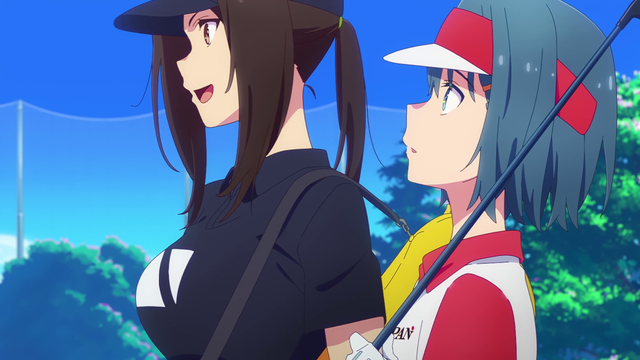
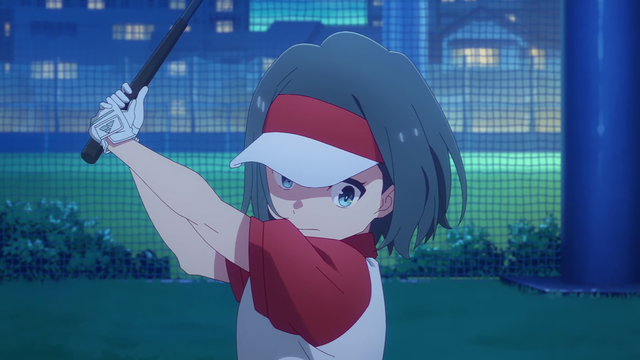
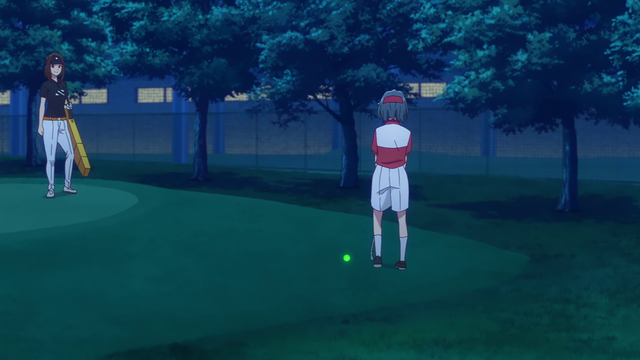
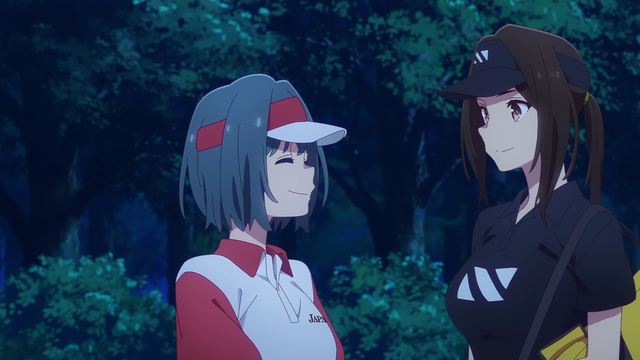
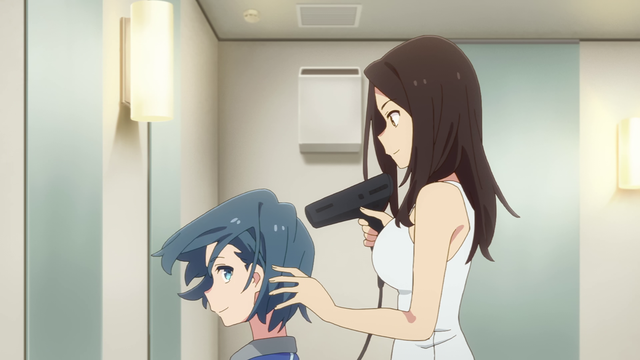
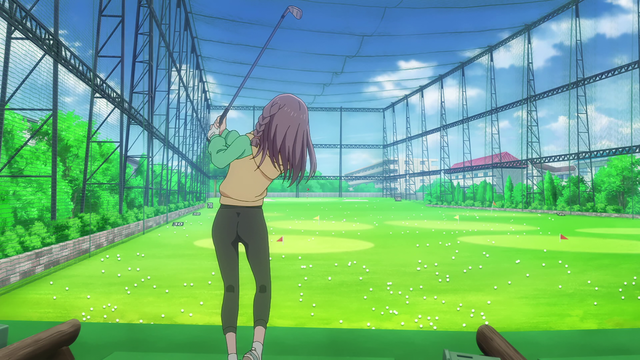
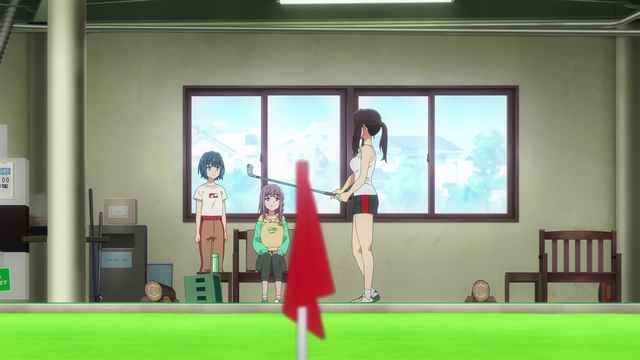
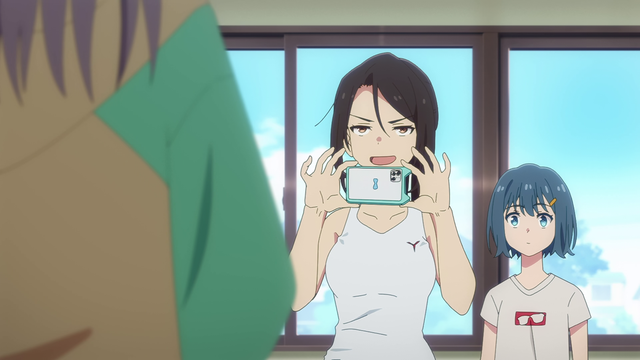
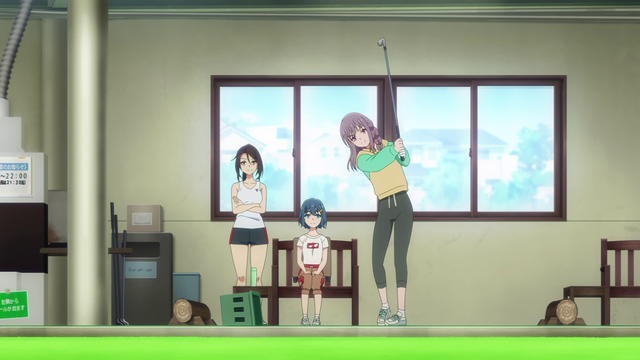
After a string of serendipitous events convinces Minami her time to get a hole in par has come, she becomes excited to hit the links. However, Ayaka is out doing a collaboration with a professional golfer, and Haruka’s playing a round with her friend. Although Hina’s excited to play Minami, she’s now out in California ahead of a tournament. Minami tries asking the elderly gentlemen at her driving range, and while they’re happy to play, injuries bring that plan to a halt. This leaves Minami to play a game on her own, per Haruka’s suggestion. Although she’s unaccustomed to the quiet experience, she’s enthused by the fact that there are people who love golf enough to play alone and decides to give this a go, doing her best to get a hole in par. Emboldened by a good first drive, Minami learns that while scoring par is harder than it looks, she’s making fewer mistakes and is able to get closer to the par score as the day wears on. On her last hole, Minami manages to reach par, and she turns around, only for her excitement to transform into melancholy when she realises that Haruka and Ayaka aren’t with her. Dejected, Minami returns to the driving range. It turns out Haruka and Ayaka were waiting for her, and after learning Minami made par, Haruka becomes excited to see this feat for herself: she suggests they play a night round of golf before getting dinner together. In a post-credits scene, Ayaka, Minami and Haruka decide to sign up for a golf tournament hosted in their area. This brings Sorairo Utility to a close, and with it, director Kengo Saitō’s dream of producing a golf-centred anime has now been realised. By anyone’s standard, Sorairo Utility was a success, telling a touching story of how individuals can, under their own motivation, seek out the things that bring them joy and, in the presence of the right people, receive the support and encouragement they need to really pursue an activity. Although perhaps lacking the more suspenseful and action-packed storylines of things like Birdie Wing, Sorairo Utility achieves its objective as a fluffy, gentle tale of discovery, improvement and appreciation of the world beyond the narrow confines of mobile games – Minami is rewarded for her willingness to step out of her comfort zone and, after twelve episodes, is now sufficiently competent as to play a game on her own. With the resilience and optimism imparted from her seniors, Minami might not be a skilled or experienced player, but she’s at a stage where she’s found her special something, something she can devote time and effort towards improving and exploring.

The choice to close Sorairo Utility with Minami playing a round of golf on her own was a suitable way to bring this heartwarming and fluffy series to a close. Until now, Minami had played golf in company: having Haruka and Ayaka supporting her and offering advice for improvement, listening to wisdom from Megumi and sharing a lively pairs experience with Hina meant there was always someone backing her, ready to pick her up whenever Minami’s game wasn’t going as she’d hoped. In playing a solo game, Minami forgoes this support: there’s no one to encourage her when a shot goes off-course, and there’s no one to celebrate with when a drive lands with unerring accuracy. In spite of this, Minami is able to complete the game and achieve her personal goal for the day, showing that she’s now mature enough to take problems in stride and not allow them to get to her. During her game, Minami also demonstrates that, while she’s still prone to bad strokes, when things connect, she’s able to get the ball a considerable distance, as well. Similarly, although putting gives her some trouble, her past experience from earlier games and earlier holes gives her an increasing sense of how to impart the right amount of force into a putt. By not letting the setbacks get to her, and taking moment to rest and regroup, Minami is able to play her best game of Sorairo Utility, even without Haruka and Ayaka in her corner. Thus, despite Minami’s melancholy at not being able to celebrate her reaching par with anyone, Sorairo Utility accentuates that, a as a result of her experiences throughout the series, Minami is now in a position where she’s also able to grow and mature on her own. In this way, Sorairo Utility‘s central theme is a straightforward one – when starting something new, the combination of support from experienced people is essential and helps one to overcome setbacks more readily, but once an individual gets past the initial hurdles, they gain enough initiative and interest to pursue something in their own manner of choosing. Although this isn’t exactly a revolutionary or world-changing message, it is appropriate for something like Sorairo Utility, whose first and foremost goal was to allow Saitō to realise his dream.

Screenshots and Commentary

  • Minami’s endearing mannerisms alone would’ve made Sorairo Utility worth watching, but this series’ draw lay in its portrayal of her entry into a difficult sport and how having good friends in her corner contributed to her decision to stick it out. From humble beginnings to a full-fledged series, reception to Sorairo Utility has been generally positive, speaking to how the story was able to convey its messages to viewers. There isn’t anything especially complex about Sorairo Utility, and as a result, viewers report being able to just kick back and enjoy things.

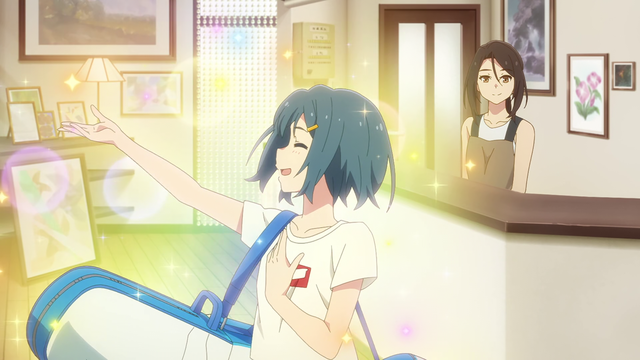
  • A part of me had hoped that Sorairo Utility‘s finale would give viewers a glimpse of Minami’s afternoon with Ayaka and Haruka at the beach, but the choice to focus purely on Minami’s anticipation of golf both spoke volumes to how director Saitō was able to preserve his vision. My wish to see Haruka in a bikini notwithstanding, I hold that Saitō made the right decision – starting the finale with Minami barely containing her excitement to hit the green shows how much fun she’s now having, and similarly, her desire to shoot a par for a hole reflects that she’s beginning to set goals for herself.

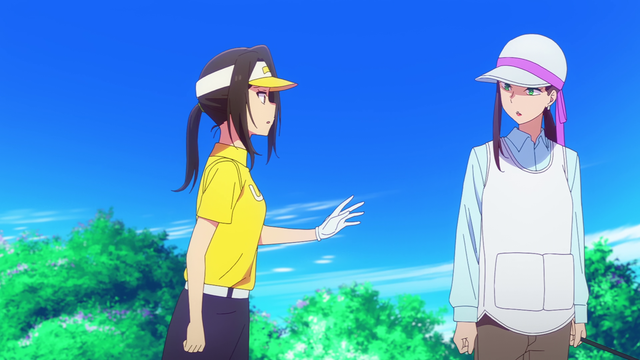
  • Minami isn’t the only one who’s grown in Sorairo Utility: Ayaka managed to get a collaboration with a professional golfer and is seen at a course near Mount Fuji, where she’s interviewing Haruka Seto. Ayaka is completely in her element, and while watching the live stream, Minami is impressed that Ayaka is able to get in touch with professionals. Although Ayaka picked golf up to bolster her social media presence and wondered if she could embrace it as wholly as Haruka did, she would come to find her own way as she spent more time with Haruka and Minami.

  • Similarly, playing alongside Minami and Ayaka prompts Haruka to re-evaluate her decision to become a professional, and she ends up accepting a golf game with her father. With all of her friends unavailable, and the elderly gentlemen incapacitated, Minami is left to play a round on her own. The portrayal of solo golf in Sorairo Utility stands in contrast with Yuru Camp△‘s interpretation of solo camping: unlike Yuru Camp△, which actively promoted the idea of experiencing something from a different perspective, Sorairo Utility is more traditional in the sense that it takes advantage of Minami’s solitude to emphasise how quiet it is when it’s just her.

  • Many anime sell the idea that things are more fun when one is in good company, and there is truth in this – as an example, when I go on outings with the photography club, it’s always an adventure, and I feel reassured knowing I can ask for pointers there and then, whereas on my own, the only thing accompanying me are my own thoughts. Yuru Camp△ took the juxtaposition between group and solo activities to suggest that, even when one is on their own, there is a different kind of experience to be had, leaving it open to viewers to interpret. Although Sorairo Utility‘s finale plainly conveys that things are more fun with others, the anime also implies that there are merits to doing things alone, too.

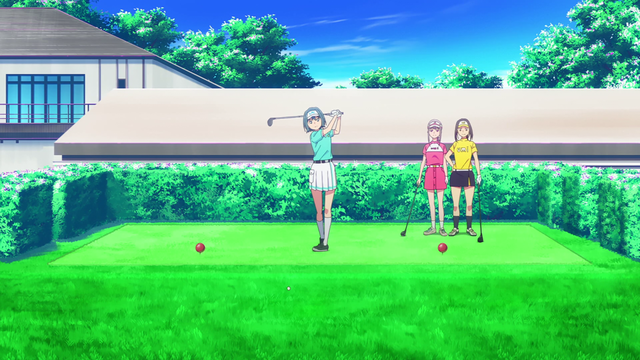
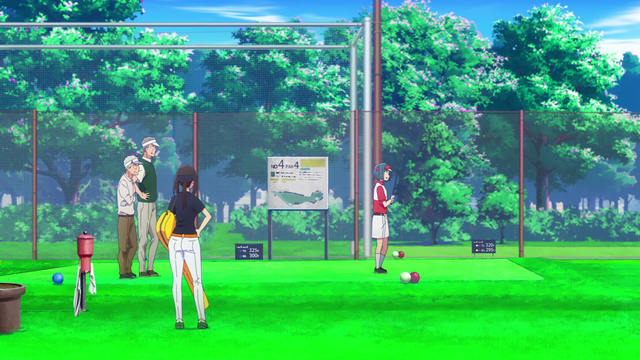
  • Sorairo Utility uses wide-angle frames liberally during its run, and while Minami was with Haruka and Ayaka, the presence of more people in a frame that accentuates the size of the golf course gave the impression that no matter how large the world is, Minami had others in her corner to help in navigating setbacks. Thus, when the same wide-angle frames are utilised during her solo game, the effect conveys Minami’s smallness in the moment. However, this isn’t all negative: once Minami tees up and starts her game, she lines up an impressive drive.

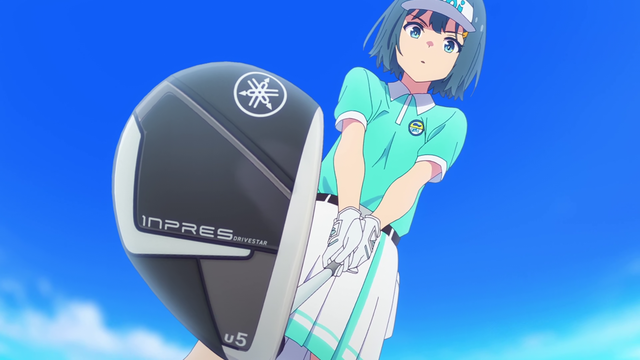
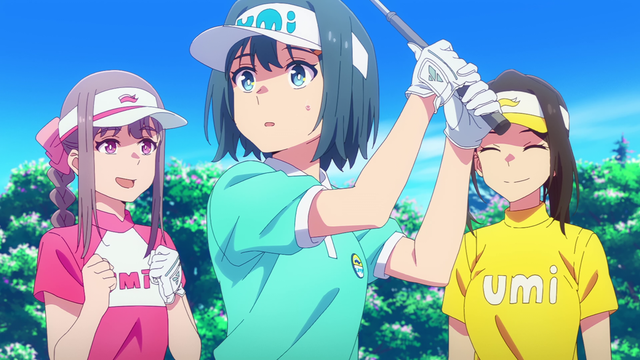
  • By having Minami starting strong, Sorairo Utility is able to show that Minami’s long game has improved – her initial drive is straight and achieves good distance. Experienced golfers, both amateur and professional, state that it is important for a beginner to start by improving their long game for several reasons. The main justification is that clean, accurate shots that land in the fairway and put one closer to the hole are better for morale and rapidly allow one to close the distance. This is where Minami starts, and her days at the driving range mean that Minami can now hit the ball with reasonable confidence, even if there are moments where she’s missing shots.

  • Indeed, once Minami get started, it becomes clear that her next goal will be to improve her short game. Different players will likely have different things to say: some players will argue that the short game is even more important than the long game because this is where variability in terrain and knowing how hard to putt the ball can shave critical strokes off one’s game, and a stronger short game can offset shorter drive distances. Because I’m not a golfer, I have no practical experience in which advice is more applicable, but I would bet that what works depends on the person, and over time, people will eventually find their own style towards golf.

  • From my perspective as a non-player, I do see the merits of improving in both the long and short game: I imagined that professional players won’t just go Haruka on the ball (i.e. driving it as far as possible) and instead, work towards landing the ball in strategic places with each stroke. For instance, it might be more favourable to aim for a shorter drive distance if it means one isn’t going to see their ball roll into a sand trap or water hazard. In the long term, golf is a thinker’s game, and as valuable as it is to have technical proficiency in both the long and short game, it is more important to develop an understanding of a course’s terrain and plan accordingly.

  • In Sorairo Utility, Minami’s progress in golf is equivalent to a novice photographer who’d just gotten her first full frame camera and has reached the point where she’s able to achieve technically solid photos with some consistency. Reaching this milestone is important because it means that Minami is now able to identify her own style and determine where she’d like to go next, and during the course of the day, it’s clear that even though she’s still shooting below par on most holes, she’s beginning to have fun on her own.

  • Although I imagine most anime fans are okay with solitude to some extent, most people would probably indicate that they feel uncomfortable while alone. There isn’t any one reason for this phenomenon, as some people might worry about being judged when on their own, or otherwise become overwhelmed by their thoughts in the absence of other people to talk to. These are perfectly valid reasons, but at the same time, being able to accept one’s own company is a skill worth cultivating.

  • This is where Minami’s active imagination becomes an asset – she’s able to immerse herself in the moment and uses positive visualisation to psyche herself up; she daydreams about making it as a professional, and earlier in Sorairo Utility, Minami had fancied herself a video game hero picking up a new piece of gear. At first glance, this is little more than a youthful fantasy, but the practise of daydreaming (in moderation) is actually something that can help the mind to regroup, focus and become more creative. I like Minami’s confidence, and during her day, even as she fails to make par on the earlier holes, she’s able to continue on.

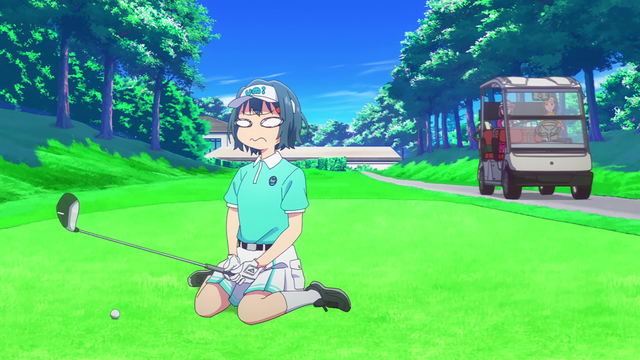
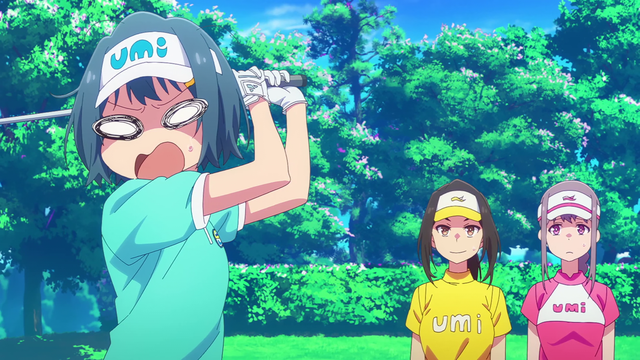
  • There are a few moments during the day where Minami whiffs on her strokes, and while she does feel disheartened when this happens, it’s never enough to send her packing. Seeing the ups and downs for Minami as the day progresses was one of the most visceral illustrations of how far she’s come in Sorairo Utility – early on, Haruka had mentioned how failures can be demoralising enough that one might consider quitting golf, but because Minami’s had nothing but fun experiences, even when her game wasn’t the best, Minami’s associated the fun moments surrounding Haruka and Ayaka with golf. To drive this home, after Minami finishes a hole that she hadn’t felt quite so good about, she moves onto the next, and here, she finds another group already at the hole.

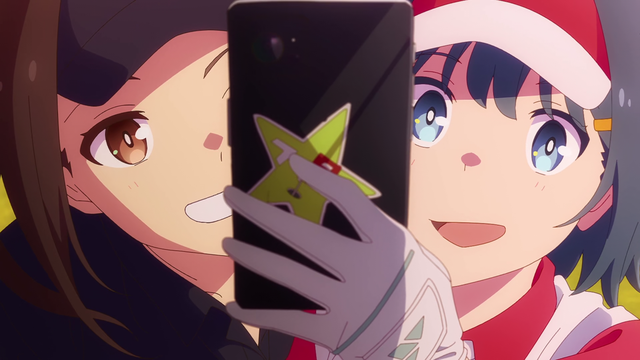
  • Amongst the group, one of the young women is also just starting out, and she’s also missing her shots. Spotting this reminds Minami of where she’d begun, and rather than feeling impatient, it’s clear that Minami has taken Ayaka and Haruka’s approach to heart – she pops by a vending machine and sits down for a drink, sending a photo of herself to Ayaka and Haruka. Seeing the photo puts Ayaka and Haruka’s minds at ease, being a clear show that Minami’s matured enough to now begin exploring new avenues on her own. Having enough confidence to do things without any immediate support is one of the surest signs that someone is now genuinely invested in a given activity, and, at least for me, this stage becomes one of the most rewarding for a given hobby.

  • Aurora excursions, being set at night, aren’t accompanied by culinary adventures, but the timing of this solar activity was quite close to the latest photography club meeting, a photo critique in which club members send in photos of their choice for feedback. For my aurora photos, it seems that from a technical standpoint, my exposure and focus is passable, allowing me to graduate onto composition and finding a suitable foreground subject to spruce up my shots. Ahead of this meeting, set on the first day of spring, I decided to swing by a tavern downtown for dinner; their “Poutine of the Week” was a Montreal Smoked Meat Poutine doused in a delicious smokey mustard and topped with a deep-fried pickle. The smoked meat was succulent and juicy, offering a burst of flavour with every bite, and the tang of the mustard balanced the savoury gravy and cheese.

  • Like Minami, while I’ve improved with taking astrophotographs by night, I am by no means proficient: I occasionally lose shots to poor focus (as a result of bumping the focus ring) or otherwise use inappropriate exposure settings for the situation at hand, resulting in an under or over-exposed photo. However, what’s important is to keep trying, as Minami does. Here, Minami becomes disappointed when she misses par by a single stroke after her putt falls short of the hole. Minami had been getting closer and closer to a par, but her short game is lacking, and this stops her from achieving her goal.

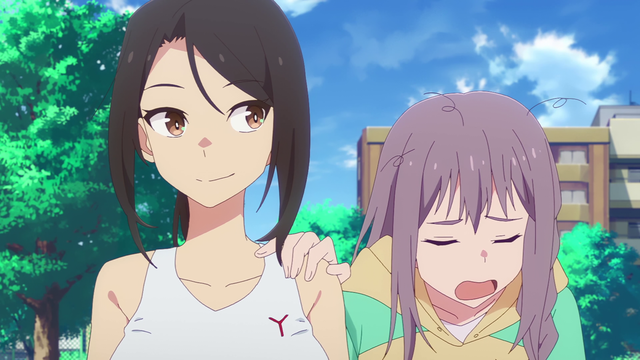
  • Despite her discouragement, Minami finds a novel way of picking herself back up: using her penguin club cover as a hand puppet, Minami gives herself a little pep talk. The action is adorable, and Minami herself becomes mortified when she notices another group of golfers staring at her, but once the embarrassment passes, Minami prepares to head towards her final hole. At first glance, Minami’s method of lifting herself up appears quite humiliating, something that might only be done in the company of friends, but in reality, it acts as a reminder of how Minami’s become a little more comfortable with herself. Unlike the sexy and spirited Haruka, and the composed Ayaka, Minami is cute, sporting mannerisms that makes it very easy to root for her.

  • Minami finds herself about five metres away from the hole, and with this being her last hole of the day, a sense of pressure begins appearing: her long game has become a little more consistent now, which allows her to reach the putting green on short order, but variability and confidence means that putts tend to (understandably) give Minami a bit more trouble. At the end of her golf game, however, Sorairo Utility makes it clear that Minami would sink this shot: she’d spent all day inching closer to her goal, and where she fell short, Minami demonstrated commendable resilience, choosing to keep playing and try again.

  • Thus, there was no doubt in my mind that Minami would make her final shot count to score par: such an outcome would be cliché and counted as being so predictable it could be seen from a mile away, but from a storytelling perspective, I hold that denying a character of their success after showing their progression and effort would be more detrimental than being cliché. A number of people believe that realism means having characters see a loss even when they’ve put in the effort, and while it is the case that in reality, people are not necessarily rewarded despite their efforts, stories are meant to portray how things can turn out when things line up, rather than reminding people of reality. As such, I am quick to dismiss criticisms of works being unrealistic for handing characters wins when in fact, the characters’ effort and journey means success is more conducive towards a given work’s themes.

  • When Minami lands her shot and scores par, her surprise at having achieved this goal gives way to exuberance. She turns around to celebrate her achievement with Ayaka and Haruka, only to realise that neither are present. Happiness becomes muted in this moment, and a loud silence accompanies the scene, one that portrays Minami standing alone on the course without anyone else in sight. The magnitude of Minami’s milestone is being vividly eclipsed by the fact her friends weren’t present, and this was where Sorairo Utility indicated, beyond any doubt, that an activity is at its best when one is in good company.

  • From Sorairo Utility‘s perspective, being able to find one’s own way and meaning even when alone is an asset, but things are at their best when there are people to share in one’s successes. I simultaneously agree and disagree with this stance because, while I’ve experienced the sheer energy and spirit that comes from participating in group activities, I also value moments where one is compelled to walk a path alone and count on themselves to get things done. With this being said, Sorairo Utility isn’t forcing its message on anyone, but rather, the series is merely suggesting that most people will have more fun and find more meaning in their achievements when doing things with others.

  • As it was, I found that Sorairo Utility was an excellent anime, one that earns an A grade (4.0 of 4.0, or 9.0 of ten points). This series did everything correctly, stopping short of a higher score simply on the virtue that the series didn’t move me to tears or change my world views in an appreciable manner. In its story, Sorairo Utility did a fantastic job of showing how Minami’s own drive to find something special led her to golf, which in turn opened her world up in a way she never anticipated. There are many parallels with my own journey through photography, and as such, I can vouch for how life-like Sorairo Utility is. Combined with lovable characters and gorgeous visual backgrounds, Sorairo Utility ends up being a wonderful series, one which made the winter pass by quite quickly.

  • Sorairo Utility‘s soundtrack also ended up being a pleasant surprise: neither too overbearing or easy to overlook, the music in the series gently adds character to the anime’s scenes. Composed by Daisuke Horita, Sorairo Utility‘s incidental music will be released in a two-CD album in just a few days and retail for 4400 Yen. I’m not too familiar with Horita’s previous compositions, which are few in number, but one work caught my eye; it turns out Horita also worked on the music to Azur Lane: Queen’s Orders.

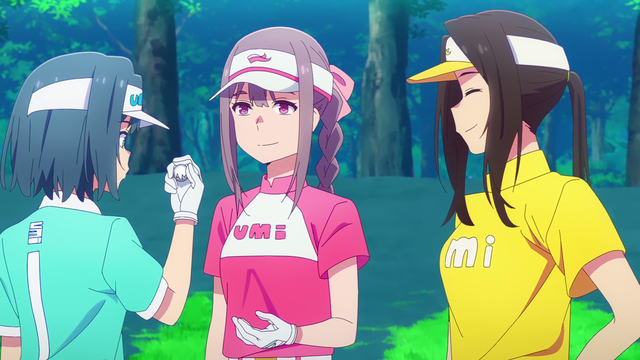
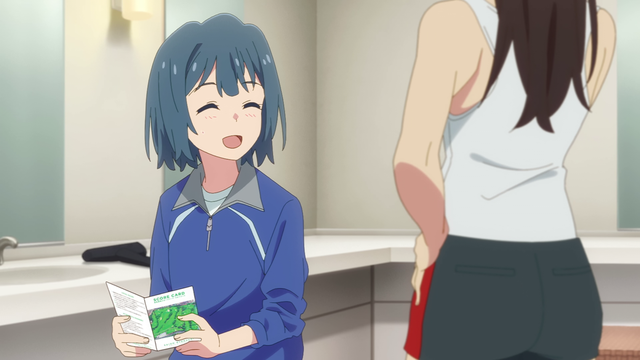
  • While Minami had been quite glum upon her return to the driving range, her old swagger returns after she runs into Ayaka and Haruka there. They were evidently waiting for her, and after spotting her friends, Minami proudly breaks out her scorecard, which shows that she’d made par on a hole for the first time. Inwardly, I smiled at how pleased Minami was with herself; experienced golfers strive to make par over an entire game, and making par on a hole is more inconsequential compared to playing an entire game well. This moment speaks to how far Minami has to go before she can start looking at a golf game from a broader perspective, but I also acknowledge that as a beginner, it’s important to have these milestones.

  • I imagine that for Ayaka and Haruka, an improving Minami opens the door up for new and fun experiences, so their happiness for Minami ends up being multi-faceted. On-screen, all Haruka offers is that on this solo outing, Minami’s played a better game than she’d previously did, and so, it might be possible that playing alone really lets Minami to focus on golf. While Minami had indeed performed better than she did while playing alongside Haruka and Ayaka, she’s aware that she most enjoys the brand of golf that lets her hand out with two people who’ve become very dear to her.

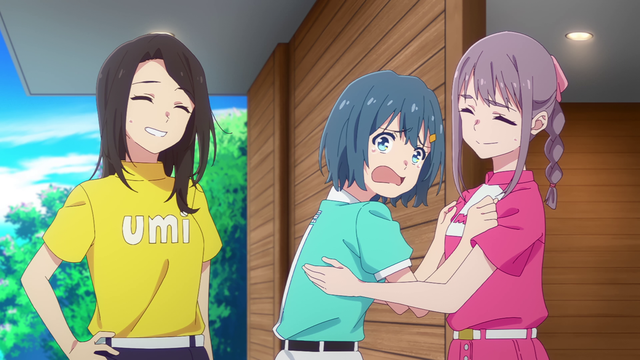
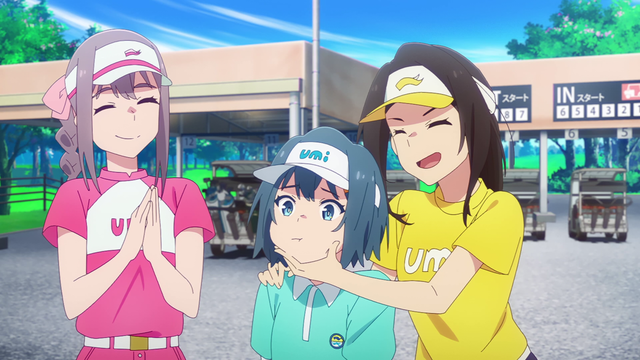
  • Hearing this leaves Ayaka and Haruka flattered, earning Minami a warm embrace from her seniors: Haryka and Ayaka know with confidence now that Minami is here to stay. Sorairo Utility is very heart-warming in this regard, and for me, Minami’s endearing manner is what really brought out the fun in Sorairo Utility – more serious works about golf focus purely on the sport, the endless drive to improve and speak about how important it is to never lose sight of one’s goals, but Sorairo Utility takes a different direction, one that suggests it’s okay to do thing for fun and to accrue new experiences without being motivated by a desire to prove oneself the best or fulfil a promise.

  • Now that Haruka and Ayaka are confident Minami’s found her golf and isn’t likely to peace out any time soon, a world of possibilities opens up to them. Sorairo Utility ends with Haruka spotting a poster advertising a tournament of sorts, and she declares it’ll be a good idea to sign up for it. Ending in this manner implies that this finale isn’t the end for Minami, and she’ll continue to have wonderful experiences, spurred on by two supportive seniors. With this, my talk on Sorairo Utility is very nearly at a close, and I can’t believe how quickly this season passed. The only other series I was actively watching this season was Okitsura, which proved to be a fun work that showcases nuances about Okinawa in greater detail than anime typically go to. I’ll strive to get a discussion out for Okitsura before the month is out, and looking ahead, the spring season is very nearly upon us.

  • There are no fewer than seven series I’m excited about (MonoZatsu Tabi ~That’s JourneyFood for the SoulSummer Pockets, Anne ShirleyUma Musume: Cinderella Gray and Mobile Suit Gundam GQuuuuuuX), as well as a handful of other titles that catch my eye. I’ve not seen a season with such a number of interesting shows for quite some time, and while I’d love to write about each of these series, shifts in my life mean that I need to be selective about what I choose to write and watch. At this point in time, I have plans to episodically review Mono because it’s an adaptation of Afro’s Manga Time Kirara manga and deals with activities I myself partake in, leaving me in a spot where I can go to great detail about the story and its elements. Zatsu TabiFood for the Soul and Summer Pockets will receive quarterly reviews because they look excellent, and the remainder of the series will be things I save for quieter seasons.

  • Although there is a non-zero possibility of Sorairo Utility receiving a continuation if home sales are solid, the fact that there’s an ending card suggests that Yostar Pictures only planned for a single season to be produced. Some works will immediately announce a second season once they conclude because they’re already in production in anticipation of financial success, but Sorairo Utility isn’t such a work. With this being said, Sorairo Utility does end on a solid note, and if things were to conclude here, the story has wrapped up in a very satisfactory manner. I will remark that after Sorairo Utility finished airing, the official Twitter account announced the release of a 1/7 scale figure of Minami in a very unique outfit from Mimeyoi in February of 2026. While Sorairo Utility might not be a life-changing anime for me, the series does have significance for me because, besides being an excellent story, I watched the OVA while moving house, and I would not object to having a tangible reminder of this memory. The preorder price is acceptable for a 1/7 scale figure, and at the time of writing, I have about 35 days to make a call before the preorder period closes.

With this, Sorairo Utility draws to a close. When the OVA aired back in 2022, I never anticipated that Sorairo Utility would become a full-fledged anime. However, this is exactly what happened, and while Sorairo Utility isn’t an especially innovative anime, it is yet another cute-girls-doing-difficult-things tale that succeeds in presenting the nuances and enjoyment in specific activities that one might otherwise never consider. Combined with a cheerful and inviting aesthetic, Sorairo Utility proved fun to watch, presented a mature outlook on activities where it is possible to become ensnared by a lack of progress – in suggesting that there’s no wrong way to approach something (except taking things too seriously), Sorairo Utility‘s messages are also applicable to other areas, and similarly, Minami’s reaction to solo golf near the end also accentuates the importance of doing things with people and enjoying shared experiences. Minami was able to enjoy her solo round and achieve a personal best, but despite making strides in her golf skill, what matters most to her are the memories she makes while learning and improving. In other words, Sorairo Utility indicates that the journey matters more than the destination; this theme is utilised in slice-of-life anime often enough that it’s become a cliché, but in the present, this is a mode of thinking that is increasingly forgotten: people are accustomed to social media, speedy processors and blisteringly fast internet connections, and when this belief intersects with the real world, it creates unrealistic and unreasonable expectations, as waiting for things and accepting it takes time to improve become viewed as a liability rather than an asset. This accounts for why people gravitate towards cryptocurrency investments and count influencing as being a legitimate career choice: there is no longer any sort of patience to put in the time and incrementally improve, especially as social media gives the sense that if one’s not instantly good at something, they’re supposedly a failure. On the flipside, Sorairo Utility emphasises that getting better at something will require elbow grease over time, but this isn’t necessarily suffering: Minami has a great time of learning how to improve her game, and by taking up golf, she’s also allowed herself to experience things that can’t be done in a mobile game.

Special Ojō-sama and Special Doubles Match – Sorairo Utility Review and Reflections At The Penultimate Episode

“Sex and golf are the two things you can enjoy even if you are not good at them.” –Roy “Tin Cup” McAvoy

Hina Yoarashi is a young golfer who greatly admires Haruka and aspires to play professionally. When she finds her score in the virtual golf game’s leaderboard has been displaced, she gets mad enough that she flies over to Nishitokyo so she can see what kind of golfers might’ve beaten her. Upon arriving at the driving range Minami frequents, Hina can’t believe that she was defeated by amateurs. Although Minami tries her best to befriend the haughty Hina, the latter ends up leaving after challenging everyone to a golf game. Haruka had gone for a run and missed Hina, so on the day of the match, Hina is shocked to find herself face-to-face with her old idol: it turns out Haruka had been the one to inspire Hina to play professionally, and Hina became quite disappointed to learn that Haruka had dropped from the world of competitions after finishing second in her final tournament. Determined to get Haruka back into tournaments, Hina proposes a challenge: if Haruka can beat her, then she can stay with Ayaka and Minami, otherwise, she’ll have to fulfil Hina’s promise. Intrigued, Haruka accepts and decides to play doubles, with Minami joining Hina. Hina’s raw skill allows her to compensate for the mistakes Minami makes, but she finds herself frustrated by Minami’s erratic play-style. When a sudden shower puts a pause on their game, Minami asks Haruka about her past, and Haruka answers: having long felt golf to define her world, Haruka began to feel that if she pushed herself to the point where golf was no longer fun, she’d lose her way. In her last tournament, Haruka had been close to winning, but nerves got the better of her, and she decided to approach golf differently so she could continue to enjoy it, without the stress of having to constantly perform. After the shower stops, the match continues, and Minami ends up making a few plays that impress Hina. However, Haruka is now fired up, allowing her to draw with Hina. When Hina misses a putt that costs her the game, she throws an adorable tantrum. Later, Hina admits that she’d long looked up to Haruka and wanted to see how her skills stacked up in a match and promises they’ll play one another again, especially since Haruka does intend to become a professional, with Haruka looking forwards to meeting this challenge. Minami is surprised that it’s still early, and although she’s keen to enjoy some cake per Haruka’s suggestion, Ayaka suggests that since they’re in Chigasaki, they could hit the beach instead. With this, we’re now finished the penultimate episode of Sorairo Utility, and while my own speculation that Minami would play in a tournament wasn’t on point, playing in a different format with someone like Hina also gives Minami a chance to see another side of golf, one that she joyfully accepts despite Hina’s cold attitude towards her.

Although Sorairo Utility is about Minami’s journey into golf, it does feel as though the final quarter’s focus is on Haruka and how her approach towards golf evolved over time. There had been some speculation that something traumatic had happened to Haruka that drove such a change, but with the latest episode, it turns out that Haruka’s just got a better measure of herself than viewers had anticipated. It takes a great deal of self-awareness to understand why one enjoys something, as well as what sorts of things may cause one’s impressions of something to degrade. As an aspiring professional, Haruka had devoted all of her effort into improving, and there were days where she legitimately became frustrated at her lack of improvement. When Haruka participated in a tournament and finished second, she felt that she’d given up an easy putt because of nerves, and subsequently lost her motivation to play. It was only through meeting Ayaka that Haruka felt she could have fun again, and since then, Haruka’s believed in playing golf for the sake of enjoying the moment, as well as taking a more measured and relaxed approach. In practise, it means that Haruka tends to play more conservatively, favouring strategic shots over bold, long distance drives. However, in the doubles match against Hina, Haruka reveals she’s lost none of her edge; she’s absolutely able to drive long distances with accuracy, but for the most part, she’s holding back, preferring to study the course before making a shot. This takes the pressure off Haruka: no longer needing to maximise distance in a single, perfect stroke, she can just focus on getting her next shot into a good spot, and this in turn allows her to have fun with a match. This is what Megumi saw in Haruka, and since Haruka was able to discover this after meeting Ayaka, Sorairo Utility simultaneously indicates again that good company provides the encouragement to lift people out of slumps, as well as reiterating to viewers that Haruka’s own perspective on golf wasn’t a particularly significant issue. In fact, by having Haruka’s past portrayed in such a fashion, Sorairo Utility is able emphasise that Minami’s in good hands – while her ability and technique is nothing like a trained player, the fact that Minami is having fun, both under her own motivation and through support from Haruka and Ayaka, means she’s more likely to stick it out and find something she can enjoy doing.

Screenshots and Commentary

  • The events of the tenth episode came as a bit of a surprise in what had otherwise been a pretty grounded series: introducing Hina as a young golf prodigy with an ojō-sama archetype to match feels quite far removed from the objective in Sorairo Utility at first glance. However, this isn’t my call to make: as a reviewer, my goal is to share how well a work achieves its objectives, and this entails looking at things from the creators’ perspective. Unsurprisingly, when things are done from this standpoint, Sorairo Utility‘s decision makes sense – Hina’s archetypical anime characteristics give Minami a chance to show viewers how far she’s come since she began playing golf.

  • Haughty, arrogant and clearly well-to-do, Hina has the golf skills to back her ego. It turns out that her interest in visiting stems purely from her shock that anyone could beat her in golf, even in a video game: a few episodes earlier, Haruka, Mimami and Ayaka had worked together to overcome the diabolical challenges in a virtual golfing game, placing first as a result. This caught Hina’s eye, and since then, Hina had been curious to see what kind of person might be able to beat her.

  • This is the second time I’ve seen something like this go down in an anime: back in last year’s Pon no Michi, Haneru ended up finding Nashiko and her friends at their mahjong parlour, after similarly being handed a defeat in online mahjong. However, whereas Haneru didn’t have a clear picture of what to expect and would end up warming up to Nashiko’s group very quickly, especially when faced with the prospect of being able to play Riche, Hina’s presence is one with a distinct aura of hostility.

  • Anime tend to downplay the severity of the implications of being able to find others in the real world – positivity and warmth means that such moments are merely fateful encounters that allow people to build new friendships with one another, but in reality, this practise can lead to dangerous, or even fatal situations arising. This is why its so important to practise good OPSEC when online: common sense actions like never revealing vital information, disclosing clues to one’s location, using secure passwords (or better yet, a password manager) and knowing fundamental digital safety practises help to keep one safe from malicious actors. However, it’s also important to maintain a low profile online – oversharing can allow sufficiently determined sleuths to work out the details.

  • For instance, in Sorairo Utility, since Ayaka registered her team to the Nishitokyo Golf Centre, all Hina needed to do was swing by herself after a quick search for the driving range’s address. From here, Hina is able to swiftly work out who HAM is. I’ve used similar techniques to identify difficult-to-find spots for anime location hunts in the past, but it doesn’t take a fertile mind to spot that the same knowhow can allow unscrupulous individuals to track down people. Sorairo Utility, being a cute-girls-doing-cute-things anime, is able to sidestep this particular problem, and while internet safety is a legitimate concern, one can forgive the anime for the direction it takes, since Hina’s curiosity is what leads her to meet Ayaka and Minami.

  • I’d expect that Hina was expecting someone with the same physical presence as that of Sylvester Stallone or Tiger Woods, so when she meets Minami and Ayaka, and spots Minami’s especially poor performance, she’s flabbergasted that these were the people who beat her. Despite Hina’s confrontational manner, Minami takes an immediate liking to her, finding Hina’s small stature adorable, and it does appear as though nothing Hina can say gets through to Minami. In the end, Hina decides to settle things on the golf course – Hina is clearly competitive and is someone whose ego gets bruised very easily. Realising she was beaten by a bunch of casuals causes her to arrange a rematch so that she may reassert her supremacy.

  • Without really understanding what’s going on, Minami and Ayaka accept Hina’s challenge, thinking it’ll be another chance to get out there and golf. Once things are arranged, Hina leaves, and Haruka returns from her run shortly after. It turns out that Hina is a big fan of Haruka, whose bold play-style is what inspired Hina to take up golfing to begin with. Based on what Sorairo Utility suggests, people become inspired by others who are renowned in their field, but rather than emulating their heroes, should seek to find their own path within an area. This is why Ayaka and Hina’s brand of golf are so different – Hina had seen the Haruka who was laser-focused on dominating a game, and Ayaka had encountered the Haruka who wanted to strike a balance between enjoying golf and incrementally improving at a measured pace.

  • Hina clearly hadn’t been expecting her idol to appear, but her excitement swiftly turns to disappointment when she sees Haruka associating with “inferior” golfers. Feeling that Ayaka and Minami (especially Minami) are holding Haruka back, Hina’s desire for a rematch to pound Ayaka and Minami into the ground turns into a desire to see Haruka returning to competition. Hina, in a manner reminiscent of Goldfinger‘s Auric Goldfinger, decides to raise the stakes: if she should beat Haruka, then Haruka will be made to abandon Ayaka and Minami.

  • Although such stakes are intimidating to Minami, who worries she’ll lose Haruka if anything should happen, Haruka takes everything in stride. Haruka’s nonchalant, laid-back attitude might give the impression that she’s unconcerned about the outcomes, but in reality, it mirrors how Haruka’s not the kind of person who allows nerves to impact her performance. From a storytelling standpoint, from the moment Hina made such a suggestion, it would become evident that she’d have to lose this golf game.

  • Perhaps spotting that if playing solo, Hina would have the edge because she’s in her element, Haruka decides to suggest playing pairs. This completely throws Hina off – she’d been hoping to go head-to-head with Haruka, and now, being asked to play with a novice means Hina is, in effect, held back by Minami’s actions. Although it’s easy enough to assume that Haruka’s not interested in giving in to Hina’s terms, Haruka’s personality means it’s more likely that she wants Hina to approach golf from another perspective, especially as Hina’s competitiveness reminds her of how she’d previously been, and what the perils of such a mindset could be.

  • If this were the case, Haruaka doesn’t say anything about this directly and instead, just starts the party. This showdown comes out of the blue and prima facie encompasses relatively high stakes, which contribute to a bit of the tension at the onset, but viewers attuned with thematic elements won’t be too worried about who ends up winning. For me, the outcome of this competition was written on the wall from the moment Haruka suggested playing doubles: because Minami is a pure novice who also happens to be the protagonist, there wasn’t any possibility that Haruka would just abandon her, and as such, this meant that Haruka would prevail.

  • Knowing what a story’s aims are means that its outcomes become trivially easy to deduce, and from that point on, the fun of watching something becomes seeing how said outcome is reached: the destination is irrelevant next to the journey. As the match begins, it suddenly hits me that Sorairo Utility is probably the first time I’ve seen someone wearing a Victorian maid outfit on a golf course. This is one of the joys of anime: viewers are treated to sights that are uncommon.

  • Right out of the gates, it’s clear that Minami’s being a liability would handily balance out Hina’s skill – Hina’s shots are well-placed and allow her to reach the hole shortly, but Minami’s unlearned technique and judgement causes her to miss the fairway, requiring extra strokes to compensate. Hina is initially confident enough that even with Minami’s mistakes, she’ll still school Haruka, but Minami’s blasé attitude and erratic performances ends up frustrating her to no end.

  • For her part, Minami seems more interested in trying to get to know Hina better, and this results in a amusing juxtaposition as the friendly-but-unfocused Minami tries to break the ice with Hina. The considerable gap between the two represents a visceral show of two different ways golf can be approached: having spent the whole of Sorairo Utility watching Minami learn and grow at her own pace, the series is able to emphasise the difference between taking up a new hobby for enjoyment, versus doing things in a professional or competitive capacity. There is a time and place to be serious, and as someone with this disposition in a professional setting, I can explain Hina’s approach well enough: she’s very objective driven and derives the most enjoyment from seeing tangible growth in herself.

  • Individuals with Hina’s disposition tend to be their best selves when they’re able to pursue growth and improvement. However, when this coincides with competitiveness, this ends up being detrimental, since it causes one to lose sight of what’s important. A mature professional player would, in Hina’s place, agree to compete but also hold back, knowing the object of the game is simply to have fun. On this note, how Haruka approached Hina’s challenge is befitting of a mature, confident player who knows when to be serious, and when to be relaxed. When a sudden downpour forces the girls to take a brief intermission, Minami ends up asking Haruka why she stopped competing.

  • Haruka replies that the road to playing on a youth tour was gruelling, and she’d pushed herself to the point where she felt her enjoyment of golf diminish. On her final game, she came in second after failing to make a putt as a result of nerves, and subsequently lost her enjoyment of golf. It wasn’t until Ayaka showed up and brought the fun back into golf that Haruka began playing again, and since then, Haruka feels that while it’s important to improve and push oneself, it’s also important to strike a balance and play golf for reasons beyond perfecting technique and score. This revelation, far from being dramatic, reminds viewers that Haruka doesn’t have a dark past or existing trauma, and instead, she was able to rediscover golf previously. In the present, she’s able to understand the importance of maintaining a healthy mindset towards golf.

  • This puts her in a position where she’s able to be a good role model and mentor for Minami: Minami has no intention of playing professionally, and as a student, she’d probably be a little slower on the uptake compared to people who are playing golf in a professional capacity. Since Haruka understands there are many ways to play golf, she would possess the patience to teach Minami and entertain Minami’s admittedly fanciful and unusual thoughts. This contributes to Sorairo Utility‘s themes of how activities can be done in any number of ways; in particular, while people skilled enough in a given activity can make a career of it, the folks who do something recreationally also can have valid reasons for doing so.

  • Blue skies dominate once the showers pass, and viewers are returned to the sort of weather that Sorairo Utility is best known for. The weather in Sorairo Utility is utilised in an archetypical fashion – overcast and rainy weather indicates hesitancy and concern, while sunny skies denotes a relaxed mind ready to make the most of a day. The mood shifts perceptibly after the skies clear, as all of the tensions melt away after Haruka clarifies her perspectives of golf and competition. From this point on, Sorairo Utility‘s penultimate episode returns to the tenour that characterised the series up until Hina’s introduction – after Minami misses an easy shot, Hina chases her around the course in frustration.

  • Sorairo Utility is at its best when things are light: while there’s nothing wrong with a serious mindset, a competitive personality can be a drawback. While competition motivates progress and self-improvement, pursuit of excellence should be motivated by a desire for more than just validation and satisfying one’s ego. Competing in a healthy manner means getting a practical sense of where one’s ability lies and helps one obtain feedback surrounding areas of improvement. Further to this, there is such a thing as “negative”, or zero-sum competition, in which competitors believe that in order to win, someone else must fail. A simple shift in mindset can help mitigate this: rather than “beating” someone for validation, competing with someone can be as easy as using their success to help one determine where they wish to improve.

  • Negative competition can bring out the worst in people, and one only needs to look at how American politicians regard China to see the consequences of how regarding a competitor as a mortal enemy can be counter-productive. Sorairo Utility uses Haruka and Minami to promote positive competition. Minami’s indefatigable positivity and excitement over everyone’s shots mirrors how she’s just here to have a good time and be inspired by what proficient golfers can do. Whether it’s Haruka or Hina’s shots, Minami cannot help but be impressed, giving her incentive to improve and continue playing. This spirit is quite infectious; when Hina’s shot fails because she forgets to account for one of the hole’s topography, and Minami manages to use a creative play that’s more effective, even Hina compliments Minami on having some skill.

  • Watching Minami having a blast, and perhaps feeling she should give Hina a chance to see her play-style in person, Haruka becomes fired up enough to decide to use her signature long drives to see if she can reach the putting green in a single stroke. This becomes an excellent teachable moment – like most activities, golf is a game of both skill and luck, and while Haruka retains her ability to line up excellent shots, in this moment, she hadn’t anticipated that the wind would pick up and push her ball back. A more conservative shot would’ve been more appropriate, but Haruka didn’t have any way of foreseeing this.

  • This doesn’t stop Haruka from feeling less frustrated, but such is how things work out. Without the stakes of a tournament over her head, though, Haruka is able to take things in stride, entrusting Ayaka to take a shot that extricates the pair from their situation and put them back on track. The two pairs end up drawing towards the end, especially when Minami misses another easy shot, and Haruka manages to achieve her goal of reaching the putting green with a single stroke later on. In most portrayals of golf in fiction, the putting green is where the tensest moments happen, and Sorairo Utility is no exception.

  • By this point, the fact that the entire game boils down to single shot has Hina excited, and in the moment, she forgets that she dislikes Minami, being thrilled that she’s facing off against the Haruka she’s long admired. When it comes down to the wire, Hina’s spotted that Minami’s strong point is using utility clubs, which are versatile clubs that help in one’s short game. The moment reminded me of how a year ago, I was out at the Alberta Birds of Prey Foundation in Coaldale, and because of the day’s photographic subject, birds, all of the photo club’s members brought their long lenses (200< mm). When one of the senior photographers asked around to see if anyone had a wide lens to capture the building and its surroundings, none of the other members were equipped for that.

  • This left me, and my Tamron 28-200 mm, to do the job. Being a landscape shooter, I’m more fond of wide-angle lenses and the images they produce, and I’d brought that lens along so I had enough reach for birds that were inside an enclosure (200 mm is much too short for birds out in the wild), but enough width so that I could capture other things if the need arose. It seems that, like me, Minami’s become very fond of her utility, akin to having a Sony G lens amongst a collection of basic lenses and favouring that G lens. However, after spotting a slight curve to the green, Minami’s mind is overloaded while trying to work out how to make the shot. Here, Hina steps in with some advice, suggesting that Minami aim a little to the right so she can compensate for the slope.

  • When Minami misses the hole by a foot, Hina does something unexpected: she praises Minami for being able to have gotten the ball close enough so that the next stroke will finish the hole. However, Hina herself misses the last putt, and this allows Haruka and Ayaka to win. Such an outcome was preordained (Sorairo Utility necessarily needed to keep Haruka with Minami and Ayaka to keep their story going), but watching things reach said outcome in the manner that it did was quite entertaining. Once Hina misses the putt, the tension drains out of the episode – ordinarily, players would work out a smile and say “good game”, but Sorairo Utility chooses to remind viewers it’s a cute-girls-doing-cute-things series in a befitting manner.

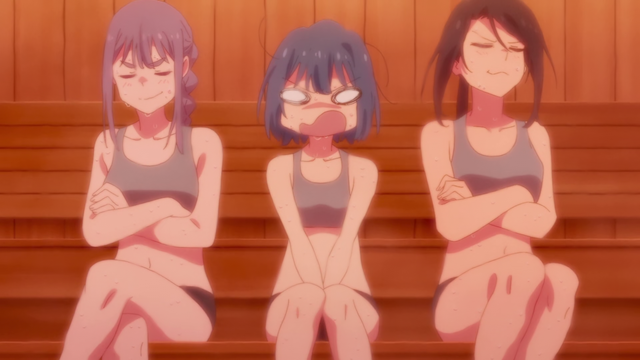
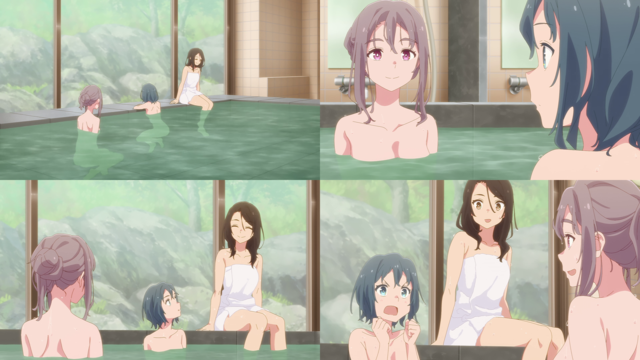
  • Having maintained a holier-than-thou attitude throughout the golf game, Hina throws a tantrum unbefitting of her usual manner; speaking to her younger age, Hina ends up referring to herself in the third person. The sharp contrast was a riot, perhaps suggesting that being a prodigy, Hina’s not accustomed to losing. Being able to handle setbacks and adversity is a natural part of living, and here in Sorairo Utility, the outcome of this golf game also provides Minami a chance to show how far she’s come. Unbothered by losing, Minami instead chooses to try and reassure Hina, but Hina’s a bit of a sore loser. Hina does admit that her entire motivation was to one day play golf with Haruka, and in the post-game onsen soak, Haruka reveals that she still intends to become a professional.

  • When Haruka asks Hina about her experience in playing alongside an amateur, Hina admits that Minami would compel her to play in a different way. Because amateurs are inexperienced, they will often act in unpredictable ways: a peer of similar skill will follow logical patterns, but when one has limited experience, they will do things that appear illogical, or even counterproductive. On this note, golf is actually counted as a one of the most unpredictable sports, and this is what makes it so enjoyable for professionals. By this point, a good, warm dip in the onsen helps Hina to cool off, and she’s surprised to learn Haruka hadn’t abandoned her aspirations of playing professionally, although owing to distractions, Haruka had failed to apply for the qualifying examination.

  • This implies that Haruka never lost her love of golf despite suffering from a setback previously, further reinforcing the notion that losing hadn’t impacted Haruka quite as much as her own concern about losing her love of something she’d come to count as an integral part of who she is. After everyone exits the baths, Hina’s begun to come around somewhat and promises to play everyone again someday – despite her reluctance to admit it, it’s clear enough that Hina did enjoy the change of pace playing alongside Haruka, Ayaka and Minami offers.

  • With this, we’re now sitting right at the penultimate episode of Sorairo Utility, and I’m rather looking forwards to sharing my thoughts on the series as a whole once the finale airs. We’re now sitting at the edge of the winter season, and a quick look ahead finds that the spring season is absolutely packed with worthwhile shows to watch and write about: besides Mono and Zatsu Tabi ~That’s Journey~, there’s also Food for the Soul, which adapts Atto’s manga and will be produced by P.A. Works. Atto is best known for working on Non Non Biyori, and the combination makes for an exciting series. Similarly, since Afro wrote Mono, and since Zatsu Tabi is another travel-themed manga, these are all stories that I am interested in. Besides these works, Summer Pockets and Anne Shirley also look very promising.

  • This creates a problem I’ve not had in a while: there are now more excellent anime to watch and potentially blog about than there are hours in a day. I still have a few weeks to go before I need to make a material decision on which shows will receive episodic discussions, but the clock is ticking; time passes very quickly, and it suddenly hits me that a month ago, I’d been out helping out with a photo-walk. A month later, the weather is miserable as March is wont to being, but while out and about picking up a few things, I also decided to return to the local farmer’s market and swing by a poutine place that caught my eye: their “Volcano Chicken” poutine, with its spicy marinated grilled chicken, Buldak sauce, cheese sauce and scallions, was an absolutely delicious way to ward off the cold, cloudy skies. I’ll be returning to write about Sorairo Utility and Okitsura‘s finales on short order, and until then, readers will have a post on Hidamari Sketch × 365 to look forwards to next.

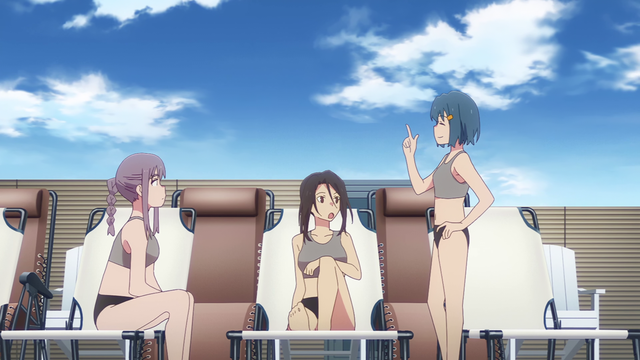
With this match drawing to an early close, leaving Minami, Haruka and Ayaka some extra time, the thought of having the girls visit a beach in their swimsuits will be all too tempting an option for Sorairo Utility (especially if Haruka is present). To ensure that Sorairo Utility doesn’t stumble on its finale, viewers will be given a special treat instead as Minami heads off to play a solo round. Until now, Minami had played with Haruka and Ayaka present, and so, when things didn’t go well, she could always lean on her dependable seniors for encouragement. A solo match, then, is an appropriate show of how far Minami’s come: if Mimami is now able to face down setbacks and challenges on her own, it would mean that, even if her skill isn’t sufficient, she now has the resilience to pick herself back up. This is an appropriate conclusion to Sorairo Utility, and such an outcome typifies how anime has matured over the years: things like beach episodes are a relatively easy way of attracting attention, so when an anime decides to minimise these aspects in favour of the main story, it indicates that the writers and producers are confident enough in their work that they needn’t resort to gimmicks to hold the viewer’s attention. Sorairo Utility is such an example: its main appeal primarily comes from watching Minami improving incrementally, and in watching how she handles playing alongside the stuffy and easily-annoyed Hina, one gains the sense that Minami’s picked up the right mindset from Ayaka and Haruka about how there’s many ways of playing golf. Rather than being discouraged or downtrodden by Hina’s remarks, Minami instead finds herself fascinated with how seriously Hina takes golf, reminding her again that there are indeed many ways to do something. It is a little saddening to write that Sorairo Utility is rapidly drawing to a close, but before we say our farewells to Minami, Haruka and Ayaka, there is one more episode left. I am rather looking forwards to seeing how things turn out for Minami as she does the equivalent of what Nadeshiko had done during Yuru Camp△ 2. Given that Minami’s solo match is set during the finale, one can reason that Minami is reasonably prepared to play on her own now, and no matter what happens, the experience will become yet another treasured memory, one that will give her yet another justification to continue playing in the future.

Sorairo Utility – Review and Reflection at the ¾ mark

“Golf is about how well you accept, respond to, and score with your misses much more so than it is a game of your perfect shots.” –Bob Rotella

After reading the light novel Izumi recommended her, Minami begins to develop an interest in creating a special “finishing move” similar to the ones the heroes in her games and books use. At the local driving range, she begins to train, and the elderly gentlemen recount how as youth, they too had signature strokes. However, the three men injure themselves while showing off for Minami, prompting the ambulance to show up. The driving range’s exasperated manager explains that this happens all the time. Minami begins to work on her “Penguin Slider”, a shot with a flat trajectory that hugs the ground. Later, Ayaka introduces Minami and Haruka to a golf video game, in which teams complete virtual courses for points, and teams that rank are able to earn prizes. Intrigued, Minami and Haruka agree to participate, and they soon find that this game is diabolical, featuring holes with sand-traps where ants punt balls from holes, a highly windy course that makes it near impossible to aim straight, and a castle that shoots down any balls that gain airtime. Although this last hole seems to defeat everyone’s efforts, Minami realises her Penguin Slider shot is perfectly suited for this, and upon sinking her ball, the girls are overjoyed to learn they’ve finished the virtual tournament and placed first, earning them a sizeable cash reward. Haruka decides to spurge on a golf game with a caddie, Megumi. Megumi’s known Haruka for some time, and while helping the girls out for the day, Megumi also gives everyone advice, encouraging to play the game in the manner they’re happiest with. During the day, Megumi suggests to Ayaka that she has the disposition for being a good caddie after watching her support Minami, and she also notices that Haruka’s style of golf has matured. Towards the end of the day, Minami loses her penguin-shaped club cover, but is overjoyed when a staff member at the golf course is able to find it. Back at the driving range, Minami is disappointed to learn that her strokes are falling short again, but when she, Haruka and Ayaka receive a call from Megumi, inviting them to play together one day, she finds herself fired up once more. Later, Haruka and Minami grow worried when Ayaka stops visiting the driving range, and after two weeks pass, their worry grows to the point where they pay Ayaka a visit. It turns out that Ayaka had participated in a challenge to complete a video game without eating anything to grow her channel, but kept being destroyed by the game. Minami mops floor with the game, and helps suggest video ideas that can help Ayaka’s online presence, but becomes disheartened when everything turns out R-rated. However, talking with Haruka and Minami, Ayaka recalls she found joy in connecting to others through golf, and Haruka suggests doing something on golf etiquette, which would be both educational and refreshing. To drive up excitement, Minami also decides to have t-shirts made for the three, but designing the shirts renders her exhausted, and she accidentally ends up ordering three hundred rather than three. Although this setback causes Minami to retreat to her apartment, Minami and Haruka are on hand to help out, selling the shirts to excited fans of Ayaka’s channel. This initiative is successful, and after receiving praise from Haruka and Minami, Ayaka bursts into tears, realising that while she never had any sort of concrete dream like Haruka, she’d come to love the idea of being able to reach out to and help others.

From playing virtual golf and experiencing the joys of having a caddie, to helping Ayaka with her social media slump, Sorairo Utility has covered quite a bit of ground since its run began. Unlike a typical sports anime, where teamwork and self-improvement drive the story, and where competitions and victory are the prizes for effort and determination, Sorairo Utility‘s cute-girls-doing-cute-things approach conveys a completely different message, one which had been evident since the third episode: activities do not exist in a vacuum, and taking up something new opens one up to much more than just the activity they’d partaken in. However, Sorairo Utility also shows how one’s existing skills can impact their enjoyment and ability. Minami had taken up golf to do something with her life after her favourite mobile game was shuttered, but finds moments where her prowess with smartphones and games would come in handy: early on, she walks Haruka through taking selfies with a smartphone, and later, in a virtual golf game, Minami’s understanding of how games work allows her to guide Haruka and Ayaka through mechanics that would never show up in a real golf course. Similarly, when Ayaka stops eating as a part of a social media challenge, Minami’s über-micro allows her to trivially beat a game, letting Ayaka to finish said challenge and finally take in some nourishment again. Showing this side to Minami’s growth helps Sorairo Utility to show that, just because one is taking up a new activity does not mean that their old skills are dulled, and similarly, one does not lose their old identity, either. Instead, picking up golf serves to expand Minami’s world and let her do things she would never have otherwise have done, but otherwise, Minami is still her old self. Outside of moments where Minami is able to lend her skills to a problem at hand, Minami’s old self endures: while playing a game with Haruka, Ayaka and Megumi, Minami runs afoul of the wildlife on the course and is reduced to running around in a blind panic when the wildlife chase her. Portraying all sides of Minami thus reiterates that doing something new won’t fundamentally change an individual to the point where they’re unrecognisable, but instead, simply serves to help one learn and grow in new ways. In this way, Sorairo Utility ends up being similar to most cute-girls-doing-cute-things, providing a comforting and heart-warming experience which, while unlikely to alter one’s worldviews or say anything profound, remains most welcome in a world where opportunities for self-discovery and encouragement to explore continues to be eroded.

Screenshots and Commentary
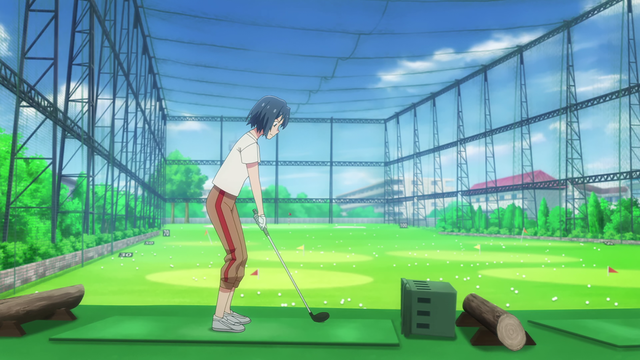
  • By now, the Nishitokyo’s Hoya Golf Center has become a familiar place for Minami – at the seventh episode’s start, after she gets inspired by a light novel Izumi’s reading, Minami is inspired to work on her signature move. It turns out the elderly gentlemen were also fond of doing this in their youth, and after overhearing Minami, they’re spurred on by her energy, enough that they decide to show her their old moves. While seemingly inconsequential, the moment serves to show viewers that what Minami fancies doing isn’t so outlandish after all.
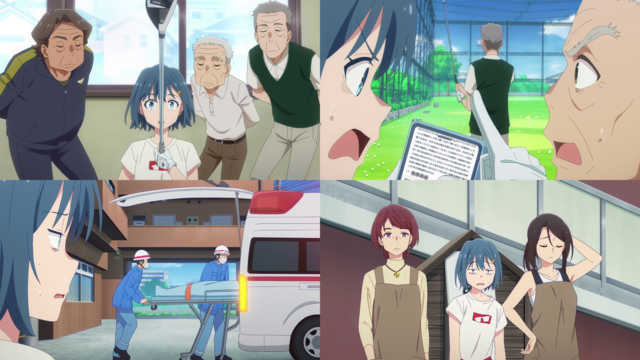
  • While the gentlemen still have spirit, it’s clear their bodies aren’t up for the task: they overexert themselves and end up being taken to the emergency room for their troubles. The moment is clearly meant to be humourous in nature and reminds folks not to overdo things, although for me, it’s also a reminder that if I wish to remain fit at those ages, I’ll need to consistently lift weights, run, partake in outdoor activities and generally live in a healthy fashion. Despite sharing looks of exasperation at what unfolded with Haruka and the manager, Minami does end up developing her patented Penguin Slider, a shot with a low, flat trajectory that also has some distance to it.
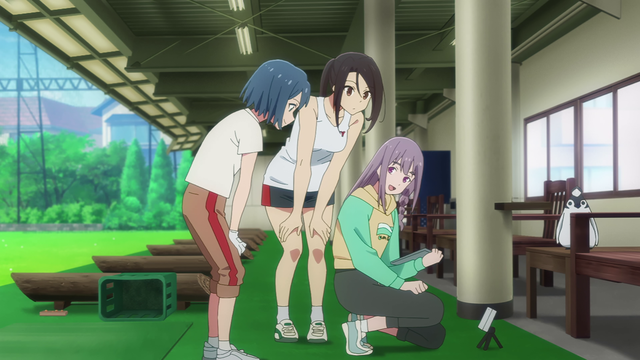
  • When Ayaka arrives, she reveals that there’s a virtual golf game that’s become popular and provides players who make the leaderboard with rewards like cash prizes. Curious, Haruka and Minami agree to join, thinking it could be fun to see how far they make it. At first glance, playing a golf video game in a story about golf seems counterproductive and extraneous, taking away from time that Minami could actually be spending on a golf course. Were Sorairo Utility to be a competitive series like Birdie Wing, then this perspective would hold merit.
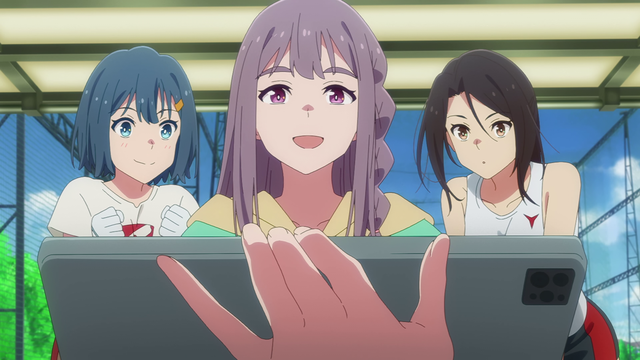
  • However, Sorairo Utility takes a much more laid back approach towards golf, and as such, something like a virtual golf tournament fits in quite well with the series. The choice to incorporate video games into Sorairo Utility gives Minami a chance to shine: while she’s been picking up the basics and improving incrementally, Minami is still a novice and therefore, is prone to making mistakes. This causes her to throw adorable tantrums or become sulky, so to reiterate Minami also has her strong points, Sorairo Utility uses moments like these to let Minami shine: the virtual golf game she and the others play isn’t conventional golf, being filled with gotcha mechanics that would probably cause real golfers to rage-quit.
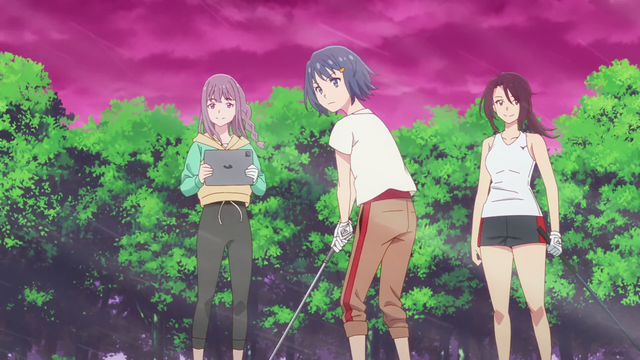
  • Japanese games are very creative in this regard, doing wild and whacky things with their design to surprise players. Among the courses the girls play are a level set in a giant sandtrap, where ants punt balls from the hole if they land, and where the sand consumes any missed shots. Seemingly unable to get past this level, Minami and Haruka end up doing the equivalent of saturation fire, putting enough balls in the hole that the ants can’t keep up, allowing them to clear this stage.
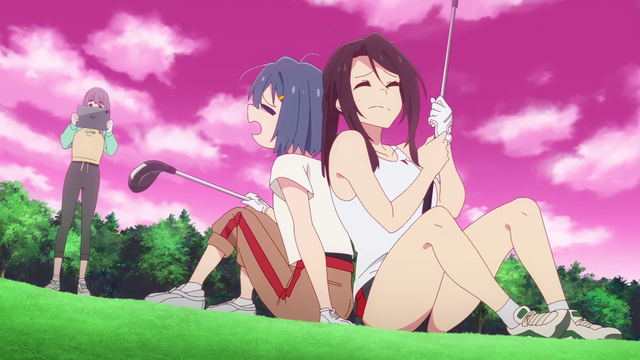
  • However, facing consecutive challenging stages proves exhausting, and when the girls reach a level whose objective is to sink a shot into a hole that’s protected by fanciful anti-air munitions and traps, nothing Haruka and Minami have appear to be effective. To observant viewers, this level was tailor-made for Minami’s Penguin Slider, and so, when conventional means fail, Minami decides to give her special finishing move a whirl. This ends up being successful, and upon completion, the girls are ecstatic to learn that not only did they make the leaderboard, but they’ve managed to finish first, too.
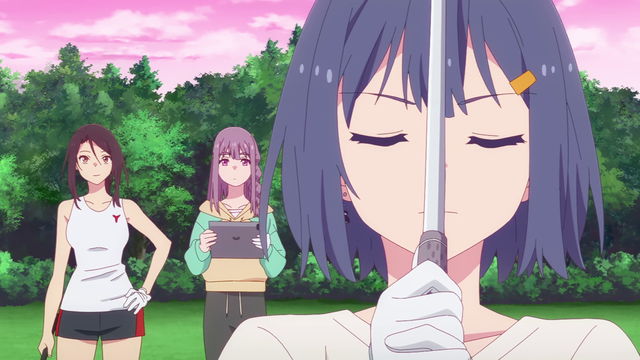
  • This allows them to collect a cash prize, one substantial enough that Haruka considers buying a new driver with it. Ayaka, however, has a different idea – she suggests taking Minami out to a course where they’ll have a caddie. The gap between Ayaka and Haruka is plain here; Haruka’s someone whose quite devoted to golf and always looking for equipment and training to improve her game, while Ayaka is more of a memories and experiences person, befitting of her being an influencer. Sorairo Utility is optimistic in its portrayal of influencers: Ayaka is friendly, down-to-earth and approachable, and while she has a large following owing to her golf and fashion content, Ayaka is also humble, standing in stark contrast with the impression of influencers most people have.
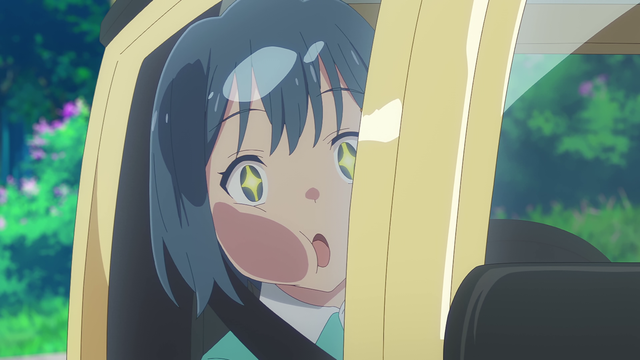
  • Because it’s Minami’s first time golfing somewhere so fancy, she’s most excited to get the day started and enters her latest round with stars in her eyes. Minami is undeniably cute, and looking back, this is a trait that almost all slice-of-life protagonists share. If I had to guess, this is comes about because such characters convey a feeling of innocence and vulnerability, which prompts viewers to feel sufficiently warm and fuzzy that they want to root for the character’s growth and development. This creates engagement and, thanks to our evolutionary tendency to want to protect cute things, it’s a way of gently encouraging viewers to relax and become excited by a work.
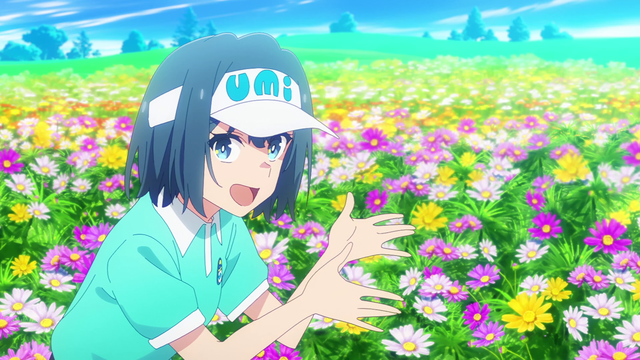
  • Longtime readers will probably be aware that I’m no fan of influencers: people who flaunt wealth, unhealthy lifestyles and unreasonable standards of beauty while receiving praise for what ultimately amounts to a shallow and unsustainable view of the world do not earn any respect in my books, and as far as I’m concerned, being “popular” isn’t a marketable skill. Thus, when Ayaka is presented as someone who wants to reach people and help them or make their day better, she represents influencers as they should be: someone who takes domain expertise and shares it with people at scale. A true influencer has a marketable skill set (in Ayaka’s case, golf and fashion) in conjunction with a sincere personality and a desire to share not for personal gain, but for the sake of others.
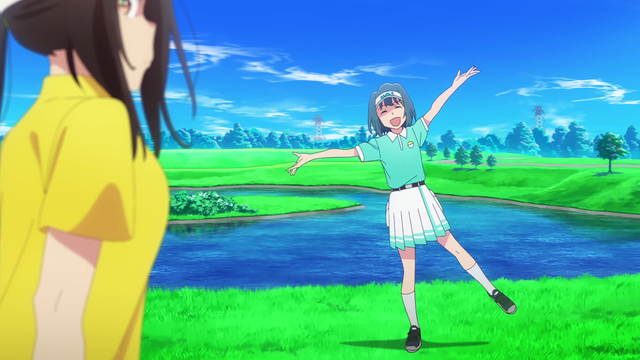
  • There are a number of people in reality who are similar to Ayaka, such as LevelCap, MrProWestie, JackFrags and TheRadBrad: they possess skills in their areas of interest, present things that are relevant to their audience and do not promote an unattainable or unsustainable lifestyle. In particular, I respect LevelCap greatly because he’s also made the plunge into being a game developer, taking his experiences and opinions of games and turning those ideas into reality through the game he’s working on, C-Beams. Ayaka has a similar ability: while she knows how to present things to an audience, the fact she’s genuinely into golf and fashion means that she has skills that can be turned to a viable long-term career.
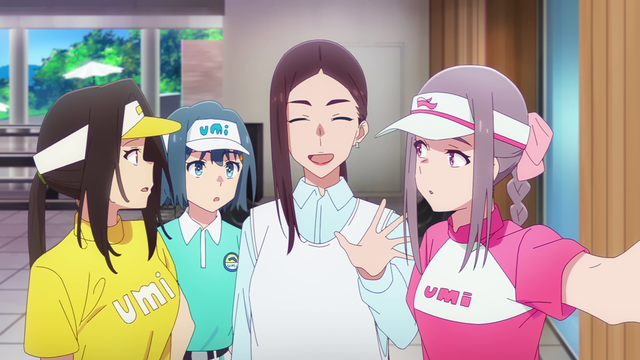
  • Ayaka’s life as an influencer is explored later on; during this trip, she takes a handful of pictures for her audience, but the episode’s focus is on Megumi and how she helps the youthful golfers in more ways than just picking up balls, selecting clubs for players and maintaining the course. In a manner of speaking, then, Megumi becomes more than just a golf caddie: she’s also a caddie who guides Minami, Ayaka and Haruka through life as they reach the transition between adolescence and adulthood. This was a pleasant turn of events, and for Haruka, it’s a chance to work with her father’s former golf student.
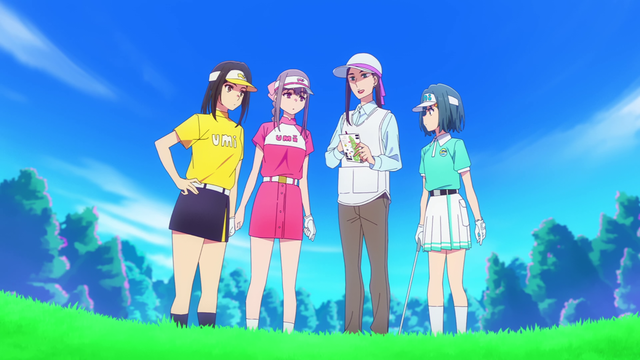
  • Until now, Minami and her friends had played golf on their own, with Haruka and Ayaka providing guidance for Minami. With Megumi present, the girls now have someone much more senior than themselves fulfilling this role, and throughout the day, both Haruka and Ayaka receive learnings of their own from Megumi. Observant viewers will have spotted that Megumi’s features are sharper, more angular than those of Minami, Ayaka and Haruka’s, mirroring the age gap. The artistic characteristics of animation are such that it can be difficult to tell how old (or young) people are if they’re between 15 and 45, so different character designers will use different, sometimes subtle, cues to denote age.
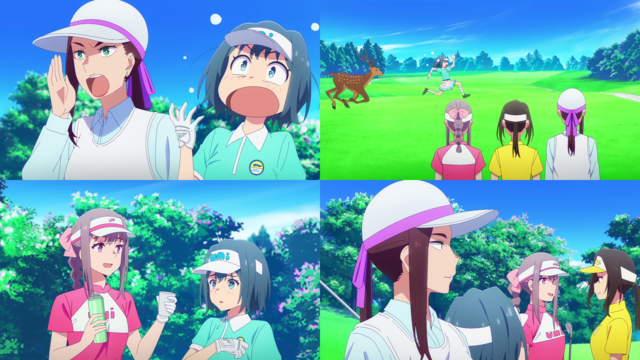
  • During the course of this game, Minami learns why golfers shout “Fore!” (a Scottish exclamation used to announce the presence of an incoming shot to anyone downrange), finds herself being chased down by various animals, including a deer, and receives support from Ayaka. Observing the girls allows Megumi to gain a better measure of their traits, and Megumi will later indicate to Ayaka that she’s got the makings of a good caddie because she’s so observant. Similarly, watching Haruka play helps Megumi to gain insight into how the former’s play has subtlety changed over time.
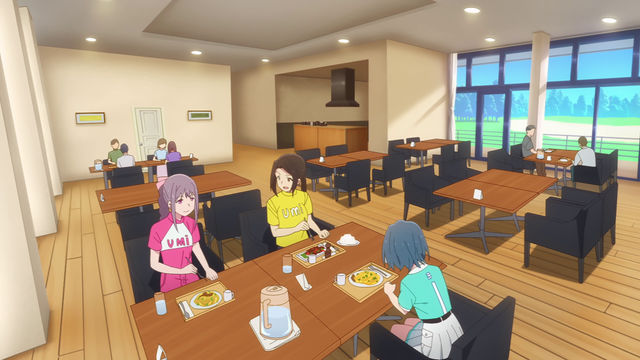
  • I subsequently headed over to the Cultural Centre for my event, and in fact, I’m waiting for the videos to finish encoding into a portable container. Back in Sorairo Utility, when it comes to Haruka, Megumi’s noticed that there’s something different about the way that she’s playing. Megumi describes Haruka’s old style as being powerful, as though Haruka plays with nothing held back and tends to let loose on her shots, but today, Haruka’s playing with more precision. Although Sorairo Utility doesn’t delve into this further, it’s straightforward to work out that Haruka’s a little confused: Megumi enjoyed watching Haruka’s older style, but she’s also complimenting on how Haruka’s grown as a golfer now that she’s making more measured shots geared at precision rather than raw distance.
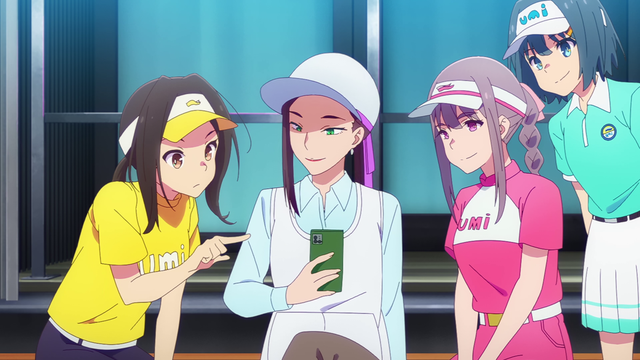
  • As such, I didn’t really see this as a sign that Haruka’s losing touch with golf or is worried about anything from her past. Rather, Haruka isn’t sure if Megumi likes her current style or old style better, and from a storytelling perspective, this makes sense – like most activities, golf is most meaningful when one is able to take feedback from others and develop a style that works best for them. Haruka comes to understand this, and when a hole allows for it, Haruka decides do something bold. When her shot lands close, Minami is suddenly filled with a desire to emulate her. This moment is why I felt that nothing was off about Haruka per se; Haruka is well aware that Minami looks up to her, so she’d been playing a more conservative game so Minami would focus on the basics.
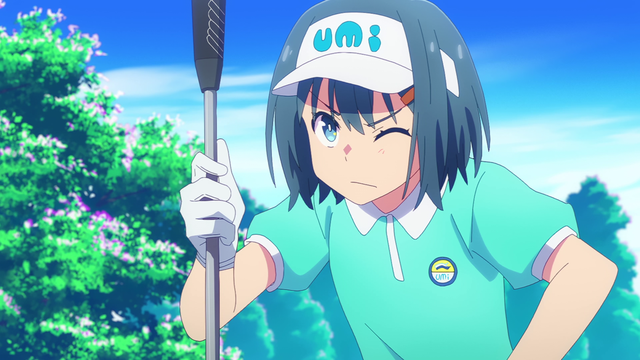
  • For her part, Minami’s day has been progressing smoothly: most of her shots are getting closer to where she intends them to land, and even when she accidentally loses a ball in a water hazard, the frog that had terrified Ayaka earlier helpfully punts the ball back to Minami. For her part, Minami begins to become more comfortable on the golf course, and with advice from Megumi, her game appears to improve. Instead, it’s other hazards on the course that give her trouble on this day – after spotting some crows nesting on the clubs, Minami becomes distracted and makes to chase them off, only to become the victim instead.
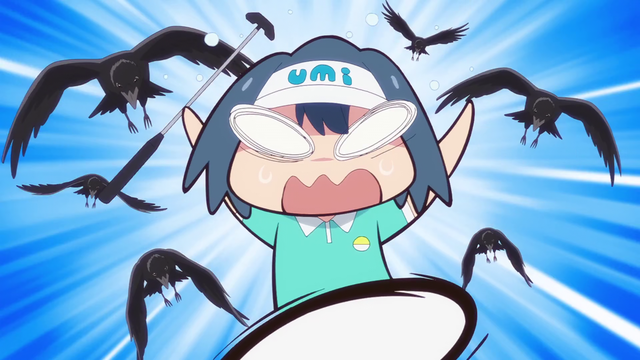
  • The minor mishaps that befall Minami are totally adorable – one cannot help but feel an overwhelming feeling of fuzziness, akin to hugging a large stuffed animal, when seeing things like this happen to Minami. It ultimately takes Megumi using her crane stance technique to drive the crows off. At first glance, this would be purely comedic, but again, there’s more to Sorairo Utility than humour; having Megumi know Wu Xing Quan (五形拳, Five Shapes Fists) indicates that caddies are multidisciplinary and skilled in a variety of things to ensure they do their job successfully.
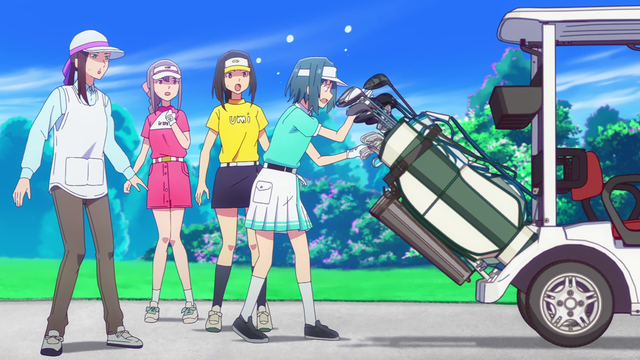
  • When Megumi put the petal to the metal earlier, Minami’s penguin club cover fell off. After the crows attack, Minami notices her cover’s gone and is heartbroken. What happens next is not shown, but based on dialogue after the fact, even with the loss of the cover on her mind, Minami must’ve at least had a fair game – the next day, Minami wonders why her seeming improvement at the course has vanished, and Sorairo Utility doesn’t go out of its way to show Minami’s game falling apart. It therefore stands to reason that, likely because of Megumi, Haruka and Ayaka, Minami is able to focus on her game, only returning her thoughts to her missing club cover after the day’s done.
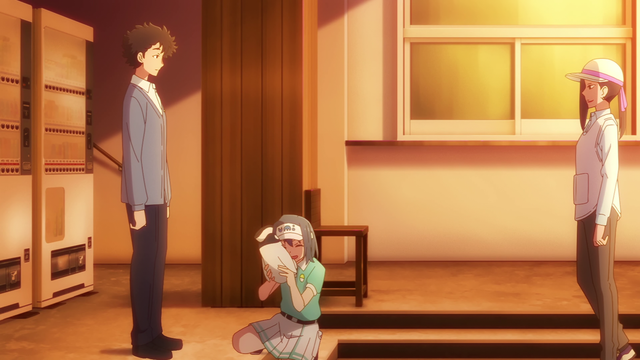
  • At the end of the day, things take a fortuitous turn when Minami is able to reunite with her penguin-shaped club cover. The staff note that it was actually some crows that brought it back, and while Minami had a rough time with the wildlife at the golf course, she’s grateful all the same. While this was likely done for humour, it’s not implausible for such things to happen: crows have remarkable cognition and studies found they’ve got enough long term memory to hold grudges. Their intellect and memory is why traditionally, crows have been regarded as tricksters, but here in Sorairo Utility, they end up giving Minami one more thing to smile about as her latest golf game draws to an end.
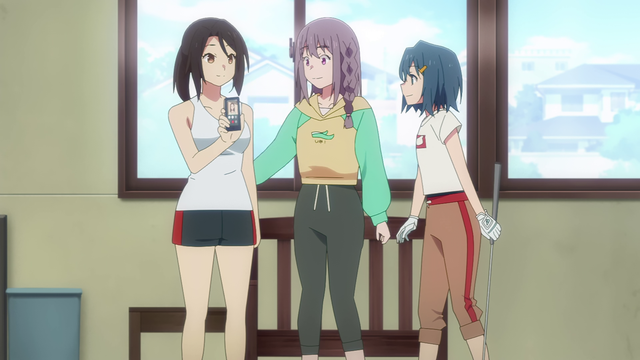
  • Later, Megumi contacts the girls and suggests they play again together: even Megumi’s young son is beginning to pick up golf. However, before this happens, Ayaka unexpectedly stops showing up at the driving range, and her social media’s gone dark, resulting in no shortage of concern from Haruka and Minami. Because of Sorairo Utility‘s nature and aims, Ayaka was never really in any trouble, and instead, she had been trying to take on a difficult social media challenge to boost her engagement and reach: complete a challenging game in full before taking her next meal. The gentle tone of Sorairo Utility belies the danger behind the things that can occur with social media challenges, which have had some very unfortunate and even deadly consequences in real life.
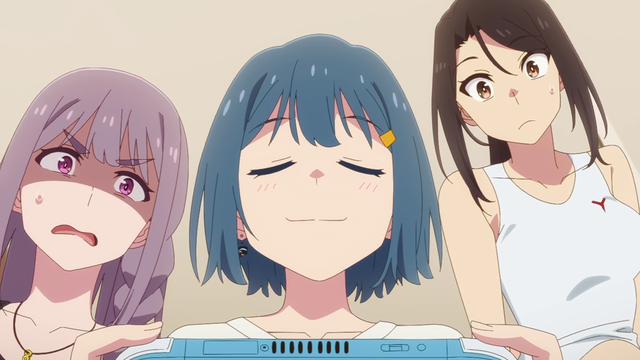
  • Minami’s prowess with games allows her to trivially complete the game, and in the aftermath, the girls get some food so Ayaka can have some sustenance. At the three quarters mark, Sorairo Utility reveals that Ayaka initially didn’t feel like she had anything going for her and, inspired by Haruka, would pick up golf as a way of emulating the energy and confidence Haruka exuded. However, whereas Haruka plays golf for the sake of golfing, Ayaka was more engaged by the prospect of reaching people and sharing with the world her journey as she sought to improve. Discussions on Sorairo Utility are extremely scant, and it took me considerable effort to find anyone else talking about it, but another blogger out there suggested that Ayaka’s goal was to reach or surpass Haruka in raw skill.
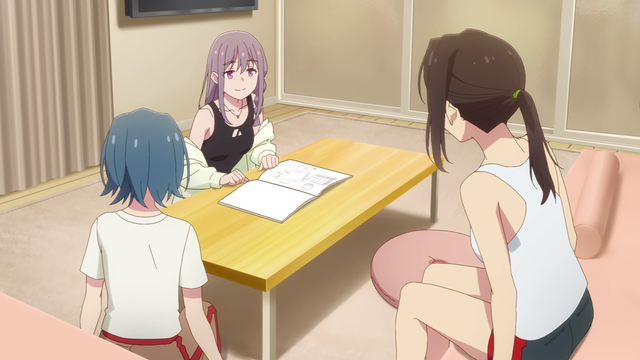
  • I never got the sense that this was the case – there isn’t a competitiveness between Ayaka and Haruka, as the latter seemed genuinely excited when Ayaka began improving. Instead, Ayaka’s focus on social media evidently comes from her feeling that while she likes golf, she doesn’t love it as Haruka does. I understand the desire to be so passionate about something that it becomes one’s identity, but this isn’t something that can be attained through emulating others. This is what Ayaka discovers as Minami and Haruka help her with her social media activities: Ayaka tries unboxing and reviewing a play-set for children, samples tea and attempts to gain spiritual enlightenment using an urbanised variant of takigyo (the waterfall ritual) with support from director Minami.
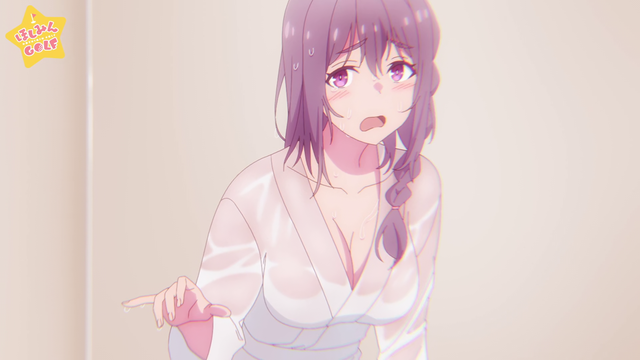
  • However, while these videos do end up having some impact (especially when Minami unintentionally frames her shots that accentuates Ayaka’s allure), they’re not the sort of thing that Ayaka’s looking for – granted, her numbers are improving, but her videos lack the impact she seeks. Conversation with Haruka and Minami leads Ayaka to land on something that’s more authentic, she decides to design custom shirts and discuss the importance of good golf etiquette. This was a capital idea: all too often, streamers and influencers use sex appeal to try and grow their viewership, and while effective in bringing in the raw numbers, such approaches invariably fail because viewers will not linger if this is all a creator does. An ethical influencer looking for success must focus on the content they’re passionate and knowledgable about: this weeds out the more degenerate viewers and engages people who are present for the creator’s content, rather than a parasocial relationship.
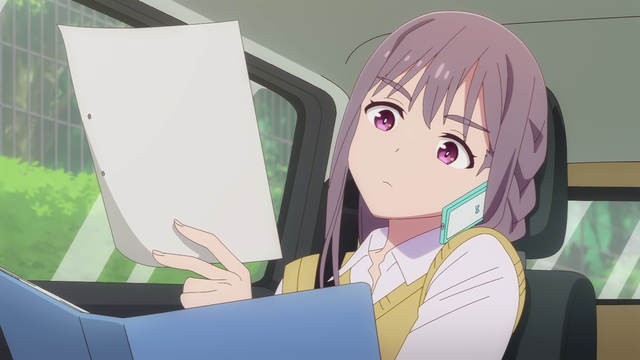
 

  • This approach takes much more work than wearing a low-cut outfit and doing “let’s chats”, but it’s also more sustainable because it allows one to connect with people who genuinely like the topic and content. In showing this aspect of what an influencer entails, Sorairo Utility offers an unexpectedly meaningful perspective on what makes a good influencer. In the present, being an influencer a fledgling occupation whose legitimacy is still widely debated – at one end of the spectrum, people suggest that an influencer is creating content and promoting things, except instead being with an agency, they’re also marketing their own personality and brand as a product. However, others hold that influencers that endorse overconsumption or promotes shallow, unhealthy values aren’t meritorious of their material or financial success.
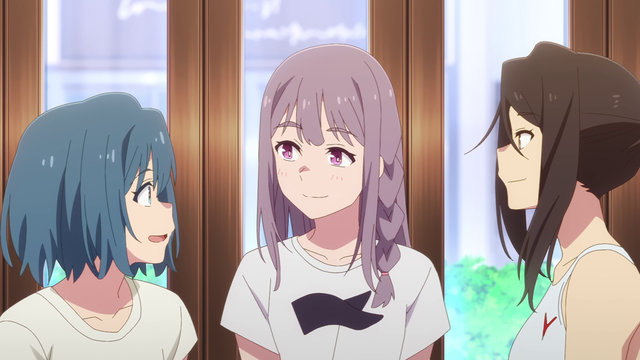
  • I agree with both arguments to an extent; being an amateur videographer and blogger, I understand it takes skill to produce content (if I were any good at either, I’d be a video editor or writer full time instead of being a mobile developer), but at the same time, I also hold that someone who posts faux-inspirational posts about getting up at 4 AM to deadlift 200 pounds (a milestone that I have, incidentally, passed for squat), and then rushes off to the beach for the sunrise so they can be inspired to work on their book, isn’t deserving of a larger income than someone in more traditional, useful occupations. Sorairo Utility thus acts as an excellent case study of what a respectable influencer, one deserving of success, looks like: it takes real work and sincere passion about a topic beyond oneself, and it’s also a group effort: Ayaka ends up burning the midnight oil to get her designs finished, and the final product looks excellent.
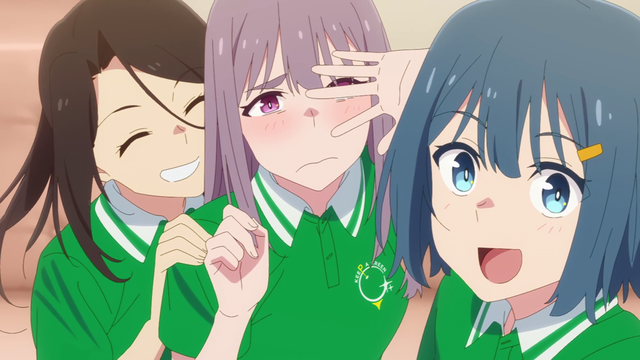
  • However, as a result of sheer exhaustion, Ayaka unintentionally orders three hundred shirts instead of three. Mortified by her mistake, Ayaka reverts to holing up in her apartment, and it takes Minami and Haruka to extricate her. Although a light-hearted joke to parallel how the episode began, Sorairo Utility also uses this moment to show how some mistakes can cause people to withdraw, and more importantly, how having good people in one’s corner can help to lift one back up. Moreover, with a bit of forward thinking from Minami, who’s taken everything in stride, the girls decide they can sell these T-shirts to fans of Ayaka’s channel. Hilariously enough, while Minami’s an excellent producer who does remarkable work behind the scenes, her own ability to be on camera is limited, once more showing how it takes a certain mindset and ability to work in front of a camera.
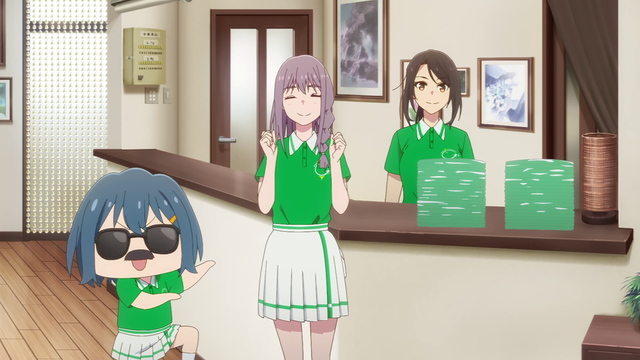
  • Although I’m not a golfer myself, I’m a very big fan of polo-style shirts: these shirts are very versatile and look pair with a variety of bottoms, from denims to slacks, and can be worn both tucked in with a belt, or untucked for a more casual look. Because of this, most of my summer wardrobe consists of polos, with a number of button-up short sleeves. If Sorairo Utility‘s team were to make the shirt HAM produces a reality, I wouldn’t object to buying one, myself: the bright green would actually work great with both light chinos and dark jeans. One subtle touch I liked was how Minami’s producer alter-ego is surprisingly confident and competent on-camera: while her initial video presence was weaker (but still adorable), it seems when Minami’s allowed to get in the moment, she’s very smooth and here, she introduces viewers to Ayaka for their latest video.
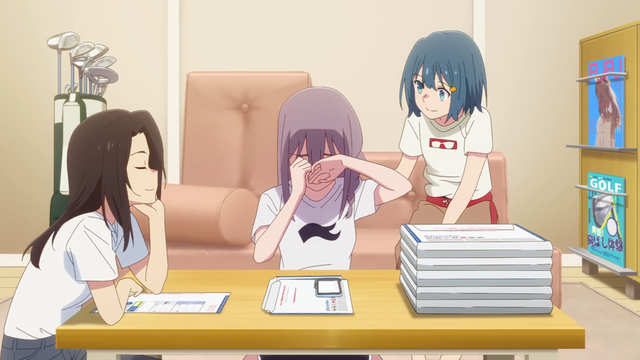
  • By turning a potential disaster into an opportunity, Minami and Haruka help Ayaka to sell a large number of the t-shirts, and while looking her latest posts and the overwhelmingly positive reaction, Ayaka breaks out into tears. This moment convinces Ayaka that there is worth in what she’s doing – rather than chasing after the ideal Haruka’s working towards, Ayaka now knows that there are things she can do, as well. Looking through one of the comments left on Ayaka’s Instagram, “This is so you, Hoshimin”, speaks volumes to this; Ayaka wasn’t trying to surpass Haruka in golf, but rather, she wanted something she could be as passionate about as Haruka was about golf. When Ayaka thanks Minami for helping out, Minami’s reply that this is part of golf, speaks volumes to her own growth. Slice-of-life anime, and stories focused around cute-girls-doing-difficult-things, might not outwardly appear complex or difficult, but over the years, I’ve found that they speak of messages that are often taken for granted.
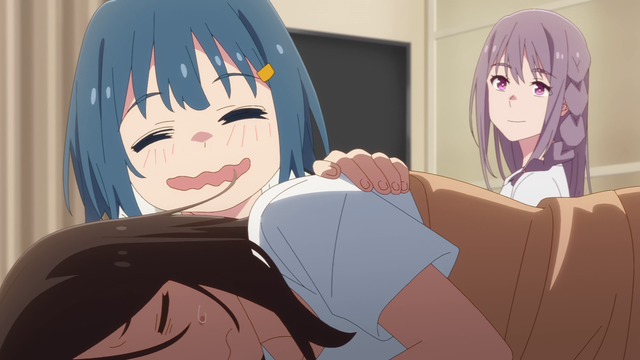
  • As such, while I appear to be pointing out the obvious for readers, my aim in posts like these is to try and gain a measure of what the work’s creator is trying to say, rather than what I make of things. Comparing and contrasting what a work says, against what I know or believe, creates the best discussions, and in my case, while there is a considerable gap between golf and photography, I do understand the feeling of progress Minami experiences as she becomes increasingly familiar with golf, and furthermore there are some commonalities – a few nights ago, I woke up at 0300 to try my hand at aurora photography when the KP reached a 4.67. After driving out to my spot from last year and taking a shot to warm up, I wound up driving further west in search of a spot I had hoped to find during October’s G4 geomagnetic storm. I was successful, and it became apparent that this would be an ideal place to go for auroras – there’s a Nodding Donkey pumpjack here that acts as an excellent foreground subject, and the lack of obstructions to the north means any aurora would be very visible. Knowing this, I now have a readily-accessible spot for auroras that I’m comfortable shooting at – like golf, photography is all about positioning and choosing the right setup for the task, and choosing the right lens isn’t any different than picking the right kind of club.

Nine episodes in, what makes Sorairo Utility standout is how the series is able to leverage the dynamics between Minami, Haruka and Ayaka to create scenarios that drive individual growth for everyone. Although Sorairo Utility opened as Minami’s story of how she would come to take charge of her life and learn something new, it turns out that along the way, having a newbie to mentor also helps Haruka and Ayaka to mature. Haruka is a seasoned golfer whose modus operandi is to go all out and push the limits of golf, but as she guides Minami through the basics, she ends up finding reason to reflect on her own play style, as well. Similarly, while Ayaka is a moderately successful influencer and enjoys golf, even she encounters moments where she loses her motivation, and Minami ends up surprising her by helping to lift her out of a slump. For her part, Minami becomes more outgoing and more willing to fail if it means learning something new. It’s evident that each of Minami, Haruka and Ayaka help one another out, and while each of the girls have completely different reasons for golfing, they find themselves unified by a common enjoyment of both the sport and one another’s company. It is clear that, while Sorairo Utility might be centred around golf, the largest take-away is that irrespective of the things that one chooses to do, being able to partake in an activity along others is an opportunity to both learn and teach, to support and be supported. The fact that a large number of cute-girls-doing-difficult-things anime willfully depict this message indicates that to creators, this is something that’s important to them. In the case of Sorairo Utility, it becomes clear that for Kengo Saitō, who’d longed to make his own golf-related anime, what makes golf fun for him is the fact that it’s able to let one to experience a veritable smörgåsbord of things with other people. I would imagine that for Saitō, Sorairo Utility is the realisation of a professional and personal goal, and going from how Sorairo Utility has turned out, it is evident that Saitō’s intentions were successfully communicated through this project. As we enter Sorairo Utility‘s final quarter, it will be intriguing to see what lies ahead for Minami: while her goals aren’t to take a national-level title or fulfil any sort of childhood promise, she’s nonetheless made enough strides in golf to begin living life more fully, and watching her playing golf with a more relaxed mind and improved technique in a tournament will be a suitable way of showing viewers her growth.

Sorairo Utility – Review and Reflections At The Halfway Point

“The most important shot in golf is the next one.” –Ben Hogan

When Ayaka and Haruka take Minami to a golf store, Minami finds herself falling in love with a utility iron after giving it a test drive. The manager informs Minami that there’s a flash sale on that particular club for 20 percent off, but Minami feels the price is a little high for her. After contemplating the decision, she decides to spring for it, only to learn the sale’s ended. However, seeing Minami’s spirit, the manager decides to a little competition: if Minami and her friends can beat him and his staff, he’ll agree to sell her the club at the discounted price. Although the manager and his staff have access to high-end gear, they’ve not practised in some time, and this allows Minami, Haruka and Ayaka to prevail. Admitting defeat, the manager agrees to sell Minami the utility iron. Minami is excited to put this new iron to use and, after finishing her exams, heads over to the driving range. However, she’s disappointed to learn that she’s not made any progress despite having acquired new gear. To help her out, Haruka and Ayaka provide some special training, which devolves into a sauna showdown as the pair compete to impress Minami. Later, Haruka and Ayaka invite Minami to go golfing with them at a larger range, and while Minami oversleeps, she barely manages to make it. When the game starts, Minami finds herself completely disoriented, but after a few holes, she finds herself hitting her stride, and after lunch, Minami feels a lot more confident about her game. By the end of the day, Minami’s so enthused that Haruka needs to drag her from the course to the onsen, and here, Ayaka explains that golf is an incremental journey: if she’s doing better now than she previously did, she’s making good progress. After struggling to decide whether or not she should go back to the driving range or join the others for some high-end cake, Minami relents and agrees to partake in some cake. Here at Sorairo Utility‘s halfway point, Minami’s journey into golf has taken a comfortingly familiar route, of slow and steady progress accompanied by ancillary experiences which, while not outwardly related to golf, also act as a reminder of how the act of picking up a new activity can broaden one’s horizons in hitherto unexpected ways, and despite her eagerness to get better so that she can become the hero of her own story, Minami is finding herself having fun in the moment with her friends: as Haruka openly states, the whole point of their golf outing was so Minami could play the game and experience its highs and lows with a smile on her face.

Minami’s entry into golf and acquisition of a starter set of clubs hasn’t stopped Sorairo Utility from exploring the topic of gear, training techniques and the importance of gaining practical experience over theory. In almost any hobby or activity, one necessarily needs to invest in some gear in order to make the most of things, and in golf, a good set of clubs and comfortable outfit are essentials. Sorairo Utility‘s portrayal of how Minami acquires her new utility iron, and its impact (or lack thereof) on her game acts as a meaningful reminder of how gear alone does not change one’s experience in an activity, and for the viewer’s benefit, Sorairo Utility shows this to viewers on three different occasions. At the golf store, the manager and his two staff find themselves losing despite confidence in their top-of-the-line clubs and prior training (one of the staff has forearms so shredded that even Haruka is intimidated). They concede that while they might have all of the best gear available, they’ve also not played in a while and have allowed their technique to become sloppy. Similarly, after Minami manages to buy her club and has a chance to play, she notices no appreciable improvement in her drive distance or during an actual match. While it is true that higher end gear can improve performance, how one does in any given activity, whether it be golf or photography, comes down to one’s understanding of the technique, and further to this, what one needs to improve is very much dependent on the individual. Haruka found her game improved when she started training her lower body, and Ayaka believes that flexibility and peace of mind is more important. Both Haruka and Ayaka are correct, but only Minami will know what works best for herself. As such, rather than having Minami train towards an arbitrary metric, Sorairo Utility takes her to another golf course so she can get some practical experience in seeing what she knows and what she needs to improve on. Touching upon all these topics makes Sorairo Utility a very convincing and practical series about entering a new activity, and there are numerous parallels between Minami’s golfing and my own journey with photography; from accepting advice veterans provide, to navigating the world of gear acquisition and getting my hands dirty by getting out there, everything Minami has experienced insofar in Sorairo Utility acts as a plausible part of her journey.

Screenshots and Commentary

  • Minami’s reaction to entering a golf specialty shop was my own when I swung by the local camera store for the first time a year earlier: there’s a store in the Beltline that sells everything one needs, and while my camera body came from BestBuy, everything I’ve bought since all come from the same store because their staff also offer excellent advice on top of their products, and being a novice, I appreciate having the extra help. This was how I came upon my 20mm f/1.8 lens last year – I had gone in looking for a microphone, but a chance sale on the lens led me to pull the trigger, and the staff were helpful in explaining both the microphone and lens I would come to buy.

  • Watching Haruka nerd out about clubs and their properties was completely relatable – although I certainly can’t tell the difference between clubs beyond drivers, putters and irons, hearing Haruka’s enthusiasm for the different clubs attests to her love of the sport. Hearing photographers talking about their preferred focal lengths and exposure settings evokes a similar feeling in me, and while talk of aperture and lens types were foreign to me a year earlier, I’ve since grown accustomed to all of the terminology, both in Cantonese and English.

  • Haruka gets a taste of her own medicine when Ayaka starts gushing about the latest golf wear. The gap in their interests suggests that Haruka plays golf in pursuit of technical excellence, while Ayaka wants to play a comfortable game. Sorairo Utility emphasises there isn’t a right or wrong way to play so long as one is improving and having a good time of it, and the disparity on what part of golf excites Haruka and Ayaka, respectively, was a pleasant reminder of this message. While Haruka and Ayaka look at clubs and apparel, Minami’s found a club that catches her eye.

  • After a test stroke, Minami’s fallen in love with the utility club and feels it’s her Excalibur. To familiarise myself with things, I took a quick look, and utility clubs tend to be best suited for hitting low shots at higher velocities. They impart flat trajectories that make them better suited for hard-surface courses or windy conditions. On the other hand, the other kind of club replacing the traditional iron is a hybrid, which are described as being beginner-friendly because their heads are more forgiving of hits that aren’t centred. By having Minami fall in love with a utility, Sorairo Utility hints at how Minami is commuting herself to golf for the long term: guides indicate beginners benefit most from hybrid clubs, equivalent to recommending APS-C cameras for first-time users because they tend to be lighter and more affordable.

  • At the onset, however, the price tag puts Minami off. Thirty thousand yen is no small sum, especially for a student in secondary school, and Minami agonises over whether or not she should pick the club up. In the end, her desire for the club outweighs the sticker shock. Photography presents people with the same challenge, and gear acquisition syndrome (an informal term referring to the persistent state of always wanting to buy more gear) is a very real concern: even though lenses and camera accessories are quite expensive, amateur photographers may justify their purchase by arguing that new gear will improve their shots. Professionals and veterans will know that good technique outweighs gear when it comes to performance, and a good photographer will be able to make a kit lens work well.

  • This is the main lesson that comes after Minami and the golf store manager make a wager – if Minami, Haruka and Ayaka can outperform the staff in a friendly competition, then the manager will be happy to sell Minami the utility club at sale price. The staff are supremely confident in their high-end gear and prior experience, but Ayaka and Haruka quickly make short work of the competition by counting on better technique. The man going up against Haruka has impressive forearms, but his swings are wild, causing the ball to fly too far to the left or right, going out of bounds in the process. On the other hand, by taking measured strokes, Haruka is able to land her shots dead centre.

  • Similarly, Ayaka also bests her opponent by keeping things simple. Determined to have her discount, Minami puts all of her heart into rooting for Ayaka, taking on the form of an adorable chibi in the process. Eventually, the manager steps up to take on Minami, and realising he might lose, he decides to break out a two million yen putter. Even with this, Minami and the manager end up drawing on several missed putts. Equivalent to 18866.77 CAD at the time of writing, this putter is a shade pricier than the 16899.99 CAD Sony FE 600 mm f/4 GM lens, a super-telephoto lens with a comparatively fast aperture relative to its focal length. Even with this putter, the manager ends up missing his last shot.

  • Having now warmed up, Minami ends up taking her shot and sinks the putt, winning the competition and her discount rate. This moment’s intention was clear enough; while the anime necessarily required Minami to win so that it could convey the idea that gear does not supersede skill, it also gives Minami an iron-clad incentive to buy the utility club she’d desired and highlight the joy of picking something new up.

  • Accompanying Minami’s utility club is a penguin club cover. In the promotional artwork and videos for Sorairo Utility, penguins are prominently featured, and I’d always wondered about their significance; Nishitokyo is far removed from the likes of The Aquatope on White Sand and doesn’t deal with aquatic birds, so penguins certainly wouldn’t relate to Sorairo Utility in a literal sense. However, because they symbolise adaptability and positive change owing to their ability to excel in both water and dry land, the penguin does become an applicable symbol for who Minami is: being new to golf leaves her a tabula rasa, a blank slate waiting to make her own way in the sport.

  • This ends up being the main message in the fifth episode, where after exams conclude, Minami ends up undergoing special training from both Haruka and Ayaka. Both modes of training mirror how differently the pair approach golf. Here, Minami is a little disheartened that her stroke distance hasn’t improved since buying her new club: it’s a subtle callback to how gear doesn’t necessarily transform a freshmen into a prodigy landing shots with unerring accuracy. Knowing how to use one’s gear in the right scenario is important, and I am reminded here of how, upon trying my A7 III and its kit lens for the first time, I immediately felt a little disappointed by how the wide end didn’t feel wide enough because I was so accustomed to shooting on an iPhone. At present, I’m still looking around for a good replacement for my kit lens, the Sony 28-70mm f/3.5-f/5.6 OSS.

  • Although technically an acceptable lens and very nearly my ideal “all-in-one” lens, I keep finding that the lack of width causes me to leave it behind in favour of wider lenses. Back in Sorairo Utility, before Minami can mope around too much about her golf performance, she’s got exams to deal with. Despite resembling the carefree gyaru in appearance, Izumi is quite sensible and worries that Minami might flub her exams if she’s so distracted. In the end, Minami manages to find the motivation to study, especially after Ayaka and Haruka dangle a carrot in front of her (in the form of a golf game at a new course) and because the results aren’t mentioned again, it stands to reason that Minami must’ve performed in a satisfactory manner.

  • This leaves Sorairo Utility free to focus on Minami’s golf game and supporting experiences: upon returning to the driving range, Minami is in a state of elation at finally being able to play golf. However, she’s surprised to learn that Haruka and Ayaka have something special planned, and worries that there won’t be enough time to practise. Haruka has something special planned in mind, and this “something special” turns out to be leg day. Haruka holds that good lower body and core strength is essential to increase driving range, so she’s planned out a workout for Minami.

  • After Minami feels up Haruka and realises that this mode of training might have its merits (reducing Haruka to a trembling mess in the process), she agrees to give things a go. Sorairo Utility only shows Minami using a seated leg press machine – I used to use these machines back when I was a university student, but I generally prefer back squats nowadays as my main exercise (and add seated leg press to leg day as a cooldown depending on the day). Leg press machines are, however, much safer for beginners compared to squats, and some machines will allow users to safely abort a rep if they can’t complete it.

  • Because of variations in seated leg press machines, I find that the resistance isn’t representative of how much one can press: at my university, for instance, I did 400 pounds as a warm-up simply because that’s what it took for the machine to offer reasonable resistance. Even someone like Minami is able to press what appears to be 200 pounds, and after learning this was only warm-up, I found myself curious to see what Haruka’s leg days entail, as well as what her squat is: Sorairo Utility appears very fond of accentuating her figure relative to the other characters, and Haruka is plainly more robust compared to Minami and Ayaka.

  • Minami ends up getting destroyed by the warm-ups, and despite feeling the satisfaction of a good leg day almost immediately, Ayaka ends up pulling her away from strength training in flavour of mindfulness through tea and yoga. While I acknowledge that it’s important to work on flexibility and inner peace, I’m more comfortable with Haruka’s mode of training simply because I’m not especially flexible and have been doing weight training for much longer. Although I’m now old enough that I can’t do a progressive overload weekly like I used to, there is merit in continuing with a consistent routine: rather than just focusing on gains as I did a decade earlier, healthy weight training entails increasing time under tension by doing what’s called a slow negative.

  • Prior to starting Ayaka’s routine, Minami’s curiosity also gets the better of her, and she feels up Ayaka’s core, as well. I’d expect that Ayaka’s figure would probably be described best as “cut” in contemporary slang: she’s still lean, but is in good shape. On the other hand, Haruka would be “jacked” since she’s noticeably thicker than the others. In response to Ayaka’s routine, Minami finds it effective and enjoyable in its own right – she’s surprisingly flexible and is able to hold the yoga poses without too much issue. While weight training destroys Minami, she’s much more at home with stretches. At first glance, I would’ve expected Minami to say she favours Ayaka’s training, but Minami struggles to pick which one she enjoys more.

  • This indecision eventually causes Ayaka and Haruka to square off in a sauna contest, leaving Minami with yet another funny-face moment. Although Haruka and Ayaka are ostensibly competing over whose approach is better, the fact that Sorairo Utility had previously noted that there’s not a right way to play golf almost gave the sense that the pair were competing for Minami herself. However, it is a stretch to say that there is any sort of yuri here in Sorairo Utility, and the affection Haruka and Ayaka have for their junior purely comes from being able to spend time with someone who’s willing to learn and grow, as well as possessing adorable mannerisms that make their own golf experiences all the more colourful.

  • In the end, Minami indicates that she appreciated both styles of training, and with this, she feels confident about getting some good drives off at the range. Upon returning, Minami is able to line up a particularly good shot to round out the day, and while one could attribute this to her ancillary training, I think that one additional factor is in play; since Minami had been worried about her drive, being able to take her mind off things by doing something else would also let her to relax. Of course, because this is a slice-of-life anime, Minami ends up adding new stress when she oversleeps and is forced to get ready in haste for her golf game with Haruka and Ayaka, undoing all of the confidence and relaxation she’d gained the previous day.

  • Besides Hina Tsurugi and Aoi Yukimura, Minami also bears traits from Locodol‘s Nanako Usami and Kantai Collection‘s Fubuki. Here, Minami worries after one of the golf course’s staff take her gear inside – Haruka and Ayaka’s response is reminiscent of how one might respond while watching a small animal struggling with something. They’ve evidently been to this particular course before, and therefore, are familiar with the ins and outs, leaving the pair in a position to walk Minami through all of the nuances. This provides viewers with the reassurance that no matter what happens, Minami’s in good hands, and this leaves one free to really enjoy things.

  • Minami’s latest golf game is set under a perfect day with clear blue skies. The weather in Sorairo Utility makes it especially suited as a winter anime: up here in Alberta, the winter chill is finally upon us, and in the past week, the temperatures have averaged -20ºC as Arctic air settled over the prairies, and while we’ve had a few days of respite, the weather swiftly returned to the -20ºC mark. Being able to immerse myself in another story for twenty minutes is a pleasant way to help the winter pass quicker: despite growing up in a place where it’s winter for up to eight months of the year, I’ve never been a fan of the snow and cold.

  • Although Minami had been most enthusiastic to start, to the point where Ayaka and Haruka consider roping her up so she doesn’t wade into the water hazard, once the round begins, Minami finds her ability to shoot straight has all but evaporated. As Minami’s doubt rises, it creates a positive feedback loop that worsens her game. However, Haruka stops Minami and reminds her that the aim of this game was not to do well, but rather, to just enjoy the experience. It takes a bit for this point to reach Minami, but once Minami learns to relax and have a good game, her performance tangibly improves.

  • Until that point, viewers are treated to more adorable funny-faces from Minami. While suffering setbacks can be tough on one’s confidence, having Ayaka and Haruka around meant there was never any point where Minami would be demoralised to the point where she’d consider quitting. The laid-back aesthetic in Sorairo Utility is to its advantage, and here, I remark that in reality, people do quit an activity if they’re feeling like they’re underperforming, arguing that if they’re not getting results, there’s no fulfilment. Mature individuals are aware that there’s merit in an activity even if one isn’t skillful in it at the onset, and will hold that a part of the enjoyment and fulfilment comes precisely from seeing how far one can go.

  • As a parallel, when I started shooting with a full frame camera, I was getting blurry, out-of-focus and poorly-exposed photos because I wasn’t familiar with the basics. However, once I became competent with aperture, shutter speed and ISO, I found that I was consistently taking better photos than I could on an iPhone. It takes time to learn and improve in anything worth doing, and while in my case, I am a decently self-directed learner, having others to provide guidance accelerated my interest in photography. In Sorairo Utility, Minami’s journey will doubtlessly follow a similar path: having two reliable and friendly seniors means that even during moments of frustration resulting in Minami’s funny-faces, she has incentive to continue playing.

  • Driving this point home, even though Minami’s confidence has taken a beatdown by midday, Haruka and Ayaka handily step in to help lift Minami’s spirits with a good lunch, and although Minami’s initially too dejected to eat, seeing the menu changes her mood completely. A good meal is always an effective pick-me-up, and there’s good reason behind why: certain foods can quickly raise blood sugar levels and give one a boost in energy, and the act of sitting down for a meal also slows one down and allows them to regroup. Haruka certainly agrees, while Ayaka believes in eating smaller meals throughout a day for better digestion.

  • Like Ayaka, I’ve got a fondness for food photography, but rather than taking them for Instagram or similar, having a photo of a meal lets me recall memories more readily later down the line. For instance, I stopped by the shopping centre downtown after helping teach a karate class and ended up going for lunch at the Bourbon Street Grill: I’m very fond of their namesake chicken, which is grilled and marinated with a sweet sauce. Besides their bourbon chicken, I also went for their blackened fish and mixed vegetables on a bed of vermicelli to round things out. The remainder of the weekend passed in a relaxing, quiet manner, and this was welcome: while the main Chinese New Year festivities are over, there are a handful of photography events in the upcoming week, so it was nice to be able to take a few easy days before things ramp up again.

  • Following Sorairo Utility‘s OVA, the unit performing the vocal pieces were announced as HAM, formed from the first letter of everyone’s names. I imagine that in 2021, the voice actresses for Haruka, Ayaka and Minami probably weren’t expecting to reunite for a full-length production; it would be great to get something like a director’s commentary or cast interview that gives us insight into the staff’s sentiments. An official TV animation guidebook would be a great purchase, and here, I admit that seeing Haruka in her activewear from a range of poses and angle would be worth the price of admissions. Here, to help Minami find her ball, Ayaka suggests writing HAM onto the ball, which gives Minami a burst of confidence when the ball coincidentally returns to the fairway after some bad bounces.

  • Although Minami had some trouble navigating the water hazard and imagined her ball to be the T-800 from Terminator 2, right down to the thumbs-up gesture when she sinks one, by the time she reaches the sand traps, Minami confidently extricates herself from this position and really begins to have fun. I was a shade nervous when Minami’s shot lands in a sand trap, since other series (like The Raccoons) portray sand traps as being nontrivial obstacles that give even experienced players trouble. Thus, when Minami expends one extra shot to get her game back on track, it becomes clear that Minami’s mindset has changed; by the time the course is completed, Minami’s so pleased with the day that she wants to play a few more holes, forgetting that the course is due to close.

  • Haruka ultimately drags Minami away to the next item in their day, a relaxing soak in the onsen. The contrast between Minami after the course, and before, is striking – such a response is fitting for someone who’s discovered the joys of something and has become committed. The visual presentation in Sorairo Utility is such that Minami takes on the demeanour of a small animal. Fluffy, heart-warming moments are commonplace in Sorairo Utility, and for my part, I adore series with this aesthetic because cute characters and a bit of comedy gives a series balance: cute-girls-doing-cute-things stories are often written to impart a moral on viewers, but the addition of comedy and moments of tenderness prevents a work from being sanctimonious.

  • For instance, Sorairo Utility has Ayaka comment that what makes golf (and any other hobby) worthwhile is the fact that one is always constantly improving, even if the changes can feel imperceptible. Golf is a great metaphor for this; Ayaka likens it to how with every stroke one takes, they get a little closer to the hole, and so, even if one has a rough start, they’re still moving forwards in a steady fashion. This philosophy is uncomplicated and relatable, perfectly capturing the central merit of a hobby. Growth is incremental, and its value becomes visible when one looks back after committing to something. In reminding viewers of this, Sorairo Utility speaks to a virtue that is becoming increasingly forgotten as people pursue instant gratification over delayed gratification.

  • After agreeing with Ayaka and Haruka’s plan to grab some cake after their golf game, Minami’s day draws to a close. Here at Sorairo Utility‘s halfway point, the story has progressed in a gentle and consistent manner, and having now played two full games, the groundwork is set for Minami to go further. There is a possibility that Minami could encounter a wall that has her considering quitting, as is the norm for stories like these, but based on the messages presented so far, Sorairo Utility‘s outcomes and direction are clear. While some might view this as a detriment to the series, having a straightforward story with clear aims is welcome, especially when there’s already enough uncertainty in reality.

Aside from a lifelike portrayal of entering a new hobby and the attendant excitement this brings, Sorairo Utility‘s charm extends to Minami’s personality, as well. Halfway into the series, Sorairo Utility casts Minami as being a character of contrasts: a humble novice with a thirst to learn, but also having a few moments where she can become confident or even boastful, Minami resembles Yama no Susume‘s Aoi Yukimura and Hokago Teibou Nishi‘s Hina Tsurugi in manner. Minami, Aoi and Hina all become squeaky puddles in response to adversity, but each of them also possesses the tenacity and willingness to learn. These combination of traits make them simultaneously adorable and relatable, giving viewers a lighthearted reason to follow their journeys – in Sorairo Utility, a large part of the draw comes from Minami making rookie mistakes that feel devastating to her, and whenever this manifests as Minami developing an exaggerated funny face reminiscent of those seen in Narenare: Cheer For You!, one cannot help but feel an adorable sense of pity for Minami. However, this feeling is never allowed to linger, and viewers are assured that either Minami’s seniors, or her own determination, will kick in shortly after and get her back on her feet. By the sixth episode, viewers are afforded with a clear picture of Minami’s character, and while her being a novice leaves her easily dejected by setbacks, her biggest strength now is that, having encountered moments that made the frustration worth it, Minami also has the drive and enthusiasm to continue playing and continue improving. Because she’s got two reliable seniors in her corner, who are willing to coach and encourage her, as well as show her how to overcome a slump, Minami’s growth in Sorairo Utility will evidently be a steady and consistent one. Having now played two full games and having found her footing, it will be worthwhile to see where Minami’s adventures in golf take her in Sorairo Utility’s second half.

Sorairo Utility – Review and Reflections After Three

“Give me golf clubs, fresh air and a beautiful partner, and you can keep the clubs and the fresh air.” –Jack Benny

Because it’s Minami’s first time on a golf course, she struggles in getting the ball to where she intends, and this causes her to spend most of the day chasing after her shots. However, Haruka reassures Minami that this is perfectly natural, and the elderly gentlemen playing the same course remind Minami that taking breaks and resting is a part of the sport, too. Towards the end of the course, Minami notices Haruka struggling to take a selfie with her phone and shows her how it’s done, impressing Haruka. When night falls, Haruka brings out glowing balls to make it easier to see where Minami’s shots land. After parting ways, Minami returns home and takes a second bath, while Haruka returns to the driving range to get a bit more practise in. Impressed with Minami’s potential, Haruka gifts her old clubs to Minami and messages a friend, indicating she’s found a new prospect to play alongside. At school, Minami collapses in shock after learning a good set of golf clubs can go for upwards of two million Yen. She quickly spots that continuing to go to the driving range will also be quite costly, and fortunately, Haruka recommends a part-time job for Minami. While working alongside Haruka at the local driving range, Minami meets Ayaka, a friend of Haruka’s who’s also a post-secondary student, golfer and part-time model. Ayaka posts a challenge to Minami: whoever can get the most drives close to a flag in the driving range will need to fulfil a favour for the other, and if Minami should win, Ayaka promises to introduce her to a part-time position with solid pay. Although Minami tries her best, Ayaka wins the competition and asks both Minami and Haruka to join her on a modelling shoot. Minami is impressed by the outfits, but feels she’s too unremarkable. Ayaka gently reminds Minami that she’ll grow into things over time, and by the end of the shoot, Minami feels a little more confident. She decides to treat the others to drinks, but is left confused when it turns out a red bean drink isn’t actually a popular beverage amongst golfers. This is Sorairo Utility after three episodes, which sees Minami play her first full round of golf and meeting new people – with technical and physical support from Haruka, Minami also now gains a new friend in Ayaka, whose modelling and Instagram presence potentially will open Minami’s world to new experiences beyond golf.

Sorairo Utility quickly establishes that even when a given story is focused around one specific activity, participation in that one activity can act as a catalyst that exposes one to a broad spectrum of new experiences. Depending on the story told, such an approach can be seen as distracting: modelling and fashion prima facie have very little to do with golf, and in a one-cour series like Sorairo Utility, any time spent on something else is time not otherwise directed at golf. However, such a storytelling device is not without merit – Sorairo Utility continues to reiterate that golf can be played in a number of ways, and during her first match, the elderly gentlemen are shown leisurely making their way through their holes, as well as taking the time to remind Minami that taking it easy and slowing down is a part of the sport, too. Similarly, when Ayaka invites Minami and Haruka to help her model some new golf apparel, she states that a good outfit also motivates her to play. While sipping a beverage under the brilliant afternoon sun and modelling outwardly feel quite far removed from golf, Sorairo Utility deliberately portrays these as a show of how engaging with one activity opens one up to numerous new experiences. Although golf is a starting point for Minami, and improving in golf will be Sorairo Utility‘s focal point, having tangential experiences allows Minami to really appreciate how her taking those first steps to try something new will reward her with more than just a leading role in her life’s story. In addition to getting better at golf, Minami will also get to see and do things that she otherwise would’ve missed out on. At the modelling studio, for instance, while contemplating her place in the world, Minami does begin thinking about getting donuts with Haruka and Ayaka. Whereas the old Minami would’ve been content to simply go home and pull her phone out, Minami now begins to develop a more inquisitive and open-minded nature, and with Ayaka present, Minami now has two excellent friends in her corner to guide her development as a golfer, as well as share in both moments of disappointment, excitement, anticipation and triumph.

Screenshots and Commentary

  • By dropping Minami right into a game of golf, Sorairo Utility achieves two things. First, this helps the series to reiterate that the only way to improve at something is to do it, and it also sets the precedence for the pacing In some slice-of-life works, like K-On! and Minami Kamakura High School Girls Cycling Club, the process of getting set up is emphasised. This is a great way to remind viewers that getting into a new activity isn’t always easy. On the flipside, getting a character acquainted with their activity right away shows that the work wants to start the character’s journey right away, and that any additional training or learning can come alongside the journey.

  • I’d previously mentioned that I have no practical experience with golf – when I was in middle school, one of my cousins took me out to one of the local courses, and he rented clubs for me. While I do remember having fun, I found that golf wasn’t quite as strenuous as martial arts, cycling, hiking or lifting weights, and as such, it was an activity I never quite got fully into. However, in North America, golf is an immensely popular sport – people who enjoy golf cite it as being a more moderate way of exercising outdoors, and the slower pace allows one to socialise. These are, incidentally, precisely the same reasons that Haruka gives as being why golf is something even Minami could do.

  • Whereas I don’t play golf myself, golf’s popularity is such that it’s a commonly-depicted sport in a variety of shows. From things like Happy Gilmore to Goldfinger, and cartoons like The Raccoons and The New Woody Woodpecker Show, golf is an activity that has presence, allowing characters to bounce off one another or otherwise, for a show to accentuate the eccentricities of golf in an amusing manner. Because I’ve got a minimal familiarity with the sport, and because Sorairo Utility deals with a beginner, I’m having no trouble following Haruka’s suggestions or what’s happening on the field for Minami.

  • Because it would be unfair to constantly dunk on Minami, Sorairo Utility also gives her a chance to shine – Haruka isn’t quite so versed with smartphones, and so, she struggles to flip her phone’s camera over to the front-facing camera. Spotting this, Minami steps in and helps out, taking her first-ever selfie with a friend. Minami’s love of mobile games means she’s very handy with a smartphone, and she has no trouble operating one. It will be interesting to see if Sorairo Utility allows Minami to retain her interest in games; many works portray characters as losing their old interests and traits as they become more invested and experienced in a new activity.

  • A story that allows characters to show how their old and new interests mesh together can show that different kinds of activities can co-exist. Hokagou Teibou Nisshi and Yama no Susume are two opposite examples: Hina and Aoi both love handicrafts, and even after learning to fish and hike, respectively, both Hina and Aoi retain their old hobbies. Hina shares her knowhow with the rest of the Breakwater Club, and the resulting plushies turn out well enough that Yūki begins to float the idea of selling them. On the other hand, Aoi still participates in making her own crafts whilst not hiking, although her friends seem less interested in picking things up from her.

  • When evening sets in, Haruka switches Minami over to luminous golf balls for improved visibility. Modern glow-in-the-dark balls are impact-activated: a sudden acceleration will cause it to light up, and LED-powered balls typically last around 14 hours. While counted as being a fun way to play golf, professional matches are unlikely to use these balls. Sorairo Utility captures their visuals perfectly, captialising on the fact that Minami’s a slower player to highlight an aspect of the sport that most wouldn’t think about.

  • Having spent most of the day chasing balls around, it’s dusk by the time Minami finishes her game, but despite this, Haruka is happy that Minami completes the course. It turns out Minami finished the course with a score of one hundred, and this corresponds with Minami taking a hundred strokes to get the balls into the holes. It was telling that Sorairo Utility did not reveal what the par score for that course was – typically, par scores give players an idea of their skill level. A positive score indicates taking more strokes than a threshold to sink a ball, and a negative score indicates taking fewer shots to achieve the same. A lower score is better, and so, by omitting a par score, Sorairo Utility subtly reminds viewers that at this point, it’s not important to know how well Minami is doing.

  • This sentiment is mirrored when Haruka decides to tell Minami that her “perfect hundred” best captures her effort. In the space of two short episodes, Minami and Haruka have become quite close. Haruka represents the cool senpai archetype, someone who’s been around the block long enough to know the ropes and act as an inspiring mentor for the protagonist. A caring senior is a welcome addition – Haruka fulfils a similar role as Yama no Susume‘s Kaede Saitō, and while Haruka is voiced by Yurina Amami rather than Yōko Hisaka, Amami manages to capture Haruka’s boisterous, outgoing manner quite well. Sorairo Utility is Amami’s first major role.

  • On the other hand, Miyu Takagi voices Minami: Takagi is a former member of Wake Up, Girls!, playing Miyu Okamoto, a cheerful older girl who sports twintails and worked as a maid. Despite leaving the WUG unit, Takagi would continue voice acting. It suddenly hits me that Sorairo Utility shares in common something very curious with 2018’s Harukana ReceiveSorairo Utility also has a tall, athletic girl named Haruka as one of the main characters. While this would not be especially remarkable on its own, a sports anime with an attractive girl named Haruka, airing one season after Sword Art Online: Gun Gale Online, represents an interesting coincidence.

  • Sorairo Utility is set in Nishitokyo: this is the name of the driving range Minami visits, and after their golf game, Haruka and Minami parting ways at Seibu-Yagisawa Station, which on a line operated by the Seibu Railway. Investigating the maps, the nearest golf course is Koganei Country Club would be the nearest, and the Hana-Koganei Stations is within walking distance. With this, it also becomes possible to work out which driving range Haruka and Minami use: it’s modelled on Hōya Golf Centre, and similarly, one can make a reasoned guess that Minami attends Hōya Senior High, which is 1.7 kilometres away from the Hōya Golf Centre.

  • Minami’s best friend, Izumi, is voiced by the legendary Yumiri Hanamori. Hanamori is famous for her role as Yuru Camp△‘s Nadeshiko Kagamihara, Yūki Yūna is a Hero‘s Gin and The Rolling Girls‘ Chiaya Misono, amongst countless others. Unlike Nadeshiko’s energetic and spirited manner, Izumi is much more reserved and pragmatic. Mirroring this, Hanamori’s voice lacks the same aural characteristics as Nadeshiko’s, speaking to her ability to voice a range of characters, and here, she seems unimpressed with Minami’s recollection of her previous day’s golf story. Because Izumi seems to also be looking for an activity of sorts, there’s always the possibility she may eventually join Minami in golfing.

  • The day after her golf game, Minami visits Haruka at the golf centre and finds a surprise waiting for her: aside from a voucher for making use of the driving range, it turns out Haruka’s also got some old golf clubs to give to Minami. These golf clubs are a little worn, but otherwise are quite usable, and Minami is beside herself in joy. The use of exaggerated facial expressions in Sorairo Utility is one of the anime’s many charms, and insofar, Minami’s many, varied faces brings her character to life. However, three episodes in, it’s also clear that Minami’s the only one with funny faces; Haruka’s always composed and enthusiastic, but she never loses her cool, and this mirrors her role as a reliable senior for Minami.

  • As it was, I found it heart-warming to see Minami take so well to Haruka’s clubs, and Haruka takes this as a sign that Minami might be the golfer she and a friend have been seeking out. Encouraged, she sends a message to said friend, who’s shown briefly at the close of the second episode. It turns out this is Ayaka, and she’s a streamer of sorts. Sorairo Utilitys OVA opened with Minami playing golf with Haruka and Ayaka, and there, it was clear that at that time, Minami, Ayaka and Haruka had known one another for some time. By taking the time to establish how everyone met, Sorairo Utility indicates that all of the characters have a role to play.

  • In keeping with the times, Ayaka is shown streaming to an audience. Longtime readers will know that I’m no fan of streamers – while there are some streamers who offer legitimately enjoyable content (like MrProWestie), a majority of streamers exist purely to exploit lonely viewers and coerce them into donating for a few seconds of attention. In some extreme cases, streamers may even resort to cheating to increase the draw of their plays, or otherwise misrepresent things to make themselves more impressive than they are. Nothing is known of Ayaka’s streaming after three episodes, so I won’t pass judgement on her, but I am reasonably confident that Ayaka isn’t the kind of person who will do this to her viewers.

  • Bringing her fancy new clubs to school gives Minami a newfound sense of smugness. This is something that I can relate to: it feels purposeful to be carrying gear around. However, when Izumi points out that golf clubs can go for up to two million Yen (around 18469.62 CAD at the time of writing), Minami collapses in shock and becomes a trembling puddle. Later, Minami learns that costs will quickly accumulate, and she sets about looking for part-time employment to earn a little extra income. A common storytelling device in anime, the task of getting a job simultaneously gives characters more money to work with, as well as improving their sense of responsibility.

  • In Yuru Camp△, Nadeshiko would take up a job at a local soba joint, where she ends up earning enough money to buy the gas lantern of her dreams. While Nadeshiko isn’t shown working at length, a profound change in her character is seen as she continues working and begins exploring solo camping, to the point where it turns out Rin’s worries about Nadeshiko’s well-being, while touching, was unfounded. This part of  Yuru Camp△ shows how experiences can drive growth, and so, in Sorairo Utility, having Minami taking a part-time job will also help her to grow.

  • In this way, Minami is introduced to Ayaka. It turns out Haruka had been quite enthusiastic to make the introduction, and while Minami reveals she’d followed Ayaka on Instagram for her adorable outfits, Ayaka comments that she started her channel to promote golf, only to find herself with a following. While I’m not always approving of influencers, I find that individuals who have a well-defined skill tend to be more valuable than those who create an audience first and then look for an area of specialisation later. Ayaka indicates that she already had a priori knowledge of golf and created a channel to share her experiences, but developed a following because of her fashion sense. Despite this, Ayaka is never conceited or aloof: she’s genuinely pleased to meet Minami.

  • While Ayaka takes a swing at the driving range, a few buildings can be seen in the distance: a four story apartment block and a red-roofed apartment can be seen. These two landmarks helped me to confirm that the Nishitokyo Golf Centre in Sorairo Utility is, in fact, based on Hōya Golf Centre. It suddenly hits me that it’s been some time since I did any location hunting: according to my blog’s archives, the last time would’ve been in 2022, when I delved into spots seen in The Aquatope on White Sand using the Oculus Quest. While these exercises were immensely enjoyable, they were also time-consuming, requiring extensive research to put together posts of a passable quality.

  • Ever since the move three years back, things have gotten busier, so finding the time to write location hunt posts has become trickier. With this being said, I still periodically mention locations the in slice-of-life anime I watch because it is a fun process to find a spot with the minimum amount of information available to me. Back in Sorairo Utility, after watching Ayaka take a a few drives, she challenges Minami to a contest of sorts, to see who has the most accurate ball placement – knowing that Minami is looking for a decent part time job, Ayaka indicates that if Minami wins, she’ll connect Minami to such a job, but on the other hand, if Ayaka wins, then Minami will have to help her with something.

  • Because Ayaka is quite involved with social media, she asks Haruka to upload a short clip of her taking a swing. It suddenly hits me that many people these days no longer have the patience or attention span to watch anything lasting more than a minute. Short-form entertainment is a form of instant gratification, something that takes very little investment to get into and hooks one quickly, and while defenders of this argue that newer generations are more choosy about how they spend their time, the reality is that short-form entertainment also takes away one’s ability to embrace delayed gratification. This is why so many people these days are drawn to the influencer lifestyle and cryptocurrencies, both of which are shortcuts to things in life that previously needed to be earned in a slow and steady manner.

  • While Ayaka knows her audience, the fact she’s into golf shows commitment and a willingness to work towards something that demands effort, and this is something that makes Sorairo Utility worthwhile: the anime isn’t promoting new beliefs, but rather, the idea that traditional values are still relevant. Because Ayaka has prior experience in golf, Minami had no chance against her. Although Minami ends up losing, the experience does allow Minami to hit her longest drive yet. The outcome leaves Minami to hear Ayaka out for her favour, and it turns out that this entails helping her with a modelling job. Thus, after school, Minami and Haruka head off to meet up with Ayaka.

  • This marks the first time viewers see Haruka in a school uniform – unlike the sailor uniform Minami rocks, Haruka’s uniform consists of a more modern collared shirt with a black skirt and dark green blazer. Japanese students wear their uniforms on days where there’s class, and while I was in Japan, seeing students out and about after school in their uniforms was quite common. Uniforms in schools are commonplace in Japan, where the idea of a uniform is to enforce conformity and creates a feeling of unity. Here in North America, uniforms are perceived as being an unnecessary cost, and while detractors of uniforms argue that letting students choose their clothing is for the sake of individual expression, money tends to talk the loudest: most parents here are happier knowing they don’t need to fork out extras for uniforms on top of tuition.

  • The topic of models go hand-in-hand with photography, and seeing the photographer here, with her mirrorless camera and what appears to be a 24-70 mm lens, brought to mind this month’s photography club meeting, in which a senior member of our club went over dynamic range and how this impacts one’s photos. The short of it is that dynamic range refers to the gap between the darkest and brightest spots in an image, and since the most sophisticated camera sensors will fall far short of what the human eye can resolve, situations where there’s a marked gap between the light and dark will cause a camera image to come out poorly exposed. It turns out that the human eye can handle anywhere from eighteen to twenty stops’ equivalent, and to put that in perspective, the best cameras available can “only” do fourteen.

  • A good-quality mirrorless camera will do around twelve stops, meaning that past a certain point, light just becomes white, and dark just becomes black. To mitigate this, a photographer has several ways of shooting a photo to avoid losing data. An old classic is to bracket one’s exposures and then composite the images together, or use neutral density filters to lessen the gap between the bright and dark spots. Advances in camera technology make this much easier: on my Sony A7 III, for instance, I can shoot up to nine bracketed shots with varying stops of difference between each shot. The senior photographer note that even with just three shots, with each photo two stops apart, one can then import everything into Camera Raw and have a solid starting point.

  • Knowing this has me excited to give the technique a whirl; for the past year, I’ve shot single exposures, and while I’ve been thoroughly impressed with how my photos turn out, there have been some cases where it would’ve been nice to do bracketed shots. This is one of the things I mentioned in my previous post about finding surprises in the thing already around me, and here in Sorairo Utility, Ayaka’s decision to bring Haruka with her presents something similar for viewers. Like Kaede, Haruka is very practical about her fashion and prefers clothing that’s easy to move around in. When Ayaka suggests a skirt, Haruka is quite unaccustomed to this, and her manner changes entirely.

  • Whereas Minami seems to do very well with cute outfits, Haruka seems a little more hesitant to try things out, but Ayaka’s encouragement is enough to push Haruka out of her comfort zone, and in this moment, Minami finds Haruka and Ayaka dazzling. Here, I note that the photographer is shooting at ISO 100, with a shutter speed of 1/125 and an aperture of f/5.6. Those settings suggest the photographer is no novice: she’s shooting against a white background, so there’s no need to shoot wide open for bokeh, but at the same time, she needs to shoot with a wide enough f-stop so that her subjects are in focus and so more light can reach the sensor, in turn reducing the shutter speed to produce a sharp shot. While watching the photographer work with Ayaka and Haruka, Minami becomes a little envious. This uncertainty is something that clearly bothered Minami, who wonders if she’ll ever find that special something to pursue.

  • Ayaka counters that this is a pessimistic way of thinking, and the best way to achieve this is simply to get out and give things the ol’ college try. Ayaka’s words parallel Mark Manson’s “Do Something” principle – failure notwithstanding, the best way to learn and improve is to attempt something and then take the learnings from the results to inform one’s future actions. While I’m no golfer, my equivalent of this would be to, once the weather improves, get back out there and see what surprises the A7 III has in store for me: winter’s been quite mild this year, and for the photography club’s monthly meeting, I walked out to comfortable temperatures after a brisket poutine dinner. With large chunks of freshly-sliced smoked brisket, sautéed onions and mushrooms on a bed of house fries with rich gravy and cheese curds, this poutine was a simple but tasty meal.

  • For me, experiencing different foods is actually one of the reasons why I enjoy photography: going out for photos provides me with a ready-made excuse to eat out. This is one of the things that Sorairo Utility tries to sell to viewers; picking up one activity can lead one to grow in different areas as other activities are needed to support one’s interests. The appreciation of non-golf moments in Sorairo Utility has me curious to see what other things await Minami, Haruka and Ayaka, and the third episode did an excellent job of showing how entering the world of golf gives Minami an unexpected, but memorable experience – modelling is prima facie as far removed from golf as one can imagine, but golf attire does require models, and this gives Minami a chance to do something she certainly wouldn’t have otherwise been able to to do had she remained glued to her smartphone.

  • In the end, while Minami ends up looking quite stiff for her group shot, an exuberant Haruka decides to mess with Minami, and this is one of the shots the photographers end up taking. Ayaka is stylish, and Haruka is cool, but it’s easy to see that Minami is adorable – earlier in the third episode, while watching Minami carry out her duties at the driving range, Haruka likens Minami to a jackrabbit eagerly running around. Minami clearly does well enough: after the day draws to a close, she’s shocked by how large the payout is, and moreover, the studio’s allowed her to keep the outfits she’d modelled earlier. This activity brings Minami a little closer to Ayaka, and with this, we’re now a quarter of the way through Sorairo Utility.

  • It should come as no surprise that I’m having a great time of watching Sorairo Utility – it was quite impressive that what was originally a one-shot OVA meant to showcase golf animation would become a full-fledged series, and while perhaps not innovative or original, Sorairo Utility represents yet another example of how Japanese studios appreciate and understand things that are otherwise taken for granted in English-speaking countries. Because of its execution, Sorairo Utility evidently has something meaningful to say, and as a result, I’m more than happy to continue writing about this series for the season.

Stories like Sorairo Utility, are counted as unimaginative or unoriginal because they follow a similar structure or progression. However, such stories have merit precisely because they act as a show of how individuals can get into a new activity and pick up new skills. At the onset, trying anything new can be a daunting thought; one’s progress is uncertain, and failure is inevitable. The reward for sticking things out, making an effort to learn and improve, and maintaining an open mind towards new experiences, is immense, and this is what makes cute-girls-doing-cute-things series worthwhile. Here in Sorairo Utility, Minami is presented as being a complete novice to golf, and she picks up the sport not to fulfil a childhood promise of playing professionally, nor does she become a golfer because of coercion, but simply because she’s bored and wants to do something different. From the perspective of someone who willingly seeks out change, Sorairo Utility stands out because it presents a scenario that most viewers would be familiar with. Most folks do not take up hiking because their best friend pulls them into the activity, and they certainly don’t fish because it was the only way to evade certain humiliation when faced with an octopus. Because Minami is golfing of her own volition, her growth and development becomes more relatable. Haruka openly notes there are some days where frustration will dominate, but those are made up for when one lands a particularly good shot, or reaches a personal best. Beyond the merits of personal growth, Minami will also have an opportunity to see more of the world around her as a result of her decision. This is what makes Sorairo Utility so intriguing, and while the story has betrayed nothing about where Minami will end up, what is certain is that the journey she’s now embarked on will, together with supportive friends, allow her to see and do things that leave her a better-rounded individual, one with the experience and mindset for tackling whatever lies ahead.